The Preeminent Jesus

Listen to the podcast of this post by clicking on the player below, and you can also subscribe on AppleSpotify, or Audible. 

There is only one Jesus, but He is presented to us in the Bible with many facets, and we get to pray in all of those facets of His name! 

One of the facets of Jesus is His preeminence. The dictionary defines preeminent as “above and before others; superior; surpassing.” 

The Bible uses the word preeminence to mean “holding the first place.” The apostle Paul uses this idea of Christ’s supremacy when He describes Him this way—

The Son is the image of the invisible God, the FIRSTBORN over all creation. For in Him ALL things were created: things in heaven and on earth, visible and invisible, whether thrones or powers or rulers or authorities; ALL things have been created through Him and for Him. He is BEFORE ALL things, and in Him ALL things hold together. And He is the HEAD of the body, the church; He is the BEGINNING and the FIRSTBORN from among the dead, so that in EVERYTHING He might have the SUPREMACY. For God was pleased to have ALL His fullness dwell in Him. (Colossians 1:15-19, emphasis mine) 

Therefore God exalted Him to THE HIGHEST PLACE and gave Him the name that is above EVERY name, that at the name of Jesus EVERY knee should bow, in heaven and on earth and under the earth, and EVERY tongue acknowledge that Jesus Christ is Lord, to the glory of God the Father. (Philippians 2:9-11, emphasis mine) 

Praying in Christ’s preeminence means that we never have to settle for less than God’s best! 

When we began this series, I mentioned that there were some people who misuse the words of Jesus. Specifically the phrase where Jesus says, “I will do whatever you ask in My name” (John 14:13, 15:16, 16:23). They have taken this as license to ask for things for their own comfort, or claiming that praying “in the name of Jesus” means that we never have to experience pain, poverty, or any setbacks. 

But preeminence ≠ prosperity! 

Prosperity wrongly says Christians will never have trouble, never experience poverty or lack, and can claim and obtain lavish things just by invoking “in the name of Jesus.” 

Preeminence correctly says that Christians may have trouble, or poverty, or even martyrdom, but that Christ’s preeminence gets the final word, the decisive word, and the best word! 

Jesus didn’t pray to be removed from trials. The godly apostle Paul experienced ample trouble, and so did the heroes of faith (John 12:27-28; 2 Corinthians 11:23-27; Hebrews 11:35-38). Yet even in all of these troubles and pain and hardship, Christ’s preeminence prevails! 

As Paul said in Colossians 1, Jesus was the “firstborn from among the dead,” meaning that He is now preeminent even over death! Jesus said that His followers will—not “may”—experience persecution here, just as those heroes of the faith listed in Hebrews 11 did, but that the rewards in eternity are beyond compare (see 1 Corinthians 15:55, 57-58; Matthew 5:11-12; Hebrews 11:39-40). 

Horatio Spafford wrote the hymn It Is Well With My Soul. One of the stanzas reminds us:

Though satan should buffet though trials should come
Let this blest assurance control
That Christ has regarded my helpless estate
And has shed His own blood for my soul

Praying in the name of the preeminent Jesus does at least four things for us: 

  1. Gives us a surpassing victory—Romans 8:31-32, 37 
  2. Keeps us humble and God glorified—2 Corinthians 4:7
  3. Detaches us from earthly things that would take our eyes off of Jesus—Philippians 3:8
  4. Keeps us focused on Heaven—2 Corinthians 4:17

(check out all of the verses listed above by clicking here)

Let me say it again: Praying in Christ’s preeminence means that we never have to settle for less than God’s best! 

God’s best is not awaiting us here on earth, but it is our promised eternal reward for persevering to the end. It may seem tough at times, but our preeminent Savior walks with us every step of the way! 

If you’ve missed any of the other messages in this series on prayer, you can find links to all of those messages by clicking here. 

►► Would you please prayerfully consider supporting this ministry? My Patreon supporters get behind-the-scenes access to exclusive materials. ◀︎◀︎

Links & Quotes

John Piper wrote to pastors, “That is the main task of preaching, and the main purpose of small groups and all the ministries of the church: helping people see the greatness of what Christ has purchased for everyone who will value it above the world. Helping people see it and savor it, so that God’s superior worth shines in their satisfaction and in the sacrifices that come from such a heart.”

“The gospel of Christ, what is it? We look at the last two words, ‘of Christ.’ Indeed, if you understand Christ, you understand the gospel. Christ is the Author of it. He, in the council chamber of eternity, proposed to become the Surety for poor fallen man! He, in the fullness of time, worked out eternal redemption for as many as His Father had given Him. He is the Author of it as its Architect and Builder. We see in Christ Jesus the Alpha and the Omega of the gospel. He has provided in the treasury of grace all that is necessary to make the gospel the gospel of our salvation. And as He is the Author of it, so He is the matter of it. It is impossible to preach the gospel without preaching the Person, the work, the office, and the character of Christ. If Christ is preached, the gospel is promulgated, and if Christ is put in the background, then there is no gospel declared.” —Charles Spurgeon

Would you prayerfully consider supporting my Patreon page at only $5 per month?

Josh McDowell addresses the question, “Did Jesus say He is God?

Marshall Seagal wrote an insightful article about patience. He notes, “Patience exists only in a world of disruption, delays, and disappointment. It grows only on the battlefield. We cannot practice patience unless our circumstances call for it—and the circumstances that call for it are the kinds of circumstances we wouldn’t choose for ourselves.”

The Biblical Archeological Report has a history of Egyptian Pharaoh Hophra that is quite fascinating. It’s always so interesting to me to watch how these archeological finds square with the historical records contained in the Bible.

3 Paradigm Shifts For Leaders

Listen to the podcast of this post by clicking on the player below, and you can also subscribe on AppleSpotify, or Audible. 

Why is it that so many people have a worst-case mindset as their guiding factor? 

As a leader responsible for programs, and large groups of people, and the financial well-being of organizations, I know that I frequently fell into this trap. When we began making plans for the future, I wanted to keep a “fallback plan” in place. I frequently found myself saying to our leadership team, “Even in the worst case scenario we can….” 

But then I realized how much vitality this was sapping from our team. 

If we as leaders want to infuse more energy and excitement in our teams it may take some paradigm shifts on our part. Here are three shifts that I have endeavored to implement in my life: 

  1. Shift scarcity to abundance. 
  2. Shift fear to hope. 
  3. Shift worst-case to best-case.

On a recent episode of our leadership podcast, my friend Greg Heeres and I discussed the limitations that come as a result of a leader’s limiting fears.

As a Christian, I believe the greatest Helper in these three paradigm shifts is the Holy Spirit. When I take time to pray about the big decisions for my personal life and for the organizations I lead, I find that His guidance helps me tap into God’s abundance, which gives me hope for the best-case scenarios to be realized. This hope in me quickly translates to hope and expectation in my team. 

Leaders, start with prayer and then try these three paradigm shifts. As the Holy Spirit transforms your heart and mind, I believe you will begin to see a greater energy and excitement in the organizations that you lead. 

Let’s stop asking, “What’s the worst thing that could happen?” and shift to asking, “What’s the best thing that could happen?” 

I would also encourage you to subscribe to The Craig And Greg Show on YouTube to hear more of our leadership-building conversations. 

►► Would you please prayerfully consider supporting this ministry? My Patreon supporters get behind-the-scenes access to exclusive materials. ◀︎◀︎
The Craig And Greg Show: A Leader’s Top Priority

Listen to the audio-only version of this podcast by clicking on the player below, or scroll down to watch the video.

On this episode of “The Craig And Greg Show” we talk about: 

  • [0:38] What are the origins of the word “priority” and why should priority be singular and not plural? 
  • [0:56] Is it true that multi-tasking increases efficiency? 
  • [2:52] Greg tells a story about shopping with his parents.
  • [3:55] Greg reminds us that the devil uses distraction as a tool.
  • [5:04] I talk about how leaders should set their first priority.
  • [6:32] Why is it so hard to invest in unavailable people?
  • [7:58] I explain how leaders can make time for their “have to” list.
  • [9:58] Greg loves “StrengthFinders” and how it helps leaders learn to work in their strength zone.
  • [10:52] We discuss the book No Is A Beautiful Word.
  • [12:42] How can leaders use the priority vs. priorities paradigm to create margin in their life?
  • [14:36] We throw out the “Not-To-Do List Challenge” for leaders.

Check out this episode and subscribe on YouTube so you can watch all of the upcoming episodes. You can also listen to our podcast on Spotify and Apple.

The Divine Jesus

Listen to the podcast of this post by clicking on the player below, and you can also subscribe on AppleSpotify, or Audible. 

I was teaching a class for my team members, and at one of the breaks a new employee came up to me to say how much he was enjoying the day, and to tell me that he would like to do what I was doing. I asked him, “But do you want to do what I did in order to do what I’m doing?” When I explained that I read about 10-12 books for this training time, and that it took me about 40 hours to prepare for our 4-hour class, he didn’t seem as interested. 

Most people don’t want to put in the work, but they just want the results. As Christians we need to remember these words from William Penn: “No pain, no palm; no thorns, no throne; no gall, no glory; no cross, no crown.” 

The human Jesus understands and empathizes with our painful struggles, and the divine Jesus helps us endure through these painful struggles to get the rewards on the other side. 

What do we mean by divine? The dictionary simply defines it as things relating to God or gods, so we need to use some context to help us understand who this divine Jesus is. After all, the New Testament refers to both Jesus and Artemis as divine (Romans 1:20; Hebrews 1:1-3; Acts 19:27). 

One way we can distinguish is by doing what the writer of Hebrews advised: “Remember your leaders, who spoke the word of God to you. Consider the outcome of their way of life and imitate their faith” (Hebrews 13:7). We see that the so-called worshippers of Artemis were more interested in their own financial gain than they were her divinity (Acts 19:23-27). In contrast, the apostle Paul demonstrated a totally Jesus-focused lifestyle: “However, I consider my life worth nothing to me; my only aim is to finish the race and complete the task the Lord Jesus has given me—the task of testifying to the good news of God’s grace” (Acts 20:24). 

Paul was following Jesus, and called all Christians to do the same. He noted that Jesus gave up all of His divine privileges to become our human Jesus, but because of this obedience, God made the divinity of Jesus shine more gloriously than anything else in creation! Then Paul transitioned to a word specifically for Christians: 

Therefore, my dear friends, as you have always obeyed—not only in my presence, but now much more in my absence—continue to work out your salvation with fear and trembling, for it is God who works in you to will and to act in order to fulfill His good purpose. (Philippians 2:12-13) 

In essence this is like Jesus saying, “I want you to have what I have, but you will have to do what I did to get it: That is, go through the painful struggles of life. But I will be right here with you every single step of the way!” 

The writer of Hebrews echoes this idea by reminding us that Jesus was made perfect through suffering, and so are we. So he calls us to “not throw away your confidence; it will be richly rewarded.” He also reminds us that although the times of suffering are not pleasant, there is an unimaginable reward on the other side (Hebrews 2:9-11; 10:35-39; 12:1-11).

I especially like this conclusion: “No discipline seems pleasant at the time, but painful. Later on, however, it produces a harvest of righteousness and peace for those who have been trained by it” (Hebrews 12:11).

The divine Jesus has made it possible for us to be rewarded as He was rewarded! His divine power leads to our divine nature. And His divine power helps us defeat the world’s weapons (2 Peter 1:3-4; 2 Corinthians 10:4) 

Jesus asks, “Do you want to do what I did in order to do what I’m doing?” The power of the divine Jesus can help us be perfected, but we only get to this perfected place by suffering as He suffered. That’s why we need to know our human Jesus understands, empathizes, and helps. 

Most people don’t want to put in the work, but they just want the rewards. Our divine Savior helps us work out what God has worked in us. He helps us get the rewards! 

If you’ve missed any of the messages in our series on prayer called Awesome: Learning to pray in the awesome name of Jesus, you can find all of the messages by clicking here. 

►► Would you please prayerfully consider supporting this ministry? My Patreon supporters get behind-the-scenes access to exclusive materials. ◀︎◀︎
The Beautiful Jesus

Listen to the podcast of this post by clicking on the player below, and you can also subscribe on AppleSpotify, or Audible. 

I think we all know the cliche, “Beauty is in the eye of the beholder.” But isn’t that too shallow? Are we really saying that beauty is only what we can see on the surface? Instead, I think we should say, “True beauty is in the heart of the beholder.”   

Where does beauty begin? What is its source? 

Jesus told us, “Love your neighbor as yourself.” I can only love others to the level that I love myself, and that also means that I can only see beauty in others as I see it in myself. But if I try to achieve this by just loving myself or telling myself how beautiful I am, my pride comes in and crumbles the whole foundation. 

So the first thing Jesus told us was to go to the Source—to Love Himself: “Love the Lord your God with all your heart and with all your soul and with all your mind and with all your strength” (Mark 12:30-31). When we come to our Heavenly Father through our beautiful Savior we discover how beautiful we are in Him. We are clothed in the righteous robes of Jesus, which makes us as beautiful as He is. Then our Father sings His love to us (see Song of Songs 2:10, 4:7). 

The dictionary defines beauty this way: “The quality present in a thing or person that gives intense pleasure or deep satisfaction to the mind.” But the word beauty originated from a Latin word that meant good or virtuous. Sadly, our vain world has made beauty something that is only skin deep, and very rarely is someone’s goodness or virtue described as beautiful. 

Let me say it again: “True beauty is in the heart of the beholder.” Peter and Jesus both make this same point, reminding us that something beautiful on the outside can actually be covering up something quite ugly on the inside, or to say it another way: true beauty is far deeper than merely what we see with our eyes (1 Peter 3:3-4; Matthew 23:27). 

On the other hand, Isaiah prophesied about Jesus that, “there was nothing beautiful or majestic about His appearance, nothing to attract us to Him” (Isaiah 53:2 NLT). Outwardly, especially at His crucifixion, Jesus was grotesque, but this ugliness was our ugliness—our sin, and our disease, and our pride that Jesus took on Himself. He willingly took on our ugliness to allow us to exchange ashes for beauty, mourning for rejoicing, and sin for righteousness (Isaiah 53:2-5; 61:1-2, 9-10). 

So in prayer, we go to the One who isn’t beautiful in the eyes of a vain world. Jesus made Himself nothing, taking on the very nature of a servant, He came not to be served but to serve, He washed dirty feet, He hung out with sinners, He didn’t stay at the Ritz (He didn’t even have a home of His own), and He had only one set of clothes to wear. But He willingly took on all of our pain and sin so that He could take away our ugly robes and clothe us in His beautifully perfect robe of righteousness. 

It’s only when I know how beautiful and loved I am in God’s sight that I can begin to love others and see the beauty in them. 

Looking at True Beauty is the only way I can see myself correctly. Looking at True Beauty I can see the intrinsic worth and beauty in others. 

Prayer takes me to the beautiful Savior. Prayer reveals Christ’s beauty in me. Prayer brings His beauty to a vain world. 

“Without prayer the Christian life, robbed of its sweetness and its beauty, becomes cold and formal and dead; but rooted in the secret place where God meets and walks and talks with His own, it grows into such a testimony of divine power that all men will feel its influence and be touched by the warmth of its love.” —E.M. Bounds 

I pray that we will know this truth—that true beauty is in the heart of the beholder—and that we will truly know that Real Beauty is only found when we gaze at our beautiful Savior. 

►► Would you please prayerfully consider supporting this ministry? ◀︎◀︎

If you’ve missed any of the messages in our series on prayer called Awesome: Learning to pray in the awesome name of Jesus, you can find all of the messages by clicking here.

The Awesome Jesus

Listen to the podcast of this post by clicking on the player below, and you can also subscribe on AppleSpotify, or Audible.

Comedian Brian Regan tells a story about people trying to one-up others with their stories. He explains that he has a “social fantasy” that he wishes he was one of the 12 people who have walked on the moon. How nice it must be, he says, that they can top any story!  

It’s one thing to read things, hear things, and even believe things, but it’s something completely different when you experience those things for yourself. 

The one with an experience…

  1. …is never at the mercy of the one with an argument 
  2. …gains the ear of others 
  3. …inspires others to desire a similar experience for themselves 

In the case of prayer, I feel bad for those who have heard that God no longer answers prayer, or no longer does the miraculous for His children. I have personally experienced God’s healing power as a direct result of someone praying for me. In fact, I’m alive today because of the prayers of my two grandmothers! 

When God answers prayer, it is awesome! 

The dictionary defines awesome with three main words: reverence, admiration, and fear. I think we can be a bit more specific with these definitions—

  • for saints: reverence 
  • for seekers: admiration 
  • for sinners: fear 

It is so important for Christians to personally experience the awesome deeds our God has done because we have prayed in the awesome name of Jesus! 

A.W. Tozer wrote, “There’s an awesomeness about God which is missing in our day altogether; there’s little sense of admiring awe in the Church of Christ these days.” 

I think this is because our prayers are too tame. 

The writer of Hebrews tells us about the powerful personal relationship we can have to Almighty God through Jesus Christ. His conclusion is, “Therefore, since we are receiving a kingdom that cannot be shaken, let us be thankful, and so worship God acceptably with reverence and awe, for our ‘God is a consuming fire’” (Hebrews 12:28-29). 

When Christians pray in the awesome name of Jesus, and God does awesome things in response, the saints stand in reverent worship of Him. God told Moses, “The people you live among will see how awesome is the work that I, the Lord, will do for you,” and David exclaimed, “You answer us with awesome and righteous deeds” (Exodus 34:10; Psalm 65:5). 

These awesome answers that we personally experience gain the attention and admiration of seekers. Again, David said, “Come and see what God has done, His awesome deeds for mankind!” (Psalm 66:5). 

But God showing up in His awesome strength will also create fear in sinners. The prophet Joel said, “The day of the Lord is an awesome, terrible thing” (Joel 2:11). The righteous judgment of God is awesome, but so is the love of God: “Lord, the God of heaven, the great and awesome God, who keeps His covenant of love with those who love Him and keep His commandments” (Nehemiah 1:5). We need to use the awesomeness of God as a means to tell both sinners and seekers how they can know the awesome love of God.  

Remember that Tozer said “there’s little sense of admiring awe in the Church of Christ these days.” So I think we need to pray this, “God, forgive us for expectations of You that are too low.” 

I challenge you: 

  • Let’s pray bolder prayers this year to our awesome God. 
  • Let’s worship in reverence of His awesome deeds. 
  • Let’s create a sense of admiration in seekers which will lead them to reverence as saints. 
  • Let’s address the fear of sinners, and lead them to admiration as seekers, and to reverence as saints. 

If you’ve missed any of the messages in our series on prayer called Awesome, you can find all of the messages by clicking here. 

►► Would you please prayerfully consider supporting this ministry? ◀︎◀︎

Links & Quotes

One of the last pictures I took with my Mom ♥

“Love of the Word appears preeminently in our Lord and Savior Jesus Christ. He read it publicly. He quoted it continually. He expounded it frequently. He advised the Jews to search it. He used it as His weapon to resist the devil. He repeatedly said, ‘The Scripture must be fulfilled.’ Almost the last thing He did was to ‘open their minds so they could understand the Scriptures’ (Luke 24:45). I am afraid that man cannot be a true servant of Christ, who has not something of his Master’s mind and feeling towards the Bible.” —J.C. Ryle, Bible Reading 

“The character of our praying will determine the character of our preaching. Light praying will make light preaching. …The preacher must be preeminently a man of prayer. His heart must graduate in the school of prayer. In the school of prayer only can the heart learn to preach.” —E.M. Bounds, Power Through Prayer 

I have blogged several thoughts about the historicity of the Bible. Here’s a post on Breakpoint about yet another archeological discovery that once again vindicates the Bible’s trustworthiness.

“Some pastors and preachers are lazy and no good. They do not pray; they do not read; they do not search the Scripture. … The call is: watch, study, attend to reading. In truth you cannot read too much in Scripture; and what you read you cannot read too carefully, and what you read carefully you cannot understand too well, and what you understand well you cannot teach too well, and what you teach well you cannot live too well. … The devil … the world … and our flesh are raging and raving against us. Therefore, dear sirs and brothers, pastors and preachers, pray, read, study, be diligent.” —Martin Luther

Looking at God’s awesomeness brings a peace that nothing else can.

A very thought-provoking Q&A with Sean McDowell and Dr. Stephen Meyer: Does Science Point to God?

A Step Backwards?

Listen to the podcast of this post by clicking on the player below, and you can also subscribe on AppleSpotify, or Audible. 

God needed to use Philip to steer a God-seeking government official to Jesus Christ. After this brief one-on-one encounter, God removed Philip from the scene and almost entirely from the pages of history.

Philip had just been leading a huge revival in Samaria, but he didn’t count success by the nickels-and-noses metrics of the world. He obeyed God even to the point of “taking a step backwards” in the world’s eyes, but in God’s eyes it was the most successful of moves.

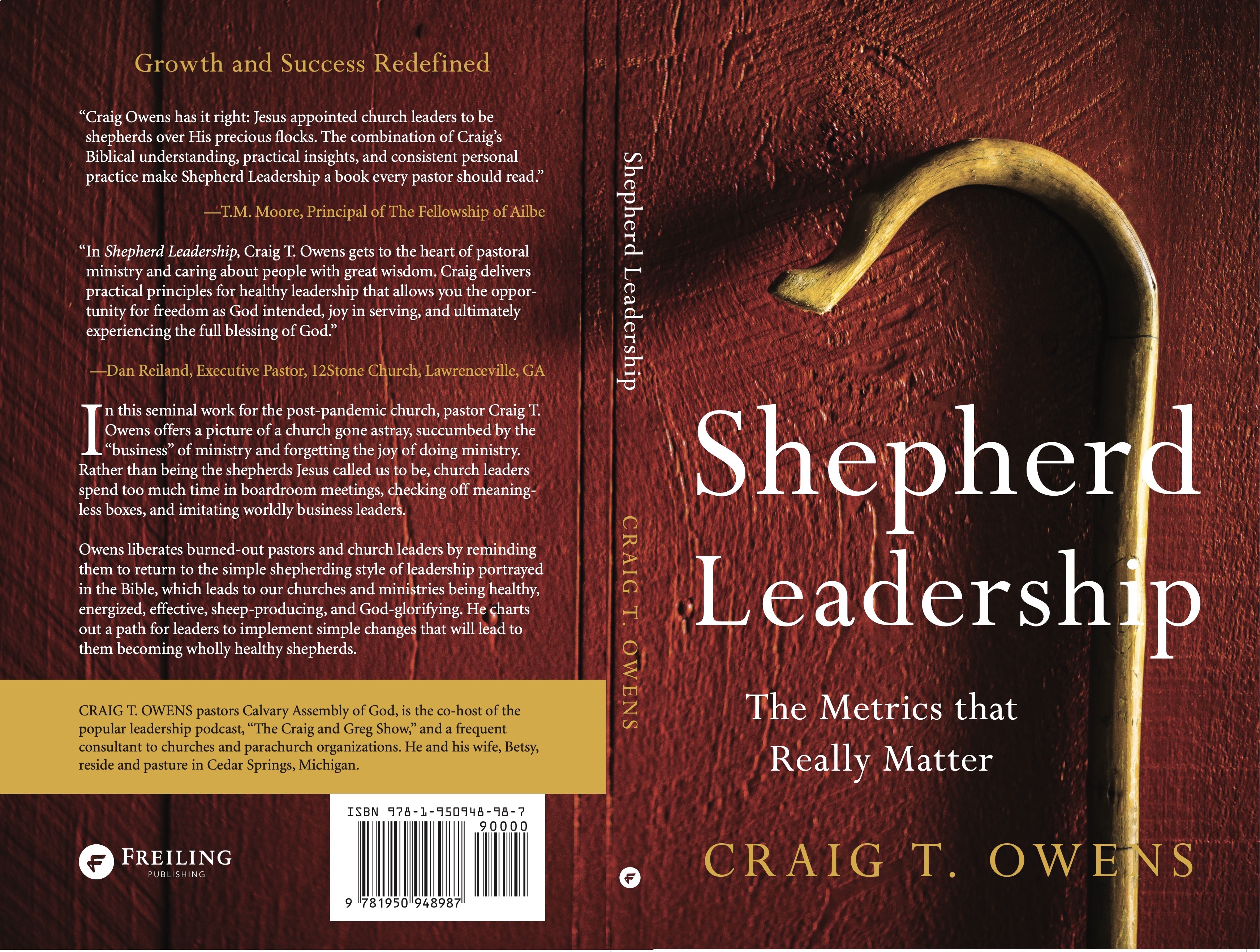
In one of the chapter of Shepherd Leadership: The Metrics That Really Matter I wrote—

     Don’t try to grow your ministry. First, because it’s not yours, it’s His; and second, because your measure of success is probably more slanted toward quantitative measurements than qualitative. Jesus wasn’t concerned about bigger numbers: “What do you think?” He asked, “If a man has a hundred sheep, and one of them goes astray, does he not leave the ninety-nine and go to the mountains to seek the one that is straying?” (Matthew 18:12). … 

     What’s the value of one government official’s life? God says that his value is incalculable. Apparently, God knew that Philip was the perfect shepherd to lead this Ethiopian to the pasture where he would accept Jesus as his Savior. Philip was obedient, a sheep was saved, and God was pleased. … 

     The Chief Shepherd made this commitment to His sheep: “And I will give you shepherds according to My heart, who will feed you with knowledge and understanding” (Jeremiah 3:15). My prayer is that we would much rather feed a few sheep where God has directed us and given us His heart than for us to try to manufacture success that is measured by how many nickels and noses we can count. 

I’ll be sharing more clips from this book signing event soon, so please stay tuned. Shepherd Leadership: The Metrics That Really Matter is available in print or ebook, and in audiobook through either Audible or Apple.

►► Would you please prayerfully consider supporting this ministry? ◀︎◀︎

You Get What You Ask For

On a recent episode of our leadership podcast, Greg Heeres and I were discussing how easy it is for people to slip into a complaining attitude. One of the things I point out is that if we ask for compliments instead of complaints, we can begin to change the culture of our organization. 

Check out all of The Craig And Greg Show episodes on our YouTube channel.