Listen to the audio-only version of this podcast by clicking on the player below, or scroll down to watch the video.
As a leader, you will have to deal with very emotional situations from time to time. While you may not always have control over when these situations arise, you do have the ability to control your reaction to them. In this episode of The Craig and Greg Show, we discuss emotional regulation and how keeping your emotions managed can be a powerful tool for leaders.
[0:34] Well-regulated emotions are powerful.
[0:55] How do we keep emotions in check?
[2:52] Greg thinks of emotional regulation as a throttle.
[3:31] What are the messes created by unregulated emotion?
[5:59] The triggers of emotional response.
[8:35] We can’t control situations, but we can control our responses.
[9:06] The four categories of regulation.
[10:52] What should you look for to help you be more self-aware?
[13:25] Don’t give up how you feel.
[14:12] Self-awareness doesn’t come from a book, it takes practice and reflection.
[16:10] Slow down!
[16:40] Dis-regulated emotions hurt your ability to influence.
[19:05] How to improve your emotional regulation skills.
[22:48] I discuss the difference between responding and reacting.
[24:02] Greg says people are sensitive and the damage done can be lasting.
[25:27] Greg shares an insightful quote from Viktor Frankl.
[26:45] We would love to coach you if you need help with emotional regulation.
Check out this episode and subscribe on YouTube so you can watch all of the upcoming episodes. You can also listen to our podcast on Spotify and Apple.
Listen to the podcast of this post by clicking on the player below, and you can also subscribe on Apple, Spotify, or Audible.
After speaking with some ministry interns, we wrapped up our time with a Q&A session. I had lots of very thoughtful questions, but this one seemed to really resonate with everyone. I was asked:
“When you’re contemplating resigning from a ministry position, how do you know that God called you to this position in the first place and it wasn’t just me calling myself here?”
I know when the going gets tough it’s natural to think that it is time to move on. Before you submit that letter of resignation, there are a couple of things to consider first. Check out this short video…
Everyone has great ideas. The problem is not thinking great things, but recalling them when you need them. I share some of my tried and true strategies in this video.
Check out my Patreon page and become a supporter today so that you can get access to all of my exclusive content.
Listen to the podcast of this post by clicking on the player below, and you can also subscribe on Apple, Spotify, or Audible.
Some people are either afraid to say what they really think, or else they aren’t entirely confident in what they believe. As a result, they tend to take an indirect approach to communicate what they want someone else to hear.
Some try to imply what they’re really trying to say: “Do you get what I’m saying? Can you read between the lines?” Others hope the other person will infer the right meaning. But bold claims are something completely different—there’s no implying, no hoping the other person will infer the right thing, but just a clear statement. Like Caiaphas’ statement that we looked at last week: “Jesus must die so that the rest of us can keep our cushy positions.”
You can always tell if the message got through by how the recipients respond. Usually the stronger the reaction, the more clearly the message was received!
Remember that I talked about the clout that Annas still held, even though he wasn’t officially the high priest anymore? We see it right after the arrest of Jesus. Instead of taking Him directly to the Sanhedrin, He was first taken to Annas. There Jesus was questioned about His followers and His teaching, and He simply replied, “Everything I taught is public knowledge. I’ve boldly and clearly proclaimed Who I am” (John 18:12-14, 19-24).
All throughout His public ministry, Jesus did make it clear who He was. There are so many places we could read about this in the Gospels, but let me just show you three examples from the Gospel of Luke:
He forgives sins and heals a paralytic to prove that He has the power of God to forgive—Luke 5:20-25
Demons recognize Him and submit to His power—Luke 8:28-35
His disciples recognize that Jesus is the Son of God—Luke 9:18-22
Finally, Jesus was asked directly by the Sanhedrin and He made His bold claim that He was indeed the Son of God (Luke 22:66-71). Remember I said earlier that you can tell how clearly the message got through by the response of the people? Well, check out this response—
Then the high priest tore his clothes and said, “He has spoken blasphemy! Why do we need any more witnesses? Look, now you have heard the blasphemy. What do you think?”
“He is worthy of death,” they answered. (Matthew 26:65-66)
What about you and me?Do we have to imply that we believe Jesus is the Son of God? Do we have to hope the other person will infer that we are His disciples? Or can it be said that our verbal and lifestyle testimony is a bold claim of what we believe and Whose we are?
The Book of Acts records the response of the Sanhedrin to the first Christians, and it appears to be identical to their response when they heard Jesus say, “I am the Son of God.” For instance:
After Peter and John healed a lame man, the Sanhedrin could see “that these men had been with Jesus” but they ordered them not to talk about Jesus anymore. These men said they could not obey that directive (Acts 4:13-14).
When they were called back in for a second appearance, Luke tells us the Sanhedrin “were furious and wanted to put them to death.” But they persisted in boldly proclaiming Jesus to everyone (Acts 5:30-39).
Then there was an early church leader named Stephen. His bold preaching brought him before the Sanhedrin as well, who ended up stoning him to death (Acts 6:8-10, 15; 7:55-56).
So let me repeat the question: Can it be said that our verbal and lifestyle testimony is a bold claim of what we believe and Whose we are? Or do we simply speak empty words?
Jesus made His bold claim and He backed it up. What about us? Do we make the bold claim that we will stand for Jesus even if that means we will be ridiculed, persecuted, or killed? Is our bold claim backed up by a lifestyle of complete trust in our Savior? These are questions every Christian should ask and allow the Holy Spirit to help them answer honestly.
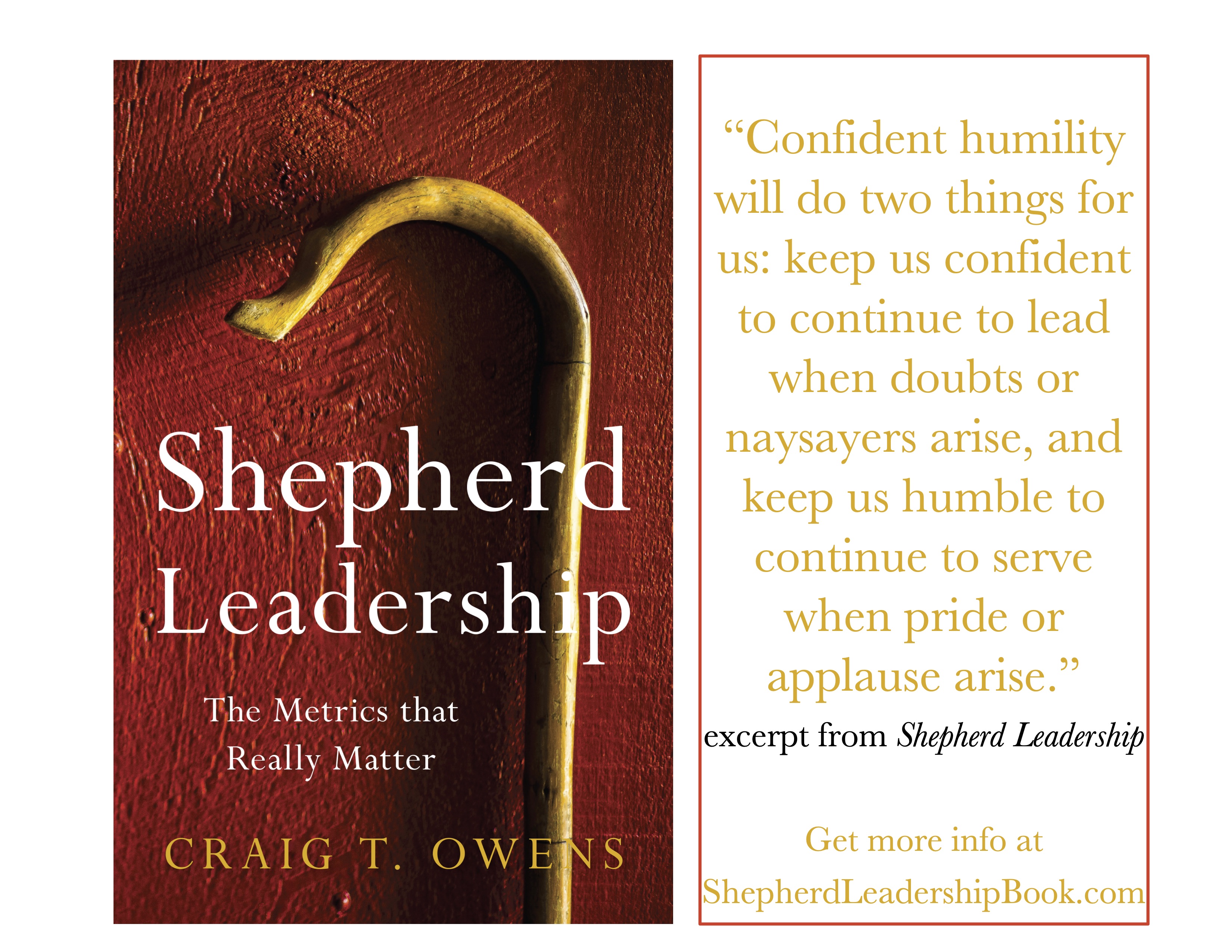
Writing Shepherd Leadership opened the door for me to have a lot of conversations with pastors, and I discovered just how beat up so many of them feel. As a result, I am working on a new book called When Sheep Bite as a way to help these pastors not just survive, but thrive in their ministry. I am self-publishing this book, and I could really use your financial investment in this project. I’ve got some special offers for you. Please check out this link and prayerfully consider helping me help these hurting pastors.
I love learning more about the historicity of the Bible! If you do too, check out this archeological biography of King Jehoram. And if you would like to keep the history of the kings and prophets straight, this side-by-side chart is one of the most downloaded resources I have ever produced.
“I can accept failure. Everyone fails at something. But I can’t accept not trying.” —Michael Jordan
Listen to the podcast of this post by clicking on the player below, and you can also subscribe on Apple, Spotify, or Audible.
Sometimes people say it would be nice to live a carefree, never-have-troubles life. But I think we would rob ourselves of so many lessons if we avoided all of the difficult things.
I’m not saying to seek out things that are difficult, but instead of trying to get out of those difficult things, try to see what lessons you can get out of those difficult things.
Listen to the podcast of this post by clicking on the player below, and you can also subscribe on Apple, Spotify, or Audible.
We’ve all heard people make some audacious claims. But the real power is in being able to back up those claims. Without any proof, it’s all talk! As things were coming to a conclusion for Christ’s ministry—at least in the world’s eyes—there were some bold claims being made. Some were made by Jesus Himself, some by His rivals, and some by His supporters.
The first bold claim we’re going to consider was made by the high priest: a man named Joseph Caiaphas.
The Sanhedrin was the highest court in the land and was made up of 70 + 1 men. This comes from Numbers 11:16-17 (seventy leaders) plus Moses. After Moses, another person was always appointed to serve as the leader, which was usually the high priest.
By the time of Jesus, this ruling body had become more political than religious. Very frequently, leadership would change because of the whims of the Romans or their puppet leaders (someone like a King Herod). The high priest in Christ’s early years was a man named Annas, who served from AD 6-15. During all of the public ministry of Jesus, the high priesthood had transferred to Caiaphas (AD 18-36), who was Annas’ son-in-law. Yet both of them still shared considerable influence (see Luke 3:2; John 18:13, 24; Acts 4:6).
Caiaphas and his family were Sadducees. They didn’t hold to any beliefs of the supernatural—no angels or demons, no resurrection, no afterlife. Partly because of these unscriptural beliefs, the Jewish Qumran, who safeguarded the careful copying of the Scriptures, called Caiaphas “the wicked priest.”
Annas, Caiaphas, and their family member were the ruling party that wanted to stay in power. So their activities were always a balancing act: Trying to keep the Jewish community happy on one hand, while not offending the Romans or other political leaders on the other hand.
It’s with this backdrop that we read the story of Lazarus’ resurrection in John 11. Jesus knew this miracle would validate His ministry, and sure enough, after the resurrection of Lazarus, more and more people put their faith in Jesus. So much so that the religious leaders wanted to kill both Jesus and Lazarus (11:53; 12:9-11).
Ironically, these same religious leaders had previously asked Jesus for a sign to prove He was who He made the bold claim to be. To this demand, Jesus said that He would give them “the sign of Jonah” who was considered dead in the belly of the fish before he was “resurrected” to complete his mission (Matthew 12:38-40, 16:1-4).
Since the religious leaders viewed everything through a political lens, they thought Jesus was also going to instigate a political or military uprising. The following that Jesus would gather would challenge the Sanhedrin’s hold on power, so Caiaphas proposed a political solution disguised as a prophecy (John 11:49-53).
Caiaphas meant it like this: “We’re trying to keep the balance between the Jewish people and the powerful Romans. If we kill one Man (Jesus) in time, we may be a little out of favor with the Jews but we will save our position with the Romans. Later on, we’ll make things right with the common people.”
Even to this day, people are trying to balance, juggle, control, appease, and bargain their way to get or keep the life they want to live. They will use religious dressing to do political things, thinking they will “make it right” later on.
Caiaphas made this bold claim: “If Jesus dies, our position will be saved for us and our children.” But he had no power to back up his bold claim, so it was just talk.
But Jesus made this bold claim: “I will die so that your souls can be saved for eternity.” He, on the other hand, had the power to back up His bold claim (John 10:17-18).
Caiaphas’ plan sounded like it would be the end of Jesus and His mission, but “the end” was really just another step in fulfilling what God had already planned!
Let me say it again: God’s plan always prevails. The bold claims of powerful evil people may make it seem like the end is near, but don’t fret because their “end” is only fulfilling God’s plan!
There are some long-lasting benefits in keeping a journal. Here’s one benefit I shared with some ministry interns. If you haven’t already done so, please check out my YouTube channel for more great content.
The James Webb Space Telescope (JWST) is causing problems for Big Bang proponents. In a recent post from the Institute for Creation Research, some of these problematic areas were laid out. “As noted in a previous Creation Science Update and Impact article, data from the JWST show that distant galaxies look more ‘mature’ and ‘developed’ than predicted by Big Bang theorists. Big Bang astronomers assume light from the most distant galaxies took almost 14 billion years to reach Earth. Although this may sound reasonable, creation scientists think this assumption is open to challenge. But in any case, by Big Bang reckoning, we should be seeing these very distant galaxies—not as they are now, but as they were almost 14 billion years ago. Hence, these galaxies should appear very “unevolved” and ‘immature.’ Yet, this expectation is routinely contradicted, and data from the JWST are making the disagreement even worse.” One thing the JWST has definitely done: It has shown the beauty and the power of our Creator!
John Piper said, “One of the greatest hope-killers is that you have tried for so long to change, and have not succeeded.” This is an encouraging word for anyone who has prayed, and prayed, and prayed for a breakthrough. “Take heart, struggler. Keep asking, seeking, knocking. Keep looking to Christ. If God gets glory by saving robbers in the eleventh hour, he surely has his purposes why he has waited till now to give you the breakthrough you have sought for years.”
This is pretty compelling evidence for the global Flood that is described in the Book of Genesis—
Listen to the audio-only version of this podcast by clicking on the player below, or scroll down to watch the video.
When we think about leadership, we often envision the people in organizationally designated leadership roles “leading down” to the people on their team. In this episode of The Craig And Greg Show, we flip the script, discussing how you can “lead up” to those above you and help your team achieve greater levels of success.
[0:30] This is part 1 of a new series of periodic episodes of how to lead at all levels of your organization.
[1:07] What is the real definition of a leader?
[1:55] You need different skills to lead up based on how receptive your leader is.
[3:31] Do you have the right tools to lead up, or do you need to fill your toolbox first?
[5:30] What happens when the leadership above you changes?
[6:35] There are two really important words when leading up: stewardship and accountability.
[7:59] “I told you so” doesn’t help you lead up, nor does withholding information from your up-leader.
[11:55] What are the best ways to talk to your up-leader?
[14:35] Everyone in the organization already knows when you have the good ideas, so you don’t have to announce it.
[15:05] How do you balance being proactive with being too aggressive?
[16:05] What lessons can you learn from working with your difficult up-leader?
[17:42] You shouldn’t try to “fix” your up-leader, but help your up-leader.
[19:34] I share how I kept my attitude in check with my difficult up-leader.
[22:00] Coaches can help you do what you’re already doing better than you’re currently doing it
Check out this episode and subscribe on YouTube so you can watch all of the upcoming episodes. You can also listen to our podcast on Spotify and Apple.