If you want your heart to be able to perform better, you are going to have to stress it a bit—that’s called exercise. The same thing is true for the heart of leadership—we have to exercise our leadership so that it can rise to the challenge later.
J. Warner Wallace wrote, “Everyone, whether they realize it or not, is engaged in worship. We all adore something, elevating it above the rest, sometimes so much that we overlook its flaws.” Check out this post about being careful about what we worship.
“Nothing teaches us about the preciousness of the Creator as much as when we learn the emptiness of everything else.” —Charles Spurgeon
“We should avoid end-time hysteria and ‘not grow weary in doing good’ (2 Thessalonians 3:13). There will be good work to do (vocationally and socially and personally) right up to the Lord’s coming. Our normal earthly duties will not end until the Lord appears. The rule then, until he comes, is, ‘Whatever you do, work heartily, as for the Lord and not for men’ (Colossians 3:23).” —John Piper
Greg Morse has a fascinating post connecting the fable of Chicken Little with the historical account of Noah and the imminent return of Jesus. “I hope an acorn falls afresh on our heads as we observe an Old Testament saint who was the Chicken Little of his day. A man who remained awake and faithful with his back against the end of the world: a man named Noah.”
Listen to the podcast of this post by clicking on the player below, and you can also subscribe on Apple, Spotify, or Audible.
How do leaders make sure that obstacles to their personal or organizational growth don’t become permanent?
This clip is from a lengthy conversation Greg and I had about leaders being like gardeners. You can check it out here. The main point is this: The seeds have what they need to grow, so the gardener-leader simply has to remove the obstacles to growth.
You may also want to check out a couple of related posts:
Listen to the podcast of this post by clicking on the player below, and you can also subscribe on Apple, Spotify, or Audible.
Most of our Royal Psalms have taken us from King David to King Jesus. Psalm 72 is a bit different because King David is speaking some of his last words as a blessing and a reminder to King Solomon. Jesus, Peter, and those in a church prayer meeting all affirmed that David’s words were inspired by the Holy Spirit (Matthew 22:43; Acts 1:16, 4:25), so these words in Psalm 72 are just as inspired.
The introduction to this psalm in the NIV says “Of Solomon.” But because the Hebrew word for “of” can also be “for” and since v. 20 says these are the final words of David, I think we can say that this psalm is of David and for Solomon.
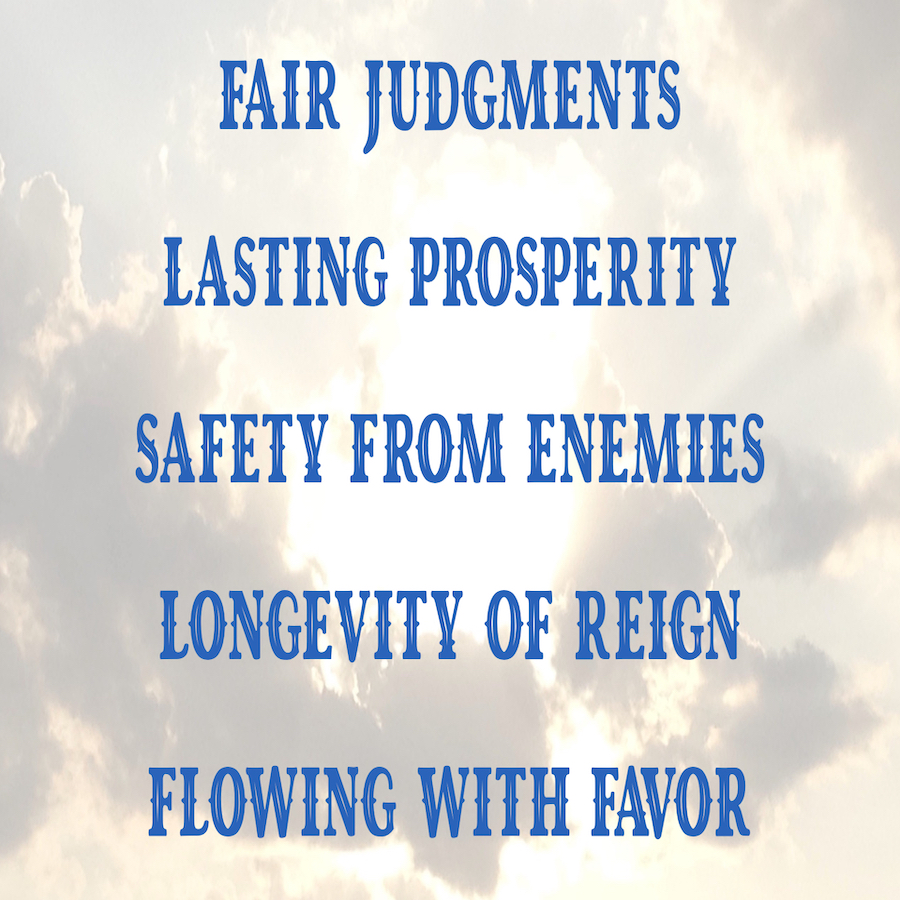
David has received God’s promise of an heir always on the throne of his kingdom. Here is the first transfer of power, and David is foreseeing the blessing that Solomon will be to the Israelite nation because of the endowment of God’s righteousness. Those blessings for his subjects include:
fair judgments (v. 2; 1 Kings 10:1-3)
prosperity (v. 3; 1 Kings 10:7, 27)
safety from enemies (v. 4; 1 Kings 10:26)
longevity (v. 5; 1 Kings 10:8)
favor (vv. 6-7; 1 Kings 10:9)
Historically, we know of the fulfillment of these things. We can especially see it in the visit of Queen Sheba in 1 Kings 10.
In this next paragraph, as we have seen with other royal psalms, there is a modulation back-and-forth between King Solomon and King of kings Jesus (vv. 8-11). Verse 8 is the ends of the earth rule of Jesus; vv. 9-10 are the local rule under Solomon; v. 11 then speaks of all kings…all nations bowing to Jesus as the King of kings.
This modulation reminds us that no earthly king can ever stand-in for the Eternal King. After the static of switching back-and-forth, from our perspective at this point in history a flashback event becomes crystal clear.
David gives instructions and a warning to Solomon (1 Kings 2:1-4)
Solomon wields his power in Israel (2 Chronicles 1:1)
Solomon falters under his power by becoming intoxicated by it (1 Kings 3:3; 11:1-4)
Solomon’s kingdom is diminished (1 Kings 11:10-13)
This is not the case for our King of kings! His kingdom has no end because His rule has no end (Isaiah 9:6-7; Luke 1:32-33).
The devil tried to limit Jesus by offering Him a shortcut, but Jesus stood firm. So the remainder of this Royal Psalm can only be fulfilled by Jesus:
vv. 12-14 foreshadow the prophecy of Jesus Isaiah 61:1-2 and its fulfillment in Luke 4:21
vv. 15-17 foretell all nations being blessed forever under the lordship of King Jesus
Don’t get caught up in looking at what’s before your eyes right now. Don’t get discouraged by the voice that’s in your ears right now. Don’t get mesmerized by the glittery things of earth. Keep your focus on the Eternal King. David’s conclusion to this Royal Psalm is that we worship our King above all else (Psalm 72:18-19).
And David’s final words should echo from our lips as well: Amen and Amen!
In biblical times, the Jews looked down on the Samaritans. But not Jesus. One of His longest conversations is with a Samaritan woman. If He had a poor attitude about her, she would have felt that. Instead, she felt His love. Jesus died so that “whoever believes in Him would not die but would have eternal life.” We need to treat everyone like one of the whoever’s that Jesus died to save.
One hundred years ago, William M. Faux called the churches in the Assemblies of God to pray more for our missionaries. “Pray, beloved, pray for missions. Are more workers needed? Yes. Praying is the secret of securing them. Are more funds needed? Yes. Prayer is the force that opens men’s hearts to give to God their resources. Is greater spirituality needed? Yes, surely. Prayer is the agency that brings greater spirituality to the entire church (Matthew 9:38). Louder than the Macedonian cry ‘Come over and help us,’ which rang out to Paul, sounds the cry today, ‘Brethren, pray for us.’ Let the Scripture warning ring in our souls—‘God forbid that I should sin against the Lord in ceasing to pray for you.’ Prayer is the greatest force that we can wield. It is the greatest talent which God has granted us. And this talent He has given to every Christian.”
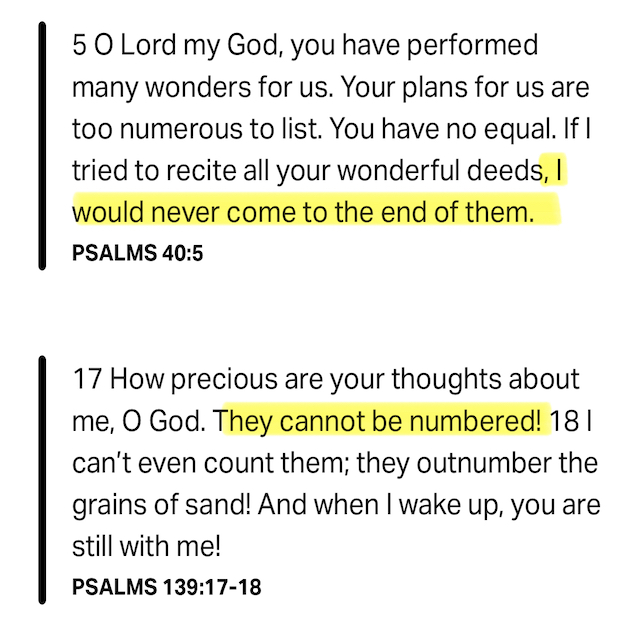
“Faith knows that every seashore on earth has less sand than God has wondrous deeds and thoughts toward us.” —Tanner Swanson
“I had always vaguely felt facts to be miracles in the sense that they are wonderful: now I began to think them miracles in the stricter sense that they were willful. I mean that they were, or might be, repeated exercises of some will. In short, I had always believed that the world involved magic: now I thought that perhaps it involved a magician. And this pointed a profound emotion always present and sub-conscious; that this world of ours has some purpose; and if there is a purpose, there is a person. I had always felt life first as a story: and if there is a story there is a story-teller.” —G.K. Chesterton
John Piper discusses how Christian apologists can contend for the faith properly without sliding into “word fights.”
You may also want to check out my blog post and video The Value of Journaling where I talk about how I capture thoughts, prayers, conversations from others, Scripture verses and more when I’m facing a big decision.
Listen to the podcast of this post by clicking on the player below, and you can also subscribe on Apple, Spotify, or Audible.
The last time we were together, Pastor Caleb mentioned that I was the only one he knew that put hot sauce on my eggs. But then several of you let him know that you do that too. After the service, someone told me that they like Tabasco sauce on their pizza, which isn’t something I enjoy.
We all have different tastes. Our tastebuds are just one of the things that makes us unique creations. Unique means one-of-kind, no one else like me. We don’t need to add something like “very unique” because just by itself the word means that God made a once-in-eternity masterpiece when He made you and me.
It’s a good thing that we are unique. I see what you don’t see, and you see what I don’t see. There are some things I know how to do well, but perhaps you struggle doing them. That’s okay because there are things you can do that I won’t have the opportunity to do. Combined together we saints make an amazing team!
The apostle Paul understood the value of unique individuals.
Titus was probably the one who carried Paul’s letter to the Corinthians and then had the responsibility to teach those saints how to carry out what was in the letter (2 Corinthians 2:12-13; 7:6-7, 13-15; 8:6, 16-17). Titus was the pastor that Paul sent to Crete. Paul quoted a poet who said, “Cretans are always liars, evil brutes, lazy gluttons” (Titus 1:12). Titus was confident and bold to stand his ground for what he believed (Galatians 2:1-3).
Timothy was more soft-spoken and tenderhearted, so Paul had to encourage him more (1 Timothy 4:7, 12), but he was the one who could soothe troubled spots. Timothy stepped in to help behind the scenes (Acts 18:1-5) and he was the one Paul reached out to with his last letter form prison, asking Timothy to come to him (2 Timothy 4:12).
What a great thing it is to have unique saints in our lives!
One person—not matter how gifted—cannot do it all. Look at Moses in Exodus 18:13-18. Even an anointed team like the 12 apostles cannot to it all. Look at Acts 6:1-2.
These leaders recognized the need to other uniquely gifted people to come alongside them. Moses was advised to choose capable men. In other words, those with the ability to judge disputes wisely (Exodus 18:19-25). The apostles chose those who were full of the Holy Spirit and wisdom (Acts 6:3-6). The Greek word for wisdom (sophia) means someone with heaven-sent wisdom that also has the ability to apply that wisdom effectively.
Israel in the Old Testament and the Church in the New Testament would have been constricted if those other people hadn’t agreed to let their God-given abilities be used.
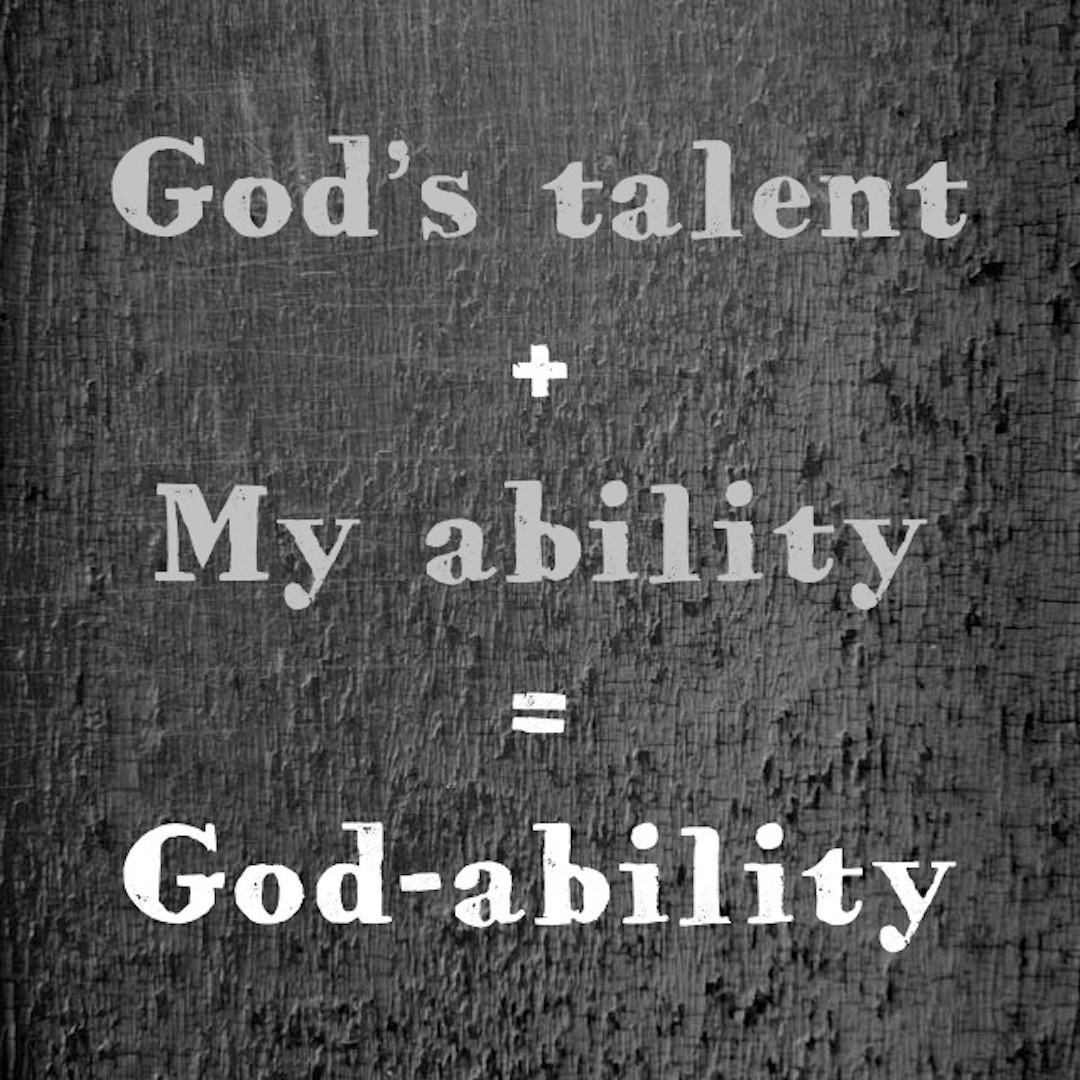
God’s talent + My ability = God-ability
In 2 Corinthians 8-9, Paul is specifically talking about the ability of people to give their offerings to help the growing church, but there is a phrase that I think is appropriate for any application of our gifts: They gave themselves first of all to the Lord (2 Corinthians 8:5).
When what we do is a cheerful “get to” and not an obligatory “got to” it is noticed by everyone. Those two chapters in 2 Corinthians are filled with words like cheerful, eagerness, and enthusiasm.
Deliver-ability to get the needed items to those who need them
But none of these work without availability. This is the attitude that makes our God-ability a blessing and not a chore.
There is a place in ministry for every Christian. When you are available, God will allow the talent that He has given you to be a blessing to the Church. You benefit, the other saints benefit, and the watching world sees a living witness that will draw them to Jesus.
“Psychologists, since the beginning of the discipline, have argued about the essence of what it means to be human. Some, like [Sigmund] Freud, insist that we are motivated by physical pleasure, while others, like Victor Frankl or Abraham Maslow, believe that some higher purpose…. Human beings, made in the image and likeness of God, only realize their full potential and pleasure as they participate in the very being of God and know and experience the pleasure He takes in Himself and His glory.” —T.M. Moore
“If you are persevering in faith today, you owe it to the blood of Jesus. The Holy Spirit, who is working in you to preserve your faith, is honoring the purchase of Jesus. God the Spirit works in us what God the Son obtained for us. The Father planned it. Jesus bought it. The Spirit applies it—all of them infallibly.” —John Piper
“The Hebrew word Davar (דבר, pronounced ‘daw-var’) reveals something profound about God’s Word—it’s not merely information, but transformation. … Throughout Scripture, God’s Word consistently proves both living and active. It has the power to create worlds (Genesis 1), transform lives (Psalm 119:105), and accomplish God’s purposes (Isaiah 55:11).” —Dave Adamson
More fascinating archeology that supports the Bible’s historicity. This is a look at the library of letters found at Tell el-Amarna in Egypt. “The most obvious connection between the Amarna Letters and biblical history is that some of the letters appear to be describing, in real-time, the attacks of the Israelites during the period of the conquest. Remember, the initial conquest battles took a period of some 5–6 years, but the attempts by various tribes to conquer their allotted territories lasted into the period of the Judges. The letters from the rulers of some of the very cities named in the biblical conquest calling for help from the attacking ʿapîru/ḫa-bi-ru, provide a poignant backdrop to this period of biblical history.”
“Because I am your constant Companion, there should be a lightness to your step that is observable to others. Do not be weighed down with problems and unresolved issues, for I am your burden-bearer.” —Jesus in Sarah Young’s Jesus Calling, based on Psalm 31:19–20; John 16:33
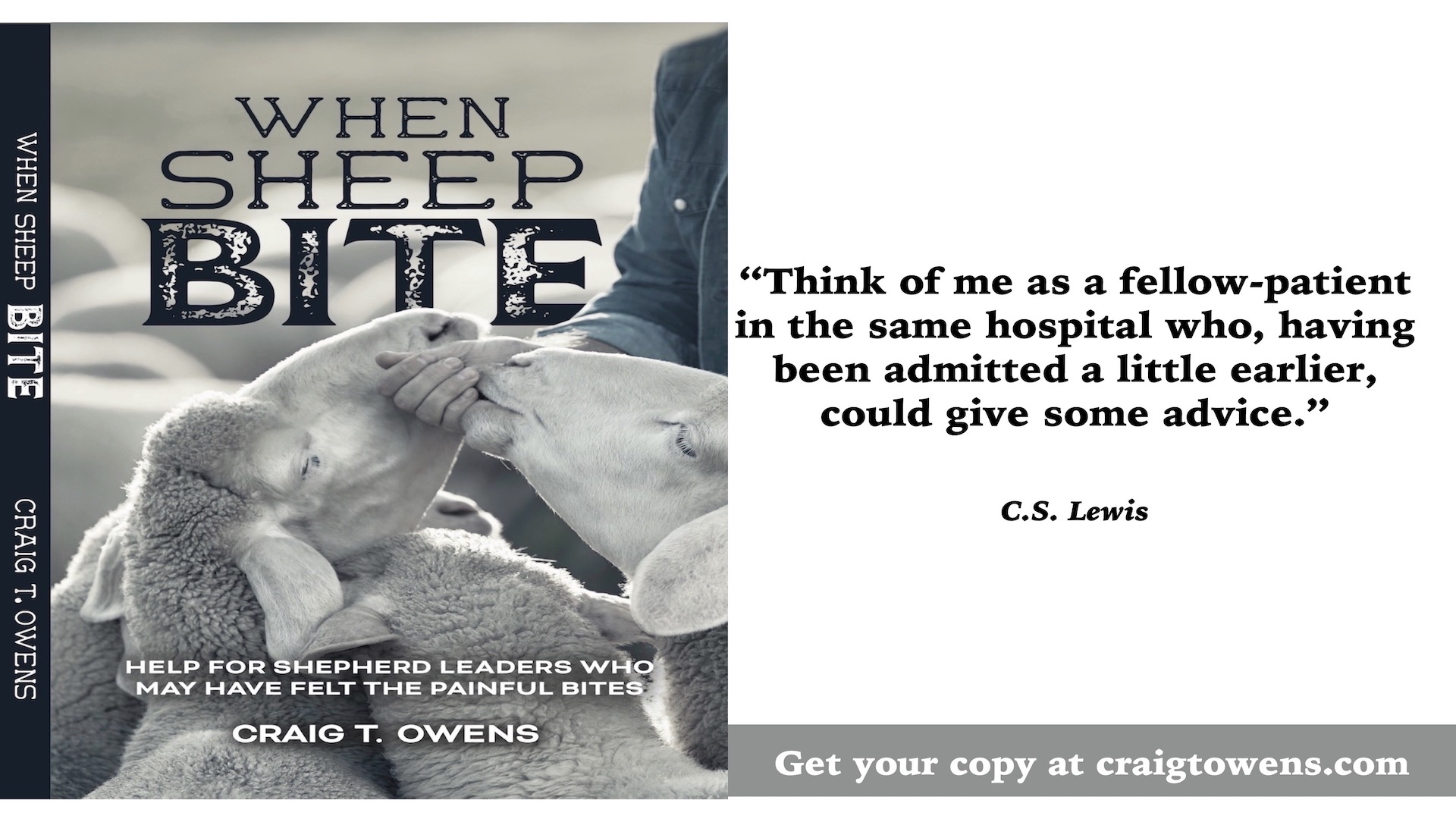
My book When Sheep Bite is all about recovering after difficulties—whether they were created by your mistakes or someone else’s mistakes. In the Introduction to my book I wrote:
I want to give you what I wanted when this happened to me: empathy, insight, a helpful perspective, and a manual of help that God has provided in the Bible. I don’t want to try to one-up your story of pain, because I’m confident that no one could truly know how deeply you’ve been hurt. But I do want to give you some assurance that I know what I’m talking about. …
Your pain and your circumstances are unique. Your pain is real, and it is incomparable to anyone else’s pain. But the biblical principles that God revealed to me—those things that helped me heal and the thoughts I want to share with you—are applicable for any shepherd. These tried-and-true principles can help you not just survive this pain but thrive in spite of this pain. I would say to you something that C.S. Lewis wrote, “Think of me as a fellow-patient in the same hospital who, having been admitted a little earlier, could give some advice.”
Listen to the podcast of this post by clicking on the player below, and you can also subscribe on Apple, Spotify, or Audible.
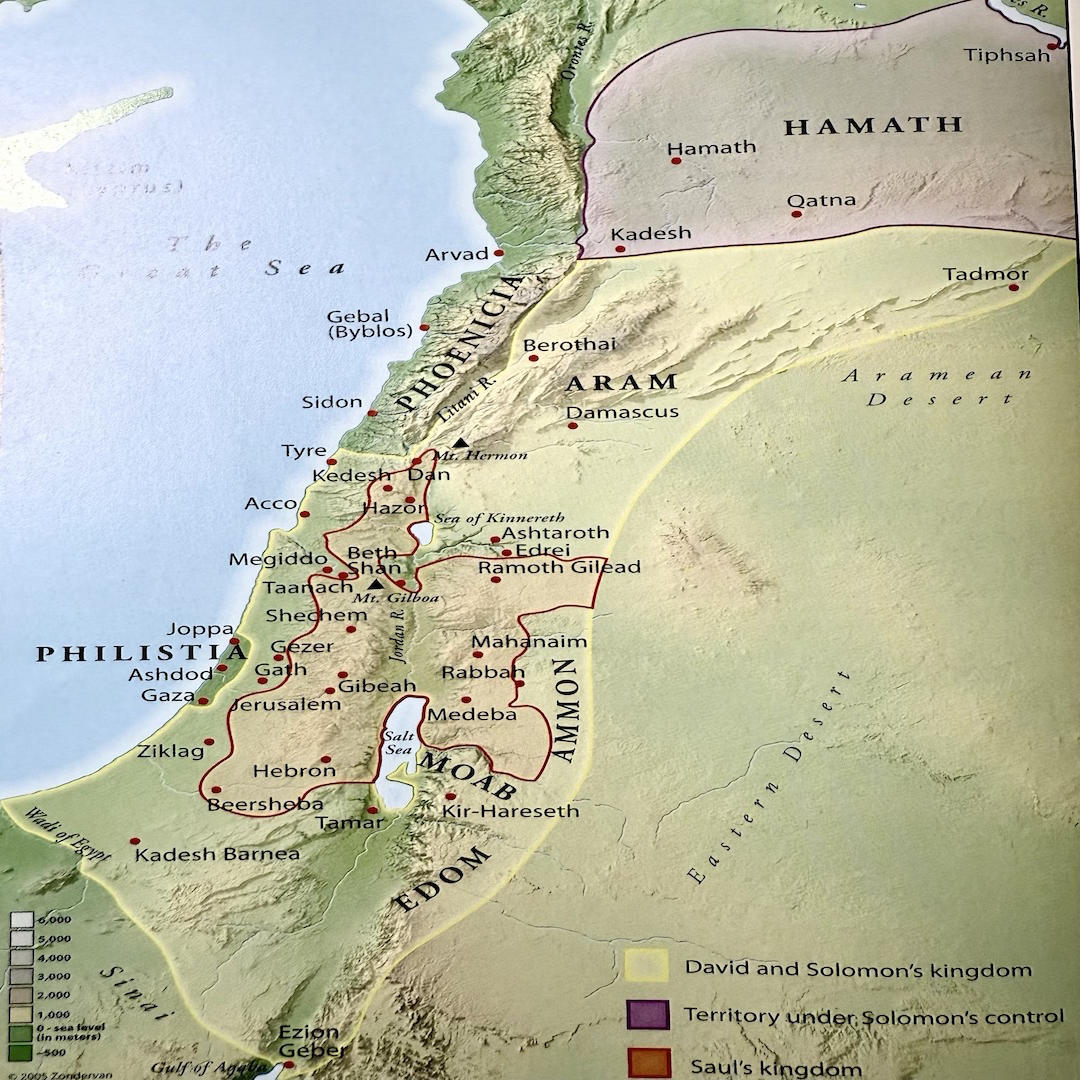
Our Royal Psalms take us from King David to King Jesus. David went from the anointed king on the run from King Saul, to being king over Judah (2 Samuel 2:4), to being king over “all the tribes” (2 Samuel 5:1-3; 8:15).
David’s kingdom stretched far and wide (1 Chronicles 22:14-16; 29:10-13). This absolute control King David now wields over every nation surrounding Israel puts fear into the hearts of Israel’s enemies. Fear of David brings freedom for the people of his kingdom.
As the Sons of Korah think about this fear that brings them freedom, they look beyond their earthly king to the King of Heaven and compose this Royal Psalm recorded in Psalm 47. This psalm has majestic terminology for God in almost every verse; including, Lord Most High, great King over all the earth (vv. 2, 7, 9), God reigns over the nations; and God is seated on His holy throne.
I’m especially intrigued by the word awesome in verse 2. The KJV says “the Lord Most High is terrible” because it does take two Hebrew words to give us the full definition of awesome. First, “Most High” is best thought of with the suffix -est: greatest, highest, noblest. In other words, there is nothing above Him. Then “terrible” is to be held in awe, to be honored, to be reverenced.
Just as the Israelites had no fear of enemies because David was on the throne, God says the same thing to us: Because the Most High is on the throne, His people have no fear of their enemies.
When we fear God we need not fear anything else.
When we fear God:
…we hate our own sin (Psalm 36:1-3)
…we love His mercy that forgives our sin (Psalm 103:2-3, 10-12)
…we hate sin in the world (2 Timothy 2:26)
…we love sinners (2 Timothy 2:24-26; Acts 10:38; Jude 20-23)
…we hate the darkness that traps people (2 Corinthians 4:4)
…we love shining the light of King Jesus (Philippians 2:15-16)
…we hate this life (John 12:25)
…we love eternal life (Romans 3:23-24, 8:18)
When the people of Israel reverenced David as their king, they would be able to know his blessings. When we fear our awesome God, we will also receive His blessings. Take a look at the amazing blessings Jesus Himself—the King of kings—lists for those who reverence His awesome Kingship (Revelation 2:7, 11, 17, 26-28; 3:5, 11-12, 21)!
God is awesome and asks us to reverence Him and then enjoy life in His freedom.



 If you want your heart to be able to perform better, you are going to have to stress it a bit—that’s called exercise. The same thing is true for the heart of leadership—we have to exercise our leadership so that it can rise to the challenge later.


 Craig T. Owens