Links & Quotes

link quote

Some good reading from today…

“Nothing stirs God’s heart more than a humble heart and a merciful spirit. God responds to mercy, because it is through compassion that we fully come to know Him. This is the defining quality of a true follower of Christ. We are never closer to the heart of God than when we are forgiving someone. And we are never farther from it than when we are holding a grudge.” —Nicky Cruz

“God’s Majesty can never delight in that which polluteth man’s dignity.” —Augustine

“If God takes away from us the old, wrinkled, beat-up dollar bill we have clutched so desperately, it is only because He wants to exchange it for the whole Federal mint, the entire treasury! He is saying to us, ‘I have in store for you all the resources of heaven. Help yourself.’” —A.W. Tozer

“From many modern sermons would you know that there was a Holy Spirit? If it were not for the benediction or the doxology you might go in and out of many churches and meeting-houses by the year together, and scarcely know that there was such a Person as that blessed, blessed giver of all good, the Holy Spirit. Sometimes we hear a little about His influences, as if the Holy Spirit were not as truly a Person as even Jesus Christ Himself, Who in flesh and blood trod this earth. Oh, dear friends, I fear the first danger, that of running wild with whimsies and fancies about inner lights and new revelations; but I equally dread this last, this going forth to work with the sword, forgetting that it is the sword of the Spirit, and only mighty as the Holy Spirit makes it mighty ‘to the pulling down of strongholds.’” —Charles Spurgeon

5 Things Christians Should Know About Depression & Anxiety

“I reject a heaven that I must enter by shutting my eyes to the sufferings of my fellow men. I choose a broken heart rather than any happiness that ignores the tragedy of human life and human death. Though I, through the grace of God in Christ, no longer lie under Adam’s sin, I would still feel a bond of compassion for all of Adam’s tragic race, and I am determined that I shall go down to the grave or up into God’s heaven mourning for the lost and the perishing.” —A.W. Tozer

Koinonia

All inIn 2007, Dave Kinnaman & Gabe Lyons published a book called unChristian. In it they reported the cultural view of Christians: haters, judgmental, hypocritical, too involved in politics, out of touch, insensitive, boring.

Do any of these words fit Jesus? No, I’ve never heard anyone—whether in the Bible or in the history of that day—call Jesus a hypocrite, or boring, or a hater. Do any of these words fit the apostles who began to spread the message of Jesus Christ after His ascension? No! Again, I’ve never read anywhere where the early Christians were called judgmental, or too political, or out of touch.

But if these labels are thrown at Christians today—Do not be surprised, my brothers, if the world hates you (1 John 3:13)—the Bible tells us how to reverse them: By living counter culture, by living according to God’s Word. In a word, by living in koinonia.

This is a Greek word that isn’t used in the Gospels, but shows up just after the first Church is born on the day of Pentecost. It’s a word and a concept that simply won’t work in a pragmatic culture, but works powerfully in a biblical counter culture. The word is usually translated fellowship in English.

Koinonia is how the Trinity operates (see 2 Corinthians 13:14). All three Persons of the Godhead are mentioned in fellowship with each other. There is no rivalry in the Trinity, but if any part of it is diminished, so is its total effectiveness and glory.

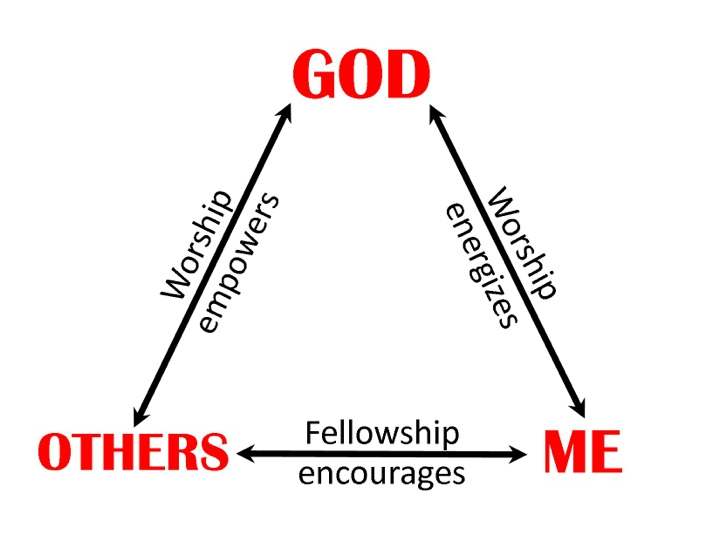
trinity of koinoniaChristians are called to be part of a trinity of koinonia as well.

  • When I worship God, I am energized to be in fellowship with others.
  • My fellowship with others that flows from my love for God empowers them to worship God for themselves.
  • The overflow of that relationship with God encourages others to be in fellowship with me.
  • And that fellowship energizes me to worship God even more deeply, which encourages my fellowship with others, which empowers them for deeper worship… and on and on and on it goes!

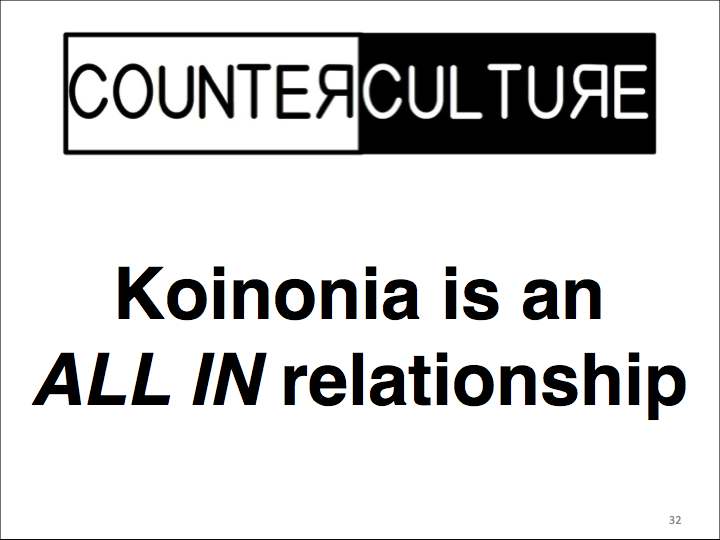
Koinonia is an ALL IN relationship. It’s not something I can dabble in, or be involved with occasionally. I’m either in koinonia, or I’m not.

To see a great example, look at the Christians the very first time the word koinonia is used in Scripture. Acts 2:42-47 shows us how the Christians were not only all in (the Bible uses the word devoted), but how others in the community responded: they were in awe and viewed the Christians with favor. And as a result, lives were being changed every single day.

Yes! That’s what I want to be a part of! How about you?

11 Quotes From “Holy Fire”

Holy FireHoly Fire by R.T. Kendall is an excellent book for dyed-in-the-wool Pentecostals, and for those who believed the operational gifts of the Holy Spirit have ceased. You can read my book review by clicking here. Below are a few quotes I highlighted in this book.

“So if you feel threatened by the Holy Spirit, is it because you are happily in your comfort zone? Are you afraid of what the Holy Spirit might do to you? What He would require of you? What He might ask you to do? Do you think you will lose something if you make yourself vulnerable and totally open to Him? Are you afraid He will embarrass you? Do you think you will lose your identity? Do you think you might have to change?”

“The canon of Holy Scripture is closed. It is final. Absolute. Incontrovertible. It is God’s complete and final revelation. No word that will come in the future will be equal to the Bible in level of inspiration. This means that any leading, prophetic word, word of knowledge, or vision one may have today must cohere with Holy Scripture. If it doesn’t, it must be rejected.”

“The Holy Spirit is our best and only reliable Teacher. In fact, He is the only Teacher who matters. Whatever teaching you hear or read (including this book)—whoever the preacher or teacher, if the Spirit does not apply it and witness it to your heart (which He is most capable of doing), you should learn to hold that teaching in abeyance—if not dismiss it.” 

“The Spirit ‘guides’ us into truth—showing what is there but what cannot be seen without Him opening our eyes. It is humbling for prideful people to admit to the need of the Holy Spirit. The cost? Our pride being shattered. But once we are broken and enabled to see our stubbornness, the Spirit will show us amazing things—in Scripture.”

“The Holy Spirit leads us to praise the Lord Jesus as He deserves.” 

“Don’t come short of discovering how real God is because some well-meaning person says this kind of relationship with God is not possible today.”

“Unbelief is doubt that degenerates to a conscious act of the will. … But when we consciously decide that God did not say what He did—and we can do it better; or that He is not going to keep His word—or manifest Himself, and then put ourselves above His Word, we cross over a line. This is dangerous stuff.” 

“Do you know the context of Hebrews 13:8? Verses 7 and 9 point to one thing: sound teaching. … Whereas we have a perfect right to apply Hebrews 13:8 against cessationist teaching, the immediate context refers to doctrine. Sound theology. The writer wanted the teaching of Jesus to remain the same yesterday and today and forever. Knowing His Word and His ways.”

“What if God in some cases keeps some skeptics from seeing the miraculous even though it actually takes place? What if miracles are largely for those believers in God’s family who have accepted the stigma of being ‘outside the camp’ (Hebrews 13:13)? After all, why didn’t the resurrected Christ appear to everybody on Easter Sunday? One might choose to argue that this would have been a reasonable thing to do if God truly wanted everybody to believe on His Son. Why did Jesus reveal Himself only to a few? Why didn’t Jesus knock on Pontius Pilate’s door on Easter morning and say, ‘Surprise!’? Why didn’t Jesus go straight from the empty tomb to Herod’s palace and say, ‘Bet you weren’t expecting Me!’ He appeared only to a few—those who were His faithful followers. I also suspect that God sometimes allows just a little bit of doubt when it comes to the objective proof of the miraculous. This keeps us humbled. And sobered.” 

“The Holy Spirit can therefore be quenched by a doctrine that does not allow for Him to show up. … It also seems to me that one of the more serious fallouts of being a cessationist is that it can eliminate any expectancy for God to work powerfully in our hearts and lives. One may become too content with his or her sheer intellectual grasp of the gospel. The consequence is that we don’t even consider—much less expect—that God will manifest His power in our lives.”

“This to me is serious—and a very precarious position to take, namely, ruling out categorically the possibility of God manifesting His glory in signs and wonders today and deleting a great portion of the Bible for today. Consider how much the Bible has to say about God’s power. Healing. Signs and wonders. Revelation of truth by the Holy Spirit. Consider what is left in Holy Scripture when you rule out the miraculous or the gifts of the Holy Spirit.”

Links & Quotes

link quote

These are links to articles and quotes I found interesting today.

May God have mercy! Belgium Parliament Approves Euthanasia For Children

[VIDEO] Nailed it: Jon Stewart Calls Out Obama For Corrupt Ambassador Choices

Watch out! 7 Times Obama Ignored The Law With His Executive Orders

“The Christian who goes out without faith in ‘wonders’ will return without fruit. No one dare be so rash as to seek to do impossible things unless he has first been empowered by the God of the impossible. ‘The power of the Lord was there’ is our guarantee of victory.” —A.W. Tozer

Tim Elmore prepares us: Welcome To Our McCulture

So excited!! The Assembly of God and the United Pentecostal Council of the Assemblies of God Unite

Ronald & Nancy Reagan loved each other deeply: Valentine′s Day Advice From Ronald Reagan

“Our blunder (or shall we frankly say our sin?) has been to neglect the doctrine of the Spirit to a point where we virtually deny Him His place in the Godhead. This denial has not been by open doctrinal statement, for we have clung closely enough to the Biblical position wherever our credal pronouncements are concerned. Our formal creed is sound; the breakdown is in our working creed. This is not a trifling distinction. A doctrine has practical value only as far as it is prominent in our thoughts and makes a difference in our lives. By this test the doctrine of the Holy Spirit as held by evangelical Christians today has almost no practical value at all. In most Christian churches the Spirit is quite entirely overlooked. Whether He is present or absent makes no real difference to anyone. Brief reference is made to Him in the Doxology and the Benediction. Further than that He might as well not exist. So completely do we ignore Him that it is only by courtesy that we can be called Trinitarian. The Christian doctrine of the Trinity boldly declares the equality of the Three Persons and the right of the Holy Spirit to be worshipped and glorified. Anything less than this is something less than Trinitarianism.” —A.W. Tozer

Forethought Or After-Thought?

What is man that You are mindful of him, the son of man that You care for him? You made him ruler over the works of Your hands; You put everything under his feet. (Psalm 8:4-5)

forethoughtafterIn mythology, humans are an after-thought, a nuisance, slaves and servants of the gods, and usually pawns in the gods’ scheming against each other.

But Jehovah God created man as a part of His creation. He created mankind in His own image and breathed His own life into him. After the first five days of creation, God said, “It is good.” But on the sixth day, after creating man, He said, “It is very good!”

Jehovah God has man at the forefront of His mind. He not only calls us into a relationship with Him, but the Trinity works in divine cooperation to make it possible for us to come to Him.

He doesn’t see a mass of humanity, but He sees each one of us individually and uniquely. And He is attentive to us—“For the Lord has heard my cry for mercy; the Lord accepts my prayer” (Psalm 6:9).

As David burst into praise with this realization of God’s forethought of us, let us echo this praise (Psalm 8:9)—

O Lord, our Lord, how majestic is Your name in all the earth!

Who Is Jesus?

JesusSome call Him Savior. Some call Him a moral teacher. Some call Him a prophet. Some only call His name as a curse word. Regardless of what people call Him, Jesus is almost universally known.

Despite what people call Him, and as much as people claim to know about Jesus, there are still so many questions that swirl around—

  • Who is this Man?
  • How can someone be both God and Man at the same time?
  • Did Jesus just show up in Bethlehem, or was He around earlier?
  • Was He really perfect? Could He really live His whole life without sinning once?
  • How could He die and yet come back to life?
  • Better yet: why did He have to die at all?
  • Does it really matter whether or not He was resurrected from the dead?

As we approach this Easter season, more and more people’s thoughts will be turning toward this Man. Please join me as we consider this simple, yet profound question: Who Is Jesus? The answer to that one simple question will be life-changing!

Check out all of the sermons in this series:

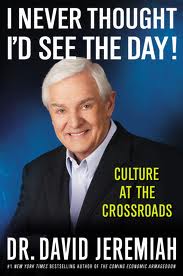
8 Quotes From “I Never Thought I’d See The Day”

I Never Thought I'd See The DayYou can read my book review of Dr. David Jeremiah’s I Never Thought I’d See The Day by clicking here. These are eight quotes that especially caught my attention in this book. Unless the quotes are otherwise attributed, they are from Dr. Jeremiah.

“I’ve shaken my fist in anger at stalled cars, storm clouds, and incompetent meteorologists. I’ve even, on one terrible day, that included a dead alternator, a blaring tornado-warning siren, and a horribly wrong weather forecast, cursed all three at once. I’ve fumed at furniture, cursed at crossing guards, and held a grudge against Gun Barrel City, Texas. I’ve been mad at just about anything you can imagine.

“Except unicorns. I’ve never been angry at unicorns.

“It’s unlikely you’ve ever been angry at unicorns either. We can become incensed by objects and creations both animate and inanimate. We can even, in a limited sense, be bothered by the fanciful characters in books and dreams. But creatures like unicorns that don’t exist—that we truly believe not to exist—tend not to raise our ire. We certainly don’t blame the one-horned creatures for our problems.

“The one social group that takes exception to this rule is atheists. They claim to believe that God does not exist and yet, according to empirical studies, tend to be the people most angry at Him.” —Joe Carter

“While the atheist arrogantly persists in the delusion that his reason is fully capable of figuring out all that there is, the religious believer lives in the humble acknowledgment of the limits of human knowledge, knowing that there is a reality greater than, and beyond, that which our senses and minds can ever apprehend.” —Dinesh D’Souza

“God brought two perfect, sinless people together in the Garden of Eden, a man and a woman who knew the perfect love of God. They did not get married to find love but to walk together in the unity and purpose God created them to fulfill: the primary task of birthing and raising the next generation. And in the process, love happened.”

“It is significant that while Adam was single, satan did not approach him or tempt him to disobey God. He waited until after Adam’s marriage to launch his attack. You would think it easier to attack one person instead of two, but by waiting he was able to attack not just an individual, but also God’s foundational building block for harmony and stability—marriage. By attacking marriage, he was able to create division and disharmony between humans themselves as well as between humans and God.”

“The oneness found in marriage is the same kind of oneness found in the Trinity.”

“We can be lulled into complacency by adopting uncritically the principle of submission to government on the assumption that the Christian history of our nation makes it safe to let our leaders do our thinking for us. But we cannot do this in our post-Christian nation where God’s Word is being marginalized. Nothing could be more dangerous for Christians and churches than to wander thoughtlessly down this path of increasing biblical indifference—a path that could well lead to a place where the Bible is not merely marginalized, but banned outrightly.”

“If the Church is being ignored because we preach the message of ‘Jesus Christ and Him crucified’ (1 Corinthians 2:2), or because the Gospel has become ‘a stumbling stone and rock of offense’ (Romans 9:33) to the world, that’s one thing. But if we are deemed irrelevant because we’re an anemic version of the world’s entertainment options or because we aren’t playing the world’s game nearly as well as the world does, then that’s another thing. That’s a tragedy.”

“William Tyndale wisely sought to avoid the confusion between ‘Church” and ‘church’ by translating ekklesia as ‘congregation’ instead of ‘church.’ …We must maintain a clean understanding of the difference between Church and church—and the priority of the former over the latter. Church buildings can necessitate huge investments of resources for construction and maintenance, and they are only temporary. Keeping the focus on people is the biblical priority and will result in the Church’s remaining relevant.”

Furious Longing

Furious longingThere is a passage of Scripture in the Book of James which has caused many people to propose many different explanations. I’m not a theologian, but here’s my take on this—

Or do your think the Scripture says without reason that the spirit He caused to live in us envies intensely? (James 4:5)

Envy in the Greek is a neutral word; it becomes a virtue or a vice depending on its context. I could long for a deeper relationship with my wife (virtue), or I could long for a drug that gives me a temporary escape (vice).

The Greek word for envy can mean pursue with love (virtue), or lust after forbidden desires (vice).

“The spirit [God] caused to live in us” came from a loving Creator, and was intended for us to long for Him. When God created man in His image, He said, “Let Us create man like Us” (Genesis 1:26). In the Triune God there is a furiously intense longing among Father, Son, and Spirit. Each part of the Godhead longs for the entire Godhead to be glorified—this makes the Godhead indivisibly and gloriously One. This is the same spirit God placed in man.

Of man God said, “It is not good for man to be alone” (Genesis 2:18). The God-implanted spirit of man longs to give love and to receive love. Our God-implanted spirit longs to connect.

But for what do we long? We were made to long for intimacy with God. If we substitute or exchange this with a longing for temporary worldly things, we are rightly called by James “adulterous people” and “an enemy of God” (James 4:4).

“But God gives more grace” (James 4:6) that we will turn from our temporary longings to long after Him. James almost seems to be saying that those in the church have their hearts hanging in the balance. Of the other eight times this Greek word for envy is used in the Bible, they are in the positive (or virtuous) connotation.

James is imploring us—longing for us—to not be the exception. Longing for us to humbly admit our need for God and to receive even more divine grace. Longing for us to tip our hearts toward God and renew the passionate, furious longing for which we were created.

O God, I want my passion to burn furiously for You alone. Jesus, may I follow Your example to only do what pleases the Father. Holy Spirit, may I hear Your voice if my heart ever begins to turn toward anything but my Beloved.

(I explored this idea further in a whole series of messages called Craving.)

Jesus: A Theography (book review)

Jesus A TheographyVery rarely do I say what I’m going to say about Jesus: A Theography by Leonard Sweet and Frank Viola: This is a must-read!

Jesus does such an amazing job of showing Christ in all His fullness throughout the entire Bible, that I cannot recommend it highly enough. It’s a weighty read covering a weighty subject. At over 300 pages of text, 20+ pages of quotes from imminent theologians, and nearly 100 pages of end notes, this book gives you so much to contemplate. As much as I enjoy speed reading my books, this was a book that I had to read and digest slowly, as there was so much to process in each paragraph.

Far too many people think Jesus “showed up” in the New Testament. But Leonard Sweet and Frank Viola do a masterful job of weaving together the Old and New Testament texts (or, as the authors call them, the First and Second Testaments), to show Christ in all His fullness. If you are among those who have only seen Jesus in the New/Second Testament, you are about to have your paradigm totally rocked!

Let me restate my opening paragraph again—If you want to know more about Jesus Christ, Jesus: A Theography is a must-read!

I am a Thomas Nelson book reviewer.

Check out some quotes from this book here.

Love Dance

I sat enthralled yesterday morning at the ministry of Pastor Bill Leach! He opened my eyes to a well-known passage in Philippians 2:5-11 as I had never before seen it.

In verse 7 the Scripture says that Jesus emptied Himself. Pastor Leach pointed out that this was not by laying something aside, but by taking on the human form. The Divine One became a doulos (the Greek word which means a bondslave with no rights of his own).

“Jesus is truly Man, but not merely Man.”

Jesus understood that being God is not getting, but giving. By taking on the human form, Jesus was showing us that He identified with us and therefore knew what to give us.

“For God so loved the world that He GAVE His One and Only Son.”

When we love someone, we enter into their orbit. We are focused on them and their desires. In the Trinity, each part of the Godhead is orbiting (or dancing) around each other.

In order for us to love God, God had to enter our orbit. We were self-absorbed: we danced only around ourselves. When Jesus took on human form He could enter our orbit—He could dance around us. It’s only then that we could understand how to join the love dance with Him.

Pastor Leach’s message called to my remembrance something I learned from another great pastor, Dave Williams, from 2 Peter 1:

His divine power has given us everything we needfor life and godliness through our knowledge of Him who called us by His own glory and goodness. (v. 3)

This verse sets the stage for what comes next (verses 5-7). The Apostle Peter then tells us to begin to add to our faith and our love dance with God. Add is a compound word that means a lavish dance with no expenses spared!

Because Jesus chose to step into our humanity, He chose to step into our self-centered dance. And now that we have seen Him—the One and Only, who came from the Father, full of grace and truth (John 1:14)—it’s time to leave our self-centered dance behind and join with a new Dance Partner who loves us like no one else ever has or ever will!