12 Quotes For Mother’s Day

“All I am, or can be, I owe to my angel mother.” —Abraham Lincoln

“My mother was the most beautiful woman I ever saw. All I am I owe to my mother. I attribute all my success in life to the moral, intellectual and physical education I received from her.” —George Washington

“I remember my mother’s prayers and they have always followed me. They have clung to me all my life.” —Abraham Lincoln

“The foundations of national morality must be laid in private families. In vain are schools, academies, and universities, instituted, if loose principles and licentious habits are impressed upon children in their earliest years. The mothers are the earliest and most important instructors of youth.” —John Adams

“The fundamental truths reported in the four gospels as from the lips of Jesus Christ, and that I first heard from the lips of my mother, are settled and fixed moral precepts with me.” —Abraham Lincoln

“The devil never reckons a man to be lost so long as he has a good mother alive. O woman, great is thy power!” ―Charles Spurgeon

“I learned more about Christianity from my mother than from all the theologians in England.” ―John Wesley

“Your motherhood is in God’s sight holier and more blessed than you realize.” —Andrew Murray

“God could not be everywhere, and therefore He made mothers.” —Jewish Proverb

“An ounce of mother is worth a ton of priest.” —Spanish Proverb

“To be a mother is the greatest vocation in the world. No being has a position of such great power and influence. She holds in her hands the destiny of nations, for to her is necessarily committed the making of the nation’s citizens.” —Hannah Whitall Smith

“Youth fades, love droops, the leaves of friendship fall; a mother’s secret hope outlives them all.” —Oliver Wendell Holmes

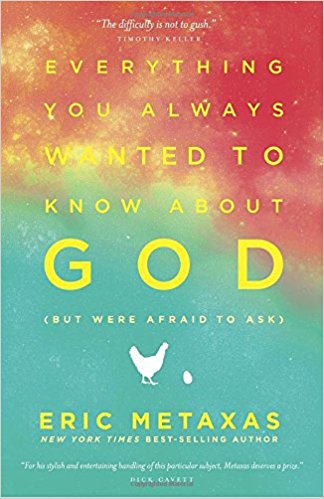
Everything You Always Wanted To Know About God (book review)

Have you ever wanted to sit down and ask some deep questions about God? What about some not-so-deep questions? Perhaps you’ve tried to have this conversation with someone, and either they weren’t too well informed or perhaps they talked “over your head.” If that describes you, I think you will enjoy Everything You Always Wanted To Know About God (but were afraid to ask) by Eric Metaxas.

This is not a deeply theological book. Eric himself states right up front, “On the subject of God, most of us want to know whether He actually exists and whether we can know He exists and how we can know that. And if He does exist, we want to know what He’s like and what that has to do with us and how we live our lives. These are the deepest human questions, and we deserve to get some answers, even if those answers might be imperfect, which the answers in this book certainly are.”

Maybe the answers are “imperfect” but then again, who really has a “perfect” answer?! What you will find in this book is a conversational feel that is very engaging without feeling like the subject matter is “dumbed down,” some good information to help guide you on your own journey of finding answers, and some pithy humor as well. Of course, I believe the best answers are found in the Bible itself, but this book is a good starting point to connect with the Scriptures.

I would recommend this book to anyone who hasn’t been able to connect with someone that could give you satisfactory answers to your God-searching questions. This book would also be an excellent resource to read together with a friend as you attempt to find answers to your God questions.

I am a Waterbrook book reviewer.

Love Re-members

love-re-membersChristians often talk about God in terms of the “Trinity.” That is, the One True God revealed in three Persons: Father, Son, and Holy Spirit.

This is sometimes a difficult concept to grasp, especially since the word Trinity doesn’t specifically appear in the Bible. But make no mistake, just because the word isn’t there doesn’t mean it’s not true. Consider…

  • God’s Three-in-One nature is first exhibited when man is created (Genesis 1:26).
  • When the prophesy is given about Jesus being born in human flesh, He is given all the titles of the three Persons of the Godhead (Isaiah 9:6).
  • At Christ’s baptism we see Jesus in human form, we see the Holy Spirit descending as a dove, and we hear the Father’s voice announcing His approval of His Son (Matthew 3:16-17).
  • Jesus Himself said He would ask the Father to send the Holy Spirit to the Christians (John 14:16).
  • And just as Jesus ascended into Heaven, He told His followers to baptize people into all three Persons of the Godhead (Matthew 28:19).

But I think the best expression of the Trinity is revealed in three simple words. John talks about how all three Persons of the Trinity are involved in the life of a Christian. And then he sums it all up in three words—

“GOD IS LOVE”

Each Person of the Godhead is encouraging and illuminating and pointing to the other Persons in the Trinity. Love is perpetually being received and given. We humans are created in God’s image … we are created to receive and to give God’s love. That’s why John tells us that we know and rely on the love God has for us (that’s the receiving part), and that whoever lives in love lives in God, and God in him (that’s the giving part).

When Adam and Eve sinned, they were dis-membered from God. As a result, every human in their natural state longs for connection with God and others, but feels separated, isolated, unloved, and even unlovable.

Love re-members! 

Jesus came to be broken and crushed and to feel the pain of separation from God. It was out of this brokenness that He could do the work of re-membering us to the fullness of the Trinity.

When Jesus shared His last supper with His disciples, He took bread (which is made from broken wheat kernels) and wine (which is made from crushed grapes). He told us as often as we eat the bread and drink the wine we are to remember how He was broken and crushed for us.

Remembering Christ’s work on the Cross re-members us to the fullness of the Trinity. 

Sin and satan want to keep us feeling separated, unloved, and unloveable. But when we were the least worthy of His love, God—Who IS love—was broken and crushed to re-member us to Him.

If you feel lonely, separated, isolated, unloved or unloveable, I urge you to remember what Jesus did for you. He loved you enough to be broken and crushed for your re-membering to all of God’s love.

Check out this video where I explain this amazing thought in more detail…

12 Quotes From “The Shadow Of An Agony”

the-shadow-of-an-agonyIn The Shadow Of An Agony, Oswald Chambers explores how we should process the hard events of our lives which seem to totally rock our neat and orderly world. Check out my book review by clicking here, and then enjoy a few quotes from this book.

“If Jesus Christ were only a martyr, His Cross would be of no significance; but if the Cross of Jesus Christ is the expression of the secret heart of God, the lever by which God lifts back the human race to what it was designed to be, then there is a new attitude to things.”

“The agony of a man’s affliction is often necessary to put him into the right mood to face the fundamental things of life. The Psalmist says, ‘Before I was afflicted I went astray: but now I have kept Thy Word.’ The Bible is full of the fact that there has to be an approach to the holy ground. If I am not willing to be lifted up, it is no use talking about the higher heights. … No man can do wrong in his heart and see right afterwards. If I am going to approach the holy ground, I must get into the right frame of mind—the excellency of a broken heart.”

“Jesus Christ did not come to give us pretty ideas of God, or sympathy with ourselves; He came from a holy God to enable men, by the sheer power of His Redemption, to become holy.”

“No man is the same after an agony; he is either better or worse, and the agony of a man’s experience is nearly always the first thing that opens his mind to understand the need of Redemption worked out by Jesus Christ.”

“The attitude of the Bible to the human race is not a common-sense one. The Christian aspect deals with the a specimen of a human race which is a magnificent ruin of what it was designed to be. Supposing the view of the Bible to be right, to whom it is it ‘up to’ to right the wrong? The Creator. Has He done it? He has, and He has done it absolutely single-handed. The tremendous revelation of Christianity is not the Fatherhood of God, but the Babyhood of God—God became the weakest thing in His own creation, and in flesh and blood He levered it back to where it was intended to be. No one helped Him; it was done absolutely by God manifest in human flesh. God has undertaken not only to repair the damage, but in Jesus Christ the human race is put in a better condition than when it was originally designed.”

“We have been taken up with creeds and doctrines, and when a man is hit we do not know what to give him; we have no Jesus Christ, we have only theology. For one man who can introduce another to Jesus Christ by the way he lives and by the atmosphere of his life, there are a thousand who can only talk jargon about Him.”

“The New Testament view of a saint is a more rugged type. You and I are a mixture of dust and Deity, and God takes that sordid human stuff and turns it into a saint by Regeneration. A saint does not mean a man who has not enough sin to be bad, but a man who has received from Jesus Christ a new heredity that turns him into another man.”

“Our guide as to what emotions we are going to allow is this—What will be the logical outcome of this emotion? If it has to do with sin and satan, then grip it on the threshold of your mind and allow it no more way. You have no business to harbor an emotion the outcome of which you can see to be bad; if it is an emotion to be generous, then be generous, or the emotion will react and make you a selfish brute.”

“When I receive the Spirit of God, I am lifted not out of reason, but into touch with the infinite Reason of God.”

“Any fool will give up wrongdoing and the devil, if he knows how to do it; but it takes a man in love with Jesus Christ to give up the best he has for Him.”

“Churchianity is an organization; Christianity is an organism. Organization is an enormous benefit until it is mistaken for the life.” 

“The stupendous difference between the religion of Jesus Christ and every other religion under heaven is that His religion is one which brings help to the bottom of hell, not a religion that can deal only with what is fine and pure.”

Every Thursday I share a section of the current Oswald Chambers book I am reading, in a series called “Thursdays With Oswald.” If you would like to be notified when these posts go live, just enter your email address in the box on the right, and then click “Sign me up!”

Thursdays With Oswald—Get Rid Of Jargon!

Oswald ChambersThis is a weekly series with things I’m reading and pondering from Oswald Chambers. You can read the original seed thought here, or type “Thursdays With Oswald” in the search box to read more entries.

Get Rid Of Jargon! 

     The New Testament is not written to prove that Jesus Christ is God Incarnate; the New Testament does not prove anything; it simply confirms the faith of those who believe beforehand. Christian evidences don’t amount to anything; you can’t convince a man against his will. … 

     Creeds are the effects of our belief, not the cause of it. I do not have to believe all that before I can be a Christian; but after I have become a Christian I begin to try and expound to myself Who Jesus Christ is, and to do that I must first of all take into consideration the New Testament explanation. “Blessed art thou, Simon bar Jonah: for flesh and blood hath not revealed it unto thee, but My Father which is in heaven.” … 

     Jesus Christ did not come primarily to teach; He came to make it possible for us to receive His heredity, to have put into us a new disposition whereby we can live totally new lives. … The Sermon on the Mount is impossible to a man, and yet it is what our Lord taught. Jesus Christ did not come to teach man to be what he cannot be, but to reveal that He can put into him a totally new heredity; and all He requires a man to say is—“I need it.” … Jesus Christ cannot begin to do anything for a man until he knows his need; but immediately he is at his wits’ end through sin or limitation or agony and cannot go any further, Jesus Christ says to him, “Blessed are you; if you ask God for the Holy Spirit, He will give Him to you.” God does not give us the Holy Spirit until we come to the place of seeing that we cannot do without Him (Luke 11:13). … 

     We have been taken up with creeds and doctrines, and when a man is hit we do not know what to give him; we have no Jesus Christ, we have only theology. For one man who can introduce another to Jesus Christ by the way he lives and by the atmosphere of his life, there are a thousand who can only talk jargon about Him.

From The Shadow Of An Agony

Oswald Chambers is reminding Christians that we only learn more about Jesus by confessing “I need You!” Then the Holy Spirit can begin to reveal real-life truths to us from God’s Word.

Peter reminded us that in order to be ready to give an answer to anyone who asks a Christian the reason for the hope they had, we must first make Jesus the Lord of our life (see 1 Peter 3:15). Creeds and doctrines and theories are of no help to a friend who is in trouble. Let’s not be one of the thousands “who can only talk jargon about Him,” but let’s really know Jesus as Lord, so that we have something real and tangible to pass on to our friends.

Get rid of the jargon! Go deeper in your personal relationship with Jesus Christ!

Thursdays With Oswald—The Uncommon Attitude Of The Bible

Oswald ChambersThis is a weekly series with things I’m reading and pondering from Oswald Chambers. You can read the original seed thought here, or type “Thursdays With Oswald” in the search box to read more entries.

The Uncommon Attitude Of The Bible

     It is not necessary for a man to understand things before he can be a Christian. … Theology is the science of religion, an intellectual attempt to systematize the consciousness of God. Intellect systematizes things to a man’s mind, but we do not reach reality through intellect. Theology comes second, not first, and ought always to be open to dispute. … 

     The attitude of the Bible to the human race is not a common-sense one. The Christian aspect deals with the a specimen of a human race which is a magnificent ruin of what it was designed to be. Supposing the view of the Bible to be right, to whom it is it ‘up to’ to right the wrong? The Creator. Has He done it? He has, and He has done it absolutely single-handed. The tremendous revelation of Christianity is not the Fatherhood of God, but the Babyhood of God—God became the weakest thing in His own creation, and in flesh and blood He levered it back to where it was intended to be. No one helped Him; it was done absolutely by God manifest in human flesh. God has undertaken not only to repair the damage, but in Jesus Christ the human race is put in a better condition than when it was originally designed. … 

     The highest standard God has is Himself, and it is up to God to make a man as good as He is Himself; and it is up to me to let Him do it.

From The Shadow Of An Agony

It’s amazing how much we argue over theology! Especially because theology never saved a soul. Theology simply is a science that organizes our thoughts about God.

But God confounds those who merely want to analyze and systematize Him. I love Chambers’ thought: “The tremendous revelation of Christianity is not the Fatherhood of God, but the Babyhood of God.” Who would have ever conceived such a harebrained idea?!

Theology has value, but it comes second. First comes faith. Never let arguments over theology sway you from your childlike faith in a God Who loved you enough to single-handedly lift you back up to Him!

7 Quotes From “The Philosophy Of Sin”

The Complete Works Of Oswald ChambersOswald Chambers always makes me think deeply, but The Philosophy Of Sin was a graduate-level, deep-thinking book on theology and philosophy for me! Check out my review of this book by clicking here. Below are some quotes I especially enjoyed.

“To people who are satisfied on too shallow a level the Bible is a book of impertinences, but whenever human nature is driven to the end of things, the Bible becomes the only Book and God the only Being in the world.”

“The life of nature is neither moral nor immoral; our bodies are neither moral nor immoral, we make them moral or immoral. Our Lord had a body, and we read that He hungered; it was not a sin for Him to be hungry, but it would have been a sin for Him to have eaten during the forty days in the wilderness, because His Father’s word at that time was that He should not eat. It is not a sin to have a body, to have natural appetites, it is a sin to refuse to sacrifice them at the word of God.”

“Lust simply means, ‘I must have this at once’; it may be a bodily appetite or a spiritual possession. The principal lust works on is, ‘I must have it at once, I cannot wait for God’s time, God is too indifferent,’ that is the way lust works.”

“If all Jesus Christ can do is to run a parallel counteraction with what satan can do, His right name is ‘Culture,’ not ‘Savior’; but His revealed nature was stated by the angel to Mary, and repeated over and over again, ‘Thou shalt call His name Jesus; for He shall save His people from their sins.’ The slight views of salvation, the sympathetic drifty views that all Jesus Christ can do is to put in us a principle that counteracts another principle, will cause anyone who is got to the last limit to blaspheme God for a thing like that. It all comes from a flimsy, wrong view of sin. If that is all He can do, what is the good of calling Him Savior? … It is sin that He came to cope with; He did not come to cope with the poor little mistakes of men, they cope with their own mistakes; He came to give them a totally new stock of heredity, that is, He came to implant into them His own nature, so that satan’s power in the soul is absolutely destroyed, not counteracted.”

“This aspect of the death of Jesus takes us into a spiritual domain beyond the threshold of the thinking of the majority of us. The cry of the Cross, ‘My God, My God, why hast Thou forsaken Me?’ is unfathomable to us. The only ones—and I want to say this very deliberately—the only ones who come near the threshold of understanding the cry of Jesus are not the martyrs, they knew that God had not forsaken them, His presence was so wonderful; not the lonely missionaries who are killed or forsaken, they experience exultant joy, for God is with them when men forsake them: the only ones who come near the threshold of understanding the experience of God-forsakenness are men like Cain—‘My punishment is greater than I can bear’; men like Esau, ‘…an exceedingly bitter cry’; men like Judas. Jesus Christ knew and tasted to a fuller depth than any man could ever taste what it is to be separated from God by sin.”

“How Jesus Christ does cleanse our conscience! It is freedom not only from sin and the damage sin has done, but emancipation from the impairing left by sin, from all the distortions left in mind and imagination.”

“The conscience formed in us by the Holy Spirit makes us amazingly sensitive to the things that tell against the honor of God.”

I’ll be sharing other quotes from this book in the near future, and I also share an extensive passage from the current Chambers’ book I am reading every Thursday. If you want to be notified when those quotes are posted, please enter your email address in the box to the right and click “Sign me up!”

I share quotes from Oswald Chambers and other inspirational authors daily on both Tumblr and Twitter.

The Philosophy Of Sin (book review)

The Complete Works Of Oswald ChambersIt’s not often that philosophy and theology appear in the same sentence, let alone in the same book! But a special mind like Oswald Chambers is one who can masterfully pull that off, and he does so in his book The Philosophy Of Sin.

Chambers describes sin and salvation from sin like this: “Sin is the radical twist with a supernatural originator, and salvation is a radical readjustment with a supernatural Originator.” Philosophy is the science of getting to the root of the matter, applying all the wisdom we can muster. As you might image, in this book Chambers digs deeper than most theologians do, and thinks wider than most philosophers do.

Chambers takes a graduate-level look at topics like sin, redemption, salvation, judgment, backsliding, temptation, conscience, and humanity. This book is a real paradigm-expander and shouldn’t be read by anyone who is looking for some “light” reading. You will need to have your Bible open as you read this book, because Chambers will shine a light on biblical passages probably unlike anyone else has. But, wow!, what a payoff you will have from working through this weighty book!

If you are a seasoned Christian who is ready for a mental challenge, The Philosophy Of Sin is for you.

11 More Quotes From “Culture”

cultureA.W. Tozer wrote almost 50 years ago, but his words to the church still ring true today. Check out my review of Culture, and then enjoy some additional quotes from this book.

“To preserve life the physician and the druggist use words of fixed meaning common to both. How much more should the pulpit and the pew have a clear understanding about the words of eternal life. The modern effort to popularize the Christian faith has been extremely damaging to that faith. The purpose has been to simplify truth for the masses by using the language of the masses instead of the language of the church. It has not succeeded, but has added to rather than diminished religious confusion.”

“The hope of the church yet lies in the purity of her theology, that is, her beliefs about God and man and the relation to each other. These beliefs have been revealed to her by the inspiration of the Holy Spirit in the sacred Scriptures. Everything there is clear-cut and accurate. We dare not be less than accurate in our treatment of anything so precious.”

“I think we make two mistakes in our attitude toward our Christian leaders, one is not being sufficiently grateful to them and the other in following them too slavishly.”

“Today we evangelicals are showing signs that we are becoming too rich and too prominent for our own good. With a curious disregard for the lessons of history we are busy fighting for recognition by the world and acceptance by society.”

“That terrible zone of confusion so evident in the whole life of the Christian community could be cleared up in one day if the followers of Christ would begin to follow Christ instead of each other.”

“The difficulty we modern Christians face is not misunderstanding the Bible, but persuading our untamed hearts to accept its plain instructions.”

“Our churches these days are filled (or one-quarter filled) with a soft breed of Christian that must be fed on a diet of harmless fun to keep them interested. About theology they know little. Scarcely any of them have read even one of the great Christian classics, but most of them are familiar with religious fiction and spine-tingling films. No wonder their moral and spiritual constitution is so frail.”

“To accept the call of Christ changes the returning sinner indeed, but it does not change the world. The wind still blows toward hell, and the man who is walking in the opposite direction will have the wind in his face. And we had better take this into account when we ponder on spiritual things.”

“Christianity’s scramble for popularity today is an unconscious acknowledgment of spiritual decline.”

“The desire to stand well with our fellow man is a natural one, and quite harmless up to a point, but when that desire becomes so all-consuming that we cannot be happy apart from the praises of man, it is no longer harmless, it is sinful in itself and injurious in its effects.”

“A Christian’s standing before God does not depend upon his standing before men. A high reputation does not make a man dearer to God, nor does the tongue of the slanderer influence God’s attitude toward His people in anyway.”

To read some additional quotes I shared from Culture, click here. You may also follow me on Twitter and Tumblr to read quotes which I share daily from Tozer and other notable thinkers.

8 Quotes From “Culture”

cultureIn Culture, you will find a collection of chapters from various A.W. Tozer books all addressing the theme of how a Christian should behave in worldly culture. If you are concerned about influencing the culture for Christ (instead of being influenced by it), I urge you to read my review of this book, and then pick up a copy for yourself. Below are a few quotes from Culture that caught my attention.

“The sacred-secular antithesis has no foundation in the New Testament. … The Lord Jesus Christ Himself is our perfect example, and He knew no divided life. In the presence of His Father He lived on earth without strain from babyhood to His death on the Cross. God accepted the offering of His total life, and made no distinction between act and act. ‘I do always those things that please Him,’ was His brief summary of His own life as it related to the Father (John 8:29). As He moved among men, He was poised and restful.”

“A Christian is now living according to the will of God as he understands it from the written Word. Of such a one it may be said that every act of his life is or can be as truly sacred as prayer or baptism or the Lord’s Supper. To say this is not to bring all acts down to one dead level; it is rather to lift every act up into a living kingdom and turn the whole life into a sacrament.”

“Keep reminding God in our times of private prayer that we mean every act for His glory; then supplement those times by a thousand thought-prayers as we go about the job of living. Let us practice the fine art of making every work a priestly ministration. Let us believe that God is in all our simple deeds and learn to find Him there.”

“You cannot get miracles as you would get a chemical reaction. You cannot get a miracle as you get a wonderful act on stage by a magician. God does not sell Himself into the hands of religious magicians. I do not believe in that kind of miracles. I believe in the kind of miracles that God gives to His people who live so close to Him that answers to prayer are common and these miracles are not uncommon.”

“Our trouble is not that we refuse to believe right doctrine, but we refuse to practice it. We have the peculiar contradiction of believing the right thing and living the wrong way.”

“It seems that the average person spends more time and intellectual labor each year filling out income tax forms then he or she spends in a lifetime trying to learn from the Scriptures and from the light of the Spirit what the church is and what he or she ought to do about it.”

“I would also have in our body the power of the Spirit of Christ. I have said that the average gospel church could get along without the Holy Spirit—and many do. We are praying for revival. What is revival? It is when the Holy Spirit takes over the work that is His, instead of being pushed aside into the benediction. He now becomes the Chief Executive of the church, running it. ‘But ye shall receive power, after that the Holy Ghost is come upon you’ (Acts 1:8). That means that the Spirit of Heaven should come to a company on earth with His all-prevailing gifts, power, and grace, with His life, His illumination, and His discernment. This is not fanaticism; this is not any weird religion. This is just what the Bible teaches.”

“Did you read the Bible or watch TV more this week? Think of the time you have spent. How many half-hour periods did you spend with your Bible, and how many did you spend with amusements? We do not take our faith seriously enough.”

I will be sharing other quotes from Culture soon. If you will enter your email address in the “Subscribe” box to on the right side of the page, you will be notified as soon as new quotes are posted. You can also read Tozer’s quotes from this book, as well as other empowering quotes that I share daily in Twitter and Tumblr.