The Irrefutable Evidence

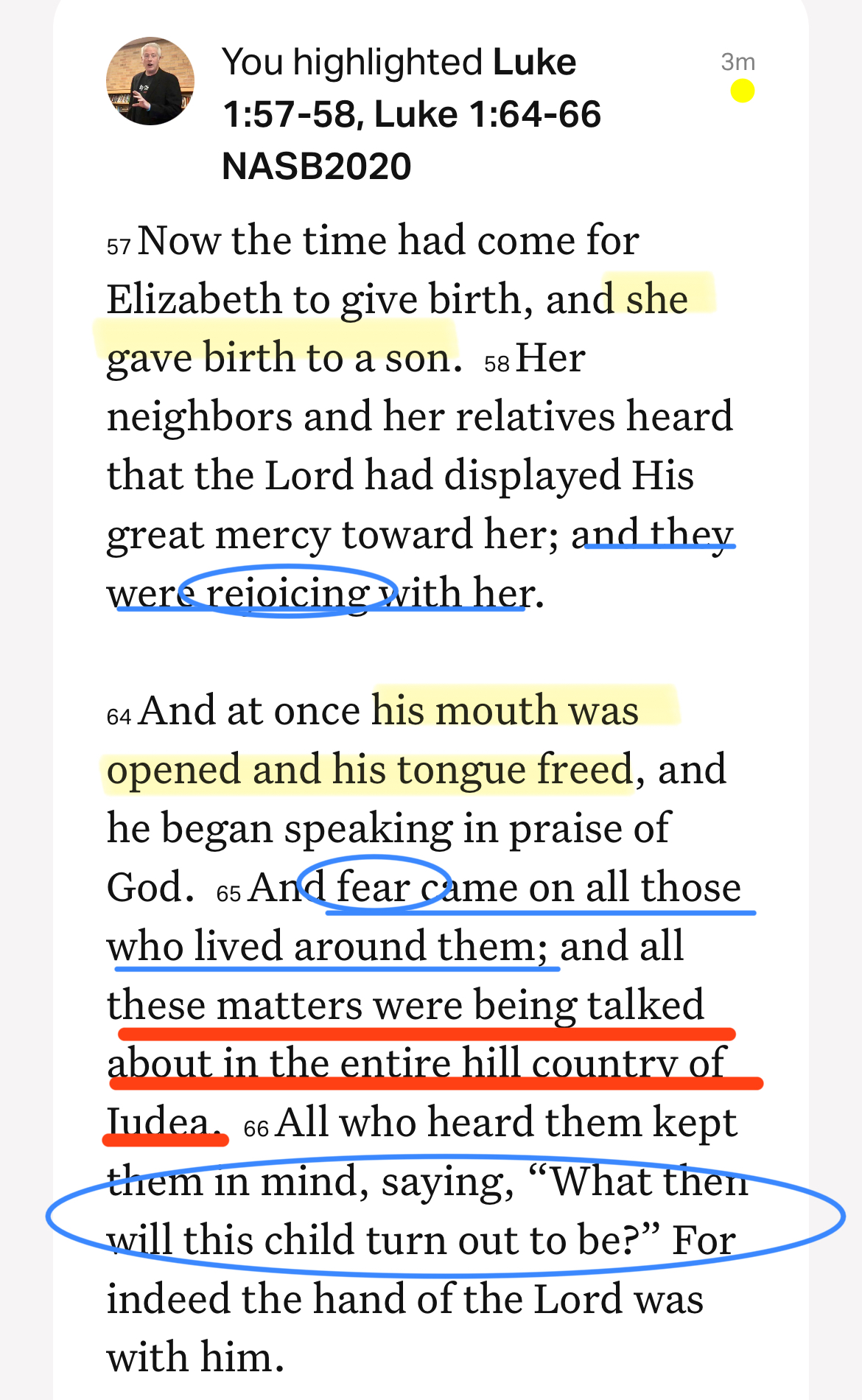
Now the time had come for Elizabeth to give birth, and she gave birth to a son. Her neighbors and her relatives heard that the Lord had displayed His great mercy toward her; and they were rejoicing with her. … And at once his mouth was opened and his tongue freed, and he began speaking in praise of God. And fear came on all those who lived around them; and all these matters were being talked about in the entire hill country of Judea. All who heard them kept them in mind, saying, “What then will this child turn out to be?” For indeed the hand of the Lord was with him. (Luke 1:57-58, 64-66)

When God does what only He can do, our testimony is irrefutable! People will rejoice, reverence God, and ask questions, but they will never be the same after witnessing a miracle. 

Let’s pray for God to do the miraculous in our own lives even now so that we can be living testimonies that draw others to our Savior and Lord! 

You may also be interested in my posts By His Stripes and Argument vs Experience. 

And check out my short video Proof!

Not That Other Stuff, But Prayer

Listen to the podcast of this post by clicking on the player below, and you can also subscribe on AppleSpotify, or Audible. 

The Church heard the threats from the Sanhedrin, warning them not to talk about Jesus anymore. Their first response was to go to God: “When they heard this, they raised their voices together in prayer to God“ (Acts 4:24). 

Not signing a petition or organizing a protest, but praying.
Not telling their friends to gain support, but praying.
Not attacking, but praying.
Not discussing, but praying.
Not strategizing, but praying.
Not complaining, but praying.
Not individually, but together.
Not later, but immediately.
Not going through the motions, but passionately.
Not aimlessly, but guided by Scripture.
Not humdrum, but expecting God’s power from on high.
Not for vengeance, but for a testimony.

God answered the Church powerfully! 

Then the people moved out boldly—“And when they had prayed, the place where they were assembled together was shaken; and they were all filled with the Holy Spirit, and they spoke the word of God with boldness” (Acts 4:31). 

Oh, for this type of unifying action today! It starts with prayer!

You may also like my blog post and sermon 4 Holy Spirit-Enhanced Habits, and my whole series on prayer called Be A First Responder.  

►► Would you please prayerfully consider supporting this ministry? My Patreon supporters get behind-the-scenes access to exclusive materials. ◀︎◀︎

An Apologetic For Apologetics

Listen to the podcast of this post by clicking on the player below, and you can also subscribe on AppleSpotify, or Audible. 

I would like to give Christians an apologetic about Christian apologetics.

Check out this episode of The Podcast.

The Scriptures I reference in this episode of The Podcast are 1 Peter 3:15-16; Luke 1:1-4; Acts 1:1-3; Luke 24:45-49; Acts 1:5, 8.

In a couple of earlier blog posts, I elaborate more on some points in this episode. Check out:

I have also talked quite a bit about apologetics on my blog, which you can find here.

Keep up with everything else I have going on, including my newest book and my other podcasts by clicking here.

►► Would you please prayerfully consider supporting this ministry? My Patreon supporters get behind-the-scenes access to exclusive materials. ◀︎◀︎

Unity Is Not Conformity

Listen to the podcast of this post by clicking on the player below, and you can also subscribe on AppleSpotify, or Audible.

Unity is not conformity nor is it mimicry. The Holy Spirit unites Christians in their message of hope to the world, but He does this by empowering each of our unique testimonies to our culture. 

This is a message I shared with the congregation at Country Chapel during their week-long revival meetings.

The Scriptures I reference in this message are—2 Chronicles 18:1-13; Romans 12:2; Mark 12:28-31; John 12:49-50; John 8:34-36; 2 Corinthians 3:16-18; Acts 15:1-35; Acts 1:8; Acts 2:1-11.

I have previously shared a whole series of messages about how the Holy Spirit empowers Christians for ministry:

►► Would you please prayerfully consider supporting this ministry? My Patreon supporters get behind-the-scenes access to exclusive materials. ◀︎◀︎

Links & Quotes

No one wants what the gloomy person has. Joy is a Christian’s testimony—it’s what attracts others to Jesus! Check out this full message from my series on the Songs of Ascent.

I have lots of new content every week, which you can check out on my YouTube channel.

“At first glance, people may not see how these different forms of sexual violence connect to each other. But, in fact, experts are increasingly recognizing that they may all stem from one common source—sexual objectification. Sexual objectification occurs when people perceive others as sex objects rather than complex human beings deserving of dignity and respect.” Pornography is a major contributor to the sexual objectification which leads to sexual violence.

Dr. Brian Thomas describes why fossils are found where they are and why land animals may even be found near marine animals: “This fossil discovery [a bone from a South American megaraptor found near Cape Otway, Australia] fits well with a biblical history, which goes something like this: Around 2348 BC, a worldwide flood crushed and reshaped the earth’s surface, breaking up a single landmass (Pangaea) into continents and fossilizing countless living things. Prior to the Flood megaraptors roamed Pangaea, during the Flood they were fossilized, and in the late Flood stages the boundaries of new continents (along with their fossils) were roughly shaped. Unlike the standard story, the outlines of this history have been testified to by reliable eyewitnesses, and this testimony has been faithfully preserved in Genesis.”

“The more we let God take over us, the more truly ourselves we become—because He made us.” —C.S. Lewis

J. Warner Wallace shares two trends in American society that are contributing to the decline of religious adherence in America.

“There is no way around hard work. Embrace it.” —Roger Federer

Shame on my thoughts, how they stray from me!
During the Psalms, they wander on a path that is not right; they run, they distract…
One moment they follow the ways of loveliness, and the next the ways of riotous shame…
Swiftly they leap in one bound from earth to heaven…
O beloved Christ… may the grace of the sevenfold Spirit come to keep them in check!
Rule this heart of mine, O swift God of the elements, that You may be my love, and I may do Your will! —Anonymous, On the Flightiness of Thought, Irish, 8th-9th century

Ungodly leaders become more and more selfish, while shepherd leaders become more and more God-fearing and more and more attentive to the needs of others (Jeremiah 12:10-11). Check out my series of posts for godly leaders and my book Shepherd Leadership.

Persecution From Religious Leaders

Listen to the podcast of this post by clicking on the player below, and you can also subscribe on AppleSpotify, or Audible. 

The religious leaders who should have known God’s Word the best were the ones who wanted Jeremiah killed for speaking God’s Word boldly. 

     The priests and the prophets and all the people heard Jeremiah speaking these words in the house of the Lord. Yet when Jeremiah finished speaking everything that the Lord had commanded him to speak to all the people, then the priests and the prophets and all the people seized him, saying, “You must die!” … Then the priests and the prophets spoke to the officials and to all the people, saying, “A death sentence for this man! For he has prophesied against this city, just as you have heard with your own ears!” (Jeremiah 26:7-8, 11) 

They did this to Jesus. The religious leaders shouted louder and louder, “Crucify Him!” 

They will do this to me. Jesus said, “Blessed are you when people insult you, persecute you and falsely say all kinds of evil against you because of Me. Rejoice and be glad, because great is your reward in heaven, for in the same way they persecuted the prophets who were before you” (Matthew 5:11-12). And He said, “Be on your guard; you will be handed over to the local councils and be flogged in the synagogues. On My account you will be brought before governors and kings as witnesses to them and to the Gentiles” (Matthew 10:17-18). 

When—not if—this persecution comes, I want to be able to stand before the religious and civil leaders of my time and be able to hear what Jesus heard from Pontius Pilate: “I find no basis for a charge against this Man” (John 18:38; 19:4, 6). 

Holy Spirit, help me to speak only what You tell me to speak and do only what You tell me to do (Matthew 10:19-20). Help me to respond quickly to any wrong thinking, speaking, or action that You point out so that I may just as quickly repent of that. I want my life to point others to Jesus, even as I face persecution. 

(I discuss the persecution flowchart above in more detail in this post.) 

►► Would you please prayerfully consider supporting this ministry? My Patreon supporters get behind-the-scenes access to exclusive materials. ◀︎◀︎

Sowing In Expectation

Listen to the podcast of this post by clicking on the player below, and you can also subscribe on AppleSpotify, or Audible. 

I’ve noticed how quick some people are to give up when things don’t get them the results they thought they should get, or the results don’t come as soon as they expected. 

Anytime we try something new, there is always the potential for failure. Even later on, those who appear to be an expert at something rarely do it perfectly. But in either case, there are three things we need to do if we don’t get the results we expected: (1) reflect, (2) evaluate possible improvements, (3) re-engage. 

Even before Jesus commissioned us to take His message of Good News to every street everywhere, He told us not to expect perfect results. In one of His best-known parables, Jesus talked about the farmer sowing seed (see Luke 8:5-8). 

(You can see all of the Scriptures I mention in this post by clicking here.)

Jesus didn’t say, “All of your efforts at sharing the Gospel will be successful.” In fact, He said some efforts would totally fail (falling on the hard path), and some would have only temporary success (falling on the weedy and stony ground). But we keep on sowing the seed because some will fall on good soil and yield a harvest a hundred times more than was sown! 

So, as John Wesley said, “Do all the good you can, by all the means you can, in all the ways you can, in all the places you can, at all the times you can, to all the people you can, as long as ever you can.” 

The baptism of the Holy Spirit brings dynamic, life-changing power (Acts 1:8). The life that is changed first is our own. Everything about us begins to change. 

When people heard Jesus speak, they said, “How did this Man get such learning without having been taught?” (John 7:15). The same Holy Spirit who empowered Jesus to speak is the same Holy Spirit who will empower our words. 

When our words are Spirit-empowered words, people can feel it. When our words are matched by our lifestyle, people can’t ignore it (John 7:46; Acts 2:37, 4:13, 6:10)! 

Just like salt that influences effortlessly, silently, and irreversibly, we never know what part the salt of our lives is playing in someone else’s life, even if it appears that nothing substantial is happening at all. But God said His word always accomplishes its purpose (Isaiah 55:10-11), which is why we keep on living and speaking as Spirit-empowered witnesses. 

And we live expecting that something is happening—Let us not become weary in doing good, for at the proper time we will reap a harvest if we do not give up (Galatians 6:9). 

How do we take this message of Jesus to every street? 

  1. Stay yielded to the influence of the Holy Spirit 
  2. Regularly and consistently read and apply God’s Word to your own life 
  3. Keep sowing in expectation 
  4. If your efforts appear to fail: reflect, evaluate, re-engage in expectation 

We can be salt without being salty; we can be light without being annoying. 

We have been empowered to take the Good News to every street, so let us not become weary in doing this. 

If you’ve missed any of the message in our series Takin’ Him to the Streets, you can find them all by clicking here. 

►► Would you please prayerfully consider supporting this ministry? My Patreon supporters get behind-the-scenes access to exclusive materials. ◀︎◀︎

Takin’ Him To Hollywood Boulevard

Listen to the podcast of this post by clicking on the player below, and you can also subscribe on AppleSpotify, or Audible. 

Jesus sent us and the Holy Spirit empowers us to take the Good News to all nations—all the streets (Luke 24:47-49; Acts 1:8)—even the streets of Samaria where we will have more differences than similarities. 

There is one street that has infiltrated and affected every other street more profoundly than any other: Hollywood Boulevard. The constant bombardment of messages through movies, television programs, music, literature, and the arts is almost immeasurable. 

I think Christians rarely stop to ponder how much of the culture on Main Street is influenced by the content from Hollywood Boulevard. Probably because so few Christians are involved in the artistic or creative communities.  

Here’s what we need to remember: All of this creativity is God-given. The opening words in the Bible say, “In the beginning God created…” (Genesis 1:1). 

We specific examples of God-given creative skills in:

  • Bezalel—Exodus 31:1-5 
  • Oholiab—Exodus 31:6, 35:34 
  • craftsmen and craftswomen—Exodus 31:6; 35:10, 22, 25 
  • Huram—1 Kings 7:13-14 
  • food administrators—Acts 6:3 
  • Tabitha—Acts 9:36-39 

(You can check out all of the Scriptures mentioned in this post here.) 

In more modern times, we see notable creative people giving credit to God for their abilities. 

  • William Shakespeare’s use of biblical themes—and even exact phrases—throughout his work is easy to spot. In the opening line of his last will and testament, he wrote, “I commend my soul into the hands of God my Creator, believing through the merits of Jesus Christ, my Savior, to be made a partaker of life everlasting.” 
  • Johan Sebastian Bach, considered by many to be the greatest composer to ever live, placed “S.D.G.” on every one of his musical compositions, which stands for Sola Deo Gloria: only for the glory of God. 

The apostle James tells us that every good and beautiful gift has come to us from God our Creator (James 1:17). And then this is my paraphrase of a similar thought the apostle Peter—

Each of you should use whatever gift you have received to serve others, as faithful stewards of God’s grace in its various forms. If anyone speaks [writes, paints, composes, sculpts], they should do so as one who speaks [writes, paints, composes, sculpts] the very words of God. (1 Peter 4:10-11)

So, here are four thoughts about how we can take the Good News of Jesus to Hollywood Boulevard. 

  1. Create a beautiful culture in your home, your Main Street, your workplace, your school. Ask the Holy Spirit to help you answer the question, “What can I do so that the love and beauty of Jesus will be felt here?” 
  1. Use your creative skills—write poems, compose music, paint a picture, sew clothing, bring innovation to your job.
  1. Support beautiful authors, musicians, moviemakers, painters, etc. Hollywood produces what they think will make money, so if you are supporting creators of beautiful things, they will produce more of those things. 
  1. Leverage Hollywood’s culture to talk to others about heavenly culture. Point out biblical themes, challenge the rationale behind unbiblical lyrics, etc.  

“Christians need to ask themselves a few key questions to help us respond to the society around us. First, what is good in our culture that we can promote, protect, and celebrate? Second, what’s missing in our culture that we can creatively contribute? Third, what’s evil in our culture that we can stop? And fourth, what’s broken in our culture that we can restore?” —John Stonestreet 

Don’t complain—create something better. 

Don’t compromise—promote what is beautiful and edifying. 

The Holy Spirit can empower us to take the Good News of Jesus even to Hollywood Boulevard! 

If you’ve missed any of the other messages in our series Takin’ Him to the Streets, you can find them all here. 

►► Would you please prayerfully consider supporting this ministry? My Patreon supporters get behind-the-scenes access to exclusive materials. ◀︎◀︎

Takin’ Him To Easy Street And Skid Row

Listen to the podcast of this post by clicking on the player below, and you can also subscribe on AppleSpotify, or Audible. 

Jesus sent us and the Holy Spirit empowers us to take the Good News to all nations—all the streets (Luke 24:47-49; Acts 1:8). As we move away from Jerusalem and into Judea, we should expect to see more differences with our audience. And then as we move into Samaria, there will probably be more differences than similarities. Regardless of how little we may have in common with those on other streets, the Holy Spirit still empowers us to witness there. 

(You can find all of the Scriptures I reference in this post by clicking here.) 

When we don’t live on someone else’s street, we tend to make some pretty big assumptions about them. For example, until I married a school teacher, I thought, “How nice it must be to be done with work by 3:00 every afternoon and have three months off in the summer!” 

Mistakenly, we think we can so easily fix the problems people on other streets have—we think we can show them how simple it is to correct anything out of balance on their street. These are natural thought patterns when so little of our circles overlap.

If you live on Main Street, two streets which are quite different from you are Easy Street and Skid Row. When it comes to finances, there tends to be extremes in our thoughts about the Samaritans that live on those streets—

  • Those on Easy Street only cares about themselves
  • Those on Skid Row should work harder 
  • Those on Easy Street have too much—it’s not fair! 
  • Those on Skip Row don’t have enough—it’s not fair! 

But here’s the thing: It’s really not about the money but it’s about our attitude about the money. 

In Luke 21:1-6, Jesus saw both rich people from Easy Street placing their tithe in the temple treasury, and a poor widow from Skid Row doing the same. Jesus said this widow put in more than anyone else. He was talking in terms of quality, not quantity. 

While they were still in the temple, the disciples pointed out how beautifully embellished the temple was. These decorations came from the money those on Easy Street had contributed. Jesus told them not to focus on the temporal temple but on the eternal Kingdom of God.  

As I said, Jesus doesn’t have a problem with money, but He does warn us about our ungodly attitude toward money (Luke 8:1-3; Matthew 27:57; Acts 4:32-5:4; Exodus 20:17; Luke 12:13-22).  

Even though Easy Street and Skid Row seem to be at opposite ends of the spectrum, I think we are effective witnesses for Jesus on these streets in exactly the same way. 

(1) Guard your attitude about money. Remember that Gad often provides for us by giving us a skill, and then making a job available that can use our skill. So let’s be thankful for our God-given jobs. Then we guard our attitude about money by tithing regularly, and making sure that when we bless others financially, we do it without expecting any fanfare (Colossians 3:23; Malachi 3:10; Matthew 6:2-3). 

(2) Let God be unique as unique with these folks on Easy Street and Skid Row as He is with you on Main Street. Don’t try to be someone else, and don’t expect others to be you—simply obey what God has spoken to your heart, just as you allow others to obey what God has spoken to their hearts. 

(3) Don’t tell, but show how you use the resources God has given to you. It’s not our place to “preach” to others about how they should or shouldn’t be handling their finances, but simply live out the biblical principles outlined above, and let your life show your godly attitude. 

(4) Always turn the focus to the eternal. Just as Jesus did with His disciples in the temple, He always reminded people that this world with its perks or tragedies is only temporary. What ultimately matters is where we will spend eternity (Luke 13:1-5). 

Money is always a touchy subject with people, so let’s make sure we have our own attitude aligned with Scripture before we try to bring the subject up with others. 

If you’ve missed any of the other messages in our Takin’ Him To The Street series, you can find them all here. 

►► Would you please prayerfully consider supporting this ministry? My Patreon supporters get behind-the-scenes access to exclusive materials. ◀︎◀︎

Responding To The Invitations

Listen to the podcast of this post by clicking on the player below, and you can also subscribe on AppleSpotify, or Audible.

The apostle Paul shows us how simply sharing the good news about Jesus opened a door for him to speak to a very influential group in Athens. I experienced something similar that I think will be helpful for you to hear. 

The Scripture I reference in this video is Acts 17:16-34. 

You can watch the full sermon this clip came from by clicking here.

►► Would you please prayerfully consider supporting this ministry? My Patreon supporters get behind-the-scenes access to exclusive materials. ◀︎◀︎