Listen to the podcast of this post by clicking on the player below, and you can also subscribe on Apple, Spotify, or Audible.
On Sunday we looked at the thought that our grief often comes because our current situation isn’t what we expected it to be. Notice that we say, “what we expected,” as though we can control anything!
Today we remember the horrific death of Jesus on the Cross and we call it Good Friday. We can only call it “good” now because we see the results on the other side. If we were to go back in time to the weeks, days, and even moments before Jesus was arrested and so cruelly treated, those around Him would call that time anything but good.
Look how the disciples responded to this coming event (Matthew 16:21-22). Grief can also come when we give more weight to today’s pain than we do to eternity’s joy.
This has always been a strategy of the devil to get people to look at now and not consider eternity. That’s how he tempted Adam and Eve, who gave in to this ploy. And then he tried the same strategy on Jesus, but failed (see Genesis 3:1-5; Matthew 4:1-10).
Jesus knew why He came to earth (Matthew 20:28). And as He got closer and closer to the day of His crucifixion, the weight began to build (John 12:27).
Look at how Jesus fought grief by making sure He gave more weight to eternity. He turned His pain into prayer so His Father could exchange His grief for His joy (Matthew 26:36-44).
Jesus prepared His disciples by trying to give them an eternal focus (Luke 22:14-20). He told them to pray that they wouldn’t give in to this temptation to trade eternal joy for momentary pain, but they didn’t understand. This is what focusing on the pain of now does—the weight of it exhausts us emotionally, physically, and spiritually.
But look at the eternal focus in vv. 17-19:
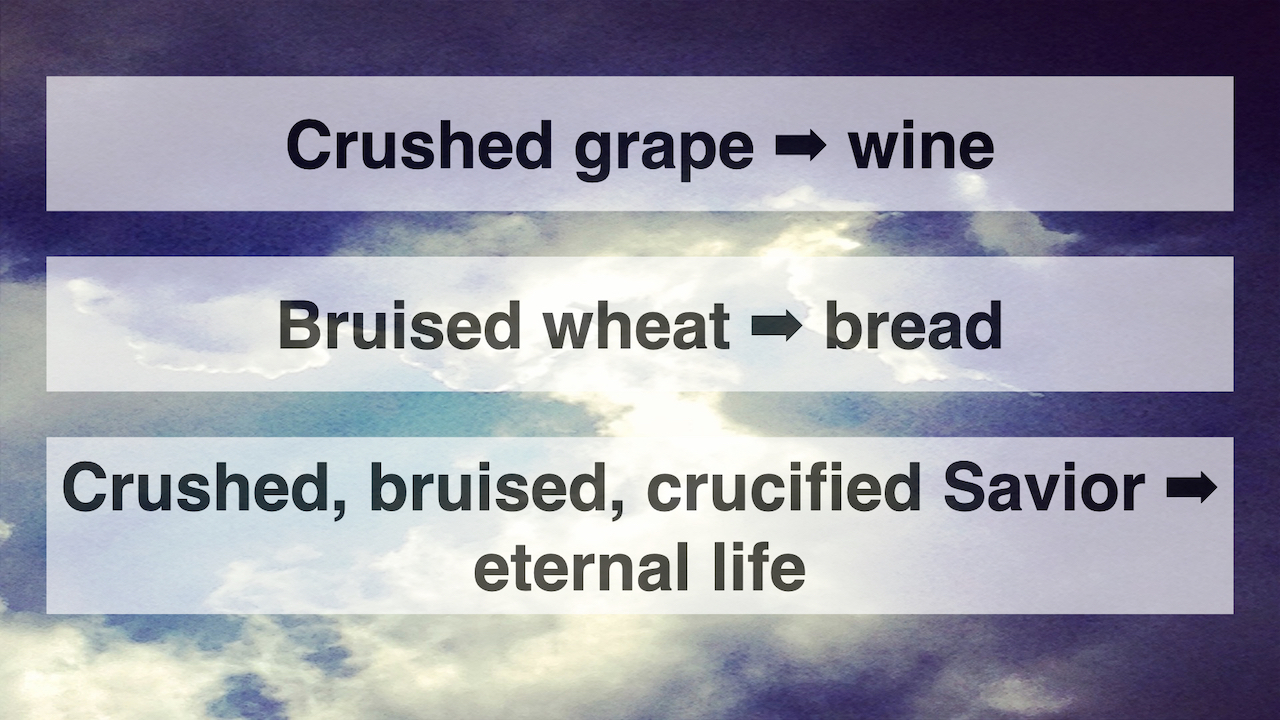
The crushed grape gives us wine
The bruised wheat gives us bread
The crushed, bruised, crucified Savior gives us eternal life
“Very truly I tell you, unless a kernel of wheat falls to the ground and dies, it remains only a single seed. But if it dies, it produces many seeds” (John 12:24).
Remember the devil’s strategy: get us so focused on the pain of now that we forget about the far greater joy that lasts forever.
Jesus wants us to “do this in remembrance of Me”—to see the crushed grape and the bruised wheat and the crucified Savior in the light of eternity.
Check out the other messages in this series called Grief Into Joyby clicking here.
Listen to the podcast of this post by clicking on the player below, and you can also subscribe on Apple, Spotify, or Audible.
Last week we saw how the Israelites in exile had their time of grief—being targeted for annihilation—turned to joy when God granted favor to Queen Esther.
The books of 1 and 2 Chronicles, Ezra, and Nehemiah are all written during this time period as the exiles are returning in waves to Israel. This is another grief-into-joy moment! More than likely, all four of these books were written by Ezra. Notice the note of joyful celebration that is repeated in the last words of 2 Chronicles and the opening words in the Book of Ezra (2 Chronicles 36:22-23; Ezra 1:1-4). We don’t know which psalmist wrote Psalm 126, but it sounds the same joyful note.
Not all the exiles returned at once. In fact, the Book of Daniel shows us that Daniel likely stayed in his position of leadership to these governments until his death.
The exiles were returning in waves. As the worship practices at the temple were reestablished and as people returned to lands allotted to each tribe, it was important for the leaders to make sure the right people were in the right places. So 1 Chronicles opens with genealogies.
Beginning with Adam and Noah (1:1-4)
The spiritual fathers (1:34)
The family line of the Messiah (2:1-15; Matthew 1:1-6) through the family tree of David (3:1-24)
Then 1 Chronicles 4 lists more clans in the tribe of Judah. Of special note is the Calebite clan (2:9, 18).
In the Calebite clan we meet Jabez in 1 Chronicles 4:9-10. His name literally translated is sorrow. I wonder: is this a nickname or his birth name? how did he even get this name?
His mother is quoted, “I gave birth to him in pain.” Did that mean it was physically a difficult birth? Did she die after childbirth? Was he born during the painful exile? His father isn’t mentioned, so maybe his birth reminded everyone of the father who was no longer there. The Amplified Bible says his mother named him “sorrow maker.”
Whatever the case, Jabez has become aware that his name or his presence is causing grief to others. There is a bit of a play on words here: “his mother named(Hebrew: qara) … Jabez cried out (Hebrew: qara) to the God of Israel.” In essence, Jabez is saying, “Since my mother cried out in pain—or thinks I am a sorrow maker—I have no where else to go but to cry out to God!”
I believe Jabez was a teenager at this time. One medical journal says, “Adolescents are physically, cognitively, and socioemotionally more advanced than children but prone to behave in ways that are inconsistent with adult values and norms. … Adolescents also frequently report greater self-consciousness, and are more concerned with and interested in others’ perceptions of self.”
This means that as the brain matures during adolescence, teenagers begin to look at themselves through the eyes of others. They are beginning to make decisions that will earn approval from their peers and their family.
This describes Jabez. He doesn’t want to be the sorrow maker any longer.
Grief happens when my reality falls short of my expectations. Jabez has become self-aware that he is a painful reminder to everyone around him. He is living in a place of grief
Jabez is called “more honorable than his brothers” (v. 9) because he turns his pain into his prayer. His brothers may either have not been as self-aware, or maybe they were aware but simply didn’t care. Jabez realized, “People have been calling me sorrow maker my whole life. There’s nothing I can do about it on my own, so the only thing I can do is call on the only One who can turn my grief into joy” (v. 10).
Look at his noble prayer:
bless me—God, You are the only One whose favor I desire
enlarge my territory—even out of this grief, bless me so that I can be a blessing
let Your hand be with me—only Your hand can restore my fortunes, can help me reap a harvest, and can allow me to sing Your songs of joy (see Psalm 126:1-6).
Let us follow this example from Jabez’s life and begin to turn every pain into prayer.
God doesn’t want to give us temporary relief from our pain, but He desires for us to know His never-ending joy (Isaiah 25:7-9; Revelation 21:3-4).
Listen to the podcast of this post by clicking on the player below, and you can also subscribe on Apple, Spotify, or Audible.
None of us are strangers to grief—we’ve all experienced this dark place.
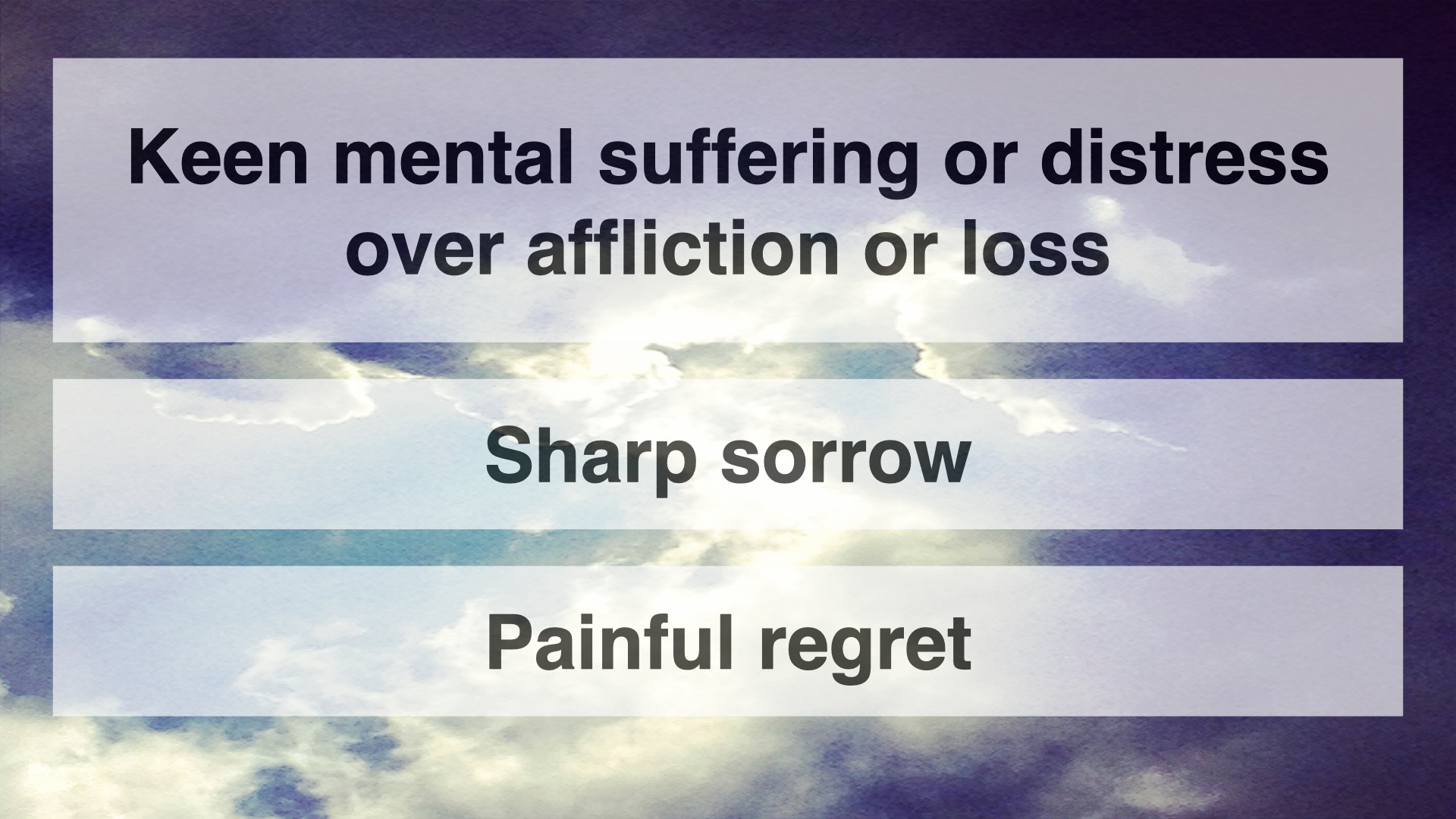
The dictionary defines grief three ways: (1) keen mental suffering or distress over affliction or loss; (2) sharp sorrow; (3) painful regret. We sometimes define it with terms like at the end of my rope, down for the count, nothing but gray skies all around, or unable to see any light at the end of the long tunnel.
One psychologist recently asked, “Can you die of a broken heart?” And she meant it literally. She wondered if a person’s grief—what we sometimes call an emotionally broken heart—could lead to a physically broken heart. The answer was, quite simply, yes. Those who cannot get relief from their grief are more susceptible to heart disease, autoimmune disorders, and breakdowns in their immune system.
We need some good news to pull us out of our grief. The good news is that God specializes not just in removing grief, but in turning grief into joy. In the hymn O Holy Night, one of the lines says, “In all our trials, born to be our Friend. He knows our need, to our weakness is no stranger.” Isaiah calls Jesus, “A Man of sorrows and acquainted with grief” (Isaiah 53:3).
Grief tends to wash over us in waves. When the waves hit, they often cause us to forget what God has done for us in the past. The apostle Paul said we should learn lessons from the history of the Israelites in the Old Testament. Let me zoom in on one particular story. Notice the waves of grief that follow one after another.
Israel was complacent about their sin (Amos 6:1, 4-7) and eventually was taken into captivity in Assyria. Soon after that, the Assyrians then defeated by the Babylonians. Meanwhile, instead of learning the lessons from Israel’s captivity, Judah had more evil kings than God-fearing kings and they were eventually defeated by the Babylonians (Psalm 137:1-4). Babylon was then defeated by the Medes and Persians.
Somewhere in this time of exile, a young Israelite girl named Hadassah becomes orphaned. She is adopted by Mordecai, who changes her name into the Persian name Esther. Queen Vashti is divorced and banished by King Xerxes, and as a result Esther is chosen from all of the eligible bachelorettes in Persia to become queen in Vashti’s place.
Mordecai is an attendant at the gate to the castle, giving him a good vantage point to stay in touch with Esther. It also puts him in a place to overhear an assassination plot against King Xerxes, which Mordecai relayed to Esther to tell the king. Sadly, Mordecai’s good deed, which saved King Xerxes’ life, is overlooked. Instead, Mordecai’s faith is attacked by Haman, the prime minister, and all of the Jews in Persia are targeted by Haman for destruction. Once again, Mordecai gets word to Esther to have her appeal to the king. Esther is put in a no-win situation here: to approach the king without an invitation could be fatal, but to do nothing would mean the death of all of the Jews.
How did all of this come to be?
Let me take you back to Deuteronomy 8:3. God allowed His people to be humbled and hungry so that they would learn that He is their only source. In the following verses we are told twice to “beware”: beware of forgetting that God is our Provider, and beware of thinking we are our own provider. If we do either of these, God will discipline us (Deuteronomy 8:5).
God isn’t mentioned at all in the Book of Esther, but He is so obviously at work. God said, “My purpose will stand, and I will do all that I please” (Isaiah 46:10). Before the Israelites went into captivity, God promised that His people would not be annihilated there but would return to Jerusalem (Jeremiah 31:10-17).
Esther did interceded before King Xerxes. Because of this, Haman was hanged, Mordecai was exalted to Haman’s place, and the Jews were saved (Esther 7:1-6; 8:1-2, 15-17; 9:20-22; 10:3).
God turned overwhelming grief into unspeakable joy!
Dick Brogden wrote, “Are you overwhelmed, out of strength, nowhere to go, out of resources, at a most critical time in your family, ministry, job, or life? Great! God allowed it so that all the earth may know that He is God alone. Don’t waste the crisis. It’s a great opportunity for missions, a great opportunity for God’s glory to be known in all the earth.”
Let your grief be a time you press into God’s presence. Like Esther taking her grief and her petition into the king’s presence, take your grief into the presence of King of kings.
Esther was unsure if Xerxes would extend favor to her, but God is already extending His favor to you even before you approach Him. He wants to turn your grief into joy.
God doesn’t want to simply remove your grief, but He wants you to be testimony for Him because of the way He moves on your behalf.
Follow along with all of the messages in our series Grief Into Joy by clicking here.
At the end of your rope … down for the count … nothing but gray skies all around … unable to see any light at the end of the long, dark tunnel. Ever been there? The reality is, we all have been there.
But the good news is that we don’t have to stay there!
God is always at work to turn our apparent no-win, dark, hopeless situations into something bright and glorious! He is working in ways that no human mind could have dreamed up, and working on our behalf in a way no human power could ever hope to rival.
God specializes in turning grief into joy!
We are approaching the time of year where we remember the death of Jesus. Without a doubt that was the darkest, most grief-stricken day in all of history. Yet that time of mourning was completely forgotten in the overwhelming joy that exploded from an empty tomb on Resurrection Sunday!
Please join me at Calvary Assembly of God for this hope-filled series as we learn how God is at work in all of our grief-darkened circumstances to bring about something gloriously joyful!
Follow along with all the messages in this series:
Listen to the podcast of this post by clicking on the player below, and you can also subscribe on Apple, Spotify, or Audible.
You may have noticed that the intensity of the pain of these sheep bites has been escalating—from flattery, to criticism, to gossip. Now we come to probably the most painful of bites: slander. This is the bite that will have the strongest pull toward the natural response, which will require our greatest reliance on the Holy Spirit to respond supernaturally.
Remember that gossip has a veneer of truth on it; slander has no truth at all. They are outright lies. They are flimsy lies. They are malicious lies. One of the Hebrew words translated slander means scandal-monger: someone who trades in lies (Jeremiah 6:28 NLT; Leviticus 19:16).
The natural response to slander is, “I have to respond to them!” The supernatural response to slander is, “I have to yield to God!”
The natural response, however, is fueled by my wounded pride. On the other hand, the supernatural response is fueled by humility toward God.
Slanderers are arrogant people too (remember Jeremiah said “they are as hard as bronze and iron” [Jeremiah 6:28]). God’s people are learning to humble themselves to wait for God (Psalm 38:12-15). These humble people are the ones who get God’s help, and not His laughter (James 4:6; Proverbs 3:34 NLT).
Look at how Jesus dealt with the very natural urge to respond to those who slandered Him. After Jesus was arrested by the temple guards, He was hauled before one group after another and each time the slanderous lies were spitefully spit at Him. In front of the Sanhedrin, before Roman governor Pontius Pilate, and in the throne room of King Herod Antipas, angry men unleashed their venomous claims—none of which were true.
There are two common themes we can notice in all of these settings.
The lies were seen for what they were: complete fabrications without any truth behind them—Mark 14:55. Governor Pilate said “I find no basis for a charge against Him” (Luke 23:4), and he added, “Herod came to the same conclusion and sent Him back to us” (v. 15).
The silence of Jesus: “Jesus remained silent and gave no answer” (Matthew 27:13-14; Mark 14:61, 15:5). The only red letters in this interaction with both the Sanhedrin and Pilate are when Jesus is asked a direct question. Jesus quickly answers the questions, “Are You the Messiah,” “Are You a King,” and “Don’t You know the power I have?” (Mark 14:61, 15:2; John 19:10), but He never responds to the slander.
Let me repeat: Our supernatural response can only come from yielding to the Holy Spirit’s influence.
We cannot treat slanderers as anything less than people created in the image of God (Genesis 1:27; Psalm 15:1, 3).
We must take our pain into God’s presence. This is what Jesus did (1 Peter 2:21-23). We can help ourselves by praying imprecatory prayers. These are words for God’s ears only (Jude 1:9; Psalm 58:6-8).
We have to learn to pray for our slanderers. We have to mature from praying against them to praying for them. Look at how Jesus interceded for His slanderers (Luke 23:34), which He calls us to as well (Luke 6:28).
We have to live as overcomers. We overcome by NOT responding to slander in the natural way (Romans 12:21). But we allow our supernatural response to be used as a powerful testimony (2 Corinthians 6:3-10; Colossians 3:1-2, 8, 12-14).
We can do this—the Holy Spirit is empowering us to do this. Let’s not get down in the mud with those who slander us, but let’s yield to God and allow Him to handle this painful situation far better than we ever could.
If you’ve missed any of the messages in this series, you can find them all here. And if you are a pastor, please check out my book When Sheep Bite, which will help you both respond to sheep bites and teach others how to respond as well.
Listen to the podcast of this post by clicking on the player below, and you can also subscribe on Apple, Spotify, or Audible.
A bite we have all experienced is gossip. We called flattery the sneaky bite, but I think gossips believe they are actually being sneaky—that somehow they are getting away with their gossip.I think gossip is also sneaky because we can be pulled into a gossipy conversation almost without realizing what is happening.
That’s because gossip usually has a veneer of truth on it. That thin coating of truth may be sugary sweet, but the words hide a bitter poison that is intended to undermine the one that is being talked about. Twice Solomon says, “The words of a gossip are like choice morsels” (Proverbs 18:8, 26:22). The Contemporary English Version translates this verse even more graphically: “There’s nothing so delicious as the taste of gossip! It melts in your mouth.” But Solomon also warns, “A perverse person stirs up conflict, and a gossip separates close friends” (Proverbs 16:28).
Moses had married a Cushite woman, a marriage that was neither morally nor legally wrong. If someone simply said, “Moses married a woman from Cush” they would have been speaking the truth. The gossips (Miriam and Aaron) want to use a truthful statement for the purpose of making a case to prove their point. These siblings crossed the line when they stopped talking about the idea and start talking about Moses. This is especially true when their conversation about Moses was to make him look inferior or to make themselves look superior.
I think a label that is very apropos for this is “character assassination.” An assassin gets close enough to strike, but also has an alibi to cover themselves. So, too, the gossip can inject their poison to denigrate someone’s character, but then use the alibi of saying, “What? Did I say something untruthful?”
There is truth in their questions that God has used all three of them to delver messages and to sing worship songs, but in light of their statement in verse 1 they are clearly asking these questions with poisonous intent. You can especially spot gossip by this characteristic sign: They talk about a person, but they won’t talk to that person. We are not told to whom Miriam and Aaron may have been speaking to in verse 2, but it certainly wasn’t Moses. That means they were trying to get other people to rally to their side.
When we have been the target of a gossip’s words, we should follow the example that Moses gave us.
Remember that God has heard the gossip (Numbers 12:2b, 4-8).
Check your pride (v. 3). If you feel you must address the gossip, you must address the topic without attacking the gossiper (see Romans 12:17-18).
Be careful of who you are correcting. It’s best to let God do the correcting (Numbers 12:8-9), but if do need to speak to the person, be cautious of adding fuel to the fire (Proverbs 9:7-9).
Desire restoration. Moses interceded for Miriam’s healing (Numbers 12:13), and Jesus has the idea of restoration and unity in the Church in mind in Matthew 18:15-16.
Stay away from the unrepentant gossiper. If the gossiper doesn’t acknowledge their sin, we have to limit our interaction with that sheep (Matthew 18:17) . After Miriam was healed of her leprosy, there is no other mention of her until she died which is probably an indication that Moses didn’t have any additional conversations with her. Paul gave Timothy similar counsel about Alexander (1 Timothy 1:19-20; 2 Timothy 4:14-15).
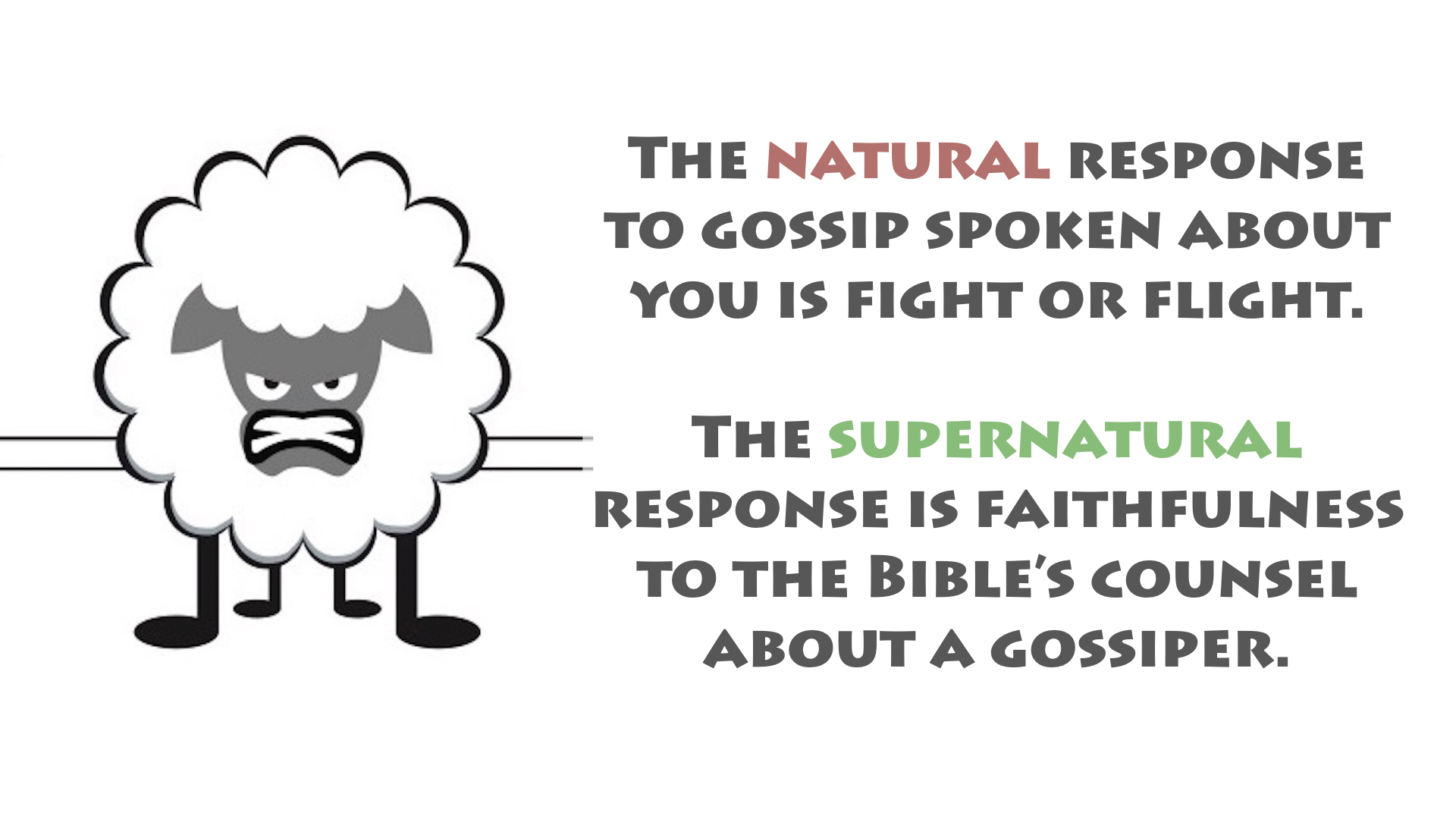
The natural response to gossip spoken about you is fight or flight. The supernatural response is faithfulness to the Bible’s counsel about a gossiper.
And one final word to all of us: Don’t become a gossip yourself!
Just as God hears those gossiping about you, He hears you gossiping about others!
Don’t…
…talk about people who aren’t in the room. Remember the Golden Rule of treating others the way you want to be treated (Luke 6:31).
…share information that isn’t yours to share (Proverbs 25:9).
…listen to a gossip. If they gossip to you about others, they will gossip about you to others!
Gossip, as Solomon warned us, separates even the closest of friends. We must identify it and deal with both the gossip and the gossiper in a God-honoring, biblically-sound way. And we must avoid becoming a gossip ourselves.
If you’ve missed any of the other sheep bites we’ve talked about in this series, you can find them all by clicking here. And if you are a pastor, check out my book When Sheep Bite, where I address the bites of sheep from a leadership paradigm.
Listen to the podcast of this post by clicking on the player below, and you can also subscribe on Apple, Spotify, or Audible.
Do you know this pair of cantankerous men from the Muppets? Statler and Waldorf sit in the balcony of the theatre and criticize everything that is happening on the stage. I mean everything! They have a good laugh at their barbs, but no one on the stage seems to find it humorous.
Have you ever met people like this? How do you typically respond to their criticism?
Unfortunately, those who are trying to do the right thing are often the targets of almost constant criticism. Abraham Lincoln said, “If I were to attempt to answer all the criticisms and complaints I receive, I would have no time for any other business.”
President Lincoln was a great leader but he wasn’t without fault, so to certain extent we could expect a little bit of criticism from people who didn’t like his policies. But what about Jesus? It was prophesied about Him that He would be the target of criticism (Isaiah 53:3).
Those out to get Jesus even criticized those who attended to Him. In Mark 14:1-5, they are criticizing a woman who poured perfume on Jesus out of her sincere desire to honor Him. Yet they spoke about her and her actions “indignantly” (v. 4), and they rebuked and criticized her (v. 5). The Greek word in this verse literally means he snorting of horses!
Jesus stepped in to protect this God-fearing woman, “Why are you bothering her? Why are you criticizing this beautiful thing she had done for Me?”
Notice that Jesus responded to the critics, but the woman did not respond. Does that mean that we never answer critics? Are we supposed to ignore them?
First, let’s go back in time to the origin of the words critic and criticism. These words originally meant someone capable of giving a meaningful—perhaps even constructive or helpful—judgment. Think of a trained and skilled chef critiquing your recipe, as opposed to someone who cannot tell the difference between nutmeg and ginger.
The natural response is to ignore all criticism. The supernatural response is prayerfully evaluate criticism. Solomon says there is such a thing as valid criticism (Proverbs 25:12).
So who is a valid critic?
(1) Someone who loves me (Proverbs 27:17; Ephesians 4:15). Paul loved Peter and respected his leadership role in the church, but he still criticized Peter when he messed up (Galatians 2:9, 11).
(2) Someone who has experience or godly wisdom that we don’t yet have (Ecclesiastes 7:5). Micaiah had a word from God, even though King Ahab thought Micaiah simply didn’t like him (1 Kings 22:1-18).
(3) Someone who wants to hurt me. Really!? Dick Brogden wrote, “The Lord uses critics to show us our own hearts, even if what they say is not fully true, informed, or even fair. There is almost always a germ of truth in what our critics (in their own pain and disappointment) shout at us. The wise [person] will humble himself and look for the truth embedded in every oppositional interaction.” As we saw previously from Psalm 26:2, when we hear words of criticism, we need to make it a matter of prayer.
Jesus told the woman’s critics to “leave her alone” but He never defended Himself against the childish barbs (Isaiah 53:7; Matthew 27:13-14). I think we would do well to follow His example. So when criticized, take a deep breath, smile, hear them out, ask clarifying questions, and then say, “Thank you for sharing that with me. I’ll make this a matter of prayer.”
They might accuse you, but you should turn it over to God (Psalm 109:4).
The natural response is to respond all critics. The supernatural response is to respond like Jesus (see 1 Peter 2:21-23).
Remember that quote from Abraham Lincoln we saw earlier? Here’s the rest of his quote—
“From day to day I do the best I can and will continue to do so till the end. If in the end I come out all right, then the complaints and criticisms and what is said against me will make no difference. But, if the end brings me out wrong, then ten angels coming down from heaven to swear I was right would still make no difference.”
Ultimately, we are longing to hear Jesus say, “Well done.” If He cannot say that to us, does it really matter if everyone else praised us? But if Jesus says, “Well cone,” does it really matter the criticism others said about us?
Let’s ask the Holy Spirit to help us respond supernaturally to our critics—listen prayerfully to ever critic, but only respond to them as Jesus did.
If you have missed any of the other messages in this series When Sheep Bite Sheep, you can find them all here. And if you’re a pastor, be sure to check out my book When Sheep Bite.
Listen to the podcast of this post by clicking on the player below, and you can also subscribe on Apple, Spotify, or Audible.
Have you ever heard this little saying: “To live above with saints we love, oh, that will be glory. But to live below with saints we know, well, that’s a different story”? I’ve found that it’s sometimes true!
We love Psalm 133:1-3 when the saints are all together. What a great “selling point” to invite someone to be a part of the Christian community! But Psalm 41:7-9 is kind of embarrassing as David talks about former friends who have hurt him deeply.
But being bitten by a fellow sheep is a reality we all have experienced, and, sadly, we will probably have to deal with again in the future. There is a natural way we tend to react when we’ve been bitten, but there is also a supernatural response that the Bible consistently calls us to. This is the God-glorifying way we all need to strive for.
In Acts 23, Paul is standing before the Sanhedrin. He opens his remarks by simply saying he has a clear conscience before God, and the high priest immediately orders that Paul be smacked on the mouth! That seems like a bit of an over-reaction on the part of the high priest, but maybe it was a bit of show of force to let Paul know who was really in charge. Paul responded with an immediate—and natural—reaction when he says, “God will slap you!”
Paul is an old man by this time. He’s been through shipwrecks, beatings, imprisonments, gone without food, traveled more miles than he can count, and preached more sermons than he can remember. His body was giving out on him, and his eyesight was especially weak. Clearly, Paul didn’t realize to whom we was addressing his remarks. But when he became aware, he immediately owned up to his mistake. Paul offered no excuses or justifications, just a quick, simple, sincere apology.
When you have been bitten (slapped) by another sheep, you should ask:
Could I have provoked them by something I said or did?
Could I have hurt them by something I didn’t say or do?
David prayed a great prayer in Psalm 139:23. But this prayer is only effective if we are willing to accept that we may have been the agitator that led to the bite. In the last words that Job speaks in the Book of Job, he is very introspective. Check out all of the “If I have” statements throughout Job 31.
In Psalm 26:2, David invites the Holy Spirit to check him three times!
test me = scrutinize me
try me = assay me
examine me = refine me in the fire
When we are bitten, we should be open to the possiblity that God is using this bite to get my attention—to make me aware of a fault in my life or something that’s been in a blind spot.
So we should consider the following:
Has this kind of bite happened more than once? From different sheep?
Has a spiritually wise person attempted to address this with me before?
Do I ever admit that I’m at fault, or is it always the other person’s fault?
Do I find myself making a list of why they should apologize to me?
When was the last time I apologized to someone else?
If the Holy Spirit reveals something in us, He will also empower us to make the change and make amends. The natural response is to place all the blame on others. The supernatural response to pray Psalm 26:2 before responding.
If we react only the natural way, it is a lose-lose for us and for the whole pasture. But if we learn to respond in a supernatural way, it becomes a win-win for everyone. Listen to the wise words of King Solomon—
He who heeds instruction and correction is not only himself in the way of life but also is a way of life for others. And he who neglects or refuses reproof not only himself goes astray but also causes to err and is a path toward ruin for others. (Proverbs 10:17 AMPC)
Let’s all strive for the supernatural response that is a win-win for the whole Kingdom of God!
Please follow along with all of the messages in this series by clicking here.
P.S. If you are a pastor, you may want to check out my book When Sheep Bite.
You and I will learn lessons in the hard times that we could learn no other way. Then God will use those lessons so we can help minister to others in their hard times. Check out my sermon about interceding for other saints.
ICR’s Dr. Randy Guliuzza says, “Convergent evolution is the fabricated conjecture evolutionists invoke to explain very similar characteristics between creatures that could not have been inherited from a common ancestor and that evolutionists will never accept as having been produced by an intelligently designed internal programming that is specified for common purposes.” This particular article is about bats which have always had the ability to fly. Not one fossil record shows any flightless bats because God created them as flying mammals.
In the early 1900s, Albert Norris was a missionary in India, observing firsthand the spiritual and physical hardships the people faced there. In an article in the Pentecostal Evangel, Norris wrote, “A Christianity that coldly sits down, and goes on its routine of formal work, and allows its fellowmen to starve, or to be obliged to go through all the hard sufferings and exposure connected with famine, without effort to help them, might as well quit its preaching.”
In answering a question about using AI to write a sermon, John Piper answers with an emphatic “no.” I agree! One of the reasons Piper shares: “One of the qualifications for being an elder-pastor-preacher in the Bible is the gift or the ability to teach, didaktikos (1 Timothy 3:2). That means you must have the ability, the gift, to read a passage of Scripture, understand the reality it deals with, feel the emotions it is meant to elicit, be able to explain it to others clearly, illustrate and apply it for their edification. That’s a gift you must have. It’s your number-one job. If you don’t have it, you should not be a pastor.”
“You don’t try to forget the mistake, but you don’t dwell on it. Don’t let it have any of your energy, or any of your time, or any of your space.” —Johnny Cash
No one likes to be mistreated—especially when the one that hurts us is one we would have thought of as an ally or even a friend.
These slights become even more painful when they take place inside the Christian community. When sheep bite sheep, our natural response is to lash out to try to even the scales of justice. But the Bible consistently and clearly calls Christians to pursue a supernatural response.
Join me for a highly practical series of messages on how you can respond in a Christ-honoring way when you are bitten by another sheep in God’s pasture.
(By the way, if you are a church leader dealing with biting sheep, my book When Sheep Bite is a great resource for you.)



 On Sunday we looked at the thought that our grief often comes because our current situation isn’t what we expected it to be. Notice that we say, “what we expected,” as though we can control anything!
  But look at the eternal focus in vv. 17-19:














 Craig T. Owens