The Story Isn’t Over Yet

Listen to the podcast of this post by clicking on the player below, and you can also subscribe on AppleSpotify, or Audible. 

One of the things I enjoy about my Apple Watch is the connection I have with others who also use an Apple Watch. For instance, I get notified when my wife has finished a workout, and one of the pre-set replies I could choose is, “I’ve got questions!” That’s a funny way of me saying, “How did you complete that workout?!” 

In Psalm 75 and Psalm 76, Asaph tells us how God will deal with the wicked. But then Psalm 77 begins with Asaph using words like, “My soul refused to be comforted, my spirit is overwhelmed,” and then he launches into the tough questions like: “How long is this going to last? Has God forgotten me? Have I fallen out of favor with God? Has His mercy dried up? Can God keep what He has promised? Is God angry with me?” When I read all this, I feel like saying, “Asaph, I’ve got questions!” 

Yet, these complaints of Asaph ring true to real life. Like when a friend called me last week and started our conversation by asking, “Why can’t things just go easy for me?”

Here’s the simple answer: The Story isn’t over yet. We are in a battle, and the enemy of our soul is still trying to take us out, or at least shut us up. 

In Psalm 77, Asaph tells his story to Jeduthun (a Levite worship leader whose name means praising) in four chapters, with a Selah for each of the breaks between the chapters. 

Chapter 1—Distress (vv. 1-3)

The word distress means confronted by an adversary. Ever been there? Every follower of God has been, so Asaph invites us to Selah: pause to contemplate things like (a) Is this distress causing me to reevaluate the foundation on which I stand? (b) What is it God is shaking in my life? When God shakes things up, it is to cause us to remember and muse about the ONLY sure foundation that can withstand any storm (see Matthew 7:24-27). 

Chapter 2—Questioning (vv. 4-9) 

Notice the words Asaph uses: thought, remembered, mused, inquired. He is asking those tough questions, but he is asking them in a way that he can carefully consider the answers. That means he is really taking a Selah pause with each question. I think he has come to this conclusion: “Aren’t all these really just rhetorical questions? And isn’t the answer to all of them a resounding ‘NO!’?” If you aren’t sure the answer to all of these questions is no, please read Romans 8:31-39.

Chapter 3—Recalling (vv. 10-15) 

Notice the continuation of the words: thought, remember, meditate, consider. He also asks another question in v. 13 which he then answers in the next two verses. His call to Selah here is another pause to reflect: “Has God lost His power? Has He changed His mind?” And once again the answer is a loud and clear, “NO!” (see Isaiah 59:1; Hebrews 13:8) 

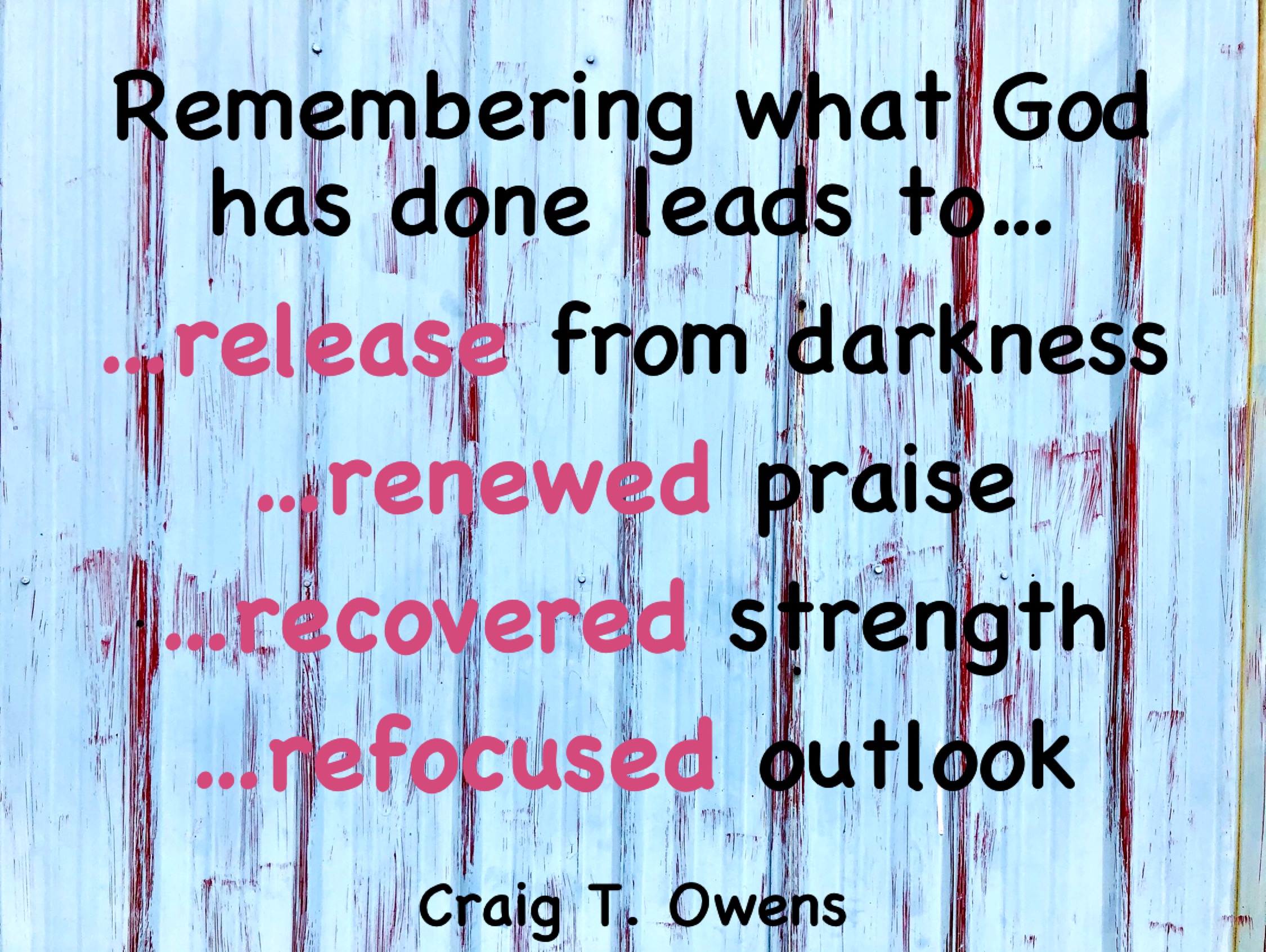
One of the important takeaways from this stanza of Psalm 77 is this: Looking back in gratitude at what God has done allows me to look forward in hope to what He is still going to do. My remembering what God has done in the past leads to: 

  1. Release from the darkness 
  2. Renewed praise 
  3. Recovered strength 
  4. Refocused outlook 

Chapter 4—Hope (vv. 16-20) 

Asaph says, “Look what God did! And since He is the same today as He was yesterday, guess what He’s still able to do!” We know this because the Bible says, “For no matter how many promises God has made, they are ‘Yes’ in Christ. And so through Him the ‘Amen’ is spoken by us to the glory of God” (2 Corinthians 1:20). 

Remember I said earlier that God isn’t done telling His story yet? God isn’t done yet, He knows His Story, and His Story is still being told. But He’s also already told us how His story will end (see Revelation 21:4-6). And the end of His story is really just the beginning of the Real Story! 

C.S. Lewis said it this way in the closing words of The Last Battle:

“And for us this is the end of all the stories, and we can most truly say that they all lived happily ever after. But for them it was only the beginning of the real story. All their life in this world and all their adventures in Narnia had only been the cover and the title page; now at last they were beginning Chapter 1 of the Great Story, which no one on earth has read; which goes on forever; in which every chapter is better than the one before.” 

When you find yourself saying, “I’ve got questions: How long is this going to last,” Selah to remember that the Story isn’t over yet. The Storyteller knows how it ends, and He promises us: But what of that? For I consider that the sufferings of this present time—this present life—are not worth being compared with the glory that is about to be revealed to us and in us and for us and conferred on us! (Romans 8:18 AMP)

If you have missed any of the messages in our Selah series, you can find the complete list by clicking here.

►► Would you please prayerfully consider supporting this ministry? ◀︎◀︎
Watch Your Horn

Listen to the podcast of this post by clicking on the player below, and you can also subscribe on AppleSpotify, or Audible. 

During my freshman year of college, I was once the butt of a good-natured joke. I didn’t mind it so much except for the fact that there were several people in the room that didn’t know me, so they would have walked away thinking I was a jerk. As I vented to my roommate about this, his counsel was simply, “Just forgive ‘em, man!” 

Yeah, right … easier said than done! I didn’t want forgiveness—I wanted payback! Ever been there? 

The Hebrew word Selah is a call for us to pause and calmly think about what’s going on in our heart and mind. For instance, in those moments where we may want someone to get justice for the way they hurt us. 

In Psalm 75, God is literally the One who speaks the Selah. In fact, God speaks twice in this short psalm: once in verses 2-5 and again in verse 10 to close this psalm. Putting together His two speeches, God says, “I choose the right time, I judge perfectly, I hold everything firm. Selah. I will cut off the horns of all the wicked, but the horns of the righteous will be lifted up.” 

What is meant by “the horn of the wicked” or “the horn of the righteous”? Literally, it means a show of strength, but it can be used in both a negative or a positive sense. 

In the negative sense it means:

  • boasting of your own power 
  • standing in defiant opposition to all other powers 
  • proudly trumpeting your own strength
  • the English words “arrogant” and “boast” in verse 5 are both the same word Hebrew word halal. This means to shine a light on yourself, literally to say “Hallelujah!” to or about yourself! 

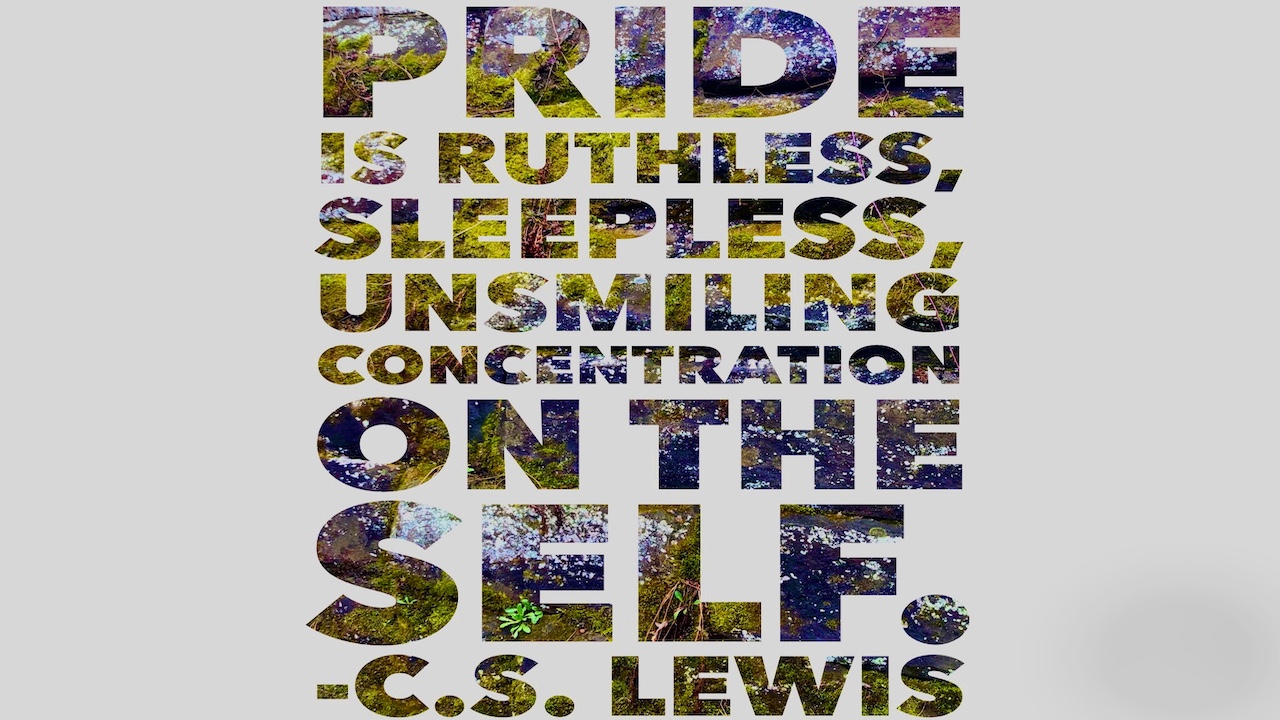
This pride is so dangerous! As C.S. Lewis said, “Pride is ruthless, sleepless, unsmiling concentration on the self.”

In the positive sense, a horn means the righteous person who shines a light on God, who concentrates on Him, who knows that anything good they have comes from Him. 

The wicked lift up their own horn (literally lift up themselves), while the righteous bow their horn (literally lift up God). What does God do? God opposes the proud but shows favor to the humble (1 Peter 5:5). 

This psalm essentially has God giving two warnings:

  1. To the wicked He says, “Do not lift up your horn against Me.” 
  2. To the righteous He says, “Submit to Me and do not try to rush My timing.” 

Notice that Asaph says “a cup of foaming wine” is coming to the wicked (v. 8). This symbolizes God’s judgment (Revelation 19:11-16). This was to be our just punishment too, but Jesus took the cup of God’s wrath Himself, and in its place gave us the cup of God’s blessing (Isaiah 51:22; Matthew 26:39-42; 1 Corinthians 10:16). This switching of the cups is what we celebrate every time we drink the cup of Communion. 

God was patient with us and He is still being patient with the boastful wicked, which is why He warns them—and us—to Selah. We were rescued from judgment and now God calls upon us to tell others about Him, so that they may also be reconciled to Him through Jesus Christ (Proverbs 24:11-12; 2 Peter 3:9). 

Here’s the call to Christians: Watch your horn! Don’t shine a light on yourself, but shine a light on Jesus Christ and remain on-mission to rescue those who persist in blowing their own horn. 

If you’ve missed any of the other messages in our Selah series, you can find the full list by clicking here. 

►► Would you please prayerfully consider supporting this ministry? ◀︎◀︎
Heart Rate Recovery

Listen to the podcast of this post by clicking on the player below, and you can also subscribe on AppleSpotify, or Audible. 

A few years ago Mark Schultz wrote a song about someone living a go-go-go, overly-busy life and he entitled the song “Running just to catch myself.” Ever been there? 

There’s a Hebrew word that shows up 70 times in the Bible (mostly in the Psalms) that, sadly, many English translations of the Bible have relegated to a footnote. That’s too bad because Selah is such a powerful word. Unless we want to live our lives “running just to catch myself,” we all need a take time to Selah. Look how some have translated this word:

  • “Stop there and consider a little” (Matthew Henry) 
  • “the sacred pause” (Charles Spurgeon) 
  • “pause and calmly think of that” (AMP) 

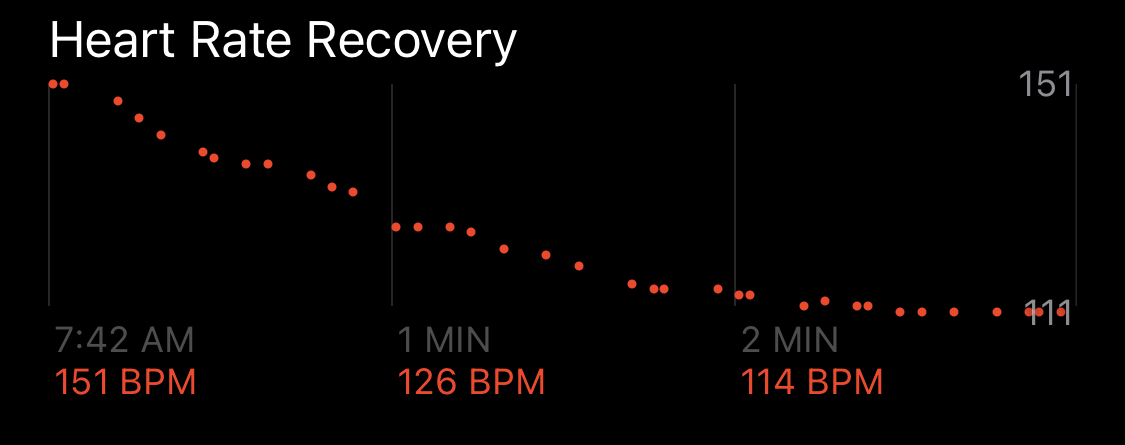
Whether it’s a planned exercise time or just something that frightens or excites us, our heart rate is designed by God to increase—this is how we prepare for fight-or-flight. Doctors say that one of the most vital statistics they now look at to gauge overall cardio health is heart rate recovery (HRR). Doctors want to see a significant increase in HRR after exercise, fright, or excitement. 

A few of the factors that boost HRR:

  • Regular, planned exercise 
  • Getting the proper amount of quality sleep 
  • Reducing stress 

Respond-and-recover is part of a health-building cycle. But if we’re “running just to catch myself” all the time, this time of recovery isn’t happening. Not only are we not recovering well, but we are not properly prepared for the next time our heart needs to start beating faster.   

This HRR is just as vital for us emotionally and spiritually as it is physically: We cannot always be stressed or always be “on.” We need a Selah—a time to stop and consider, a time to take a sacred pause to calmly think. 

This is what David teaches us in Psalm 68. Check out the “bookend verses” where he reminds us that when God arises His enemies are scattered, and that God is awesome and He gives power and strength to His people (vv. 1, 35). And look a the middle verse where David says that when God ascends in victory He gives gifts (v. 18). 

This tells me two things: (1) God is sovereignly in charge (not me or anyone else), and (2) In His love, God delights to use His sovereign power to bless His children. 

The question is not IF I’m going to be confronted by difficult things or difficult people, but HOW will I recover from these confrontations? 

May I suggest a 3-step process to increase your spiritual HRR? 

  1. Acknowledge your situation—don’t try to cover it up or justify it 
  2. Selah—pause to take a deep breath  
  3. During that breath, redirect your thoughts from the difficulty to your awesome God (see 2 Corinthians 10:5; Philippians 4:4-8)

Look at David’s example in this psalm:

Reflect Worship
God defeats enemies (vv. 1-2) Be glad, rejoice, sing (vv. 3-4)
God is a Father and Deliverer (vv. 5-7) Selah (v. 7)
God is sovereignly in control (vv. 8-18) Praise and Selah (v. 19)
God defeated Death (vv. 20-23) Join the procession of worshippers (vv. 24-27) 
God uses His strength to care for His people (vv. 28-31) Sing praises and Selah (vv. 32-35)

As you breathe deeply in this worship of recovery, think on this: “Your sigh can move the heart of Jehovah; your whisper can incline His ear to you; your prayer can stay His hand; your faith can move His arm.” —Charles Spurgeon 

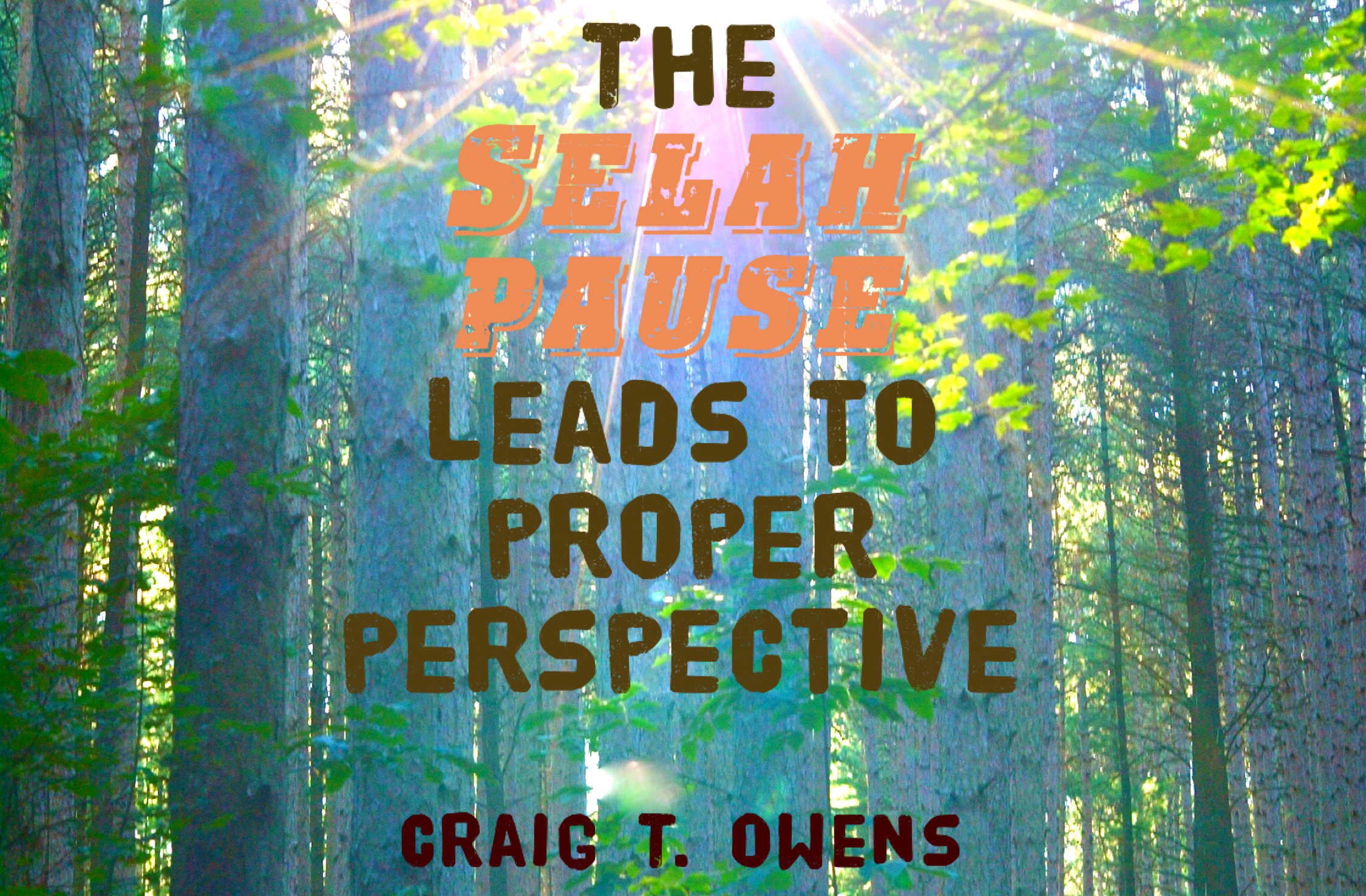
Our Selah pause leads to proper perspective, which allows us to recover more quickly. That, in turn, helps us to be better prepared for the next time we’re confronted by difficulties. 

To check out the other lessons we’ve learned in our ongoing series called Selah, please check out the list I’ve compiled here.

►► Would you please prayerfully consider supporting this ministry? ◀︎◀︎
Selah

The word Selah appears nearly 70 times in the Bible, almost exclusively in the Psalms. Although it is primarily a musical term, it applies beautifully to our summer series. 

Selah can mean…

  • a pause from the noise to reflect;
  • a preparation for an exciting accent; or 
  • a reflective time of consideration

Throughout the Psalms, Selah appears at the end of a verse, at the end of the psalm, or sometimes even mid-sentence. But each one of them is perfectly placed by the Spirit-inspired authors to get us to take a breath and deeply contemplate what we just read or sang. 

Summertime is typically a time for us to pause from our regular routine. Perhaps it’s a vacation, time with friends and family, driving around with the windows down and the music blasting, or just a quiet walk through woods or along a beach. In any case, whether we realize it or not, we’re actually doing Selah in these break-from-the-routine activities. 

Join me this Sunday as we continue our summertime look at each of the Psalms that ask us to Selah. I think you will find that this Sunday summertime pause will be both refreshing and encouraging. You can join me either in person or on Facebook Live. 

Since this is a continuation of our summer series, you can check out the Selahs we discussed by clicking here for the 2018 messages, here for the 2019 messages, and here for the 2020 messages.

The messages this summer include:

Blessing Over Judgment

Listen to the podcast of this post by clicking on the player below, and you can also subscribe on Apple or Spotify.

My heart is steadfast, O God, my heart is steadfast; I will sing and make music. (Psalm 57:7) 

David is on the run, hiding in a cave. The bad guys are described as lions, ravenous beasts with teeth like spears and arrows, and tongues like swords. They hotly pursue David, setting traps for him everywhere he would go. So it’s no wonder that David begins this prayer crying out to God, 

Have mercy on me, O God have mercy on me, for in You my soul takes refuge. I will take refuge in the shadow of Your wings until the disaster has passed (v. 1). 

As David is prone to do in many of his psalms, he inserts the word Selah, reminding both himself and his readers to pause for a moment. He records how God answers his prayer: “God sends from heaven and saves me, rebuking those who hotly pursue me” (v. 3). 

But the Selah comes in the middle of the verse, almost as if David is pausing to ask, “How exactly does God save me?” In this instance, it’s not so much God rebuking the wicked as it is God blessing David. After the Selah pause he says, “God sends forth His love and His faithfulness. 

By blessing His righteous servant David, God rebukes the wicked and vindicates David by creating a longing in those wicked men to also be blessed by God. 

In the New Testament we see that the arrival of Jesus was an act of God’s kindness: “Because of and through the heart of tender mercy and loving-kindness of our God, a Light from on high will dawn upon us and visit us” (Luke 1:78). And it is God’s kindness that continues to draw us to Himself: “…Are you unmindful or actually ignorant of the fact that God’s kindness is intended to lead you to repent—to change your mind and inner man to accept God’s will?” (Romans 2:4). 

David foresees his enemies falling into the very traps they have set for him (v. 6). And then once again he calls for a Selah pause to consider how God has and is blessing him. 

From this point on, David expresses no more thoughts about the wicked people pursuing him, but all of his words through the remainder of this psalm are worship, praise, and exaltation (vv. 7-11). 

When evil people are assailing you perhaps you could pray this prayer: 

O God, that my heart could be so transformed that I desire Your blessing on my life more than I look for Your judgment or retribution on the wicked! I pray that my heart would be a place of continual praise to You, and not a hotbed of anxious thoughts about wicked people. Father, may Your kindness to me be such a powerful testimony to even evildoers, that they will repent—change their mind to accept You as their God too. In Jesus’ name, I pray. Amen. 

►► Would you please prayerfully consider supporting this ministry? ◀︎◀︎
5 Truisms From Psalm 62

Listen to the podcast of this post by clicking on the player below, and you can also subscribe on Apple or Spotify.

When I see words like truly (3 times), surely (2 times), and yes (1 time) occurring so frequently in a rather short psalm, it catches my attention. Combined with the call for a Selah pause another two times in this twelve-verse psalm, and this is clearly a chapter that we should read slowly and deliberately. 

Because of these words truly and surely, I find five truisms that David makes clear to us, and I also find that they are linked together in a beautiful circular chain. 

Truism #1—God keeps me secure. He alone is my source of security (vv. 1-2). 

Truism #2—Evil people are envious of a righteous person’s secure position and will try to pull them down (vv. 3-4). When this happens I need to take a Selah pause to remember Who holds me secure. 

Truism #3—These attacks by evil people do not put my security in jeopardy, but instead it gives me a been-there-done-that testimony to share with others (vv. 5-8). Again, I need to Selah to remember that my challenges are often for the benefit of others as much as they are for my strengthening. 

Truism #4—Poor people are not excluded from God’s help, and rich people are not above God’s help (vv. 9-10). God sees every human being as infinitely valuable. 

Truism #5—God is both All-Loving and All-Powerful. He gets the final word on both judgment and reward (vv. 11-12). This fifth truism should refuel my understanding of the first truism—that God holds me securely—which continues my confident journey through this chain of beautiful truisms all over again. 

Friends, I urge you to go slowly through your personal Bible reading time. Pray for the Holy Spirit’s illumination before you begin reading, and then watch to see how He will point out to you patterns, repeated words, and other insights that will allow you to apply God’s Word to your daily life.

►► Would you please prayerfully consider supporting this ministry? ◀︎◀︎
Year-End Review (2020 Edition)

I have the privilege of pastoring Calvary Assembly of God. One of the things I am honored to do is share a message from God’s Word with our church each week. Sharing the messages is one thing, but reminding folks of what has been shared is another. This is something that resonated with both the apostle Peter and the apostle Paul. 

Peter wrote, “Dear friends, this is now my second letter to you. I have written both of them as reminders to stimulate you to wholesome thinking” (2 Peter 3:1). And Paul not only told the Romans that “I have written you quite boldly on some points to remind you of them again” (Romans 15:15), but he also taught his protege Timothy to “keep reminding God’s people of these things” (2 Timothy 2:14). 

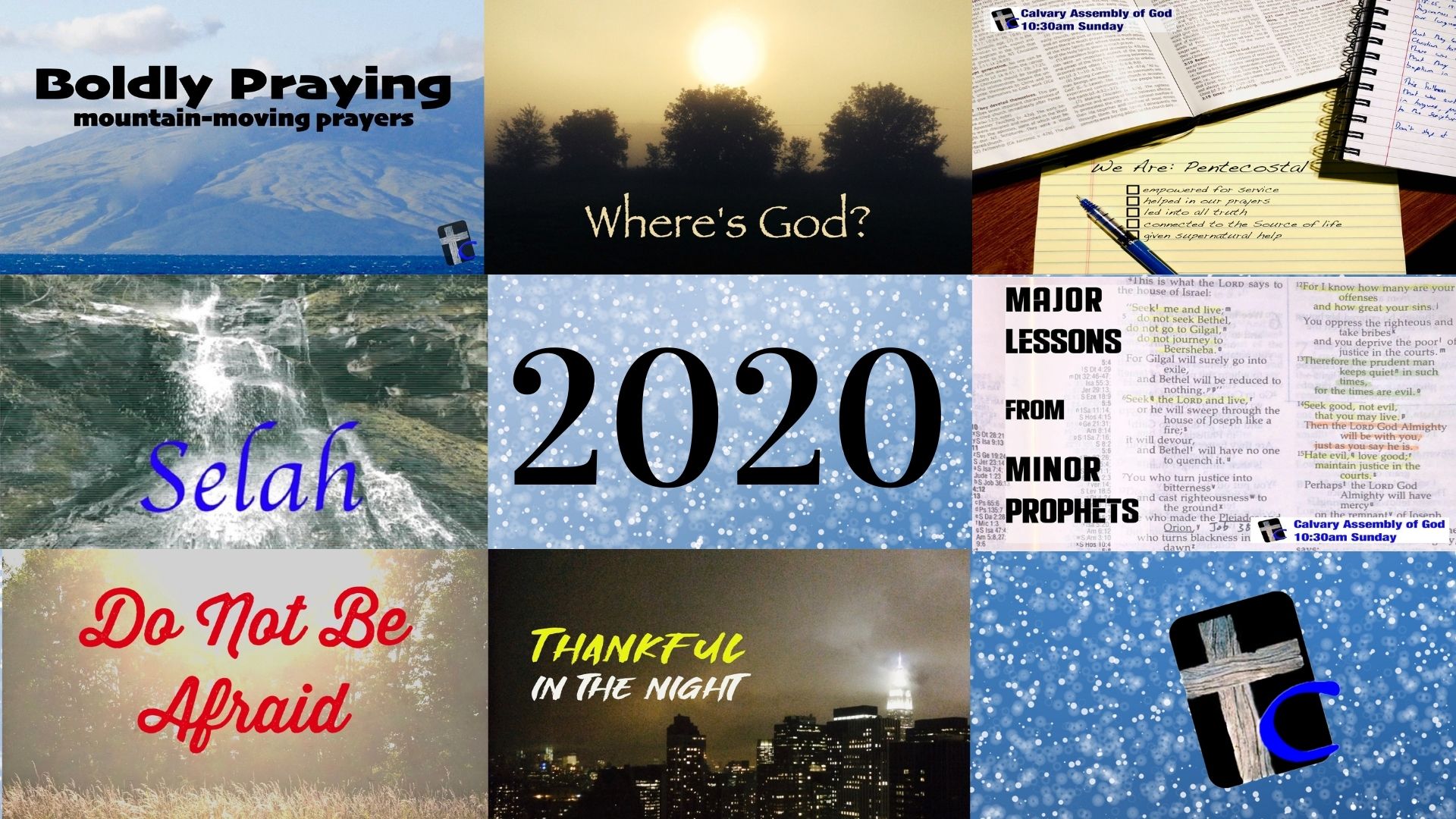
With that backdrop, here is a listing of the sermon series that I presented this year. Clicking on each series title will take you to a list of all of the sermons in that series. 

Prayer Plan—A Christian’s strategy is worked out in the prayer closet. John Piper noted, “Why do God’s children so often fail to have consistent habits of happy, fruitful prayer? Unless I’m badly mistaken, one of the reasons is not so much that we don’t want to, but that we don’t plan to.” These messages taught us to have a plan to pray. 

Where’s God—We’ve all asked that question. Something happens that rocks our world, and we wonder where in the world God is. We call out to God and He seems silent. We search our hearts to see if we can discern something we’ve done wrong, and seeing nothing amiss we cry out again, “God, where are You?” So where is God in our heartache? In our abandonment? In our sorrows? In our distress? In death? Believe it or not, God may be closer in His silence than you’ve ever perceived before. 

We Are: Pentecostal—Pentecost for over 1500 years was a celebration in Jerusalem that brought in Jews from all over the world. But on the Day of Pentecost that came just ten days after Jesus ascended back into heaven, the meaning of Pentecost was forever changed! Followers of Jesus—now empowered by an infilling of the Holy Spirit—began to take the good news of Jesus all over the world. These Spirit-filled Christians preached the Gospel and won converts to Christ even among hostile crowds, performed miracles and wonders, stood up to pagan priests and persecuting governmental leaders, and established a whole new way of living as Christ-followers. We, too, can be Pentecostal followers of Jesus Christ today. 

Selah—The word Selah appears nearly 70 times in the Bible, almost exclusively in the Psalms. Although it is primarily a musical term, it applies beautifully to our summer series. It means a pause. Throughout the Psalms, Selah appears at the end of a verse, at the end of the psalm, or sometimes even mid-sentence. But each one of them is perfectly placed by the Spirit-inspired authors to get us to take a breath and deeply contemplate what we just read or sang. 

Major Lessons From Minor Prophets—Sometimes the naming of things gives us an inaccurate picture of the thing being named. For instance, many people think the “old” in Old Testament means outdated or perhaps updated by the “new” in the New Testament. When in fact, both Testaments are needed to give us the full picture of God’s love and glory. A similar thing happens with the headings “major prophets” and “minor prophets.” It makes it sound like the major prophets have something major to say to us, while we could take or leave the minor messages of the minor prophets. In reality, they were given these headings simply because of the volume of writing—the five major prophets consist of 182 chapters, whereas the 12 minor prophets only have 67 chapters. The volume of their writing may be minor, but their content carries major messages of meteoric power! 

Thankful In The Night—The psalmist wrote, “Yet the Lord will command His loving-kindness in the daytime, and in the night His song shall be with me” (Psalm 42:8). Notice that the psalmist was praising God IN the night, not praising Him FOR the night. Many people have gone through what has been called “the dark night of the soul.” I don’t think anyone has ever given thanks because of being in a dark time, but certainly they have given thanks afterward because of the lessons learned in that dark time. Quite simply put, there are some things God wants to teach us that we can learn in no other way than to go through a dark night. So we can learn to be thankful even IN those nights. 

Do Not Be Afraid—There are more angels sent by God concerning one event than anywhere else in the Bible—the Advent of Jesus. Clearly, this is a big deal: The coming to earth of God Himself! You would think this would be an occasion for great joy. But all four of the angelic appearances around the birth of Jesus have the same message: Do not be afraid. Why are people so afraid? It’s because fear invites us to make a decision to trust God completely. People remain crippled by fear when they try to deal with fear by themselves. But when they learn to fear God instead, there is an almost inexpressible joy and freedom that explodes in our hearts! 

We will be returning to a couple of these series in 2021, and we’ll be launching some brand new ones as well. In either case, if you don’t have a home church in the northern Kent County area, I would love to have you join us! 

The Legacy Of Worship

As my friend Josh Schram led us through Psalm 66 in our Selah series, I was reminded how our worship of God—especially in our trials—can leave a godly legacy that crosses generations and continents. 

There are three Selahs in this psalm. Remember that Selah is a call to pause to consider the impact of what the inspired biblical text just said to us. The Selahs in this psalm are surrounded by praise to God, as well as the impact of that praise. 

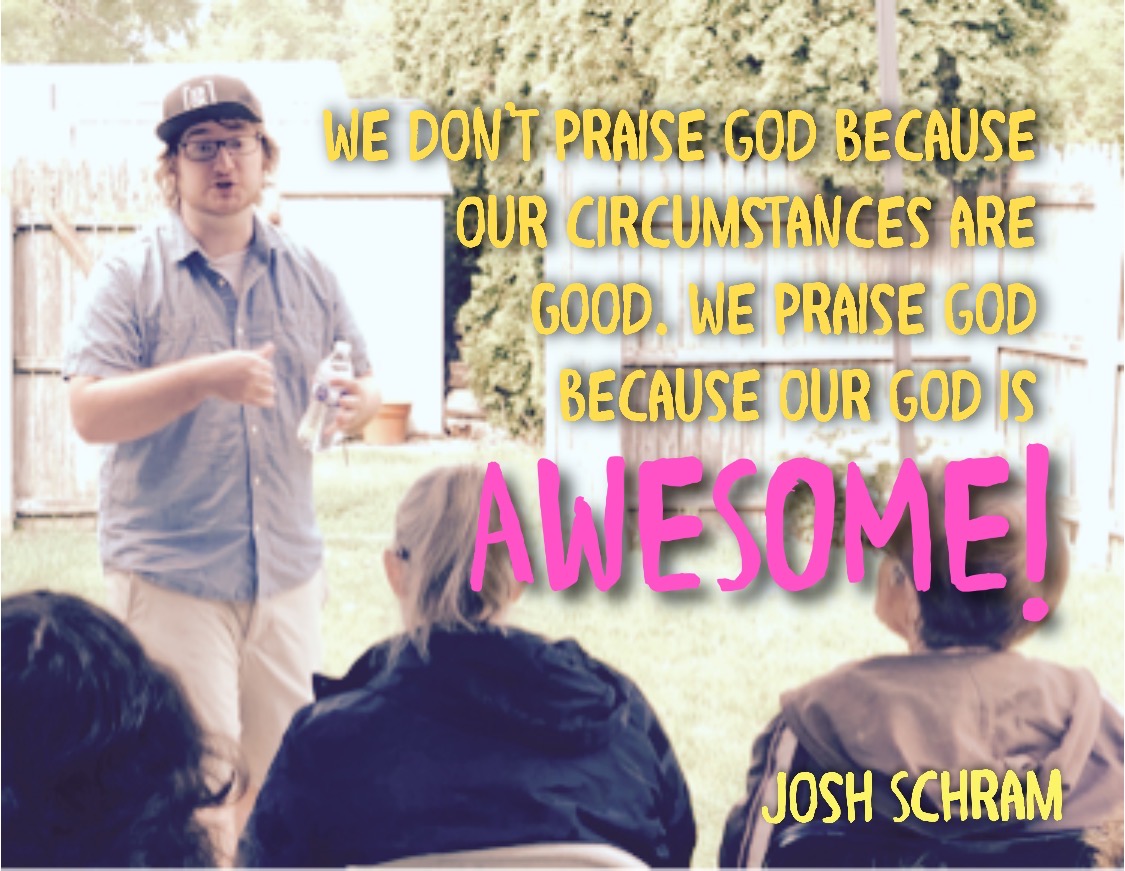
“We don’t praise God because our circumstances are good. We praise God because our God is awesome!” —Josh Schram 

 Psalm 66 could be briefly outlined like this:

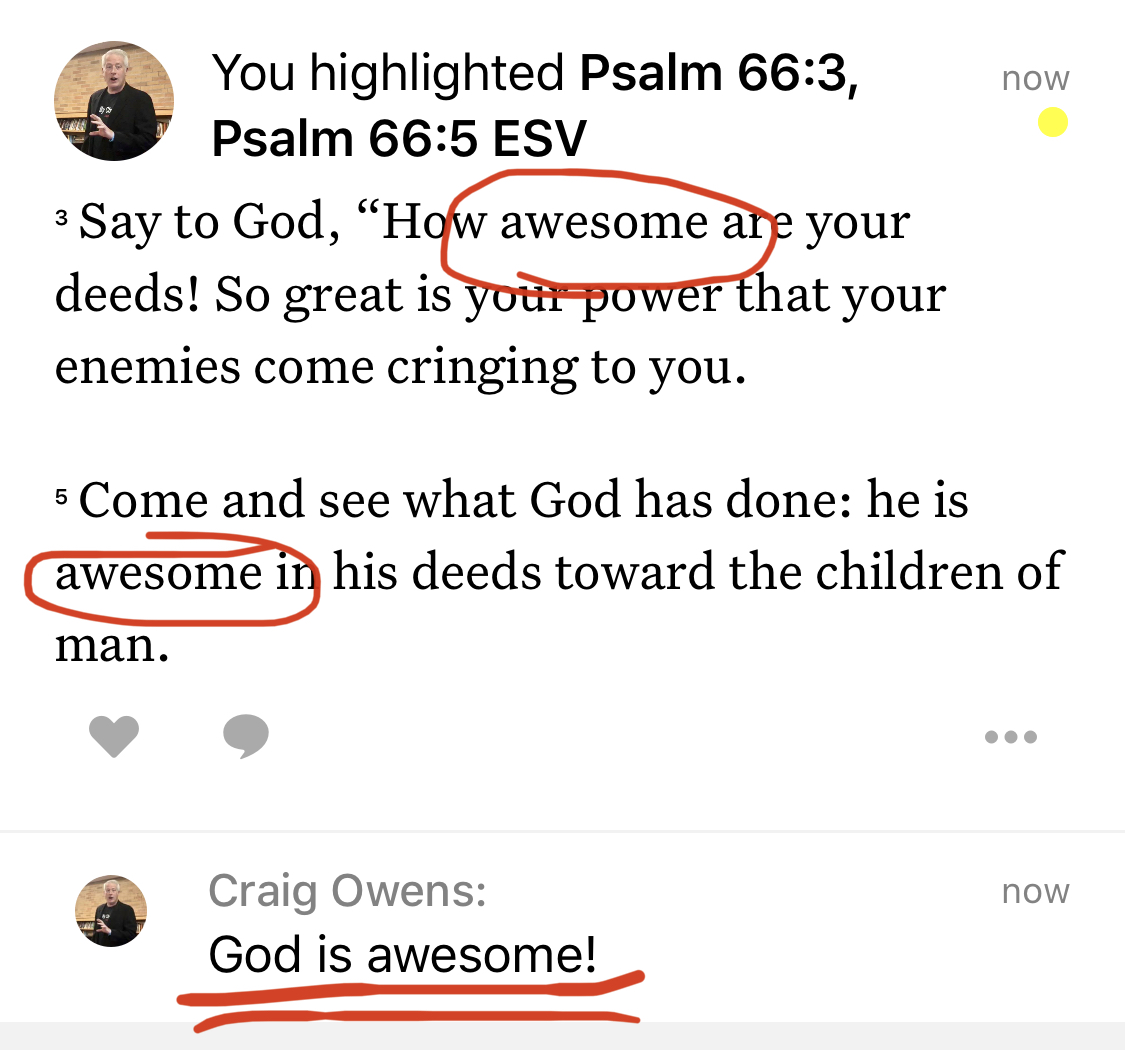
  • We say to God, “How awesome are Your deeds!” 
  • Selah—pause to ponder how awesome God is. 
  • We say to others, “Come and see the awesome things God has done!” 
  • Selah—pause to let our worship of God impact others. 
  • Others join with us in saying, “God is worthy to be praised!” 
  • Selah—pause and rejoice as their praise to God reverberates. 
  • Now we can say to an even larger audience, “Come and listen to the awesome things God has done!” 

Notice that our praise of God—despite the circumstances we’re in—makes all of the other steps possible. 

“Come and see my life of praise” (v. 3) precedes the opportunity to say, “Come and listen to my testimony” (v. 5). In other words, we live out our love for God and earn the right to speak out to others about our love for God. 

Look at the same pattern in Paul and Silas:

  • They are thrown in prison on sham charges and they still are about to sing through their physical pain, “How awesome is our God!” 
  • God sends an earthquake that breaks off their shackles and opens the prison doors. 
  • The jailer asks how he also can have this kind of relationship with Jesus. 
  • Paul and Silas have the opportunity to say to him and his family, “Come and listen.” 
  • The jailer and his family accept Jesus as their Savior. 

But it’s not just this jailer. Luke wrote that the other prisoners were also listening to Paul and Silas sing about their awesome God. Through the jailer and perhaps some of these prisoners, a church was started in Philippi. 

Later on, Paul would write to this church about their partnership in ministry, and he would write to the Corinthian church about the amazing missions generosity of the Philippian church (see Philippians 1:3-5; 2 Corinthians 8:1-2). That’s what I mean about leaving a godly legacy that crosses generations and continents. 

God is worthy to be praised! Let others hear you saying, “God is awesome” even in the midst of your painful trials, and you, too, will earn the opportunity to say to them, “Come and listen as I tell you how awesome it is to be in a relationship with God through His Son Jesus!” You can be a part of this godly legacy in your community. 

If you’ve missed any of the messages in our Selah series, you can find the full list of messages by clicking here. 

Now And Not Yet

Psalm 68 is a Christological Psalm. That means it points to Jesus and it is fulfilled through Christ’s First and Second Advents. These types of psalms don’t make sense if they are restricted strictly to the Old Testament. 

As I have explained previously, Hebrew literature often puts the key point in the middle—in the case of this psalm, that’s verses 18-20. The opening verse sets the stage, or the scene of battle, and then right in the middle of this psalm of David is the description of God’s victory won through Jesus. 

There are three Selahs in this psalm, and I want you to notice what’s happening at each one: 

  • When You marched through the wasteland (v. 7) 
  • Who daily bears our burdens (v. 18) 
  • Sing praise to the Lord (v. 32) 

Do you remember the three definitions of Selah? A pause to consider; a breath before the crescendo; a time to weigh what’s valuable. In this case, I believe we should lean more to the second definition. Why? Because all three of these Selahs shows us what God has done, what He is still doing, and what He will ultimately do in the eternity of Heaven. I believe we are living in the breath/Selah after Christ’s First Advent and leading up to the crescendo of His Second Advent. 

Jesus is BOTH the Immanuel that came to earth at His First Advent AND the returning King at His Second Advent. We are living in an era of BOTH “now” AND “not yet.” 

The apostle Paul looks back to this psalm (especially those middle verses of 18-20) even as he looks forward to the Second Advent. He captures the essence of “now” and “not yet” in all these passages:  

Jesus paid the price for our sin.
He broke the bonds of hell and death.
He prepared the way to Heaven.
He showed the way to Heaven.
He built our mansions in Heaven.
He WILL return to take us to be with Him in Heaven!


So how shall we now live in this time of “now” and “not yet”? In a word: AWARE… 

  • …of His ultimate victory (Psalm 68:1) 
  • …of the desperation of the enemy. Death, sin, and the devil have been defeated! We now deal with a broken army, a scattered foe in the final death throes, a wounded, dying warrior desperately lashing out. The prince of this earth is quickly failing, while God is liberally pouring out rewards that were purchased by Christ our King! 
  • …of the brevity of this life (v. 2)
  • …of the joy of living in God’s presence (v. 3) 
  • …of the power of worship (v. 4) 
  • …of our confidence in being heirs of God and co-heirs with Christ (vv. 5-6) 

Now is not the time for fainting, but fighting the good fight. Our Immanuel has won the battle, He will continue to strengthen us every day that we walk this Earth, and He will keep us by His side as He reigns for all eternity as King of kings and Lord of lords! 

If you’ve missed any of the previous posts in this series, you can check out the full list by clicking here. 

The EGO That God Blesses

Have you ever noticed that it seems a lot easier to say, “God bless you” than it does to say, “God bless me”? Why is that? 

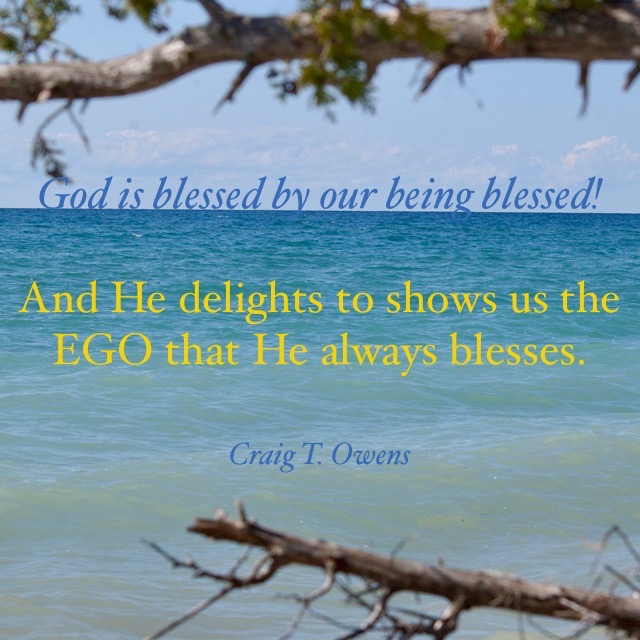
Do I feel unworthy of His blessing? If I am a Christian, I need to remind myself that I am in Christ, and He is in me, and He has brought me into the Father. This means that I am as blessed as the Father blesses the Son (John 14:20; Ephesians 1:3-6). God is blessed by our being blessed! 

Or perhaps I feel that “God bless me” is an arrogant prayer, while saying “God bless you” is a humble prayer. There is an EGO that God always blesses, and He delights to show us what that is!   

In Hebrew literature, the key point is found in the middle of a poem or story. In Psalm 67, that would make the middle verse: May the nations be glad and sing for joy, for You rule the peoples justly and guide the nations of the earth. Selah. (v. 4)

The nations rejoice because God judges fairly and God guides the nations. Selah—pause and take that in. The natural attitude is actually a God-negative attitude—“I prefer to be in charge … I don’t like anyone telling me what to do!” But the unnatural attitude is a God-positive attitude—“I trust God more than I trust me, so I’m glad He is in charge … I trust God to judge justly more than I trust world institutions, so I’m glad He is the final Judge!” 

This is very good news: Only God can rule and judge correctly! Men have biases and agendas; men are selfish and self-seeking; men seek their own glory and their own advancement. So the psalmist wants us to Selah/pause to remember that only God can lead and judge in a way that brings Him glory and brings us blessing. God is blessed by our being blessed! 

Working outward from verse 4, we see verses 3 and 5 are identical, teaching us that our God-honoring desire should be for all peoples in all nations to experience the blessing of an intimate relationship with God. 

A similar theme is sounded in the “bookend” verses of 1-2 and 6-7: We are asking God to bless us so that “all the ends of the earth will fear Him.” Once again we Selah/pause to consider this: Do I have the right EGO to request this blessing? Remember: There is an EGO that God always blesses.  

In his book Lead Like Jesus, Ken Blanchard identifies two types of E.G.O.s in our relationship with God:

  • Negative E.G.O.—Edging God Out 
  • Positive E.G.O.—Exalting God Only

The negative EGO says things like, “Bless me” and “Shine on me.” The positive EGO says, “Bless me so that I can be a blessing to others” and “Shine Your light on me so that others will see You.” 

Jesus told us to not let the light of our life be hidden. We are blessed by God so that we can be a blessing to all of the peoples in all of the nations. We desire that all may know the joy of serving a Righteous King. We want everyone to know the praise that comes from Exalting God Only. 

Oh God, be merciful to me. Cause Your face to shine on me. Bless me indeed so that I may teach others to fear You, so that they may come to know You as their All-Righteous, Good, and Loving King! 

If you have missed any of the messages in this series exploring the Selahs in the Psalms, you can find the full list of messages by clicking here.