A Proactive Pause

Listen to the podcast of this post by clicking on the player below, and you can also subscribe on AppleSpotify, or Audible. 

Let’s keep in mind why we are learning and working on these spiritual disciplines. The key phrase is “so that”—I get stronger so that we can get stronger.

Today we are looking at spiritual discipline #2—Solitude. We will need discipline to abide with Jesus in our time of solitude—removing all distractions—so that we can respond better to our circumstances, and help other saints respond better too. 

Part of the dictionary definition of solitude is “a place absent of human activity.” Note that important word human activity. Solitude is a time for stepping back from all our human striving to get a heavenly perspective. Solitude is a proactive pause in difficult times so that we can respond with a God-honoring reaction. 

Let me give you five ideal situations to discipline ourselves to find solitude. 

(1) After ministry exertion. I’m sure there have been times when an interaction with another person or a group of people has exhausted you. It’s at these times we should find a place of solitude to be refreshed, just as Jesus did (Luke 5:16). 

(2) In stormy times. When everything around us seems to be unstable, proactively pausing in a time of solitude is saying with the psalmist, “God is our refuge and strength, an ever-present help in trouble,” and then hearing God say to our anxious hearts, “Be still, and know that I am God” (Psalm 46:1, 10). These are the same words Jesus said to both the stormy seas and the disquieted hearts of His disciples (see Mark 4:35-39). 

(3) When we’re between a rock and a hard place. This is when we feel like neither option before us is a pleasant one. Like when the Israelites were caught between the onrushing Egyptian army and the uncrossable Red Sea. Listen to how similar the words of Moses sound, “The Lord will fight for you; you need only to be still” (see Exodus 14:1-14). 

(4) When we have a big decision ahead. We may gather all of the information and do our our research and still feel inadequate to make a good decision. Jesus had hundreds of disciples, but He needed to choose just twelve to serve as His apostles. Before making this decision, Jesus spent the night in solitude with His Father (Luke 6:12-13). 

(5) When we get angry. There are other strong emotions that sometimes seem to overwhelm us, but I’ve noticed that anger causes more people to fly off the handle than most of the other emotions. When Jesus saw the shameful way the temple was being used, He got so angry that His disciples recalled the Psalm that said zeal was burning Him up (Psalm 69:9; John 2:17). Instead of reacting in the heat of the moment, Jesus spent all night in solitude with His Father (Mark 11:11, 19).  

Our solitude time could include Bible reading, but it’s probably more of a time for quieting ourselves—taking a break from human activity—so we can hear the Holy Spirit reminding us of what we’ve already studied (John 14:26).  

Then keep in mind that solitude is not retreating and staying away from others, but solitude is so that I can effectively respond to pressing situations. Christian solitude is not me-time, it’s us-time (where the “us” is me + Jesus) so that I’m ready for we-time (where the “we” is me + others). 

This is such an important discipline for Christians so that we don’t respond inappropriately in an intense situation, but we respond in a Christ-like way that brings glory to God. Pay attention to your strong emotions, listen to the Holy Spirit, and proactively find a place of solitude. 

If you have missed any of the other messages in this series called Saints Together, you can find them all by clicking here.

►► Would you please prayerfully consider supporting this ministry? My Patreon supporters get behind-the-scenes access to exclusive materials, like a 10-minute video I just shared on study tips for the poetic books of the Bible. ◀︎◀︎

It Takes All Of Us

Listen to the podcast of this post by clicking on the player below, and you can also subscribe on AppleSpotify, or Audible. 

In my book Shepherd Leadership I talk about some strong, godly men who gave into temptation at a moment of weakness—David who behaved so poorly toward Bathsheba and Uriah, Elijah who got depressed and suicidal, and Peter who denied knowing Jesus. 

One common factor for all of these guys is that their moment of giving in came when they were alone. They were isolated from others who may have been able to help them overcome the temptations that tripped them up. 

The principle is clear: Christians are stronger when they are with other Christians.  

Have you ever heard of the law of the weakest link? 

If I have a chain with links that can handle 400, 300, 250, 175, and 500 pounds, how much weight can the chain hold? You don’t really need a calculator for this one because the answer is the capacity of the weakest link: 175 pounds. This is why it’s to my advantage to not only strengthen myself, but to help others grow their strength as well. 

In Galatians 6:2-5, the apostle Paul talks about the strength we need for ourselves and our fellow Christian brothers and sisters. First, he says that each of us should test our own actions. I can only know my breaking point if I’m tested, and the Holy Spirit knows how to do this perfectly. After this testing, Paul says then I can take pride in myself without saying, “Well, at least I’m better than him!” 

Quite simply, Paul tells each of us that we must be able to carry our own loads. Why? Because only a strong Christian can help someone else with their load. We each have to get stronger individually so that we have strength for others! 

This is just like what we’ve been learning in our look at the Songs of Ascent: the goal is for all of the pilgrims to get to Zion together!

In this series, we are going to learn about six spiritual disciplines. Much like a physical workout, the Holy Spirit will start with us where we are. Not everyone will be at the same level nor will everyone progress at the same rate. But all of us will need these four things.

(1) Discipline. This is saying no to the easy thing or the thing that brings only fleeting happiness so that I can say yes to the things that bring eternal joy. 

(2) Stick-to-it-iveness. I have to be committed to this process for a lifetime. 

(3) Grace for yourself. There are going to be moments of struggles, plateaus, and even stumbles. Those are all a part of the journey, so we must extend grace to ourselves to learn, repent, and move forward. 

(4) Patience for others. As I just mentioned, we are all on our own journey and we all progress at different rates. Let’s be patient with each other. 

All of these spiritual disciplines are to strengthen us individually so that we have something to share with other saints (2 Corinthians 1:3-6). 

These spiritual disciplines shouldn’t become legalistic. Don’t make the way you do it the way everyone has to do it. After all, a 175-pound link will be different than a 250-pound link. 

What I am calling spiritual disciplines, C.S. Lewis called religious practices. In a letter to a friend, he wrote about the safety and beauty that result from these pursuits—

“I think about the practices what a wise old priest said to me about a ‘rule of life’ in general—‘It is not a stair but a bannister’…i.e. it is, not the thing you ascend by but it is a protective against falling off and a help-up. I think thus we ascend. The stair is God’s grace. One’s climb from step to step is obedience. Many different kinds of bannisters exist, all legitimate. It is possible to get up without any bannisters, if need be: but no one would willingly build a staircase without them because it would be less safe, more laborious, and a little lacking in beauty.” (C.S. Lewis)

The New Testament always has the words “saints” in the plural, so these disciplines will help us grow from strong individual saints to a healthy and effective collection of saints. 

Each of us needs all of us, and all of us need each of us! It does, indeed, take all of us.  

If you would like to follow along as we learn about these six spiritual disciplines, you can find all of the messages by clicking here. 

►► Would you please prayerfully consider supporting this ministry? My Patreon supporters get behind-the-scenes access to exclusive materials. ◀︎◀︎

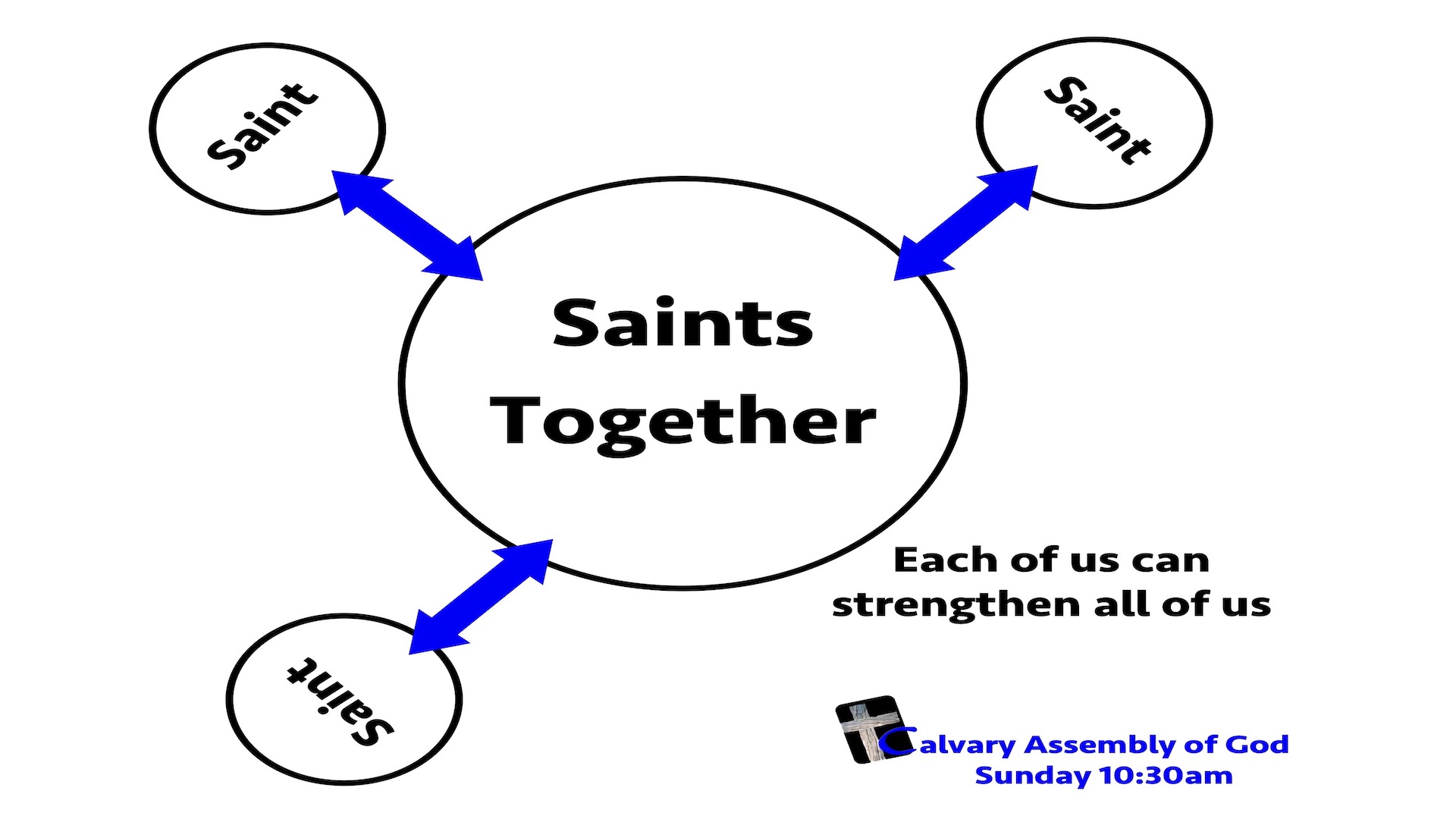
Saints Together

Throughout the New Testament the word “saints” is always in the plural form. This is a clear indication that none of us can develop into the full-fledged Christians we were meant to be on our own. 

We all need each other. More specifically, we all need the most mature version of each other. 

A key component of an individual saint’s development is the time spent alone being forged by the discipline of the Holy Spirit. Maturing saints then come together with each other to continue to strengthen and sharpen everyone in the church. Strong individual saints make a strong church, and a strong church makes strong individual saints! 

Join me for our new series called Saints Together. We will be studying the six spiritual disciplines that each individual saint must put into practice so that they can use their newly developed strengths to help other saints in their own development. 

Check out all of these messages here:

God’s Pleasure In Our Relationships

Listen to the podcast of this post by clicking on the player below, and you can also subscribe on AppleSpotify, or Audible. 

Last week we talked about God’s pleasure in our good work ethic and our good attitude about work. We have a God-implanted craving to do excellent work because God is an excellent Worker. 

We also said that although we would all like to have the job that was wonderful, even the crummy jobs deserve our best attitude and our best effort.  

This is very much the same for our relationships. We would all love to only have relationships in our lives that are energizing, fulfilling, and win-win. But the reality is that many of our relationships may be the exact opposite of this. 

Jesus said our love for others would show the world that we are His disciples. Oh yeah, and the love we show is supposed to be a “10” on the Jesus Love Scale (John 13:34-35). Why? Because that’s how Jesus loved us:

Now it is an extraordinary thing for one to give his life even for an upright man, though perhaps for a noble and lovable and generous benefactor someone might even dare to die. But God shows and clearly proves His own love for us by the fact that while we were still sinners, Christ (the Messiah, the Anointed One) died for us. (Romans 5:7-8 AMP)

Remember we said that God is Love? But love needs to have both a lover and beloved—someone reaching out and someone receiving. God is Father, Son, and Holy Spirit so God is Relational. The Father loving the Son and Spirit, the Son loving the Spirit and the Father, the Spirit loving the Father and the Son. All loving and promoting the Other. 

God is also Happy in this Relationship. 

Because we are created in God’s image, we have a God-implanted craving to love and to be loved, to have meaningful companionships (Genesis 1:26; 2:18). 

Remember that Jesus was all-in for us so that we could have this love relationship with God.  This same passage calls us to have the same attitude as Jesus had. But we can also back up just a couple of more verses to find out what fuels the relationships that satisfy our craving for companionship and please God (Philippians 2:1-11). Those characteristics include:

  • being like-minded in striving to find agreement with others 
  • having the same love as Jesus demonstrated  
  • being one in spirit—this unique Greek word reminds us we all have immortal souls. As C.S. Lewis reminded us, “It is a serious thing to live in a society of possible gods and goddesses, to remember that the dullest and most uninteresting person you talk to may one day be a creature which, if you saw it now, you would be strongly tempted to worship, or else a horror and a corruption such as you now meet, if at all, only in a nightmare. All day long we are, in some degree, helping each other to one of these destinations.”
  • being one in purpose  
  • giving up selfish ambitions as we trade “me” for “we” 
  • not indulging in vain conceit, but thinking more highly of others 
  • being humble 
  • always striving to find the win-win 

When Alexander Dumas wrote The Three Musketeers his Musketeers have been given a famous line: “All for one and one for all, united we stand divided we fall.” This is actually quite biblical because the Bible only has saints in the plural form, never in the singular. And the apostle Paul reminds us, “And if one member suffers, all the parts share the suffering; if one member is honored, all the members share in the enjoyment of it” (1 Corinthians 12:26 AMP). 

God is pleased when our attitude about our fellow saints is all for one and one for all—when all the saints love and nurture the individual saint, and when each individual saint loves and supports all the other saints. 

We were created for this. We crave this. God is pleased when we live and love like this. And this is the only way we will experience the joy of God’s favor on our relationships.

If you’ve missed any of the other messages in our series called Craving, you can find a list of all of the messages by clicking here. 

►► Would you please prayerfully consider supporting this ministry? My Patreon supporters get behind-the-scenes access to exclusive materials. ◀︎◀︎

Poetry Saturday—The True Aaron

Listen to the podcast of this post by clicking on the player below, and you can also subscribe on AppleSpotify, or Audible. 

See Aaron, God’s anointed priest,
Within the veil appear;
In robes of mystic meaning dressed,
Presenting Israel’s prayer.

The plate of gold which crowns his brows,
His holiness describes;
His breast displays, in shining rows,
The names of all the tribes.

With the atoning blood he stands,
Before the mercy-seat;
And clouds of incense from his hands,
Arise with odor sweet.

Urim and Thummim near his heart,
In rich engravings worn;
The sacred light of truth impart,
To teach and to adorn.

Through him the eye of faith descries,
A greater Priest than he;
Thus Jesus pleads above the skies,
For you, my friends, and me.

He bears the names of all His saints,
Deep on His heart engraved;
Attentive to the state and wants
Of all His love has saved.

In Him a holiness complete,
Light and perfections shine;
And wisdom, grace, and glory meet;
A Savior all divine.

The blood, which as a Priest He bears
For sinners, is His own
The incense of His prayers and tears
Perfume the holy throne.

In Him my weary soul has rest,
Though I am weak and vile
I read my name upon His breast,
And see the Father smile. —John Newton [Levitcus 8:7-9]

►► Would you please prayerfully consider supporting this ministry? My Patreon supporters get behind-the-scenes access to exclusive materials. ◀︎◀︎

Giving Preference To Others

Listen to the podcast of this post by clicking on the player below, and you can also subscribe on AppleSpotify, or Audible.

Be kindly affectionate to one another with brotherly love, in honor giving preference to one another” (Romans 12:10). 

What does it mean to give preference to a friend or loved one? Here are a few suggestions to get the ball rolling. 

Giving preference means I am…

  1. …speaking their “language.” I am a classic Doer, which means my style is, “Ready, Fire! aim.” I need to give grace to those who move a bit slower than me.
  1. …moving at their “speed.” My temperament is highly choleric, so I get fired up quickly and attack situations head-on. I need to give grace to those temperaments that are less emotional and want to handle things more strategically. 
  1. …sensitive to their “fears.” It’s insensitive for me to say, “It’s no big deal” about something that troubles them. Empathy is important so I can see and feel things like they see and feel them. 
  1. …helping them battle their “demons.” Perhaps viewing pornography isn’t a temptation for me, but it may be for someone else. So I need to seek out resources and accountability to help them fight this battle like I was fighting my own battle. 
  1. …avoiding their “stumbling blocks.” Perhaps I can watch certain genres of movies without compromising my Christian testimony, but it may cause my brother or sister a lot of grief. If I am going to prefer them in love, I will avoid talking about those movies in their presence, and I certainly won’t try to get them to “lighten up” to see things my way. 

Agape love is never selfish—it doesn’t want “my way” but it wants others to be edified. So, ultimately, what it means to give preference to another is to only promote those things that will build them up. Remember: saints is always plural in the New Testament, so we must build each other up to bring out the saintliness in all of us. 

►► Would you please prayerfully consider supporting this ministry? My Patreon supporters get behind-the-scenes access to exclusive materials. ◀︎◀︎

“Let Us” Be The Church

Listen to the podcast of this post by clicking on the player below, and you can also subscribe on AppleSpotify, or Audible. 

I had a great time on the 200churches podcast with Jeff Keady. 

Jeff asked me what was different for our church during the pandemic shutdowns. I explained to him how our season of change had begun long before anyone was even talking about a coronavirus.

Of course one of the big things in my personal life during the last year was authoring a #1-selling book called Shepherd Leadership: The Metrics That Really Matter. As I commented to Jeff, those “let us” phrases in the Book of Hebrews so struck me that I wrote about it in my book. 

     Have you noticed that the word “saints” in the New Testament is always in the plural, never the singular? That’s because we need each other to bring out the saintly qualities in each other. This is why the writer of Hebrews stresses the camaraderie of “let us” so many times (Hebrews 10:22–25). I’ve found that many shepherd leaders tend to isolate. They are so involved in their own pasture of ministry that they seldom make the time to interact with other shepherds. In fact, isolation is one of the devil’s favorite tactics. I encourage you to find friends—fellow saints—who are also committed to healthy spiritual growth and avail yourself of their friendship and insight. —an excerpt from the chapter ‘Four Elements to Optimal Spiritual Health’ 

“Let us” be the church wherever God places us and however He chooses to use us. 

I’ll be sharing more clips from this 200churches interview soon, so please stay tuned. Shepherd Leadership: The Metrics That Really Matter is available in print or ebook, and in audiobook through either Audible or Apple. 

►► Would you please prayerfully consider supporting this ministry? My Patreon supporters get behind-the-scenes access to exclusive materials. ◀︎◀︎

Completing The Body

Listen to the podcast of this post by clicking on the player below, and you can also subscribe on AppleSpotify, or Audible. 

One of the miracles we talked about last week was the Holy Spirit giving gifts to people that evangelize the sinner and edify the saint. Let me be more specific: YOU are God’s gift to the world if you are using God’s gift to glorify God in the world. 

You are a one-of-a-kind creation. God is infinitely creative so He never has to duplicate any of His creative works. He saw your life and implanted in you what you need to glorify Him (Psalm 139:13-18). But we need to think about this uniqueness the right way. 

Lucifer, an archangel, became satan, the Christian’s archenemy, because of his oversized pride. Pride is what turned Lucifer into satan, and it’s a tactic he still uses today on God’s creations. His other tactic is slander: attempting to get us to think we are insignificant and have no real purpose in the world. 

Just like Jesus did, we overcome satan’s lies with the truth in God’s Word.  

In Romans 12, Paul talks about our lives being used as a living, breathing, God-honoring sacrifice. But Romans 12:1 begins with the word “therefore,” so we need to back up a few verses. The final four verses of chapter 11 are a beautiful doxology that is praising God for His wisdom and sovereignty. Paul then offers this conclusion: Therefore we need to think correctly about our place in the world, allowing the Holy Spirit to transform our thoughts. 

Paul uses the word “think” twice in this passage. The root word is the same in each place (phroneo in Greek), but the prefix is what sets them apart from each other. The first has the prefix hyper-. That means it’s overly-analyzed thinking, overly self-concerned thinking, or self-focused.

The second time the prefix is soph- (which means “wise”). This is sound thinking, big-picture thinking, or others-focused. The Holy Spirit wants to give us sophroneo thinking to reveal our God-implanted gifts and talents that are to be used to benefit others—in fact, to benefit the whole Body of Christ.

In Romans 12, Paul uses the phrase “one body” twice as he talks about our spiritual gifts. He uses the same “one body” praise three times in 1 Corinthians 12 as he again talks about spiritual gifts (1 Corinthians 12:12-13, 20). 

All of our spiritual gifts are to be used in love and to build up others (1 Corinthians 12:31—13:3; 14:1, 12, 26, 40). 

The Holy Spirit gives gifts to individuals so that individuals can edify the whole Body of Christ. It’s not competing with one another but completing one another. 

Remember: Saints is always plural in the New Testament! I need you to bring out the saintly qualities in my life, as much as you need me to bring out the saintly qualities in your life. 

This summer I will be offering an in-depth teaching on the spiritual gifts listed in the New Testament. We’ll take some assessments and discuss how these gifts can best be invested in the Body of Christ. I hope you can join me for an hour of learning on Wednesdays. 

If you’ve missed any of the messages in our series exploring our Pentecostal roots, you can find all of those messages by clicking here.

►► Would you please prayerfully consider supporting this ministry? My Patreon supporters get behind-the-scenes access to exclusive materials. ◀︎◀︎

Soul Friends

Listen to the podcast of this post by clicking on the player below, and you can also subscribe on AppleSpotify, or Audible. 

I had a great time on the Ailbe Podcast with Rusty Rabon. 

Rusty referred to a chapter in my book called ‘Going Farther,’ where I talk about the importance of a shepherd leader having strong, godly friends close by.  

I learned a long time ago that there is a reason that the word “saints” is always in the plural—never in the singular—throughout the New Testament. I also share a couple of notable Old Testament examples of leaders who stumbled when they tried to go alone. 

In Shepherd Leadership: The Metrics That Really Matter I wrote, “You will not only extend your leadership by having other servant-hearted shepherds around you, but you will also have a guard against the aloneness that led to such ugly warts on the biography of otherwise powerful leaders such as David, Elijah, and Peter.” 

I’ll be sharing more clips from this interview soon, so please stay tuned. If you would like to check out the other clips I have already shared from this podcast, please check them out here. Shepherd Leadership: The Metrics That Really Matter is available in print or ebook, and in audiobook through either Audible or Apple. 

►► Would you please prayerfully consider supporting this ministry? My Patreon supporters get behind-the-scenes access to exclusive materials. ◀︎◀︎

Thursdays With Spurgeon—Walking Preachers

This is a weekly series with things I’m reading and pondering from Charles Spurgeon. You can read the original seed thought here, or type “Thursdays With Spurgeon” in the search box to read more entries.

Listen to the podcast of this post by clicking on the player below, and you can also subscribe on iTunes or Spotify.

Walking Preachers  

For we walk by faith, not by sight. (2 Corinthians 5:7) 

     Walking is a position that…signifies activity. You would suppose from the way some Christians deport themselves, that their whole life was spent in meditation. It is a blessed thing to sit ‘with Mary at the Master’s feet.’ But we walk as well as sit. We do not merely learn, but we practice what we know. We are not simply scholars, but, having been taught as scholars, we go on to show our scholarship by working in the vineyard or wherever else the Master may be pleased to place us. …  

     You would gather indeed from what others say, that the whole life of a Christian is to be spent in prayer. Prayer, it is true, is the vitality of the secret parts of Christian life, but we are not always on our knees! We are not constantly engaged in seeking blessings from heaven. We do continue in prayer, but we are also engaged and showing forth to others the blessings that we have received and in exhibiting in our daily actions the fruits that we have gathered on the mountaintop of communion with God. We walk, and this implies activity. …  

     ‘We walk.’ This is more than some can say. They can affirm, ‘We talk. We think. We experience. We feel.’ But true Christians can say with the apostle Paul, ‘We walk.’ Oh, that we may ever be able to say it too! Here, then, is the activity of the Christian life.

From Faith Versus Sight

Edgar A. Guest captured this idea well in his poem “Sermons We See.” The first stanza says,

I’d rather see a sermon than hear one any day;
I’d rather one should walk with me than merely show the way.
The eye’s a better pupil and more willing than the ear;
Fine counsel is confusing, but example’s always clear.
And the best of all preachers are the men who live their creeds.
For to see the good in action is what everybody needs.
 

Or as Francis of Assisi noted, “It is no use walking anywhere to preach unless our walking is our preaching.” 

So a fantastic question for every Christian to ask themselves is this: Do people know that I’m walking with Jesus even if I never open my mouth to tell them?

►► Would you please prayerfully consider supporting this ministry? ◀︎◀︎