Eyes On The Eternal

Listen to the podcast of this post by clicking on the player below, and you can also subscribe on AppleSpotify, or Audible. 

Most of our Royal Psalms have taken us from King David to King Jesus. Psalm 72 is a bit different because King David is speaking some of his last words as a blessing and a reminder to King Solomon. Jesus, Peter, and those in a church prayer meeting all affirmed that David’s words were inspired by the Holy Spirit (Matthew 22:43; Acts 1:16, 4:25), so these words in Psalm 72 are just as inspired. 

(Check out all of the Scriptures in this post by clicking here.)

The introduction to this psalm in the NIV says “Of Solomon.” But because the Hebrew word for “of” can also be “for” and since v. 20 says these are the final words of David, I think we can say that this psalm is of David and for Solomon. 

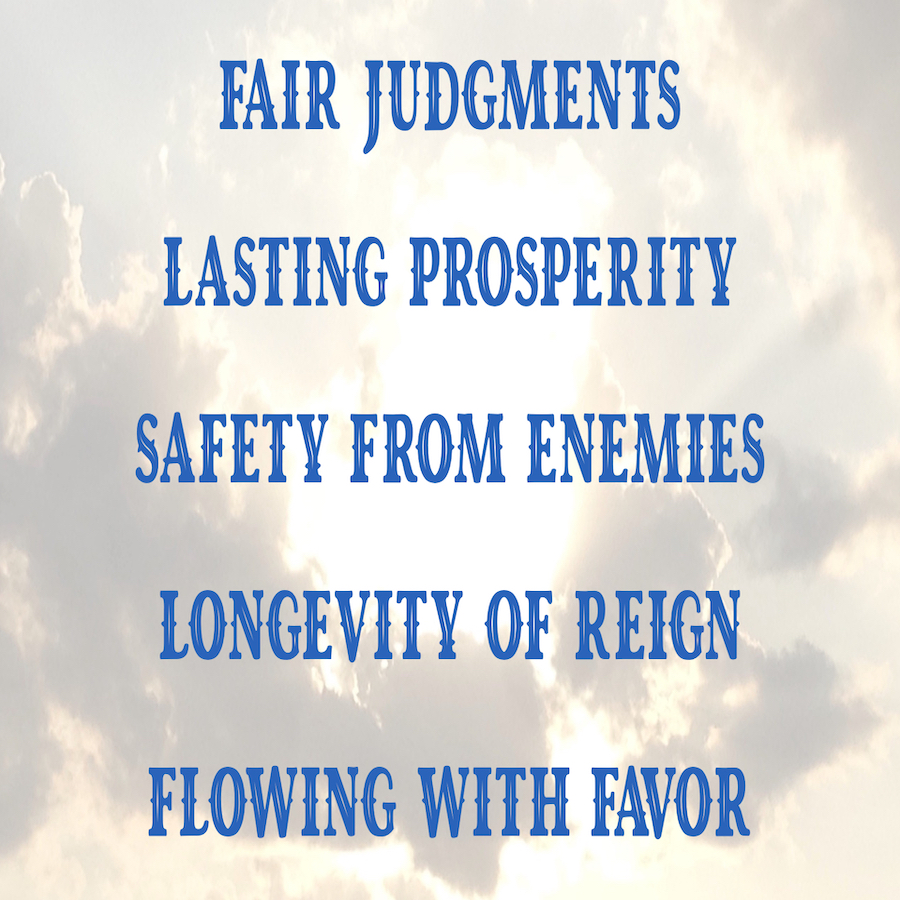
David has received God’s promise of an heir always on the throne of his kingdom. Here is the first transfer of power, and David is foreseeing the blessing that Solomon will be to the Israelite nation because of the endowment of God’s righteousness. Those blessings for his subjects include: 

  • fair judgments (v. 2; 1 Kings 10:1-3) 
  • prosperity (v. 3; 1 Kings 10:7, 27) 
  • safety from enemies (v. 4; 1 Kings 10:26) 
  • longevity (v. 5; 1 Kings 10:8) 
  • favor (vv. 6-7; 1 Kings 10:9) 

Historically, we know of the fulfillment of these things. We can especially see it in the visit of Queen Sheba in 1 Kings 10. 

In this next paragraph, as we have seen with other royal psalms, there is a modulation back-and-forth between King Solomon and King of kings Jesus (vv. 8-11). Verse 8 is the ends of the earth rule of Jesus; vv. 9-10 are the local rule under Solomon; v. 11 then speaks of all kings…all nations bowing to Jesus as the King of kings. 

This modulation reminds us that no earthly king can ever stand-in for the Eternal King. After the static of switching back-and-forth, from our perspective at this point in history a flashback event becomes crystal clear. 

  • David gives instructions and a warning to Solomon (1 Kings 2:1-4) 
  • Solomon wields his power in Israel (2 Chronicles 1:1) 
  • Solomon falters under his power by becoming intoxicated by it (1 Kings 3:3; 11:1-4)
  • Solomon’s kingdom is diminished (1 Kings 11:10-13) 

This is not the case for our King of kings! His kingdom has no end because His rule has no end (Isaiah 9:6-7; Luke 1:32-33). 

The devil tried to limit Jesus by offering Him a shortcut, but Jesus stood firm. So the remainder of this Royal Psalm can only be fulfilled by Jesus:

  • vv. 12-14 foreshadow the prophecy of Jesus Isaiah 61:1-2 and its fulfillment in Luke 4:21 
  • vv. 15-17 foretell all nations being blessed forever under the lordship of King Jesus 

Don’t get caught up in looking at what’s before your eyes right now. Don’t get discouraged by the voice that’s in your ears right now. Don’t get mesmerized by the glittery things of earth. Keep your focus on the Eternal King. David’s conclusion to this Royal Psalm is that we worship our King above all else (Psalm 72:18-19). 

And David’s final words should echo from our lips as well: Amen and Amen! 

If you’ve missed any of the other messages on these Royal Psalms, you can find them all here. 

►► Would you please prayerfully consider supporting this ministry? My Patreon supporters get behind-the-scenes access to exclusive materials. ◀︎◀︎
The Freedom In Fear

Listen to the podcast of this post by clicking on the player below, and you can also subscribe on AppleSpotify, or Audible. 

Our Royal Psalms take us from King David to King Jesus. David went from the anointed king on the run from King Saul, to being king over Judah (2 Samuel 2:4), to being king over “all the tribes” (2 Samuel 5:1-3; 8:15). 

(Check out all of the Scriptures in this post by clicking here.) 

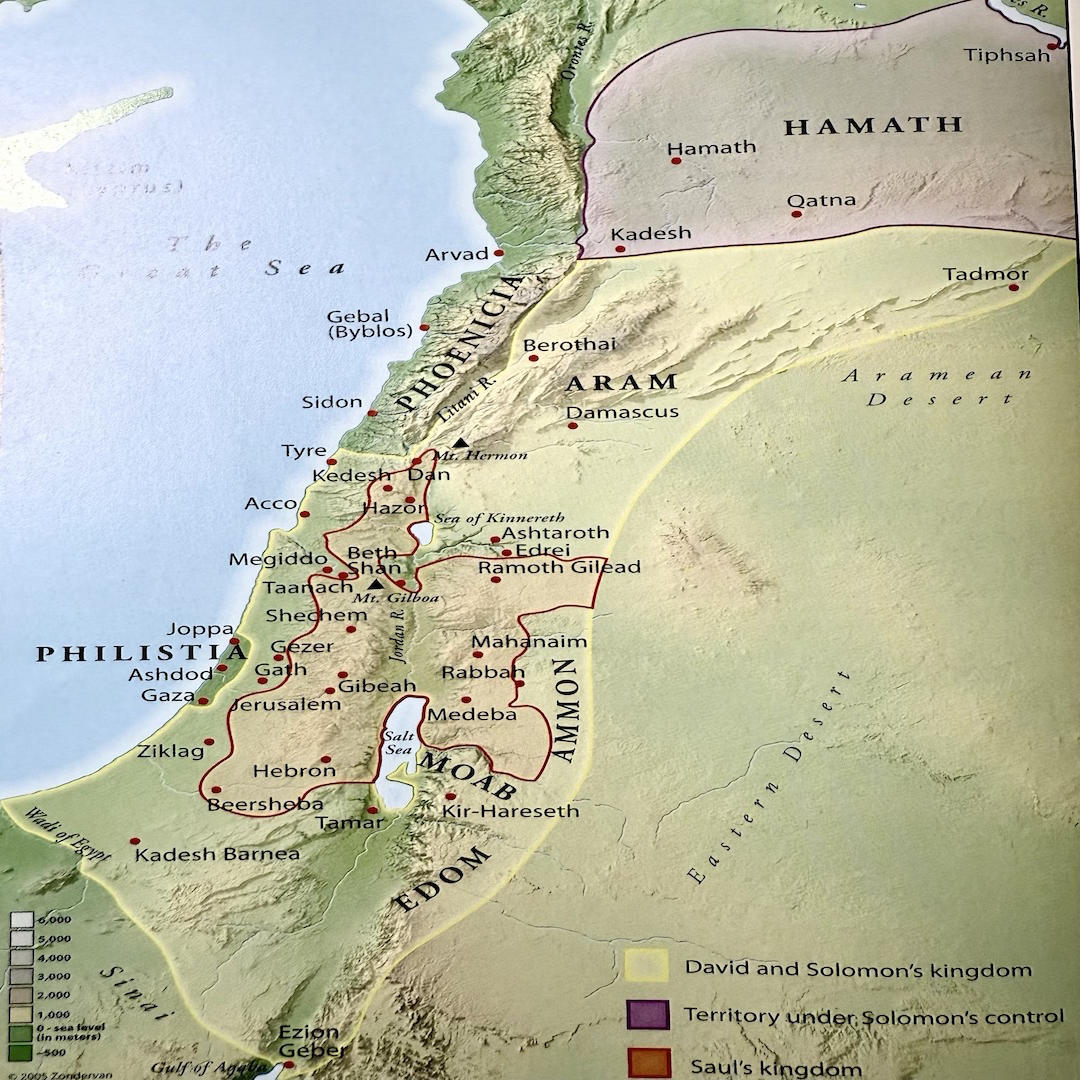
David’s kingdom stretched far and wide (1 Chronicles 22:14-16; 29:10-13). This absolute control King David now wields over every nation surrounding Israel puts fear into the hearts of Israel’s enemies. Fear of David brings freedom for the people of his kingdom.

As the Sons of Korah think about this fear that brings them freedom, they look beyond their earthly king to the King of Heaven and compose this Royal Psalm recorded in Psalm 47. This psalm has majestic terminology for God in almost every verse; including, Lord Most High, great King over all the earth (vv. 2, 7, 9), God reigns over the nations; and God is seated on His holy throne. 

I’m especially intrigued by the word awesome in verse 2. The KJV says “the Lord Most High is terrible” because it does take two Hebrew words to give us the full definition of awesome. First, “Most High” is best thought of with the suffix -est: greatest, highest, noblest. In other words, there is nothing above Him. Then “terrible” is to be held in awe, to be honored, to be reverenced. 

Just as the Israelites had no fear of enemies because David was on the throne, God says the same thing to us: Because the Most High is on the throne, His people have no fear of their enemies. 

When we fear God we need not fear anything else. 

When we fear God: 

…we hate our own sin (Psalm 36:1-3) 

…we love His mercy that forgives our sin (Psalm 103:2-3, 10-12) 

…we hate sin in the world (2 Timothy 2:26) 

…we love sinners (2 Timothy 2:24-26; Acts 10:38; Jude 20-23) 

…we hate the darkness that traps people (2 Corinthians 4:4) 

…we love shining the light of King Jesus (Philippians 2:15-16) 

…we hate this life (John 12:25) 

…we love eternal life (Romans 3:23-24, 8:18)

When the people of Israel reverenced David as their king, they would be able to know his blessings. When we fear our awesome God, we will also receive His blessings. Take a look at the amazing blessings Jesus Himself—the King of kings—lists for those who reverence His awesome Kingship (Revelation 2:7, 11, 17, 26-28; 3:5, 11-12, 21)! 

God is awesome and asks us to reverence Him and then enjoy life in His freedom. 

If you have missed any of the other royal psalms we have covered, you can find the full list by clicking here. 

►► Would you please prayerfully consider supporting this ministry? My Patreon supporters get behind-the-scenes access to exclusive materials. ◀︎◀︎
The King’s Bride

Listen to the podcast of this post by clicking on the player below, and you can also subscribe on AppleSpotify, or Audible. 

How many of you have taken time to watch a royal wedding? It captivates the attention of so many people when actress Grace Kelly becomes Princess Grace of Monaco, or when a Kate Middleton becomes the Princess Catherine of Wales. There is something that enthralls us when someone who isn’t born to royalty is elevated to such a special place in a fairy tale-like romance and wedding. 

Remember that these Royal Psalms are pointing through the earthly representative to the heavenly Reality. Psalm 45 is a wedding song, quite probably a wedding march for King David’s bride. 

(Check out all of the Scriptures in this post by clicking here.)

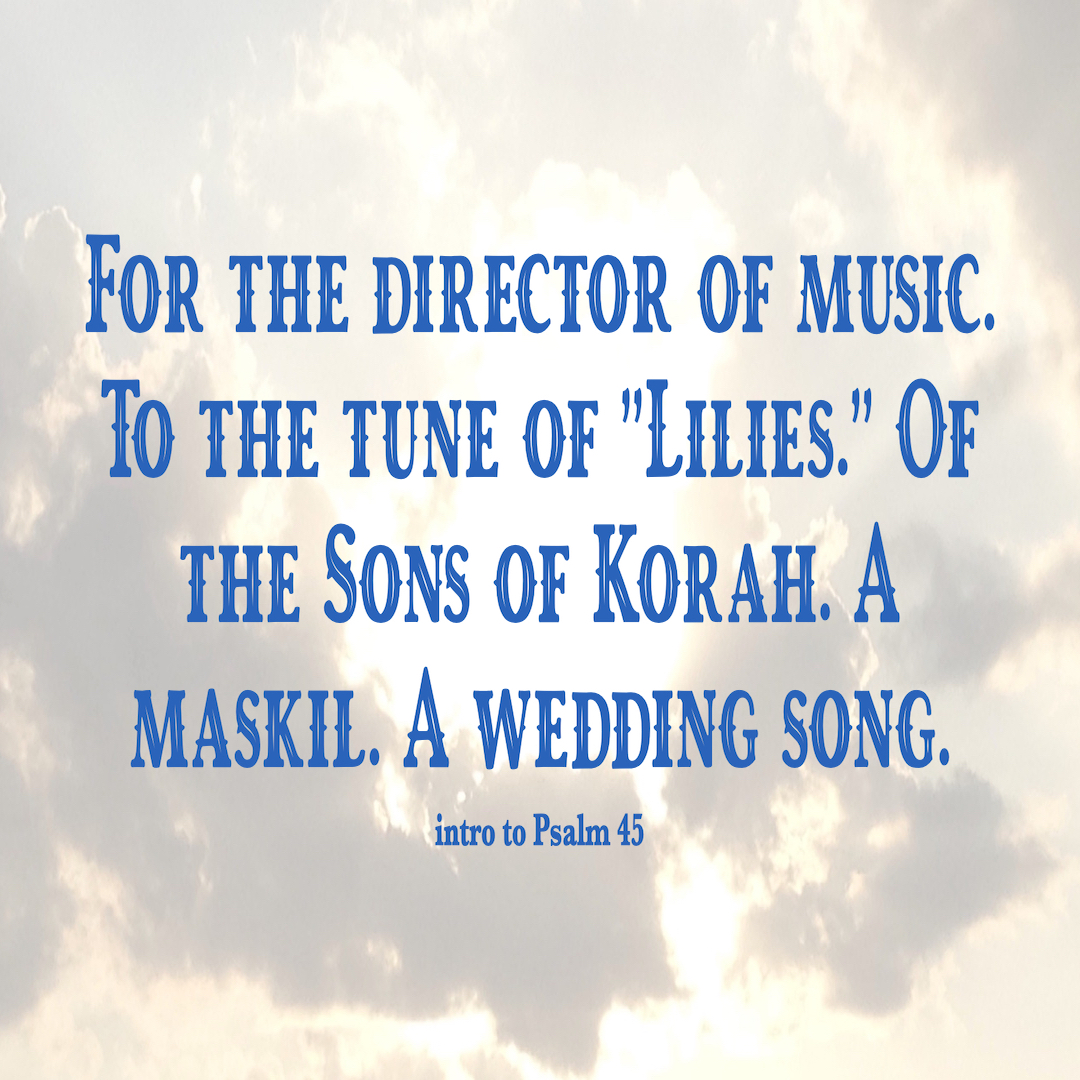
I’m intrigued by the preamble to this Psalm, as it is longer and more descriptive than most. 

  • For the director of music—appears 55x in the Psalter. 
  • To the tune of “Lilies”—appears only here and Psalms 69 and 80. 
  • Of the Sons of Korah—these are the skilled worship leaders. There are 11 songs written by them or for them. 
  • A maskil—this means it is to be a reflective song and is used 13 times. 
  • A wedding song—sometimes called a “song of love” in some translations. This Hebrew word is used 9 times in the Old Testament, always in poetic form, but Psalm 45 is the only instance it is said to be a wedding song. 

When we combine the beauty of lilies, the reflection of a maskil, and the skill of the Sons of Korah, we have a unique arrangement for a fairy tale-like romance that is culminating in a royal wedding. 

So I ask you to imagine this royal wedding ceremony where this song is sung from the perspective of the bride who is about to become royalty. As we see King David standing at the front awaiting his bride, let’s watch the scene expand to find King Jesus standing and awaiting His Church. 

  • Psalm 45:1-2 … Hear the bride, “How handsome You are, my Beloved! Oh, how charming!” (Song of Songs 1:16), and hear the wedding guests Revelation 19:6-7. 
  • vv. 3-7 … see the King standing with all the trophies of victories He has won. Verse 7 is quoted by the writer of Hebrews, specifically stating, “But about the Son [God] says…” (Hebrews 1:8-9). Also see Revelation 19:11-16. 
  • v. 8 … the aroma of victory is on the King and imputed to the Bride (Song 1:3; 2 Corinthians 2:14-15; Song 1:12). 
  • vv. 9-15 … the King is enthralled with the beauty of His Bride (Revelation 19:7-8; Song 1:15; Ephesians 5:25-27). 
  • vv. 16-17 … a blessing is pronounced on the couple (Ephesians 5:32). 

When we are enthralled with our King—when we only have eyes and hands and heart for Him—we are a pure virgin in His sight (2 Corinthians 11:2). But we are also a testimony to those who watch us watching our King.  

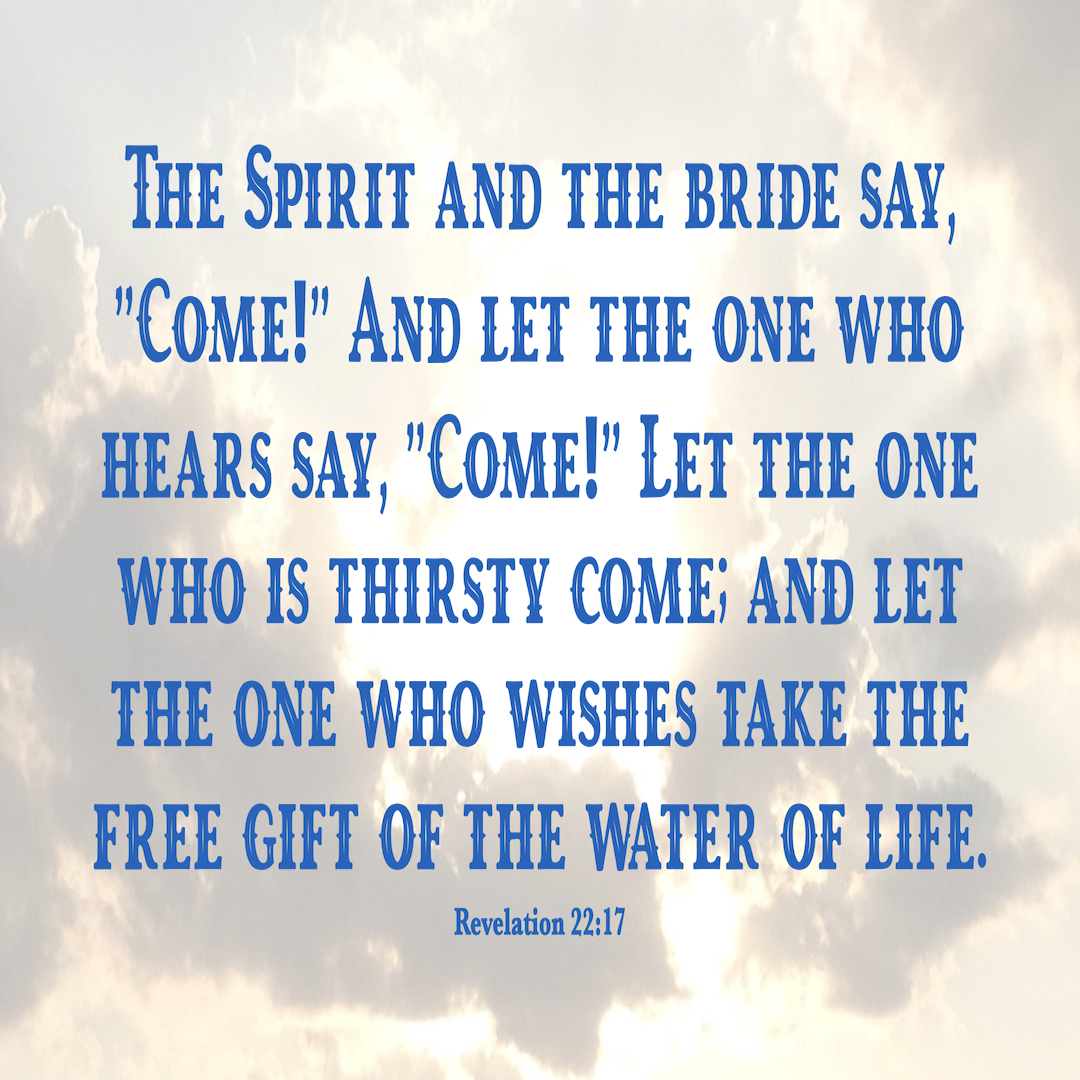
Just as royal weddings on earth captivate people who are watching the fairy tale-like wedding celebration, so will our devotion to the King intrigue and captivate a watching world. Notice again verse 17, “the nations will praise You for ever and ever.” When we love our King with all our heart, soul, mind, and strength, and then love others with that same love, we will draw the nations to our King (Revelation 22:17). 

If you have missed any of the other messages in our series looking at the Royal Palms, you can find them all here. 

►► Would you please prayerfully consider supporting this ministry? My Patreon supporters get behind-the-scenes access to exclusive materials. ◀︎◀︎
Light In The Darkest Of Times

Listen to the podcast of this post by clicking on the player below, and you can also subscribe on AppleSpotify, or Audible. 

One of the reasons I appreciate the Bible—in fact, one of the main reasons that continually convinces me of the truthfulness of the Bible—is the way it portrays life as it really is. It doesn’t avoid the difficult subjects, nor does it sugarcoat the bitterness of life. The Bible tells it as it is. 

The songs that have us singing praises to God “when the sun’s shining down on me and the world’s all as it should be” are great, but when we can also find hope when we’re “found in the desert place” is the real test. 

Dark times come to all of us. 

David is anointed king of Israel and given a promise by God for a lasting legacy (2 Samuel 7:8-9, 16, 27-29; Psalm 110:1). And yet David cried out one of the most painful phrases ever uttered in Psalm 22:1-2, “My God, my God, why have You forsaken me?”  

(Check out all of the Scriptures in this post by clicking here.) 

Despite the promises that God gave David, when any of us are in a dark place, there is a natural human tendency to focus on the darkness around us and second-guess what is happening to us. You know the questions:

  • How did I get here? 
  • How will I get out of here? 
  • When will I get out of here? 
  • Have I offended God and perhaps missed out on His promise? 
  • Has He forgotten me? 

The Bible does tell us, “If You, Lord, kept a record of sins, Lord, who could stand?” and we also know it’s true that “all have sinned and fall short of the glory of God” (Psalm 130:3; Romans 3:23). 

That’s for us, not for Jesus. He is the sinless One. He obediently became human to rescue us, knowing full well that He was the fulfillment of the promise God made to David (Matthew 1:1; 22:41-44). Yet He ended up uttering the same painful words David did (Matthew 27:41-46). 

Remember I said that King David was a visible picture to help us see the coming King of kings. David was inspired by the Holy Spirit with this knowledge (Acts 2:29-30, 25-28). 

The old hymn says, “When darkness veils His lovely face, I rest on His unchanging grace” and “When all around my soul gives way, He then is all my hope and stay.” Look at David’s preaching to himself:

  • I am feeling forsaken (Psalm 22:1-2) … YET You are on Your throne (vv. 3-5) 
  • I am scorned by others (vv. 6-8) … YET You are closer than my scorners (vv. 9-11) 
  • I am completely cut off (vv. 12-18) … BUT You are my rescue (vv. 19-24) 

What did Jesus know:

  • He would sit on the throne of Heaven—Matthew 26:62-64 
  • His Father was completing everything—John 19:30; Psalm 22:25-31 
  • He would conquer every enemy—Revelation 1:8, 18 

Jeremiah cries out about his dark time, and then like David he says, “YET this I call to mind and have hope.” Jeremiah then talks about the never-ending love and mercy of God, and concludes by preaching to himself, “I say to myself, ‘The Lord is my portion; therefore I will wait for Him’” (Lamentations 3:19-24). 

The Lord is my portion” means the Lord is my King who declares promises and fulfills promises. 

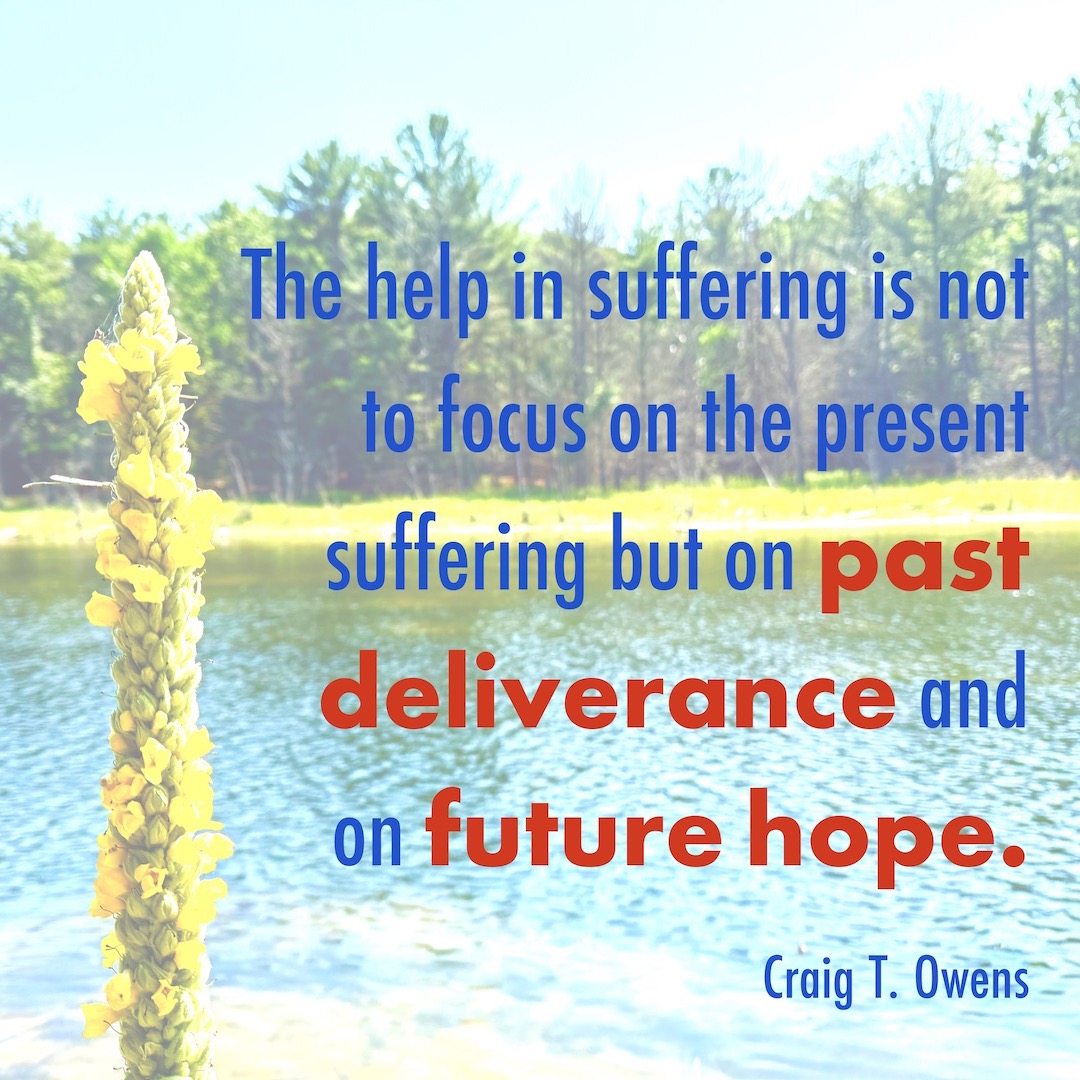
The help in suffering is not found in focusing on the present darkness—and all the questions—but to focus on God’s promises. Like David’s “yet” and “but” we need to preach to ourselves about God’s past deliverance and then be assured of our future hope. 

Just assuredly as our King of kings said, “I will be resurrected from the dead to sit on the throne of Heaven,” He also said, “I will come to take you where I am”! 

Take your eyes off the present, temporary darkness and put them on the eternal King! 

If you have missed any of the messages in this series on the Royal Psalms, you can find them all here. 

►► Would you please prayerfully consider supporting this ministry? My Patreon supporters get behind-the-scenes access to exclusive materials. ◀︎◀︎
Refuge From The Shoving

Listen to the podcast of this post by clicking on the player below, and you can also subscribe on AppleSpotify, or Audible. 

I don’t know when the last was that you may have tried to get a dozen little kids lined up, but it’s quite an experience! Everyone is vying for their spot. Someone gets mad and yells out, “He cut!” And then the reply is yelled back, “No, I didn’t. She was saving my spot!” This usually results in lots of pushing and shoving as each person tries to reclaim their rightful place in line. 

This is the backdrop for Psalm 7. The introduction tells us that Cush is causing David grief. Maybe because Cush is from the tribe of Benjamin like King Saul, and he doesn’t want David cutting in line so he is shoving him back to his proper place. 

(Check out all of the Scriptures in this post by clicking here.)

There’s a musical term David uses, which isn’t used in any other psalm: shiggaion. This means a rhythm that isn’t normal—it’s a freewheeling, irregular, impassioned beat. This also helps set the atmosphere for what’s happening in David’s life. The root word for shiggaion implies a shakeup (or a shoving and pushing) that could lead to someone losing their way. 

David tries to do the right thing. He asks for God’s help (v. 1) so that he doesn’t get ripped to shreds (v. 2). He even takes time to ask himself if he has done anything that led to Cush’s shoving (vv. 3-5). But notice these are all David’s attempts to make things right. 

Remember that this is a Royal Psalm, but we haven’t heard anything about God as King yet. But now we come to the end of v. 5, which is also the end of David’s own striving. It’s marked by the word Selah. 

My little friends push and shove to try to get their place. But all of that stops when I say, “Johnny is my line leader, and this is the way the rest of you are going to line up behind him.” David’s Selah pause was a call to switch from doing things on his own to yielding to the King to sort things out. He was saying, “The King of kings is the Leader and He knows my place in line.” 

It’s only after the Selah that we see the royal terms for the Undisputed Leader:

  • He is the One who will decree justice (v. 6) 
  • He will rule…from on high (v. 7) 
  • He is the Supreme Judge (vv. 8, 11) so David yields his introspection to Him (vv. 3-4, 8-9) 
  • He is God Most High (vv. 10, 17) 

Our King has no rival. No one can shove Him. No one can contradict Him. No one can hide anything from Him (vv. 11-16). 

We must bow only to the King of kings (Philippians 2:10-11). 

We mistakenly bow our knee to man when…

  • …we aren’t willing to own our mistakes 
  • …we try to administer our own “shove” of justice 
  • …we make our own refuge 

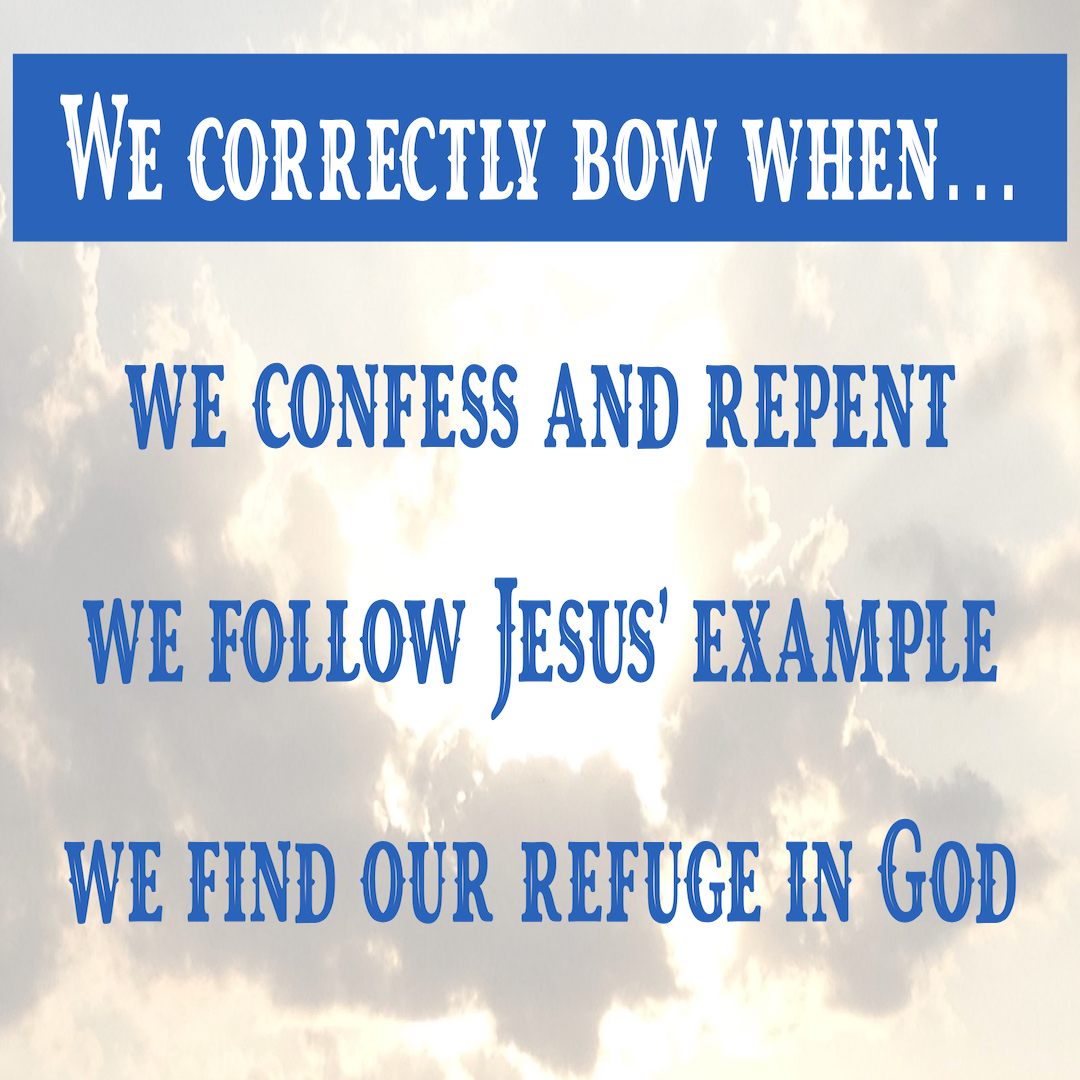
So we bow to the King when…

  • …we acknowledge, confess, and repent of our sins (vv. 3-5; Psalm 19:12, 69:5)
  • …we follow the example of Jesus when we’re shoved around (1 Peter 2:21-23)
  • …find our refuge solely in God (v. 1; c.f. 2:12; Ephesians 6:12; James 4:7)

Our best response in troublesome times—when you feel like you are being shoved around—is to fall to your knees in reverence to the King of kings (v. 17)! The beloved of the Lord shall dwell in safety by Him; He covers him all the day long, and makes His dwelling between his shoulders (Deuteronomy 33:12 AMPC). 

If you’ve missed any of the other messages in our series looking at the royal psalms, you can catch up by clicking here. 

►► Would you please prayerfully consider supporting this ministry? My Patreon supporters get behind-the-scenes access to exclusive materials. ◀︎◀︎