Turning From Moral Folly To Wisdom

“The man who says, ‘I want to go to heaven, but I don’t want to live a pure life; I want to be free to continue with my present life. I will change a little and do better, but I have no desire to be pure,’ or the man who says, ‘I want to escape hell and make heaven my home at last, but I have no particular desire to cease to live as I have lived’ is deceiving himself. You are hearing the language of a moral fool. This is not the language of wisdom, but the folly of the damned. … 

“The penitent man wants to be changed. If you are still sufficiently in love with yourself and all you want is a little improvement, I see no possibility of faith approaching your heart. Unless a man comes to Christ seeking to be a different person, to be humble, meek, and self-effacing, he is not coming to Christ at all. Unless we hate evil and love righteousness, at least to the degree we are able at the moment, we are still in the bonds of iniquity and the enemies of righteousness. … 

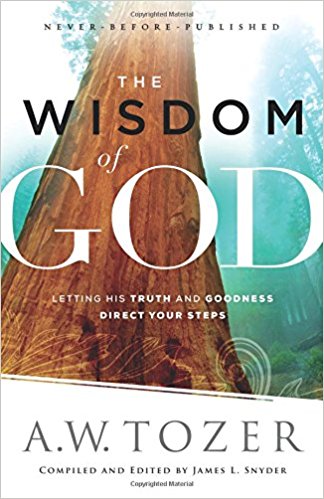
“Join me in this prayer: “Oh, I want to be other than what I am. I want to be different. I want to change. I am not satisfied. I want to believe in Thee, and trust in Thee, and throw myself boldly on Thee, and I want to be made like Thyself. I do not want only to escape hell, I want to escape sin. I not only want to go to Heaven at last, but I want to have Heaven in my heart now. I not only want to dwell with the redeemed, I want to be like the redeemed here on earth. I want to be another kind of person.” —A.W. Tozer, in The Wisdom of God

The Day Of The Lord

All we know about the prophet Joel is that he is the son of Pethuel, and his name means Jehovah is God. He appears to be addressing the southern part of Israel (Judah/Jerusalem). 

What is interesting to note about Joel’s writing is a recurring theme that goes something like this: 

Foreshadowing (or prophetic foretelling) → Calling for a godly response → God’s blessing on a right response or God’s punishment on a wrong response → An outcome which foreshadows or foretells another more dire event → repeat…

For instance, in Joel’s prophesy the massive invasion of locusts was intended to get the Israelites to pay attention to their sins. Joel calls for fasting and repentance and warns (foreshadows/foretells) that an invading army at a later date would do even greater damage (1:2-14). 

Likewise, the invading army—which would do more damage than the invading locusts—should also call the Israelites to repentance and imploring God for His help. 

Jesus, just like Joel, taught that whether it was an evil man, an accident, or even a natural disaster, painful things should cause us to consider the state of our eternal soul (see Luke 13:1-5). And Jesus and Joel both foretell of the Day of the Lord when there will be no more opportunities for repentance. 

To prepare God-fearing people for this dreadful day of the Lord, Joel foretells if the outpouring of the Holy Spirit. This is the same empowering Spirit that Jesus said would equip His followers to take the message of salvation to all four points of the compass (Acts 1:4-8). And just as Joel foretold 800 years earlier, on the first Pentecost Sunday after Christ’s ascension back into heaven, the Christians were baptized in the Holy Spirit, prompting Peter to quote an extension passage from Joel (compare Joel 2:28-32 with Acts 2:14-21).

Joel’s final chapter talks about Judgment Day, and about the multitudes, multitudes in the valley of decision. Peter confronted his audience as well about the decision they should make to turn to Jesus as their Savior and Lord. 

The Day of the Lord could come at any moment and millions around the world are still in the valley of decision. I find these words quite sobering—

“Someone asked, ‘Will the heathen who have never heard the Gospel be saved?’ It is more a question with me whether we—who have the Gospel and fail to give it to those who have not—can be saved.” —Charles Spurgeon 

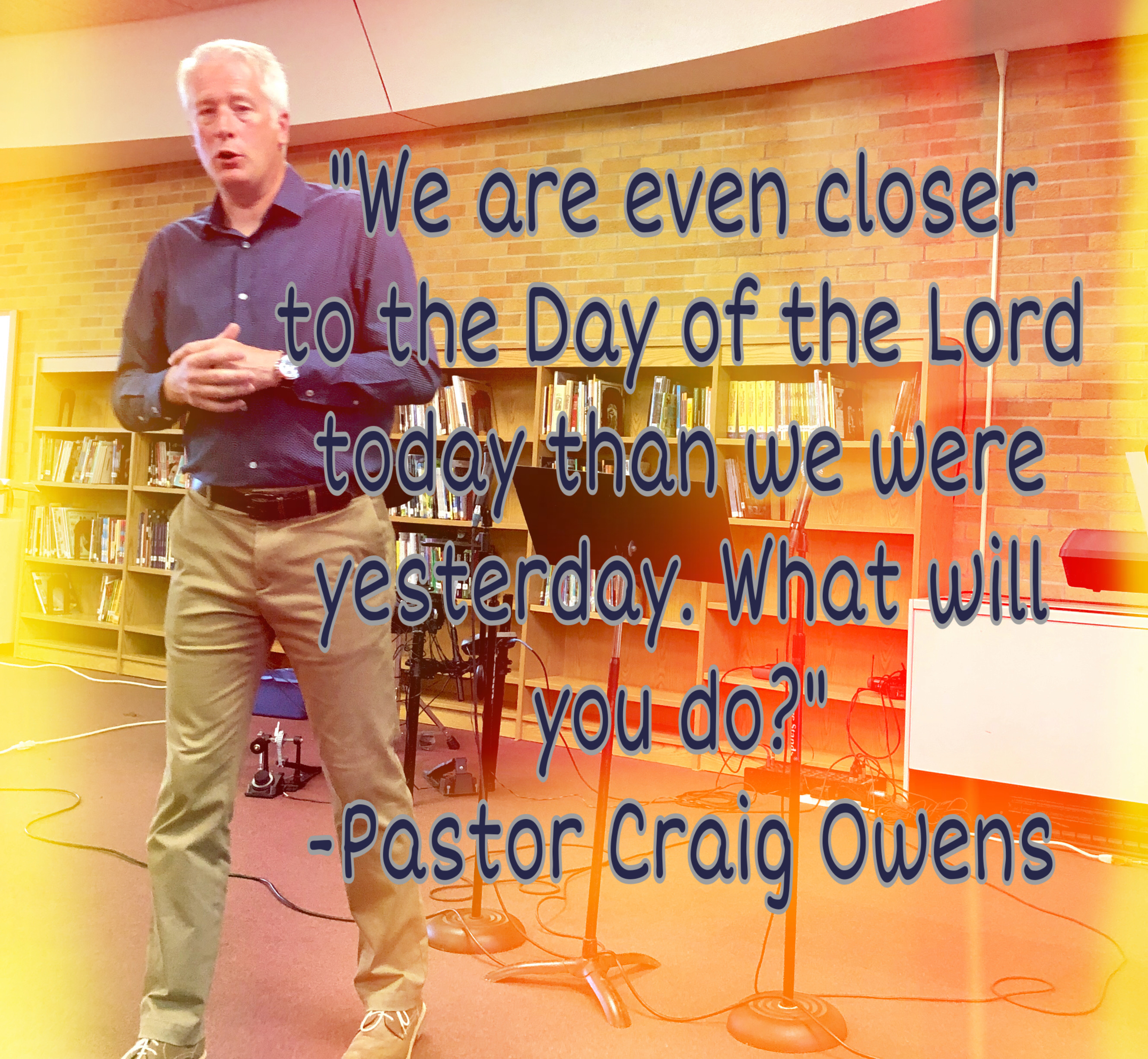
We are even closer to the Day of the Lord today than we were yesterday. What will you do?

Please join me this Sunday as we continue our series learning the major lessons from the minor prophets.

Thursdays With Spurgeon—Holding Two Extreme Truths

This is a weekly series with things I’m reading and pondering from Charles Spurgeon. You can read the original seed thought here, or type “Thursdays With Spurgeon” in the search box to read more entries.

Holding Two Extreme Truths

     This is a deep, unsearchable mystery. Man walks without a leash yet treads in the very steps that God ordained him to tread in as certainly as though manacles had bound him to the spot! Man chooses his own seat, selects his own position; guided by his will, he chooses sin, or guided by divine grace, he chooses right. And yet in His choice God sits as sovereign on the throne, not disturbing but still overruling and proving Himself to be as able to deal with free creatures as with creatures without freedom. As able to effect His purpose when He has endowed men with thought and reason and judgment, as when He had only to deal with the solid rocks and with the imbedded sea.

     O Christians! You will never be able to fathom this, but you may wonder at it. I know there is an easy way of getting out of this great deep either by denying predestination altogether or by denying free agency altogether. But you can hold the two: You can say, “Yes, my consciousness teaches me that man does as he wills, but my faith teaches me that God does as He wills, and these two are not contrary the one to the other. And yet I cannot tell how it is. I cannot tell how God effects His end. I can only wonder, and say, ‘Oh, the depth of the riches both of the wisdom and knowledge of God! How unsearchable are His judgments and His ways past finding out!’” (Romans 11:33). Every creature is free and doing as it wills, yet God is freer still and doing as He wills not only in heaven, but also among the inhabitants of this lower earth. 

From The Infallibility Of God’s Purpose

The debate has raged for years: predestination vs. freewill. 

People will sometimes ask me, “Are you a Calvinist (predestination) or an Arminian (freewill)?” And I always give the same answer, “Yes, I am a solid Cal-minian!” As with most things that are difficult for our finite, human minds to grasp about God’s nature, the answer is not either-or but it’s both-and.

C.S. Lewis captured the same sentiments as Spurgeon. Lewis always said the best course between two immovable ideas was right between them. He added, “Heaven will solve our problems, but not, I think, by showing us subtle reconciliations between all our apparently contradictory notions. The notions will all be knocked from under our feet. We shall see that there never was any problem” (emphasis mine).

Spurgeon would agree—there never was any problem, at least not with God. Any problems of understanding are in ourselves, not in Him. So far better than choosing one over the other, choose the both-and, and then stand in awe and wonder and worship that our infinite God is sovereign over all. Even over our puny, limited theologies and doctrines. 

Gone From My Sight

   I am standing upon the seashore. A ship at my side spreads her white sails to the morning breeze and starts for the blue ocean. She is an object of beauty and strength. I stand and watch her until at length she hangs like a speck of white cloud just where the sea and sky come to mingle with each other.

   Then someone at my side says, “There, she is gone!”

   “Gone where?”

   Gone from my sight. That is all. She is just as large in mast and hull and spar as she was when she left my side, and she is just as able to bear her load of living freight to her destined port.

   Her diminished size is in me, not in her. And just at the moment when someone at my side says, “There, she is gone,” there are other eyes watching her coming, and other voices ready to take up the glad shout, “Here she comes!” —Henry Van Dyke

Thursdays With Spurgeon—Study The Right Things

This is a weekly series with things I’m reading and pondering from Charles Spurgeon. You can read the original seed thought here, or type “Thursdays With Spurgeon” in the search box to read more entries.

Study The Right Things

     It is very advantageous to the Christian mind frequently to consider the deep and unsearchable attributes of God. … If we study man and make him the only object of our research, there will be a strong tendency in our minds to exaggerate his importance. We will think too much of the creature and too little of the Creator, preferring the knowledge that is to be found out by observation and reason to the divine truth that revelation alone could make known to us. … 

     The fleeting things of human life and the fickle thoughts and showy deeds of men are as movable and as changeable as the waters of the treacherous deep. But when we mount up, as it were, with eagles’ wings to Him Who sits upon the circle of the earth, before Whom all its inhabitants are as grasshoppers (Isaiah 40:22), we nestle in the Rock of Ages that from its eternal socket never starts and in its fixed immovability can never be disturbed.

From The Infallibility Of God’s Purpose

I read a lot of books. But in the hands-down, it’s-not-even-close category, I read the Bible more than anything else. It is the Book of books because it reveals the eternal Wisdom behind the earth’s wisdom. 

Zig Ziglar used to say, “Every morning I read my Bible and I read the newspaper. That way, I know what both sides are up to.” That’s pretty good!

We read the Bible not just to know the Bible, but to know the One Who authored the Bible. Or, as I like to say it—

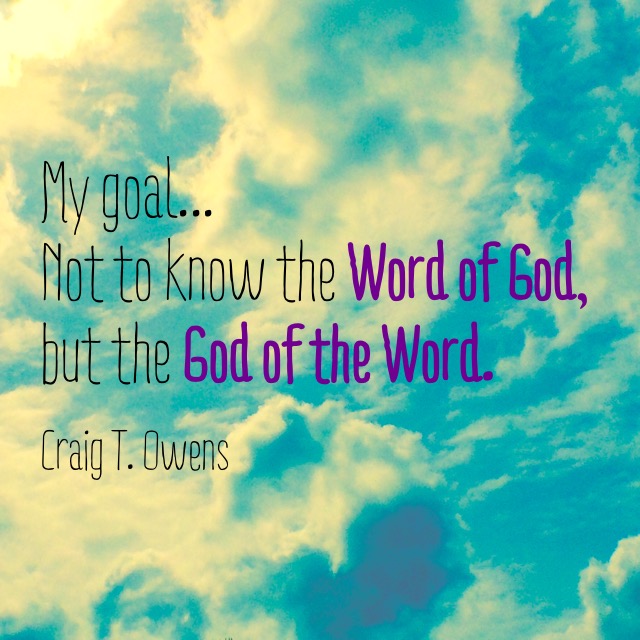
My goal in reading the Word God is to get to know the God of the Word better and better.

Charles Spurgeon would never say—nor do I—that you shouldn’t study a variety of topics. Just make sure that your priority is God’s Word. This will give you the greatest insight into other topics and will protect you from humanistic error. 

The Personal Element

It is the personal element that Christian discipleship needs to emphasize. ‘The gift without the Giver is bare.’ The call of this age is a call for a new discipleship, a new following of Jesus, more like the early, simple, apostolic Christianity when the disciples left all and literally followed the Master. Nothing but a discipleship of this kind can face the destructive selfishness of the age, with any hope of overcoming it. … But if our definition of being a Christian is simply to enjoy the privileges of worship, be generous at no expense to ourselves, have a good, easy time surrounded by pleasant friends and by comfortable things, live respectably, and at the same time avoid the world’s great stress of sin and trouble because it is too painful—if this is our definition of Christianity, then surely we are a long way from following the steps of Him who trod the way with tears of anguish for a lost humanity.” —Rev. Maxwell in Charles Sheldon’s In His Steps (emphasis mine)

A Life Worthy Of The Gospel

Only let your conduct be worthy of the gospel of Christ… (Philippians 1:27).

The apostle Paul wanted the Philippians’ living to be their preaching. Much like Francis of Assisi said years later: “Preach always; if necessary, use words.”

The big question is—what does conduct “worthy of the gospel of Christ” look like? I believe Paul identifies at least 15 characteristics in just the next 20 or so verses

  1. It is not a people-pleasing lifestyle. It is a God-honoring, Spirit-lead, Christ-glorifying lifestyle.
  2. It is steadfast, which means it perseveres even through the trials and difficulties.
  3. It is a heart and mind unified with other Christians.
  4. It is bold—“without being frightened in any way by those who oppose you.” 
  5. It is strengthened in Christ and it is in constant fellowship with the Holy Spirit. 
  6. It overflows with loving comfort, affection, and mercy to those around it.
  7. It humbly serves others while confidently refreshing itself in Christ.
  8. It strives to live as Jesus did, seeking always for God to be glorified.
  9. It is obedient to the conviction and direction of the Holy Spirit.
  10. It finds pleasure in doing God’s will.
  11. It doesn’t complain.
  12. It is a blameless and harmless life.
  13. It shines a light that attracts others to God’s love.
  14. It holds fast to the Word of life for the long haul.
  15. It is a rejoicing, contented lifestyle.

Heavenly Father, may it always be said of my life that it is one that is worthy of the gospel of Christ. May I always be sensitive to the nudges of the Holy Spirit to keep my life aligned in this way. In Jesus’ name I pray, Amen! 

When Trials Come

Notice that the title of this post says “when” not “if.” Maybe this will be a newsflash for some of you (but I highly doubt it): Christians will face trials.

Even the apostle James says, “Dear brothers and sisters, when troubles of any kind come your way, consider it an opportunity for great joy” (James 1:2). Wait, trials are “an opportunity for great joy”? How can that be?!

→ Trials teach us lessons that we can learn in no other way! ←

How much more mature, and wise, and empathetic would we become if instead of trying to get out of the trials that come our way, we would instead see what we could get out of that trial!

We can rejoice, too, when we run into problems and trials, for we know that they help us develop endurance. And endurance develops strength of character, and character strengthens our confident hope of salvation. And this hope will not lead to disappointment. For we know how dearly God loves us, because He has given us the Holy Spirit to fill our hearts with His love. (Romans 5:3-5)

“When trials come we can try to get out of them, or we can learn to get something out of them.”

—Craig T. Owens

So the next time a trial comes your way, ask the Holy Spirit to show you what lessons you can learn by going through the trial.

The Church Needs To Foster Community

“Amid the confusion of Christians mistreating people with gender dysphoria to prop up their sense of self-righteousness, and progressives mistreating them to advance their agenda of autonomy, those with real identity struggles are forgotten. Christ alone understands who we are through and through. And because of that each one of us in our fractured states needs to come to Him. …

“The need of the hour is for biblically faithful compassion. The church needs to open its doors and Christians need to open their hearts so that those struggling to find resolution to their dysphoria—and those who are struggling to find clarity amidst other confusions—can find community and, ultimately, their true identity in Christ. In Christ, they can be understood. …

“God’s original intent is for harmony between one’s soul and one’s body. This is why Christians, of all people, should be compassionately concerned with helping people find mind-body congruence. For the Christian, the mind and the body are both important and were meant to work harmoniously. … This biblical perspective defends our integrity as whole human beings in contradistinction to the secular effort to reduce us to our chemistry and jettison any idea that we have an immaterial mind or soul. …

“That is why the invitation of Christ has come in this order: recognition, repentance, redemption, regeneration. When we recognize our need for the Savior (because of our sins in general, not because of our dysphoria), repentance happens and then we are redeemed. But that redemption works itself out in our lives over time. It is the Holy Spirit who lives and works in us to conform us to Jesus’ likeness. It is not an overnight process, which means the church must do a better job of helping that process along. The church needs to foster community.” —Abdu Murray

Ultimate Wisdom

Last week I posted a quote on some of my social media channels that simply stated: “Our opinions don’t matter if they don’t square with God’s Word on the matter.” This seemed to me to be a fairly uncontroversial statement, but one anonymous reader really took me to task for using the hashtag #objectivetruth. Apparently, he thinks there is no such thing. 

But don’t we all rely on objective, external standards all the time? For instance, a gallon of gasoline is a gallon regardless of where you buy it, or whether you feel like it’s a gallon or not. And when you go to pay for your gasoline, the price isn’t based on how the gas station attendant is feeling at that moment, but on the objective amount posted. 

Psalm 49 is somewhat unusual in that it is a “wisdom psalm.” This psalm feels a lot more like something we would read in Proverbs or Ecclesiastes than it does a prayer or song in the Psalms. 

For instance, the first four verses of this Psalm sound a lot like the opening verses of the Book of Proverbs. And verses 5-13 of the Psalm echo what Solomon wrote in Ecclesiastes 2. 

This psalmist—like Solomon—wants us to understand how important it is to get wisdom. So we are urged to listen intently to those who have hard-won insight, to those who have “been there, done that” so that we don’t have to repeat their folly. 

What is that wisdom? It can be broken down into two profound statements:

(1) Everyone dies. 

That can be a really depressing truth IF your focus is building your own kingdom. If all there is to life is what you can earn and build before you die, only to realize that your “kingdom” ends at your last breath, that can be very depressing. 

However, this realization that everyone dies can be a very liberating truth IF your focus is on the eternal kingdom that is awaiting you in Heaven. When you realize that Jesus is preparing a place for you to experience ultimate joy and unending pleasure forever and ever, then you will live here for what’s coming next! 

(2) Our eternal destination after we die is determined before we die.

If someone told me that he had discovered the secret to immortality, and then he died and came back to this life to tell me that his theory was correct, it would be wise listen to him. 

That’s exactly what Jesus did for us!

He told us that He would die on a Cross and that He would be raised back to life. AND HE DID IT! His hard-won insight, His “been there, done that” wise words to us are this—“Believe in Me. I died to pay the penalty for the sins that will keep you out of Paradise. So place your faith in what I did, and ask my Father to forgive your sins. Then I promise you that you will spend forever and ever with Me in Paradise!” 

THIS objective truth determines everything else about our lives. 

So I’ll repeat it again—

“Our opinions don’t matter if they don’t square with God’s Word on the matter.” —Craig T. Owens

Join me next Sunday as we continue our series looking at the Selahs in the Psalms.