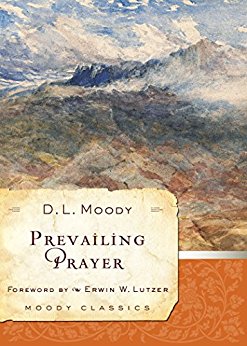
D.L. Moody challenges all Christians to stick with prayer a little longer. Far too many of us give up too soon, and miss out on the miracle God wants to do. Check out my review of Prevailing Prayer by clicking here.
“The two first and essential means of grace are the Word of God and Prayer. … If we read the Word and do not pray, we may become puffed up with knowledge, without the love that buildeth up. If we pray without reading the Word, we shall be ignorant of the mind and will of God, and become mystical and fanatical, and liable to be blown about by every wind of doctrine.”
“The reason we so often fail in moving our fellowmen is that we try to win them without first getting power with God. Jesus was in communion with His Father, and so He could be assured that His prayers were heard.”
“It is not by eloquent sermons that perishing souls are going to be reached; we need the power of God in order that the blessing may come down.”
“Our Master’s prayers were short when offered in public; when He was alone with God that was a different thing, and He could spend the whole night in communion with His Father. My experience is that those who pray most in their closets generally make short prayers in public.”
“In Proverbs 28:9 we read, ‘He that turneth away his ear from hearing the law, even his prayer shall be abomination.’ Think of that! It may shock some of us to think that our prayers are an abomination to God, yet if any are living in known sin, this is what God’s Word says about them.”
“There is a great deal more said in the Bible about praise than prayer; yet how few praise-meetings there are! David, in his Psalms, always mixes praise with prayer. Solomon prevailed much with God in prayer at the dedication of the temple; but it was the voice of praise which brought down the glory that filled the house. … However great our difficulties, or deep even our sorrows, there is room for thankfulness.”
“Even if nothing else called for thankfulness, it would always be an ample cause for it that Jesus Christ loved us, and gave Himself for us.”
“When the church, the pulpit, and the pew get united, and God’s people are all of one mind, Christianity is like a red-hot ball rolling over the earth, and all the hosts of death and hell cannot stand before it.”
“We are not told that Jesus ever taught His disciples how to preach, but He taught them how to pray. He wanted them to have power with God; then He knew they would have power with man.”
“It is not the most beautiful or the most eloquent language that brings down the answer; it is the cry that goes up from a burdened heart.”
“Some people think God does not like to be troubled with our constant coming and asking. The only way to trouble God is not to come at all. He encourages us to come to Him repeatedly, and press our claims.”
“The Lord delights in hearing His children make their requests known unto Him—telling their troubles all out to Him; and then we should wait for His time.”
“Let our prayer be that God may advance His work, not for our glory—not for our sake—but for the sake of His beloved Son whom He hath sent.”
While I was growing up I heard an oft-repeated phrase around our church: “I prayed it through.” I think this would resonate with the heart of Dwight Moody, as he clearly articulates this concept in his book Prevailing Prayer.
Quite simply, Moody defines prevailing prayer as prayer that “involves the whole of our being. It affects our minds because we are occupied with God; it affects our wills because we desire to be yielded to God; and it affects our emotions because we are consumed with a love for God.” But many people—even seasoned Christians—wold probably confess that praying like this is challenging. Moody would agree with this, which is why he has given us such a practical book.
Moody not only lays out for us what will increase the likelihood that we will prevail in prayer, but he also diagnoses some of the roadblocks to this kind of consuming prayer. Each chapter links with the other chapters to build a convincing case that every Christian can learn how to prevail in prayer.
Moody uses stories from the Bible, stories from his own life and ministry, quotes from other Christian thinkers, as well as common-sensical ideas to create a desire to pray in this powerful, sustained way.
Whether you are a brand new Christian or a “seasoned saint,” Prevailing Prayer will energize your prayer life!
“This incense was to be ‘offered with’ or ‘laid upon’ so as to cover or envelope the ‘prayers of all saints’—yes, all saints, from Able downwards; for this seems to be the gathering into one of all prayers from the beginning, that at length they may be answered (Luke 18:3, 7). Upon the golden altar in front of the throne the prayers of the saints of all ages have been laid; there they have accumulated; the unanswered ‘How longs?’ not forgotten.
“Not one petition, even the poorest or feeblest, has dropped from that altar, or been swept away, or lost in the process of time. All, all are there. In themselves the are poor, having no fragrance; but their intrinsic imperfection cannot change the nature of that altar on which they are laid. There they are preserved— each sigh, each tear, each cry, from child or aged man, from the chief of sinners, from the thief upon the cross, from the chamber of weakness and sorrow, from the crushed spirit and the broken heart—there they are: the groanings that cannot be uttered; the ‘God be merciful to me, a sinner;’ the ‘How long?’ of the tortured martyrs; the moan of the suffering saint upon his tossing sick-bed—there they are: the father’s prayer, ‘Lord, save my child;’ the child’s prayer, ‘Lord, save my father’— there they are: the pleadings for the church of God, for the overthrow of Antichrist, for the binding of satan, for the deliverance of earth, for the consummation of the eternal purpose! Not one cry lost; not one petition gone astray. All there!
“There is no such thing as unanswered prayer. Delay will only add to the fullness of the answer, and increase our joy when it comes. And it will come. He is faithful that promised. He cannot deny Himself.” —Horatius Bonar, in Light & Truth: Revelation (emphasis mine)
This is an excerpt from the 21-Days For Life Prayer Guide (which I highly recommend) that outlines a clear moral pro-life philosophy.
There is no morally significant difference between the embryo you once were and the adult you are today that justifies killing you at that earlier stage of development. Differences of size, level of development, environment, and degree of dependency are not good reasons for saying you could be killed then but not now. Stephen Schwarz suggests the acronym SLED as a helpful reminder of those non-essential differences:
Size: You were smaller as an embryo, but does body size determine value? Of course not!
Level of Development: You were less developed as an embryo, but infants are less developed than teenagers physically and mentally. Do we think they have less value? Of course not!
Environment: Where you are has no bearing on what you are. Does an eight-inch journey through the birth canal change the essential value of the unborn? Of course not!
Degree of Dependency: You depended on your mother for survival, but does dependence on another human determine value? Of course not! (Consider those with disability, or conjoined twins, for example.)
In short, humans are equal by nature, not by function.
We all differ immensely in our respective degrees of development, but are nonetheless equal because we share a common human nature. We had that human nature from the moment we began to exist. If that isn’t true then human equality is a fiction.
Download this 21-day prayer guide for prayer points, encouraging pro-life stories, and helpful information that will equip you to articulate an effective pro-life position.
Jesus had a way of praying that sounds unusual to our ears because He didn’t pray “normal” prayers. His prayers were bold statements! But Jesus also taught us to pray just like He did.
Most prayers that Christians pray sound like they come from the same formula. We may start with something like, “Heavenly Father” or “Dear God.” Then we probably spend some time praising God for His greatness before we make our requests of Him. Often our requests include something like “If this is Your will, I ask You to please heal/help/answer/etc.” And then almost always the prayer concludes, “In Jesus’ name, Amen!”
When Jesus prayed, His prayers sounded more like commands than requests. He would say things like, “Be clean” or “Rise up and walk” or “Blind eyes, be opened.” He usually didn’t ask His Father if it was His will to heal/help/answer/etc. And He never concluded a prayer by saying, “In My name, Amen!”
In Luke 6 there is a story about a man with a withered hand. Jesus healed him by speaking to the man, not to God. He said, “Stretch out your hand,” and when the man did so, his hand was completely restored. Jesus spoke with the authority of the Creator.
I believe this was possible because Jesus had an unbroken conversation with His Father and the Holy Spirit. Certainly He had set times of prayer (see Mark 1:35, Mark 6:45-46, and Luke 6:12-13 as examples), but Jesus also told us that He only did what His Father told Him to do (John 5:19), and He only said what His Father told Him to say (John 12:49).
I know sometimes people want to say, “Yeah, but this is Jesus we’re talking about! C’mon, He’s the Son of God, so of course He could do these things.” But remember that the miracle of Christ’s Incarnation is that He chose NOT to do these things out of His Deity while He was on Earth, but restricted Himself only to His humanity. That’s why the Bible says that everything we face, Jesus also faced in the flesh (Hebrews 2:14-18).
But perhaps another example from someone who had no Deity in his nature might help. Consider Joshua—this man spent more time in God’s presence, listening to His voice, than even Moses (Exodus 33:11). So when the time came, Joshua could pray an incredibly bold prayer: He actually spoke to the sun and the moon and told them to stand still in the sky, AND THEY OBEYED HIM!
Just like Jesus spoke to the man with the withered hand in the authority of the Creator, Joshua spoke to the sun and the moon in the same authoritative voice. How could these men do that? Because they were familiar with God’s voice, and when He told them to speak out boldly, they simply obeyed.
Jesus said we could pray the same way—Very truly I tell you, whoever believes in Me will do the works I have been doing, and they will do even greater things than these, because I am going to the Father. And I will do whatever you ask in My name, so that the Father may be glorified in the Son. You may ask Me for anything in My name, and I will do it (John 14:12-14, emphasis added).
How can we learn to pray this boldly? We need to spend more and more time in dialogue with God. We need to become increasingly aware of the His abiding presence with us. Then we, too, can pray in the Creator’s authority.
Praying this way glorifies God!
Get together with a friend this week and work through these application questions:
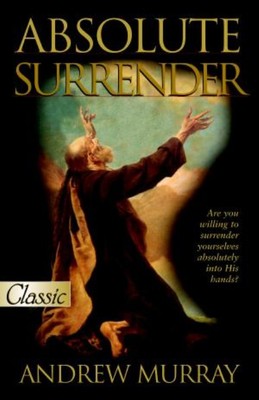
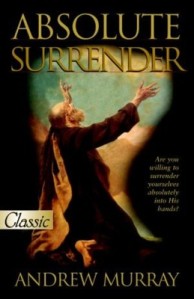
This book is a challenging book for any Christian to read. Check out my review by clicking here, and then check out a few quotes that especially caught my heart.
“I have a pen in my pocket, and that pen is absolutely surrendered to the one work of writing, and that pen must be absolutely surrendered to my hand if I am to write properly with it. If another holds it partly, I cannot write properly. … Can God work His work, every day and every hour, unless you are entirely given up to Him? God cannot.”
“How much Christian work is being done in the spirit of the flesh and in the power of self! How much work, day by day, in which human energy—our will and our thoughts about the work—is continually manifested, and in which there is but little of waiting upon God, and upon the power of the Holy Ghost!”
“One of the great causes why God cannot bless His Church is the want of love. … It is only when God’s people stand as one body, one before God in the fellowship of love, one toward another in deep affection, one before the world in a love that the world can see—it is only then that they will have power to secure the blessing which they ask of God.”
“A great many of us try hard at times to love. We try to force ourselves to love, and I do not say that is wrong; it is better than nothing. But the end of it is always very sad. ‘I fail continually,’ such a one must confess. And what is the reason? The reason is simply this: Because they have never learned to believe and accept the truth that the Holy Spirit can pour God’s love into their heart.”
“You can deceive yourself with beautiful thoughts about loving God. You must prove your love to God by your love to your brother; that is the one standard by which God will judge your love to Him. If the love of God is in your heart you will love your brother.”
“God has a plan for His Church upon earth. But alas! we too often make our plan, and we think that we know what ought to be done. We ask God first to bless our feeble efforts, instead of absolutely refusing to go unless God go before us. God has planned for the work and the extension of His kingdom.”
“God can only reveal His will to a heart that is humble and tender and empty. God can only reveal His will in perplexities and special difficulties to a heart that has learned to obey and honor Him loyally in little things and in daily life.”
“May God forgive me that I have allowed self and the flesh and the will actually to have the place that God wanted the Holy Ghost to have.”
“The cause of the weakness of your Christian life is that you want to work it out partly, and to let God help you. And that cannot be. You must come to be utterly helpless, to let God work, and God will work gloriously. … All God’s servants in the Old Testament counted upon the omnipotence of God doing impossibilities. And this God lives today, and this God is the God of every child of His. And yet we are some of us wanting God to give us a little help while we do our best, instead of coming to understand what God wants, and to say: ‘I can do nothing. God must and will do all.’”
“Ah, the great question for us to ask of God in self-examination is that we may be shown whether our religious life is lived more in the power of the flesh than in the power of the Holy Spirit.”
“Ah, yes; you failed because you do not accept the strength of God. God alone can work out His will in you. You cannot work out God’s will, but His Holy Spirit can; and until the Church, until believers grasp this, and cease trying to by human effort to do God’s will, and wait upon the Holy Spirit to come with all His omnipotent and enabling power, the Church will never be what God wants her to be, and what God is willing to make of her.”
I will be sharing more quotes from this book soon. To be notified immediately when these quotes are posted, fill in your email address in the field to the right and click “Sign me up!” Also be sure to follow me on Tumblr and Twitter for great quotes I share every day.
Last week I asked you to imagine how your relationship grew with your best friend. You probably found that this special friendship was formed during hours and hours of talking.
I’m going to guess that at first your conversation was a little on the superficial side. You talked about “tame” topics like sports teams, or your job, or the city you lived in. But at some point you took a huge risk—you became vulnerable by sharing something really personal. Perhaps you shared a time that you got hurt, or something that makes you anxious, or maybe a big dream you carry around in your heart. But if that friend is still your friend, that means they treated what you shared reverently. They didn’t laugh at you, belittle your hurts or dreams, nor did they share with others what you said.
The relationships became deeper and more special because you now knew each other on a more intimate level.
Prayer is a conversation with a Friend. Of course, that Friend is God, so some people wonder, “What do I talk to God about?” The simple answer is anything and everything!
Time and time again God calls us to come closer to Him (see Isaiah 55:1-3), to discuss with Him things we don’t understand (Jeremiah 33:3), or to be assured that He is intimately tuned in to what’s happening in our life (Psalm 139:17; 1 Peter 3:12).
How do we get there? A good place to start is with our Bible. Dwight Moody said:
“The two first and essential means of grace are the Word of God and Prayer. … If we read the Word and do not pray, we may become puffed up with knowledge, without the love that buildeth up. If we pray without reading the Word, we shall be ignorant of the mind and will of God, and become mystical and fanatical, and liable to be blown about by every wind of doctrine.”
Scripture was written to point us to Jesus. So we don’t read the Bible just to read it; we read it to get to know God.
A great place to start is in the book of the Psalms. Many of these were written as prayers, so it’s a good way to start our conversation with God. You can also search in the New Testament for all the places that biblical writers said, “I pray…” or “This is my prayer….”
I share a personal example of this in this video, especially if you want to fast forward to the 36:00 minute mark.
Don’t just read through the Bible this week—pray through the Bible. Use it as a means to have a conversation with the very Best Friend you could ever know!
I encourage you this week, as you think about this topic, to get together with an earthly friend and discuss these questions: