Our Perfect King

Listen to the podcast of this post by clicking on the player below, and you can also subscribe on AppleSpotify, or Audible. 

Our country has a policy of separation of church and state, and that appears to be a good thing. When the head of the government starts telling the church how to worship, or when the head of the church starts telling the government how to run its affairs, strife typically results. 

There have been some notable examples of wise kings who were God-fearing rulers, and some examples of religious leaders who had the wisdom to make just laws. But history has most often shown us that when a king imposes on the church a mode of worship or a pastor imposes on the king religious ways of governing, clashes result. Some of them have been bloody civil wars and some have spread into international conflicts. 

That being said, wouldn’t it be better for everyone if there was a way that one person could hold both of those offices simultaneously? If only there was some way to bring those different offices together. Very few people could ever accomplish this because it would require a perfect person with both absolute wisdom and complete God-honoring selflessness, someone so confident in both their wisdom and their relationship with God that they would never be swayed unfairly one way or the other. 

Last week we saw the first bold claim from Jesus: “I am the I AM.” With this title and authority, Jesus claimed to be the Head of the Church. This is a title Paul uses several times in his letter to the church at Ephesus (Ephesians 1:22, 5:23). Paul goes on to remind us that our aim as the Church body is to grow into maturity under the Headship of Jesus (Ephesians 4:15). 

Consider two other notable rulers during this same time period. As the high priest, Caiaphas would have laid claim to the title of “head of the church.” As the Roman governor, Pilate would have laid claim to the title of “head of the government in Judea.” Yet both of them clearly demonstrated that they had “become the symbol of those who make religious decisions based on political expediency rather than truth and justice,” as Dr. Donald Stamps noted. 

Paul goes father than calling Jesus simply the Head of the Church—

And He [Jesus] is the head of the body, the church; He is the beginning and the firstborn from among the dead, so that in everything He might have the supremacy. (Colossians 1:18) 

Not just Headship over the Church, but Headship over “everything.” 

After the bold claim of Jesus that He was the I AM, the Sanhedrin wanted to have Him put to death, so they took Jesus to Pontius Pilate (Luke 22:71—23:2; Matthew 27:1-2; John 18:28-37). 

Pilate “knew it was out of self-interest that they had handed Jesus over to him” (Matthew 27:18), but he still asked Jesus, “Are You the king of the Jews?” Just as Caiaphas was trying to save his position of power by keeping a delicate balance between the Jews and the Romans, Pilate was also trying to save his skin. Pilate was trying to appease both the Sanhedrin and Tiberius Caesar. 

Jesus answers Pilate’s question in a way Pilate never expected. Twice Jesus says “My kingdom,” noting that His kingdom is other-worldly. His kingdom comes from outside this world and therefore supersedes any government of this world. Pilate clearly has never heard anything like this, so after hearing this statement he announces, “You are a king, then!” 

Just as Jesus had answered the Sanhedrin with, “You are right in saying I am the Messiah,” now He answers Pilate, “You are right in saying I am a king.” 

Combining those two bold claims—“I am God” and “I am a King”—Jesus is the only One who can perfectly hold both offices without any conflict. This is what the prophecy in Isaiah 9:1-7 foretold, and this is the fulfillment that John shows us at the end of time (Revelation 17:14, 19:11-16). 

What does this mean for us? How are we now supposed to live knowing Jesus as our God and as our King? We should live confidently before our King and humbled before our God. We don’t fear earthly kings, but neither do we fight them. We don’t have to try to convince earthly kings to rule a certain way because they are God’s servants to accomplish God’s plan. We don’t have to get caught up in the politics of the day because this day will come to an end. 

We are subjects of a kingdom not of this world, so the kings of this world don’t get to decide our final destiny!

(If you would like to explore this topic further, check out my series of messages from 1 Peter called Aliens and Strangers.)

If you’ve missed any of the messages in our series called Bold Claims, you can find the full list of messages by clicking here. 

►► Would you please prayerfully consider supporting this ministry? My Patreon supporters get behind-the-scenes access to exclusive materials. ◀︎◀︎

Links & Quotes

How would you respond to someone who asked, “Why would God punish Jesus for what I did?” Here’s a thoughtful reply from cold-case detective J. Warner Wallace.

“It were a good strife amongst Christians, one to labor to give no offense, and the other to labor to take none. The best men are severe to themselves, tender over others.” —Richard Sibbes

What can archeology tell us about the place where Pilate sentenced Jesus to death by crucifixion?

Doug Clay shares some thoughts on what the resurrection of Jesus means for us today.

Wow, check out this photo from the Hubble Space Telescope. It is the most distant star yet photographed.

Celebrating my Dad’s 90th birthday!

Fight The New Drug shares the benefits of quitting porn from people who actually quit using pornography.

Crucifixion Events

Listen to the podcast of this post by clicking on the player below, and you can also subscribe on AppleSpotify, or Audible. 

The death of Jesus may be the most attested execution in all of history. It’s certainly the most meaningful execution, as the death of Jesus brought a fulfillment to prophecy that was made in the immediate aftermath of humanity’s first sin. 

I have frequently written about the historicity of the Bible. The crucifixion of Jesus is not a “once upon a time” or “in the make-believe land of Israel” story, but an actual event, which involved actual people, at an actual moment in history. Even the way the four Gospel writers record the crucifixion of Jesus attests to the historicity of this event.

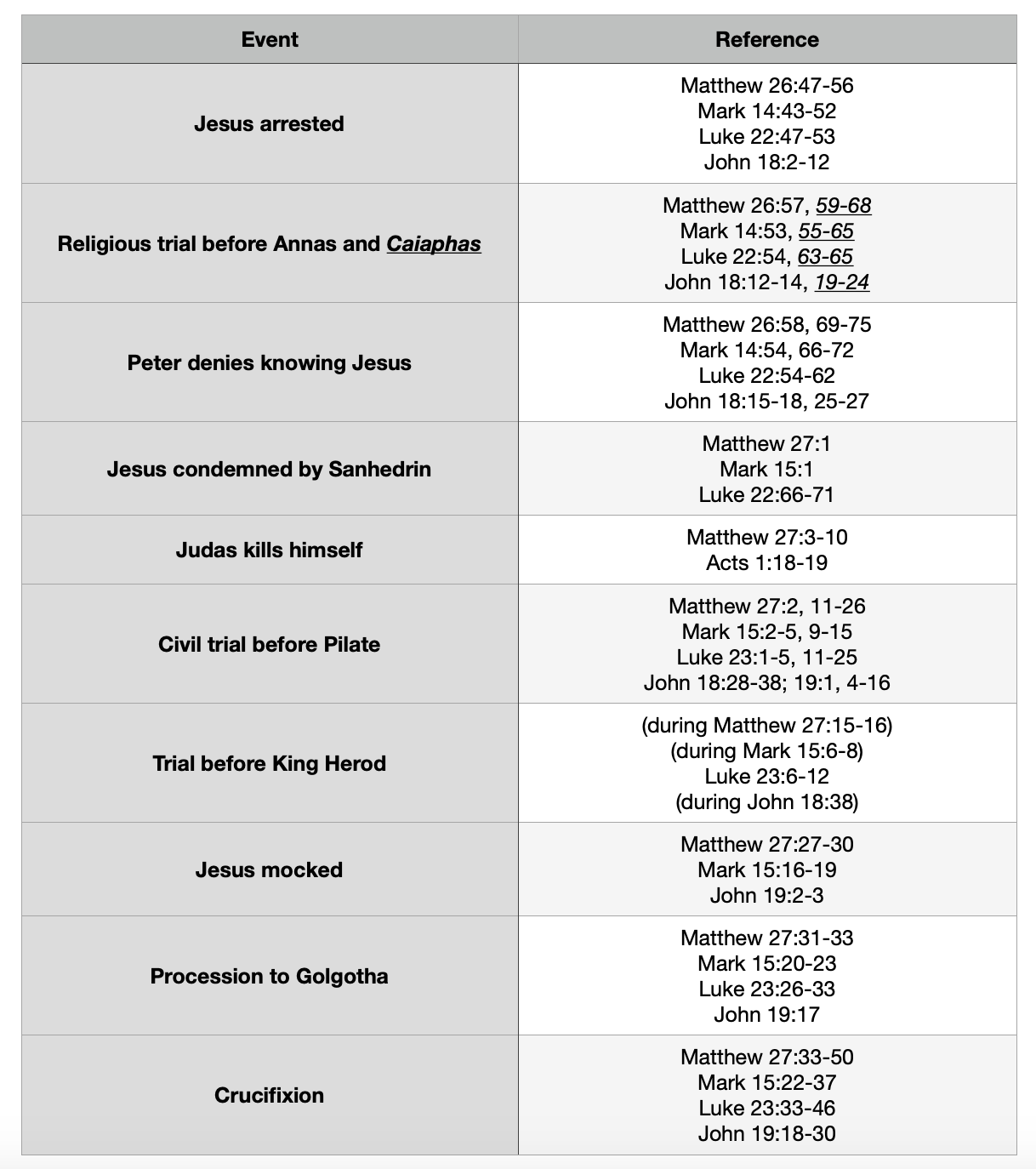
Check out this chart of the events that show how Matthew, Mark, Luke, and John record this historical moment. 

When did this moment in history occur? Consider this scholarly insight from The Archeological Study Bible

“In what year was Jesus born, and when was He crucified? These are long-standing historical questions. The seemingly obvious answer to the first—that He was born in A.D. 1 (there is no year 0)—is incorrect, however, since the calculations on which our modern calendar is based were faulty. …

“The chronology of Jesus’ life, though clear in outline, cannot be fixed with absolute precision. Matthew and Luke both inform us that Jesus was born before the death of Herod (4 B.C.), though it would appear that His birth occurred toward the final years of Herod’s reign, suggesting an approximate date of 6-4 B.C. The next chronological marker comes from Luke 3:1, where we learn that John the Baptist’s ministry began during the fifteenth year of the reign of the emperor Tiberius. Since A.D. 14 is the generally accepted date for Tiberius’ accession to the throne, John’s ministry would have commenced between August A.D. 28 and December of 29. Jesus began His own ministry shortly after John had embarked on his, at some point in A.D. 28 or 29, making Jesus about 32 or 33 years old at the time. This fits well with Luke’s statement that Jesus was ‘about 30 years old’ (Luke 3:23).

“The duration of Jesus’ public ministry was approximately three years. While the exact chronology of this period is difficult to ascertain, the final phase of His ministry allows for closer scrutiny. It is clear that Jesus was crucified under Pontius Pilate, who governed Judea from A.D. 26-36. …

“Taking Friday, Nisan 14, as the day of the crucifixion, astronomical data informs us that the only years from A.D. 29-36 that could have seen Nisan 14 on a Friday are A.D. 30, 33 and 36. A.D. 36 is easily dismissed as too late, while A.D. 30 seems too early (although some who begin Jesus’ ministry in A.D. 28 and shorten His public ministry find it acceptable). This leaves A.D. 33 as the most likely date for the year of Jesus’ death and resurrection.” 

As you celebrate the victory over sin and death that Jesus won by His sacrificial death on the Cross, rejoice also that this is an actual historical event that bought your freedom from your sin. It is indeed miraculous, but it is also historic. Let’s never lose sight of either of those facets. 

►► Would you please prayerfully consider supporting this ministry? My Patreon supporters get behind-the-scenes access to exclusive materials. ◀︎◀︎

First-Century Rulers In Palestine

I have frequently made the assertion that God is sovereign over all history, or as I like to say it… All History is His Story

When we are reading the Bible, it is important to keep in mind that these are not “once upon a time” stories, nor are they set “a long time ago in a galaxy far, far away,” but we are reading the accounts of actual people in actual moments of history.

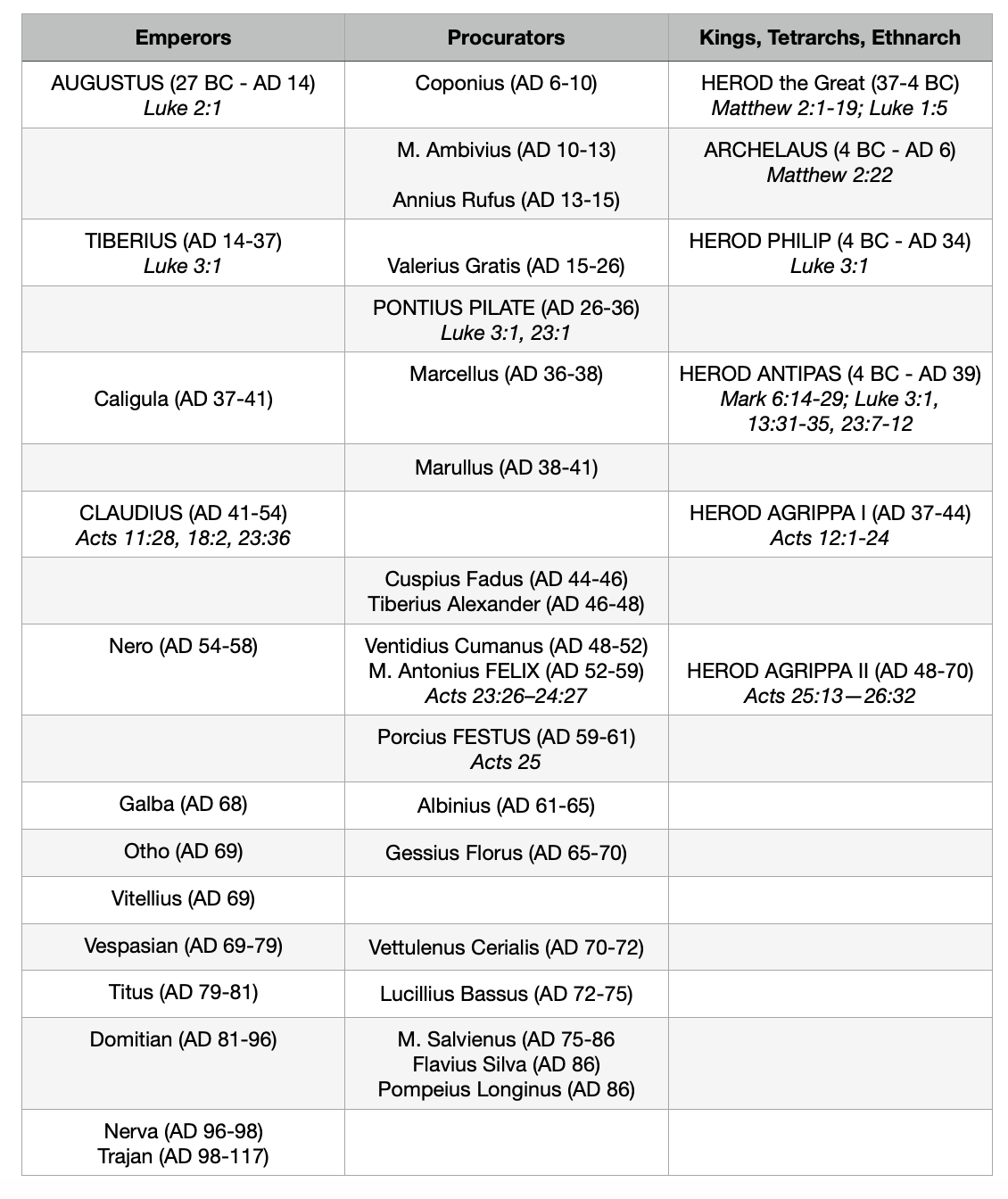
I hope this chart from The Archeological Study Bible helps you in your reading of the New Testament.

Any of the names listed above in ALL CAPS are people who appear on the pages of the New Testament.

You may also want to check out a previous post where I discuss the historicity of the Gospels, or this post and this post about the resurrection appearances of Jesus.

The Spirit Of Truth

Listen to the podcast of this post by clicking on the player below, and you can also subscribe on Apple or Spotify.

When I was 4 years old, I heard my echo for the first time as I yelled “Hello!” to a barn on the other side of a pasture. I was totally convinced that I had a friend in that barn yelling back to me, and I ended up being a bit disappointed later when I discovered that it was just my own sound waves bouncing back to me. 

To my 4-year-old brain, a little friend yelling back from the barn was absolutely true. It was maturity and new information that taught me differently. Isn’t this an ongoing story for all of us? Many things seem true from our current perspective, but then as we get older or smarter we realize that our original belief—what we really believed to be true—is now invalidated. 

Rarely does anyone admit, “I was immature back then,” but we usually try to justify ourselves by saying, “If I would have known back then what I know now….” But the fact is it will always be an impossibility for you to know then what you know now. 

In 1880, Edwin A. Abbott wrote Flatland, a favorite book of Albert Einstein. Abbott was a college-trained mathematician and theologian; in fact, he was actually better known for his theological writings than for this book. In this fabulous little book, Square, who lives in two-dimensional Flatland, cannot perceive height or depth. So what appears to him to be a wall, would merely be a line to you and me. One day Sphere from three-dimensional Spaceland visits Flatland, trying to explain to Square what his world was really like, but Square and his other Flatlanders could never fully grasp the idea. 

When Jesus was interviewed by Pilate, it sounds as though Pilate is missing a “dimension.” Pilate tries to state things the way that he understands them, but Jesus is revealing to him a whole new dimension (see John 18:33-38). The word Jesus uses for “truth” in this conversation means objective truth: something that is always true, regardless of where or when we live. Jesus explained that He as God IS objective truth. Any of our truth statements that aren’t grounded in God are subjective truth statements at best. 

Listen to how John describes Jesus: In the beginning—before all time—was the Word (Christ), and the Word was with God, and the Word was God Himself. He was continually existing in the beginning co-eternally with God. All things were made and came into existence through Him; and without Him not even one thing was made that has come into being. In Him was life and the power to bestow life, and the life was the Light of men. The Light shines on in the darkness, and the darkness did not understand it or overpower it or appropriate it or absorb it and is unreceptive to it. (John 1:1-5 AMP) 

Here’s the absolutely amazing thing: Jesus wants us to have this same insight into heavenly dimensions! Jesus said He would ask the Father to send us the Holy Spirit, Whom He called “the Spirit of Truth” (John 14:6, 16-17; 15:26; 16:12-13).

The Spirit of Truth…

  • …reminds us of the words of Jesus—John 14:26 
  • …helps us testify to others about the Truth—John 15:26-27 
  • …continually reveals objective truth to us—John 16:12-13 
  • …gives us truthful words to share with other “Flatlanders” who doubt the words of God—Matthew 10:16-20 
  • …and helps us spot and refute the falsehoods of the antichrist—1 John 2:18-27  

[Check out all of these Scriptures by clicking here.]

I love the King James Version of 1 John 2:20—But ye have an unction from the Holy One, and ye know all things. Being baptized in the Spirit of Truth means that you have access to an eternal perspective. You are no longer bound by the dimensions and paradigms of this “Flatland” but you are seeing things from God’s transcendent perspective. 

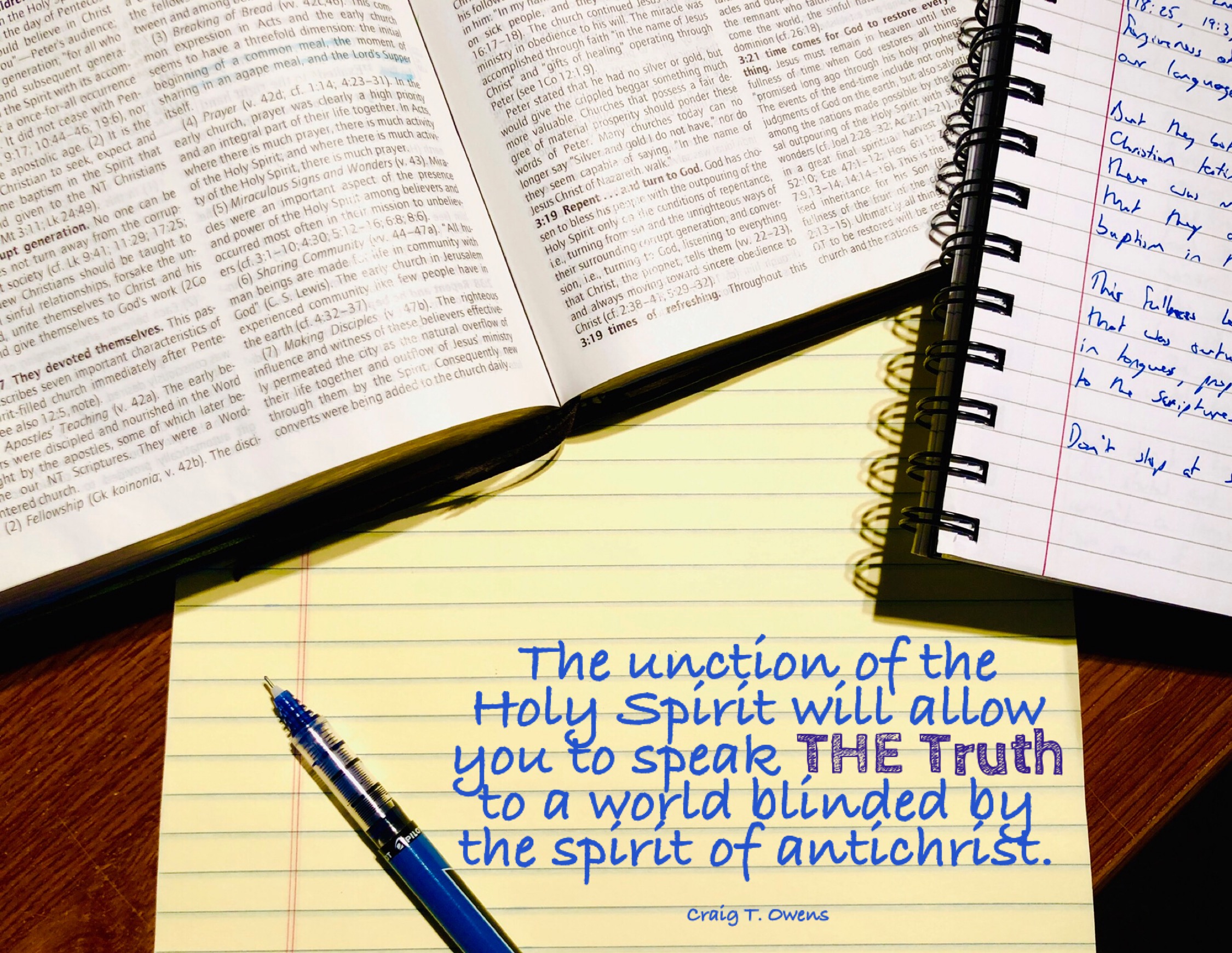
The unction of the Holy Spirit will allow you to speak THE Truth to a world blinded by the spirit of the antichrist. 

If you’ve missed any of the messages in our series We Are: Pentecostal, you can access the full list by clicking here.

►► Would you please prayerfully consider supporting this ministry? ◀︎◀︎

“Father, Forgive Them”

Listen to the podcast of this post by clicking on the player below, and you can also subscribe on Apple or Spotify.

In our system of law, special attention is given to someone’s dying declaration. If our legal system gives such weight to the last words of an imperfect man, it seems to me that we should take special note of the dying declarations of the only truly innocent Man who ever walked this earth: Jesus Christ. 

After being nailed to the Cross, the first dying declaration from Jesus was: Father, forgive them, for they do not know what they are doing (Luke 23:34). 

Let’s say that Billy is dying on a hospital bed after being fatally shot, and all he can muster the strength to do is point at Johnny and whisper, “He… shot… me….” We would know who the “he” was in that situation, but who exactly is the “them” in this declaration of Jesus? 

Who offended Jesus? Who mortally wounded Him? Who caused Him such anguish? Maybe it was…

  • His disciples who couldn’t stay awake to pray with Him 
  • Judas who betrayed Him with a kiss 
  • the nine disciples who ran away 
  • Peter who denied three times that he knew Jesus 
  • the false witnesses in Caiaphas’ house
  • the members of the Sanhedrin who hit Him and spit on Him 
  • the members of the Sanhedrin who were silent 
  • the temple guards who mocked Him 
  • those who spewed lies when Jesus stood before Pilate
  • those who lied about Jesus when He stood before Herod 
  • Herod and his soldiers who mocked Him 
  • the Roman soldiers who abused Him 
  • the Roman soldiers who stripped Him naked and crucified Him 

To all of the above, Jesus said, “Father, forgive them”!  

Listen to how Peter described the response of Jesus to all of this: When they hurled their insults at Him, He did not retaliate; when He suffered, He made no threats… (1 Peter 2:23). That word for insults means to heap abuse on Him or to pile on. This was a fulfillment of a 700-year-old prophecy: He was oppressed and afflicted… (Isaiah 53:7). Isaiah uses similar words, where oppressed means tyrannized, and afflicted means a humiliating, painful loss of dignity. 

Christ’s own disciples afflicted Him, and so did the temple guards, and Pilate, and King Herod, and the Roman soldiers… and you and me. All of this mistreatment and humiliation and tyrannizing was handed out by us too (see Isaiah 53:6; 1 Peter 2:24-25). That’s why His arms were spread so wide when He said, “Father, forgive them,” because there were so many that needed forgiveness! 

When Jesus said forgive, He was asking His Father to take away our guilt that kept us out of God’s presence. Think of a courtroom scene where God the Father is the Judge, satan is the prosecutor, Jesus is the victim, and I am the defendant. The evidence is overwhelming and incontrovertible, and I am pronounced guilty. My punishment is a death sentence. When Jesus says, “Father, forgive him,” He is taking the death penalty in my place! 

In another beautiful fulfillment of an Old Testament practice, Jesus became both our sin offering and our scapegoat, making atonement for us at the mercyseat in the Most Holy Place, and allowing us to be welcomed into God’s holy presence (Leviticus 16:15-16, 20-22; Hebrews 9:12-14). 

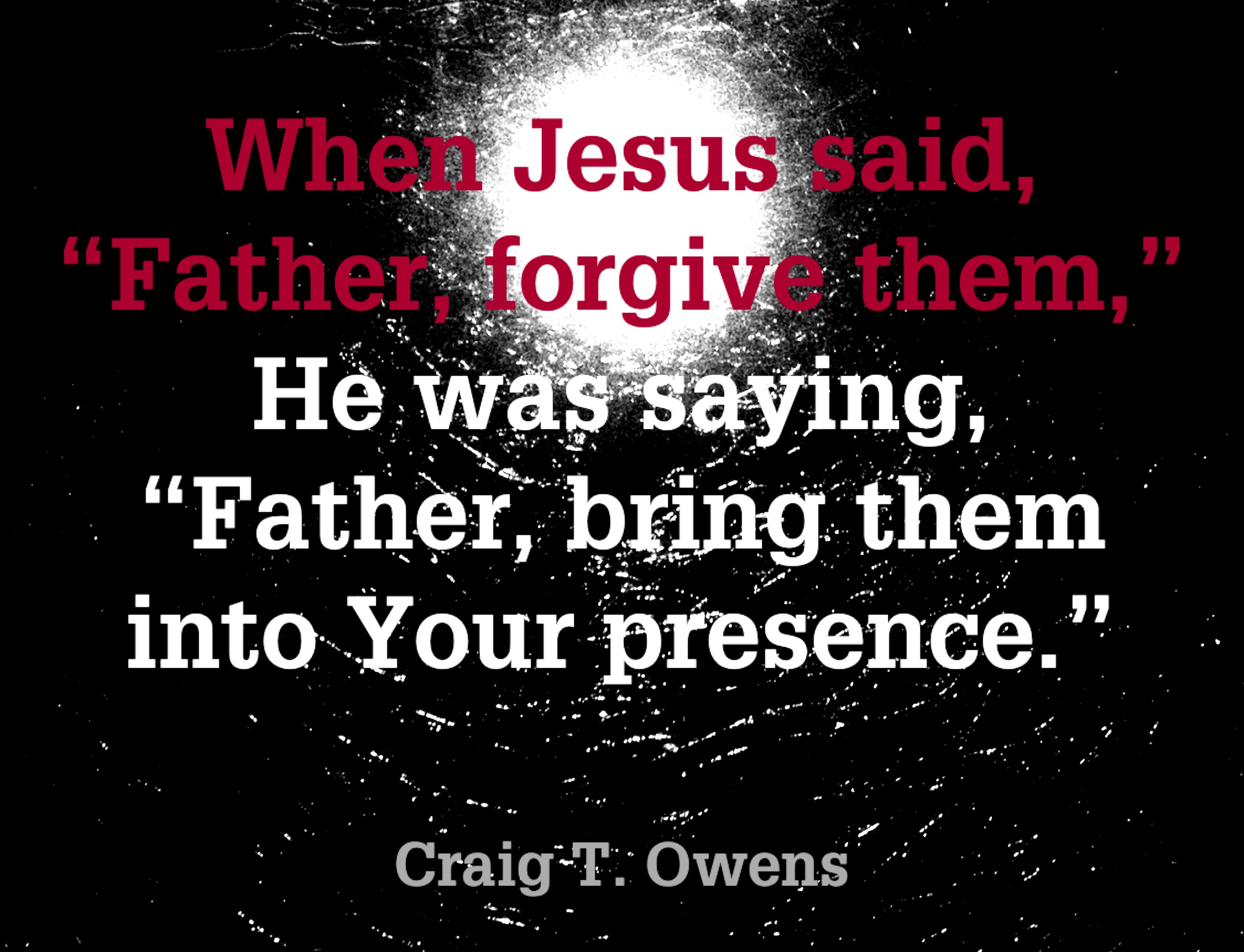
When Jesus said, “Father, forgive them,” He was saying, “Father, bring them into Your presence!” 

You and I need to accept by faith the atoning work done on the Cross, the forgiveness of sins that was purchased for us. Jesus didn’t come to condemn us, but to lovingly restore us, and for that we are eternally and humbly grateful. 

Please don’t miss out on any of these dying declarations from Jesus. You can find my thoughts on all of the confessions of this dying Man by clicking here.

►► Would you please prayerfully consider supporting this ministry? ◀︎◀︎

Sovereign Love

Listen to the podcast of this post by clicking on the player below, and you can also subscribe on AppleSpotify, or Audible.

Jesus is on His passionate journey toward the Cross. Every step on this journey is a step of love. 

After Jesus finished His last supper with His disciples, they all went to one of their favorite places to pray—the Garden of Gethsemane. It was a place they all knew well. Including Judas, who had been looking for an opportunity to turn Jesus over to the religious authorities when He was out of the public eye. 

Jesus knew this time was coming (Matthew 10:33-34; John 13:1, 3; 18:4), and His knowing prompted His serving. So we can say that His foot-washing service was as much a reminder to Himself as it was to His followers. 

After they entered the garden to pray, events began to unfold at a fast pace, ultimately culminating in Jesus being crucified. 

But let us never forget that through all of this horrific, inhumane mistreatment and torture, Jesus remains the King of kings, the Son of God. In fact, very God Himself.

The Jewish religious leaders knew this too (John 8:54-59; 10:31-33). And without “knowing it” the soldiers that came to arrest Jesus knew it as well.

Just look at the absolute authority of the King of kings. Grown men—religious leaders and hardened soldiers—fall to their knees at just three words: “I am He.” 

Christ’s kingdom has overruling authority. It collects no taxes, it has no standing army, it requires no checks-and-balances because its Sovereign IS Truth and Love. This unequaled, unrivaled power was contained in Jesus—“You would have no authority over Me unless it was given you from above.” 

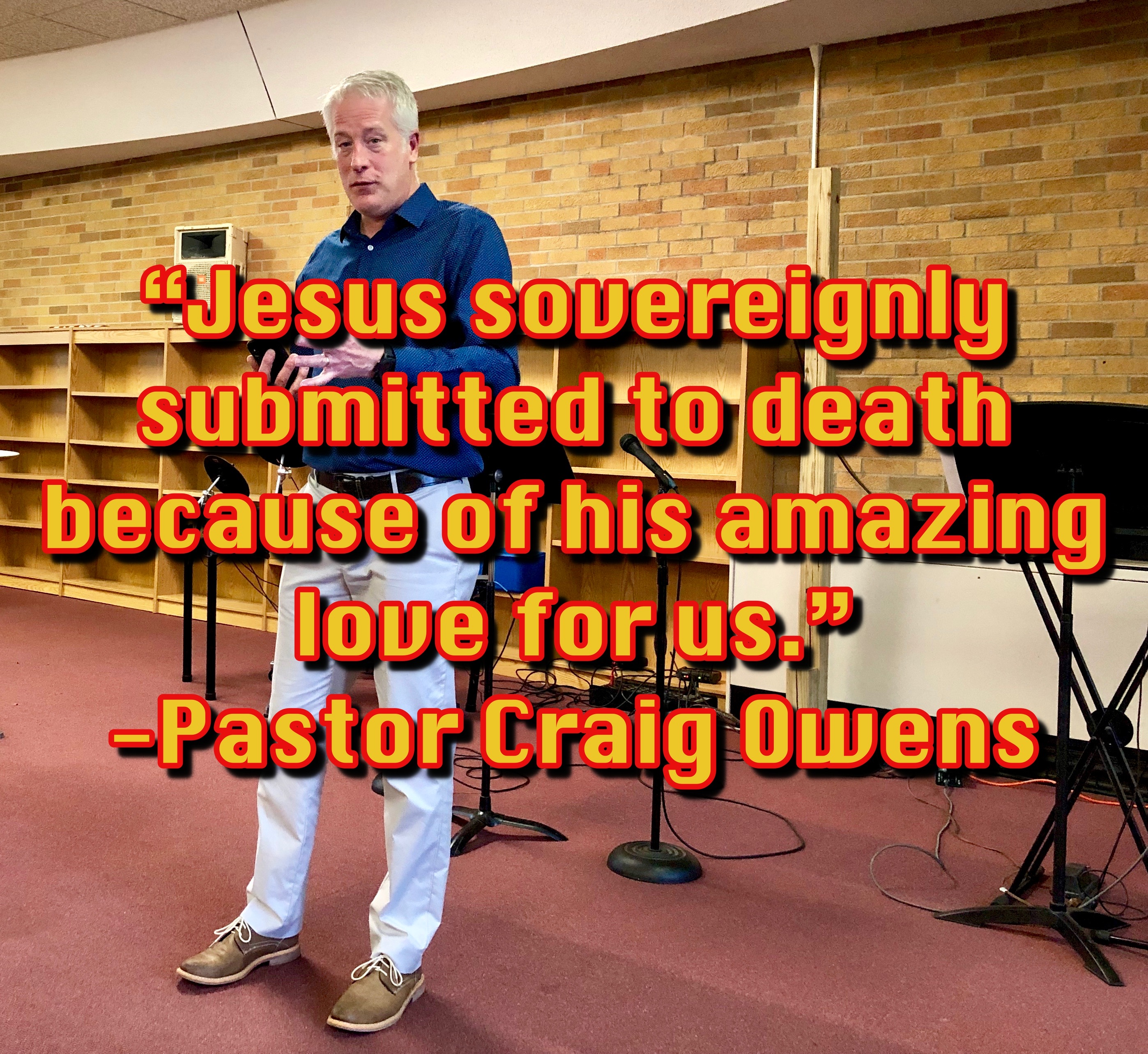
Which makes His submission to Pilate and others even more amazing! One word from Him could have crushed legions and toppled governments—yet for love’s sake, He submitted. Let that sink in—Sovereignty submitted.

What appeared to be the cruelty of man was the sovereignty of God. 

No one can take My life from me. I sacrifice it voluntarily. For I have the authority to lay it down when I want to and also to take it up again. For this is what My Father has commanded. (John 10:18) 

“Christ’s death was not the death of a martyr, who sinks at last overwhelmed by enemies, but the death of a triumphant conqueror, who knows that even in dying He wins for Himself and His people a kingdom and a crown of glory.” —J.C. Ryle 

Christ has bought us out from under the doom of that impossible system by taking the curse for our wrongdoing upon Himself. For it is written in the Scripture, “Anyone who is hanged on a tree is cursed” (as Jesus was hung upon a wooden Cross). (Galatians 3:13 TLB) 

Sovereign love submitted to the cruelty of man SO THAT you and I could be saved from the inescapable doom that will inevitably crash down on us. Jesus loved us so much that He allowed the Cross to happen to Him. 

The question now remains—what are you doing with this sovereign love? 

Do you know Jesus as your Savior? Have you received this gift He willingly, lovingly purchased for you on the Cross? 

If you have, let me ask you another question: Christian, are you living in a way that leads others to this sovereign love too (John 13:34-35)?

Anytime you see the Cross, remember what sovereign love did there for you. 

►► Would you please prayerfully consider supporting this ministry? My Patreon supporters get behind-the-scenes access to exclusive materials. ◀︎◀︎
What Are You Doing With God’s Story?

…You could have no power at all against Me unless it had been given you from above… (John 19:11)

As Daniel says, “The Most High is sovereign over all the kingdoms of the earth, and He gives them to whom He pleases.” 

God is sovereign. All of History is His story!

Pilate tried to change the story—twice he said, “I find no fault in Him” (vv. 4, 6). But still his caving in to the chief priests fulfilled His story.

The soldiers were looking for personal gain (v. 24), and yet their greed unwittingly fulfilled His story.

Jesus knew what was happening, and purposely let people treat Him a certain way to fulfill His story (vv. 28-30, 36-37). 

God is still telling His story today.

The question is—am I willfully fighting against it (like Pilate), or ignorantly fulfilling it (like the soldiers), or obediently submitting to it (like Jesus)?

Thursdays With Oswald—Jeremiah 5

This is a weekly series with things I’m reading and pondering from Oswald Chambers. You can read the original seed thought here, or type “Thursdays With Oswald” in the search box to read more entries.

Jeremiah 5

[These are notes from Oswald Chambers’ lecture on Jeremiah 5.] 

     The Bible is not so much a revelation about God as a revelation of God who is adequate to deal with the worst. …  

     The tumbling and turmoil in human history is caused everywhere by the consuming fire of God rather than by the futile rage of the devil. In reading history the saint sees that the great presence and power is God, not the devil. …

     Hordes of barbarians and powers of worldly dominion are unconscious of God, but God uses them for His own purpose. Nothing happens by chance. When our Lord stood before Pilate He said, “You would have no power over Me if it were not given to you from above” (John 19:11). The tyranny of the Roman Empire over God’s people was the providential order of God, and Jesus recognized that this was so, He did not start a revolution, or say, “We must fight against this” (John 18:36). Perils are clear to God’s mind alone, but they mean panic to everyone who does not know the mind of God. …  

     We learn the marvelous truth that we may become more than conquerors through our right relationship to God over everything that may come against us. …  

     In order to make proper changes in a nation’s life, you must change the people’s wants. 

From Notes On Jeremiah 

All over the globe, it appears that evil is holding sway and that sin is running rampant. It could appear as if the devil is winning, and Christians are just desperately trying to hold on to the end. But is that what it means when the Bible says that we are more than conquerors? 

Let’s be clear about this—God is in control. 

God may use barbarians, dictators, and evil people to accomplish His purposes, but they are all under His control. These forces have bounds past which they may not go. Any power they have has been given to them from above. 

If we forget this, we can easily fall into a hand-wringing panic. But let’s remind ourselves again and again that God is in control! If our relationship with Him is right, then we truly soar over these temporal upheavals; we become more than conquerors through Him Who loves us!

Thursdays With Oswald—The Hardy Annuals

Oswald ChambersThis is a weekly series with things I’m reading and pondering from Oswald Chambers. You can read the original seed thought here, or type “Thursdays With Oswald” in the search box to read more entries.

The Hardy Annuals

     By “hardy annuals” I mean the healthy-minded sinners. … How are we to get these irreligious people who are quite happy and healthy-minded to the place where they want Jesus? … 

     I want us to look at three types of pagans—Gallio, Herod and Pilate. …. 

     “And Gallio cared for none of those things” [Acts 18:12-15]. He said in effect, “I have nothing whatever to do with your religious quarrels, I am not here to decide questions of your law for you.” The opponents of Christianity are not weak, they are opponents who are able to ignore us; so the first thing to do is to examine and see what kind of Gospel we are preaching. … Have I a pet doctrine I am lifting up? If I have, then these healthy-minded folk will simply heap ridicule on me; but immediately I preach Christ, something happens—the Spirit of God begins to work where I cannot. …

     Herod is a rare type of pagan, he is obscene; he was bad, unmentionably bad, and you will find that when he saw Jesus Christ face to face he was not the slightest bit troubled. Why? He had heard the voice of God before through John the Baptist, and he had ordered that voice to be silent [Mark 6:17-18]. Herod is the presentation of the awful possibility of a fixed character, absolutely fixed in immorality. Jesus Christ did not awaken one tremor of conscience in him….  Did you ever notice what is recorded? “Now when Herod saw Jesus, he was exceeding glad” [Luke 23:8-9]—why? For the same reason that people go to a picture show, they want to see things. We read that Herod questioned Jesus in many words; “but He answered him nothing.” … 

     Pilate represents the type of pagan who always seeks his own interests; that type is known to us all today. People belong to certain churches because it is better for their business; or they shift their membership to other churches because it is more convenient for business. A once-born man, who acts from this point of view is an opportunist. “If it is Jesus Christ’s Gospel that is in the ascendancy, then I will use it to serve my own ends.” You have to bring that man face to face with Christ, not with your experience, but with Jesus Christ Himself. … 

     Rely on the Holy Ghost as the most practical Being you ever knew, and live among the facts of God’s Word and among human facts, and people will recognize Jesus Christ through you. … The next time you come across a ‘hardy annual,’ see that you lay hold of God for that one until Jesus Christ is presented by the power of the Holy Ghost, and then you will see the altered face, the altered attitude, and the altered life. 

From Workmen Of God

Well said!