Listen to the audio-only version of this podcast by clicking on the player below, or scroll down to watch the video.
Honesty is a vital part of a successful organization, something that every good leader is well aware of. However, when was the last time you asked the question, “Am I being honest with myself?” In this episode, Greg and I unpack how honest self-reflection is a powerful tool to help improve your leadership.
[0:14] A challenging quote to kick off this episode.
[1:14] My breakthrough moment regarding my own self-assessment.
[3:37] What’s the difference between who I think I am and who I really am?
[6:00] We all operate with certain assumptions about ourselves.
[7:37] We share some good and bad experiences with interactions we have observed from other leaders.
[10:27] Leaders need to hold themselves to the same standards as the rest of their team.
[13:47] Why do leaders hesitate to self-evaluate?
[15:19] How do leaders create a safe environment to self-evaluate?
[18:45] Greg sends us down a rabbit trail!
[19:53] What does leadership integrity look like?
[22:17] Leaders need to know what their tendencies are.
Check out this episode and subscribe on YouTube so you can watch all of the upcoming episodes. You can also listen to our podcast on Spotify and Apple.
Listen to the audio-only version of this podcast by clicking on the player below, or scroll down to watch the video.
When every quality is distilled down, the two things a leader is looking for in a teammate are skill and will. Which one should come first, and what happens if you identify a deficiency in yourself or others in one of these areas? Greg and I tackle these questions, and much more, in this episode of The Craig and Greg Show.
[0:25] What goes into the hiring decision? We think there are two important categories.
[1:14] What are some key leadership skills?
[3:53] Which comes first—skill or the will to use the skill?
[4:49] Some skills are innate and some are learned.
[6:17] Willpower makes the skills go farther and work more effectively.
[8:44] Leaders love to coach those with hustle.
[11:03] Is there a trigger for someone’s willpower to kick in?
[13:18] Leaders sometimes need to adopt a no-matter-what willpower.
[13:59] Top skills that emerging leaders should cultivate.
[17:00] Positivity is an attractive quality.
[18:21] Leaders can help their teammates learn skills and willpower.
[19:52] We need to help people overcome the pull to quit too soon.
Check out this episode and subscribe on YouTube so you can watch all of the upcoming episodes. You can also listen to our podcast on Spotify and Apple.
Listen to the audio-only version of this podcast by clicking on the player below, or scroll down to watch the video.
Criticism is baked into leadership. Any change you make, whether good or bad, will be met with some level of criticism either internally or externally. Other times, you’ll be in the position of having to express criticism of a decision someone on your team made.
Navigating criticism in a productive way can be tricky, but luckily Greg and I are here to help! In this episode, we discuss how the right kind of criticism can be empowering for your organization.
[0:27] Leaders will always be criticized, even for the good things they have done.
[1:30] Leaders need both humility and confidence to process criticism in a healthy way.
[4:18] Is criticism different than an assessment? It seems like the word “critic” has been hijacked in a negative way.
[6:00] Defensiveness doesn’t help leaders, but we do need to protect ourselves.
[8:27] How do we give constructive criticism without putting others on the defensive?
[10:22] Why is it hard for people to receive criticism?
[12:55] How should we give feedback to others so that it will be received well?
[16:15] Is there a correlation between criticism and coachability?
[19:57] Let’s remember that many of our teammates have had negative interactions with a critical
leader, so we have to change the climate.
[21:28] What happens if a teammate won’t receive any feedback at all?
[23:20] Greg shares an insightful quote from Winston Churchill.
[25:26] As always, leaders have to go first!
Check out this episode and subscribe on YouTube so you can watch all of the upcoming episodes. You can also listen to our podcast on Spotify and Apple.
Listen to the podcast of this post by clicking on the player below, and you can also subscribe on Apple, Spotify, or Audible.
In my book Shepherd Leadership I talk about some strong, godly men who gave into temptation at a moment of weakness—David who behaved so poorly toward Bathsheba and Uriah, Elijah who got depressed and suicidal, and Peter who denied knowing Jesus.
One common factor for all of these guys is that their moment of giving in came when they were alone. They were isolated from others who may have been able to help them overcome the temptations that tripped them up.
Have you ever heard of the law of the weakest link?
If I have a chain with links that can handle 400, 300, 250, 175, and 500 pounds, how much weight can the chain hold? You don’t really need a calculator for this one because the answer is the capacity of the weakest link: 175 pounds. This is why it’s to my advantage to not only strengthen myself, but to help others grow their strength as well.
In Galatians 6:2-5, the apostle Paul talks about the strength we need for ourselves and our fellow Christian brothers and sisters. First, he says that each of us should test our own actions. I can only know my breaking point if I’m tested, and the Holy Spirit knows how to do this perfectly. After this testing, Paul says then I can take pride in myself without saying, “Well, at least I’m better than him!”
Quite simply, Paul tells each of us that we must be able to carry our own loads. Why? Because only a strong Christian can help someone else with their load. We each have to get stronger individually so that we have strength for others!
This is just like what we’ve been learning in our look at the Songs of Ascent: the goal is for all of the pilgrims to get to Zion together!
In this series, we are going to learn about six spiritual disciplines. Much like a physical workout, the Holy Spirit will start with us where we are. Not everyone will be at the same level nor will everyone progress at the same rate. But all of us will need these four things.
(1) Discipline. This is saying no to the easy thing or the thing that brings only fleeting happiness so that I can say yes to the things that bring eternal joy.
(2) Stick-to-it-iveness. I have to be committed to this process for a lifetime.
(3) Grace for yourself. There are going to be moments of struggles, plateaus, and even stumbles. Those are all a part of the journey, so we must extend grace to ourselves to learn, repent, and move forward.
(4) Patience for others. As I just mentioned, we are all on our own journey and we all progress at different rates. Let’s be patient with each other.
All of these spiritual disciplines are to strengthen us individually so that we have something to share with other saints (2 Corinthians 1:3-6).
These spiritual disciplines shouldn’t become legalistic. Don’t make the way you do it the way everyone has to do it. After all, a 175-pound link will be different than a 250-pound link.
What I am calling spiritual disciplines, C.S. Lewis called religious practices. In a letter to a friend, he wrote about the safety and beauty that result from these pursuits—
“I think about the practices what a wise old priest said to me about a ‘rule of life’ in general—‘It is not a stair but a bannister’…i.e. it is, not the thing you ascend by but it is a protective against falling off and a help-up. I think thus we ascend. The stair is God’s grace. One’s climb from step to step is obedience. Many different kinds of bannisters exist, all legitimate. It is possible to get up without any bannisters, if need be: but no one would willingly build a staircase without them because it would be less safe, more laborious, and a little lacking in beauty.” (C.S. Lewis)
T.M. Moore has a regular series of posts for pastors. This week he shared this, “In his training manual for pastors, Gregory the Great wrote, ‘There are some who investigate spiritual precepts with cunning care, but what they penetrate with their understanding they trample on in their lives: all at once they are teaching the things which not by practice but by study they have learnt; and what in words they preach by their manners they impugn. Whence it comes to pass that when the shepherd walks through steep places, the flock follows to the precipice’ (The Book of Pastoral Rule).” If you are a pastor, I encourage you to check out the Pastor To Pastor posts on The Fellowship Of Ailbe.
On May 22, A.D. 337, Emperor Constantine died. John Stonestreet wrote, “Many Christians think that Constantine was perhaps the worst thing to happen to the Church. They believe he made Christianity the imperial religion, thus leading the Church to compromise with pagan culture, marrying it to state power, and derailing the spread of the Gospel. The Church, they argue, was better off as a persecuted minority.” Please check out this post co-written by Dr. Glenn Sunshine that gives some better historical perspective than perhaps what you have heard previously.
One of the most powerful missions sermons I have heard was preached by Dick Brogden:
An important warning from Axis—What it is: The Surgeon General has issued a warning on the dangers of social media for teenagers. Why the alarm bell is reaching a fever pitch: People have been wary of social media’s impact on developing brains for two decades—so why are highly-visible tone setters, like the Surgeon General and the American Psychological Association, issuing big, sweeping statements now? Part of it could be because we are getting more quality data on how social media shapes a young person’s brain. One newer study that’s been getting some buzz suggests that individuals who received their first smartphone at a later age have better mental health as young adults. Several big bills that aim to protect minors online will be voted on this year as tech giants face increased scrutiny over their safeguards (or lack thereof), for younger users. Kids growing up even a decade from now may encounter a completely different digital landscape when it’s their turn to learn about online literacy.
Leaders always go first. I want to develop myself so that I have something to give to other emerging leaders around me. If I’m not growing, I’m not going to be able to help others. Check out this full conversation Greg and I had our on leadership podcast The Craig And Greg Show. And be sure to check out all of my videos on my YouTube channel.
“The important thing is not to stop questioning. Curiosity has its own reason for existing. One cannot help but be in awe when he contemplates the mysteries of eternity, of life, of the marvelous structure of reality. It is enough if one tries merely to comprehend a little of this mystery every day. Never lose a holy curiosity.” —Albert Einstein
This is sort of gross, but kind of cool at the same time. “A new study in the journal Scientific Reports concludes that 12 severed hands discovered in 2011 at Tell el-Dab’a (the site of the ancient Hyksos capital of Avaris) constitute the first bioarchaeological evidence of the gruesome ‘trophy taking’ practice of amputating the right hands of defeated enemies.” Read more about this find here. This is a corroboration of the ‘trophy taking’ David performed for King Saul in the Bible.
The more scientists learn about Creation, the more in awe of our Creator I am! Recently, researchers have discovered even more happening inside our cells that keep everything operating optimally. And then there’s this: “Besides the origin of the eye, Darwin had a problem with the origin of flowering plants (angiosperms—plants that produce seeds within an enclosure, i.e., a fruiting plant), known as Darwin’s abominable mystery. The biblical model of origins maintains that the first forms of life created by God were land plants on Day 3 of the creation week. Land plants were fully-formed and functional—‘in the beginning.’”
Dan Reiland encourages leaders to look at their weaknesses differently. “The chinks in your armor allow you to develop empathy and compassion. They give you insight to human nature. They help you genuinely connect with people. Without these things it’s difficult to lead with God’s heart.”
I am a proud member of the Assembly of God fellowship, so I especially loved reading this report on Breakpoint:
“According to recent research by pastor Ryan Burge of eight major Protestant denominations, only the Assemblies of God has seen a steady increase in church membership since 1987. Each of the others, mostly denominations that are fully progressive theologically and culturally, are experiencing steady decline.
“Denominations like The Episcopal Church, Evangelical Lutheran Church in America, and the Presbyterian Church (USA) began long ago to move away from orthodoxy and capitulate to new ideas about sex, gender, and marriage. On the other hand, the Assemblies of God (AG) remained committed to orthodoxy on matters of Scriptural authority, the Deity of Christ, the Resurrection, and on sexual matters. It supports the protection of life at all stages, marriage between one man and one woman, and it insists that the body determines identity as male and female.
“Christians are constantly pressured, within the Church and without, to evolve on these issues or, we are told, we will die out. It seems however, that biblical orthodoxy draws people in. Maybe because it provides an anchor in confusing times.”
I am really looking forward to a new series of sermons that I am launching this Sunday. This will be a once-per-month series for the remainder of the year and it’s simply called A Christian’s Mental Health. If you don’t have a home church in the west Michigan area, I would love for you to join me in person, but the sermons will also be posted on my YouTube channel.
T.M. Moore has an outstanding post called The Essence of the Lie. In one part, Moore writes, “Thus the lie claims to be the truth, but, at the same time, it insists that truth is personal, relative, pragmatic, and utilitarian. Truth, from this perspective, is not absolute, but dynamic, changeable rather than fixed. It is conditioned by circumstances of time and place. At the end of the day, people are the final arbiters of truth, and truth is whatever they find to be useful for their purposes. Ultimate truth is that which people impose on others by one or another kind of force, whether intellectual, political, or physical.” Check this one out!
Harvard University has been studying a group of individuals since 1938 to try to determine the main factors that contribute to a long and healthy life. The director and assistant director of this study just published an article that sums up what they have learned over all these years—“[If] we had to take all 85 years of the Harvard Study and boil it down to a single principle for living, one life investment that is supported by similar findings across a variety of other studies, it would be this: Good relationships keep us healthier and happier. Period. If you want to make one decision to ensure your own health and happiness, it should be to cultivate warm relationships of all kinds.”
“The battle for control and leadership of the world has always been waged most effectively at the idea level. An idea, whether right or wrong, that captures the minds of a nation’s youth will soon work its way into every area of society, especially in our multimedia age. Ideas determine consequences.” — The American Covenant
“The storms of life are no longer our point of reference when [Jesus] is our focal point.” —Dutch Sheets
John Stonestreet was intrigued by a street reporter asking, “What are men good for?” There were a lot of soft, ambiguous answers given, but John quipped, “Men are good for fathering, protecting, loving, providing, leading, fighting for what’s right with their lives if need be, and obeying, in a masculine way, the creation mandate of the God who made us male and female and declared both ‘very good.’ Was that so hard?” Amen!
Listen to the audio-only version of this podcast by clicking on the player below, or scroll down to watch the video.
As leaders, it’s our responsibility to help our organization grow. As Greg and I discuss in this episode of The Craig And Greg Show, one of the best ways to do that is by focusing on your own personal development. It might seem counterintuitive, but by focusing inward we make ourselves more flexible, robust, and prepared leaders. This, in turn, enables us to better influence and encourage others in our leadership roles.
[17:21] Check out some of the benefits of personal development.
[19:15] It’s important to self-reflect on the areas where we’ve already grown.
[20:34] More benefits that come with personal development.
[23:10] Personal development is the best resume.
[25:07] I have seen that as I develop myself I am able to be a greater help for my team’s development.
[26:14] Comparing is a personal development killer.
[27:24] Progress is exciting!
[29:22] Greg and I would love to help coach you in your personal development.
Check out this episode and subscribe on YouTube so you can watch all of the upcoming episodes. You can also listen to our podcast on Spotify and Apple.
Listen to the podcast of this post by clicking on the player below, and you can also subscribe on Apple, Spotify, or Audible.
There are so many things a leader can do to develop themselves and develop the people around them. In fact, at times there may be too many things from which we could choose!
So how do we narrow it down? How do we know which things to guard in our schedule, which things to drop, and which things to add?
One thing that has been immensely helpful for me is asking the question, “Why do I want to do this, or learn this, or make a commitment to this?” And then answer the question with these two words, “So that….”
What is the “so that” I am aiming for? How will that thing enhance my leadership or develop me personally? I need to keep asking that question again and again until I hit upon the key factor that needs to be added to my schedule and then guarded in my schedule.
I co-host a leadership podcast called The Craig And Greg Show with my lifelong friend Greg Heeres. On a recent episode, we were discussing the value of personal development and we got into this “so that” topic.
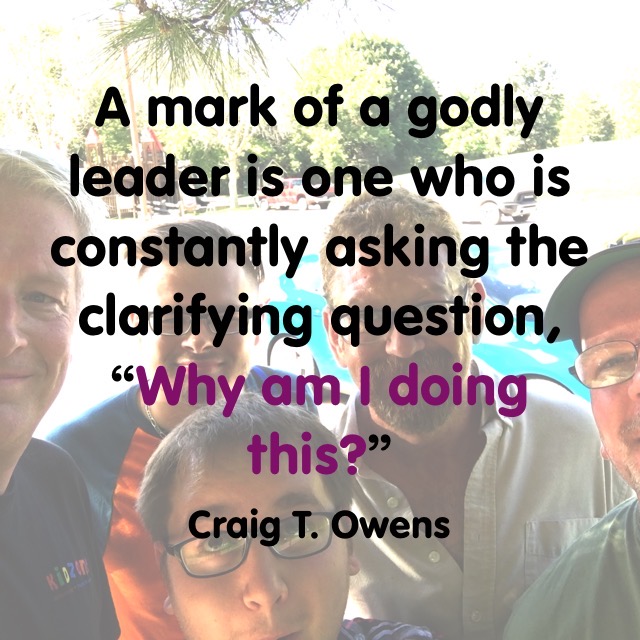
A mark of a godly leader is one who is regularly asking the question, “Why am I doing this?” and then continually drilling down to a solid “so that” reason.
If I can help coach you through this process in your leadership journey, please reach out to me.
This is part 68 in my series on godly leadership. You can check out all of my posts in this series by clicking here.



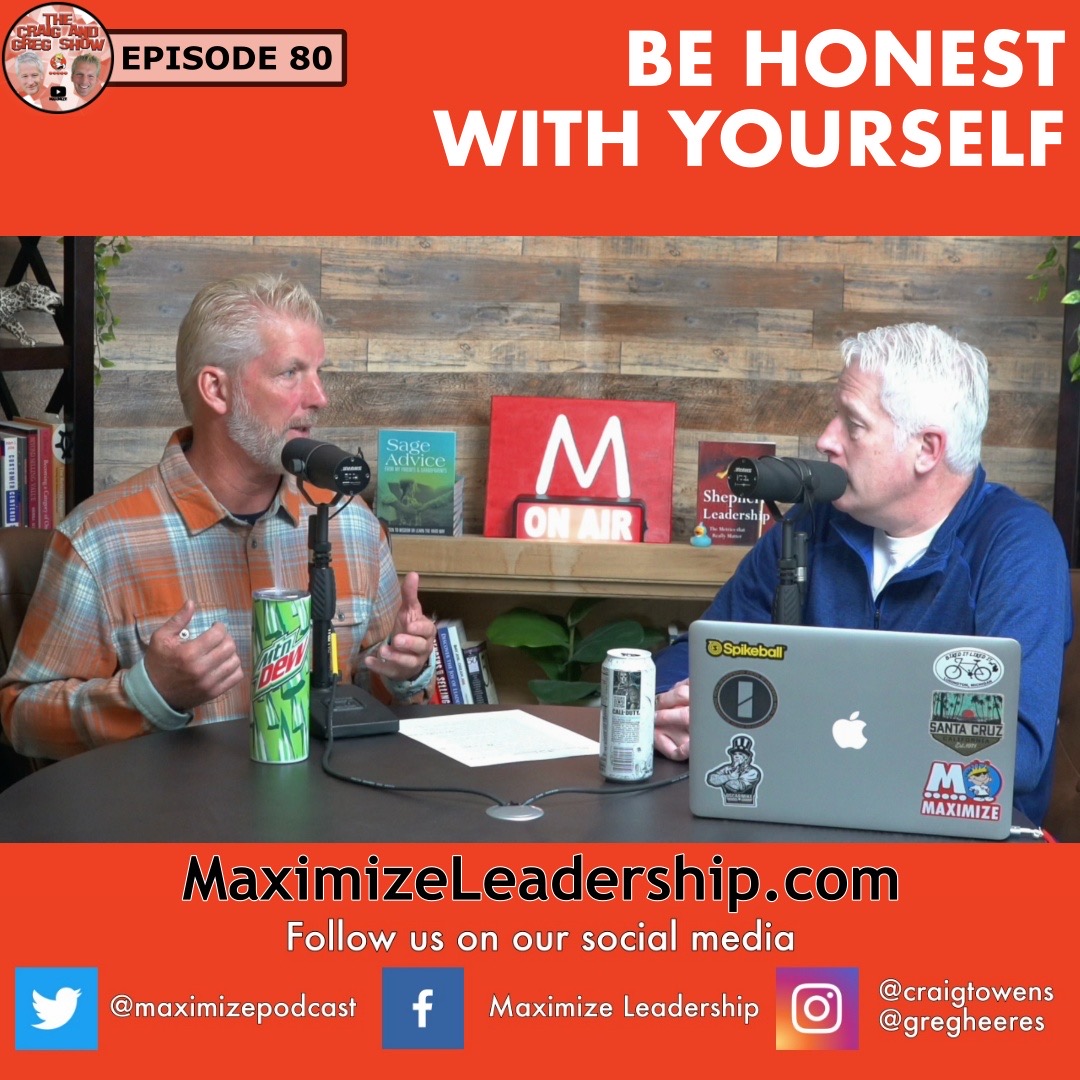 Honesty is a vital part of a successful organization, something that every good leader is well aware of. However, when was the last time you asked the question, “Am I being honest with myself?” In this episode, Greg and I unpack how honest self-reflection is a powerful tool to help improve your leadership.





 Craig T. Owens