Links & Quotes

link quote

These are links to articles and quotes I found interesting today.

“The patience of hope does not turn men and women into monks and nuns, it gives men and women the right use of this world from another world′s standpoint.” —Oswald Chambers

The proper place of science in our culture: Science And Its Limits

Astronomers, cosmologists and physicists are always trying to explain the “missing” parts of their evolutionary theories: Missing Galaxy Mass Found

Very good! The Non-Physical Sides Of Sex

“You may think it out of place for me to say so, but in our churches today we are leaning too heavily upon human talents and educated abilities. We forget that the illumination of the Holy Spirit of God is a necessity, not only in our ministerial preparation, but in the administrative and leadership functions of our churches.” —A.W. Tozer

“It is not the man who has too little, but the man who craves more, who is poor.” —Seneca

“Selfish religion loves Christ for His benefits, but not for Himself.” —David Brainerd

“Few marriages can make it if both partners are hiding out from God. Show me a marriage without one partner that is close to Jesus, and I’ll show you a marriage with little chance of survival. At least one of the partners must be in daily consultation with the Lord. It is best when both husband and wife are talking to Him, but if one partner is running from God, it is all the more important that the other be able to run to a secret closet of prayer for help and direction. A praying wife can often save her marriage, as can a praying husband. Love alone is not enough to keep a marriage strong—only God’s power can do that. That power is at work right now, healing and keeping marriages. Where Jesus rules, the marriage can make it.” —David Wilkerson

Don’t Exasperate Them

Pastoring is not for the faint of heart. Nor those easily offended. Nor those lacking in patience…. You get the idea!

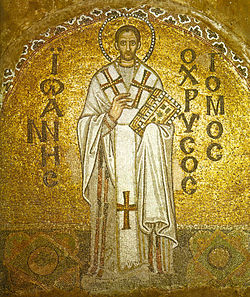
ChrysostomJohn Chrysostom (347-407) gave this counsel to pastors—

Thus then must the Priest behave towards those in his charge, as a father would behave to his very young children; and as such are not disturbed either by their insults or their blows, or their lamentations, nor even if they laugh and rejoice with us, do we take much account of it; so should we neither be puffed up by the promises of these persons nor cast down at their censure, when it comes from them unseasonably.”

The Bible tells fathers not to irritate and provoke your children to anger [do not exasperate them to resentment], but rear them [tenderly] in the training and discipline and the counsel and admonition of the Lord. (Ephesians 6:4, Amplified Bible)

Instead we should follow the example of Jesus, the Great Shepherd—

When He saw the throngs, He was moved with pity and sympathy for them, because they were bewildered (harassed and distressed and dejected and helpless), like sheep without a shepherd. (Matthew 9:36, Amplified Bible)

Ask our Shepherd to give you His patience, and compassion, and tenderness, and wisdom to carry His sheep in your arms. After all, it’s His flock that we’ve been given the privilege and responsibility to care for!

19 Quotes From “If Ye Shall Ask”

If Ye Shall AskA challenging and educational look at prayer from the unique perspective of Oswald Chambers is If Ye Shall Ask. You can read my book review of this book and another book on prayer Chambers wrote by clicking here. These are some of the quotes that I especially liked from this book.

“Prayer is not an interruption to personal ambition, and no man who is busy has time to pray. What will suffer is the life of God in him, which is nourished not by food but by prayer.”

“The purpose of prayer is to reveal the Presence of God, equally present at all times and in every condition.”

“Our Lord in His teaching regarding prayer never once referred to unanswered prayer; He said God always answers prayer.” 

“As long as we are self-sufficient and complacent, we don’t need to ask God for anything, we don’t want Him; it is only when we know we are powerless that we are prepared to listen to Jesus Christ and to do what He says.”

“If prayer is not easy, we are wrong; if prayer is an effort, we are out of it.” 

“If once we accept the Lord Jesus Christ and the dominion of His Lordship, then nothing happens by chance, because we know that God is ordering and engineering circumstances.”

“A thing is worth just what it costs. Prayer is not what it cost us, but what it cost God to enable us to pray. It cost God so much that a little child can pray. It cost God Almighty so much that anyone can pray.” 

“It is not a prayer that is strenuous, but the overcoming of our own laziness.”

“We must be in continual practice so that when we find ourselves in a tight place we are perfectly fit to meet the emergency.” 

“There is no such thing as a holiday for the beating of your heart. If there is, the grave comes next. And there is no such thing as a moral or spiritual holiday. If we attempt to take a holiday, the next time we want to pray it is a struggle because the enemy has gained a victory all around, darkness has come down and spiritual wickedness in high places has enfolded us. If we have to fight, it is because we have disobeyed; we ought to be more than conquerors.”

“God’s silences are His answers.”

“Can it be said of us that Jesus so loved us that He stayed where He was because He knew we had a capacity to stand a bigger revelation?”

“Some prayers are followed by silence because they are wrong, others because they are bigger than we can understand.” 

“Jesus Christ does not make monks and nuns, He makes men and women fit for the world as it is (see John 17:15).”

“God does not expect us to work for Him, but to work with Him.” 

“God will not leave us alone until we are one with Him, because Jesus has prayed that we may be.”

“A Christian’s duty is not to himself or to others, but to Christ. We think of prayer as a preparation for work, or a calm after having done work, whereas prayer is the essential work. It is the supreme activity of everything that is noblest in our personality.”

“As long as we get from God everything we ask for, we never get to know Him, we look upon Him as a blessing-machine, that has nothing to do with God’s character or with our characters. … Then why pray? To get to know the Father.”

“All other fields have the glorious but risky snare of publicity; prayer has not.”

Thursdays With Oswald—The Purpose In Prayer

This is a weekly series with things I’m reading and pondering from Oswald Chambers. You can read the original seed thought here, or type “Thursdays With Oswald” in the search box to read more entries.

Oswald Chambers

The Purpose In Prayer

     The battle in prayer is against two things in the earthlies: wandering thoughts, and lack of intimacy with God’s character in His Word.

     …The effect of prayer on ourselves is the building up of our character in the understanding of the character of God, that is why we need patience in prayer. 

From Christian Disciplines

God hears all of our prayers. Every single one. Yet sometimes we think He doesn’t hear or doesn’t love us because He doesn’t answer in the way or the timing we expected.

We must remember that prayer changes us. Prayer is drawing us into greater intimacy with our Father’s heart, just as Jesus prayed that we would be one with God as He is one with Him. Prayer is fashioning us into the people who can bring God glory on earth. Prayer is shaping our character.

Hang in there! Keep on praying, knowing that God does hear and He is doing something amazing through your prayer times.

Growing Pains

Listen to the podcast of this post by clicking on the player below, and you can also subscribe on AppleSpotify, or Audible. 

I remember when I was a teenager having such an ache in my legs at night. I’d be laying on my bed trying to sleep, but I couldn’t get comfortable because of that dull, unrelenting ache in my legs. I’d go ask my Mom what was going on, and her reply was simple: “Those are growing pains.”

In order to grow in any area of our lives—physically, emotionally, mentally, relationally—we have to go through a certain amount of pain.

No pain, no gain.

The process is not always a lot of fun, but that’s why we have to keep our eyes on the goal. The process may not be something we like, but the end results will make the pain worth it.

For instance, you may not like dieting but you like the weight loss or lower cholesterol numbers, so you stick with it. You may not like saying, “I’m sorry, I was wrong, please forgive me” but you like the healed relationship, so you say it.

Throughout the New Testament the phrase one another is frequently used to address how members of the Body of Christ should relate to each other. God desires that all of us operate interdependently with one another. In order to get there, we must get ready for some growing pains!

In Ephesians 4:2, Paul tells us what is required to get to a place of unity and maturity in the Church:

  • Be completely humble (the King James Version says lowliness). This Greek word means not letting our thoughts rise far from the ground. In other words, we are thinking of ourselves as God thinks of us, not independently as a self-made man or woman, but viewing all of my success as God-appointed. This process toward interdependence starts in our thoughts—in our attitudes about ourselves and about others.
  • Gentle means strength under control. Gentleness says, “I could do this, but for your sake I won’t.”
  • Patient interaction (KJV: longsuffering) with others is allowing them the freedom to grow just as others allowed me the freedom to grow.
  • Bearing with one another in love. Think of a load-bearing wall in a building that is holding up the weight of the roof and walls. When we bear with one another we are helping to share the burdens.

Being humble with ourselves and gentle and patient with others is the way we go through the growing pains of bearing with one another in love. The process may not be a lot of fun, but the end result is something that glorifies God, that’s why we must stick with one another through all our growing pains.

Check out all of the other messages in our series Live Together by clicking here.

►► Would you please prayerfully consider supporting this ministry? My Patreon supporters get behind-the-scenes access to exclusive materials. ◀︎◀︎

Love Is… (part 1)

Love is… worksheet 1The greatest definition of love in the history of mankind is given to us in 1 Corinthians 13. This is the “gold standard” to which all of us should strive to pattern our lives.

But notice that right at the beginning, Paul says, “Love IS” (verse 4). Not love feels good or even love does; but love is. Love is not love because it makes us feel good. Love is not love because we did something nice. Love is love because it measures up to this standard in 1 Corinthians.

Here are the first five attributes of love.

Love is patient

  • Patient love doesn’t lose heart, but stays hopeful.
  • It endures patiently and bravely in enduring misfortune and disappointment.
  • “It can endure evil, injury, and provocation, without being filled with resentment, indignation, or revenge.” —Matthew Henry

Love is kind

  • It is pleasant and courteous.
  • It both seizes opportunities and makes opportunities to show kindness.
  • …as far as it depends on you, live at peace with everyone. (Romans 12:18)

Love is catching others doing something good

  • The biblical phrase is love is not envious, but I want to turn the positive into a negative. Far too often we Christians are known more for what we against, not what we’re for. So the positive way of saying this: we rejoice when others succeed. Or, we catch them doing something good.

Love is complementing others

  • Again, we turn the negative love does not boast into a positive, and say love complements others.
  • Agape raises the value of the object of its love.

Love is others-focused

  • Again, turning the negative love is not proud into a positive.
  • Do nothing out of selfish ambition or vain conceit, but in humility consider others better than yourselves. (Philippians 2:3)

Here’s where the real test comes in: How will you apply these attributes of love to someone in your life? More specifically: to someone you think is “unloveable”?

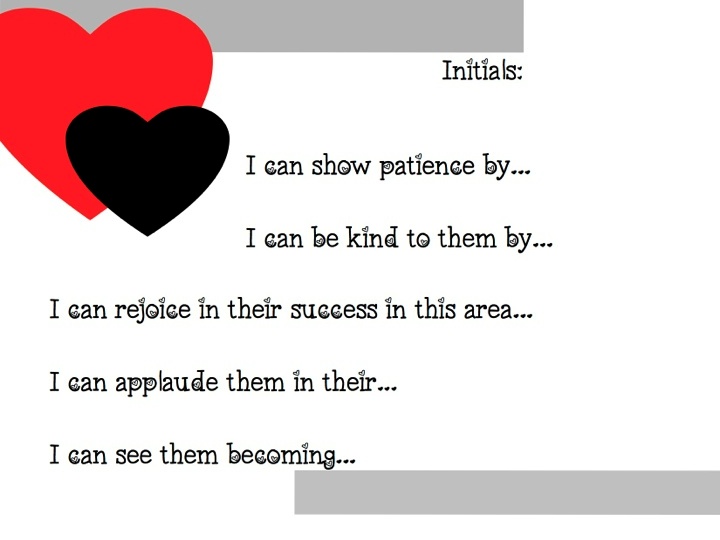
I know you have someone in your life that you think is unloveable. With that person’s face clearly in mind, how will you fill in the blanks:

  1. I can show patience by…
  2. I can be kind to them by…
  3. I can rejoice in their success in this area…
  4. I can applaud them in their…
  5. I can see them becoming…

If you would like a downloadable PDF of this worksheet, click here –> Love is… worksheet 1

If you missed any of the messages in our Loving the Unlovable series, you can check them all our here.

The Blessing Of Adversity (book review)

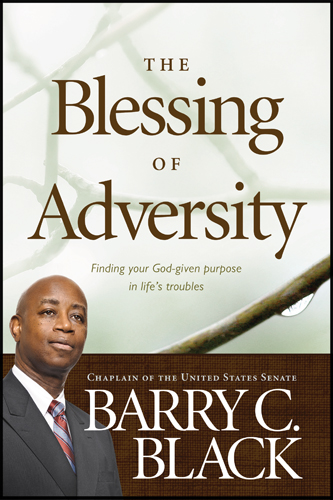
Barry C. Black has lived a full life, and that fullness has been poured into his timely book The Blessing Of Adversity: Finding your God-given purpose in life’s troubles.

A quick show of hands: how many of you have experienced trouble lately? How many of you are experiencing it right now? If you raised your hand in either category, this book could be quite helpful to you.

The Blessing Of Adversity is arranged into 23 chapters, but each chapter is broken down into several “mini chapters.” By that I mean that Chaplain Clark gives us several different ways of viewing the same topic of how to respond to adversity. He might tell you a personal story from his boyhood or his 23-year military career; or perhaps he’ll give you a modern-day example from his current ministry as chaplain to the U.S. Senate; or maybe a story from the pages of history; or a well-timed quote. Whatever his method, he always connects it with an encouraging word from the Bible to help the reader correctly process the times of adversity we all must pass through.

I found this book to be highly practical, and immediately applicable to my life. And for those of you who didn’t raise your hand earlier, there are a couple of chapters for you on how to prepare for the future adversity you are bound to face. This book would work very well as either an individual or small group Bible study.

I am a Tyndale book reviewer.

An Extra Hour Of Sleep

I’m a morning person. I absolutely love getting up early and spending some quiet time alone with my Bible. This is the time of day I most absorb all that God is saying to me. It’s my most creative time too. In fact, I so love getting up early that most mornings I’m awake before my alarm clock goes off.

But not this morning.

Today my alarm clock began playing Way-FM and I felt like I was in a fog. It took me a minute or so to even open my eyes and sit up.

I was about to press ahead with my morning, when I thought, “I should sleep some more.”

You see, I’ve learned a few things about myself. When I’m tired…

  • I have a shorter attention span.
  • I’m not as creative.
  • I’m not as patient.
  • I am more prone to give in to temptation.
  • I make decisions that are too short-sighted.
  • I’m more susceptible to colds and flu.

So I re-set the alarm and slept another hour.

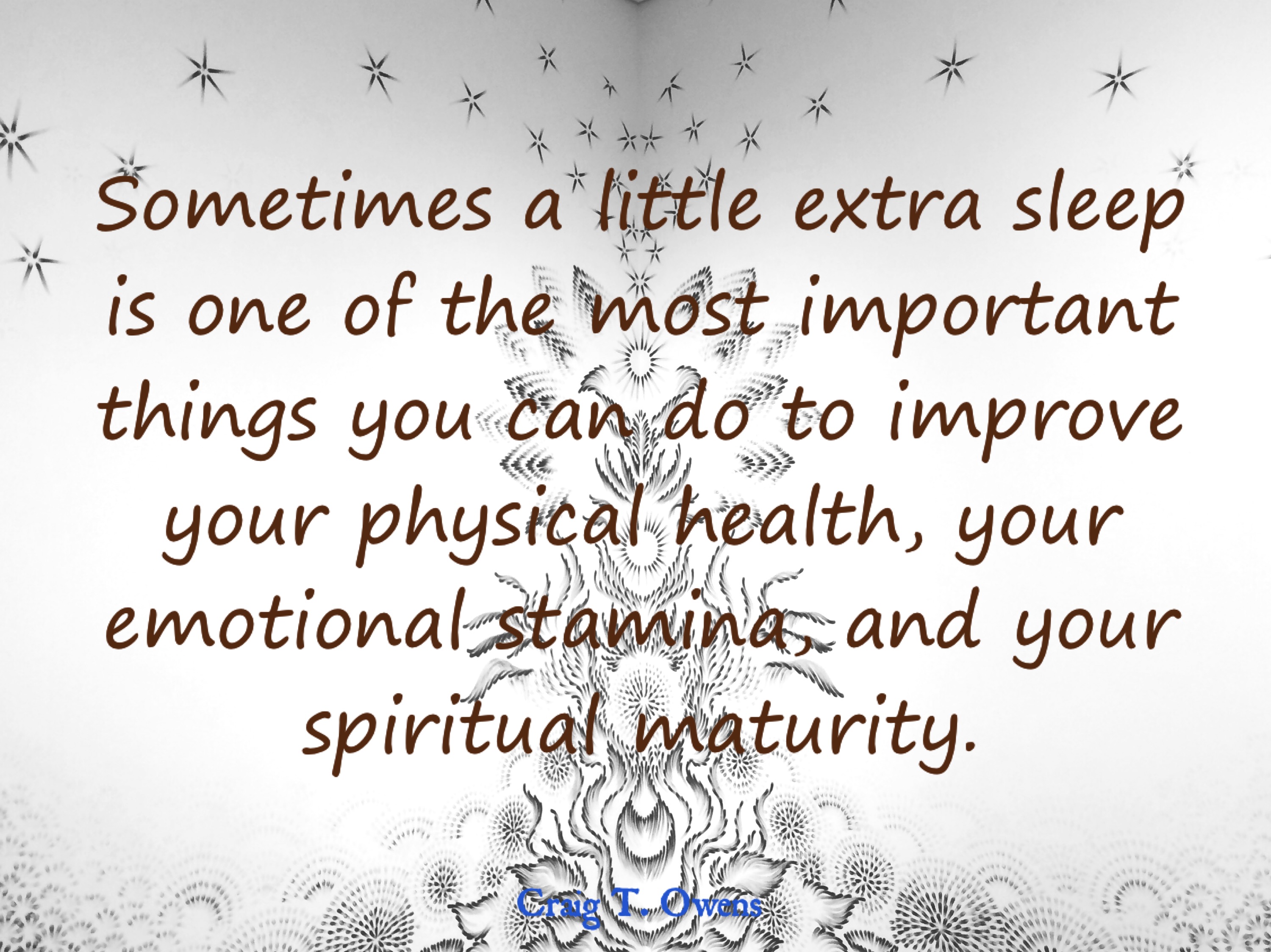
Sometimes a little extra sleep is one of the most important things you can do to improve your physical health, your emotional stamina, and your spiritual maturity.

UPDATE: In my book Shepherd Leadership: The Metrics That Really Matter I have five chapters about a leader’s health—mental, physical, spiritual, and emotional health is vital to a leader’s effectiveness and longevity.

What Jesus Didn’t Say

All throughout the first four books of the New Testament—Matthew, Mark, Luke, and John—there are lots of “red letters” (words spoken by Jesus). But as each of these gospel writers begins to recount the arrest and sham trial of Jesus, I’m struck by how many “black letters” there are. This fulfilled an Old Testament prophesy—

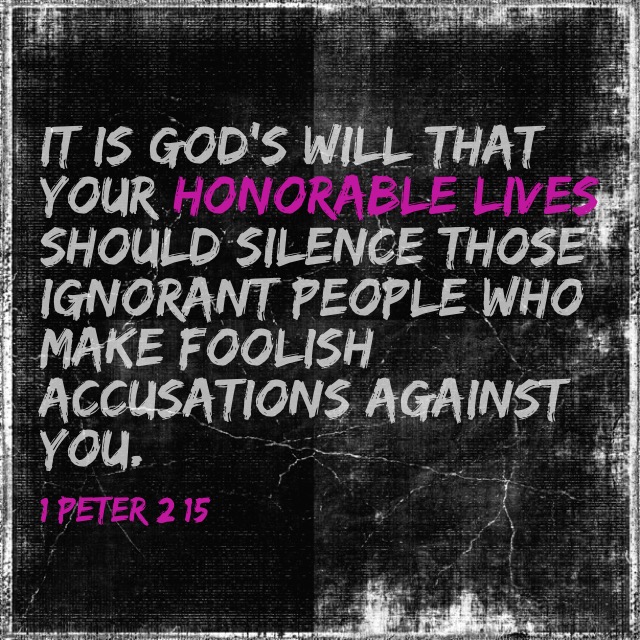
He was oppressed and treated harshly, yet He never said a word. He was led like a lamb to the slaughter. And as a sheep is silent before the shearers, He did not open His mouth (Isaiah 53:7).

The chief priests and the Sanhedrin brought out a string of witnesses to falsely accuse Jesus, but even then these witnesses couldn’t get their stories to jive, so Jesus remained silent. In exasperation the chief priest Caiaphas lashed out at Jesus, “Aren’t You going to answer these charges? Don’t You hear what they’re saying about You? Why won’t You defend Yourself?”

So here’s how Jesus responded to His accusers: But Jesus remained silent (Matthew 26:63). His silence resonated louder than any words could have!

How could Jesus do this? How could He stand silently when all of these nasty things were being said about Him?

He looked back—”…He had done no violence, nor was any deceit in His mouth…” (Isaiah 53:9). All four Gospels record Jesus saying, “You heard Me speaking in public all the time. My life has been on display for You. If I had said or done anything wrong, you could have arrested Me earlier, but the facts are: I haven’t said or done anything sinful.”

He looked forward—”…Because of the joy awaiting Him, He endured the Cross, disregarding its shame…” (Hebrews 12:2). He knew that one wrong word could undo all of the good words which He previously spoke, so He looked forward to the joy that would come after this was over.

I just went through a period of my life where people threw incredibly hurtful lies at me, but what was that compared to the horrific abuse heaped upon Jesus? If He could remain silent, how much more should I?

While I was in the midst of this difficult time, a prayerful friend handed me a notecard which I have kept close to me. Perhaps these words will be helpful to you, too—

May kindness be the response in you
where such a response is not expected.
May gentleness have the power
to overrule an offense and the power to heal. (David Teems)

May this Good Friday be a time of reflection in what Jesus didn’t say. And may I, along with you, learn this power of silence when falsely accused.