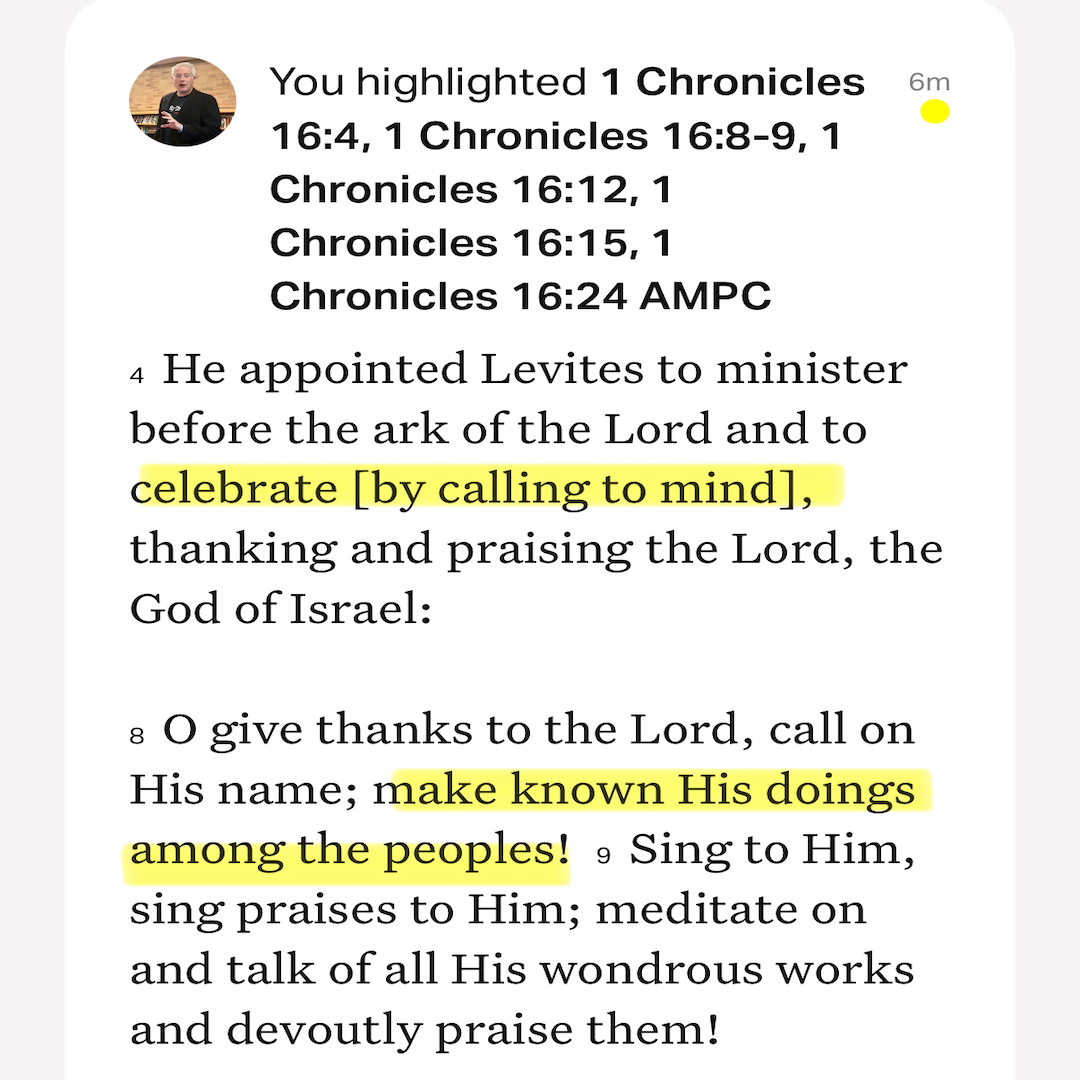
[King David] appointed Levites to minister before the ark of the Lord and to celebrate by calling to mind, thanking and praising the Lord, the God of Israel: … O give thanks to the Lord, call on His name; make known His doings among the peoples! Sing to Him, sing praises to Him; meditate on and talk of all His wondrous works and devoutly praise them! … Earnestly remember the marvelous deeds which He has done, His miracles, and the judgments He uttered as in Egypt. … Be mindful of His covenant forever, the promise which He commanded and established to a thousand generations. … Declare His glory among the nations, His marvelous works among all peoples. (1 Chronicles 16:4, 8-9, 12, 15, 24 AMPC)
Calling to mind … meditate … earnestly remember … be mindful. All these things lead to both worship and proclamation.
Recalling to mind all that God has done for us in the past, all that He is for us now, and all that He will do in the future gives us a song of praise. This praise is to be proclaimed among all people—both fellow worshipers and those who don’t know God as their Savior yet.
The more we meditate on Who God is, the more we praise Him; the more we praise Him, the more compelling our testimony to the nations becomes.
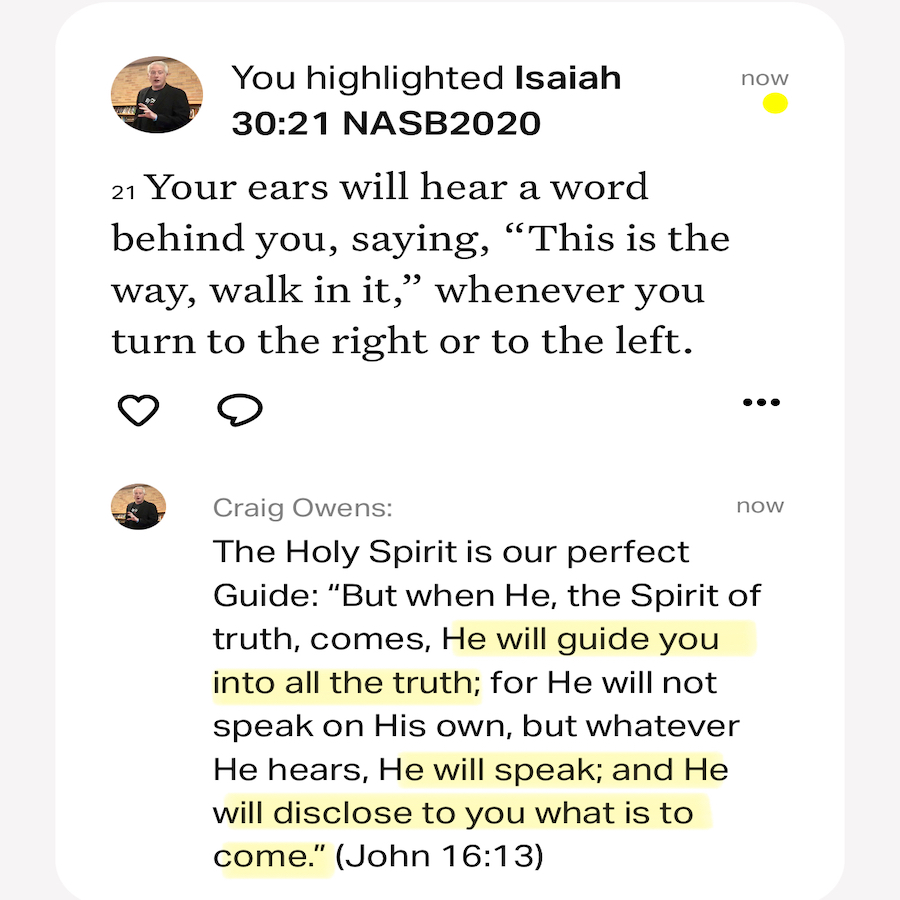
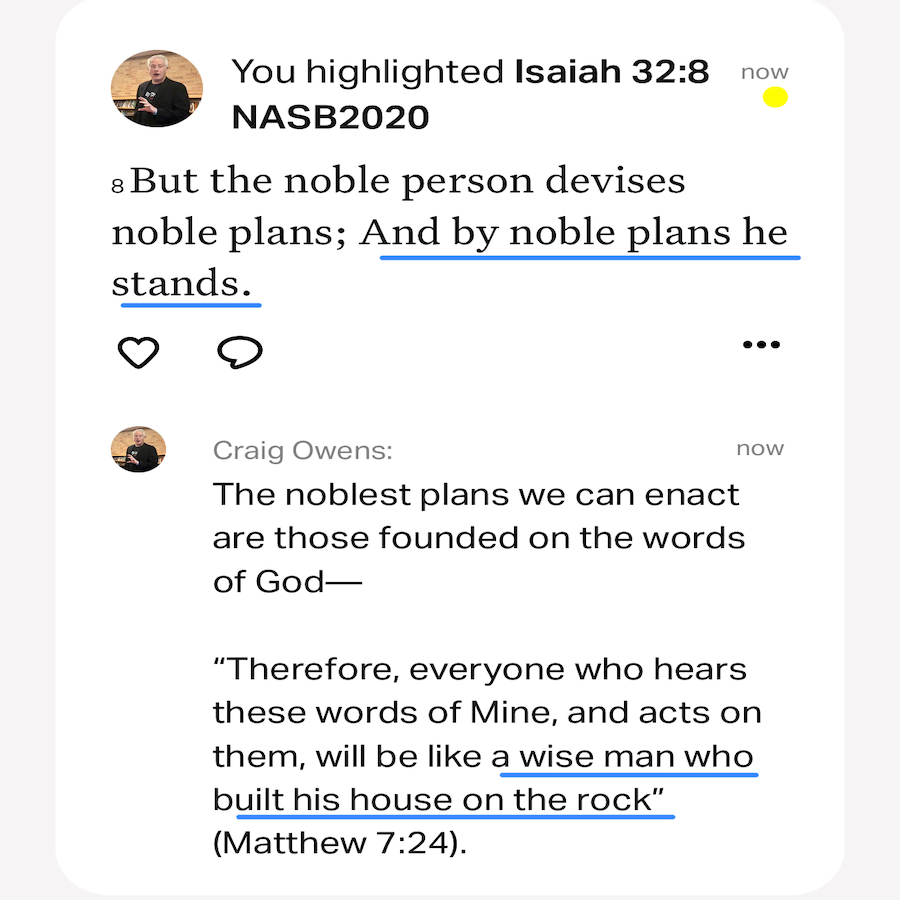
Something stood out to me quite clearly the other day as I highlighted several verses from Isaiah and was reminded of their complementary verses scattered throughout the New Testament. Always remember—
In the fourth year of King Hezekiah, which was the seventh year of Hoshea son of Elah, king of Israel, Shalmaneser king of Assyria came up against Samaria and besieged it (2 Kings 18:9). The Bible Archeology Report puts together wonderful biographies of biblical characters based on archeological discoveries that corroborate the account in Scripture. Here is the biography of Assyrian King Shalmaneser V.
Meteorologist Dr. Roy Spencer writes, “Atmospheric CO2 levels will start to fall even with modest reductions in anthropogenic CO2 emissions. Why is that? The reason is due to something called the CO2 ‘sink rate.’ It has been observed that the more CO2 there is in the atmosphere, the more quickly nature removes the excess.” Imagine that! It’s almost as if the Creator of the Universe knew exactly what He was doing.
J. Warner Wallace makes the case that the origin of the universe points to a Creator—but he does so without using Scripture.
“You will not be able to extemporize good thinking unless you have been in the habit of thinking and feeding your mind with abundant and nourishing food.” —Charles Spurgeon
Listen to the podcast of this post by clicking on the player below, and you can also subscribe on Apple, Spotify, or Audible.
Last week I challenged you to free up some time in your schedule so that you could begin to apply these six spiritual disciplines we are going to discuss.
Let’s keep in mind why we are learning and working on these disciplines. The key phrase is “so that”: I’m going to get stronger so that I have something to give to others, so that they will have something to give to others (and to me), and on and on it goes. Each of us needs all of us, and all of us need each of us!
I love to read. In fact, I’m usually reading several books at the same time. Without a close second, my favorite book is my Bible. I say “my Bible” because I’ve made it mine—it’s underlined, circled, notated, and marked. It’s the Book I’m in every day, and it’s the Book that helps me glean the best knowledge from all the other books I read.
G.K. Chesterton, the famous British writer, was once invited to a meeting of the leading intellectuals in England. They were discussing what one book they would want to have with them if they were shipwrecked on an island. Everybody expected Chesterton to say, “My Bible.” But when it came to his turn to speak, Chesterton said, “If I were shipwrecked on a desert island, I’d like to have Thomas’s Guide to Practical Shipbuilding.”
Chesterton wasn’t saying the Bible wouldn’t have been of benefit to him on that island, but he was saying that those who study the Bible have the most practical insights! The Bible doesn’t just have lofty ideas, but it gives us heavenly wisdom that is highly practical to our everyday lives.
The first spiritual discipline we are considering in our series Saints Together is: Studying our Bible. Notice I didn’t say just to read the Bible, but to really study the Book of books.
The apostle Paul wrote, “So then faith comes by hearing, and hearing by the Word of God” (Romans 10:17). How do we know our faith is growing? It must be tested. Look at what James had to say about growing our faith—“the testing of your faith produces perseverance” (James 1:3).
Testing really comes down to this: Does what I believe work in my everyday life? Can I truly put what the Bible teaches me into action? James went a little deeper with this in James 2:17-19.
Allow me to share four indispensable components of our Bible study time. You will notice that for all of these components, I am giving you verses from the 119th chapter of the Psalms. This single chapter mentions God’s Word in every single one of its 176 verses. As an added bonus, this chapter is divided into twenty-two 8-verse sections. Scientists tell us that if you do anything for twenty-one days in a row, you will have gone a long way toward making it a permanent habit. So reading one section of Psalm 119 every day is a great place to start on this spiritual discipline of studying your Bible.
Here are the four components:
(1) Read the Word. You cannot study something you haven’t read. I would suggest you pray before reading (Psalm 119:18, 33). I’d also suggest you leverage the power of your brain using a well-worn path by setting aside the same time, same place, and same method of study every day.
(4) Live out the Word. Apply it by allowing it to make a change in your life. Notice the action words in Psalm 119:1-4: walk … keep … walk … fully obey…. Or as God said to Joshua—
“Keep this Book of the Law always on your lips; meditate on it day and night, so that you may be careful to do everything written in it. Then you will be prosperous and successful.” (Joshua 1:8)
This is how Jesus lived His life and it’s also how He said the Holy Spirit would help us live our lives in a God-glorifying way (John 12:49-50, 14:26).
Every day we should be living out the living Word of God!
This is a weekly series with things I’m reading and pondering from Charles Spurgeon. You can read the original seed thought here, or type “Thursdays With Spurgeon” in the search box to read more entries.
Listen to the podcast of this post by clicking on the player below, and you can also subscribe on Apple, Spotify, or Audible.
Delightful Judgments
My soul is consumed with longing for Your laws at all times. (Psalm 119:20)
Search God’s Word and you will have before your eyes the ultimate judgment of unerring truth, the last decree from the supreme authority from which there is no appeal! The Bible contains the verdict of the Judge of all the earth, the judgments of God who cannot lie and cannot err.
Thus, God’s Word is rightly called His ‘judgments.’ It is a Book not to be judged by us, but to be our judge—not a word of it may be altered or questioned. But to it we may constantly refer as to a court of appeal whose sentence is decisive. …
Our judgments must be daily more and more conformed to the judgments of God that are laid down in Scripture. And there must be in our spirit a longing after holiness until we delight in the Law of the Lord and meditate therein both day and night. We will grow to the likeness of that which we feed upon, heavenly food will make us heavenly minded! The Word of God received into the heart changes us into its own nature and, by rejoicing in the decisions of the Lord, we learn to judge after His judgment and to delight ourselves in that which pleases Him.
From Holy Longings
The 119th Psalm is an amazing chapter—176 verses arranged as a love letter to both God’s Word and the God who gave us His Word. Every one of these verses extol the value and beauty of God’s commands, decrees, precepts, statues, law, and judgments.
As Spurgeon pointed out, “judgment” does not mean a sentence of guilt pronounced against us, but a standard for determining the rightness or lawlessness of something. God’s Word is the final judgment on sin and righteousness.
The psalmist who penned this beautiful prose more than likely had only the first five books of our Bible—Genesis, Exodus, Leviticus, Numbers, and Deuteronomy—and yet he finds such delight in these words because of the awesome God they reveal. Look at his delight…
I delight in Your decrees (v. 16)
Your statues are my delight (v. 24)
I delight in Your commands (v. 47)
I delight in Your law (v. 70)
Your commands give me delight (v. 143)
As Spurgeon said, the more we delight in God’s Word, the more we will meditate on it; the more we meditate on it, the more it will change our hearts to make lifestyle judgments that are pleasing to God.
No matter whether you’ve never really studied the Bible, or you are an “old pro” with a well-worn Bible close at hand, may we all continue to grow in our delight of God’s Word and our reverence of the God revealed to us in the Word.
If you would like some Bible studies to help get you started, check out:
Listen to the podcast of this post by clicking on the player below, and you can also subscribe on Apple, Spotify, or Audible.
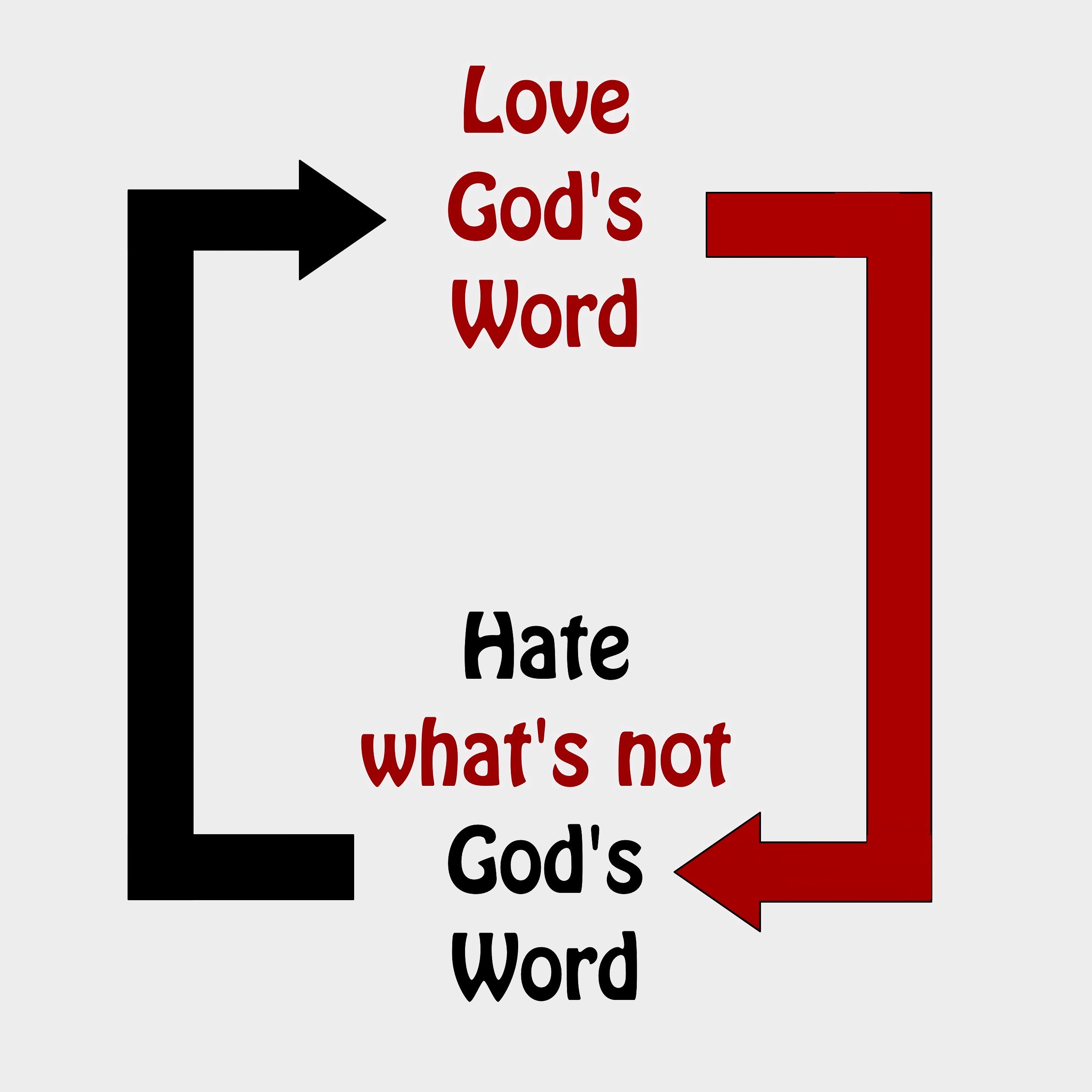
Oh, how I love Your law! … Therefore I hate every wrong path (Psalm 119:97, 104).
These bookend verses of the section called Mem form the conclusion of a logical argument, and in between are each step of the progression. Notice the word “for” (in vv. 98, 99, 100, and 102) and the words “so that” in v. 101.
This progression forms a circle from love to hate, and back to love again. Check this out—
I love Your law so I meditate on it all day.
Meditating on Your law makes me wiser than my enemies and my teachers.
This wisdom helps me obey Your laws.
Obedience keeps me on the right path.
I stay on the right path because You Yourself teach me while I’m on that path.
Because You are my Teacher, Your laws are sweet to me.
Because Your laws are sweet, I hate anything contrary to Your laws.
Hating everything that is not found in Your law helps me love Your law even more.
[Back to the top] Since I love Your law, I keep on meditating on it all day.
A mark of a maturING saint is one who when he realizes he is in a trough begins to praise God in anticipation of the blessings which are coming! Even the most mature Christian you know hasn’t “arrived”; we are all a work-in-progress. Going through the dark nights is one way God helps mature our understanding of contentment.
You know the differences between a need and a want: a need is something vital, something I require to survive; a want is something that would be nice to have.
In good times I can convince myself that my wants are really the same as my needs. In the bright, sunny times a lot of wants mistakenly get called needs. But in the dark nights, this confusion is quickly clarified!
In Philippians 4, Paul explains what he has learned about needs as he went through some very challenging, dark times. When he says he knows what a need is, he isn’t exaggerating a bit (see 2 Corinthians 11:24-28). And yet the Amplified Bible has Paul saying, “Not that I am implying that I was in any personal want.”
That’s because Paul was learnING contentment. The verb tense here means I have learned, I am learning, and I will keep on learning. It was an ongoing process that helped him clarify needs from wants. The word Paul uses for content is unique in all the New Testament and it means independent of external circumstances, or as the Amplified Bible says, “satisfied to the point where I am not disturbed or disquieted in whatever state I am.”
Paul uses another unique word in verse 12 when he says “I have learned.” This is a different Greek word from the previous verse. This time it means disciplined by experience to know how to respond. In other words, Paul disciplined himself to reflect on the lessons he learned in the night. The cliche “Experience is the best teacher” isn’t necessarily true. Lots of people go through experiences and never learn a single thing. Instead, we should say, “Evaluatedexperience is the best teacher.” That’s exactly what Paul is saying here: “I have learned lessons in my time of meditation after going through a dark night.”
The English dictionary defines contentment in two important phrases:
Satisfied with what I have. In Psalm 16, David learned that he had everything he needed in God, and Jesus reminded us that “your Father knows what you NEED before you ask Him” (Matthew 6:8).
Satisfied with who I am. Paul knew that “God, who set me apart from my mother’s womb and called me by His grace, was pleased” (Galatians 1:15). God made Paul on purpose and for a purpose, and Paul was satisfied with who he was in Christ. God made you on purpose too!
Our relationship with Jesus is a maturING one. It’s only IN Christ that I can be satisfied with what I have, and satisfied with who I am. It’s only IN the night that my wants get separated from my needs, by learnING contentment.
I can be thankful in the night because I am learning contentment.
Notice Asaph’s words at the beginning of Psalm 77. Twice he says he “cried out” to God. This literally means that he called aloud, not caring who heard him. It wasn’t a whimper, but Asaph said he was “distressed.” As soon as he realized the distressed state he was in, notice the words of meditation in the next four verses:
remembered (2x)
mused (2x)
thought
inquired
Asaph also began to ask himself questions, all of which have the obvious answer “NO”:
Will the Lord reject me forever?NO!
Will He never show His favor again?NO!
Has His unfailing love vanished forever?NO!
Has His promise failed for all time?NO!
Has God forgotten to be merciful?NO!
Has He in anger withheld His compassion?NO!
Again, Asaph meditates (notice the words thought, remember, meditate, and consider once again in the next three verses). His conclusion leads him not to self-pity, but to praising God.
Asaph taught us that when we get our eyes off ourselves we can see what God is doing in us, around us, and through us.
One lesson I learned in a very dark night time of my life: Who my true friends are. When all my “fans” stopped cheering and started jeering, I ended up in a very dark place. But as soon as I realized the valley I was in and began to meditate on God’s presence even in this dark place, I began to see what was happening around me. One of the things I saw were two men who stood up for me against all the foes attacking me. They stepped in when all my “fans” stepped away.
Dark times can quickly lead us to self-pity UNLESS we will realize we are in a dark place and begin to meditate on all that God says in His Word about His faithfulness. Once we get our eyes off ourselves and onto Him, we will begin to see the lessons God is teaching and the amazing things He is accomplishing.
I can be thankful IN the night because the dark nights have shown me my true friends.
This is a weekly series with things I’m reading and pondering from Charles Spurgeon. You can read the original seed thought here, or type “Thursdays With Spurgeon” in the search box to read more entries.
Stick To The Revealed Word Of God
Remember your leaders, who spoke the Word of God to you. Consider the outcome of their way of life and imitate their faith. Jesus Christ is the same yesterday and today and forever. Do not be carried away by all kinds of strange teachings. It is good for our hearts to be strengthened by grace, not by eating ceremonial foods, which is of no benefit to those who do so. (Hebrews 13:7-9)
From the connection it is evident that our text refers to the teaching of Christ, who is ‘the same yesterday, today, and forever.’ This is not according to the so-called development folly. Theology, like every other science, is to grow, watered by the splendid wisdom of this enlightened age, fostered by the superlative ability of the gentlemen of light and leading of the present time, so much superior to all who came before them!
We think not so, brothers and sisters, for the Lord Jesus Christ was the perfect revelation of God. … In previous ages, God has spoken to us by His prophets, but in these last days He has spoken to us by His Son [Hebrews 1:1-2]. Now as to that which was a complete revelation, it is blasphemous to suppose that there can be any more revealed than has been made known in the Person and work of Jesus Christ, the Son of God! … And as He shuts up the book that contains the written revelation, He bids you never dare to take from it, lest He should take your name out of the Book of Life! And never dare to add to it, lest He should add to you the plagues that are written in this book [Revelation 22:18-19]!
From The Unchangeable Christ
BEWARE when someone tells you they have discovered some new revelation from God that they—and they alone—have uncovered. God’s Word doesn’t need anyone’s “help.”
This is a weekly series with things I’m reading and pondering from Charles Spurgeon. You can read the original seed thought here, or type “Thursdays With Spurgeon” in the search box to read more entries.
Thoughtful Meditation And Application
Remember your leaders, who spoke the word of God to you. Consider the outcome of their way of life and imitate their faith. Jesus Christ is the same yesterday and today and forever. (Hebrews 13:7-8)
Observe, then, that God’s people are a thoughtful people. If they are what they are to be, they do a great deal of remembering and considering. … I wish, in these days, that professing Christians remembered and considered a great deal more, but we live in such a flurry, hurry, and worry, that we do not give time for thought. …
Our great Master never aimed at originality—He said that He did not even speak His own words, but the words that He had heard of His Father [John 12:49]. He was docile and teachable. As the Son of God and the Servant of God, His ears were open to hear the instructions of the Father, and He could say, ‘I always do those things that please Him’ (John 8:29). …
There is no difference whatever in the relationship of the Lord Jesus Christ to His people at this time! He is just as ready to comfort us tonight as He was to comfort those with whom He dwelt when here below! Sister Mary, He is as willing to come down to your Bethany and help you in your sorrow about Lazarus as He was when He came to Martha and Mary whom He loved! Jesus Christ is just as ready to wash your feet, my brother, after another day’s weary travel through the foul ways of this world. He is as willing to take the basin and the towel and to give us a loving cleansing as He was when He washed His disciples’ feet! Just what He was to them, He is to us! Happy is it if you and I can truly say, ‘What He was to Peter, what He was to John, what He was to Magdalene, that is Jesus Christ to me—the same yesterday, today, and forever.’
From The Unchangeable Christ
If Charles Spurgeon thought the 19th century was a time of “flurry, hurry, and worry,” what adjectives might describe the supersonic, multi-tasking, get-everything-done-now 21st century?!
Today, more than ever, we need to take time to reflect on God’s Word. Read it slowly. Put yourself in the story. What would you have observed if you were there? What would you have felt? Look around at the others who were there: how would they have perceived what was happening?
You don’t meditate on God’s Word so that you can find something original, but you meditate so that the Holy Spirit can reveal the original truths that are already there! The Holy Spirit can show you how to apply the Bible to your life, if you will only slow down to give Him time to do so.
Don’t race through your Bible reading time—slow down and take it all in. Then let the Holy Spirit work out what He has helped you put in your heart and mind.



 [King David] appointed Levites to minister before the ark of the Lord and to celebrate by calling to mind, thanking and praising the Lord, the God of Israel: … O give thanks to the Lord, call on His name; make known His doings among the peoples! Sing to Him, sing praises to Him; meditate on and talk of all His wondrous works and devoutly praise them! … Earnestly remember the marvelous deeds which He has done, His miracles, and the judgments He uttered as in Egypt. … Be mindful of His covenant forever, the promise which He commanded and established to a thousand generations. … Declare His glory among the nations, His marvelous works among all peoples. (1 Chronicles 16:4, 8-9, 12, 15, 24 AMPC)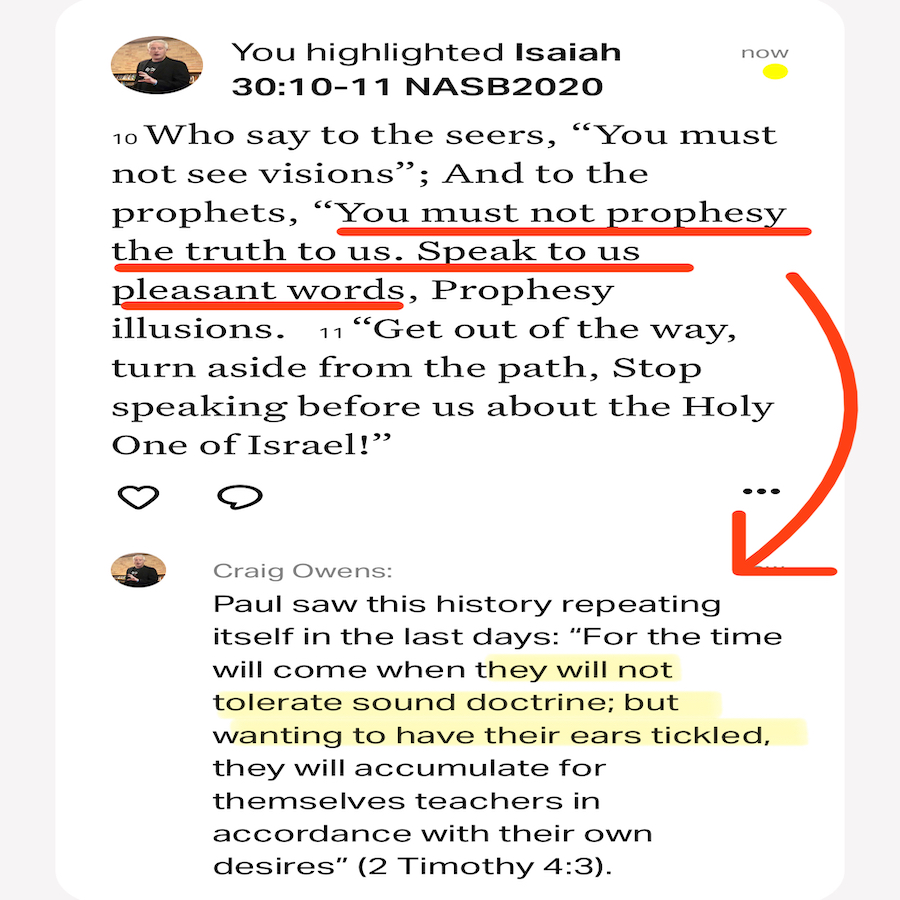







 Craig T. Owens