Thursdays With Spurgeon—Standing Firm

This is a weekly series with things I’m reading and pondering from Charles Spurgeon. You can read the original seed thought here, or type “Thursdays With Spurgeon” in the search box to read more entries.

Listen to the podcast of this post by clicking on the player below, and you can also subscribe on AppleSpotify, or Audible. 

Standing Firm 

     Superficial brilliance is always afraid of fire, but gold is not. The paste gem dreads to be touched by the diamond, but the true diamond fears no test. People who have a kind of confectionery godliness will wish to be preserved from temptations, for they cannot endure them. But the Christian counts it all joy when he falls into different trials, knowing that ‘tribulation produces perseverance; and perseverance, character; and character, hope. Now hope does not disappoint, because the love of God has been poured out in our hearts by the Holy Spirit who was given to us’ (Romans 5:3-5). My dear friends, if your faith is only a sunshiny faith, get rid of it! … 

     So our gracious God, beloved, glorifies Himself by permitting His people to be subjected to trials and by enabling them to endure the strain. We would never know the music of the harp if the strings were left untouched. We would never enjoy the juice of the grape if it were never trod in the winepress. We would never discover the sweet perfume of cinnamon if it were not pressed and beaten. And we would never know the warmth of fire if the coals were not utterly consumed. The excellence of the Christian is brought out by the fire of trouble. The wisdom of the great Workman and the glory of His skill and power are discovered by the trials through which His vessels of mercy are permitted to pass. … 

     Depend upon it, beloved, those who suffer as I have described are the children of God, for they show it. They show it by the way in which they bear their trials. In the worst times there is always a clear distinction that marks them as separate from other men. If they cannot shout, ‘Victory!’ they bear patiently. If they cannot sing to God with their mouth, yet their hearts bless Him. There is a degree of light even in their worst darkness…. If they get into the mire, they do not perish there. They cry for help when their woes surround them, and in the very nick of time, when everything appears to be lost, their heavenly Father hastens to their aid.

From The Believer Sinking In The Mire

I shared a series of messages called Thankful In The Night. Another psalmist wrote, “Yet the Lord will command His loving-kindness in the daytime, and in the night His song shall be with me” (Psalm 42:8). 

Notice that this psalmist was praising God IN the night, not praising Him FOR the night. Many people have gone through what has been called “the dark night of the soul.” I don’t think anyone has ever given thanks because of being in a dark time, but certainly they have given thanks afterward because of the lessons learned in that dark time. 

Quite simply put, there are some things God wants to teach us that we can learn in no other way than to go through a dark night. So we can learn to be thankful even IN those nights. IN those nights, we can learn to say, as Spurgeon did, “I believe in my Lord because He is a God who cannot lie. He is faithful and true to His every word and, therefore, let the whole creation go to rack and ruin, my faith will not waver or give up its confidence.” 

Amen! Let us stand firm in that confidence.

►► Would you please prayerfully consider supporting this ministry? ◀︎◀︎

Poetry Saturday—Before

Listen to the podcast of this post by clicking on the player below, and you can also subscribe on AppleSpotify, or Audible.

Before you speak, listen.
Before you write, think.
Before you spend, earn.
Before you invest, investigate.
Before you criticize, wait.
Before you pray, forgive.
Before you quit, try.
Before you retire, save.
Before you die, give. —William Arthur Ward

►► Would you please prayerfully consider supporting this ministry? ◀︎◀︎

Thursdays With Spurgeon—Forgiven And Forgiving

This is a weekly series with things I’m reading and pondering from Charles Spurgeon. You can read the original seed thought here, or type “Thursdays With Spurgeon” in the search box to read more entries.

Listen to the podcast of this post by clicking on the player below, and you can also subscribe on iTunes or Spotify.

Forgiven And Forgiving  

Forgiving one another, even as God for Christ’s sake has forgiven you. (Ephesians 4:32) 

     Now observe how the apostle puts it. Does he say, ‘forgiving another’? No, that is not the text. If you look at it, it is ‘forgiving one another.’ One another! Ah, then that means that if you have to forgive today, it is very likely that you will, yourself, need to be forgiven tomorrow, for it is ‘forgiving one another.’ … Let us begin our Christian career with the full assurance that we will have a great deal to forgive in other people, but that there will be a great deal more to be forgiven in ourselves! … 

     Note again: When we forgive, it is a poor and humble business compared with God’s forgiving us, because we are only forgiving one another—that is, forgiving fellow servants. But when God forgives us, the Judge of all the earth is forgiving, not His fellows, but His rebel subjects, guilty of treason against His majesty! For God to forgive is something great—for us to forgive, though some think it great—should be regarded as a very small matter. … What we owe to God is infinite, but what our fellow creature owes to us is a very small sum. …  

     If anyone here who is a Christian finds a difficulty in forgiveness, I am going to give him three words that will help him wonderfully… Here they are again: ‘For Christ’s sake.’ … 

     I do not know how to put this next word I am going to say. It is a paradox. You must forgive or you cannot be saved. But at the same time, you must not do it from compulsion, you must do it freely. … Remember, it is of no use for you to put your money into that offering box as you go out unless you remember, first, to forgive your brother. God will not accept the gifts, prayers, or praises of an unrelenting heart. … The very prayer that teaches you to ask for mercy bids you say, ‘And forgive us our debts, as we forgive our debtors’ (Matthew 6:12). Unless you have forgiven others, you read your own death warrant when you repeat the Lord’s Prayer!

From Forgiveness Made Easy 

We honor the forgiveness that God has extended to us by liberally forgiving others. And our forgiveness of others shows them just how loving and forgiving our God is too! 

Make no mistake, it’s hard work to forgive. As C.S. Lewis said, “We need to forgive our brother seventy times seven not only for 490 offenses but for one offense.” But that hard work develops our maturity as Christians. In fact, a mark of a maturing saint is one who is closing the gap between being injured and forgiving the offender. 

I add my prayer to Charles Spurgeon’s that you would grasp the truth that we can forgive one another for Christ’s sake because God has forgiven us for Christ’s sake. Let’s all grow in this Christian maturity!

►► Would you please prayerfully consider supporting this ministry? ◀︎◀︎


Thursdays With Spurgeon—Keep Moving Forward

This is a weekly series with things I’m reading and pondering from Charles Spurgeon. You can read the original seed thought here, or type “Thursdays With Spurgeon” in the search box to read more entries.

Listen to the podcast of this post by clicking on the player below, and you can also subscribe on iTunes or Spotify.

Keep Moving Forward  

For we walk by faith, not by sight. (2 Corinthians 5:7) 

     God does not say to us, ‘This is the way,’ and then stop. He says, ‘This is the way, walk in it.’ We are always to be making advances. We are to be going from faith in its beginnings to faith in its perfections, from faith to assurance, from assurance to full assurance. And from there, we are to go to the full assurance of hope to the full assurance of understanding, always forward, waxing stronger and stronger. …  

     The Christian’s motto is ‘Upward and onward.’ Not as though he has already obtained, either is already perfect, he presses forward to the mark for the prize of his high calling in Christ Jesus. …  

     Can you perform the common activities of the household and the daily duties that fall to your lot in the spirit of faith? This is what the apostle means. He does not speak about running or jumping or fighting, but about walking—and he means to tell you that the ordinary life of a Christian is different from the life of another man—that he has learned to introduce faith into everything he does. 

From Faith Versus Sight

I have a t-shirt that says on the front, “Keep moving forward.” But the back of the t-shirt has the real-life challenge: “Crawling is acceptable. Falling is acceptable. Puking is acceptable. Crying is acceptable. Pain is acceptable. Quitting is not!” 

How true! 

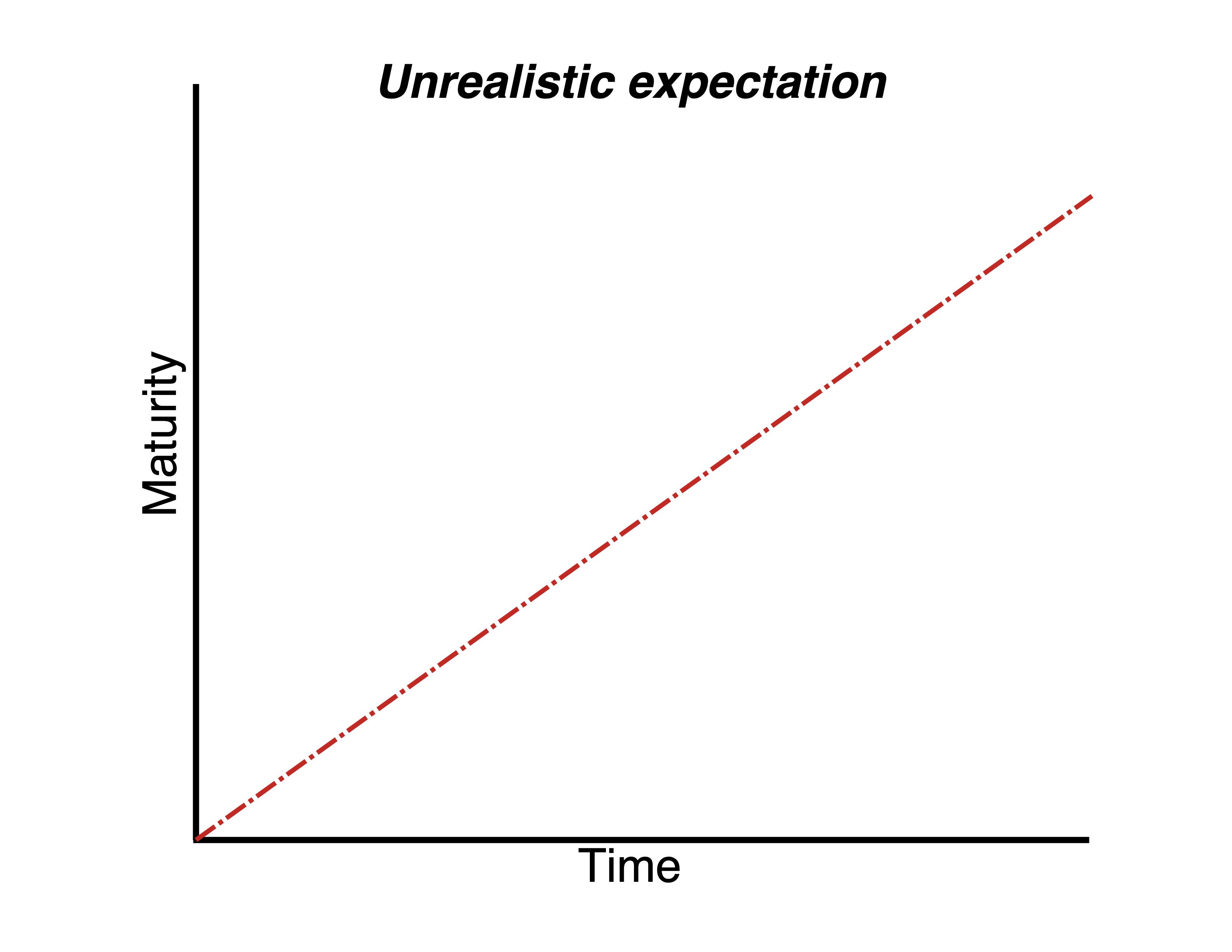
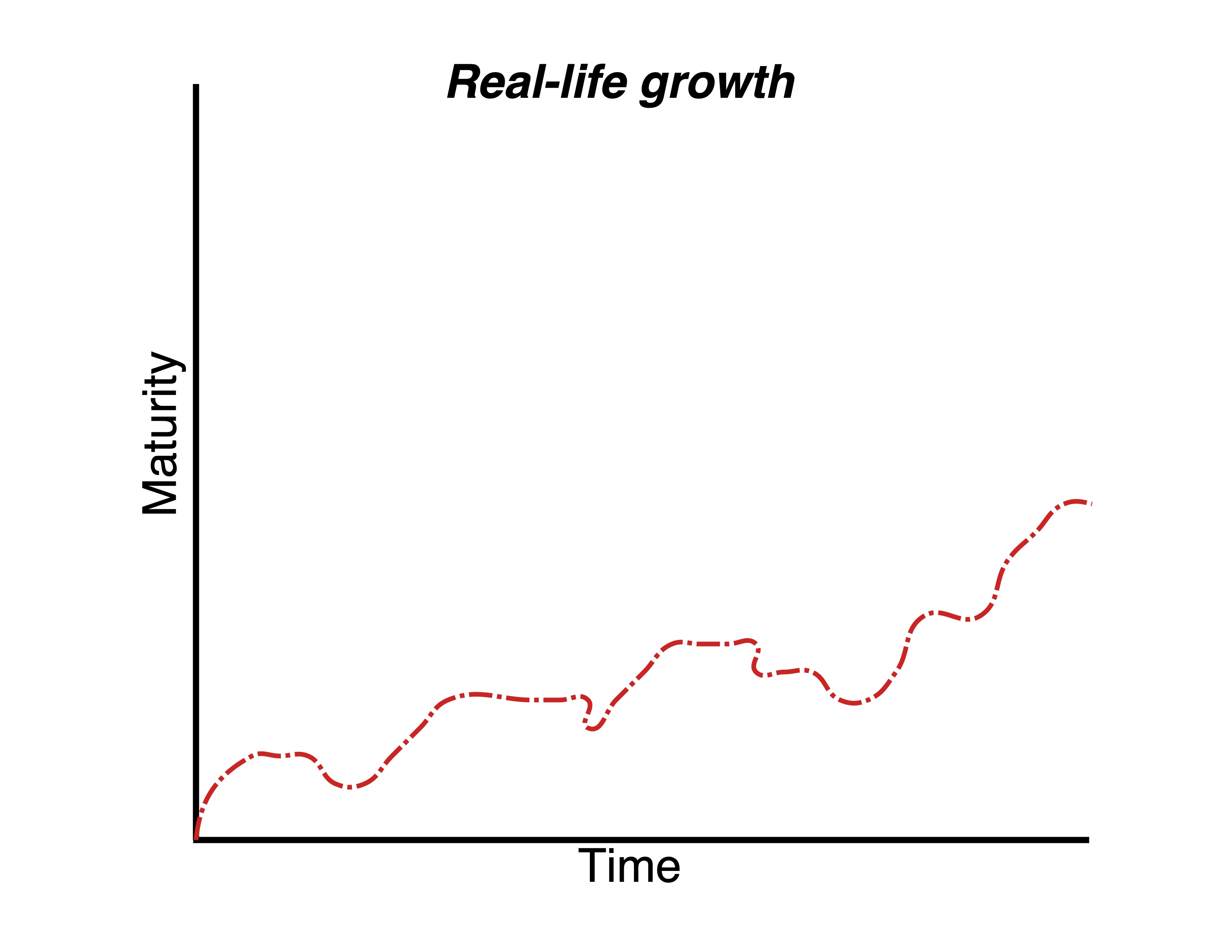
I think the problem for many Christians is that they have an unrealistic expectation of growth. Somehow we’ve come to believe that our Christian growth is a constant upward trajectory to maturity, and that if there are ever any stumbles along the way, that means we’ve blown it. (By the way, Oswald Chambers has some helpful thoughts on our stair-step growth.)

But Paul tells us, “We walk”: We keep moving forward. That doesn’t mean there aren’t times of stumbling, or a plateau, or even a pause to catch our breath. Paul tells us that an important aspect of our walk is that we forget what’s behind us and we keep moving forward—keep walking—keep going. 

Every single day, let us say along with Paul, “I don’t mean to say that I have already achieved these things or that I have already reached perfection. But I press on to possess that perfection for which Christ Jesus first possessed me. No, dear brothers and sisters, I have not achieved it, but I focus on this one thing: Forgetting the past and looking forward to what lies ahead, I press on to reach the end of the race and receive the heavenly prize for which God, through Christ Jesus, is calling us” (Philippians 3:12-14 NLT). 

My friend, keep moving forward in faith, believing that the Holy Spirit is with you—maturing you, strengthening you—on every single step on your Christian walk.

►► Would you please prayerfully consider supporting this ministry? ◀︎◀︎


The Heart Is The Heart Of The Matter

Listen to the podcast of this post by clicking on the player below, and you can also subscribe on AppleSpotify, or Audible. 

A heart that devises wicked schemes… (Proverbs 6:18). 

This is the item listed in the exact middle of the list “there are six things the Lord hates, seven that are detestable to Him.” Check out the whole passage: 

There are six things the Lord hates, seven that are detestable to Him: [1] haughty eyes, [2] a lying tongue, [3] hands that shed innocent blood, [4] a heart that devises wicked schemes, [5] feet that are quick to rush into evil, [6] a false witness who pours out lies and [7] a man who stirs up dissension among brothers. (vv. 16-18) 

Now let’s follow this progression from the middle item outward: 

  • …it begins in a devious heart—[4] 
  • …it moves to the actions of the hands and feet—[3] and [5] 
  • …it is excused or justified by lies—[2] and [6] 
  • …it hardens into unrepentant pride that divides a community—[1] and [7]

The heart is the heart of the matter!

 Verse 18 is also the middle verse of this whole 6th chapter of Proverbs—

  • it is a heart issue that leads to making rash vows (vv. 1-5) 
  • it is a heart issue that causes a poor work ethic (vv. 6-11) 
  • it is a heart issue that prompts double-talk, equivocation, and a lack of integrity (vv. 12-15) 
  • it is a heart issue that takes a person spiraling down into adultery (vv. 20-35)

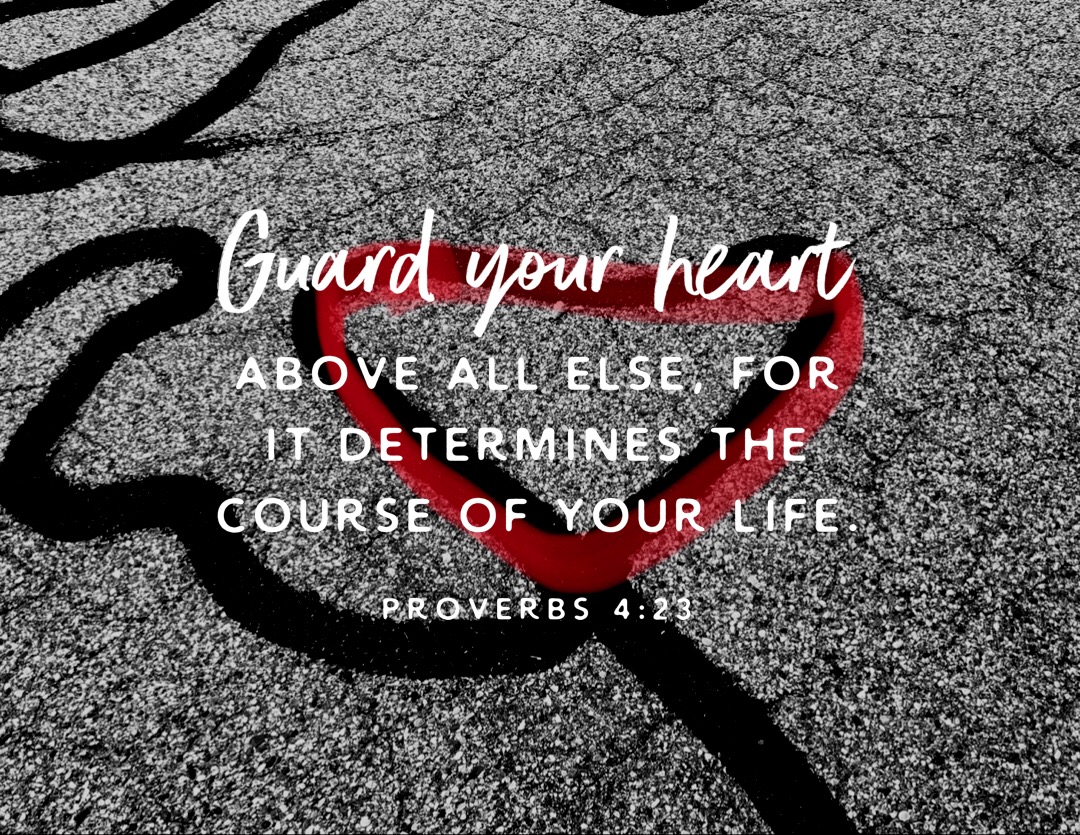
Let me repeat this principle: The heart is the heart of the matter! This is why Solomon told us in an earlier chapter, “Guard your heart above all else, for it determines the course of your life” (Proverbs 4:23). 

But a wise person, who allows the Holy Spirit to correct sinful thoughts, can see a different outcome. With the Spirit’s help, it could look like this:

  • …it begins in a heart sensitive to the Holy Spirit’s prompting—[4] 
  • …it moves to the actions of the hands and feet—[3] and [5] 
  • …it is demonstrated in truthful, loving words—[2] and [6] 
  • …it promotes the humility that unites a community—[1] and [7]

Let’s make this our prayer: Holy Spirit, help me to guard my heart today. No compromising, no justifying, but just a quick obedience to Your prompts to repent and soften my heart. 

Let it start in your heart and just watch what happens. The heart IS the heart of the matter! 

►► Would you please prayerfully consider supporting this ministry? ◀︎◀︎

Poetry Saturday—In The Crucible

Listen to the podcast of this post by clicking on the player below, and you can also subscribe on AppleSpotify, or Audible.

Out from the mine and the darkness,
Out from the damp and the mold,
Out from the fiery furnace,
Cometh each grain of gold.
Crushed into atoms and leveled
Down to the humblest dust
With never a heart to pity,
With never a hand to trust.
Molten and hammered and beaten
Seemeth it ne’er to be done.
Oh, for such fiery trial,
What hath the poor gold done?
Oh, ‘twere a mercy to leave it
Down in the damp and the mold.
If this is the glory of living,
Then better to be dross than gold.
Under the press and the roller,
Into the jaws of the mint,
Stamped with the emblem of freedom,
With never a flaw or a dint.
Oh, what a joy, the refining,
Out of the damp and the mold.
And stamped with the glorious image,
Oh beautiful coin of gold! —Anonymous

►► Would you please prayerfully consider supporting this ministry? ◀︎◀︎

Poetry Saturday—Three Friends

Listen to the podcast of this post by clicking on the player below, and you can also subscribe on AppleSpotify, or Audible.

Of all the blessings which my life has known,
I value most, and most praise God for three:
Want, Loneliness, and Pain, those comrades true,

Who masqueraded in the garb of foes
For many a year, and filled my heart with dread.
Yet fickle joys, like false, pretentious friends,
Have proved less worthy than this trio. First,

Want taught me labour, led me up the steep
And toilsome paths to hills of pure delight,
Tried only by the feet that know fatigue,
And yet press on until the heights appear.

Then loneliness and hunger of the heart
Sent me upreaching to the realms of space,
Till all the silences grew eloquent,
And all their loving forces hailed me friend.

Last, pain taught prayer! placed in my hand the staff
Of close communion with the over-soul,
That I might lean upon it to the end,
And find myself made strong for any strife.

And then these three who had pursued my steps
Like stern, relentless foes, year after year,
Unmasked, and turned their faces full on me,
And lo! they were divinely beautiful,
For through them shown the lustrous eyes of Love. —Ella Wheeler Wilcox

►► Would you please prayerfully consider supporting this ministry? ◀︎◀︎

Maturing Reactions

Listen to the podcast of this post by clicking on the player below, and you can also subscribe on Apple or Spotify.

Jesus lived out the example of wholly healthy growth. The way Dr. Luke records it, the pinnacle of Christ’s health (and our health too) is seen in our relationships with other people.  

Why is relational maturity at the peak of the pinnacle? How else could you know whether you truly have mental, physical, and spiritual health unless it’s put to the test? And the ultimate test is how we react when we’re caught off guard. Our so-called Freudian slips can reveal an area of immaturity. C.S. Lewis reminds us that the suddenness of the provocation that caused the slip didn’t create our immature response, but it actually revealed what is really inside our hearts. Surely our unplanned reactions are a better indicator of our spiritual maturity than our planned actions! 

Jesus told us that our “slips” reveal what’s really inside (Matthew 15:19), but are these really unknown to us? If we’re really honest, how many times do we think unpleasant things without saying them or doing them? The Holy Spirit—the Spirit of Truth—knows so well what’s on the inside (Psalm 139:1-4). 

When we experience one of these slip ups, the devil loves to pounce! Paul calls it “sin seizing an opportunity” (Romans 7:7-11). But even as sin pounces, Paul assures us, “Therefore there is no condemnation for those who are in Christ Jesus” (Romans 8:1). 

What is the “therefore” there for? After the “therefore” the Holy Spirit as the Spirit of Adoption reminds us we are in Jesus and children of God, and the Holy Spirit as the Spirit of Intercession help us pray perfect, childlike prayers. So what comes before the “therefore” must be something that makes us feel unworthy, distant, and condemned. 

Paul explains that “we died to sin” (Romans 6:2). That word “died” means to be separated from one thing which brings about the destruction of the other thing. When we are separated from God by our sin we are dead, when are separated from our sin by God we are alive. At that moment of salvation, we stand before Almighty God justified—just as if I’d never sinned. That is irrevocable: God will never go back on that, we will never slip away from His grace. But that moment of salvation also begins a lifelong process of sanctification—or as I like to say it saint-ification. 

Remember that pyramid of growth Jesus demonstrated for us? Paul says, “I myself in my mind am a slave (Romans 7:25). The mind is where the Spirit of Truth begins His maturing, saint-ifying process in us. As our minds are transformed, then our bodies and our mouths can live out a Christlike lifestyle (see Romans 12:1-2). It’s this mind and body transformation that matures our spiritual health, which is then revealed in our relationships with others.  

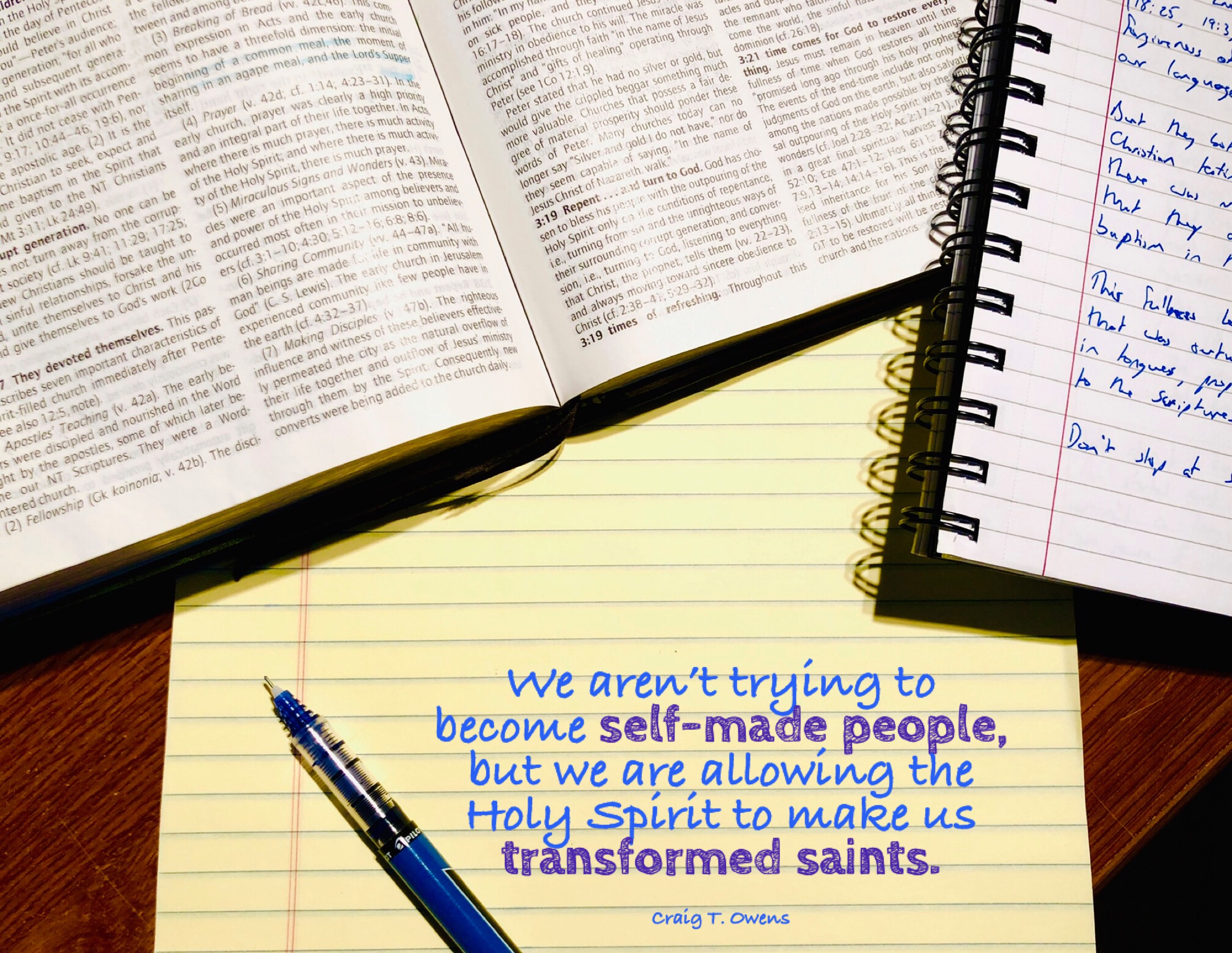
Notice that it is after we have been through this transformation of mind, body, and spirit that Paul tells us the standard for God-honoring living. This is where we see even our unplanned reactions becoming more and more Christ-like (Romans 12:9-21). We cannot live out this Romans 12 mandate solely on our own willpower. We aren’t trying to become self-made people, but instead, we are allowing the Holy Spirit to make us transformed saints. Transformed saints that are known by their unplanned Christlike reactions. 

This is why I keep stressing for Christians to not stop at salvation, but to press on to be baptized in the Holy Spirit. 

If you’ve missed any of the messages in our series We Are: Pentecostal, you can access the full list by clicking here.

►► Would you please prayerfully consider supporting this ministry? ◀︎◀︎

The Spirit Of Truth

Listen to the podcast of this post by clicking on the player below, and you can also subscribe on Apple or Spotify.

When I was 4 years old, I heard my echo for the first time as I yelled “Hello!” to a barn on the other side of a pasture. I was totally convinced that I had a friend in that barn yelling back to me, and I ended up being a bit disappointed later when I discovered that it was just my own sound waves bouncing back to me. 

To my 4-year-old brain, a little friend yelling back from the barn was absolutely true. It was maturity and new information that taught me differently. Isn’t this an ongoing story for all of us? Many things seem true from our current perspective, but then as we get older or smarter we realize that our original belief—what we really believed to be true—is now invalidated. 

Rarely does anyone admit, “I was immature back then,” but we usually try to justify ourselves by saying, “If I would have known back then what I know now….” But the fact is it will always be an impossibility for you to know then what you know now. 

In 1880, Edwin A. Abbott wrote Flatland, a favorite book of Albert Einstein. Abbott was a college-trained mathematician and theologian; in fact, he was actually better known for his theological writings than for this book. In this fabulous little book, Square, who lives in two-dimensional Flatland, cannot perceive height or depth. So what appears to him to be a wall, would merely be a line to you and me. One day Sphere from three-dimensional Spaceland visits Flatland, trying to explain to Square what his world was really like, but Square and his other Flatlanders could never fully grasp the idea. 

When Jesus was interviewed by Pilate, it sounds as though Pilate is missing a “dimension.” Pilate tries to state things the way that he understands them, but Jesus is revealing to him a whole new dimension (see John 18:33-38). The word Jesus uses for “truth” in this conversation means objective truth: something that is always true, regardless of where or when we live. Jesus explained that He as God IS objective truth. Any of our truth statements that aren’t grounded in God are subjective truth statements at best. 

Listen to how John describes Jesus: In the beginning—before all time—was the Word (Christ), and the Word was with God, and the Word was God Himself. He was continually existing in the beginning co-eternally with God. All things were made and came into existence through Him; and without Him not even one thing was made that has come into being. In Him was life and the power to bestow life, and the life was the Light of men. The Light shines on in the darkness, and the darkness did not understand it or overpower it or appropriate it or absorb it and is unreceptive to it. (John 1:1-5 AMP) 

Here’s the absolutely amazing thing: Jesus wants us to have this same insight into heavenly dimensions! Jesus said He would ask the Father to send us the Holy Spirit, Whom He called “the Spirit of Truth” (John 14:6, 16-17; 15:26; 16:12-13).

The Spirit of Truth…

  • …reminds us of the words of Jesus—John 14:26 
  • …helps us testify to others about the Truth—John 15:26-27 
  • …continually reveals objective truth to us—John 16:12-13 
  • …gives us truthful words to share with other “Flatlanders” who doubt the words of God—Matthew 10:16-20 
  • …and helps us spot and refute the falsehoods of the antichrist—1 John 2:18-27  

[Check out all of these Scriptures by clicking here.]

I love the King James Version of 1 John 2:20—But ye have an unction from the Holy One, and ye know all things. Being baptized in the Spirit of Truth means that you have access to an eternal perspective. You are no longer bound by the dimensions and paradigms of this “Flatland” but you are seeing things from God’s transcendent perspective. 

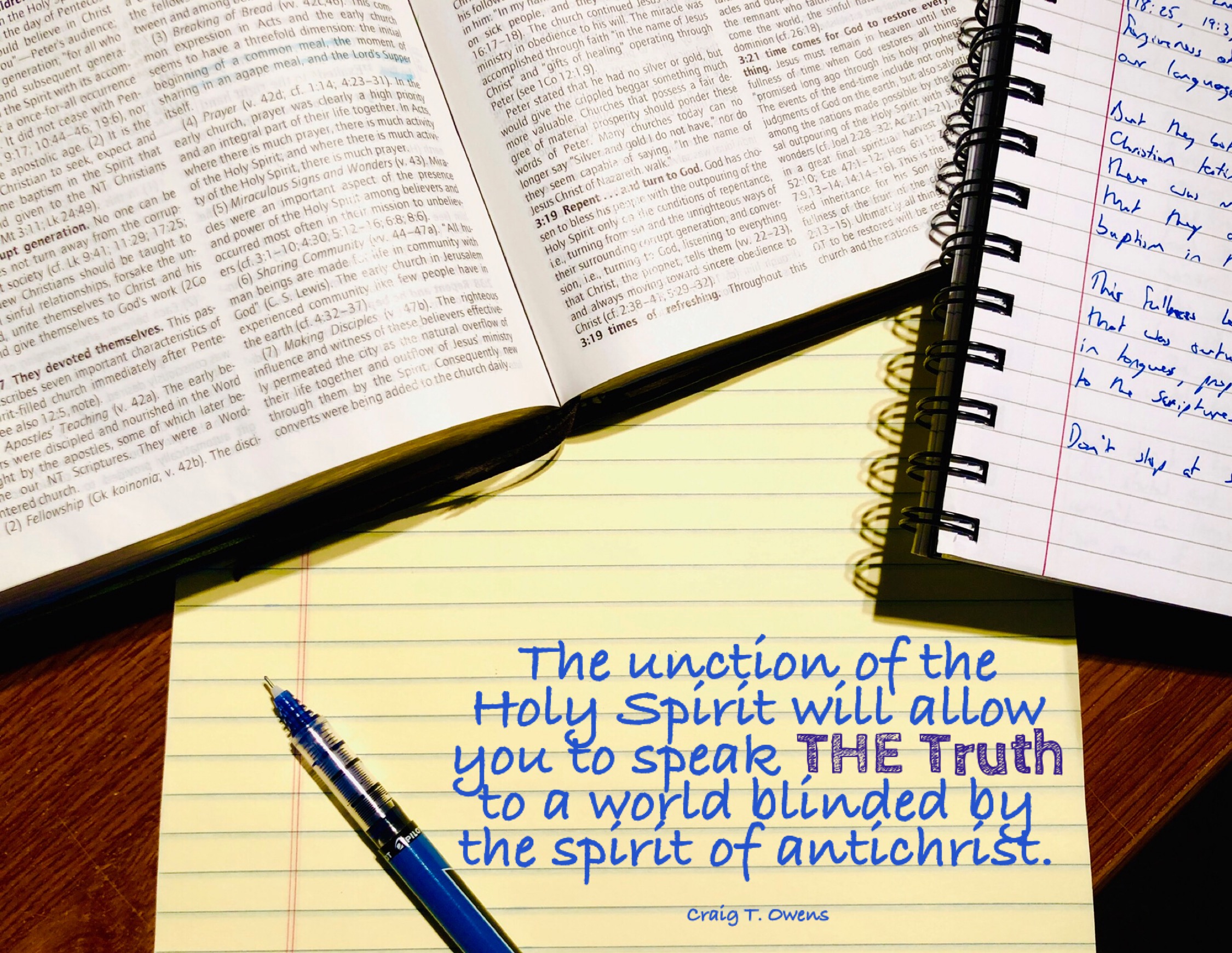
The unction of the Holy Spirit will allow you to speak THE Truth to a world blinded by the spirit of the antichrist. 

If you’ve missed any of the messages in our series We Are: Pentecostal, you can access the full list by clicking here.

►► Would you please prayerfully consider supporting this ministry? ◀︎◀︎

Prayer (book review)

Listen to the podcast of this post by clicking on the player below, and you can also subscribe on Apple or Spotify.

John Bunyan was in prison for refusing to bow to the dictates of the ecclesiastical rulers of England, but prison could not silence his pen. Before writing The Pilgrim’s Progress, which Bunyan said came to him in a dream, he wrote two manuscripts on prayer which can only have come from a visit to a much more substantial heavenly realm. 

Prayer is actually two books written in the mid-seventeenth century. The first book is A Discourse Touching Prayer in which Bunyan dives deep on the apostle Paul’s desire, “I will pray with my spirit, but I will also pray with my understanding” (1 Corinthians 14:15). The second book is The Saints’ Privilege And Profit, which is a deep dive into the idea of “the throne of grace” (Hebrews 4:15). 

When I say “deep dive” I mean that John Bunyan gives us a masters’ level course on prayer! This is not reading for a new Christian nor for someone who merely utters a superficial prayer here and there. These books are for the mature Christian who is dissatisfied with their current level of prayer and longs for a deeper level of intimacy in communion with our Heavenly Father. 

Let me reiterate that Bunyan wrote these books from jail. Not exactly the idyllic setting for contemplation, nor an environment for pious platitudes that are reserved for the serene time of prayer in a place of comfort. Just imagine: Bunyan uses just one verse from the Bible for each of these works, and then keeps drilling down and down into the immeasurable riches that are found in our relationship with God. 

If you’re ready to take your prayer to an entirely new and more intimate place, spend some time with your Bible and these two short books from John Bunyan. 

►► Would you please prayerfully consider supporting this ministry? ◀︎◀︎