“While grief is expressed in words, its resolution is in God and the hope He gives for the future. In a way, the lamentation process is one of coming to grips with all that God wants us to see about our present circumstances.” —Dr. Henry Halley
My friend Greg Heeres and I have a brand new episode in our leadership podcast called The Craig And Greg Show. This discussion is all about setting good priorities.
Baruch was a faithful scribe and friend to Jeremiah. Not only did he transcribe all of Jeremiah’s dictation (twice!), but he also read all of Jeremiah’s words at the temple when the prophet was under house arrest. By identifying with Jeremiah, Baruch became the target of the false prophets’ vitriol.
Perhaps Baruch had big plans for his life, but those plans seemed thwarted because he was obedient to Jeremiah and to God. He was having a bit of a pity party which seemed to stem from his unrealized plans for himself.
I love the juxtaposition between two phrases in this chapter:
“You [Baruch] have said…” (v. 3)
“The Lord says…” (v. 4)
Baruch said, “My plans are failed.” God said, “My plans always prevail.”
Baruch said, “I’m done for.” God said, “Wherever you go, you will live.”
I have to stop listening to me. When I listen to me, my thwarted plans bring about a pity party. I have to keep listening to God. When I do, He brings life wherever He sends me.
I believe that shepherd leaders can learn a valuable lesson from Baruch’s life. In fact, in my book I talk about a time that God and my wife had to deal with me about my own pity party.
Shepherd Leadership: The Metrics That Really Matter is available in print or ebook, and in audiobook through either Audible or Apple.
Listen to the podcast of this post by clicking on the player below, and you can also subscribe on Apple, Spotify, or Audible.
Isaiah 52–53 contain a description of Jesus as a servant leader. One phrase describes Him like this: “See, My Servant will act wisely” (Isaiah 52:13).
That phrase “act wisely” is translated in some other translations of the Bible as “deal prudently.” I like that word prudently. It’s not a word that we use very often today, but it’s one that sets God’s servant leaders apart from worldly leaders.
Prudent can be described as…
circumspect
intelligently speaking and acting
teaching skillfully
having increasing understanding and insight
helping others grow in understanding
behaving appropriately
living wisely
guiding oneself and others willingly
What happens to the leader who lives and leads this way? Listen to the entire verse that I only quoted a portion of earlier—
See, My Servant will act wisely; He will be raised and lifted up and highly exalted.
Notice that this exalted person is described as a servant—not just anyone’s servant, but Jehovah’s servant. As a servant of God, Jesus becomes a servant of all. And as a servant of God, He is exalted and honored above all.
Jesus is every leader’s Ultimate Example of this. Jesus set aside every prerogative He had that would give Him the right to do things His way, in order to make Himself a servant of God and a servant of mankind (Philippians 2:6-11; Mark 10:45). Jesus gave all of His followers this example to emulate (John 13:15-17), so Paul tells us our “mindset should be the same as that of Christ Jesus” (Philippians 2:5).
I need to ask myself a question—and I would invite you to ask yourself this too: As a leader, am I growing in Christlike prudence?
A mark of a godly leader is one who can see his growth in prudence.
Jesus, may You be pleased as I follow Your example of living and leading prudently. Holy Spirit, help me see the areas in my life where I need to submit to You. Father, may You be pleased to bless my leadership as it aligns with Your heart. I want to act wisely, lead prudently, and help others to follow this example of Jesus for themselves.
This is part 61 in my series on godly leadership. You can check out all of my posts in this series by clicking here.
Listen to the podcast of this post by clicking on the player below, and you can also subscribe on Apple, Spotify, or Audible.
And they were not able to resist the wisdom and the Spirit by which [Stephen] spoke. (Acts 6:10)
Luke the historian doesn’t give us very many details about Stephen, but one common thread is the obvious help the Holy Spirit gave him:
Stephen, full of faith and power, did great wonders and signs among the people
they were not able to resist the wisdom and the Spirit by which he spoke
all who sat in the council…saw his face as the face of an angel
when they heard these things they were cut to the heart
being full of the Holy Spirit, [Stephen] gazed into heaven and saw the glory of God, and Jesus standing at the right hand of God
Jesus lived this way too. Near the end of His public ministry He said,
“I have never spoken on My own authority or of My own accord or as self-appointed, but the Father Who sent Me has Himself given Me orders concerning what to say and what to tell. And I know that His commandment means eternal life. So whatever I speak, I am saying exactly what My Father has told Me to say and in accordance with His instructions.” (John 12:49-50 AMP)
Jesus said this same Holy Spirit who directed His vocabulary, and Who gave Stephen his irresistible words, would do the same thing for us too. The apostle Paul asked for the Ephesian Christians to pray for him like this, “Pray also for me, that whenever I speak, words may be given me so that I will fearlessly make known the mystery of the gospel” (Ephesians 6:19).
When we are yielded to the Holy Spirit we can say with assurance…
A mark of a godly leader is his irresistible, Spirit-led vocabulary.
This is part 60 in my series on godly leadership. You can check out all of my posts in this series by clicking here.
On a recent episode of our leadership podcast, Greg Heeres and I were discussing how easy it is for people to slip into a complaining attitude. One of the things I point out is that if we ask for compliments instead of complaints, we can begin to change the culture of our organization.
Listen to the podcast of this post by clicking on the player below, and you can also subscribe on Apple, Spotify, or Audible.
I love reading, and I love sharing my love of good books with others! Here is a list of the books I read and reviewed in 2021. Click on a title to be taken to that review.
“Stunningly, the Good Shepherd has put the care of His foolish flock into the hands of under-shepherds who tend to be somewhat stupid ourselves. The grand gamble only works if under-shepherds studiously lead in the way that Jesus instructed us to—and therein is the rub, for none of us naturally agrees with His model. Our flesh, culture, ambitions, and propensities all fight Shepherd Leadership like the plague. We may kiss the concept theoretically, but we fundamentally flee from it functionally. …
“It is good to be a sheep; it is good to be an under-shepherd. Just remember you are stupid, chosen by the Wise One, and as long as you serve as a shepherd, you and your flock will be safe.
“The book you are about to read is a refreshing look at leading as a sheep, of serving like our Chief Shepherd. I trust you will benefit from it as much as I did.”
[18:30] Legacy is determined by what our family says about us
[19:56] How leaders can set family leadership goals for the New Year
Check out this episode and subscribe on YouTube so you can watch all of the upcoming episodes. You can also listen to our podcast on Spotify and Apple.
Listen to the podcast of this post by clicking on the player below, and you can also subscribe on Apple, Spotify, or Audible.
On a recent episode of The Craig And Greg Show, Greg and I discussed the vitally important role of leading in our families.
Most parents know they should do this, but one of the things that gets in the way is trying to determine just how “success” should be defined in a family setting.
Greg and I talk about the distractions to meaningful interactions with our spouse and kids, and I share a story about how I helped my church board understand this concept so that they could support me in this.
The bottom line: Someone else can do our jobs, but we are the only ones who can be the godly spouse for our husband or wife, and the godly parent for kids. Let’s make sure this is always our priority!
If you would like to watch this full episode of The Craig And Greg Show, please click here. And if you would like to know more about my book which I mentioned in this podcast, please click here.
Listen to the podcast of this post by clicking on the player below, and you can also subscribe on Apple, Spotify, or Audible.
At a recent Q&A, I was asked how leaders in smaller markets or communities can avoid becoming discouraged if their measurable metrics aren’t continually rising.
I answered this by pointing to a simple three-word phrase that God laid on my heart a number of years ago.
This is an idea that I unpack throughout my book Shepherd Leadership: The Metrics That Really Matter. Please pick up a copy for yourself or as a gift for your friends who are in leadership positions. My book is available in print or ebook, and in audiobook through either Audible or Apple.




 My friend Greg Heeres and I have a brand new episode in our leadership podcast called The Craig And Greg Show. This discussion is all about setting good priorities.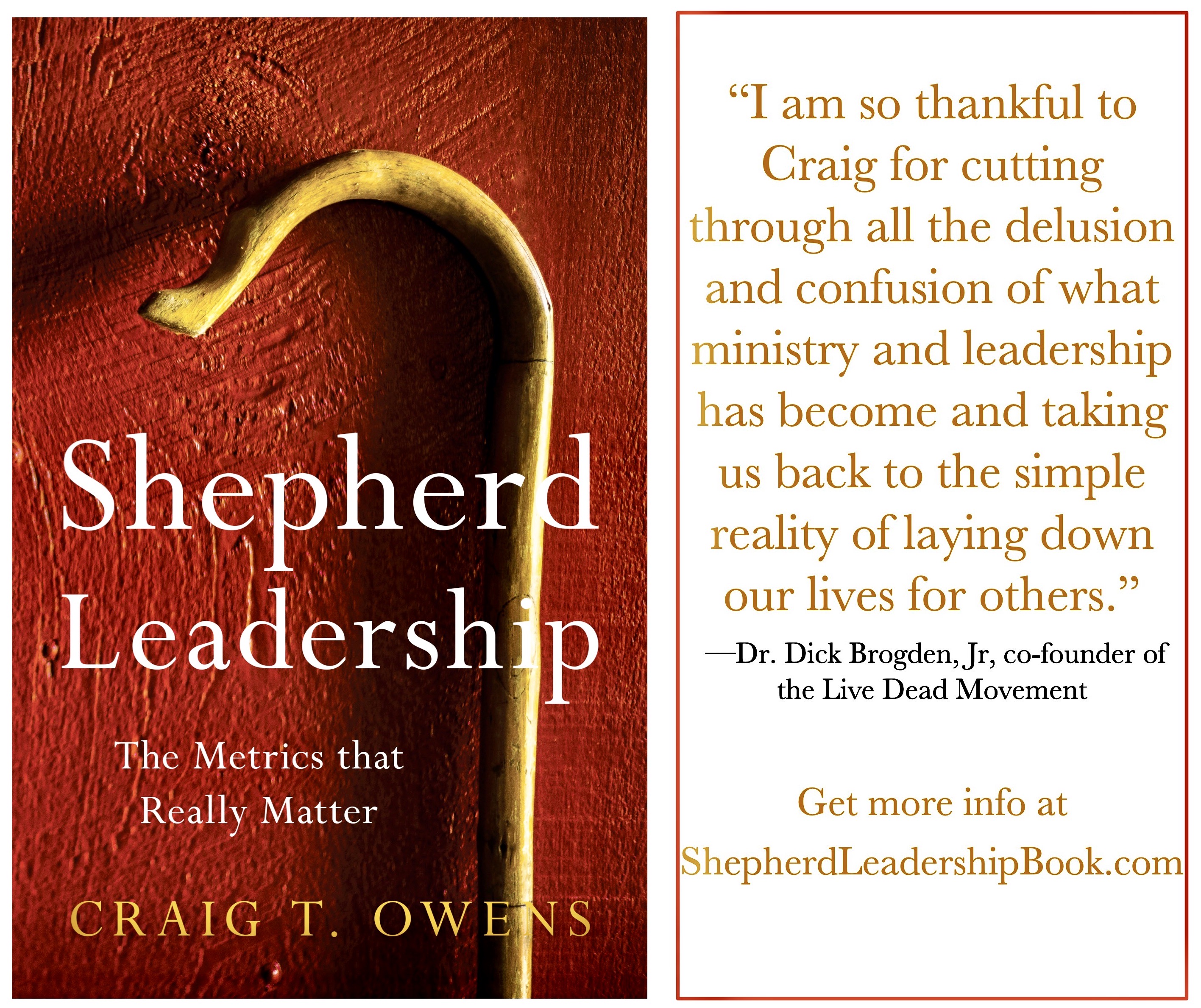






 Craig T. Owens