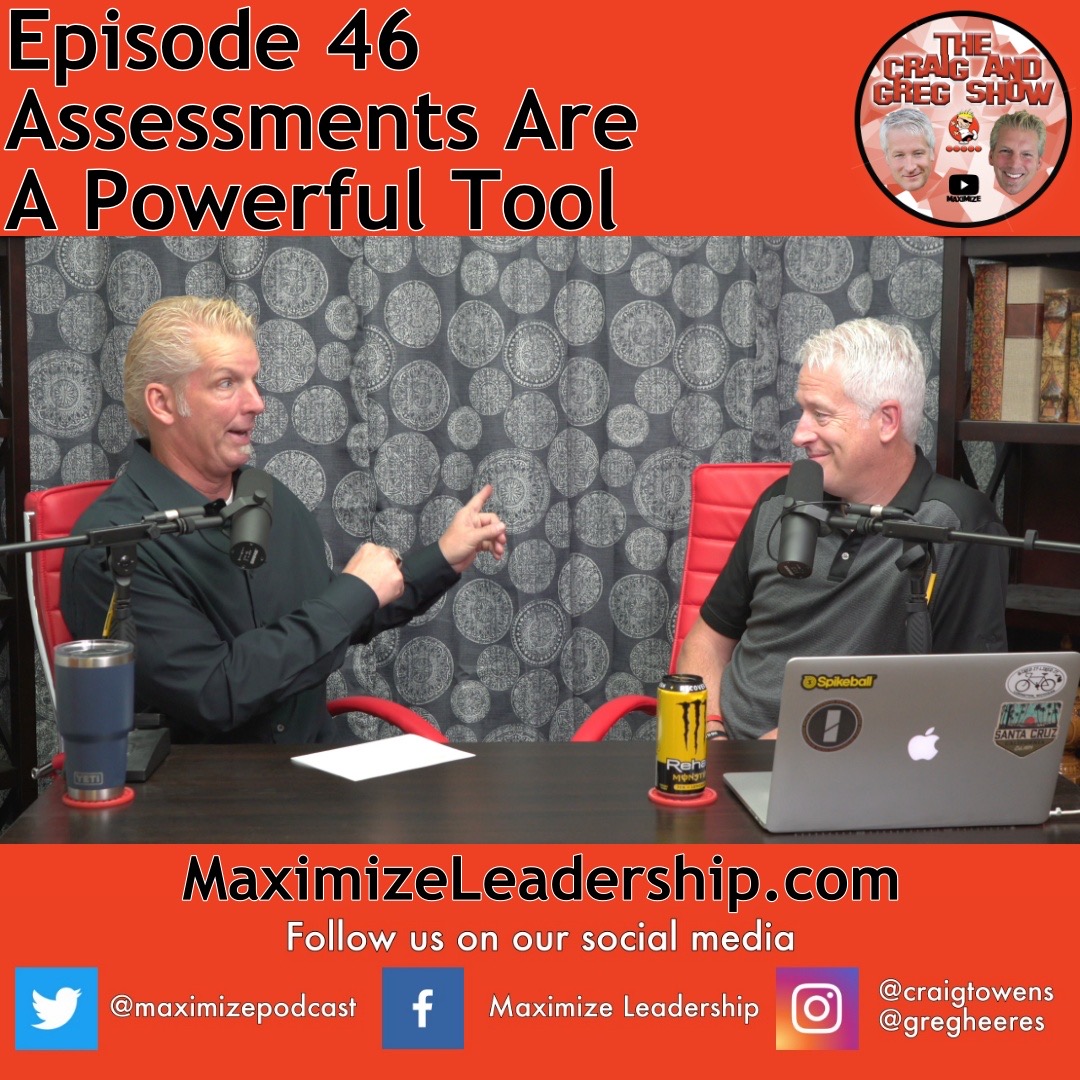
[0:38] We prefer preventative care both physically and in our leadership health
[1:40] When should we use assessments?
[3:10] Assessments can help leaders get an objective perspective on themselves and their team members
[4:36] We need windows of insight into ourselves first before we start working with our teammates
[5:40] What’s the goal of assessments?
[7:40] There are no “wrong answers” in assessment results
[9:39] How do leaders share the results of assessments with the whole team?
[13:31] When we have insight about our teammates, it helps us grow and understand each other
[15:34] Intuition and assessments work really well together
[17:01] What if an assessment appears to raise a warning flag?
[18:02] Leaders should use their assessments to setup their teammates for consistent success
[19:35] Assessments allow leaders to craft a complete team
[20:37] An outside coach can help your organization know what assessments to use and how to implement the results of any assessments
Check out this episode and subscribe on YouTube so you can watch all of the upcoming episodes. You can also listen to our podcast on Spotify and Apple.
Premier athletes know the value of flexibility for keeping them in the game. I think we would be wise to practice flexibility in our relationships too—this is definitely a game-changing move! Check out my weekly Monday Motivation videos on my YouTube channel.
“The bravest are surely those who have the clearest vision of what is before them, glory and danger like, and yet notwithstanding, go out to meet it.” —Thucydides
One of my YouVersion friends (Nikki) commented a great reminder: “God can do way more with my surrender than with my striving.”
Thomas Zimmerman was an influential leader in the early days of the Assembly of God fellowship’s history. “Over a 50-year period, Thomas F. Zimmerman (1912-1991) served the Assemblies of God as pastor, district official, department leader, assistant general superintendent, and general superintendent. His leadership greatly increased the influence of the Pentecostal movement in the evangelical world, as well as in the broader American religious landscape.”
I post quality content nearly every day. If you don’t have time to read all that I share, please let me read it for you. The Craig T. Owens Audio Blog is just like this blog, except you get to hear me read my blog posts. Check it out my podcast on Spotify, Apple, and even Audible.
“The word ‘hell’ is used in the New Testament fourteen times, twelve times by Jesus Himself. It is not a myth created by dismal and angry preachers. It is a solemn warning from the Son of God who died to deliver sinners from its curse. We ignore it at great risk.” —John Piper
Christian apologist and cold-case detective J. Warner Wallace wrote, “the battleground on the abortion issue is beginning to shift, and this shift is going to cause us to rethink our approach to the debate.” Pro-life advocates need to check out Wallace’s post Justifying Homicide: The Future Battleground In The Abortion Debate.
Listen to the podcast of this post by clicking on the player below, and you can also subscribe on Apple, Spotify, or Audible.
I had a great time on the Thriving In Ministry podcast with Kyle Willis while his podcast partner Dace Clifton was on sabbatical.
From all of the podcasts and interviews they had done, Kyle shared with me how so many pastors find it difficult to take a Sabbath break. Kyle noted that a pastor’s day of rest seems to bump into everyone else’s day of work.
That passage in Mark 6 that I mentioned is instructive for leaders in a couple of ways. First, Jesus was looking out for His teammates. He saw that they were tired and He called them to a place of rest. Good shepherds are always tuned in to the needs of the flock around them. As David said in Psalm 23, the Good Shepherd knows when to lead us to quiet pastures and still waters.
Second, I see that Jesus was also tuned in to Himself. Even though He was trying to get to a quiet place, He took time to minister in teaching and food to a crowd that was described as “sheep without a shepherd.” When this time was finished, Jesus took time alone to pray (Mark 6:46).
I think sometimes leaders have sabotaged their own health and effectiveness by saying things like, “This is quitting time” or “This is my day off.” Instead, we should listen to the Holy Spirit giving us insight like, “Take a break now. It’s time to go to a quiet pasture. It’s time to recharge in prayer.”
Leaders, don’t stick rigidly to your schedule but stay tuned in to yourself. Listen for the unmistakable voice of the Holy Spirit giving you wisdom. I have a section of five chapters in my book Shepherd Leadership that deal with every aspect of a leader’s health. Please pick up a copy today.
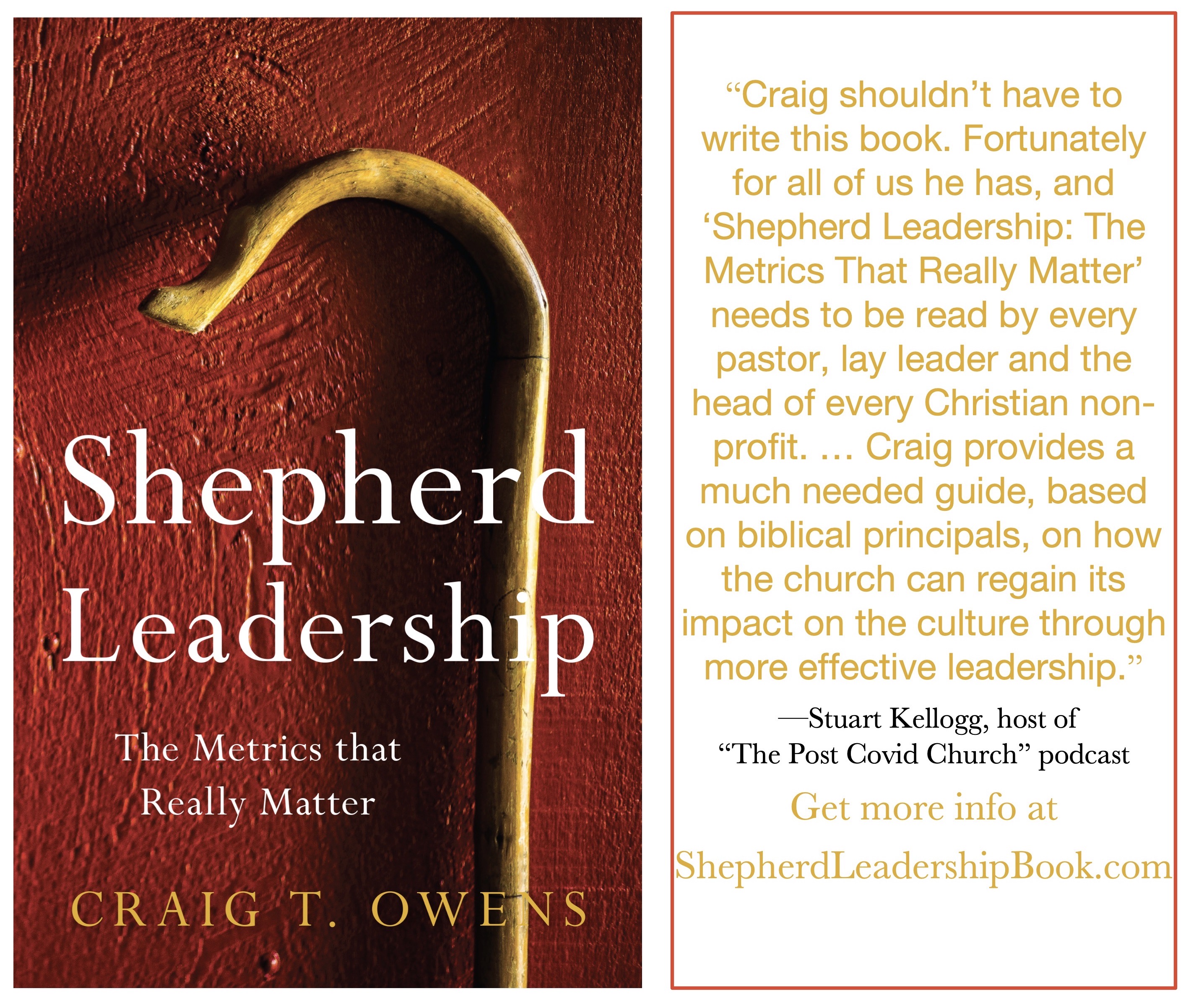
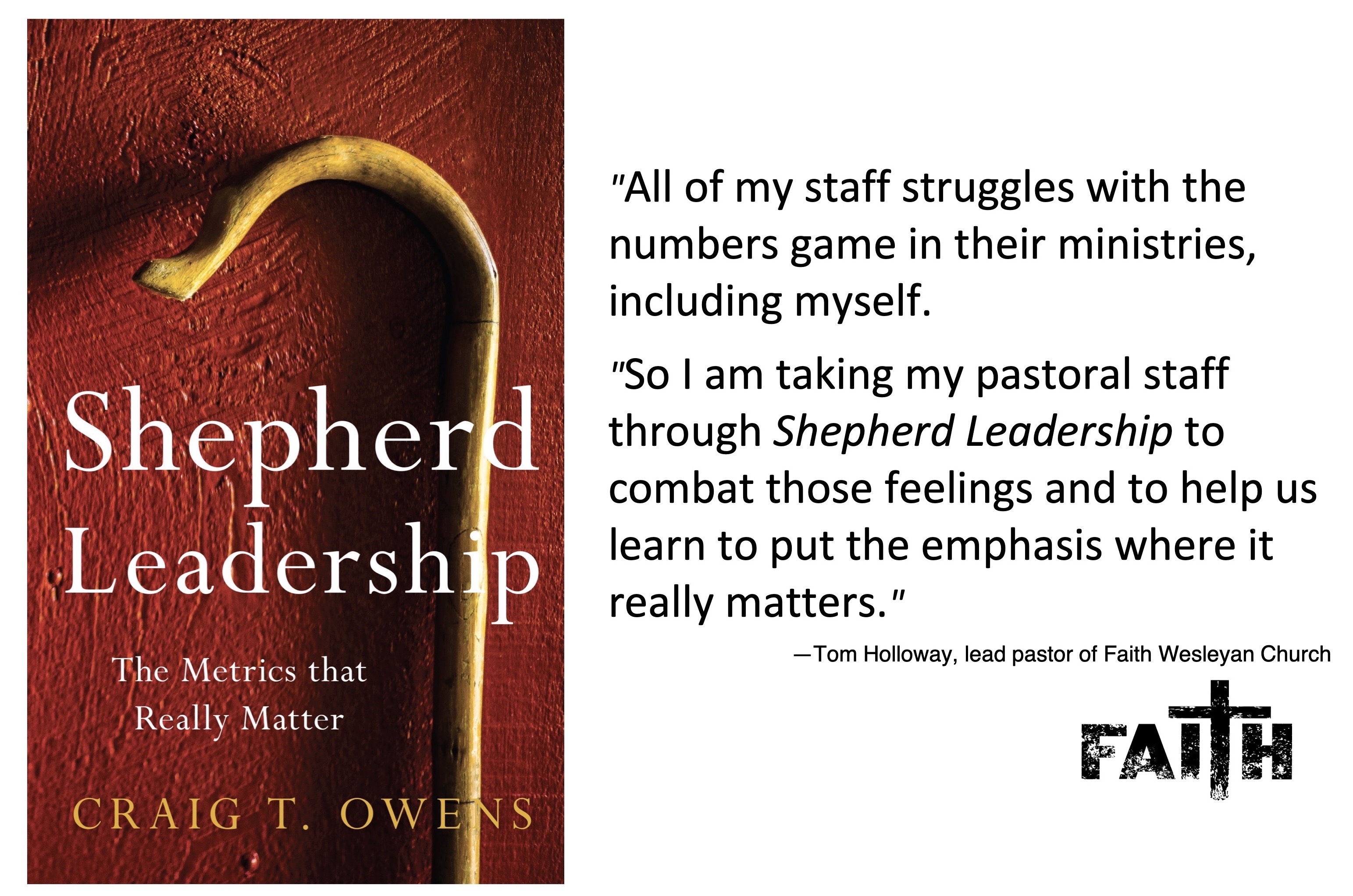
I’ll be sharing more clips from this Thriving In Ministry interview soon, so please stay tuned. Shepherd Leadership: The Metrics That Really Matter is available in print or ebook, and in audiobook through either Audible or Apple.
[19:25] What can we do with the notes from the books that we read?
[21:53] Greg has a new book coming out soon. Stay tuned for Sage Advice
Check out this episode and subscribe on YouTube so you can watch all of the upcoming episodes. You can also listen to our podcast on Spotify and Apple.
Listen to the podcast of this post by clicking on the player below, and you can also subscribe on Apple, Spotify, or Audible.
I’ve discussed quite a bit the two ways that organizations—especially churches and non-profit ministries—can measure success: By quantity or by quality. And I think a good case can be made for both of these metrics from the Bible.
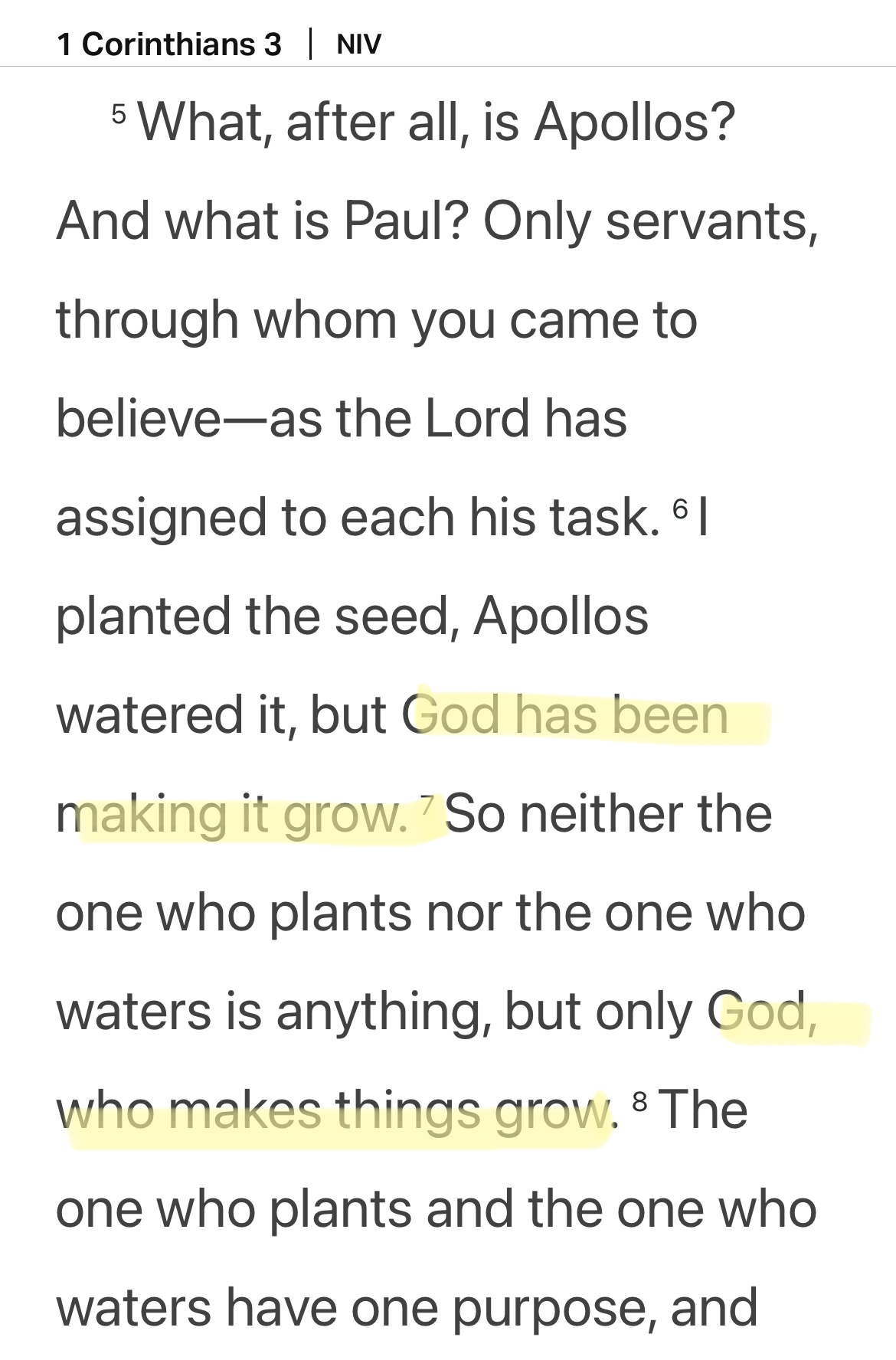
My bigger concern is when we try to use bigger numbers as the sole gauge of success. In a training time I had with some ministry interns, we took a deep dive into the reasons why the metric of bigger and ever-increasing numbers became the sole measurement for success in our churches. During this training time, I took these interns to Paul’s teaching in 1 Corinthians and two Old Testament examples where people got this wrong. Take a listen…
Listen to the podcast of this post by clicking on the player below, and you can also subscribe on Apple, Spotify, or Audible.
When God spoke to the “princes of Israel,” He was speaking to those in leadership positions. They were men who had wealth, position, and a high level of influence. God called them to live up to their title as “prince” because leadership is a high and holy calling given by God.
They are to be peacemakers, never men of violence nor oppression (45:9).
They are to be fair, consistent, and impartial in their interactions with others (45:10).
They are to generously provide for the people under their care (45:15-17, 22; 46:13-14).
They are to have a “get to do it” attitude toward their duties, not a “have to do it” attitude” (46:5, 7, 11).
They are to be among their people, not aloof nor isolated from them (46:10).
They are to provide for their family without impoverishing the people under their care (46:18).
Since God calls leaders, He will also call them to account. Jesus made it clear that there are only one-of-two assessments that leaders will hear from God:
Well done, good and faithful servant
You wicked, lazy servant
Let me say it again: Leadership is a high and holy calling. So…
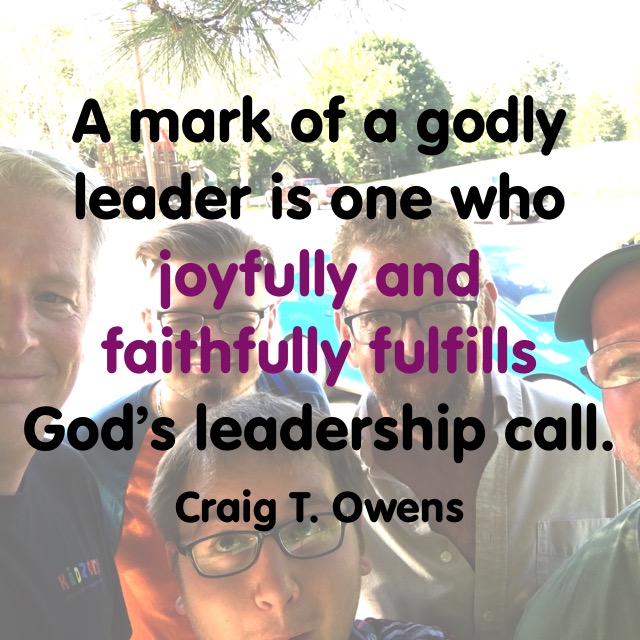
A mark of a godly leader is one who joyfully and faithfully fulfills God’s leadership call.
This is part 67 in my series on godly leadership. You can check out all of my posts in this series by clicking here.
[13:56] How do leaders “call out” what’s in our team members?
[16:01] A leader’s self-assessment is key to how well we motivate others.
[18:23] Are company-wide benefits demotivating? How can we switch this up?
[20:30] Does the carrot-or-stick method of motivation actually work?
[21:10] Greg shares a quote about how dreams can help motivation.
[22:51] Great leaders don’t assume, but they ask important questions.
[23:53] Our coaching huddles can help you individualize your leadership motivational skills and practices.
Check out this episode and subscribe on YouTube so you can watch all of the upcoming episodes. You can also listen to our podcast on Spotify and Apple.
Jesus said we are hypocrites when we give, pray, or fast only outwardly. He called our prayers “pagan” when we try to pray unnaturally. Jesus desires for our giving, praying, and fasting to be natural parts of who we are.This is a short clip of a full-length teaching called “Keepin’ it real” that I shared exclusively with my Patreon supporters. If you would like to sponsor me too for just $5/month, check out the details here.
“Nothing is impossible, the word itself says ‘I’m possible’!” —Audrey Hepburn
“Astronomers are thrilled by the extraordinary images provided by the new James Webb Space Telescope (JWST)—but some of the data already contradict Big Bang expectations. … Creationists have long noted that the Big Bang suffers from the mature distant galaxy problem. Big Bang theorists assume that light from the most distant galaxies took more than 13 billion years to reach Earth. By Big Bang reckoning, we should be seeing these very distant galaxies, not as they are today, but as they were more than 13 billion years ago. Hence, these galaxies should look ‘unevolved’ and ‘immature.’ Yet this expectation is routinely contradicted, and preliminary data from Webb continues the trend.” Check out more from this ICR article.
“Our leadership will always be second to our followership of Jesus.” —Pastor Ben Stoffel
Have you ever been cursed out? Here’s how Jesus wants Christians to respond. It’s pretty easy to say something nice to someone who has done something nice for you. But Jesus tells us to say nice things to people regardlessof how they have treated us.
“The battles that count aren’t the ones for gold medals. The struggles within yourself—that’s where it’s at.” —Jesse Owens
“Your walk walks, and your talk talks, but your walk talks more than your talk talks.” —Anonymous
John uses the word “fellowship” four times in 1 John 1:3, 6-7. This is the Greek word koinonia,which means intimacy of relationship. The whole purpose of the motivational gifts, the operational gifts, and the leadership gifts is to bring maturity and unity to the Body of Christ. This maturity brings out the fruit of the Spirit.
All of these gifts of the Holy Spirit are intended to help us demonstrate the fruit of the Spirit in ways that make the Kingdom of God visible and desirable. A key component is our koinonia that draws us together as one Body. Two key phrases that appear generously throughout the New Testament Church are one another and each other.
Patiently bearing with one another—Ephesians 4:2; Ephesians 4:3 TLB
Speaking the truth in love to one another—Ephesians 4:15; Colossians 3:9
Forgiving one another—Ephesians 4:32; Colossians 3:13
Submitting to one another—Ephesians 5:21
Acting like Jesus toward each other—Philippians 2:5
Doing what is good for one another—1 Thessalonians 5:15
Spurring one another on—Hebrews 10:24
Regularly meeting with one another—Acts 2:46; Hebrews 10:25
Looking after each other—Hebrews 12:15 AMP
Confessing sins to one another—James 5:16
Showing hospitality to each other—1 Peter 4:9
Doing the hard work of getting along with each other—James 3:17-18 MSG
Those things lead to #26, which starts the cycle over again at #1.
Increasing our love for one another—1 Thessalonians 3:12; 2 Thessalonians 1:3; Hebrews 13:1; 1 Peter 4:8
Our koinoniain the church is encouraging for the saints and it is a blessing for the unsaved because of all of the good things a unified, strong, loving church can do. Koinonia ultimately becomes one of the greatest witnessing tools. Jesus prayed—
My prayer is not for them alone. I pray also for those who will believe in Me through their message, that all of them may be one, Father, just as You are in Me and I am in You. May they also be in Us so that the world may believe that You have sent Me. (John 17:20-21)
Listen to the podcast of this post by clicking on the player below, and you can also subscribe on Apple, Spotify, or Audible.
Perhaps you’ve heard the phrase, “The best laid plans of mice and men often go awry.”
This is a line from a poem written by Robert Burns in 1785 called To A Mouse. The story behind the poem is Burns had been plowing his field and destroyed a nest that a mouse had been working all day to build. His poem was written as an apology. The famous line from the Scottish poet actually is written like this—
The best laid schemes o’ Mice an’ Men
Gang aft agley,
An’ lea’e us nought but grief an’ pain,
For promis’d joy!
That phrase “gang aft agley” means often go awry.
Do you ever feel this way? Like your perfectly planned agenda got derailed before you even finished breakfast? Or that your To Do list never quite gets “To Done” by the end of the day?
I had a great time on the Thriving In Ministry podcast with Kyle Willis while his podcast partner Dace Clifton was on sabbatical. We had planned to discuss how to help pastors get some rest so they could be at their optimal health, but our best laid plans definitely “gang aft agley”! We had multiple technical issues before we could even start recording, and then just as we talked about how pastors could find a way to rest, well, this happened…
Ah yes! Plans gone awry, indeed!
But here is an important principle for all of us to remember. The Bible says this: We can make our plans, but the Lord determines our steps (Proverbs 16:9). That means the thing that I call “an interruption” may be something or someone God has sent my way.
I used to really struggle with this, saying things like, “My plans never work out.” Until one day I heard the distinct voice of the Holy Spirit ask me, “Whose plans?”
Now listen, you who say, “Today or tomorrow we will go to this or that city, spend a year there, carry on business and make money.” Why, you do not even know what will happen tomorrow. What is your life? You are a mist that appears for a little while and then vanishes. Instead, you ought to say, “If it is the Lord’s will, we will live and do this or that.” (James 4:13-15)
Pastor, look at the life of Jesus. He often tried to get away for a time of rest, but people with needs showed up. His well-laid plans appeared to go awry. But He had compassion on them because He viewed them “like sheep without a shepherd” (Matthew 9:36; Mark 6:34). Jesus then found time to sabbath later.
Don’t view people with needs as an interruption or as something that derails your plans, but thank God for sending them your way. Then listen to the Holy Spirit showing you how and when you can get the rest you need to be energized to accomplish the rest of the items on your agenda.
I’ll be sharing more clips from this Thriving In Ministry interview soon, so please stay tuned. Shepherd Leadership: The Metrics That Really Matter is available in print or ebook, and in audiobook through either Audible or Apple.



 [0:38] We prefer preventative care both physically and in our leadership health