Jesus Is Wonderful Counselor

Listen to the podcast of this post by clicking on the player below, and you can also subscribe on AppleSpotify, or Audible. 

Jesus made His first appearance as a fully human Man in a stable in Bethlehem. But His Advent—or appearing—had been anticipated for a long time before that. 

In fact, one of the darkest chapters in human history takes place shortly after human history began. Mankind sinned and was separated from God because of that sin. The initial separation foretold an eternal separation (Genesis 3:22), but God shines His light of hope in this darkest hour, foretelling the Advent of our rescue (3:15). 

(Check out all of the Scriptures in this post by clicking here.)

Seven hundred years before Christ’s birth in Bethlehem, the setting is still dark and getting darker. Sin is running rampant, God’s people are groping in darkness, and enemies are pressing in from every side. 

Out of the darkness, God speaks (Isaiah 8:5-10), giving us a glimpse of the Messiah’s glory. Notice the hope-filled words Immanuel (v. 8) and God with us (v. 10). This darkness is the inevitable result of not gazing on God’s glory (vv. 21-22), and yet there appears another glorious promise in a single word: Nevertheless (9:1-7). 

We get a glimpse of Immanuel’s glory in the titles that will describe our Messiah. Let’s look first at Wonderful Counselor. 

Wonder can have two definitions: 

  1. Something so extraordinary that it is hard for our finite human minds to comprehend—Exodus 15:11; Isaiah 25:1 NLT. 
  2. God’s awesome deeds: His works that leave us in absolute awe of His greatness—Jeremiah 32:17 AMPC. 

Counselor is someone who gives counsel; not just any counsel, but perfect counsel because He is omniscient (knows it all) and omnipotent (can do it all)—Isaiah 14:26-27; Psalm 139:1-6; Psalm 32:8. 

Job got a glimpse of this Awesome Counselor too in Job 42:1-6. 

Our First Testament friends only got a glimpse of the Messiah’s glory, but we have the glory revealed to us—Hebrews 1:1-3a; Matthew 1:22-23; John 1:5, 14, 18. 

We have His wonderful counsel revealed to us too—Luke 5:20-26; John 7:37-46. 

And we look forward to seeing His glory undimmed at His Second Advent—John 1:47-51; Mark 14:61-62. 

As we live now between the Advents, we have the joyful privilege and responsibility to proclaim this glory to those still living in darkness—Matthew 28:18; Acts 4:30.  

See how the saints proclaimed Christ’s glory, relying on His wonderful counsel in Acts 4:13, 20, 31; 5:12; 6:8, 10; 8:6-8. This is how we are to live too (2 Thessalonians 2:16-17). 

As you live between the Advents, I pray that the glory of our Wonderful Counselor will become more real to you and that it will shine out of every word you speak and everything you do! 

Check out the other posts in this series Jesus Is… here.

►► Would you please prayerfully consider supporting this ministry? My Patreon supporters get behind-the-scenes access to exclusive materials. ◀︎◀︎

Remember Who’s In Control

Listen to the podcast of this post by clicking on the player below, and you can also subscribe on AppleSpotify, or Audible. 

I love the Fibber McGee and Molly radio broadcasts! One of the running gags on this show was Fibber’s closet: People who mistakenly opened the closet door got buried under a pile of stuff that Fibber had stashed away. 

In one episode, Molly is determined to grow through all of the items that were strewn across the floor before they got shoved back into the closet. One by one Molly asked Fibber about all of the odd knick-knacks and he had a good explanation for every single one justifying why he couldn’t possibly part with it. One of my favorites was this—“What’s this bamboo pole,” Molly asked, and Fibber said, “Why, that pole is very important. If I was ever offered to be Joe Louis’ sparing partner, that’s the ten-foot pole I wouldn’t touch it with!” 

I’m afraid that many of us have closets like this in our minds. We’ve accumulated a lot of just-in-case stuff for each and every scenario that may come upon us at some point in our lives. 

All of our contingency plans implies that something is going to go wrong and that only the prepared and well-stocked will make it through. 

(Check out all of the Scriptures in this post by clicking here.) 

Psalm 107 is the first psalm in Book 5 of the Psalter—the book that focuses mostly on praise. This author is recounting the history of Israel through the times of crisis: 

  • lost and homeless (v. 4) 
  • hungry and thirsty (vv. 5, 9) 
  • trouble and distress (vv. 6, 13, 19, 28) 
  • darkness and deepest gloom (vv. 10, 14) 
  • prisoners in chains (v. 10) 
  • knocking on death’s door (v. 18) 
  • terrorized (v. 26) 
  • at their wits’ end (v. 27) 

We quickly go into crisis mode when we forget that God is in control! 

In God’s Kingdom there is no emergency, no crisis, no Plan B. God is sovereignly in control—Isaiah 46:10. 

  • God is in control of the macro—Genesis 1:1; Job 38:4-11 
  • God is in control of the micro—Psalm 139:16; Jeremiah 29:11 
  • God will use what we call a crisis to display His glory—Exodus 14:4 NLT 

When you feel yourself spiraling into crisis mode—when you feel you’re at your wits’ end—you can get back into contentment mode. 

“When a man is at his wits’ end it is not a cowardly thing to pray, it is the only way he can get in touch with Reality.” —Oswald Chambers 

That’s what Job finally did—Job 42:1-2. 

And that’s also what the psalmist did—Psalm 107:6-8, 13-15, 19-21, 28-31.  

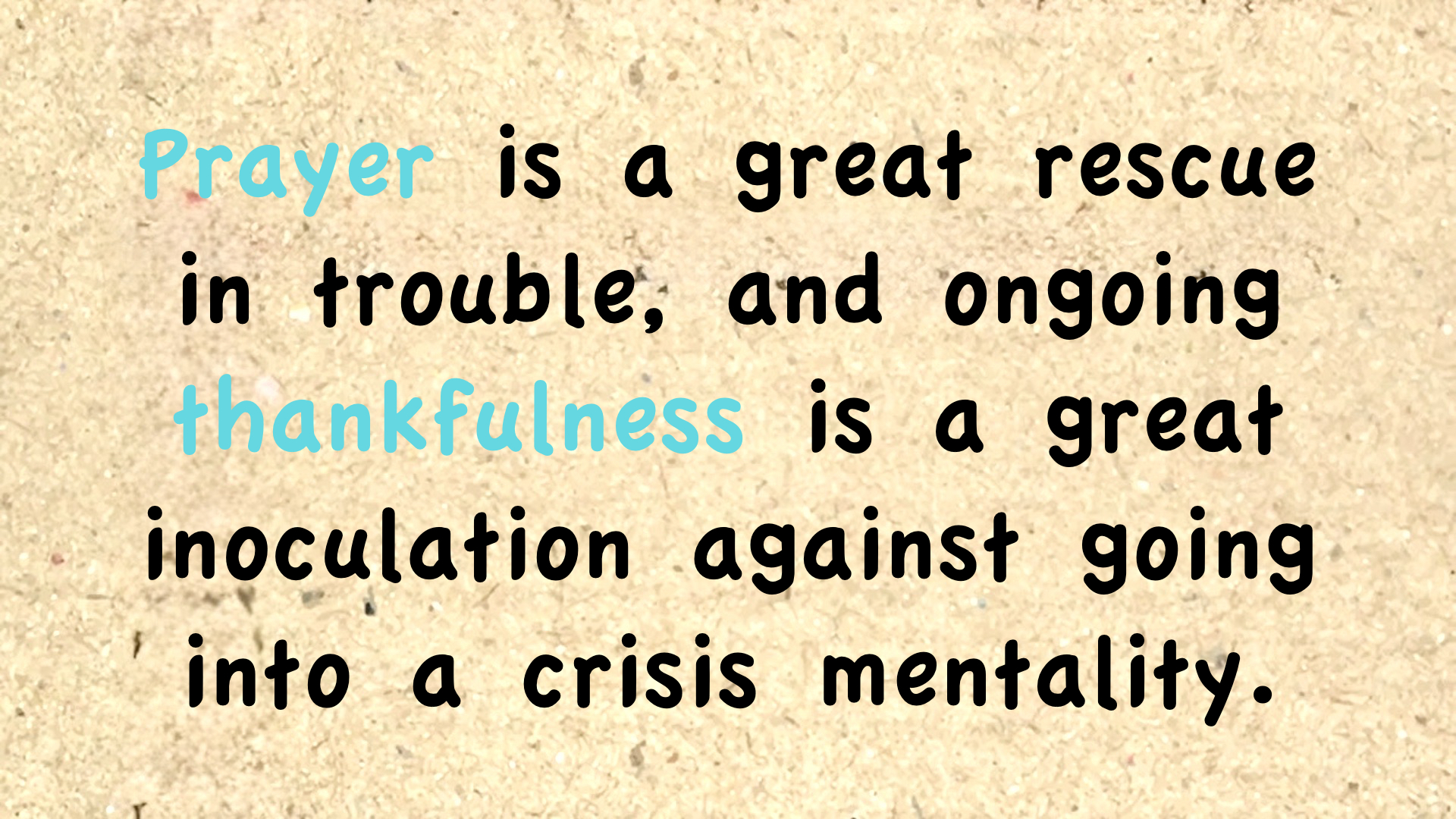
Prayer is a great rescue in trouble, and ongoing thankfulness is a great inoculation against going into crisis mentality. Notice that those four repeated phrases have both cried out to the Lord AND Let them give thanks to the Lord for His unfailing love. 

Let’s strive to remain aware of His unfailing love by cultivating consistent gratitude. I like v. 2 from the NLT: “Has the Lord redeemed you? Then speak out! Tell others He has redeemed you from your enemies”. When you are preoccupied with telling others and yourself how good God is, there isn’t room in your heart for the worry that leads toward crisis mode. 

Remember: We can quickly go from contentment mode to crisis mode when we forget that God is in control, so remain full of thanks. “At all times and for everything giving thanks in the name of our Lord Jesus Christ to God the Father” (Ephesians 5:20 AMPC). 

►► Would you please prayerfully consider supporting this ministry? My Patreon supporters get behind-the-scenes access to exclusive materials. ◀︎◀︎

God’s Timing Is Perfect

In the month of Kislev in the 20th year of the Israelites’ exile in Babylon, Nehemiah began to pray for favor when he spoke with King Artaxerxes. In the month of Nisan—four months later—Nehemiah was finally given the opportunity to speak with the king about his heart’s desire to travel to Jerusalem (Nehemiah 1:1–2:6). 

Jeremiah dictated all of God’s words to Baruch in the 4th year of King Jehoiakim’s reign. Presumably, Baruch begin sharing these words immediately, but it wasn’t until the 9th month of the 5th year that these words appeared to hit home (Jeremiah 36:1-6, 8-9). 

In the 3rd year of King Cyrus’ reign, Daniel was shown a vision from God and he began to pray for God to give him the meaning of the vision. Twenty-one days later and angel arrived with the answer (Daniel 10:1-12) 

Zechariah and Elizabeth prayed and tried to get pregnant until Elizabeth became post-menopausal. Even after they stopped praying and stopped trying, Gabriel told them their prayer had been heard and Elizabeth became pregnant (Luke 1:5-25).

God’s timing is perfect! 

What has God promised you? Are you still praying for it? Still believing for it? Are you still doing what you need to do to see it happen? If God spoke it to you, He has not forgotten you! Don’t believe the lie that the window of opportunity has closed!

If it seems slow in coming, wait patiently, for it will surely take place. It will not be delayed. (Habakkuk 2:3)

Related posts:

See all of the Scriptures here.

The Healing Word

Listen to the podcast of this post by clicking on the player below, and you can also subscribe on AppleSpotify, or Audible. 

If you go to the doctor because you sense that something is wrong, you want your doctor to tell you the truth. A doctor who avoids telling you the truth because it might hurt your feelings doesn’t put you on the road to recovery. 

If this is true for medical doctors, isn’t it more important for soul doctors? After all, even the best doctors cannot keep your physical body alive forever, but your soul will live eternally. 

If God has given you His Word to share, He says, “I will make My words fire in your mouth” (Jeremiah 5:14). Deliver that painful—but absolutely vital—diagnosis to help people recover from the ravages of their sin. 

To soften the words, to water-down the medicine for the sake of people’s feeling or for the desire to be liked by people, is to become a quack, a false prophet. God says of these charlatans, “They dress the wound of My people as though it were not serious. ‘Peace, peace,’ they say, when there is no peace” (Jeremiah 6:14, 8:11). 

Then God says,

The prophets prophesy falsely, and the priests exercise rule at their own hands and by means of the prophets. And My people love to have it so! But what will you do when the end comes? (Jeremiah 5:31) 

The healing word is often a hard word. It might even be considered by those plagued by the ravages of sin to be a harsh and painful word. But the only path to healing is the medicine found in God’s Word—the healing balm that comes from exposing my sin, repenting of my sin, and finally enjoying the healing of God’s forgiveness. 

We must always speak the truthful healing word in love because eternity is at stake! 

►► Would you please prayerfully consider supporting this ministry? My Patreon supporters get behind-the-scenes access to exclusive materials. ◀︎◀︎

God Provides For His Servants

Listen to the podcast of this post by clicking on the player below, and you can also subscribe on AppleSpotify, or Audible. 

God promised to provide for Jeremiah if he remained faithful to preach the word God had given him. Jeremiah did deliver a hard message that turned out to be highly unpopular, and as a result those who heard his sermon became quite angry with Jeremiah. 

In what I think is a very human response, Jeremiah began to complain to God—

   Your words were found, and I ate them; and Your words were to me a joy and the rejoicing of my heart, for I am called by Your name, O Lord God of hosts. I sat not in the assembly of those who make merry, nor did I rejoice; I sat alone because Your powerful hand was upon me, for You had filled me with indignation. Why is my pain perpetual and my wound incurable, refusing to be healed? Will You indeed be to me like a deceitful brook, like waters that fail and are uncertain? (Jeremiah 15:16-18 AMPC) 

God had to speak a correcting word to Jeremiah— 

   If you return and give up this mistaken tone of distrust and despair, then I will give you again a settled place of quiet and safety, and you will be My minister; and if you separate the precious from the vile—cleansing your own heart from unworthy and unwarranted suspicions concerning God’s faithfulness—you shall be My mouthpiece. Let them return to you—not you to the people. (v. 19) 

Jeremiah got over his pity party and once again continued to faithfully deliver God’s message, despite what people thought of him or said about him. Jeremiah even remained resolute in his devotion to God when the rulers of the people abused Jeremiah or threw him into prison or threatened to kill him. 

Just as God promised, as the Babylonians pressed in on Jerusalem, the people flocked back to Jeremiah to ask him to intercede before God on their behalf (21:1-2; 37:3; 42:2)

Remember that God had promised to take care of Jeremiah, assuring him of a place of quiet and safety. God also said, 

   Truly your release, affliction, and strengthening will be for good purposes; surely, Jeremiah, I will intercede for you with the enemy and I will cause the enemy to ask for your aid in the time of evil and in the time of affliction. (15:11) 

This promise was fulfilled when Nebuzaradan—the commander of the imperial guard in Nebuchadnezzar’s army—came to Jerusalem:

   Now Nebuchadnezzar king of Babylon had given these orders about Jeremiah through Nebuzaradan commander of the imperial guard: “Take him and look after him; don’t harm him but do for him whatever he asks.” … [Nebuzaradan] had found Jeremiah bound in chains among all the captives from Jerusalem and Judah who were being carried into exile to Babylon. When the commander of the guard found Jeremiah, he said to him, “The Lord your God decreed this disaster for this place. And now the Lord has brought it about; He has done just as He said He would. All this happened because you people sinned against the Lord and did not obey Him. But today I am freeing you from the chains on your wrists.” (39:11-12; 40:1-2) 

God never promises His servants their task will be easy, but He does promise both temporal provision and eternal rewards for His servants who remain faithful to Him and to His calling. 

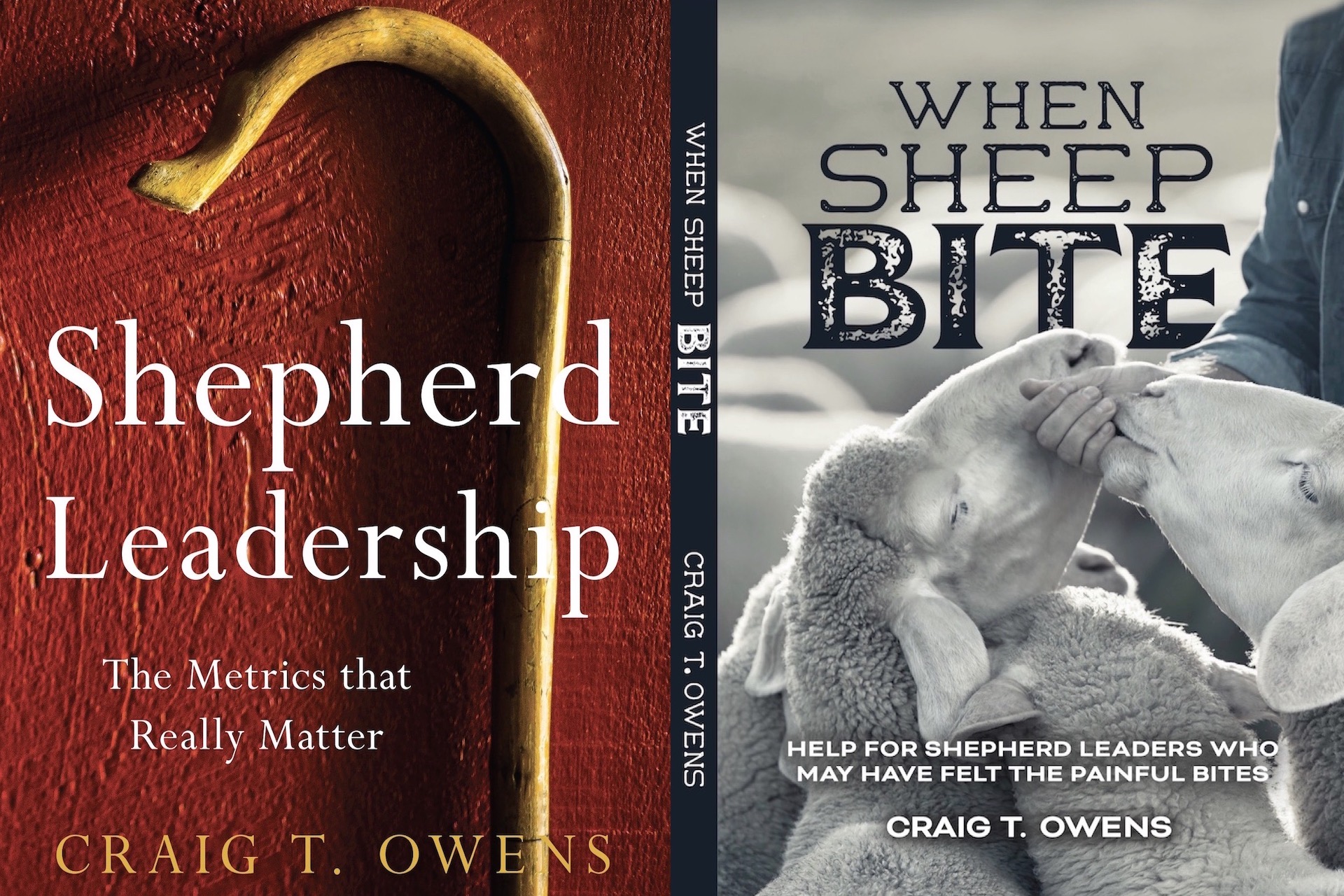
In my book Shepherd Leadership, I talk about a time God had to correct me when I was throwing myself a pity party. 

And in my book When Sheep Bite, the entire third section contains biblical strategies to help God’s servants not give in to the very natural response of fight-or-flight, but how to tap into the supernatural response of faithfulness. 

If you are a spiritual leader, I would encourage you to pick up a copy of both of these books. And keep in mind that God always provides for His servants. 

►► Would you please prayerfully consider supporting this ministry? My Patreon supporters get behind-the-scenes access to exclusive materials. ◀︎◀︎

Learning From Mistakes

Listen to the podcast of this post by clicking on the player below, and you can also subscribe on AppleSpotify, or Audible. 

Have you made any mistakes lately? Let’s talk about what we do next on this episode of The Podcast. 

The Scriptures I referenced in this video are Psalm 25:4, 8, 10; James 1:5; Jeremiah 33:3. 

I also referenced my blog posts Self-Talk During Fearful Times and Refined By Fire. 

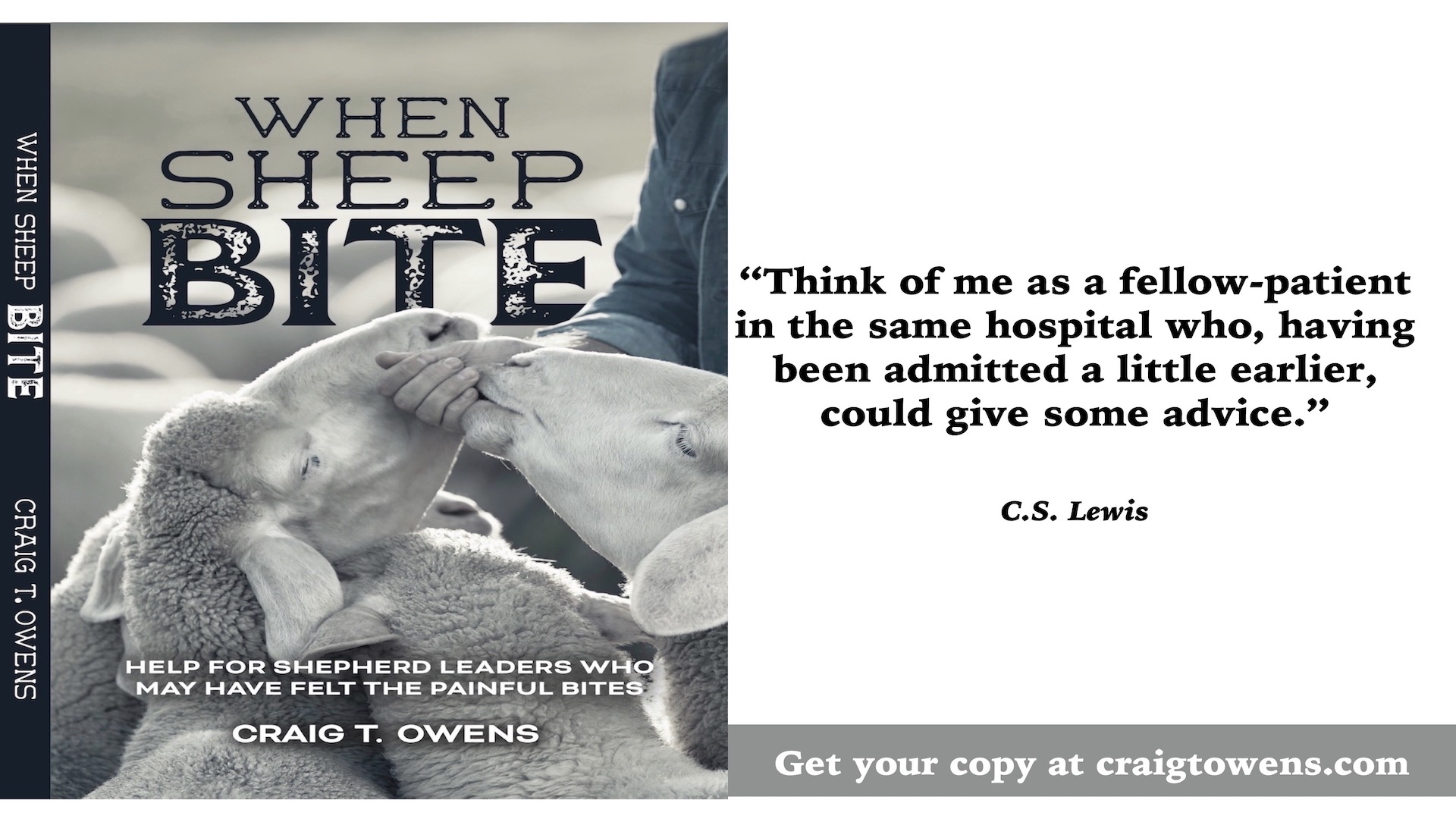
My book When Sheep Bite is all about recovering after difficulties—whether they were created by your mistakes or someone else’s mistakes. In the Introduction to my book I wrote: 

     I want to give you what I wanted when this happened to me: empathy, insight, a helpful perspective, and a manual of help that God has provided in the Bible. I don’t want to try to one-up your story of pain, because I’m confident that no one could truly know how deeply you’ve been hurt. But I do want to give you some assurance that I know what I’m talking about. … 

     Your pain and your circumstances are unique. Your pain is real, and it is incomparable to anyone el􏰃se’s pain. But the biblical principles that God revealed to me—􏰄those things that helped me heal and the thoughts I want to share with you􏰄—are applicable for any shepherd. These tried-and-true principles can help you not just survive this pain but thrive in spite of this pain. I would say to you something that C.S. Lewis wrote, “Think of me as a fellow-patient in the same hospital who, having been admitted a little earlier, could give some ad􏰋vice.” 

Check out When Sheep Bite for yourself. 

►► Would you please prayerfully consider supporting this ministry? My Patreon supporters get behind-the-scenes access to exclusive materials. ◀︎◀︎

Miserable Strategizing

Listen to the podcast of this post by clicking on the player below, and you can also subscribe on AppleSpotify, or Audible. 

Ahab, king of Israel, and Jehoshaphat, king of Judah, are strategizing a battle plan against Syria when they call for God’s prophet to share with them God’s counsel in this matter. 

Then Micaiah said, “I did see all Israel scattered upon the mountains as sheep that have no shepherd, and the Lord said, ‘These have no master. Let each return to his house in peace.’ … Now, you see, the Lord put a lying spirit in the mouths of your prophets; and the Lord has spoken evil concerning you. … If you return at all in peace, the Lord has not spoken by me” (2 Chronicles 18:16, 22, 27).

(Check out all of the Scriptures in this post here.)

You would think this would cause these kings to scrap their battle plans and keep their armies at home. But the next verse says they utterly rejected the prophet’s warning. “So Ahab king of Israel and Jehoshaphat king of Judah went up to Ramoth-gilead” (v. 28). 

What in the world is Jehoshaphat doing?!

He asked for a prophet from God and then when he hears from God that this combined army will be defeated, Jehoshaphat still goes with Ahab?!

But let’s back up: Why was Jehoshaphat even here hanging out with Ahab? And before even hearing from Micaiah, why does he commit his army and cavalry to this joint-venture (v. 3)? 

I think the clue is in v. 1: Jehoshaphat “was allied by marriage to Ahab.” Jehoshaphat’s son Jehoram is married to Ahab’s daughter Athaliah (2 Kings 8:18). 

Jehoshaphat thought this was a strategic move. Like a chess master moving his pieces on the board, he calculated that this alliance would give him an advantage. But instead this move resulted in years of heartache and destruction.

First, Jehoshaphat feels trapped into allying with Ahab in this ill-fated battle against the Syrians. Ahab is killed in this battle, and Jehoshaphat barely escapes with his life, although his army is embarrassed in defeat. 

As he is returning to Jerusalem, another prophet meets him and pronounces this heartbreaking message, “Should you help the ungodly and love those who hate the Lord? Because of this, wrath has gone out against you from the Lord” (2 Chronicles 19:2). 

Later on, Jehoshaphat again partners with Ahab’s son, “After this, Jehoshaphat king of Judah joined with Ahaziah king of Israel, who did very wickedly” (20:35). 

After Jehoshaphat died, his son Jehoram ascends the throne. 

His reign as king is only eight years long, and is noted for him walking “in the ways of the kings of Israel” by doing evil in God’s sight (2 Kings 8:15). Jehoram was killed in battle. 

Ahaziah his son then sits on the throne in Jerusalem for only a year, manipulated by his mother Athaliah. “He walked in the ways of the house of Ahab and did evil in the sight of the Lord, as did the house of Ahab, for his father was son-in-law of Ahab” (2 Kings 8:27). This alliance led to another disastrous joint military campaign with Israel. Ahaziah was killed by Jehu shortly after this. 

Look what happens next: “When Athaliah the mother of King Ahaziah of Judah saw that her son was dead, she arose and destroyed all the royal descendants (2 Kings 11:1). This began a six-year reign of terror in which Athaliah assumed the throne. 

Where did all of this mayhem begin? When Jehoshaphat calculated his own destiny. 

We have such a limited view; whereas, God is timeless, all-knowing, all-powerful. It is the highest form or arrogance to think we can out-maneuver God’s plan, or that we can even begin to know what’s best for our lives. 

The One who has all of our days written in His book is also the One who tells us that we can call to Him to learn things we don’t know and access the wisdom we don’t have (Psalm 139:16; Jeremiah 33:3; James 1:5). 

Think of the misery that could have been avoided if Jehoshaphat would have heeded the counsel of his forefather Solomon: “Lean on, trust in, and be confident in the Lord with all your heart and mind and do not rely on your own insight or understanding. In all your ways know, recognize, and acknowledge Him, and He will direct and make straight and plain your paths” (Proverbs 3:5-6 AMPC). 

What a miserable strategist I am when I make plans that I think are clever! Instead, I’m trying my best to follow Solomon’s counsel, and I pray you are too. 

►► Would you please prayerfully consider supporting this ministry? My Patreon supporters get behind-the-scenes access to exclusive materials. ◀︎◀︎

The Mind Of God

Listen to the podcast of this post by clicking on the player below, and you can also subscribe on AppleSpotify, or Audible. 

Last week we talked about the Voice of the Holy Spirit. I love the phrase from 1 Samuel 9:15 where God “told Samuel in his ear” about Saul’s arrival and what he should say to Saul. Then the Holy Spirit’s Voice for all of us is foretold in Isaiah 30:21. 

It’s great hearing the Spirit’s Voice, but He also empowers us to know the Mind of God. 

This is not something that automatically comes to every Christian at the moment they invite Jesus to be their Lord and Savior, as we see mention of immature Christians throughout the New Testament. 

Even after Jesus is resurrected from the dead, we see His followers as unsure, troubled men. We meet their…

  • lack of faith—Luke 24:11; Mark 16:14 
  • wonderment—Luke 24:12 
  • troubled minds—Luke 24:37; John 20:19 
  • lack of understanding of Scripture—Luke 24:44 

(Check out all of the Scriptures in this post by clicking here.)

This is all post-resurrection but pre-conversion, but look at what happens next. After Jesus breathes on them (John 20:22), they are peaceful (vv. 19, 21, 26) and they can now understand the Scriptures (Luke 24:45-48). 

As we’ve said, we shouldn’t stop at salvation. Certainly, Jesus wanted more for His followers than merely salvation. He wants His disciples empowered for witnessing and disciple-making (Luke 24:48; Acts 1:4-5, 8). 

Check out these examples of the Holy Spirit sharing with us the mind of God:

  • Joseph—Genesis 41:16, 38-40 
  • Daniel—Daniel 2:19-23, 27-28, 47 
  • Peter—Acts 2:14f; 3:17-26; 4:8-12 
  • Stephen—Acts 7 
  • Philip—Acts 8:30-35 

And just in case you think this is just for “super spiritual” people, look how the Holy Spirit helps the whole Church share the Gospel—

After they prayed, the place where they were meeting was shaken. And they were all filled with the Holy Spirit and spoke the Word of God boldly. … Those who had been scattered preached the word wherever they went. (Acts 4:31, 8:4).

This was always God’s plan! Paul harkens back to prophecies like Isaiah 55:8-9, Isaiah 40:13, and Jeremiah 31:33 when he writes about Christians having “the mind of God” in 1 Corinthians 2:6-16. 

He says, “These are the things revealed to us by His Spirit” (v. 10). 

What things? “Things God has prepared for those who love Him”—things which human eyes haven’t seen, human ears haven’t heard, human minds haven’t conceived (v. 9). These are the the very thoughts of God Himself! 

Just as my spirit is the only one that knows what’s really in my mind, the Holy Spirit is the only One Who knows the mind of the Father and Son (v. 11). We have been given the Holy Spirit “so that we may understand what God has freely given us” (v. 12). Contrast this with the dull, unfruitful minds of both unbelievers (2 Corinthians 4:4) and carnal Christians (Philippians 3:18-19). 

This mind of God is given to us for our edification so that we can be empowered witnesses and disciple-makers. So don’t stop at salvation, but be baptized in the Holy Spirit, and then keep on being filled with the Spirit. 

If you’ve missed any of the messages in this series, you can check them all out here. 

►► Would you please prayerfully consider supporting this ministry? My Patreon supporters get behind-the-scenes access to exclusive materials. ◀︎◀︎

When Grief Becomes A Testimony

Listen to the podcast of this post by clicking on the player below, and you can also subscribe on AppleSpotify, or Audible. 

None of us are strangers to grief—we’ve all experienced this dark place. 

The dictionary defines grief three ways: (1) keen mental suffering or distress over affliction or loss; (2) sharp sorrow; (3) painful regret. We sometimes define it with terms like at the end of my rope, down for the count, nothing but gray skies all around, or unable to see any light at the end of the long tunnel. 

One psychologist recently asked, “Can you die of a broken heart?” And she meant it literally. She wondered if a person’s grief—what we sometimes call an emotionally broken heart—could lead to a physically broken heart. The answer was, quite simply, yes. Those who cannot get relief from their grief are more susceptible to heart disease, autoimmune disorders, and breakdowns in their immune system. 

We need some good news to pull us out of our grief. The good news is that God specializes not just in removing grief, but in turning grief into joy. In the hymn O Holy Night, one of the lines says, “In all our trials, born to be our Friend. He knows our need, to our weakness is no stranger.” Isaiah calls Jesus, “A Man of sorrows and acquainted with grief” (Isaiah 53:3). 

(Read all of the Scriptures in this post by clicking here.)

Grief tends to wash over us in waves. When the waves hit, they often cause us to forget what God has done for us in the past. The apostle Paul said we should learn lessons from the history of the Israelites in the Old Testament. Let me zoom in on one particular story. Notice the waves of grief that follow one after another. 

Israel was complacent about their sin (Amos 6:1, 4-7) and eventually was taken into captivity in Assyria. Soon after that, the Assyrians then defeated by the Babylonians. Meanwhile, instead of learning the lessons from Israel’s captivity, Judah had more evil kings than God-fearing kings and they were eventually defeated by the Babylonians (Psalm 137:1-4). Babylon was then defeated by the Medes and Persians. 

Somewhere in this time of exile, a young Israelite girl named Hadassah becomes orphaned. She is adopted by Mordecai, who changes her name into the Persian name Esther. Queen Vashti is divorced and banished by King Xerxes, and as a result Esther is chosen from all of the eligible bachelorettes in Persia to become queen in Vashti’s place. 

(Check out two of my posts related to this story in the Book of Esther: 4 Big Lessons from Esther and All of HIStory is His Story.)

Mordecai is an attendant at the gate to the castle, giving him a good vantage point to stay in touch with Esther. It also puts him in a place to overhear an assassination plot against King Xerxes, which Mordecai relayed to Esther to tell the king. Sadly, Mordecai’s good deed, which saved King Xerxes’ life, is overlooked. Instead, Mordecai’s faith is attacked by Haman, the prime minister, and all of the Jews in Persia are targeted by Haman for destruction. Once again, Mordecai gets word to Esther to have her appeal to the king. Esther is put in a no-win situation here: to approach the king without an invitation could be fatal, but to do nothing would mean the death of all of the Jews. 

How did all of this come to be? 

Let me take you back to Deuteronomy 8:3. God allowed His people to be humbled and hungry so that they would learn that He is their only source. In the following verses we are told twice to “beware”: beware of forgetting that God is our Provider, and beware of thinking we are our own provider. If we do either of these, God will discipline us (Deuteronomy 8:5). 

God isn’t mentioned at all in the Book of Esther, but He is so obviously at work. God said, “My purpose will stand, and I will do all that I please” (Isaiah 46:10). Before the Israelites went into captivity, God promised that His people would not be annihilated there but would return to Jerusalem (Jeremiah 31:10-17). 

Esther did interceded before King Xerxes. Because of this, Haman was hanged, Mordecai was exalted to Haman’s place, and the Jews were saved (Esther 7:1-6; 8:1-2, 15-17; 9:20-22; 10:3). 

God turned overwhelming grief into unspeakable joy!  

Dick Brogden wrote, “Are you overwhelmed, out of strength, nowhere to go, out of resources, at a most critical time in your family, ministry, job, or life? Great! God allowed it so that all the earth may know that He is God alone. Don’t waste the crisis. It’s a great opportunity for missions, a great opportunity for God’s glory to be known in all the earth.”  

Let your grief be a time you press into God’s presence. Like Esther taking her grief and her petition into the king’s presence, take your grief into the presence of King of kings. 

Esther was unsure if Xerxes would extend favor to her, but God is already extending His favor to you even before you approach Him. He wants to turn your grief into joy. 

God doesn’t want to simply remove your grief, but He wants you to be testimony for Him because of the way He moves on your behalf. 

Follow along with all of the messages in our series Grief Into Joy by clicking here. 

►► Would you please prayerfully consider supporting this ministry? My Patreon supporters get behind-the-scenes access to exclusive materials. ◀︎◀︎

The Malicious Attack

Listen to the podcast of this post by clicking on the player below, and you can also subscribe on AppleSpotify, or Audible.  

You may have noticed that the intensity of the pain of these sheep bites has been escalating—from flattery, to criticism, to gossip. Now we come to probably the most painful of bites: slander. This is the bite that will have the strongest pull toward the natural response, which will require our greatest reliance on the Holy Spirit to respond supernaturally. 

Remember that gossip has a veneer of truth on it; slander has no truth at all. They are outright lies. They are flimsy lies. They are malicious lies. One of the Hebrew words translated slander means scandal-monger: someone who trades in lies (Jeremiah 6:28 NLT; Leviticus 19:16).

(Check out all of the biblical references in this post by clicking here.) 

The natural response to slander is, “I have to respond to them!” The supernatural response to slander is, “I have to yield to God!” 

The natural response, however, is fueled by my wounded pride. On the other hand, the supernatural response is fueled by humility toward God. 

Slanderers are arrogant people too (remember Jeremiah said “they are as hard as bronze and iron” [Jeremiah 6:28]). God’s people are learning to humble themselves to wait for God (Psalm 38:12-15). These humble people are the ones who get God’s help, and not His laughter (James 4:6; Proverbs 3:34 NLT). 

Look at how Jesus dealt with the very natural urge to respond to those who slandered Him. After Jesus was arrested by the temple guards, He was hauled before one group after another and each time the slanderous lies were spitefully spit at Him. In front of the Sanhedrin, before Roman governor Pontius Pilate, and in the throne room of King Herod Antipas, angry men unleashed their venomous claims—none of which were true.  

There are two common themes we can notice in all of these settings.

  1. The lies were seen for what they were: complete fabrications without any truth behind them—Mark 14:55. Governor Pilate said “I find no basis for a charge against Him” (Luke 23:4), and he added, “Herod came to the same conclusion and sent Him back to us” (v. 15). 
  2. The silence of Jesus: “Jesus remained silent and gave no answer” (Matthew 27:13-14; Mark 14:61, 15:5). The only red letters in this interaction with both the Sanhedrin and Pilate are when Jesus is asked a direct question. Jesus quickly answers the questions, “Are You the Messiah,” “Are You a King,” and “Don’t You know the power I have?” (Mark 14:61, 15:2; John 19:10), but He never responds to the slander. 

Let me repeat: Our supernatural response can only come from yielding to the Holy Spirit’s influence. 

  1. We cannot treat slanderers as anything less than people created in the image of God (Genesis 1:27; Psalm 15:1, 3). 
  1. We must take our pain into God’s presence. This is what Jesus did (1 Peter 2:21-23). We can help ourselves by praying imprecatory prayers. These are words for God’s ears only (Jude 1:9; Psalm 58:6-8). 
  1. We have to learn to pray for our slanderers. We have to mature from praying against them to praying for them. Look at how Jesus interceded for His slanderers (Luke 23:34), which He calls us to as well (Luke 6:28). 
  1. We have to live as overcomers. We overcome by NOT responding to slander in the natural way (Romans 12:21). But we allow our supernatural response to be used as a powerful testimony (2 Corinthians 6:3-10; Colossians 3:1-2, 8, 12-14). 

We can do this—the Holy Spirit is empowering us to do this. Let’s not get down in the mud with those who slander us, but let’s yield to God and allow Him to handle this painful situation far better than we ever could. 

If you’ve missed any of the messages in this series, you can find them all here. And if you are a pastor, please check out my book When Sheep Bite, which will help you both respond to sheep bites and teach others how to respond as well. 

►► Would you please prayerfully consider supporting this ministry? My Patreon supporters get behind-the-scenes access to exclusive materials. ◀︎◀︎