Listen to the podcast of this post by clicking on the player below, and you can also subscribe on Apple, Spotify, or Audible.
Does it sound loving when the Bible says that God’s hand was against His people to defeat them when they went out to battle? It’s actually one of the most loving things God could do for them.
Not only does Judges 2:15 say, “Whenever Israel went out to fight, the hand of the Lord was against them to defeat them,” but these words from Isaiah 63 are just as startling—
In all their distress [God] too was distressed, and the angel of His presence saved them. In His love and mercy He redeemed them; He lifted them up and carried themall the days of old. Yet they rebelled and grieved His Holy Spirit. So He turned and became their enemy and He Himself fought against them. (Isaiah 63:9-10)
But this got their attention: “Then His people recalled the days of old” (v. 11), repented of their evil ways, and turned wholeheartedly back to God.
Listen to the podcast of this post by clicking on the player below, and you can also subscribe on Apple, Spotify, or Audible.
Last week we talked about the Voice of the Holy Spirit. I love the phrase from 1 Samuel 9:15 where God “told Samuelin his ear” about Saul’s arrival and what he should say to Saul. Then the Holy Spirit’s Voice for all of us is foretold in Isaiah 30:21.
It’s great hearing the Spirit’s Voice, but He also empowers us to know the Mind of God.
This is not something that automatically comes to every Christian at the moment they invite Jesus to be their Lord and Savior, as we see mention of immature Christians throughout the New Testament.
Even after Jesus is resurrected from the dead, we see His followers as unsure, troubled men. We meet their…
This is all post-resurrection but pre-conversion, but look at what happens next. After Jesus breathes on them (John 20:22), they are peaceful (vv. 19, 21, 26) and they can now understand the Scriptures (Luke 24:45-48).
As we’ve said, we shouldn’t stop at salvation. Certainly, Jesus wanted more for His followers than merely salvation. He wants His disciples empowered for witnessing and disciple-making (Luke 24:48; Acts 1:4-5, 8).
Check out these examples of the Holy Spirit sharing with us the mind of God:
Joseph—Genesis 41:16, 38-40
Daniel—Daniel 2:19-23, 27-28, 47
Peter—Acts 2:14f; 3:17-26; 4:8-12
Stephen—Acts 7
Philip—Acts 8:30-35
And just in case you think this is just for “super spiritual” people, look how the Holy Spirit helps the whole Church share the Gospel—
After they prayed, the place where they were meeting was shaken. And they were all filled with the Holy Spirit and spoke the Word of God boldly. … Those who had been scattered preached the word wherever they went. (Acts 4:31, 8:4).
This was always God’s plan! Paul harkens back to prophecies like Isaiah 55:8-9, Isaiah 40:13, and Jeremiah 31:33 when he writes about Christians having “the mind of God” in 1 Corinthians 2:6-16.
He says, “These are the things revealed to usby His Spirit” (v. 10).
What things? “Things God has prepared for those who love Him”—things which human eyes haven’t seen, human ears haven’t heard, human minds haven’t conceived (v. 9). These are the the very thoughts of God Himself!
Just as my spirit is the only one that knows what’s really in my mind, the Holy Spirit is the only One Who knows the mind of the Father and Son (v. 11). We have been given the Holy Spirit “so that we may understand what God has freely given us” (v. 12). Contrast this with the dull, unfruitful minds of both unbelievers (2 Corinthians 4:4) and carnal Christians (Philippians 3:18-19).
This mind of God is given to us for our edification so that we can be empowered witnesses and disciple-makers. So don’t stop at salvation, but be baptized in the Holy Spirit, and then keep on being filled with the Spirit.
Listen to the podcast of this post by clicking on the player below, and you can also subscribe on Apple, Spotify, or Audible.
I would like you to think about a wise, loving friend. One who has years of godly wisdom, empathy, loads of patience, and loving boldness. When you talk with them, you know that you will always get good counsel—even if you may not like exactly what they have shared with you, deep down you know it is still sound wisdom. This is what the Holy Spirit—as our Counselor—does for us.
The Holy Spirit is not merely a force, but He is a Person. Jesus Himself give the Spirit the pronouns “He / Him / His.”
I especially want to key in on those last two attributes where the Holy Spirit is speaking to us.
Samuel grew up during the time of the judges, where everyone did whatever they thought best. This is a time that is described like this, “In those days the word of the Lord was rare; there were not many visions” (1 Samuel 3:1). Visions in the Hebrew language is two words: open communication. In other words, people just weren’t listening for God’s voice.
Samuel had to learn to hear God’s voice as well (see this passage and all of the other biblical references in this post by clicking here).
God doesn’t reveal His heart to those who are unwilling to obey. His persistent call is for obedience to His Word and reliance on His provision. So the word of the Lord had to be revealed to Samuel (v. 7). When Samuel said he was listening (v. 10), that was a posture of readiness to obey.
God wants to reveal His heart to His obedient people. I love how God does this later for Samuel, “Now the Lord had told Samuel in his earthe day before Saul came…” (1 Samuel 9:15).
This is how Jesus described the Holy Spirit in John 7:37-39, as streams that flow continuously out of our being. And Jesus also calls Him Counselor (John 14:16).
Isaiah described our Counselor like this, “Whether you turn to the right or to the left, your ears will hear a Voice behind you, saying, ‘This is the way; walk in it’” (Isaiah 30:21).
Let’s call this GPS = God’s Personal Spirit in us!
Those who are baptized in the Holy Spirit—utterly yielded to His wisdom—will experience:
More insight into God’s Word—Psalm 119:18
More timely application of God’s Word—2 Timothy 3:16-17
More boldness in prayer—2 Samuel 7:27 (same word for in his ear as Samuel experienced)
All Christians have a deposit of the Holy Spirit in their lives at the moment of salvation. The baptism in the Holy Spirit is a completed yielding to the Counselor’s influence. So don’t stop at salvation, but ask Jesus to send you what the Father has promised (Luke 24:49; Acts 2:33).
Check out all of the messages in our series leading up to Pentecost Sunday by clicking here.
Listen to the podcast of this post by clicking on the player below, and you can also subscribe on Apple, Spotify, or Audible.
The insidious thing about leprosy is that it kills the body’s pain receptors. Lepers may walk on a broken ankle, utterly mangling their foot. Or they may stick their hand in the first without realizing it.
Pain is important to us—it tells us that something isn’t right and that we should seek help. Just as there is a danger if we ignore physical pain, there is a greater danger if we ignore spiritual pain. It’s a greater danger because eternal separation from God is far more deadly than mere physical death.
Moses warned the Israelites of the danger of spiritual complacency, or we could call it spiritual leprosy. Check out the warning in Deuteronomy 8:10-14, 17. It didn’t take too long for this spiritual numbness to set it (see the fulfillment of Moses’ words in Judges 2:10-15).
When we read in Judges 2, “The hand of the Lord was against them,” this is actually a very loving statement. Think about it: What would happen if God continued to give them success in their sinful endeavors?
We can see this a little more clearly in Isaiah 63:7-10 where we see that God’s love is both redemptive and corrective. His fighting against His people caused them to recall God’s ways and wait on Him once again (63:11; 64:4-5). Notice the last question of verse 5, “How can we be saved?”
It starts with remembering—that’s what Moses said at the beginning of this journey, and it’s also what Jesus says at the end (Revelation 2:5).
…prompts godly sorrow without condemnation (Romans 8:1-2; 2 Corinthians 7:8-9)
Only when this grief is turned to joy again can God use us to minister to others. We are able to comfort and redirect others because God has comforted and redirected us back onto His path.
David became enamored with his spiritual success and forgot God’s laws. His sin caused God to turn and fight against him. In his deep grief, David cried out to God (Psalm 51:7-13). It was only after David repented that his grief was lifted and he was able to teach others about our loving God.
Let’s not ignore our grief, but instead let’s ask God what He is trying to tell us through that grief. Remember, in our distress He is distressed and will carry us. But if our spiritual leprosy has taken us away from God, He will lovingly fight against us to get us to return to Him!
You can check out all of the other messages in this series by clicking here.
Listen to the podcast of this post by clicking on the player below, and you can also subscribe on Apple, Spotify, or Audible.
I don’t know if this ever happens to you, but I’ve lost count of the number of times that this happens to me. I open up my Bible and begin reading right where I left off the day before, and as I’m reading, my attention is riveted by words that seem to pop off the page!
I look at them again and see that this passage contains highlights or underlining or notations from when I read here before. Yet I’m left scratching my head saying, “How did I miss this when I read this passage earlier?!”
I know this is because I’m a different person now than I was the last time I was reading this passage. I’ve learned some things and hopefully I have grown in the process. Quite simply, the Holy Spirit knew I wasn’t ready earlier for the new concept that jumped off the page at me.
The other day I was reading in the Book of Romans and I noticed something that Paul wrote—
And, moreover, that the Gentiles might glorify God for His mercy. As it is written: “Therefore I will praise You among the Gentiles; I will sing the praises of Your name.” Again, it says, “Rejoice, you Gentiles, with His people.” And again, “Praise the Lord, all you Gentiles; let all the peoples extol Him.” And again, Isaiah says, “The Root of Jesse will spring up, One who will arise to rule over the nations; in Him the Gentiles will hope.” (Romans 15:9-12)
Look at that wording: “As it is written … again it says … and again … and again….” Paul is telling us that God tells us the same thing in different ways, at different times, and through different voices. It’s the same message, but it resonates a little differently in each place. As God’s Word speaks to us again and again and again, we see the richness and fullness of the message.
In v. 9, Paul quotes David in 2 Samuel 22:50 and Psalm 18:49.
In v. 10, the quotation is fromMoses in Deuteronomy 32:43.
In v. 11, an anonymous psalmist in Psalm 117:1 is quoted.
And in v. 12, Paul quotes the prophet Isaiah in Isaiah 11:10.
The Jews considered the Holy Scripture to be divided into three sections: The Law, the Prophets, and the Writings. Look again what Paul did:
He quotes Moses from the Law
He quotes Isaiah from the Prophets
He quotes David and the anonymous psalmist from the Writings
Jesus said, “Do not think that I came to destroy the Law or the Prophets. I did not come to destroy but to fulfill” (Matthew 5:17). And after His resurrection, as He walked and talked with a couple of disciples, He reminded them, “This is what I told you while I was still with you: Everything must be fulfilled that is written about me in the Law of Moses, the Prophets and the Psalms” (Luke 24:44).
One of the reasons that the consistent message of the Scripture is repeated again and again and again is so that everyone will have a chance to hear it and believe it.
There is such a beauty in this! I encourage you to take the time to look up the cross-references that many Study Bibles have put together. As you read the “it is written” statements in the Bible, I hope you will be encouraged as you see it throughout all the Bible again and again and again!
Check out the book reviews I’ve shared on these study Bibles:
Listen to the podcast of this post by clicking on the player below, and you can also subscribe on Apple, Spotify, or Audible.
This whole series of messages is about how God can turn our grief into joy. On Easter Sunday we celebrate the most joy-filled event in all of history: the resurrection of Jesus!
At our Good Friday service, we talked about how the day was anything but good for those who were there. The day is only good for people who have been rescued from eternal, inescapable grief.
The Bible tells us that all of us have sinned and the penalty for that sin is eternal separation from God (Romans 3:23, 6:23a). But Jesus died in our place (Romans 5:8) to turn our eternal grief into eternal joy. Check out this out: God promises to exchange the cup of wrath and judgment with the cup of righteousness and peace (Isaiah 51:17-22). That’s exactly what Jesus accomplish with this death and resurrection!
On Friday, no one was joyful. In fact, it was just the opposite: Grief gripped their hearts and held them in fear. Probably the only one who was happy on that day was the devil.
On Saturday, the clouds of grief and fear darkened even more. It was the Sabbath day, and the Jewish followers of Jesus would still have to attend the synagogue and go through the motions of the day. Can you imagine how hollow and meaningless all of the activities seemed?
Then Sunday morning arrived. Jesus had predicted this (Matthew 12:40), but when some of the women who attended to His needs during His years of ministry came to the tomb, they were completely unprepared for what they found (Luke 24:1-7).
Jesus told them that they would see their grief turned to joy (John 16:20, 22; Luke 22:53), but when these ladies told His disciples, they still couldn’t comprehend it (Luke 24:9-12, 19-24).
Grief can so grip our emotions, that it will effect us physically as well: our eyes are clouded, our mind is fuzzy, and our ears seem stuffed with cotton (John 20:14-16; Luke 24:15-17).
So what finally convinced them? Their own hearts!
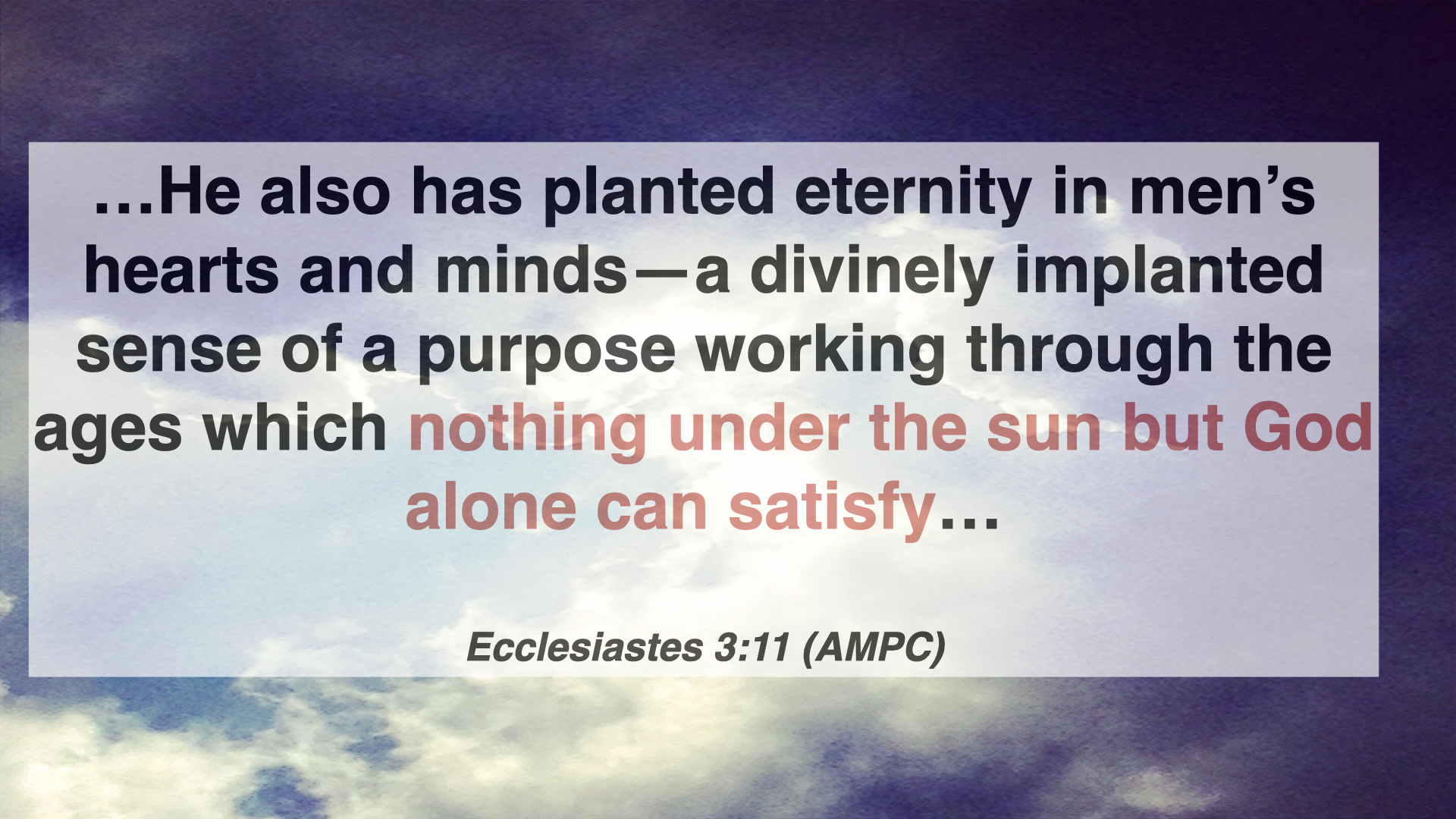
Solomon wrote, “He has planted eternity in the human heart” (Ecclesiastes 3:11). The AMPC says: He also has planted eternity in men’s hearts and minds—a divinely implanted sense of a purpose working through the ages which nothing under the sun but God alone can satisfy.
Mary finally saw Jesus and saw her grief turned to joy when she heard Jesus say, “Mary.”
These men on the road said their hearts burned in them when Jesus explained the Scripture to them (Luke 24:31-32, 27).
And when the other disciples were locked away for fear of the Jews (John 20:19), Jesus spoke to them about how His Word was fulfilled in His actions (Luke 24:44-46).
There is a hymn that ends, “You ask me how I know He lives, He lives within my heart.” There is something unmistakable and irrefutable when someone knows what it is to have their sins forgiven—to have their grief turned to unquenchable joy!
In fact, the best proof of a risen Savior is seeing a life freed from gripping grief that used to plague them.
If you don’t know Jesus as your Savior, the thought of the end of life and what comes next probably fills you with a sense of uneasiness. It doesn’t have to be this way!
If you do know Jesus, please remember that your best testimony is a life that doesn’t get bogged down in the same grief the world experiences. When you can show supernatural joy while everyone else is gripped by grief, people will turn to you (1 Peter 3:15).
Please check out the other messages in this series called Grief Into Joyby clicking here.
Listen to the podcast of this post by clicking on the player below, and you can also subscribe on Apple, Spotify, or Audible.
Esther was unsure if Xerxes would extend favor to her, but God is already extending His favor to you even before you approach Him. He wants to turn your grief into joy.
Let your grief be a time you press into God’s presence. Like Esther taking her grief and her petition into the king’s presence, take your grief into the presence of King of kings.
Listen to the podcast of this post by clicking on the player below, and you can also subscribe on Apple, Spotify, or Audible.
Last week we saw how the Israelites in exile had their time of grief—being targeted for annihilation—turned to joy when God granted favor to Queen Esther.
The books of 1 and 2 Chronicles, Ezra, and Nehemiah are all written during this time period as the exiles are returning in waves to Israel. This is another grief-into-joy moment! More than likely, all four of these books were written by Ezra. Notice the note of joyful celebration that is repeated in the last words of 2 Chronicles and the opening words in the Book of Ezra (2 Chronicles 36:22-23; Ezra 1:1-4). We don’t know which psalmist wrote Psalm 126, but it sounds the same joyful note.
Not all the exiles returned at once. In fact, the Book of Daniel shows us that Daniel likely stayed in his position of leadership to these governments until his death.
The exiles were returning in waves. As the worship practices at the temple were reestablished and as people returned to lands allotted to each tribe, it was important for the leaders to make sure the right people were in the right places. So 1 Chronicles opens with genealogies.
Beginning with Adam and Noah (1:1-4)
The spiritual fathers (1:34)
The family line of the Messiah (2:1-15; Matthew 1:1-6) through the family tree of David (3:1-24)
Then 1 Chronicles 4 lists more clans in the tribe of Judah. Of special note is the Calebite clan (2:9, 18).
In the Calebite clan we meet Jabez in 1 Chronicles 4:9-10. His name literally translated is sorrow. I wonder: is this a nickname or his birth name? how did he even get this name?
His mother is quoted, “I gave birth to him in pain.” Did that mean it was physically a difficult birth? Did she die after childbirth? Was he born during the painful exile? His father isn’t mentioned, so maybe his birth reminded everyone of the father who was no longer there. The Amplified Bible says his mother named him “sorrow maker.”
Whatever the case, Jabez has become aware that his name or his presence is causing grief to others. There is a bit of a play on words here: “his mother named(Hebrew: qara) … Jabez cried out (Hebrew: qara) to the God of Israel.” In essence, Jabez is saying, “Since my mother cried out in pain—or thinks I am a sorrow maker—I have no where else to go but to cry out to God!”
I believe Jabez was a teenager at this time. One medical journal says, “Adolescents are physically, cognitively, and socioemotionally more advanced than children but prone to behave in ways that are inconsistent with adult values and norms. … Adolescents also frequently report greater self-consciousness, and are more concerned with and interested in others’ perceptions of self.”
This means that as the brain matures during adolescence, teenagers begin to look at themselves through the eyes of others. They are beginning to make decisions that will earn approval from their peers and their family.
This describes Jabez. He doesn’t want to be the sorrow maker any longer.
Grief happens when my reality falls short of my expectations. Jabez has become self-aware that he is a painful reminder to everyone around him. He is living in a place of grief
Jabez is called “more honorable than his brothers” (v. 9) because he turns his pain into his prayer. His brothers may either have not been as self-aware, or maybe they were aware but simply didn’t care. Jabez realized, “People have been calling me sorrow maker my whole life. There’s nothing I can do about it on my own, so the only thing I can do is call on the only One who can turn my grief into joy” (v. 10).
Look at his noble prayer:
bless me—God, You are the only One whose favor I desire
enlarge my territory—even out of this grief, bless me so that I can be a blessing
let Your hand be with me—only Your hand can restore my fortunes, can help me reap a harvest, and can allow me to sing Your songs of joy (see Psalm 126:1-6).
Let us follow this example from Jabez’s life and begin to turn every pain into prayer.
God doesn’t want to give us temporary relief from our pain, but He desires for us to know His never-ending joy (Isaiah 25:7-9; Revelation 21:3-4).
Listen to the podcast of this post by clicking on the player below, and you can also subscribe on Apple, Spotify, or Audible.
None of us are strangers to grief—we’ve all experienced this dark place.
The dictionary defines grief three ways: (1) keen mental suffering or distress over affliction or loss; (2) sharp sorrow; (3) painful regret. We sometimes define it with terms like at the end of my rope, down for the count, nothing but gray skies all around, or unable to see any light at the end of the long tunnel.
One psychologist recently asked, “Can you die of a broken heart?” And she meant it literally. She wondered if a person’s grief—what we sometimes call an emotionally broken heart—could lead to a physically broken heart. The answer was, quite simply, yes. Those who cannot get relief from their grief are more susceptible to heart disease, autoimmune disorders, and breakdowns in their immune system.
We need some good news to pull us out of our grief. The good news is that God specializes not just in removing grief, but in turning grief into joy. In the hymn O Holy Night, one of the lines says, “In all our trials, born to be our Friend. He knows our need, to our weakness is no stranger.” Isaiah calls Jesus, “A Man of sorrows and acquainted with grief” (Isaiah 53:3).
Grief tends to wash over us in waves. When the waves hit, they often cause us to forget what God has done for us in the past. The apostle Paul said we should learn lessons from the history of the Israelites in the Old Testament. Let me zoom in on one particular story. Notice the waves of grief that follow one after another.
Israel was complacent about their sin (Amos 6:1, 4-7) and eventually was taken into captivity in Assyria. Soon after that, the Assyrians then defeated by the Babylonians. Meanwhile, instead of learning the lessons from Israel’s captivity, Judah had more evil kings than God-fearing kings and they were eventually defeated by the Babylonians (Psalm 137:1-4). Babylon was then defeated by the Medes and Persians.
Somewhere in this time of exile, a young Israelite girl named Hadassah becomes orphaned. She is adopted by Mordecai, who changes her name into the Persian name Esther. Queen Vashti is divorced and banished by King Xerxes, and as a result Esther is chosen from all of the eligible bachelorettes in Persia to become queen in Vashti’s place.
Mordecai is an attendant at the gate to the castle, giving him a good vantage point to stay in touch with Esther. It also puts him in a place to overhear an assassination plot against King Xerxes, which Mordecai relayed to Esther to tell the king. Sadly, Mordecai’s good deed, which saved King Xerxes’ life, is overlooked. Instead, Mordecai’s faith is attacked by Haman, the prime minister, and all of the Jews in Persia are targeted by Haman for destruction. Once again, Mordecai gets word to Esther to have her appeal to the king. Esther is put in a no-win situation here: to approach the king without an invitation could be fatal, but to do nothing would mean the death of all of the Jews.
How did all of this come to be?
Let me take you back to Deuteronomy 8:3. God allowed His people to be humbled and hungry so that they would learn that He is their only source. In the following verses we are told twice to “beware”: beware of forgetting that God is our Provider, and beware of thinking we are our own provider. If we do either of these, God will discipline us (Deuteronomy 8:5).
God isn’t mentioned at all in the Book of Esther, but He is so obviously at work. God said, “My purpose will stand, and I will do all that I please” (Isaiah 46:10). Before the Israelites went into captivity, God promised that His people would not be annihilated there but would return to Jerusalem (Jeremiah 31:10-17).
Esther did interceded before King Xerxes. Because of this, Haman was hanged, Mordecai was exalted to Haman’s place, and the Jews were saved (Esther 7:1-6; 8:1-2, 15-17; 9:20-22; 10:3).
God turned overwhelming grief into unspeakable joy!
Dick Brogden wrote, “Are you overwhelmed, out of strength, nowhere to go, out of resources, at a most critical time in your family, ministry, job, or life? Great! God allowed it so that all the earth may know that He is God alone. Don’t waste the crisis. It’s a great opportunity for missions, a great opportunity for God’s glory to be known in all the earth.”
Let your grief be a time you press into God’s presence. Like Esther taking her grief and her petition into the king’s presence, take your grief into the presence of King of kings.
Esther was unsure if Xerxes would extend favor to her, but God is already extending His favor to you even before you approach Him. He wants to turn your grief into joy.
God doesn’t want to simply remove your grief, but He wants you to be testimony for Him because of the way He moves on your behalf.
Follow along with all of the messages in our series Grief Into Joy by clicking here.
Listen to the podcast of this post by clicking on the player below, and you can also subscribe on Apple, Spotify, or Audible.
Do you know this pair of cantankerous men from the Muppets? Statler and Waldorf sit in the balcony of the theatre and criticize everything that is happening on the stage. I mean everything! They have a good laugh at their barbs, but no one on the stage seems to find it humorous.
Have you ever met people like this? How do you typically respond to their criticism?
Unfortunately, those who are trying to do the right thing are often the targets of almost constant criticism. Abraham Lincoln said, “If I were to attempt to answer all the criticisms and complaints I receive, I would have no time for any other business.”
President Lincoln was a great leader but he wasn’t without fault, so to certain extent we could expect a little bit of criticism from people who didn’t like his policies. But what about Jesus? It was prophesied about Him that He would be the target of criticism (Isaiah 53:3).
Those out to get Jesus even criticized those who attended to Him. In Mark 14:1-5, they are criticizing a woman who poured perfume on Jesus out of her sincere desire to honor Him. Yet they spoke about her and her actions “indignantly” (v. 4), and they rebuked and criticized her (v. 5). The Greek word in this verse literally means he snorting of horses!
Jesus stepped in to protect this God-fearing woman, “Why are you bothering her? Why are you criticizing this beautiful thing she had done for Me?”
Notice that Jesus responded to the critics, but the woman did not respond. Does that mean that we never answer critics? Are we supposed to ignore them?
First, let’s go back in time to the origin of the words critic and criticism. These words originally meant someone capable of giving a meaningful—perhaps even constructive or helpful—judgment. Think of a trained and skilled chef critiquing your recipe, as opposed to someone who cannot tell the difference between nutmeg and ginger.
The natural response is to ignore all criticism. The supernatural response is prayerfully evaluate criticism. Solomon says there is such a thing as valid criticism (Proverbs 25:12).
So who is a valid critic?
(1) Someone who loves me (Proverbs 27:17; Ephesians 4:15). Paul loved Peter and respected his leadership role in the church, but he still criticized Peter when he messed up (Galatians 2:9, 11).
(2) Someone who has experience or godly wisdom that we don’t yet have (Ecclesiastes 7:5). Micaiah had a word from God, even though King Ahab thought Micaiah simply didn’t like him (1 Kings 22:1-18).
(3) Someone who wants to hurt me. Really!? Dick Brogden wrote, “The Lord uses critics to show us our own hearts, even if what they say is not fully true, informed, or even fair. There is almost always a germ of truth in what our critics (in their own pain and disappointment) shout at us. The wise [person] will humble himself and look for the truth embedded in every oppositional interaction.” As we saw previously from Psalm 26:2, when we hear words of criticism, we need to make it a matter of prayer.
Jesus told the woman’s critics to “leave her alone” but He never defended Himself against the childish barbs (Isaiah 53:7; Matthew 27:13-14). I think we would do well to follow His example. So when criticized, take a deep breath, smile, hear them out, ask clarifying questions, and then say, “Thank you for sharing that with me. I’ll make this a matter of prayer.”
They might accuse you, but you should turn it over to God (Psalm 109:4).
The natural response is to respond all critics. The supernatural response is to respond like Jesus (see 1 Peter 2:21-23).
Remember that quote from Abraham Lincoln we saw earlier? Here’s the rest of his quote—
“From day to day I do the best I can and will continue to do so till the end. If in the end I come out all right, then the complaints and criticisms and what is said against me will make no difference. But, if the end brings me out wrong, then ten angels coming down from heaven to swear I was right would still make no difference.”
Ultimately, we are longing to hear Jesus say, “Well done.” If He cannot say that to us, does it really matter if everyone else praised us? But if Jesus says, “Well cone,” does it really matter the criticism others said about us?
Let’s ask the Holy Spirit to help us respond supernaturally to our critics—listen prayerfully to ever critic, but only respond to them as Jesus did.
If you have missed any of the other messages in this series When Sheep Bite Sheep, you can find them all here. And if you’re a pastor, be sure to check out my book When Sheep Bite.



 Not only does Judges 2:15 say, “Whenever Israel went out to fight, the hand of the Lord was against them to defeat them,” but these words from Isaiah 63 are just as startling—
















 Craig T. Owens