Leaders Are The First To Step Into The Unknown

Listen to the podcast of this post by clicking on the player below, and you can also subscribe on AppleSpotify, or Audible. 

The Jordan River was a powerful border guard. For years it had served the Canaanites well, protecting their eastern border from large-scale attacks from their enemies. Now the Jordan was all that stood between the Israelites on the east side of the river and their promised land on the west side. 

Joshua gave some unusual instructions to the priests that carried the ark of the covenant of the Lord. He told them to carry the ark while they walked into the middle of the flood-level river. He said they should trust that God would stop the flow of the river while they stood there (see Joshua 3:1—4:11). 

I can imagine the two priests carrying the ark at the front stepping into the water, feeling the current rush around their ankles, and holding their breath as they took their next steps deeper into the river. 

Step after step the two priests in front waded into the Jordan. Until finally they walked far enough that the priests carrying the ark from the back stepped into the Jordan. 

And all of a sudden, the water levels begin to go down! Lower and lower until the priests were standing on a damp riverbed that had been completely covered by water just a few minutes earlier. To their left, as they looked downstream, no water was to be seen. To their right, as they looked upstream, they might have glimpsed the wall of water piled up as the invisible Hand of God held it back. 

Only then did the Israelites began crossing the previously uncrossable river. Family after family, tribe after tribe began to march at long last into their promised land. 

   And while all Israel passed over on dry ground, the priests who bore the ark of the covenant of the Lord stood firm on dry ground in the midst of the Jordan, until all the nation finished passing over the Jordan. … For the priests who bore the ark stood in the midst of the Jordan until everything was finished that the Lord commanded Joshua to tell the people…. (Joshua 3:17, 4:10)

It was only after every Israelite had crossed the Jordan, and memorial stones had been gathered from the riverbed and carried to the shore, that the priests carrying the ark of the covenant of the Lord came across themselves. It was immediately after this that the mighty Jordan River began flowing again at full strength. 

There are two important lessons here. First, godly leaders go first. They don’t want to be first, but they want to go first in obeying God so that the way is opened for everyone else to enjoy God’s blessings. 

Second, godly leaders stand their ground until all the people enter into God’s blessing. Remember that God is patient, “not wanting anyone to perish, but everyone to come to repentance” (2 Peter 3:9). 

So leaders, let me encourage you—

Keep going first in obeying God, keep standing firm in His promises, keep showing others the path they need to follow to step into God’s blessings, and keep encouraging people to walk into that blessing. 

Don’t be slow in obeying. Don’t fear going first into the unknown. And don’t become weary or frustrated or nervous and walk away too soon. 

►► Would you please prayerfully consider supporting this ministry? My Patreon supporters get behind-the-scenes access to exclusive materials. ◀︎◀︎
First, Make It Right

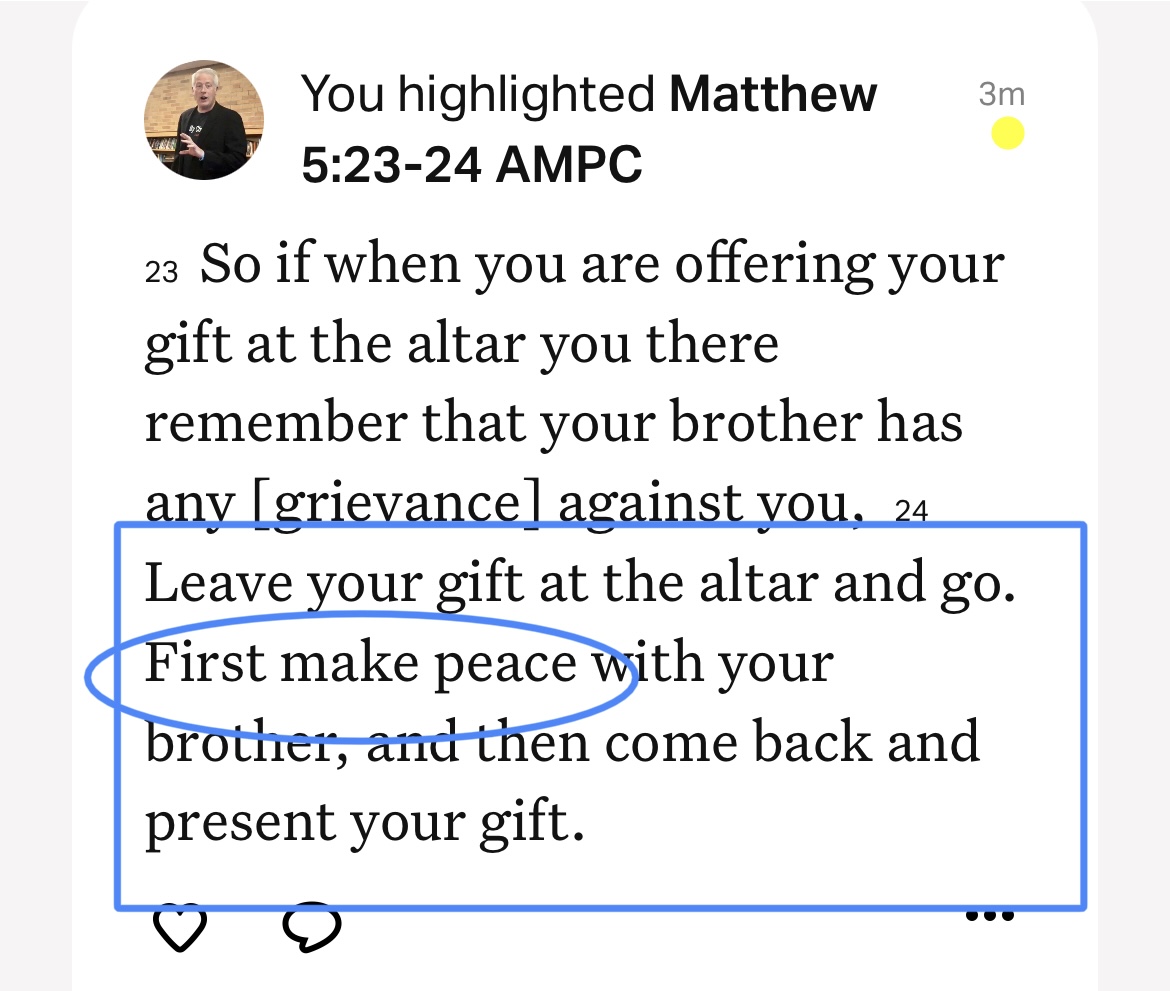
So if when you are offering your gift at the altar you there remember that your brother has any [grievance] against you, leave your gift at the altar and go. First make peace with your brother, and then come back and present your gift. (Matthew 5:23-24 AMPC) 

If someone has something against you, you must take the initiative to make it right. We cannot brush it off with, “I didn’t do anything wrong” or “That’s their problem,” but we must be proactive peacemakers. 

It could be that our restorative action will allow the other person to enter into worship in a way they were unable to before you reached out to them. 

I talk about this more in:

Links & Quotes

Leaders need to give others confidence to try something new. We need to help people get moving so that we can coach what they are doing. For more great leadership insights, check out The Craig and Greg Show.

I have lots of new content every week, which you can check out on my YouTube channel.

A couple of thought-worthy quotes for pastors. First from David Mathis: “Pastors, observe that in and of itself, mocking is no clear reflection of the faithfulness or fruitfulness of preaching Christ. Wise preachers do not take mocking as an indicator of failure, nor as an indicator of success. Twice in Athens some mock Paul, which may seem like a failure compared to his homiletic triumphs elsewhere. However, others say, ‘We will hear you again.’ And then, in the end: ‘some men joined him and believed’ [Acts 17:32-34]. … How foolish it would be to distract ourselves with the mockers. Or to call special attention to the mocking as some great badge of our own faithfulness. Rather, we have the example of Paul at Mars Hill, who, so far as we can tell, wholly overlooks, with a holy disregard, these mockers and concerns himself instead with those asking honest questions.”

…and then one from John Piper: “Preaching is a happy business. Because even if the text is a hard word that devastates the hearers, the preacher connects the hard word with the gracious word and the hopeful word, and he catches them as they fall. So, in the end, all preaching is a happy business.

“A people that values its privileges above its principles soon loses both.” —Dwight D. Eisenhower

“For condemnation to work, we must say to God what the devil has said to us and believe it. If I want to stand before God with excuses that make what He said to me void, I’ll have to quote the devil to God. Does that sound like a good thing to do? God’s will for me is not to condemn me, but to liberate me from everything that holds me back from being what He created me to be through an ongoing relationship. To accomplish that, I need to do the opposite of what I used to do when I walked in condemnation. Instead of quoting to God what the devil is saying, I quote to the devil what God has said.” —Jim Wiegand, in Recruiting To Releasing 

Thinking about “how Martin Luther, a professor at Wittenberg University, helped to spark the 16th century Protestant Reformation,” J. Calvin Holsinger conceived the idea of preparing missionaries to US colleges and universities—a ministry called Chi Alpha.

Another great story from the “Here We Stand” series of biographies of notable people during the Reformation. “An attendant asked [King Henry VIII] whom he wished to have at his bedside. The king asked for Thomas [Cranmer]. By the time Cranmer arrived, King Henry was unable to speak. Foxe tells the story. ‘Then the archbishop, exhorting him to put his trust in Christ, and to call upon His mercy, desired him though he could not speak, yet to give some token with his eyes or with his hand, that he trusted in the Lord. Then the king, holding him with his hand, did wring his hand in his as hard as he could (Foxe’s Book of Martyrs, 748).’ The scene sweetly punctuates the most important friendship in the English Reformation. Whatever King Henry believed when he squeezed Cranmer’s hand that day, God used the bond between them to break England free from Roman Catholicism and to recover the one true gospel.”

The ICR reports, “Genesis claims that people in the pre-Flood world routinely attained 900-year lifespans. The best-known example is Methuselah, who had the longest recorded lifespan of 969 years (Genesis 5:27). Skeptics dismiss these great ages as fanciful legends, but recent fossil data are providing unexpected, albeit indirect, corroboration of the Bible’s testimony.” Check out this full report.

“In my experience, each failure contains the seeds of your next success—if you are willing to learn from it.” —Paul Allen, cofounder of Microsoft

Links & Quotes

A.W. Tozer said, “There’s an awesomeness about God which is missing in our day altogether; there’s little sense of admiring awe in the Church of Christ these days.” May we repent of little prayers and boldly pray to an awesome God who wants to do awesome things that will bring Him glory!

I have lots of new content every week, which you can check out on my YouTube channel.

I always smile at the archeological discoveries which confirm the historicity of the Bible! Discovery after discovery keeps reinforcing that the Bible is a reliable historical document—which is exactly what one would expect from the inspired Word of God. Here are two recent article: (1) An archeological biography of the Assyrian king Ashurbanipal, and (2) The excavation of a rare Roman prison in Corinth that “likely gives us a picture of those that held the apostles as recorded in the New Testament (e.g. Acts 5:18, 12:5, 16:23).”

This is a very informative Q&A session with cold case detective and Christian apologist J. Warner Wallace. But I especially like his answer to the first question: Do Christians have to investigate every other religion to be convinced that the Bible is true?

“Faith untried may be true faith, but it is sure to be little faith, and it is likely to remain dwarfish so long as it is without trials. Faith never prospers so well as when all things are against her: tempests are her trainers, and lightnings are her illuminators. … No flowers wear so lovely a blue as those which grow at the foot of the frozen glacier; no stars gleam so brightly as those which glisten in the polar sky; no water tastes so sweet as that which springs amid the desert sand; and no faith is so precious as that which lives and triumphs in adversity. … Faith increases in solidity, assurance, and intensity, the more it is exercised with tribulation. Faith is precious, and its trial is precious too.” —Charles Spurgeon 

“Mature Christians can be recognized by a variety of indicators. They feast on the Word of God (Hebrews 5:14), persevere in love and good works (Hebrews 6:9-10), bear the fruit of the Spirit rather than the marks of the flesh (Galatians 6:16-23), use their gifts to help build the church (1 Corinthians 12:7-11; Ephesians 4:12-16), teach the things of Jesus to others (Hebrews 5:12: Acts 1:8), and more. This, the New Testament insists, is the condition toward which every Christian strives.” —T.M. Moore (check out all of the Scriptures T.M. references here

“Now is the accepted time, not tomorrow, not some more convenient season. It is today that our best work can be done.” —W.E.B. Du Bois 

Jesus shows us that only secure people can serve others. Insecure people won’t ever make themselves vulnerable, and so they miss out on God’s blessing. I address this in more depth in my book Shepherd Leadership.

Links & Quotes

You are more likely to act yourself into good feelings than you are to feel yourself into action. Leaders need to get moving and keep moving! Check out this full conversation from The Craig and Greg Show.

I have lots of new content every week, which you can check out on my YouTube channel.

In news that’s not surprising at all, many recent paleontological discoveries confirm to exactly what would be expected if we take the biblical account of Creation and a global Flood literally.

John Piper was asked to weigh-in on the value of repetitive phrases in worship songs. He said, “The issue’s not repetition per se but whether there is enough substance, enough rich content of truth about God woven into the repetitions to justify them, to warrant them. That’s the issue. There’s a difference between repetitions that are called forth by the repeated crescendo of new, glorious truth, and repetitions that serve as a kind of mantra without sufficient truth that is simply used to sustain or intensify a mood. Moods in worship should be awakened and sustained primarily by truth, assisted by music—not primarily by music with a little truth thrown in to justify the singing.”

Pastor John Piper used Psalm 136 as an example in the post above. T.M. Moore also shared this thought about Psalm 136: “The term most frequently used to describe this everywhere-present-and-always-at-work love of God is translated as ‘lovingkindness’ or, in some versions, ‘steadfast love.’ Especially Psalm 136, with its antiphonal arrangement of verses, insists that the cosmos is upheld, sustained, and pervaded by the lovingkindness of God. … It would improve our learning to pray without ceasing if we simply took some time out during the day to thank the Lord for the many ways His steadfast love surrounds, sustains, and swarms us at every moment!”

“When people refer to a man as a man of the Book, meaning the Bible, he’s generally found to be a man of multitudinous books, which simply isolates the one Book to its proper grandeur. The man who reads only the Bible does not as a rule know it or human life.” —Oswald Chambers

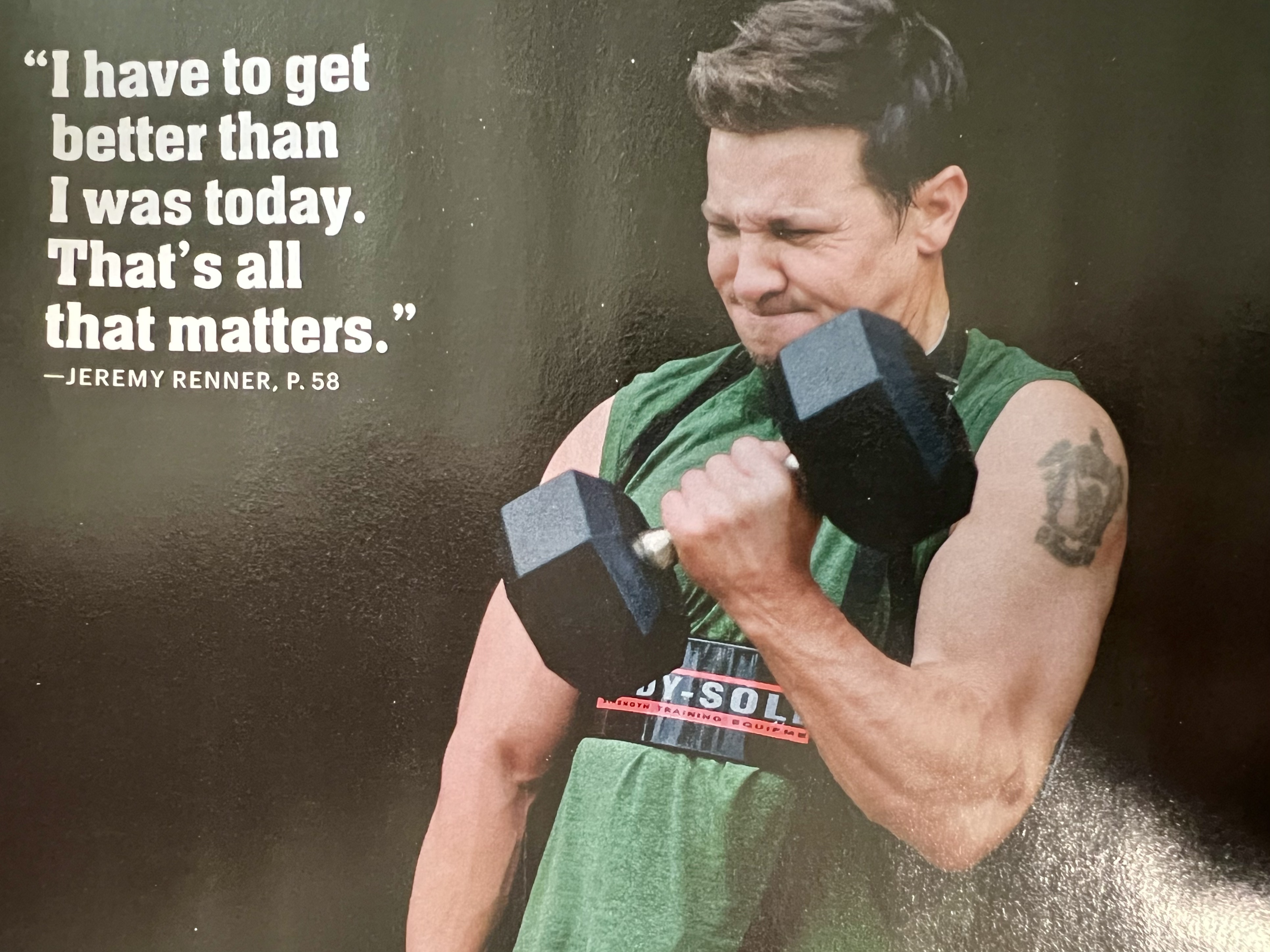
Men’s Health magazine shared an interview with Jeremy Renner, who was nearly killed in a tragic accident. I love his attitude about making today better than yesterday. His words remind me of a poem my grandma used to use to motivate me to keep “besting” what I had already done.

Christopher Ash writes about reading the Psalms through the lens of Jesus. He concludes this way: “I remember seeing on the wall of a church the words of Psalm 20:4: ‘May [the Lord] grant you your heart’s desire and fulfill all your plans!’ How wonderful, you might think. The Bible promises me all that my heart desires. Until you read the psalm and realize that Psalm 20 is a prayer for the king in David’s line. Ultimately, it is a prayer that Jesus will have His heart’s desire granted and that His plans will be fulfilled. And they will! The Psalms are not all about me. If I think they are, I will end up disillusioned. But when I grasp that they are all about Christ, my heart lifts in joy that He is the blessed Man and I belong to Him.”

Links & Quotes

Don’t let fear keep you standing still. Take a swing and give yourself or your coach something to tweak. Check out this full conversation hereI have lots of new content every week, which you can check out on my YouTube channel.

“Our human minds cannot comprehend the immensity of [Christ’s] task and His sacrifice. We simply know that it was to save us, and that Jesus’ suffering is the most blessed influence the world has ever known.” —Dr. Henry Halley, Halley’s Study Bible 

The Hill, though high, I covet to ascend,
The Difficulty will not me offend;
For I perceive the Way to life lies here.
Come, pluck up Heart, let’s neither faint nor fear;
Better, though difficult, the Right Way to go,
Than wrong, though easy, where the End is Woe. —Christian in John Bunyan’s The Pilgrim’s Progress 

“Nearly half the Law of God is devoted to directing God’s people in how to worship Him. And while the specific practices of that portion of God’s Law have been replaced (Hebrews 7:11-18), the emphasis on worship and the idea that worship and life are related remains. The more faithful we are in worshiping the Lord the more we will love our neighbors with the justice His Law prescribes.” —T.M. Moore

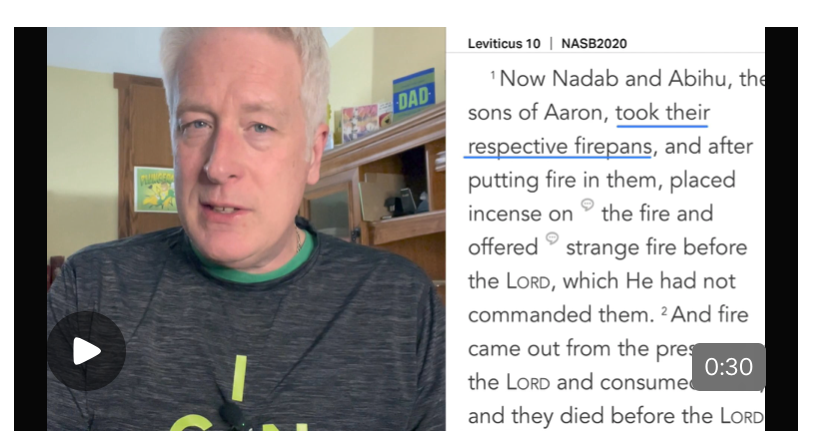
The deaths of Nadab and Abihu is a tragic story, but I think there are some important leadership insights to be gleaned from it. I shared an exclusive video with my Patreon supporters. Will you prayerfully consider joining?

Links & Quotes

This is just one example of the power of a leader’s storytelling. Check the full conversation Greg and I had on The Craig And Greg Show. I have lots of new content every week, which you can check out on my YouTube channel.

“We are all born ignorant, but one must work hard to remain stupid.” —Benjamin Franklin

George Jeffreys was born with a limiting speech impediment, but with the empowering of the Holy Spirit, George and his brother Stephen led incredible Pentecostal revivals in England and Wales. They were said to be the greatest evangelists since George Whitefield and John Wesley. Someone asked Jeffreys how long a revival should last, and he responded, “Thank God, a revival started in my heart 30 years ago, and it has never stopped; it will never end.” He continued by saying, “As long as Jesus is kept in the front, and made the center of fellowship and blessing and unity, the revival will never end.” Check out this mini biography about his life.

John Stonestreet uses the example of C.S. Lewis’ Aslan to talk about how God can speak to us through our pain. John writes, “Pain is never the point of God’s plans, any more than it is the purpose of physical exercise. Never pushing ourselves to the point that it hurts means never improving our health. On the other hand, seeking pain is more likely to do harm than to aid our wellbeing. In and of itself, pain is not good, but it is meaningful. Pain indicates that something is wrong and needs to be addressed.”

“The best way to make a dream come true is to wake up.” —Dame Anna Wintour

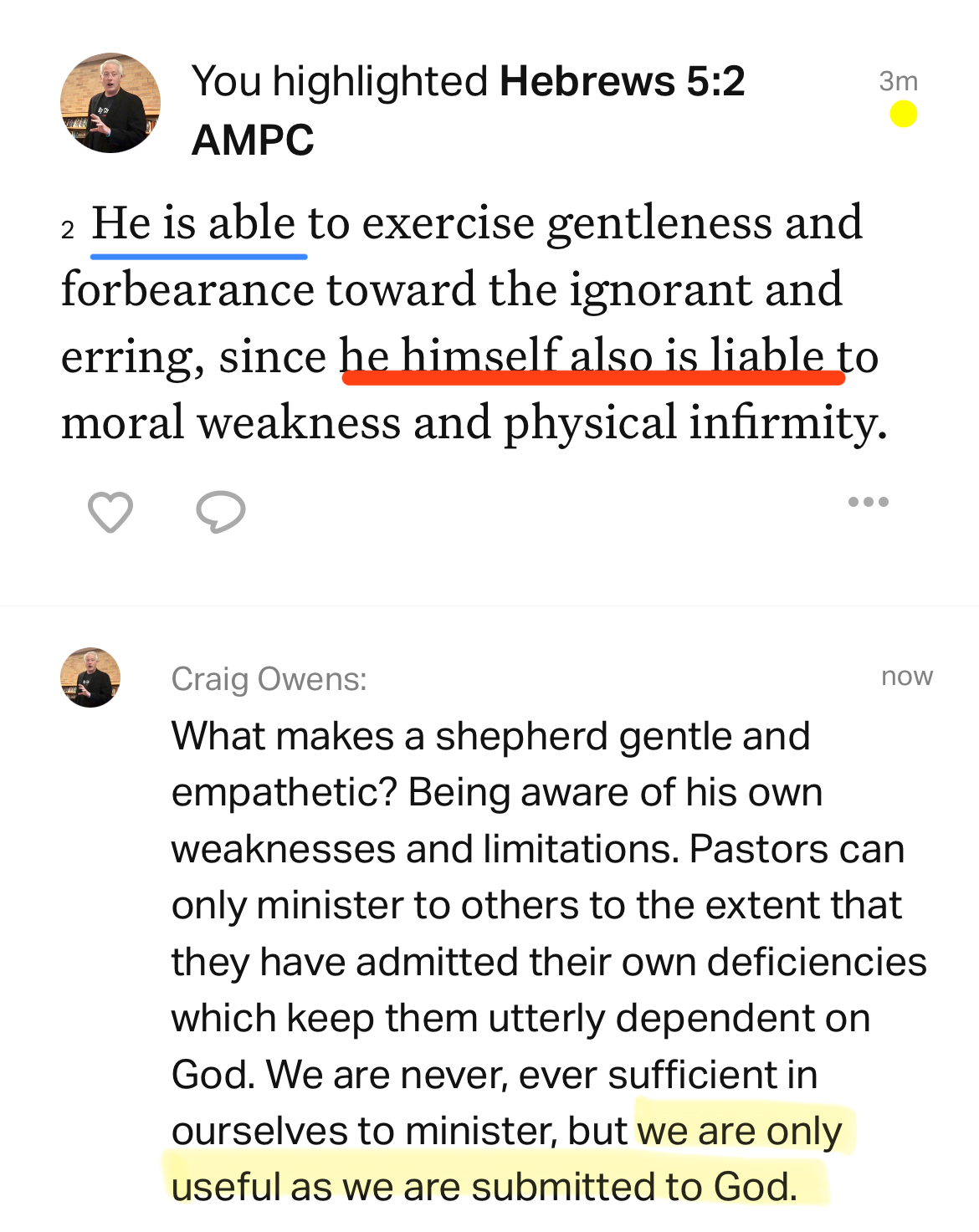
Because of the extensive prayer, research, and work I put into my book Shepherd Leadership, I am frequently drawn to passages of Scripture that reinforce the idea of pastors as shepherds. I was meditating on Hebrews 5:2 the other day, and I shared some of my thoughts with some of my pastor friends.

A Leadership Separator

Listen to the podcast of this post by clicking on the player below, and you can also subscribe on AppleSpotify, or Audible. 

We are more likely to act ourselves into feeling good than we are to wait until we feel good about something before we act on it. That self-initiative is a true leadership separator. 

Check out the full episode of The Craig And Greg Show where we talk about grit, perseverance, and resilience.

►► Would you please prayerfully consider supporting this ministry? My Patreon supporters get behind-the-scenes access to exclusive materials. ◀︎◀︎

Leaders Keep Going First

Listen to the podcast of this post by clicking on the player below, and you can also subscribe on AppleSpotify, or Audible.

Now the leaders of the people settled in Jerusalem… (Nehemiah 11:1). 

Before inviting other people to move into the capital city with its newly rebuilt walls and gates, the leaders moved in first. 

Leaders always go first. 

And then leaders continue “firsting” even when the people seem to backslide. 

Leaders continue to remain hopeful for their friends even in those backsliding times. 

Simply stated: Leaders keep going first in following God so that they can continually be empowered to lead others in the right paths. 

A mark of a godly leader is one who keeps going first, and who keeps bringing others along on life-giving, God-honoring paths. 

This is part 71 in my series on godly leadership. You can check out all of my posts in this series by clicking here.

►► Would you please prayerfully consider supporting this ministry? My Patreon supporters get behind-the-scenes access to exclusive materials. ◀︎◀︎
Thursdays With Spurgeon—Bragging About God

This is a weekly series with things I’m reading and pondering from Charles Spurgeon. You can read the original seed thought here, or type “Thursdays With Spurgeon” in the search box to read more entries.

Listen to the podcast of this post by clicking on the player below, and you can also subscribe on AppleSpotify, or Audible. 

Bragging About God

I will extol the Lord at all times; His praise will always be on my lips. I will glory in the Lord; let the afflicted hear and rejoice. Glorify the Lord with me; let us exalt His name together. (Psalm 34:1-3)

     Boasting is a very natural propensity, and if it were used as in this case, the more it were indulged the better. The exultation of this verse is no mere tongue bragging; the soul is in it, and the boasting is meant and felt before it is expressed. 

     What scope there is for holy boasting in Jehovah! His Person, attributes, covenant, promises, works, and a thousand things besides are all incomparable, unparalleled, matchless; we may cry them up as we please, but we shall never be convicted of vain and empty speech in so doing.

From Spurgeon And The Psalms

What is even more remarkable about the praise David offers up in this psalm is the setting. The introduction to the psalm tells us it is while David is running from Saul and trapped in a Philistine stronghold. 

And yet David still chooses to praise God.

It is a choice of his will. David didn’t wait until he felt like praising God, or until his circumstances were improved. We are more likely to act ourselves into feeling than we are to feel ourselves into action. So David says, “I will extol the Lord … His praise will be on my lips.” 

This bragging about God—when from a human standpoint there appears to be nothing to brag about—becomes a testimony. David’s personal pronouns “I” and “my” quickly turn into the plural pronoun “us” as David invites others to ponder the beauty of Jehovah! “Glorify the Lord with me; let us exalt His name together. 

Our bragging about God, especially in the face of difficult circumstances, is a powerful testimony that will draw others to Him. You may start out praising Him on your own, but it won’t be long until others join your worship chorus. 

Friends, your praising and bragging about God is more powerful than you may realize. When God is worshipped, He is lifted up for all to see, so keep on bragging about Him!

►► Would you please prayerfully consider supporting this ministry? My Patreon supporters get behind-the-scenes access to exclusive materials. ◀︎◀︎