10 Quotes From “The Servant As His Lord”

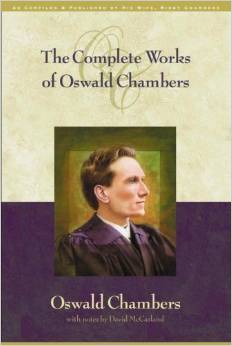
Whenever I read an Oswald Chambers’ book, I know I’m going to get exceptional content that is really going to make me think. The Servant As His Lord lived up to my expectations! I have shared several passages from this book already in my weekly “Thursdays With Oswald” posts (more about that in a moment), but here are a few more quotes I wanted to pass along to you.

“I continually come across people with rusty ‘thinkers,’ they think about their business but about nothing else, and the forces within have become desperately weak; consequently when tribulation comes their minds are confused, and the result is that errors come into the life. If the forces within are strong and healthy they give us warning and enable us to crush in a vice on the threshold of the mind everything that ought not to come there. God can impart to a man the power to select what his mind thinks, the power to think only what is right and pure and true.”

“God has no favorites, but when we let Him have His right of way through us He begins to unveil something more of His purposes in our lives. … Is tribulation making you wilt? making you swoon for sympathy? making you stagnate? It is an easy business to want to get away from tribulation, but fighting makes us strong, gloriously strong.”

“God grant we may be so filled with the Holy Spirit that we listen to His checks along every line. No power can deceive a child of God who keeps in the light with God. I am perfectly certain that the devil likes to deceive us and limit us in our practical belief as to what Jesus Christ can do. There is no limit to what He can do, absolutely none. ‘All things are possible to him that believeth.’ Jesus says that faith in Him is omnipotent. God grant we may get hold of this truth.”

“Look at the world either through a telescope or a microscope and you will be dwarfed into terror by the infinitely great or the infinitely little. Naturalists tell us that there are no two blades of grass alike, and close inspection of a bee’s wing under a microscope reveals how marvelously it is made. What do I read in the Bible? I read that the God of heaven counts the hairs of our heads. Jesus says so. I read that the mighty God watches the sparrows so intimately that not one of them falls on the ground without His notice. I read that the God who holds the seas in the hollow of His hand and guides the stars in their courses, clothes the grass of the field. Through the love of God in Christ Jesus we are brought into a wonderful intimacy with the infinitely great and the infinitely little.”

“The great need today amongst those of us who profess sanctification is the patience and ability to work out the holiness of God in every detail of our lives.”

“We are only safe in taking an estimate of ourselves from our Creator, not from our own introspection.”

“There is no one in the world more easy to get to than God. Only one thing prevents us from getting there, and that is the refusal to tell ourselves the truth.”

“God does not do what false Christianity makes out—keep a man immune from trouble, there is no promise of that; God says, ‘I will be with him in trouble.’ … No matter what actual troubles in the most extreme form get hold of a man’s life, not one of them can touch the central citadel, that is, his relationship to God in Christ Jesus.”

“The afflictions after sanctification are not meant to purify us, but to make us broken bread in the hands of our Lord to nourish others.”

“If we are self-willed when God tries to break us and will do anything rather than submit, we shall never be of any use to nourish other souls; we shall only be centers of craving self-pity, discrediting the character of God.”

“Thursdays With Oswald” is a weekly feature where I share a longer section from an Oswald Chambers book, along with a thought or two of my own. You can subscribe to my blog and get notified each time I share one of these posts, or you can type Thursdays With Oswald in the search box.

You can read my review of The Servant As His Lordclicking here by .

10 Quotes From “Legacy Leadership”

I just finished an outstanding reading plan on YouVersion called Legacy Leadership by Dr. J. Lee Whittington. For anyone interested in the biblical concept of servant-leadership, I highly recommend you check out this reading plan.

Here are a few quotes I especially liked…

“Legacy Leadership is a process of intentional influence that takes place in the context of a relationship.”

“There is a recurring pattern of affirmation and exhortation in Paul’s leadership. He provided a dynamic balance between challenging his followers to grow and acknowledging their progress. He was affirming, but never content.”

“There is a growing trend to attack, criticize, and resent anyone who has talent or achievements that sets them apart from others. This tendency extends to those who resent the efforts of leaders who challenge the status quo. Opponents of change initiatives often attempt to marginalize leaders by attacking their character and questioning their motives. If the messenger is flawed, then the message and vision they offer cannot be trusted. As disappointing as it is, these challenges come with the territory of leadership.

“If I am to lead with integrity, I must always confront my own lack of integrity. This demands a willingness to constantly reflect on my motives and the courage to confront my own hypocrisy. It also requires me to allow myself the discomfort of inviting the scrutiny of both the Lord and others who care enough to confront me about my motives, my attitudes, and my behavior.”

“The most effective leaders are able to exert influence without asserting their formal authority. … Paul deliberately chose to forego the legitimate, reward, and coercive power inherent in his position. Instead, he leaned into another base of power: referent power. Referent power is based on respect and admiration. When this is present, the followers identify with and want to emulate their leader. This power base does not come from the leader’s position or control of resources. Rather, it is based on the leader’s character and integrity. Referent power is based on who the leader is.”

“Legacy Leaders do not lead from a distance. They imitate Jesus who said, ‘I am among you as one who serves’ (Luke 22:27). They are comfortable sharing their lives with their followers.”

“The best relationships between a leader and their followers are those that are characterized by a great deal of mutual trust and shared information. The responsibility for creating this type of relationship rests squarely on the shoulders of the leader.”

“Authentic leaders have a seamless link between their values and their actions. But the congruence between values and attitudes is just the starting point for authentic leadership.  From the perspective of scripture, a leader’s attitudes and actions must be anchored to God’s standards. When a leader’s enacted values are in congruence with their espoused values, and those espoused values are in turn anchored to God’s principles, the leader had moral authority.”

“It’s easy to critique the authenticity of others.  But, if we are really serious about developing our own authenticity, we must focus on ourselves. I read this statement several years ago: ‘If we are to be people of integrity, we must constantly confront our lack of integrity.’”

“Legacy Leaders embrace the principles of servant-leadership and understand that the conscious choice to lead comes after the desire to serve. This inclination is not natural. It must be energized by continuous reliance on the empowering presence of God’s Spirit.”

The Promised Power Of Pentecost

When the Israelites were delivered from Egypt on the night of Passover, fifty days later they arrived at Mount Sinai where God delivered the Ten Commandments to them. This became the birth of the Jewish nation. For millennia following this, not only did the Jewish people observe Passover but they also celebrated “The Feast of Weeks” (also known as Pentecost) fifty days following Passover.

But on the first Pentecost after Christ ascended to Heaven, something amazing happened which was a game-changer for the new Christians. An event which became the birth of the Christian nation.

On that Pentecost Sunday, the Holy Spirit was poured out on Christ’s followers in a way never before seen in history. Although this had never been seen before, it was the fulfillment of something God had promised thousands of years before.

  1. Promised

This blessing of the Holy Spirit had been hinted at when God first called Abraham, as He promised that from Abraham would come a blessing for all peoples on earth (Genesis 12:3). Jesus said that this blessing would be realized with the outpouring of the Holy Spirit, and then Peter tied the Day of Pentecost experience to the fulfillment of those promises (Acts 2:38-39).

  1. Commanded

Jesus had this empowerment of the Holy Spirit and He wanted all of His followers to have it too, so His directive to His follower is not a suggestion. Twice when Jesus tells His followers to receive the baptism in the Holy Spirit, the verbs He uses are commands (see Luke 24:49 and Acts 1:4).

  1. Normal Experience

For the first Christians, the baptism in the Holy Spirit was a normal experience for them following salvation. This baptism gave them power to…

  1. Initial Evidence

The baptism in the Holy Spirit is accompanied by an initial physical evidence of speaking in a language you’ve never studied. This is to be an unmistakable proof—primarily to you—of the Spirit’s outpouring. But the ongoing development of Christlike character is the continual evidence of the baptism in the Holy Spirit.

So what’s the controversy? Why do people spend so much time arguing this baptism isn’t for us, or for now? If we start down that path, what else are we going to say is outdated or exclusive for some?

Doesn’t it seem much more logical to simply accept what God promised all His people?!

So here’s the question I would ask you—Have you been baptized in the Holy Spirit? If not, why not?

Thursdays With Oswald—God’s Surgery

Oswald ChambersThis is a weekly series with things I’m reading and pondering from Oswald Chambers. You can read the original seed thought here, or type “Thursdays With Oswald” in the search box to read more entries.

God’s Surgery

     It is difficult to realize that it is God who arranges circumstances for the whole mass of human beings; we come to find, however, that in the Providence of God there is, as it were, a surgical knife for each one of us individually, because God wants to get at the things that are wrong and bring us into a right relationship to Himself. … 

     The nature of any dominating lust is that it keeps us from arriving at a knowledge of ourselves. For instance, a covetous man will believe he is very generous. Thank God for the surgery of providence by means of which He deals with these absurdities. … The surgery of the providence of God will break up all ignorance of ourselves. … 

     The Holy Spirit continually urges us to sign away our right to our individual self to Jesus. “Learn of Me,” says Jesus, “for I am meek and lowly in heart.” How few of us do learn of Him! We cling to our individuality like a drowning man to a straw. … Individuality must be transfigured by the indwelling of the Holy Spirit, and that means a sword going through the natural. … 

     God’s providence seems to pay no attention whatever to our individual ideas because He is after only one thing—“that they may be one, even as We are one.” It may look like a thorough breaking up of the life, but it will end in a manifestation of the Christian self in oneness with God. 

From The Soul Of A Christian

In Psalm 139 David confesses how thoroughly God already knows him, but then he prays, “Search me!” David recognizes that there may be part of his individuality that is keeping God from using him completely.

Jesus taught us to pray, “Your kingdom come; Your will be done.” That means my kingdom has to go, and my will has to be set aside.

Christian, we must continually allow the Holy Spirit to search our heart and then perform the necessary surgery to remove the unhealthy clinging to our own kingdom. This is the only way for us to fully know the manifestation of the Christian self in oneness with God.

Thursdays With Oswald—Whose Temple Is My Body?

Oswald ChambersThis is a weekly series with things I’m reading and pondering from Oswald Chambers. You can read the original seed thought here, or type “Thursdays With Oswald” in the search box to read more entries.

Whose Temple Is My Body?

     If you have been laid hold of by the Spirit of God don’t think it strange concerning the spring-cleaning God is giving you, and don’t clamor for anything because it will have to go. … My body is designed to be a “temple of the Holy Ghost,” and it is up to me to stand up for the honor of Jesus Christ in my bodily practices. … 

     The Spirit of God will not allow me to use my body for my own convenience; the whole limit must be God’s. I am not to serve my own ends with my body, I am to serve the ends of Jesus Christ and be a devoted disciple of His. … 

     The historic Temple was twice cleansed by our Lord; and when He came again to Jerusalem He no longer spoke of it as “My Father’s house,” but “Behold, your house is left onto you desolate” [Matthew 23:37-38]. A terrible pronouncement, and a terrible possibility in our own lives. It is appallingly true that we may get to the place where Jesus can no longer say of us, “My Father’s house”; where He can no longer give us the benefit of scourging and cleansing, but can only retire, a weeping Christ, over our willfulness. “How often would I … and ye would not!” … 

     I am responsible before God for conducting my body as the temple of the Holy Ghost. Am I doing it, or is my body dictating to God, telling Him what it must do? … “Let not sin therefore reign in your mortal body, that ye should obey it in the lusts thereof” [Romans 6:12]. 

From The Soul Of A Christian

This is the key question: Is my body my house or is it my Father’s house?

In other words, after becoming a Christian am I saying, “I can do whatever I want with my body” or am I saying, “My body is Yours, God, to do with as You see fit”?

Whose temple is your body?

What If We Had Higher Expectations?

Humans are hardwired by God to be in relationship with Him and with others.

  1. God is a Triune God so each part of the Godhead is in relationship with the other parts—John tells us in his epistle that God is love, meaning there is both a Lover and a Beloved.
  2. We are created in God’s image—we are made to love and be loved.
  3. God affirmed our need for relationships with others—see Genesis 2:18.
  4. Relationships with others give us a return on investment, help in trouble, encouragement in dark times, and protection from attack—see Ecclesiastes 4:9-12.
  5. Christians being in healthy relationships with others is a testimony to just how powerful God’s love is.

Sadly, Brennan Manning pointed out that Christians “have come a long sad journey from the first century, when pagans exclaimed with awe and wonder, ‘See how these Christians love one another!’”

When I read this, I don’t want to throw in the towel, but I want to reclaim this awe and wonder! 

One of the things that will quickly kill relationships is having low expectations for the other person or for the relationship itself. This can be counteracted by having higher expectations for other people and for our relationships with them.

John Maxwell noted, “People rise or fall to meet our level of expectations for them. If you express skepticism and doubt in others, they’ll return your lack of confidence with mediocrity. But if you believe in them and expect them to do well, they’ll wear themselves out trying to do their best.”

Consider the high expectations that God had for a relationship with us. If He had low expectations, one of the best-known verses in the Bible would be, “God thought a few people in the world had something worth saving, so He sent a handful of angels to tell us His story.”

Instead, the verse tells us: God so loved the entire world that He sent the very best that He had—He sent His One and Only Son!

  • Jesus died for us when we were unworthy of His love
  • Jesus gave us all His authority to represent Him in the world
  • Jesus empowered us with His Holy Spirit to be His witnesses
  • Jesus told us that our love for others would be a blazing sign to that we were His

Since God has this high expectation for us … what would happen if we had the same high expectations for everyone with whom we came into contact? What would happen if we believed the best for everybody, and then gave all that we could to bring the best out of them? I think that once again people would exclaim with awe and wonder,

“See how these Christians love one another!”

We will be talking more about Relationship Builders & Killers this Sunday and I would love if you could join me!

Thursdays With Oswald—Knowing Evil By Living Good

Oswald ChambersThis is a weekly series with things I’m reading and pondering from Oswald Chambers. You can read the original seed thought here, or type “Thursdays With Oswald” in the search box to read more entries.

Knowing Evil By Living Good

     There are some things of which we must be ignorant, because knowledge of them comes in no other way than by disobedience to God. In the life originally designed for Adam it was not intended that he should be ignorant of evil, but that he should know evil through understanding good. Instead, he ate of the fruit of the tree of knowledge of good and evil and thereby knew evil positively and good negatively. … 

     The only way to find out things in the moral universe is by obedience. … 

     The philosophy of life is based on the topsy-turvy reasoning of going into things in order to find out about them, which is like saying you have to go into the mud before you can know what clean water is. “I must know the world”—if you do, you will only know good by contrast with evil. … Jesus Christ knew good and evil by the life which was in Him, and God intended that man’s knowledge of evil should come in the same way as to our Lord. … 

     The marvel of the Redemption is that Jesus Christ can put into any man His own hereditary disposition of holiness. … 

     Jesus Christ carried out all that Adam failed to do, and He did it in the simple way of obedience to His Father. … Are we humble and obedient, learning as Jesus learned, or are we hurrying into experiences we have no right to? … We grow spiritually by obeying God through the words of Jesus being made spirit and life to us. … 

     “I would have you wise unto that which is good, and simple unto that which is evil” [Romans 16:19]. … When we are born again we have to obey the Spirit of God, and as we draw on the life of Jesus and learn to assimilate and carry out what He speaks to us, we shall grow in ignorance of certain things and be alive and alert only to what is God’s will for us.

From The Soul Of A Christian

I love the fact that Jesus Christ can put into any man His own hereditary disposition of holiness. It doesn’t matter what you’ve done, what you’ve thought or said, or what you’ve seen, Jesus Christ can put His innocence into you.

Ask yourself Chambers’ question: “Are we humble and obedient, learning as Jesus learned, or are we hurrying into experiences we have no right to?”

After asking that question, do you need to make some changes?

Thursdays With Oswald—The Enormous Need To Be A Christian

Oswald ChambersThis is a weekly series with things I’m reading and pondering from Oswald Chambers. You can read the original seed thought here, or type “Thursdays With Oswald” in the search box to read more entries.

The Enormous Need To Be A Christian 

     All we can deal with in psychology is consciousness, but God does not limit our salvation by our consciousness. The need to be a Christian is not simply that Jesus Christ’s salvation may work on our conscious life, but that the unconscious realm of our personality may be protected from supernatural powers of which we know nothing. …  

     We are much more than we are conscious of, and if Jesus Christ only came to alter our conscious life, then the Redemption is “much ado about nothing.” But when we come to examine the New Testament we find that Redemption does infinitely more than alter our conscious life; it safeguards the unconscious realm which we cannot touch. … 

     Part of our personal life is conscious, but the greater part is unconscious, and every now and again the unconscious part emerges into the conscious and upsets us because we do not know where it comes from or where it leads to, and we get afraid of ourselves. … 

     There is only one Being Who understands us, and that is our Creator. … 

     Have we ever awakened to the fact that there are forces of evil around us greater than we can control? Jesus Christ by His Redemption not only saves us completely, but keeps us oblivious of the awful dangers there are outside. … 

     Unless we hand over the keeping of our personality to God to garrison, there are a hundred and one influences which can come into us which we never can control but which will soon control us. … 

     It is impossible to guard our spirit, the only One who can guard its entrances is God. If we hand ourselves over to His keeping we shall be kept not only from what we understand as dangers, but from dangers we have never even imagined. … 

      These aspects revealed the need to be a Christian as an enormous need. Thank God for the amazing security of His salvation! It keeps us not only in conscious life but from dangerous of which we know nothing, unseen and hidden dangers, subtle and desperate. 

From The Soul Of A Christian

Thank God for the amazing security of His salvation! Do you know this security? If not, don’t wait another day to invite Jesus Christ into your life.

Inside & Outside

When God was about to deliver the Israelites out of Egypt, the last event that displayed His power is now remembered as the Passover. It was the night that anyone who followed God’s command to sacrifice a perfect lamb and apply the lamb’s blood to the doorposts of their house was spared His judgment. In other words, His judgment passed over that house.

How did an Israelite family know that God’s judgment had passed over them? Quite simply, their firstborn child was still alive the next morning.

Jesus described Himself as not only the sacrificial Lamb and the saving Blood, but He also said, “I am the Door.” When we place our faith in what Jesus did for us on the Cross, His blood is applied to our heart, we enter in His door and we are safe from God’s judgment.

But how do we know that God’s judgment has passed over us? Are there any visible signs?

Actually, God gives us two assurances that we have been saved from His judgment:

  1. The inner witness of the Holy Spirit
  2. The outward evidence of our new life in Jesus

The Apostle Paul talked about his inner turmoil when he tried to live a life he could control (note the prevalence of me, I, and my, and the absence of any mention of Jesus in Romans 7:14-24). His bottom line conclusion—O what a wretched man I am! Who will rescue me from this body of death?

But then he discovers the power of Christ: Thanks be to God—through Jesus Christ our Lord, and as a result of this he discovers…

  • there is no more condemnation
  • there is no more death
  • there is no more hostility
  • there is no more fear
  • there is now life
  • there is now freedom
  • there is now assurance of God’s love

How? By the Holy Spirit’s inner witness in his heart (see Romans 8).

With this inner witness, a new lifestyle (the outward evidence) begins to show, as Paul begins to live a brand new life. This brand new life on the inside shows on the outside. Paul says it’s a life full of love, joy, peace, patience, kindness, goodness, faithfulness, gentleness and self-control.

So here’s the new cycle for a Christian that an assurance of salvation from God’s judgment, and gives an encouragement to live a life that glorifies Jesus our Savior:

The inner witness of the Holy Spirit assures me of God’s love ➞ I want to live a life that pleases Him ➞ the Holy Spirit internally approves or corrects my outward lifestyle ➞ I continue to live outwardly in a way that is showing more fruitfulness …. and on and on and on it goes. 

All for the glory of God!

If you are a Christian, do you have that inner assurance? If you do, are you acting on it outwardly so that people can see the difference Jesus has made in your life?

Thursdays With Oswald—A Dangerous (But Vital) Prayer

Oswald ChambersThis is a weekly series with things I’m reading and pondering from Oswald Chambers. You can read the original seed thought here, or type “Thursdays With Oswald” in the search box to read more entries.

A Dangerous (But Vital) Prayer

     No one but a fool or a sincere soul would ever pray this prayer—‘Search me, O God’ [Psalm 139:23-24] … Any soul who prays that prayer will be answered. … 

     If you want to know what the scrutiny of God is like, listen to Jesus Christ: “For from within, out of the heart of man, evil thoughts proceed…” [Matthew 15:19], and then follows a rugged catalog of things few of us know anything about in conscious life, consequently we are apt to be indignant and resent Jesus Christ’s diagnosis—“I have never felt like a murderer, or an adulterer, therefore those things cannot be in me.” To talk in that way is proof that we are grossly ignorant of ourselves. If we prefer to trust our ignorant innocence we pass a verdict on the only Master of the human heart there is, we tell Him He does not know what He is talking about. The one right thing to do is to listen to Jesus Christ and then hand our hearts over to God to be searched and guarded, and filled with the Holy Spirit. … 

     Jesus Christ has undertaken through His Redemption to put into us a heart so pure that God Almighty can see nothing to censure in it, and the Holy Spirit searches us not only to make us know the possibilities of iniquity in our heart, but to make us “unblameable in holiness” in His sight.

From The Soul Of A Christian

Are you willing to really pray this prayer, listen to what the Holy Spirit says, and then allow Christ’s work of redemption to make you unblameable in holiness?

Or, Chambers asks, “Are we willing to let God scrutinize us, or are we doing the worst of all things, trying to justify ourselves?”

It’s your choice.