Links & Quotes

link quote

“Christ did not risk death. He embraced it. That is precisely why He came: not to be served but to serve and give His life a ransom for many (Mark 10:45). … Christmas is for freedom. Freedom from the fear of death. Jesus took our nature in Bethlehem, to die our death in Jerusalem, that we might be fearless in our city. Yes, fearless. Because if the biggest threat to my joy is gone, then why should I fret over the little ones?” —John Piper

“The danger of all dangers would be to lose trust and confidence in the mercy of God. … To distrust Him would be a far more terrible thing than any physical evil which all the enemies of God put together could inflict on us, for without God’s permission neither the devils nor their human ministers could hinder us in the slightest degree.” —Francis Xavier

“Each instant of present labor is to be graciously repaid with a million ages of glory.” —J.W. Alexander

“If God did so much for us when enemies, what will He do, or rather, what will He not do, for us now that we are friends? … If Christ’s death did so much for us, what will not His life do?” —Horatius Bonar

“Ignorant men raise questions that wise men answered a thousand years ago.” —Goethe

[VIDEO] Tim Dilena shares some practical keys for a consistent prayer life.

“I would exhort those who have entertained an hope of their being true converts, and yet since their supposed conversion have left off the duty of secret prayer, and do ordinarily allow themselves in the omission of it, to throw away their hope. If you have left off calling upon God, it is time for you to leave off hoping and flattering yourselves with an imagination that you are the children of God.” —Jonathan Edwards

“For too many of us, Christian experience is episodic rather than continuous, with a few religious experiences interspersed throughout our lives, which are otherwise lived on our own terms. Such people can see little need or use for prayer.” —Ralph Lehman

Eric Metaxas helps us get ready for Religious Freedom Day on January 16.

[VIDEO] Not just at Christmas when you are receiving gifts, but all year long we should be people of appreciation. Check out John Maxwell’s short video—

Links & Quotes

link quote

“It’s easy to label what we consider ‘good things’ in our lives as gifts from God and to welcome them with gratitude. But when difficult things happen, we don’t look at them as part of God’s good plan for us. Mary’s example [Luke 1:38] shows us we can also welcome those things we would not necessarily label ‘good,’ confident that God’s gifts sometimes come in perplexing and even painful packages. When we belong to God, we know He will use whatever He allows into our lives for good. Somehow, in God’s hands, these things also become gifts of His grace toward us.” —Nancy Guthrie

“Unless we intend completely to forfeit our holy seasons, and to allow them to be taken captive for the purposes of crass commercialism and narrow-minded narcissism, we need to make the best use of these times as God intends….” —T.M. Moore

“No one who is lost has lost one ounce of value to God. Even if you don’t have a relationship with Him, you have immense value to God. Lostness implies value. Whatever someone is willing to spend to recover something that’s lost shows how valuable that item is. In the most famous verse in the Bible, Jesus clearly explains our value: ‘God loved the world so much that He gave His one and only Son so that whoever believes in Him may not be lost, but have eternal life’ (John 3:16).” —Rick Warren

If you have trouble knowing whether to use theirthere, or they’re, this may help.

“By giving to You what You do not need, and what I might enjoy, I am saying more earnestly and more authentically, ‘You are my treasure, not these things.’” —John Piper on fasting

I was going through an Advent reading plan on YouVersion, and I came across this quote: “Each Christmas is practice for the moment of Christ’s second coming, when every knee will bend, either in worship or terror.”

In this video, Brett Kunkle explains from Scripture and from personal observation how we know humans are born into sin.

“Many Christians today…choose to listen only to soft, flesh-assuring preaching. Where there is no convicting word, there can be no godly sorrow over sin. Where there is no godly sorrow for sin, there can be no repentance. And where there is no repentance, there is only hardness of heart.” —David Wilkerson

“We are tempted in our day to be ashamed of the gospel. It is thought to be bare, unintellectual, almost childish by many. Hence, they would overlay it with argument and eloquence, to make it more respectable and more attractive. Every such attempt to add to it is being ashamed of it [Romans 1:16].” —Horatius Bonar

Check out some absolutely stunning pictures from the Hubble Space Telescope!

15 More Tweetable Billy Graham Quotes

BillyGrahamI recently shared 15 quotes from The Quotable Billy Graham that fit nicely into Twitter. I saw lots of those quotes appearing in other places, so here are 15 more tweetable quotes from Dr. Graham…

“Without God, the best man in the world is capable of the most terrifying crimes.”

“We have become so accustomed to immorality that it no longer seems to us to be immoral.”

“One of the best ways to get a boy to say ‘I do’ at the marriage altar is for the girl to say ‘No’ before marriage.”

“One of the worst sins we can commit is that of ingratitude.”

“I beg you not to squander life. I beseech you to take the long view. Do not live for the world only.”

“All mankind is searching for ideal conditions in a world that is anything but ideal.”

“A religion which is full of pretense is nothing but religious addiction.”

“Crisis times are the times when Christ should be proclaimed.”

Only if Christ is a partner in the home and in the hearts of the two people will romance continue.”

“Self-respect is a wonderful thing so long as it is not produced by self-deception.”

“It has always been the mark of decaying civilizations to become obsessed with sex.”

“The three chief consequences of sin are: estrangement from God; bondage to self; disharmony with others.”

“The verb of the world is ‘get.’ The verb of the Christian is ‘give.’” 

“Any philosophy which deals only with the here and now is not adequate for man.”

“Everyone meets temptations, but some folks entertain them.”

You can read my review of this book here. And check out some longer quotes from Billy Graham here and here.

Links & Quotes

link quote

“If then, Christian, you believe the gospel to be ‘glad tidings’ (Luke 1:19; 8:1), show that you believe it, by lighting up your face with a smile.” —Charles Bridges

“God’s yardstick for measuring faithfulness is how faithful you are with your own gifts. You are not responsible for the nature of your gift. But you are responsible for how you use it!” —Max Lucado

J. Warner Wallace shares some of his favorite sources for Christians to make their case.

How to keep your gratitude going after Thanksgiving Day.

From Live Action: “Extremists have made the 2016 election about attacking reproductive rights,” Cecile Richards says in the video. “Enough is enough.” Yes, Ms. Richards—enough IS enough:

  • when it comes to the slaughter of preborn babies in the womb. (327,653 reported in their 2013-2014 annual report)
  • when it comes to harvesting their body parts for profit.
  • when it comes to $528 million tax dollars annually to the abortion chain while Planned Parenthood directors receive six digit salaries.
  • when it comes to Planned Parenthood pushing sexual deviancy on teens.
  • when Planned Parenthood covers up the sexual abuse of young girls.
  • when Planned Parenthood names its highest award after its founder, Margaret Sanger, a known Klan speaker and supporter of racist eugenics.
  • of ambulances summoned to Planned Parenthood due to abortion complications.
  • of the silence when Planned Parenthood leaves a Black woman on the table to bleed to death after an abortion.
  • of Planned Parenthood’s lies.
  • nearly one-quarter of all Planned Parenthood’s revenue comes from abortions.

[VIDEO] I like what Barnabas Piper says about how the church should handle questions—

You Are God’s Lavish Gift To Others

GratefulI have noticed a couple of things about thank-full people (people who are full of thanks). In a single word the difference is ABUNDANCE.

  • Thank-full people have an abundance mentality—they believe there’s plenty for everyone; that God’s grace overflows and is boundless.
  • Thank-full people want others to find this abundant life too. As Charles Spurgeon prayed, “I would then that the quickening Spirit would come down upon me, and upon you, upon every one of us in abundance, to create men valiant for truth and mighty for the Lord.”

This abundance mentality is what Paul is referring to when he writes, “Let the word of Christ dwell in you richly” (Colossians 3:16). Both words dwell and richly convey someone who is so saturated in the abundance of God, that they cannot help wanting to share it with everyone!

So how do Christians lavish their thank-fullness and peace-fullness on others? The rest of that verse in Colossians tells us:

  1. We teach.
  2. We admonish with all wisdom.
  3. We sing.

Teaching others is always rooted in love, and is for the benefit of the other person (Ephesians 4:15, 25, 29).

Wisdom is the Greek word sophia. It means heavenly insight that is extremely practical. That’s what we need when we admonish those we love. This word means to warn people if they are on a wrong path. We love them enough to speak a loving word of warning (Proverbs 27:5-6).

And we sing out of our abundant overflow. The word of Christ dwells in us so richly that it literally bursts out of us in song! Have you ever been around someone so full of God’s presence that their words almost seem to be a song?

But don’t miss out on this. The lavish gift God wants to pour out on people is YOU! Notice how many times the pronoun you is used in Colossians 3:15-17. YOU are God’s gift to your family, your friends, your co-workers, your community!

Don’t rob others of this amazing gift by becoming ungrateful.

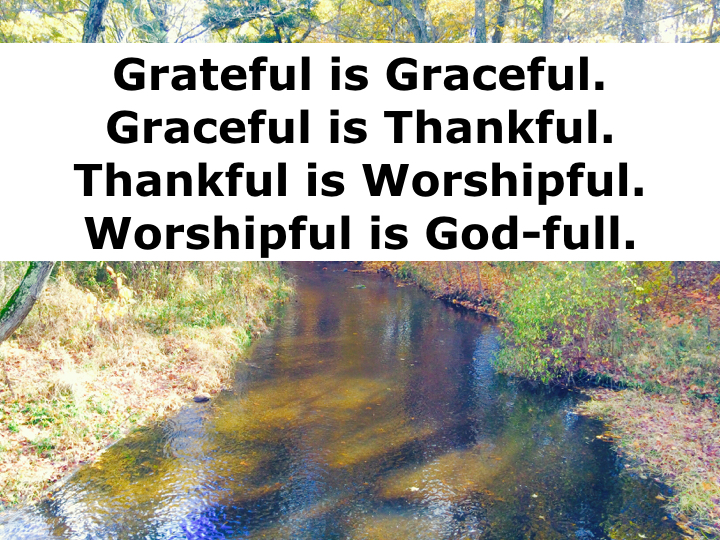
Grateful is graceful. 
Graceful is thankful. 
Thankful is worshipful.
Worshipful is God-full.

“The essence of Christianity is that we give the Son of God a chance to live and move and have His being in us, and the meaning of all spiritual growth is that He has an increasing opportunity to manifest Himself in our mortal flesh.” —Oswald Chambers

What will you do to remain thank-full, and remain God’s lavish gift to others?

Part three of our 3-part series on gratitude is coming up this Sunday. If you don’t have a home church in the Cedar Springs area, I would be so thank-full to have you come join us!

4 Powerful Truths About Peacefulness

PeacefulnessHave you ever noticed the importance the Apostle Paul gives to “peace”? Not just any kind of peace, but the peace that is linked with God’s grace.

Paul always puts grace and peace together. Every one of his letters opens with “grace and peace. The only exceptions are his two personal letters to Timothy where he says “grace, mercy and peace.

In his letter to the Colossians we get a clue to why this is, when he writes, “Let the peace of Christ rule in your hearts, since as members of one body you were called to peace. And be thankful” (Colossians 3:15).

Let me start at the end of the verse. The word “thankful” is the Greek word euchristos. It’s where we get our word Eucharist (or Communion). The root word (charizomai) means to (a) live gracefully, (b) forgive gracefully, (c) rescue gracefully, (d) restore gracefully. That’s just how Jesus—the Prince of Peace—lived on earth, and that’s what His broken body and spilled blood purchased for us: peace with God.

So a thankful Christian is a peaceful Christian. Or another way of saying this: a Christian’s peace-fullness comes from thank-fullness.

When we “let the peace of Christ rule” in our heats, it’s because we understand what His grace has purchased for us. And we want others to know this grace and peace as well!

  1. Peacefulness is contagious—a peace-full person has plenty of peace to share.
  2. Peacefulness is unifying—fear makes people run away, but peace brings them close to God and close to each other (Luke 2:14; John 14:27).
  3. Peacefulness promotes worship—we don’t worship what we fear, but we worship what we are drawn to (Luke 19:38; Hebrews 10:22).
  4. Peacefulness signals victory—the absence of conflict is peace (Romans 16:20).

If you don’t have peace in your life, can I suggest that you might want to start by looking at your thank-fulness level. When you are thankful for what the Prince of Peace did on the Cross for you, it’s so much easier to become thankful for all the other blessings that He gives as well. This thank-fullness will raise your level of peace-fullness!

On Sunday we are going to continue to look at the power and beauty of grace-filled gratitude. Please join us!

Graceful Gratitude

Graceful GratitudeAs we approach Thanksgiving Day, it’s natural for people to think about thanking. This shouldn’t be the case for Christians though…

Christians should be so full of thanks that every day is a day of thanks-giving!

There is a power in thankfulness. There is something attractive about gracious people. There is a security and a peace that comes from knowing just how many blessings have been lavished on me by my Heavenly Father.

Beginning this Sunday, I am going to share a series of three messages from three verses in the book of Colossians. We are going to look at the power of being people of graceful gratitude.

If you don’t have a church home in Cedar Springs, I would be so honored if you would join us. If you cannot make it in person, check out our live broadcast on Periscope at 10:30am (search for user @craigtowens).

18 Quotes From Wise People In “15 Invaluable Laws Of Growth”

15 Invaluable Laws of GrowthJohn Maxwell always shares great quotes in his books! This is the hallmark of a true servant leader, who doesn’t hoard what he reads or hears, nor is he concerned about getting all the credit. Here are some of the quotes I enjoyed from Maxwell’s book The 15 Invaluable Laws Of Growth.

“Character is a quality that embodies many important traits such as integrity, courage, perseverance, confidence, and wisdom. Unlike your fingerprints that you were born with and can’t change, character is something that you create within yourself and must take responsibility for changing.” —Jim Rohn

“I’ve concluded that while nobody plans to mess up their life, the problem is that a few of us plan not to. That is, we don’t put the necessary safeguards in place to ensure a happy ending.” —Andy Stanley

“I bless you, prison—I bless you for being in my life—for there lying on rotting prison straw, I learned the object of life is not prospering as I had grown up believing, but the maturing of the soul.” —Alexander Solzhenitsyn

“Character cannot be summoned at the moment of crisis if it has been squandered by years of compromise and rationalization. The only testing ground for the heroic is the mundane. The only preparation for that one profound decision which can change a life, or even a nation, is those hundreds of half-conscious, self-defining, seemingly insignificant decisions made in private. Habit is the daily battle ground of character.” —Senator Dan Coats

“If you plan on being anything less than you are capable of being, you will probably be unhappy all the days of your life.” —Abraham Maslow

“It’s never too late to be what you might have been.” —George Elliot

“A sign of wisdom and maturity is when you come to terms with the realization that your decisions cause your rewards and consequences. You are responsible for your life, and your ultimate success depends on the choices you make.” —Denis Waitley

“When we are no longer able to change a situation, we are challenged to change ourselves.” —Viktor Frankl

“The great secret of success is to go through life as a man who never gets used up.” —Albert Schweitzer

“All meaningful and lasting change starts first in your imagination and then works its way out.” —Albert Einstein

“It’s better to look uninformed than to be uninformed.” —Richard Thalheimer

“When average people ask themselves, ‘Can I do this?’ they base it on the circumstances they see. … An abundant thinker asks different questions. An abundant thinker asks, ‘How can I?’ This simple twist of semantics changes everything. It forces your mind to create a solution.” —Brian Klimmer

“It is not wise, or even possible, to divorce private behavior from public leadership…. By its very nature, true leadership carries with it the burden of being an example.” —Gordon B. Hinckley

“Never confuse the giftedness of a person with the person. Their gifts allow them to do amazing things but the person may be flawed, which will eventually cause harm.” —Fred Smith

“Great things happen whenever we stop seeing ourselves as God’s gift to others, and begin seeing others as God’s gift to us.” —James S. Vuocolo

“Your doubts are not the product of accurate thinking, but habitual thinking. Years ago you excepted flawed conclusions as correct, begin to live your life as if those warped ideas about your potential were true, and ceased the bold experiment in living that brought you many breakthrough behaviors as a child.” —Price Pritchett

“If you send a rocket to the moon, about 90 percent of the time it’s off course—it ‘fails’ its way to the moon by continually making mistakes and correcting them.” —Price Pritchett

“Self-fulfillment thinks of how something serves me. Self-development thinks of how something helps me to serve others. With self-fulfillment, feeling good is the product. With self-development, feeling good is the by-product.” —Fred Smith

I have shared a lot of other content from this book:

10 Quotes On Emotional Health From “Brain Savvy-Leaders”

Brain-Savvy LeadersOur emotions start in our brain. Charles Stone wrote a very helpful book called Brain-Savvy Leaders, in which he covers a lot of ground inside our heads. One aspect is our emotional health. I encourage you to read my review of this book by clicking here. Below are some quotes Charles shared on our emotional health.

“Gratefulness is actually good for brain and body health.” 

“When the emotionality of leaders takes over, they compromise their ability to lead well in these ways:

  • impulse can overwhelm intention
  • imagination gets pushed aside by instinct
  • defensiveness stifles healthy positions
  • automatic behavior shuts down reflective thought
  • emotionality gets in the way of intentionality.”

“Fear, conscious and unconscious, is prompted by the amygdala. The brain naturally focuses on problems and the negative. It overestimates threats and underestimates opportunities. In fact, two-thirds of the brain cells in our amygdala are primed for negativity and fear. Negative networks in our brain outweigh positive ones by five to one. And negative emotions are more easily consolidated (made more permanent) into our long-term memory than positive emotions.”

“Fear can even be subconscious, especially if we’re surrounded by bad news, critical people, or if our self-talk is constantly negative.”

“Neuroscientists have found that stuffing, denying, or a ignoring our emotions reinforces them, affects short-term memory, increases blood pressure, and robs our brain’s prefrontal cortex of the mental energy it needs.”

“Although it may seem counterintuitive, tagging your emotions, through labeling and naming them by putting feelings into words, actually recruits our impulse break and dampens activity in our panic alarm.”

“Anger is the wind that blows out the lamp of the mind.” —Chinese Proverb

“Since our brains process and remember bad events more thoroughly than good ones…it’s vital that we develop the discipline of being aware of our thoughts. … Thinking about our thinking is called ‘metacognition.’”

“Emotions play a significant role in decision-making and influence how well your team will embrace change. Just presenting facts without engaging positive and hopeful emotions will seldom move your team forward. The brain can only handle so much change at once. Trying to create too much change too quickly can engage the brain’s fear center and cause an away response, thus hindering change.”

“In one research study in Israel, Dr. Tal Shafir looked at the impact of movement on the brain of twenty-two young male and female participants. They looked at video clips of actors performing various emotions that corresponded to sad, fearful, happy, or neutral. Happy movements included raising their arms in the air, skipping, and jumping. Sad movements included closing their chests and slumping forward. The participants then either mimicked the movements or imagined themselves doing them. The emotions they reported mirrored the corresponding movements. So, if you need a mood boost, keep a good posture or throw your arms up and out into the air.”

Previously I shared some other quotes from this book on how we learn, and on how to keep our brain healthy. Please check these out too.

7 Quotes On Brain Health From “Brain-Savvy Leaders”

Brain-Savvy LeadersCharles Stone gave us a very practical book in Brain-Savvy Leaders (you can read my full review by clicking here). Obviously out brain works best when we’re healthy, so check out some quotes from this book on brain health.

“Gratefulness is actually good for brain and body health.”

“At the end of our chromosomes lie protective caps called telomeres that are linked to longevity. Apparently, the longer your telomeres, all else being equal, the longer you live. Long-term stress shortens them, and mindfulness apparently helps lengthen them. For a Christian, mindfulness practices, such as meditation on Scripture and reflective prayer, which we often do in our devotional time, may possibly help us live longer.”

“The hypothalamus acts as a controller to the master hormone gland, the pituitary gland. … Chronic stress can damage our body and even kill neurons in the hippocampus. However, since the hippocampus is one of the few structures that can grow neurons, called neurogenesis, when stress decreases and cortisol levels out, the brain can regrow neurons here.”

“When we feel bored we don’t get as much oxygen and blood flow. When the brain lacks engagement over long periods of time (we are bored), dendrites can atrophy. When that happens, we can lose brain real estate.”

“Neuroscientists have found that stuffing, denying, or a ignoring our emotions reinforces them, affects short-term memory, increases blood pressure, and robs our brain’s prefrontal cortex of the mental energy it needs.”

“Chronic anxiety and stress cause what scientists call allostatic load…. When our body secretes too much cortisol over long periods of time, these problems can affect us: impaired immunity, weight gain, greater emotional reactivity, heart problems, decreased memory, and diminished brain functioning.”

“Exercise increases a key protein necessary for a healthy brain.”

I shared some quotes about how we learn from Brain-Savvy Leaders earlier, and you can read them here.