You Are God’s Lavish Gift To Others

GratefulI have noticed a couple of things about thank-full people (people who are full of thanks). In a single word the difference is ABUNDANCE.

  • Thank-full people have an abundance mentality—they believe there’s plenty for everyone; that God’s grace overflows and is boundless.
  • Thank-full people want others to find this abundant life too. As Charles Spurgeon prayed, “I would then that the quickening Spirit would come down upon me, and upon you, upon every one of us in abundance, to create men valiant for truth and mighty for the Lord.”

This abundance mentality is what Paul is referring to when he writes, “Let the word of Christ dwell in you richly” (Colossians 3:16). Both words dwell and richly convey someone who is so saturated in the abundance of God, that they cannot help wanting to share it with everyone!

So how do Christians lavish their thank-fullness and peace-fullness on others? The rest of that verse in Colossians tells us:

  1. We teach.
  2. We admonish with all wisdom.
  3. We sing.

Teaching others is always rooted in love, and is for the benefit of the other person (Ephesians 4:15, 25, 29).

Wisdom is the Greek word sophia. It means heavenly insight that is extremely practical. That’s what we need when we admonish those we love. This word means to warn people if they are on a wrong path. We love them enough to speak a loving word of warning (Proverbs 27:5-6).

And we sing out of our abundant overflow. The word of Christ dwells in us so richly that it literally bursts out of us in song! Have you ever been around someone so full of God’s presence that their words almost seem to be a song?

But don’t miss out on this. The lavish gift God wants to pour out on people is YOU! Notice how many times the pronoun you is used in Colossians 3:15-17. YOU are God’s gift to your family, your friends, your co-workers, your community!

Don’t rob others of this amazing gift by becoming ungrateful.

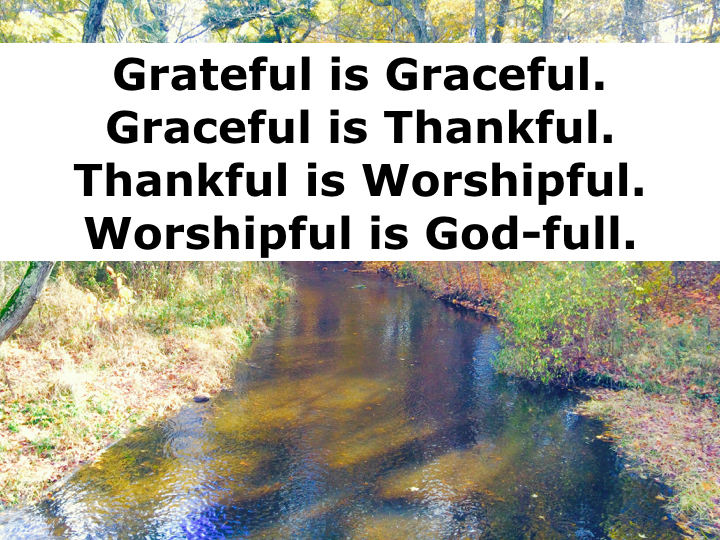
Grateful is graceful. 
Graceful is thankful. 
Thankful is worshipful.
Worshipful is God-full.

“The essence of Christianity is that we give the Son of God a chance to live and move and have His being in us, and the meaning of all spiritual growth is that He has an increasing opportunity to manifest Himself in our mortal flesh.” —Oswald Chambers

What will you do to remain thank-full, and remain God’s lavish gift to others?

Part three of our 3-part series on gratitude is coming up this Sunday. If you don’t have a home church in the Cedar Springs area, I would be so thank-full to have you come join us!

4 Powerful Truths About Peacefulness

PeacefulnessHave you ever noticed the importance the Apostle Paul gives to “peace”? Not just any kind of peace, but the peace that is linked with God’s grace.

Paul always puts grace and peace together. Every one of his letters opens with “grace and peace.” The only exceptions are his two personal letters to Timothy where he says “grace, mercy and peace.”

In his letter to the Colossians we get a clue to why this is, when he writes, “Let the peace of Christ rule in your hearts, since as members of one body you were called to peace. And be thankful” (Colossians 3:15).

Let me start at the end of the verse. The word “thankful” is the Greek word euchristos. It’s where we get our word Eucharist (or Communion). The root word (charizomai) means to (a) live gracefully, (b) forgive gracefully, (c) rescue gracefully, (d) restore gracefully. That’s just how Jesus—the Prince of Peace—lived on earth, and that’s what His broken body and spilled blood purchased for us: peace with God.

So a thankful Christian is a peaceful Christian. Or another way of saying this: a Christian’s peace-fullness comes from thank-fullness.

When we “let the peace of Christ rule” in our heats, it’s because we understand what His grace has purchased for us. And we want others to know this grace and peace as well!

  1. Peacefulness is contagious—a peace-full person has plenty of peace to share.
  2. Peacefulness is unifying—fear makes people run away, but peace brings them close to God and close to each other (Luke 2:14; John 14:27).
  3. Peacefulness promotes worship—we don’t worship what we fear, but we worship what we are drawn to (Luke 19:38; Hebrews 10:22).
  4. Peacefulness signals victory—the absence of conflict is peace (Romans 16:20).

If you don’t have peace in your life, can I suggest that you might want to start by looking at your thank-fulness level. When you are thankful for what the Prince of Peace did on the Cross for you, it’s so much easier to become thankful for all the other blessings that He gives as well. This thank-fullness will raise your level of peace-fullness!

On Sunday we are going to continue to look at the power and beauty of grace-filled gratitude. Please join us!

Graceful Gratitude

Graceful GratitudeAs we approach Thanksgiving Day, it’s natural for people to think about thanking. This shouldn’t be the case for Christians though…

Christians should be so full of thanks that every day is a day of thanks-giving!

There is a power in thankfulness. There is something attractive about gracious people. There is a security and a peace that comes from knowing just how many blessings have been lavished on me by my Heavenly Father.

Beginning this Sunday, I am going to share a series of three messages from three verses in the book of Colossians. We are going to look at the power of being people of graceful gratitude.

If you don’t have a church home in Cedar Springs, I would be so honored if you would join us. If you cannot make it in person, check out our live broadcast on Periscope at 10:30am (search for user @craigtowens).

18 Quotes From Wise People In “15 Invaluable Laws Of Growth”

15 Invaluable Laws of GrowthJohn Maxwell always shares great quotes in his books! This is the hallmark of a true servant leader, who doesn’t hoard what he reads or hears, nor is he concerned about getting all the credit. Here are some of the quotes I enjoyed from Maxwell’s book The 15 Invaluable Laws Of Growth.

“Character is a quality that embodies many important traits such as integrity, courage, perseverance, confidence, and wisdom. Unlike your fingerprints that you were born with and can’t change, character is something that you create within yourself and must take responsibility for changing.” —Jim Rohn

“I’ve concluded that while nobody plans to mess up their life, the problem is that a few of us plan not to. That is, we don’t put the necessary safeguards in place to ensure a happy ending.” —Andy Stanley

“I bless you, prison—I bless you for being in my life—for there lying on rotting prison straw, I learned the object of life is not prospering as I had grown up believing, but the maturing of the soul.” —Alexander Solzhenitsyn

“Character cannot be summoned at the moment of crisis if it has been squandered by years of compromise and rationalization. The only testing ground for the heroic is the mundane. The only preparation for that one profound decision which can change a life, or even a nation, is those hundreds of half-conscious, self-defining, seemingly insignificant decisions made in private. Habit is the daily battle ground of character.” —Senator Dan Coats

“If you plan on being anything less than you are capable of being, you will probably be unhappy all the days of your life.” —Abraham Maslow

“It’s never too late to be what you might have been.” —George Elliot

“A sign of wisdom and maturity is when you come to terms with the realization that your decisions cause your rewards and consequences. You are responsible for your life, and your ultimate success depends on the choices you make.” —Denis Waitley

“When we are no longer able to change a situation, we are challenged to change ourselves.” —Viktor Frankl

“The great secret of success is to go through life as a man who never gets used up.” —Albert Schweitzer

“All meaningful and lasting change starts first in your imagination and then works its way out.” —Albert Einstein

“It’s better to look uninformed than to be uninformed.” —Richard Thalheimer

“When average people ask themselves, ‘Can I do this?’ they base it on the circumstances they see. … An abundant thinker asks different questions. An abundant thinker asks, ‘How can I?’ This simple twist of semantics changes everything. It forces your mind to create a solution.” —Brian Klimmer

“It is not wise, or even possible, to divorce private behavior from public leadership…. By its very nature, true leadership carries with it the burden of being an example.” —Gordon B. Hinckley

“Never confuse the giftedness of a person with the person. Their gifts allow them to do amazing things but the person may be flawed, which will eventually cause harm.” —Fred Smith

“Great things happen whenever we stop seeing ourselves as God’s gift to others, and begin seeing others as God’s gift to us.” —James S. Vuocolo

“Your doubts are not the product of accurate thinking, but habitual thinking. Years ago you excepted flawed conclusions as correct, begin to live your life as if those warped ideas about your potential were true, and ceased the bold experiment in living that brought you many breakthrough behaviors as a child.” —Price Pritchett

“If you send a rocket to the moon, about 90 percent of the time it’s off course—it ‘fails’ its way to the moon by continually making mistakes and correcting them.” —Price Pritchett

“Self-fulfillment thinks of how something serves me. Self-development thinks of how something helps me to serve others. With self-fulfillment, feeling good is the product. With self-development, feeling good is the by-product.” —Fred Smith

I have shared a lot of other content from this book:

10 Quotes On Emotional Health From “Brain Savvy-Leaders”

Brain-Savvy LeadersOur emotions start in our brain. Charles Stone wrote a very helpful book called Brain-Savvy Leaders, in which he covers a lot of ground inside our heads. One aspect is our emotional health. I encourage you to read my review of this book by clicking here. Below are some quotes Charles shared on our emotional health.

“Gratefulness is actually good for brain and body health.” 

“When the emotionality of leaders takes over, they compromise their ability to lead well in these ways:

  • impulse can overwhelm intention
  • imagination gets pushed aside by instinct
  • defensiveness stifles healthy positions
  • automatic behavior shuts down reflective thought
  • emotionality gets in the way of intentionality.”

“Fear, conscious and unconscious, is prompted by the amygdala. The brain naturally focuses on problems and the negative. It overestimates threats and underestimates opportunities. In fact, two-thirds of the brain cells in our amygdala are primed for negativity and fear. Negative networks in our brain outweigh positive ones by five to one. And negative emotions are more easily consolidated (made more permanent) into our long-term memory than positive emotions.”

“Fear can even be subconscious, especially if we’re surrounded by bad news, critical people, or if our self-talk is constantly negative.”

“Neuroscientists have found that stuffing, denying, or a ignoring our emotions reinforces them, affects short-term memory, increases blood pressure, and robs our brain’s prefrontal cortex of the mental energy it needs.”

“Although it may seem counterintuitive, tagging your emotions, through labeling and naming them by putting feelings into words, actually recruits our impulse break and dampens activity in our panic alarm.”

“Anger is the wind that blows out the lamp of the mind.” —Chinese Proverb

“Since our brains process and remember bad events more thoroughly than good ones…it’s vital that we develop the discipline of being aware of our thoughts. … Thinking about our thinking is called ‘metacognition.’”

“Emotions play a significant role in decision-making and influence how well your team will embrace change. Just presenting facts without engaging positive and hopeful emotions will seldom move your team forward. The brain can only handle so much change at once. Trying to create too much change too quickly can engage the brain’s fear center and cause an away response, thus hindering change.”

“In one research study in Israel, Dr. Tal Shafir looked at the impact of movement on the brain of twenty-two young male and female participants. They looked at video clips of actors performing various emotions that corresponded to sad, fearful, happy, or neutral. Happy movements included raising their arms in the air, skipping, and jumping. Sad movements included closing their chests and slumping forward. The participants then either mimicked the movements or imagined themselves doing them. The emotions they reported mirrored the corresponding movements. So, if you need a mood boost, keep a good posture or throw your arms up and out into the air.”

Previously I shared some other quotes from this book on how we learn, and on how to keep our brain healthy. Please check these out too.

7 Quotes On Brain Health From “Brain-Savvy Leaders”

Brain-Savvy LeadersCharles Stone gave us a very practical book in Brain-Savvy Leaders (you can read my full review by clicking here). Obviously out brain works best when we’re healthy, so check out some quotes from this book on brain health.

“Gratefulness is actually good for brain and body health.”

“At the end of our chromosomes lie protective caps called telomeres that are linked to longevity. Apparently, the longer your telomeres, all else being equal, the longer you live. Long-term stress shortens them, and mindfulness apparently helps lengthen them. For a Christian, mindfulness practices, such as meditation on Scripture and reflective prayer, which we often do in our devotional time, may possibly help us live longer.”

“The hypothalamus acts as a controller to the master hormone gland, the pituitary gland. … Chronic stress can damage our body and even kill neurons in the hippocampus. However, since the hippocampus is one of the few structures that can grow neurons, called neurogenesis, when stress decreases and cortisol levels out, the brain can regrow neurons here.”

“When we feel bored we don’t get as much oxygen and blood flow. When the brain lacks engagement over long periods of time (we are bored), dendrites can atrophy. When that happens, we can lose brain real estate.”

“Neuroscientists have found that stuffing, denying, or a ignoring our emotions reinforces them, affects short-term memory, increases blood pressure, and robs our brain’s prefrontal cortex of the mental energy it needs.”

“Chronic anxiety and stress cause what scientists call allostatic load…. When our body secretes too much cortisol over long periods of time, these problems can affect us: impaired immunity, weight gain, greater emotional reactivity, heart problems, decreased memory, and diminished brain functioning.”

“Exercise increases a key protein necessary for a healthy brain.”

I shared some quotes about how we learn from Brain-Savvy Leaders earlier, and you can read them here.

10 Quotes To Help Celebrate Independence Day

Listen to the podcast of this post by clicking on the player below, and you can also subscribe on Apple, Spotify, or Audible.

I love the United States of America! As we celebrate our country’s birthday, here are 10 quotes from my files about America.

“Throughout our history Americans have put their faith in God and no one can doubt that we have been blessed for it. The earliest settlers of this land came in search of religious freedom. Landing on a desolate shoreline, they established a spiritual foundation that has served us ever since.” —Ronald Reagan

“America was not built on fear. America was built on courage, on imagination and an unbeatable determination to do the job at hand.” ―Harry Truman

“A patriot must always be ready to defend his country against his government.” —Edward Abbey

“If ever a time should come, when vain and aspiring men shall possess the highest seats in Government, our country will stand in need of its experienced patriots to prevent its ruin.” —Samuel Adams

“If American democracy is to remain the greatest hope of humanity, it must continue abundantly in the faith of the Bible.” —Calvin Coolidge 

“The strength of a country is the strength of its religious convictions.” —Calvin Coolidge

“It is the duty of all Nations to acknowledge the providence of Almighty God, to obey His will, to be grateful for His benefits, and humbly to implore His protection and favors. … The Hand of Providence has been so conspicuous in all this, that he must be worse than an infidel that lacks faith, and more than wicked, that has not gratitude enough to acknowledge his obligations.” —George Washington 

“We have been the recipients of the choicest bounties of Heaven. We have been preserved, these many years, in peace and prosperity. We have grown in numbers, wealth and power, as no other nation has ever grown. But we have forgotten God. We have forgotten the gracious hand which preserved us in peace, and multiplied and enriched and strengthened us; and we have vainly imagined, in the deceitfulness of our hearts, that all these blessings were produced by some superior wisdom and virtue of our own. Intoxicated with unbroken success, we have become too self-sufficient to feel the necessity of redeeming and preserving grace, too proud to pray to the God that made us!” —Abraham Lincoln

“We’ve staked the whole future of American civilization, not upon the power of government. Far from it. We have staked the future upon the capacity of each and every one of us to govern ourselves, to sustain ourselves according to the Ten Commandments of God.” —James Madison

“There is not a single instance in history in which civil liberty was lost, and religious liberty preserved entire.” —John Witherspoon

Links & Quotes

link quote

“The marvelous thing about spiritual wealth is that when we take our part in that, everyone else is blessed; whereas if we refused to be partakers, we hinder others from entering into the riches of God.” —Oswald Chambers

“Gratitude gets us through the hard stuff. To reflect on your blessings is to rehearse God’s accomplishments. To rehearse His accomplishments is to discover His heart. Gratitude always leaves us looking at God and away from dread.” —Max Lucado

“We can choose to define ourselves (our smarts, our brand, our character) on who rejects us. Or we can choose to focus on those that care enough to think we matter. Carrying around a list of everyone who thinks you’re not good enough is exhausting.” —Seth Godin

U.S. Congressmen have already introduced a bill to protect our First Amendment rights in light of the latest Supreme Court ruling.

Links & Quotes

link quote

“I have no business on the bed of sloth; I have no right to be wandering abroad after private business; I can claim no time which I may set apart for my own follies, or to my own aggrandizement. My true position as a Christian is to be always ministering to God, always standing before His altar. Do I hear you ask how this can be, with your farms and with your merchandise? Know you not, brethren, that whether you eat, or drink, or whatsoever you do, you may do it all to the glory of God?” —Charles Spurgeon

“It ill becomes a man of God to be ungrateful, or to sponge upon those that are generous.” ―Matthew Henry

10 Quotes From “Inspire To Be Great”

Inspire To Be GreatThe news show 60 Minutes described Zig Ziglar as “a legend in the industry—the Bill Gates, Henry Ford, and Thomas Edison of enthusiasm.” Truer words were never spoken! Zig is a fabulous motivator (you can read my review of Inspire To Be Great by clicking here). Here are some of my favorite quotes from this book.

“People often tell me that motivation doesn’t last, and I tell them that bathing doesn’t either. That’s why I recommend it daily.”

“To avoid procrastination, write your schedule out the night before, including precisely when you are going to start.”

“People with integrity are more successful, because with integrity you do the right thing, and there is no guilt attached to you. With integrity, you have nothing to fear because you have nothing to hide.”

“The greatest good we can do for anyone is not to share our wealth with them, but rather to reveal their own wealth to them.”

“It’s not what you’ve got; it’s what you use that makes a difference.”

“Never say anything negative about yourself. If we don’t see ourselves as ‘fearfully and wonderfully made’ [Psalm 139:14], who will?”

“When your goals are clearly defined and intelligently set, you have, in essence, taken a major step toward programming your left brain. That frees your right brain to be its creative best.”

“Among the things you can give and still keep are: your word, a smile, and a grateful heart.”

“Failure is an event, not a person. So regardless of what happens to you along the way, you must keep on going and doing the right thing in the right way. Then the event becomes a reality of a changed life.”

“Make failure your teacher, not your undertaker.”