Simply Profound

This morning I went to “Donuts With Dad” with my youngest son. It’s a time for Dads to bring their kids to school, grab a donut, and then walk around the school with their child. It was so cool seeing how excited my son was for me to be there with him!

We sat in his classroom to eat our donut, then he gave me the grand tour: the library, the computer lab, the lunchroom, the art room, and the gym. So simple, yet so important to him.

Earlier in the morning on my way to drop off my older children at their school, we were reading this passage in Colossians:

It’s that simple. That is the substance of our Message. We preach Christ, warning people not to add to the Message. We teach in a spirit of profound common sense so that we can bring each person to maturity. To be mature is to be basic. Christ! No more, no less. That’s what I’m working so hard at day after day, year after year, doing my best with the energy God so generously gives me.

So I’ve been thinking: if the simple things are the joy-filled things, why do we insist on making things so complicated in our Christian faith? We tell God’s children, “To be in a relationship with God you must do thus-and-so, and you must do it this many times each week, and you must do it this way.”

Must, must, must.

Complex rule after convoluted rule after antiquated rule. Why not simply say, “Love God will all that you’ve got. Just love Him in the unique way He made you to love Him”?

There’s great joy in simplicity. There is a profoundness in simplicity.

Here’s to a simpler walk with Christ!
Take The Initiative

“You have not lived today until you have done something for someone who can never repay you.” —John Bunyan

I love doing something unexpected for someone. Something kind and thoughtful, but totally “out of the blue.” It’s especially nice when the person for whom you do something nice needs it the most, yet would be the last person to ask for help.

In Matthew 25 Jesus talks about people who take the initiative to help the poor, the hungry, the needy. Jesus never says that they asked for help, but simply that His followers saw the need and addressed it. Jesus concludes by saying, “When you did it to one of the least of these My brothers and sisters, you were doing it to Me!

Even better: we take the initiative to bless one of the least of these and we get a blessing from God. How cool is that!

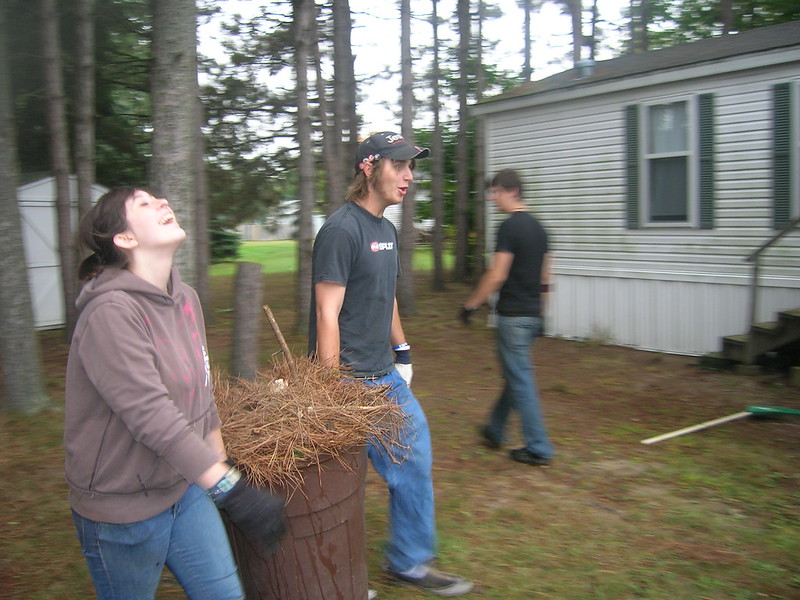
Over the weekend our youth group showed up at a precious lady’s house unannounced. We all affectionately refer to Thelma as “Grandma.” We didn’t tell her that we were coming, we just showed up and started cleaning up her yard. (Disclaimer: I have to admit that we did get an immediate blessing, in that Grandma’s daughter Joan made us a cake, so we got a slice before we left.) Pictures are here.

I’m so proud of these young servants who showed up to bless Grandma. As you helped her, you were helping Jesus. Great will be your reward in heaven—way to go!

Deadly Viper Character Assassins

The dictionary defines an assassin as “one who murders by surprise attack.” No assassin worth his/her salt sends you an announcement to say, “I’ll be stopping by your office tomorrow morning to kill you. If that’s not a convenient time for you, please let me know.” Of course not! Assassins never tell you that they’re coming.

Theodore Roosevelt said, “Character, in the long run, is the decisive factor in the life of an individual and of nations alike.”

So a “character assassin” is something that sneaks up and takes out the essential factor that could have made us successful and effective in life. This is why Deadly Viper Character Assassins is such a vital resource.

Here are the two pulls in my life:

Be self-controlled and alert. Your enemy the devil prowls around like a roaring lion looking for someone to devour [assassinate]. (1 Peter 5:8)

You, therefore, must be perfect [growing into complete maturity of godliness in mind and character, having reached the proper height of virtue and integrity], as your heavenly Father is perfect. (Matthew 5:48)

If I keep our character intact, I’ve developed a foundation that will sustain me for the long haul. In my experience, here’s what I’ve done to keep developing my character:

  1. Be more concerned about my character than my popularity.
  2. Regularly look myself in the mirror of God’s Word to see chinks in my armor.
  3. Make myself accountable to godly friends.

Don’t wait until the assassin has already taken a shot at your character, but begin to protect yourself now. Continue to grow in the character Jesus Christ exhibited for us.

Biodegradable Words

The day has been a good one so far: There’s been a lot of traffic through the store, all of the employees showed up for their shifts on time, and the manager is feeling great. Then because of one complaint from a finicky customer, the whole day seems to crumble.

The day has been a good one so far: You got up on time, found the right outfit to wear, got to school on time, smiled at your classmates, and got right down to business. Then a teacher points out a mistake you made yesterday, and your whole afternoon becomes gloomy.

Usually that’s all it takes. Just one complaint, one correction, one unkind word, one angry look, one unfriendly email. Just one, and it’s hard to remember any of the good stuff which happened earlier. Just one, and the rest of the day seems so hard to bear.

That’s because good words are biodegradable. Kind words break down faster than unkind words. Compliments are quickly erased by complaints.

“One of the commodities in life that most people can’t get enough of is compliments. The ego is never so intact that one can’t find a hole in which to plug a little praise. But, compliments by their very nature are highly biodegradable and tend to dissolve in hours or days after we receive them—which is why we can always use another.” —Phyllis Theroux

Here’s how you can help today. It might take a couple of extra minutes, but the results are so worth it! Give three compliments today.

  • Tell the barista at your coffee shop how much you appreciate her smile every morning.
  • Mention to the building custodian how nice he keeps the office looking.
  • Say “thanks” to the band for playing one of your favorite songs.
  • Compliment your kids for doing their homework without you having to ask them.
  • Thank your school teacher for her informative lesson.
  • Tell your supervisor you appreciate their extra effort.

It’s not hard to find something to compliment about anyone. Your compliment may be just the antidote they need to counteract a complaint that has gotten them down. And when you treat others this way, you can be sure that compliments will be coming your way too!

Undecided Or Uncommitted?

Listen to the podcast of this post by clicking on the player below, and you can also subscribe on AppleSpotify, or Audible.

I’ve noticed a concerning trend in our busy culture. It’s in the way we can parse our words to make others think we are saying one thing, while we are actually giving ourselves an “out” in case we need it. You know, giving ourselves a little wiggle room.

Let me illustrate. I ask someone, “Are you going to the party on Friday night?” And the answers I get sound like this:

  • “I’m planning on it.”
  • “Sure gonna try.”
  • “It looks like I’ll be there.”

They walk away smiling, and I’m left standing there wondering, “Was that a ‘yes’? Are they really going to be there? Or are they keeping their options open in case a better offer comes along?”

Even on Facebook’s event invitations, I have the option to check “Attending,” “Not Attending” or “Maybe Attending.”

Are we truly undecided?

Or are we simply unwilling to commit to our decisions?

Here’s the danger in being undecided about something as innocent as going to a party: The indecision anywhere can start a pattern that carries over to everywhere in my life, and then undecided in one area can easily be uncommitted in all areas.

The greatest danger? Being uncommitted to the life God has called you and me to live. Like saying…

  • … “God, I’ll follow You anywhere (as long as I have a comfy bed every night).”
  • … “I’m totally committed to You (but I have to take care of my family).”
  • … “I’ve put You first (but I want to have some fun too).”

Undecided … parsing words … giving yourself an out … saying “Yes” to what you should say “No” to, and vice versa. Jesus directly addressed the dangers of this type of speech—

And don’t say anything you don’t mean. This counsel is embedded deep in our traditions. You only make things worse when you lay down a smoke screen of pious talk, saying, “I’ll pray for you,” and never doing it, or saying, “God be with you,” and not meaning it. You don’t make your words true by embellishing them with religious lace. In making your speech sound more religious, it becomes less true. Just say “yes” and “no.” When you manipulate words to get your own way, you go wrong. (Matthew 5:33-37, The Message)

If you say “yes,” make your “yes” mean “yes.”

Or else, just say “no.”

Say what you mean and mean what you say. Let’s commit to being totally committed!

These are not my words, but Christ’s: “Just say a simple, ‘Yes, I will,’ or ‘No, I won’t.’ Anything beyond this is from the evil one” (Matthew 5:37).

Decide what you are going to do … commit to it … say it … mean it … then do it!

►► Would you please prayerfully consider supporting this ministry? My Patreon supporters get behind-the-scenes access to exclusive materials. ◀︎◀︎

Pursuing

“They followed worthless idols and became worthless themselves” (Jeremiah 2:5).

Simple principle: I become what I pursue.

Pursuing things that will not last into eternity is worthless, and the pursuit of them will make my life worthless too. Allow me to elaborate with a few modified quotes:

“For where your [pursuit] is, there your heart will be also” (Jesus).

“All [pursuits] that are not eternal are eternally useless” (C.S. Lewis).

“But more than anything else, put God’s [pursuits] first and do what He wants” (Jesus).

“The impulse to [pursue] God originates with God, but the outworking of that impulse is our following hard after Him; and all the time we are [pursuing] Him we are already in His hand” (A.W. Tozer).

“But on the judgment day, fire will reveal what kind of work each of us has [pursued]. The fire will show if a person’s [pursuit] had any value” (Paul).

“The true worth of a man is to be measured by the objects he [pursues]” (Marcus Aurelius Antoninus).

“I love those who love Me, and those who [pursue] Me always catch Me” (God).

“‘Tis the business of little minds to shrink; but he whose heart is firm, and whose conscience approves his conduct, will [pursue] his principles unto death” (Thomas Paine).

As each week wraps up, I’m trying to remember to ask myself, “Did I pursue the right things this week? Were my pursuits eternal and God-honoring?” Good questions. Perhaps you could take some time to assess your pursuits too.

Remember, you will become what you pursue, so pursue wisely.

Feeding Jesus

Even before reading The Hole In Our Gospel, this thought has been haunting me: Am I doing all that I can to help the last and the least?

  • Am I speaking up for the one with no voice?
  • Am I looking out for the one who’s been ignored?
  • Am I feeding the physically hungry?
  • Am I feeding the spiritually hungry?
  • Am I representing the cause of the marginalized and ignored?
  • Am I doing this everywhere I can?

Jesus made it quite clear: after my brief life here is over, He’s going to say one of two things to me. Either I took care of the least and the last, or I didn’t. There’s no middle ground. The conversation either sounds like this…

“I was hungry and you fed Me,
I was thirsty and you gave Me a drink,
I was homeless and you gave Me a room,
I was shivering and you gave Me clothes,
I was sick and you stopped to visit,
I was in prison and you came to Me,” Jesus will say.

“Master,” I will answer, “what are You talking about? When did I ever see You hungry and feed You, thirsty and give You a drink? And when did I ever see You sick or in prison and come to You?”

“Whenever you did one of these things to someone overlooked or ignored, that was Me—you did it to Me.”

Or like this…

“I was hungry and you gave Me no meal,
I was thirsty and you gave Me no drink,
I was homeless and you gave Me no bed,
I was shivering and you gave Me no clothes,
Sick and in prison, and you never visited,” Jesus will say.

“Master,” I will answer, “what are You talking about? When did I ever see You hungry or thirsty or homeless or shivering or sick or in prison and didn’t help?”

“Whenever you failed to do one of these things to someone who was being overlooked or ignored, that was Me—you failed to do it to Me.” (My paraphrase of Matthew 25:31-46)

Mother Teresa said that in the faces of the poor whom she served she saw “Christ, in His most distressing disguise.” My prayer is that God will open my eyes. I need to see the poor, the marginalized, the hungry, and the suffering through their disguises. That’s Jesus who is poor, ignored, and suffering, and it’s up to me to do something about it.

“Let my heart be broken by the things that break the heart of God.” —Bob Pierce, founder of World Vision

What’s Your Work?

When I’m at business functions, I along with all of the other attendees are typically walking around with the “Hello, My Name Is” label stuck to my chest. The idea is that as I shake hands with new people I can glance down and say, “Nice to meet you, uh, Bob!”

Nine times out of ten, after the initial introduction is made the very next question people have for me is, “So, what do you do?” All of us usually give an answer related to our jobs: I’m a pastor, I’m a graphic designer, I’m a teacher, I’m a blogger, etc. Yes, that’s what you do; that’s your job. But what do you work at?

I’ve been thinking about this over the past couple of days. And what got me thinking were two “interruptions” to my job.

On Wednesday night I was teaching a Bible study. I was just getting to the pay-off—the part of the lesson where the attendees would really be challenged to apply the lesson to their real-life situations—when my lesson was interrupted. A friend had slipped out of his seat and was standing at the back. All of a sudden he was clutching his chest and saying, “I need help!” Immediately my lesson stopped, I was at his side trying to recall some of my medical training, and then asking someone to call 911.

I didn’t finish my “job” on Wednesday evening, but I did my work as a friend.

Today I had planned to devote the better part of my day to preparing a message for Sunday morning. It’s my “job” as a pastor to come to church prepared with a timely, relevant message. But after talking with a friend on the phone, I could hear the heavy despondency in his voice, and I knew I needed to go see him face-to-face.

I put my job on hold to go do my work as a friend.

Bill Hybels wrote, “Keep the ‘church’ in church work.” My work—as a member of the Church, as a friend—should always trump my “job.”

The Apostle Paul wrote, “Carry each other’s burdens, and in this way you will fulfill the law of Christ” (Galatians 6:2).

At the end of my life, I don’t think God is going to ask me how good my sermons were. But He is going to ask me how well I did my work as His servant.

Then the King will say to those on His right, “Come, you who are blessed by My Father, inherit the Kingdom prepared for you from the creation of the world. For I was hungry, and you fed Me. I was thirsty, and you gave Me a drink. I was a stranger, and you invited Me into your home. I was naked, and you gave Me clothing. I was sick, and you cared for Me. I was in prison, and you visited Me. … I tell you the truth, when you did it to one of the least of these My brothers and sisters, you were doing it to Me!” (Matthew 25:34-36, 40).

How’s your work going today?

Still Learning

I live by the axiom, “If you’re through learning, you’re through.” So I try to learn something new every day.

I just finished a class called New Testament Survey: a quick overview of the 27 books that compromise the New Testament of the Bible. Here’s a couple of interesting factoids I picked up from my studies:

  • The earliest-written book was James. Interesting, because at one point James thought Jesus (his half-brother) was nuts.
  • Only Matthew uses the term kingdom of heaven; all of the other writers use kingdom of God.
  • Mark uses the word immediately more times than anyone else. Perhaps because his source (Peter) was always doing things so quickly… sort of a ready, FIRE!, aim kinda guy.
  • Luke wrote what is called “the global gospel” for everyone, so he included 45 teachings/events that no one else records.
  • John doesn’t record any of Jesus’ parables.
  • John uses the word believe nearly 100 times— way more than any other writer.
  • Luke talks about the Holy Spirit nearly 60 times in the 28 chapters of Acts.
  • Romans is the longest of Paul’s epistles with 7101 words; Philemon is the shortest with just 355 words.
  • With the exception of the pastoral epistles (1 Timothy, 2 Timothy, Titus) Paul’s letters are arranged in the Bible from longest to shortest.
  • In 1 & 2 Thessalonians (only 136 verses) Paul refers to God, Christ, the Holy Spirit, or a combination thereof more than 150 times.
  • Paul gives Timothy seven word pictures to describe the kind of pastor he should be: son, soldier, athlete, farmer, workman, instrument, and servant.
  • Hebrews is called “the book of better things” so better is used 13 times. This word is used only six times in the remaining 26 books of the New Testament.
  • James wrote 108 verses but issues 50+ direct commands.
  • In John’s three short epistles he uses the word know 33 times, and the word dear ten times.

Keep on learning! There’s a lot of good stuff out there. What have you learned lately?

What Jesus Didn’t Say

All throughout the first four books of the New Testament—Matthew, Mark, Luke, and John—there are lots of “red letters” (words spoken by Jesus). But as each of these gospel writers begins to recount the arrest and sham trial of Jesus, I’m struck by how many “black letters” there are. This fulfilled an Old Testament prophesy—

He was oppressed and treated harshly, yet He never said a word. He was led like a lamb to the slaughter. And as a sheep is silent before the shearers, He did not open His mouth (Isaiah 53:7).

The chief priests and the Sanhedrin brought out a string of witnesses to falsely accuse Jesus, but even then these witnesses couldn’t get their stories to jive, so Jesus remained silent. In exasperation the chief priest Caiaphas lashed out at Jesus, “Aren’t You going to answer these charges? Don’t You hear what they’re saying about You? Why won’t You defend Yourself?”

So here’s how Jesus responded to His accusers: But Jesus remained silent (Matthew 26:63). His silence resonated louder than any words could have!

How could Jesus do this? How could He stand silently when all of these nasty things were being said about Him?

He looked back—”…He had done no violence, nor was any deceit in His mouth…” (Isaiah 53:9). All four Gospels record Jesus saying, “You heard Me speaking in public all the time. My life has been on display for You. If I had said or done anything wrong, you could have arrested Me earlier, but the facts are: I haven’t said or done anything sinful.”

He looked forward—”…Because of the joy awaiting Him, He endured the Cross, disregarding its shame…” (Hebrews 12:2). He knew that one wrong word could undo all of the good words which He previously spoke, so He looked forward to the joy that would come after this was over.

I just went through a period of my life where people threw incredibly hurtful lies at me, but what was that compared to the horrific abuse heaped upon Jesus? If He could remain silent, how much more should I?

While I was in the midst of this difficult time, a prayerful friend handed me a notecard which I have kept close to me. Perhaps these words will be helpful to you, too—

May kindness be the response in you
where such a response is not expected.
May gentleness have the power
to overrule an offense and the power to heal. (David Teems)

May this Good Friday be a time of reflection in what Jesus didn’t say. And may I, along with you, learn this power of silence when falsely accused.