I don’t think there is any arguing that Jesus was the healthiest individual who ever walked planet Earth. Some may want to push back with, “Of course He was because He didn’t have any problems to deal with!”
But the writer of Hebrews tells us that Jesus experienced everything you and I will ever experience (Hebrews 2:17), so His deity didn’t exclude Him from the stressors that His humanity would have to face. And yet, He handled all of these things successfully.
Luke the physician observed the growth of Jesus and tells us that it all began with Jesus having a robust mental health. From that foundation, everything else—physical, spiritual, relational—all could develop properly. We must learn from this example and pay careful attention to our own mental health.
This Sunday we will begin a series that we will be returning to once each month throughout this whole year called A Christian’s Mental Health. I would love to have you join us in person, but if you are unable to do that, we will make all of the messages available on Facebook and YouTube. If you’ve missed any of the messages, or simply want to review what we’ve already learned, you can find them all here:
Listen to the podcast of this post by clicking on the player below, and you can also subscribe on Apple, Spotify, or Audible.
I have been so grateful for the insights of Dr. Gary Chapman in his book The Five Love Languages. I have found this book to be of immense value in helping couple prepares for marriage, and in helping married couples get beyond a place where intimacy has become stuck.
In short, the five love languages are words of affirmation, quality time, gifts, acts of service, and physical touch. The goal of learning the other person’s love language—and learning to speak it consistently and fluently—is an increased level of intimacy. In the book of Amos, God asks, “Can two people walk together without agreeing on the direction?” (Amos 3:3 NLT), and speaking the right love language definitely helps people agree!
The whole reason we come to God in prayer as a Father, as a Brother, and as a Counselor is so that we can hear Him speaking our love language and we can continue to walk in deeper intimacy with Him.
When my then-girlfriend Betsy and I first met, we spent hours and hours getting to know each other. We would ask questions, share stories, and tell things we did and didn’t enjoy. This is the epitome of intimate conversation: getting to know the other person’s heart as you open up your heart to them as well.
I’ve shared this analogy before, but intimacy grows stale and can eventually disappear altogether if those in a relationship are no longer walking together. It doesn’t work if I say, “Betsy, I’m looking forward to spending an hour with you each week,” or even if I say, “I’ll give you 15 minutes each morning.” Instead, our relationship needs to be one of continual walking.
It’s the same thing for us as Christians: we cannot only give God an hour at a church service on Sunday mornings, nor is intimacy going to increase if I only walk and talk with my Savior for a few minutes in my morning devotions.
Walking closely with Him is what God has desired right from the beginning. He walked with Adam and Eve each evening. This phrase “walking with God” is used consistently throughout the Bible of those who had an intimate relationship with their Father, Brother, and Counselor—Noah, Abraham, Isaac, the people of Israel (Genesis 3:8, 6:9, 17:1, 48:15; Leviticus 26:12). And even as the New Testament era dawns, we read, “And they [Zechariah and Elizabeth] were both righteous before God, walking in all the commandments and ordinances of the Lord blameless” (Luke 1:6 NKJV).
But I’m especially intrigued by the story of Enoch in Genesis 5:21-24. Twice in four short verses, we read “Enoch walked with God.” Remember that verse in Amos—“Can two people walk together without agreeing on the direction?”—so Enoch and God had to be in agreement. In fact, that’s exactly what we read about Enoch in the Book of Hebrews:
By faith Enoch was taken from this life, so that he did not experience death: “He could not be found, because God had taken him away.” For before he was taken, he was commended as one who pleased God. And without faith it is impossible to please God, because anyone who comes to Him must believe that He exists and that He rewards those who earnestly seek Him. (Hebrews 11:5-6)
If you’ve taken Dr. Chapman’s love language assessment, you probably found that you were pretty lopsided: maybe you scored very highly in one love language and then barely registered in another. We may be lopsided in our love language skill, but God speaks every language perfectly!
Dr. Chapman noted that when our love language is being spoken to us sincerely and consistently, our love tank is filled, and all of the love languages begin to become more meaningful.
Just as God walked with Enoch until the day He brought him Home, so He wants to walk with us.
Walk in obedience to all that the Lord your God has commanded you, so that you may live and prosper. (Deuteronomy 5:33)
The Lord will establish you as His holy people, as He promised you on oath, if you keep the commands of the Lord your God and walk in obedience to Him. (Deuteronomy 28:9)
May He turn our hearts to Him, to walk in obedience to Him and keep the commands. (1 Kings 8:58)
Blessed are all who fear the Lord, who walk in obedience to Him. (Psalm 128:1)
And this is love: that we walk in obedience to His commands. As you have heard from the beginning, His command is that you walk in love. (2 John 6)
When we walk in loving intimacy with Him, our intimacy grows deeper and more mature. Sometimes they will say of couples who have been married for a long time and walk in increasingly deeper intimacy with each other, “They seem to know each other’s thoughts.” That’s because they know each other’s hearts—and that’s what God wants to do with us. He did it with Enoch, and He will do that with us too (Jude 14; Jeremiah 33:3; Habakkuk 3:19).
Enoch walked intimately with God for 365 years. Let us walk intimately with God for 365 days a year, for as many years as He gives us until God takes us away with Him forever!
If you’ve missed any of the messages in our prayer series called Intimate Conversation, you can find all of the messages by clicking here.
Listen to the podcast of this post by clicking on the player below, and you can also subscribe on Apple, Spotify, or Audible.
I’ll bet you have “go-to” people in your life. The ones you immediately call when you need computer help, relationship insights, household or car repairs, Bible questions, or even cooking instructions.
We love having these go-to people in our lives, but I’m also going to guess that none of us has someone who possesses all of these go-to skills. After all, all of us are only human, with limitations and deficiencies.
We’ve learned that in prayer we can come to God as a Father—calling Him our Abba Father.We can also come to God as a Brother—knowing that Jesus has walked every path we will ever walk, and He intercedes to the Father on our behalf.
In fact, we saw last week that Jesus was never at a loss of what to say, what path to take, or what prayer to pray. He spoke what He did, and did what He did, and prayed what He did because of the help of the indwelling Holy Spirit.
This is the same Holy Spirit that is in us as Christians. It’s because of this that we can come to God as a Counselor. The Holy Spirit is THE Go-To Resource for everything!
Andrew Murray wrote, “Prayer is simply the breathing of the Spirit in us; power in prayer comes from the power of the Spirit in us as we wait on Him. Failure in prayer is the result of a spirit that is not yielded to the Spirit of God.”
What does it mean to yield to the Holy Spirit? It means that we don’t look for other go-to people for certain situations, but we trust the Spirit to be the Go-To Resource for everything. This is what Jesus did.
As Jesus relied on the Counselor, so must we. As the Counselor helped Jesus, so He will help us.
Second, Jesus was never at a loss of what path to take, and neither do we have to experience any confusion about what to do and when to do it (Matthew 4:1; Luke 2:27; Acts 16:6-10).
In addition, there is not one issue we will ever face that God hasn’t already addressed for us in Scripture (Ephesians 3:4-5). We see Jesus being totally reliant on Scripture (Luke 4:4, 8, 12). In an identical way, the Holy Spirit will help illuminate and apply the Scripture to our lives (John 14:26; 1 Corinthians 2:13).
Let me repeat this vital truth: The Holy Spirit is THE Go-To Resource for everything!
We are vulnerable to temptation without the help of our Go-To Counselor.
We are limited in our understanding of Scripture without the help of our Go-To Counselor.
We have a shallow prayer life without the help of our Go-To Counselor.
We will be frequently confused about words to use or paths to take without the help of our Go-To Counselor.
Let us learn to rely on our Counselor, as we keep our eyes on our Brother, and as we go together to our Father in childlike prayer. This is what leads to true intimate conversation!
If you’ve missed any of the other messages in our prayer series Intimate Conversation, please click here.
When Jesus says, “I need you,” will you be able to say, “I’m ready for You”? Here is a great example of a man who stayed ready year after year for that precise moment when Jesus said, “It’s time.” Please subscribe to my YouTube channel.
Pastors, I was challenged by the insight from T.M. Moore, and I hope you will take a couple of minutes to read the full post and even subscribe to his regular emails. “John Calvin explained that one of the marks of a true church is that the Word of God is faithfully proclaimed and heard. He did not consider a church to be fulfilling its mission simply by sound preaching. Sound preaching had to be coupled with sound hearing and obedience, for only as believers do the Word to they receive it as God intends.
“In this, Calvin and Columbanus are in agreement: ‘While we preach often we improve slowly; often are we offended, seldom patient, often conquered, seldom conquerors, often led astray, seldom wise. Then what will help us, like weak and unskilled fighters whose weapons turn and wound them, while it is no credit to hear these things, but to accomplish them? For the law does not make holy by hearing, but doubtless by performance; each should honour the Lord, not simply by words and bodily toil, but by ripeness of character and purity of heart’ (Sermon II).”
Don’t despair in the middle of the Story! All of History is His Story. No matter how dark it seems, we are assured of God’s victorious outcome!
Bethlehem is our proof:
700 years before it happened, Bethlehem is named as the birthplace of Jesus (Micah 5:2; Luke 2:1-7)
700 years before Jesus was born in Bethlehem, His titles were given and then fulfilled in the way that Jesus lived (see for example Isaiah 9:6 and Hebrews 13:20)
Sometimes God has to let the darkness fall so heavy so that it seems hopeless. In fact, in human power alone it is hopeless and impossible. So God foretells His victory—
“Listen to this, you descendants of Jacob, you who are called by the name of Israel and come from the line of Judah, you who take oaths in the name of the Lord and invoke the God of Israel—but not in truth or righteousness—you who call yourselves citizens of the holy city and claim to rely on the God of Israel—the Lord Almighty is His name: I foretold the former things long ago, My mouth announced them and I made them known; then suddenly I acted, and they came to pass. … Therefore I told you these things long ago; before they happened I announced them to you so that you could not say, ‘My images brought them about; my wooden image and metal god ordained them.’” (Isaiah 48:1-5)
We have seen how Micah prophesied our Messiah coming as the Great Shepherd and as the Prince of Peace, but He also comes as our Mighty Deliverer (Micah 5:1-6). He comes at an incredibly dark time that is described like this: “He will rescue us from the Assyrians when they pour over the borders to invade our land” (Micah 5:6 NLT).
Darkness may appear to have a stranglehold even now in our time. One of the verses in the New Testament that pretty accurately sums up a Christ-less culture says, “The god of this world has blinded the unbelievers’ minds that they should not discern the truth, preventing them from seeing the illuminating light of the Gospel of the glory of Christ” (2 Corinthians 4:4 AMP) .
But this is only temporary darkness. When the mob came to arrest Jesus, He said, “This is your hour—when darkness reigns” (Luke 22:53). Darkness only gets an hour, but the Light of God shines for all of eternity!
One of my favorite Advent texts is found in Hebrews 2:14-15:
Since the children have flesh and blood, [Jesus] too shared in their humanity so that by His death He might destroy him who holds the power of death—that is, the devil—and free those who all their lives were held in slavery by their fear of death.
Our Mighty Deliverer came to destroy satan’s power and free those held hopelessly in darkness. The word “destroy” is a powerful, all-encompassing word. Imagine a tyrannical ruler who sent one of his strongest police officers with an arrest warrant, who then grabbed onto you and subdued you with his vice-like grip.
Only someone stronger than that officer can release you from that grip. That’s what Jesus did when He destroyed satan’s ironclad grip on your soul. Paul asks mockingly, “Where, O death, is your victory? Where, O death, is your sting? The sting of death is sin, and the power of sin is the law. But thanks be to God! He gives us the victory through our Lord Jesus Christ!” (1 Corinthians 15:55-57)
Now you may be free of the grip of that officer, but the arrest warrant still remains—you are still subject to the penalty. But that word “destroy” also means that the charges against you have been set aside so that there is no penalty outstanding against you. The apostle Paul again addressed this when he wrote, “For we know that our old self was crucified with [Jesus] so that the body ruled by sin might be done away with, that we should no longer be slaves to sin. … Who will bring any charge against those whom God has chosen? It is God who justifies” (Romans 6:6, 8:33).
You are now set completely and irrevocably free! “But it has now been revealed through the appearing of our Savior, Christ Jesus, who has destroyed death and has brought life and immortality to light through the gospel” (2 Timothy 1:10).
The Messiah—our Mighty Deliverer—destroys darkness and delivers those who believe in Him!
No matter how hopeless it may seem, the Mighty Deliverer always prevails! Jesus has destroyed every enemy that has opposed God’s people! Jesus our Champion shines a light so brightly that nothing in satan’s arsenal can ever diminish it.
The Light shines in the darkness, and the darkness can never extinguish it (John 1:5 NLT).
So allow me to repeat: Don’t despair in the middle of the Story! All of History is His Story. No matter how dark it seems, Bethlehem is our proof that Jesus has destroyed our enemy and removed from him all grounds for charging us with sin. Bethlehem is our proof that we can live assured of God’s victorious outcome!
Listen to the podcast of this post by clicking on the player below, and you can also subscribe on Apple, Spotify, or Audible.
The word amazement shows up numerous times throughout the Gospels. As you might expect, it’s almost always associated with something Jesus said or did. He would heal someone, calm a storm, silence His detractors, or teach persuasively, and the people stood amazed!
But there are two instances where Jesus Himself is amazed.
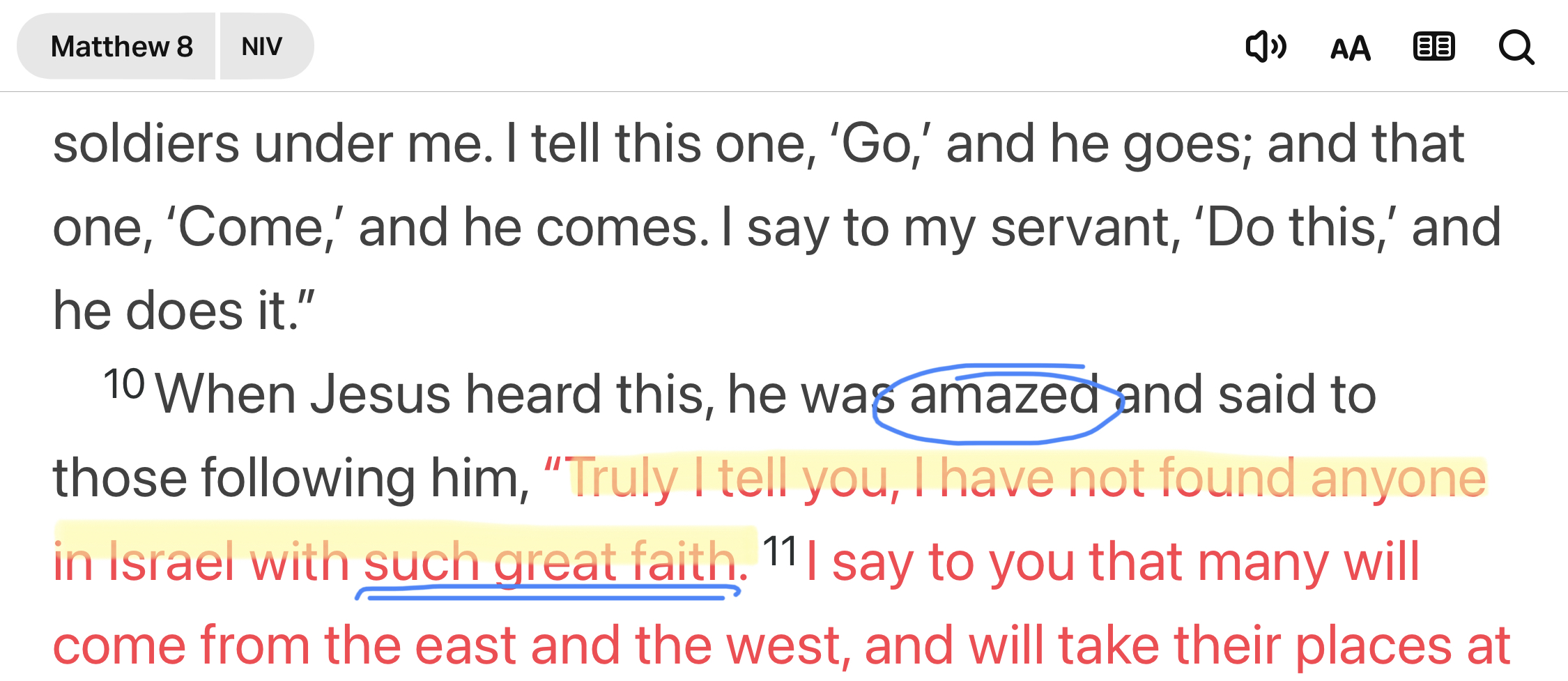
The first time is when a Roman centurion sends a message to Jesus by way of a servant. This centurion asks Jesus to speak a word of healing over another one of his servants. He says that just a word from Jesus will be sufficient, and he doesn’t need Jesus to personally come to his house.
When Jesus heard this, He was amazed. “Turning to those who were following Him, He said, ‘I tell you the truth, I haven’t seen faith like this in all Israel!’” (Matthew 8:10; Luke 7:9).
Because of this centurion’s faith, his servant was immediately healed!
The second time Jesus was amazed was when He was visiting His hometown. There He discovered people with whom He had grown up that refused to believe that He was who He claimed to be. As a result, Jesus “was amazed at their unbelief” (Mark 6:6).
So either Jesus is amazed at our faith in Him, or He is amazed at our unbelief in Him. When I have faith in Jesus—when I believe He is who He says He is, and that He is willing to do what He says He will do—He is amazed at my faith and can do miracles on my behalf. But when I doubt, when I allow my unbelief to seize my heart, I exclude myself from the miracles He wants to do.
Jesus will be amazed at you. Will He be amazed at your faith in Him? Or will He be amazed at your unbelief in His power that is waiting to be released on your behalf? I pray that Jesus will always be amazed at our faith in Him.
Listen to the podcast of this post by clicking on the player below, and you can also subscribe on Apple, Spotify, or Audible.
The word “amazed” shows up numerous times throughout the Gospels, almost always associated with something Jesus said or did. He would heal someone, calm a storm, silence His detractors, or teach persuasively. And the people marveled!
But there are two instances where Jesus Himself is amazed, where the Bible says He marveled at what someone said.
The first is when a centurion asked Jesus for help, but said he didn’t need Jesus to be personally present. He told Jesus that just a word from Him would be more than enough to heal a sick servant. Jesus was amazed at this man’s faith, and as a result, the servant was healed (Matthew 8:10; Luke 7:9)!
The second time that Jesus was amazed was when He was visiting His hometown and the people with whom He grew up didn’t believe He was who He claimed to be. As a result, Jesus was amazed and the Bible says He was unable to do many miracles there (Mark 6:6). How sad!
It’s still true today. Either Jesus will be amazed at our faith or He will be amazed at our unbelief. When we have faith in Him—when we stand amazed and in awe and in expectation of His power—He is amazed and can perform miracles. But when we push Jesus away and say, “We can take care of this ourselves,” Jesus is also amazed. But this type of amazement results in Jesus being unable to unleash His miraculous power on our behalf.
Let’s learn this amazing lesson, and always stand amazed at who Jesus is and what Jesus can do. When we are amazed, and our faith grows stronger, Jesus will be amazed at our faith and will move on our behalf in amazing ways!
Listen to the podcast of this post by clicking on the player below, and you can also subscribe on Apple, Spotify, or Audible.
Last week I mentioned over-dramatic kids complaining, “I’m starving!” Or people with expensive phones complaining about a slow internet connection. We’re really good at expressing what we want, aren’t we? In fact, we’re really good at loudly letting everyone around us know that we want something.
But here’s a good question: Are we just as quick to loudly express our gratitude?
It’s innate human nature to behave this way. No one has to teach a child to express their desires—loudly! But we do have to teach our children to say, “Thank you.” And sometimes it takes even more prompting to get them to say it loud enough for others to hear, and sincere enough for others to believe that they are truly grateful.
So why would we expect it to be any different just because we happen to be older? That’s why we’ve noted that the attitude of gratitude is a great attitude, and it’s also an attitude that makes the grateful person stand out from the crowd.
G.K. Chesterton noted, “In life you can take things one of two ways: you can take them for granted or you can take them with gratitude.” Sadly, it seems that “for granted” is what is typically exhibited. In fact, I think the granted-to-grateful ratio is 10-to-1.
Luke alone tells a story in his Gospel about ten men with leprosy (Luke 17:11-19). All ten lepers had no problem calling out their need for healing “in a loud voice.” And they called out to the right Person, as they called Jesus “Master.” This word shows that they believed He could do something no one else could do. Indeed, Jesus shows His authority over leprosy with just the word, “Go” and “as they went, they were cleansed.”
All ten were quick to loudly express their desire for healing and to call on the authority of Jesus, but only “one of them…came back, praising God in a loud voice.” Both Luke and Jesus affirm that all ten men were cleansed on the outside—their skin no longer showed the ravages of leprosy, but only to the one grateful man did Jesus say, “Your faith has healed and saved you” (v. 19 MSG).
The Greek word here is sōzō. This is the same word used for the eternal salvation that Jesus alone can bring. Check out John 3:17, John 10:9, Acts 2:21, and Romans 10:9. This is better than just physical cleansing, it’s wholeness that lasts for eternity!
E.M. Bounds wrote, “Gratitude and murmuring never abide in the same heart at the same time.” Sadly, the ratio of grumblers-to-praisers is only going grow as we move closer and closer to the end of the age, culminating in people who have the outward appearance of godliness (like the nine cleansed lepers) but ignore the true power of God for salvation (see 2 Timothy 3:1-5).
In this take-everything-for-granted, focus-on-the-outward culture, those 1-in-10 stand out. Those who have gone beyond skin-deep cleaning to soul-deep salvation, and who loudly express their gratitude, are the ones the apostle Paul declares shine brightly and influence those around them (Philippians 2:14-16).
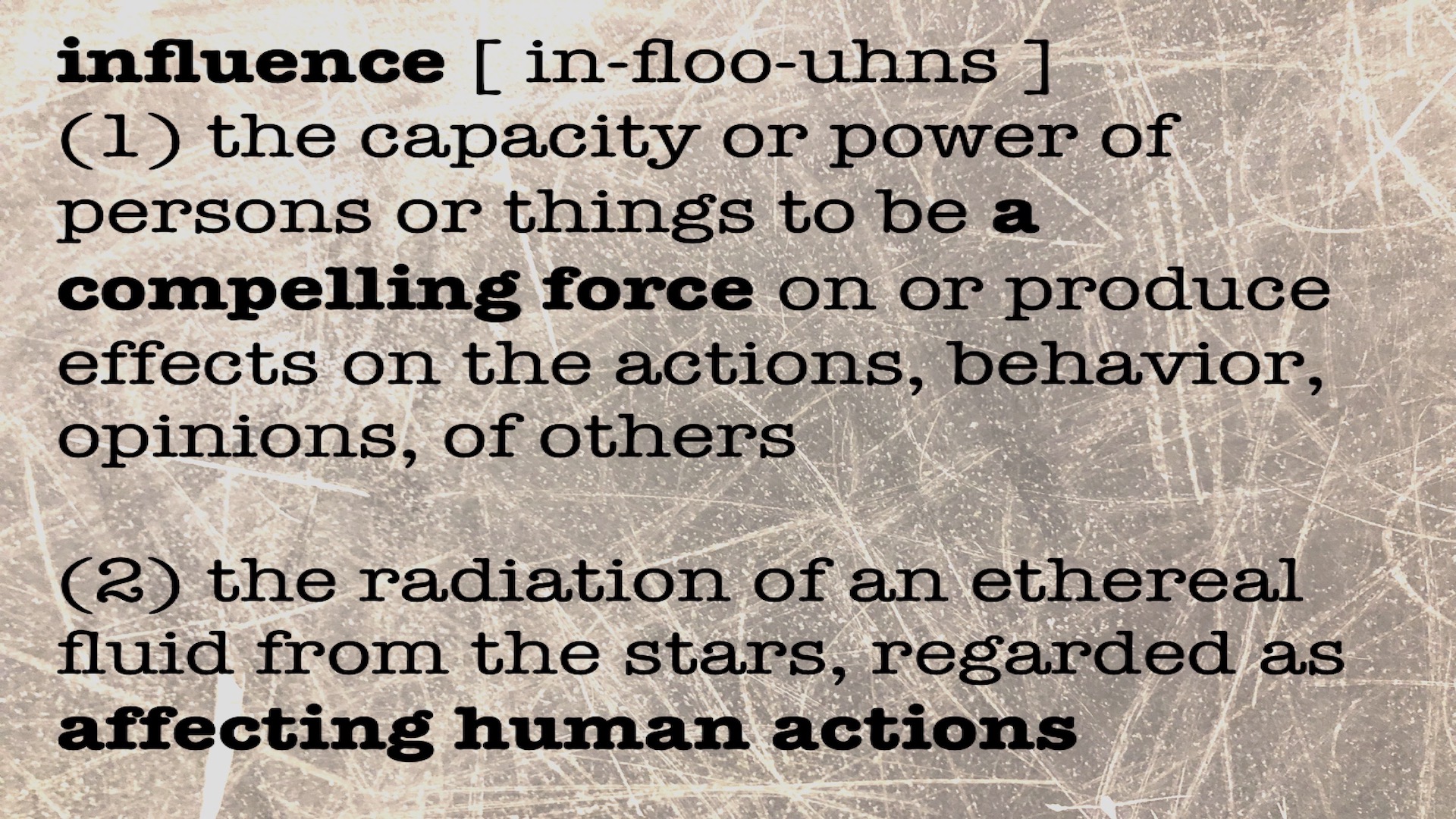
The origin of the word influence comes from a power people thought those bright stars had to affect the lives of humans. So your consistent gratitude is influencing those around you, and giving them a star to chart their course, more consistently than almost anything else you can do.
So shine on! Praise God loudly, quickly, and sincerely for what He has done for you! Be the 1-in-10! And then watch your influence impact everyone who encounters you.
Listen to the podcast of this post by clicking on the player below, and you can also subscribe on Apple, Spotify, or Audible.
Imagine if 700 years before you were born there was a prophecy given about you (Matthew 3:3). Or if on the day of your birth your father said, “And you, my child, will be called a prophet of the Most High; you will go on before the Lord to prepare the way for Him” (Luke 1:76).
This was John the Baptist.
With these kinds of announcements and the stamp of approval from God Himself, it’s really quite astounding how humble John remained:
“After me comes One Who is more powerful than I, Whose sandals I am not worthy to carry” (Matthew 3:11).
“[Jesus] must increase, but I must decrease” (John 3:30).
The confidence that he was God’s man for the hour gave John boldness to speak truth to religious leaders, wealthy people, and Roman soldiers (Matthew 3:7-12; Luke 3:7-20). Yet his humility was almost his undoing.
John preached boldly, fulfilling the prophecies that were made about him. But when Jesus came to him to be baptized, John’s humility caused him to defer initially. Then Jesus reminded him that His baptism was necessary “to fulfill all righteousness. Then John consented” (Matthew 3:13-15).
Whether I am lacking confidence to speak or lead boldly, or lacking humility to let someone else take the lead, I need to return to the Word of God—just as John did. Both his confidence and his humility were balanced by words spoken over him by God. So it must be for you and me too.
Confidence without humility or humility without confidence can trip me up and cause me to miss out on all that God needs me to do. So my daily prayer must be: Holy Spirit, may I be sensitive to every correction and adjustment You need to make in me. Illuminate the Scriptures that I need to apply to my life that will keep me in a healthy, balanced place.
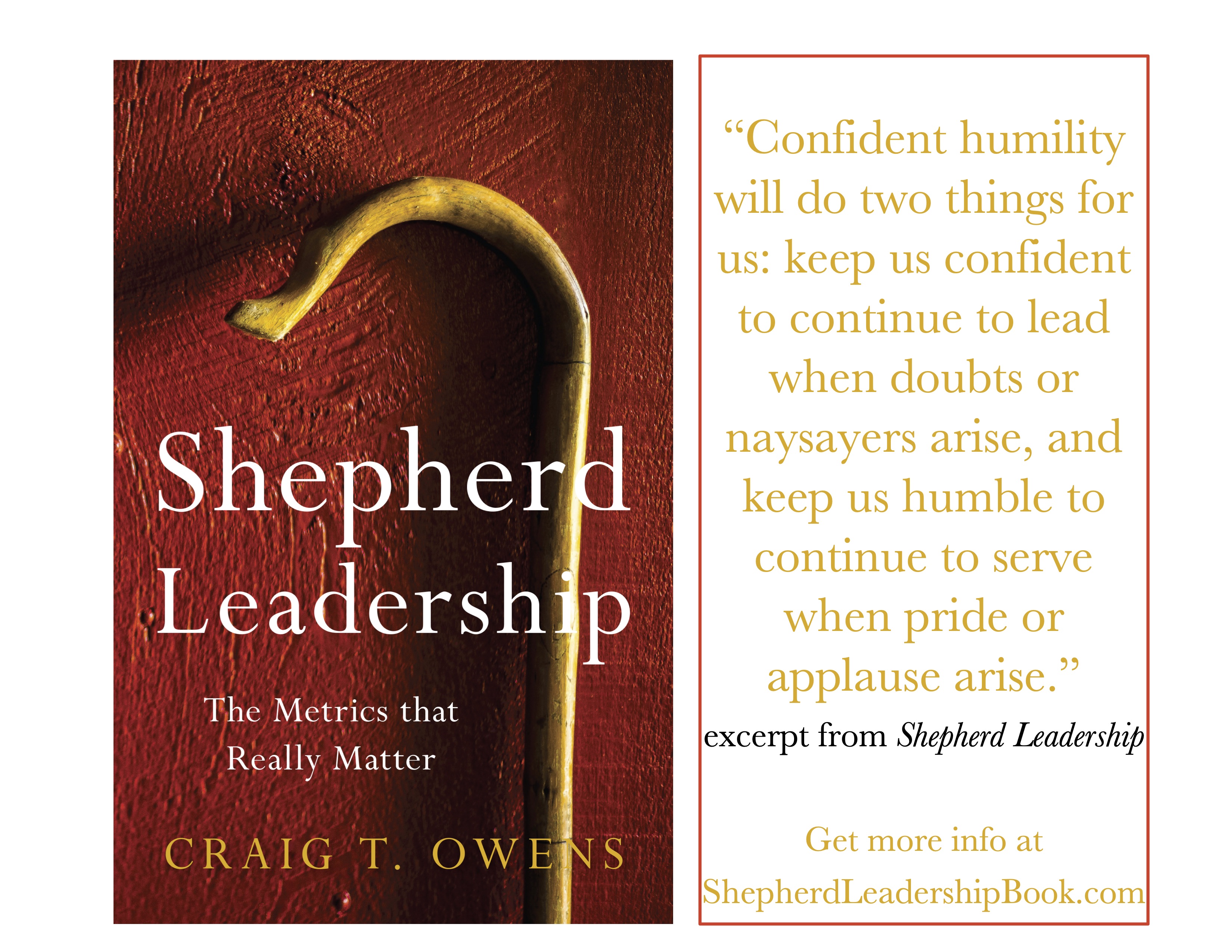
I wrote about this tension between confidence and humility in my book Shepherd Leadership. This was also a topic of conversation in two interviews I did, which you can find here and here. Healthy leaders need the proper balance of confidence and humility to keep their leadership in a place that God can use powerfully.



 I don’t think there is any arguing that Jesus was the healthiest individual who ever walked planet Earth. Some may want to push back with, “Of course He was because He didn’t have any problems to deal with!”








 Craig T. Owens