Poetry Saturday—My Heart Is Resting

Listen to the podcast of this post by clicking on the player below, and you can also subscribe on AppleSpotify, or Audible.

My heart is resting, O my God—
I will give thanks and sing;
My heart is at the secret source
Of every precious thing.
Now the frail vessel Thou hast made
No hand but Thine shall fill
For the waters of the Earth have failed,
And I am thirsty still.

I thirst for springs of heavenly life,
And here all day they rise—
I seek the treasure of Thy love,
And close at hand it lies.
And a new song is in my mouth
To long-loved music set
Glory to Thee for all the grace
I have not tasted yet.

Glory to Thee for strength withheld,
For want and weakness known—
And the fear that sends me to Thy breast
For what is most my own.
I have a heritage of joy
That yet I must not see;
But the hand that bled to make it mine
Is keeping it for me.

There is a certainty of love
That sets my heart at rest—
A calm assurance for today
That to be poor is best—
A prayer reposing on His truth
Who hath made all things mine,
That draws my captive will to Him,
And makes it one with Thine.

I will give thanks for suffering now,
For want and toil and loss—
For the death that sin makes hard and slow,
Upon my Savior’s Cross—
Thanks for the little spring of love
That gives me strength to say,
If they will leave me part in Him,
Let all things pass away.

Sometimes I long for promised bliss,
But it will not come too late—
And the songs of patient spirits rise
From the place wherein I wait;
While in the faith that makes no haste
My soul has time to see
A kneeling host of Thy redeemed,
In fellowship with me.

There is a multitude around
Responsive to my prayer;
I hear the voice of my desire
Resounding everywhere.
But the earnest of eternal joy,
In every prayer I trace;
I see the glory of the Lord:
On every chastened face.

How oft, in still communion known,
Those spirits have been sent
To share the travail of my soul,
Or show me what it meant!
And I long to do some work of love
No spoiling hand could touch,
For the poor and suffering of Thy flock
Who comfort me so much.

But the yearning thought is mingled now
With the thankful song I sing;
For Thy people know the secret source
Of every precious thing.
The heart that ministers for Thee
In Thy own work will rest;
And the subject spirit of a child
Can serve Thy children best.

Mine be the reverent, listening love,
That waits all day on Thee,
With the service of a watchful heart
Which no one else can see—
The faith that, in a hidden way
No other eye may know,
Finds all its daily work prepared,
And loves to have it so.

My heart is resting, O my God,
My heart is in Thy care
I hear the voice of joy and health
Resounding everywhere.
“Thou art my portion,” saith my soul,
Ten thousand voices say,
And the music of their glad Amen,
Will never die away. —Anna Laetitia Waring


Poetry Saturday—Clasping Of Hands

Listen to the podcast of this post by clicking on the player below, and you can also subscribe on AppleSpotify, or Audible.

Lord, Thou art mine, and I am Thine,
If mine I am: and Thine much more,
Then I or ought, or can be mine.
Yet to be Thine, doth me restore;
So that again I now am mine,
And with advantage mine the more,
Since this being mine, brings with it Thine,
And Thou with me dost Thee restore.
         If I without Thee would be mine,
         I neither should be mine nor Thine.

Lord, I am Thine, and Thou art mine:
So mine Thou art, that something more
I may presume Thee mine, then Thine.
For Thou didst suffer to restore
Not Thee, but me, and to be mine,
And with advantage mine the more,
Since Thou in death wast none of Thine,
Yet then as mine didst me restore.
         O be mine still! still make me Thine!
         Or rather make no Thine and Mine! —George Herbert


Thursdays With Spurgeon—Present Communion With Jesus

This is a weekly series with things I’m reading and pondering from Charles Spurgeon. You can read the original seed thought here, or type “Thursdays With Spurgeon” in the search box to read more entries.

Listen to the podcast of this post by clicking on the player below, and you can also subscribe on iTunes or Spotify.

Present Communion With Jesus

     The desire of a renewed soul is to find Christ and to be with Him. … Past communion with Christ is very well: ‘Therefore I will remember Thee from the land of Jordan…’ (Psalm 42:6). But these are only stale meats, and a loving soul wants fresh food every day from the table of Christ. … 

     A true loving soul, then, wants present communion with Christ. So the question is, ‘Tell me where You feed. Where do You get Your comfort from, O Jesus? I will go there. … Where do You feed Your flock? In Your house? I will go there, if I may find You there. In private prayer? Then I will not be slack in that. In the Word? Then I will read it night and day. Tell me where You feed; wherever You stand as the Shepherd, there will I be, for I want You. I cannot be satisfied to be apart from You. My soul hungers and thirsts to be with You.’

From The Church’s Love To Her Loving Lord

There are so many pictures in the Bible about our continual reliance on God’s presence—from the manna that was only good for each day, to Jesus teaching us to pray for “our daily bread,” to the vivid example of Christians being as dependent on Jesus as a branch is dependent on the vine (see Exodus 16:4-5, 14-17; Matthew 6:11; John 15:1-8).  

All of these mean that we need to constantly abide with our Savior. 

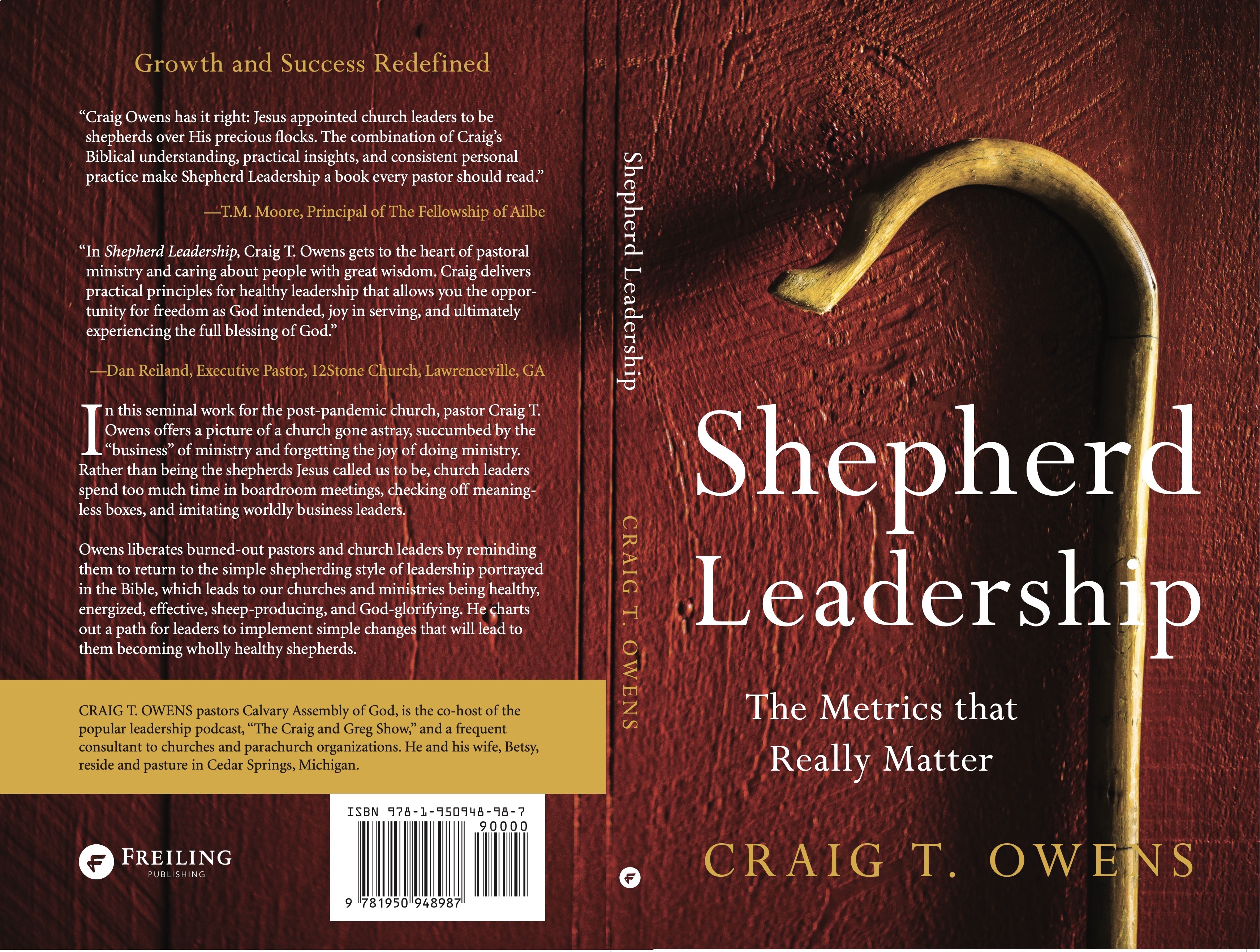
In my book Shepherd Leadership: The Metrics That Really Matter, I spend two chapters talking to leaders about the need to rest—or sabbath. In fact, I call it sabbathing to give it the emphasis on the ongoing nature of this activity. I wrote—

“Without building in sabbath breaks, we run down emotionally, spiritually, mentally, and physically, which means loving God becomes a chore, not a delight (Mark 12:30). This then means loving your neighbor becomes nearly impossible (Mark 12:31). Ultimately, this means that we aren’t able to be the compassionate, wise, strong shepherds that the sheep under our care need us to be. … 

“The goal of sabbathing is to infuse more vitality into the shepherd leader for the purpose of pasturing the sheep under that leader’s care. You cannot give hope to others unless you are hope-filled; you cannot give health to others unless you are healthy; you cannot consistently speak wisdom to others unless you are growing in wisdom. All of this healthy growth for the shepherd leader takes place while sabbathing….” 

To reiterate what Pastor Spurgeon said: “A true loving soul, then, wants present communion with Christ.” I hope you will always seek that for yourself.

►► Would you please prayerfully consider supporting this ministry? ◀︎◀︎

Abiding In God’s Omnipresence

Listen to the podcast of this post by clicking on the player below, and you can also subscribe on AppleSpotify, or Audible. 

Why do Christians say things like, “Let’s go to church” or “Let’s go meet with God”? 

Do we forget that Jesus said He would never leave us, or that He sent the Holy Spirit to be our constant Companion, or that our very heart is the temple of God’s presence (Matthew 28:20; John 14:16; 1 Corinthians 3:16)? We are naturally self-focused creatures. It takes discipline on our part to keep reminding and re-reminding ourselves that God is always with us. 

Psalm 84 and its two Selahs is one way of re-reminding ourselves of God’s abiding presence. The Selahs are reminders to pause and consider, “Where am I?” and to know that the answer can always be, “Surely I am in God’s presence!” 

This psalm is divided into three 4-verse stanzas. Stanzas 1 and 2 end with the call to Selah, and all three stanzas feature a powerful name for God: LORD Almighty. When we see LORD in all capital letters, that is God’s covenant name: Yahweh or Jehovah, which means that He is the “I AM that I AM.” Almighty signifies that He is the invincible, un-defeatable Captain of angel armies. 

In these two combined titles, we have the personal intimate God of love and the unstoppable God of limitless power! If He were just the God of love, we may not be able to trust His power. If He were just the God of power, we may not be able to approach Him. He is the All-Loving, Ever-Approachable Power. 

Another important recurring theme in Psalm 84 is the word blessed. It’s used three times in this psalm, more than in any other single psalm. This word means God’s unmerited favor, and the word either begins or ends each of the three stanzas.  

In stanza 1 (vv. 1-4), twice we have that combined title of LORD Almighty. But we must always remember that our God is not distant and unapproachable, but the sons of Korah call Him “my King” and “my God.” At the end of this first stanza, we are invited to Selah—a pause to praise our glorious King! 

Stanza 2 (vv. 5-8) begins with that reminder that we are blessed. The psalmists tell us that God’s blessings flow even in my Valley of Baca (or weeping). With God’s presence surrounding me, I can go fromstrength to strength” because the LORD Almighty hears my prayer and responds to my prayer! So at the end of this stanza, we are again invited to Selah—this time it’s a pause to pray to our listening God. 

In stanza 3 (vv. 9-12), another important word is featured that reminds us that our God is not a stingy King, but One who delights in His children and wants to lavishes them with His blessings: the word is favor. We read, “look with favor on Your anointed one” and “the LORD bestows favor and honor; no good thing does He withhold from those whose walk is blameless.” God’s favorable blessings flow toward us as eternally as He exists! 

This psalm is circular: it begins as it ends, so it invites us to continue to praise, continue to pray, and continue to abide in His presence. We’re called not just to know about God’s presence, but to rejoice in His presence. 

It’s one thing to know about God’s omnipresence, but it’s an entirely different thing to abide in God’s omnipresence! 

This isn’t something that happens overnight. Brother Lawrence reminds us that this is a progressive revelation for Christians: “One does not become holy all at once. … The more one knows Him, the more one desires to know Him. And as knowledge is commonly the measure of love, the deeper and more extensive our knowledge shall be, the greater will be our love: and if our love of God were great we should love Him equally in pains and pleasures.” 

I encourage you to Selah frequently so that you can move from mere head knowledge of God’s presence to becoming intimately aware of His closeness! 

If you’ve missed any of the messages in our series looking at the Selahs in the Psalms, you may find the full list by clicking here. 

►► Would you please prayerfully consider supporting this ministry? ◀︎◀︎

Poetry Saturday—Sun Of My Soul

Listen to the podcast of this post by clicking on the player below, and you can also subscribe on AppleSpotify, or Audible.

Sun of my soul, Thou Savior dear,
It is not night if Thou be near;
Oh, may no earthborn cloud arise
To hide Thee from Thy servant’s eyes.

When the soft dews of kindly sleep
My wearied eyelids gently steep,
Be my last thought of how sweet to rest
Forever on my Savior’s breast.

Abide with me from morn till eve,
For without Thee I cannot live;
Abide with me when night is nigh,
For without Thee I dare not die.

Come near, and bless us when we wake,
Ere through the world our way we take;
Till in the ocean of Thy love
We lose ourselves in Thee above. —John Keble

►► Would you please prayerfully consider supporting this ministry? ◀︎◀︎

Poetry Saturday—Why Art Thou Weary?

Listen to the podcast of this post by clicking on the player below, and you can also subscribe on AppleSpotify, or Audible.

Sad heart, why art thou weary
With anxious strivings drear?
Thou hast no cause for sadness,
No cause for restless fear.
Thou longest for thy Master,
Then cease and be at rest;
For shall not He who made thee
Know what for thee is best? —Oswald Chambers

►► Would you please prayerfully consider supporting this ministry? ◀︎◀︎

Poetry Saturday—Affliction IV

Listen to the podcast of this post by clicking on the player below, and you can also subscribe on Apple or Spotify.

Broken in pieces all asunder,
                      Lord, hunt me not,
                     A thing forgot,
Once a poore creature, now a wonder,
               A wonder tortur’d in the space
               Betwixt this world and that of grace.

My thoughts are all a case of knives,
                     Wounding my heart
                     With scatter’d smart,
As watring pots give flowers their lives.
               Nothing their furie can controll,
               While they do wound and prick my soul.

All my attendants are at strife,
                     Quitting their place
                     Unto my face:
Nothing performs the task of life:
               The elements are let loose to fight,
               And while I live, trie out their right.

Oh help, my God! let not their plot
                     Kill them and me,
                     And also Thee,
Who art my life: dissolve the knot,
               As the sunne scatters by his light
               All the rebellions of the night.

Then shall those powers, which work for grief,
                     Enter Thy pay,
                     And day by day
Labour Thy praise, and my relief;
               With care and courage building me,
                Till I reach heav’n, and much more, Thee. —George Herbert (**spelling is 1663 English**)

►► Would you please prayerfully consider supporting this ministry? ◀︎◀︎

Zeal For God

Listen to the podcast of this post by clicking on the player below, and you can also subscribe on Apple or Spotify.

For zeal for Your house consumes me, and the insults of those who insult You fall on me (Psalm 69:9). 

David said this about 1000 years before Jesus lived it out. 

David was uncomfortable with the spiritual status quo that had seemed to descend on him and the people around him. He desperately wanted to stoke the passion of his heart to burn hot for God again. So he prayed, he fasted, he abased himself, he cried out to God. Zeal for God consumed David! 

Jesus wanted all people everywhere to come into His Father’s presence. So when Jesus saw His Father’s house overrun by merchants, effectively keeping people away from the closeness that David and others longed for, He went into action. Zeal for God consumed Jesus! 

In both of them we see a passion for God that moved them to action, but action that also aroused the anger of those who preferred the passivity of “religious activity” to the realness of God’s presence. Both David and Jesus became the targets of insults, scorn, and mockery. 

Just as Jesus would announce 1000 years later, David expressed the same motivation that prompted his zealous action: God’s glory—

  • may those who hope in You not be disgraced because of me
  • may those who seek You not be put to shame because of me
  • may Your salvation protect me 

Zeal for a real closeness to God’s presence is rare.

Zeal for that intimacy upsets hypocrites. 

Zeal for God empowers others who aren’t satisfied with merely playing at religion. 

Zeal for God glorifies God. 

And most importantly: Zeal for God pleases God! 

When you see play actors and religionists blocking hungry seekers from coming closer to God, I pray that your zeal, too, burns white hot. Be prepared to be the target of scorn, but know that God’s smile on your zeal for Him far outweighs their insults. 

►► Would you please prayerfully consider supporting this ministry? ◀︎◀︎

The Sin Of Man, The Salvation Of Jesus

Listen to the podcast of this post by clicking on the player below, and you can also subscribe on Apple or Spotify.

“Jesus is risen indeed!” This is the glorious good news that Christians around the world celebrate. 

But good news is really only good news when you fully realize how bad the bad news was. Like when the doctor comes in to tell you, “You’re going to be fine,” and you breathe a sigh of relief. And then the doctor goes on to explain what your condition was and all of the heroic efforts that were undertaken on your behalf, and you realize how close to death you actually were that your sigh of relief turns into a shout of joy! 

The resurrection of Jesus is the good news that brings us eternal life. But instead of merely breathing a sigh of relief thinking, “I shall not perish but have everlasting life,” let’s take a look at how close we were to everlasting death. 

Our fourth foundational belief says: “Man was created good and upright…. However, man by voluntary transgression fell and thereby incurred not only physical death but also spiritual death, which is separation from God.” 

Adam and Eve were given a choice: they were able not to sin and they were able to sin. God gave them dominion over everything in His creation but themselves, and He made them to be personally and intimately connected with Himself. But satan tempted them to take dominion over themselves, saying that they would become like God.

They sinned. “And sure enough, they then had knowledge of good and evil, but it was from the standpoint of becoming evil and remembering how good they once were,” said Nancy Guthrie. Because they sinned, now all of us are unable not to sin. Why? Because no one has been able to demonstrate to us how to be able not to sin. 

Their sin had consequences for them that have extended to us:

  • they felt shame at their vulnerability before God
  • they were fearful to be in God’s presence 
  • they were separated from God  
  • and they doomed all of us to live an utterly meaningless existence forever! 

But Adam and Eve’s sin didn’t send God scrambling for a remedy. Our fifth foundational truth says: “Man’s only hope of redemption is through the shed blood of Jesus Christ the Son of God.” 

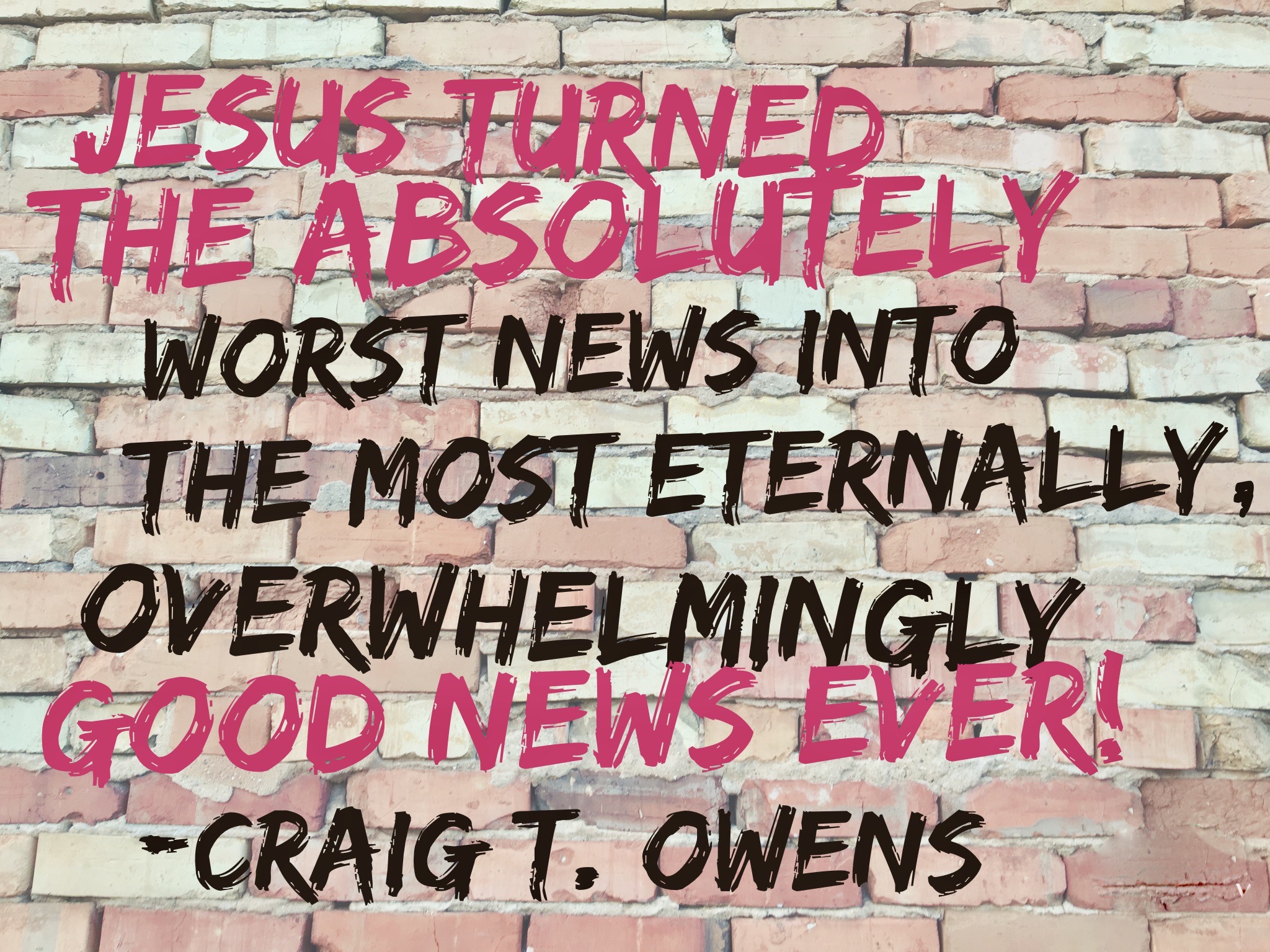
Jesus turned the absolutely worst news into the most eternally, overwhelmingly good news ever! 

Jesus was made the cure for sin from before the foundation of the world. God made Jesus to be our sin (not just to carry our sins). In order for this to happen, Jesus had to become human like us. That means that Jesus, like Adam and Eve, had the same choice to sin or to not sin but He did not sin. This allowed Him to be our perfect sacrifice on the Cross. 

When He died on the Cross, Jesus removed the uncrossable abyss between us and God. Jesus made it possible once again for us to be able not to sin. Not only that, but Jesus covers the shame that would linger even after our sin is forgiven by clothing us in His own righteousness! 

(check out all of the biblical references for the above points by clicking here)

Sin had us doomed to not only a meaningless existence on earth, but also to an utterly meaningless existence for the eternity following death. Jesus became our sin to allow us to be reunited with God and reclothed in Christ’s righteousness. This is not just good news, it’s eternally, overwhelmingly good news! 

If you’ve missed the discussion of any of our other foundational truths, you may access the full list by clicking here.

►► Would you please prayerfully consider supporting this ministry? ◀︎◀︎

The Mercyseat

Listen to the podcast of this post by clicking on the player below, and you can also subscribe on Apple or Spotify.

Hear my cry for mercy … He has heard my cry for mercy (Psalm 28:2, 6).

For David, his cry for mercy was never a one-and-done action. The verb in verse 2 makes this verse read more like, “Hear my cry for mercy as I am continually calling to You for help, as I am continually lifting up my hands toward Your Most Holy Place.” 

Why the Most Holy Place? What was there? Inside the Most Holy Place was the ark of the covenant of the Lord which represented the presence of God. 

What was on top of the ark of the covenant, covering and superseding the Law that was inside the ark? It was the mercyseat (or the “atonement cover” in some translations). The mercyseat is where the high priest sprinkled the blood of the sacrificial lamb every year to make atonement for sins.

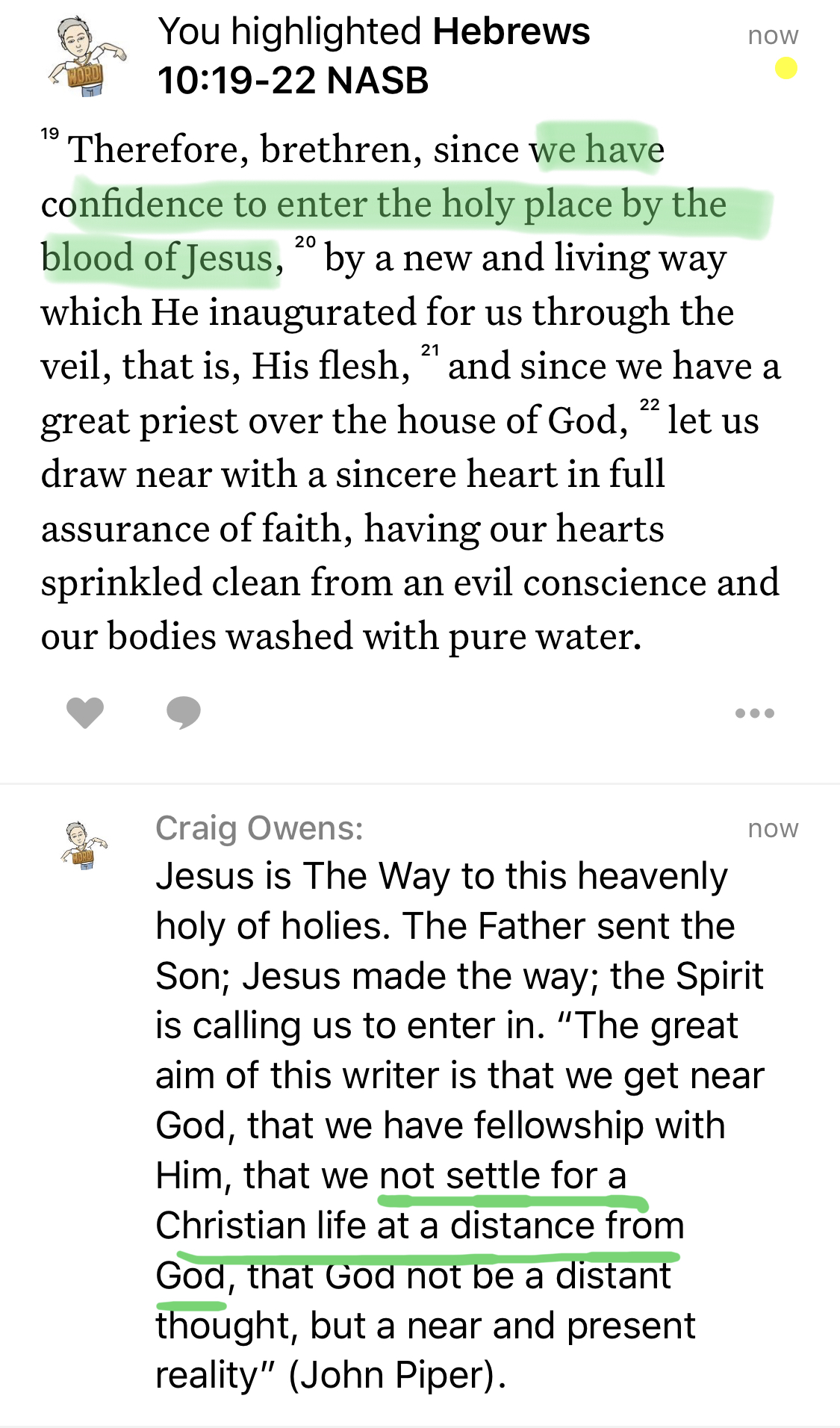
Jesus became the once-for-all sacrificial Lamb to make ultimate atonement for all who would believe in Him. When Jesus had finished His work on the Cross, the curtain separating us from the Most Holy Place was torn in two. The ark of the covenant of the Lord with its covering mercyseat—the presence of God—was now accessible to all of us! It was accessible because it was in Jesus, and when I have taken Jesus as my atonement, He is in me and He takes me in to the Father. The mercyseat of my heart has been sprinkled with the blood of the Lamb (see Hebrews 9:1-5, 11-14; 10:19-22). 

Whether David was saying, “Hear my cry,” or “He has heard my cry,” the Hebrew word means to listen with interest and full attention. Whenever you pray, God listens to you with interest and full attention because you are praying right in His presence! Your very breath can be a continual crying, a continual lifting of your voice toward the mercyseat where God meets with you! 

God is not far away from us. He is closer than we usually think. That’s why David says, “My heart leaps for joy, and with my song I praise Him”! 

Keep this in mind the next time you are asking God to hear your cry: He listens to you with full attention because Jesus has taken you right into His presence.

Would you please prayerfully consider supporting this ministry?