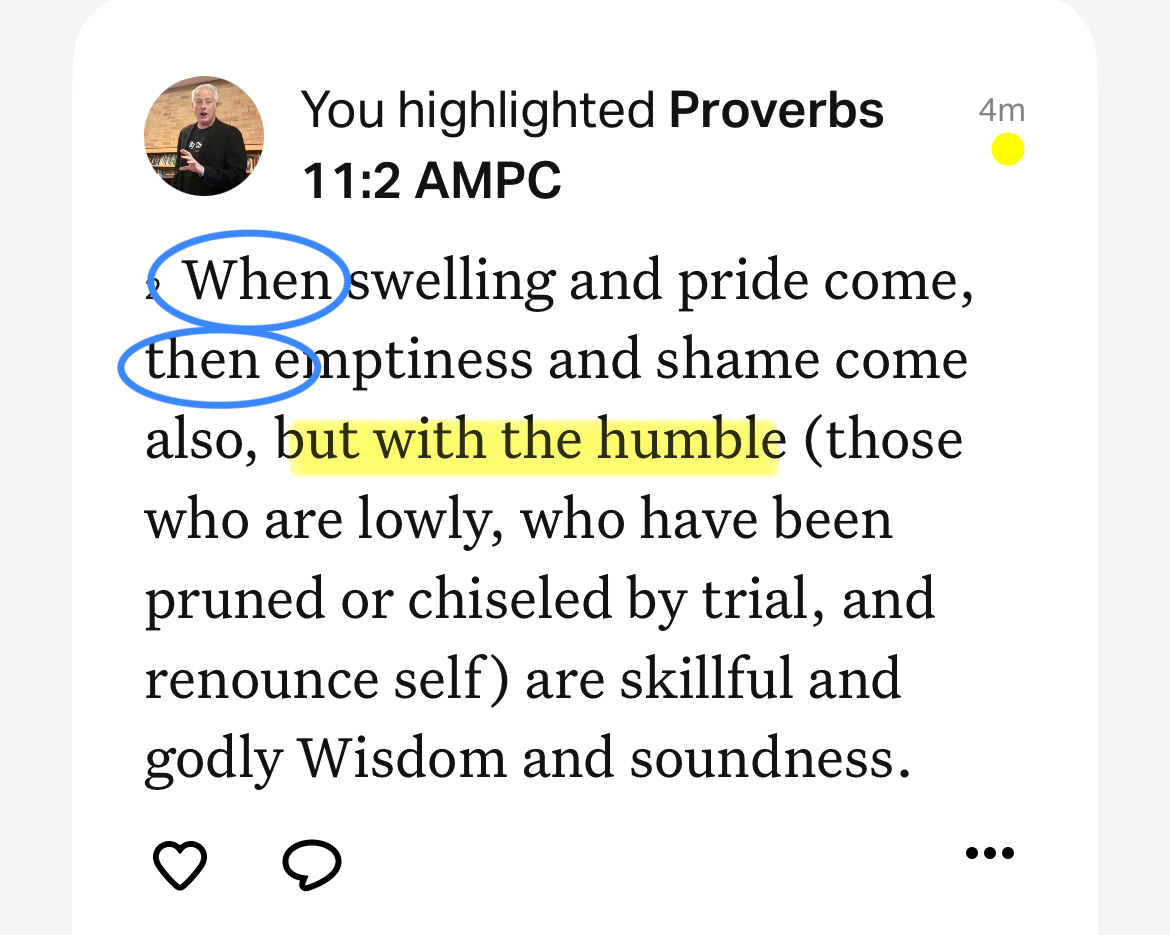
When swelling and pride come, then emptiness and shame come also, but with the humble (those who are lowly, who have been pruned or chiseled by trial, and renounce self) are skillful and godly Wisdom and soundness. (Proverbs 11:2 AMPC)
The pruning, trials, and discipline the Lord allows us to experience are for an important purpose: To allow ourselves to be emptied of ourselves. This humility that empties us of ourselves makes room for us to be full of the presence of God.
On the other hand, remaining full of yourself—also called “pride”—will also bring an emptiness. But this emptiness comes with shame and is absent of God’s fulfilling presence.
You and I must choose one or the other: humility before God or pride in ourselves.
Listen to the podcast of this post by clicking on the player below, and you can also subscribe on Apple, Spotify, or Audible.
Last week I shared this thought with you from Pastor Tim Keller: “Your prayer must be firmly connected to and grounded in your reading of the Word. This wedding of Bible and prayer anchors your life down in the real God. … Without immersion in God’s words, our prayers may not be merely limited and shallow but also untethered from reality.”
“Untethered from reality” means that we determine the manner in which we come to God in prayer, the way prayer works, and the way God must respond to our prayer. But what we read in the Bible is the opposite of this (Isaiah 1:11-15).
I think there are two opposite and equal erroneous thoughts about how we approach prayer:
I’m not worthy to come into the presence of an all-holy God
I can waltz right into God’s presence whenever and however I please
Both are wrong and both are strategies the devil has used to keep us prayerless. Either we don’t go to God at all or our prayers are unheard because the Bible says that our arrogance has made our prayer ineffectual.
Our Prayer Book—the Bible—helps us find the balance. George Whitefield noted, “Reading the Bible is a good preparative for prayer, as prayer is an excellent means to render reading effectual.” So here’s what we read about those two errors.
I’m not worthy. God is unapproachable in His holiness, but Jesus has made it possible for us to enter in through His righteousness (1 Timothy 6:15-16; Isaiah 6:1-5; Hebrews 4:1, 14, 16; John 16:23-24).
I can come anyway I want to. Passages like Psalm 15:1-5 and Isaiah 58:2-4 make it clear that we cannot simply approach God in a way of our choosing.
Let’s unpack that second error a little more. We have to be clothed in righteousness in order to come into God’s presence, but we cannot be clothed in a righteousness that is apart from Jesus. When we say that we are praying in the name of Jesus, it means we are praying in the nature of Jesus and through the righteousness of Jesus. We must be wearing His righteous robe (Romans 3:22-24; Isaiah 61:10).
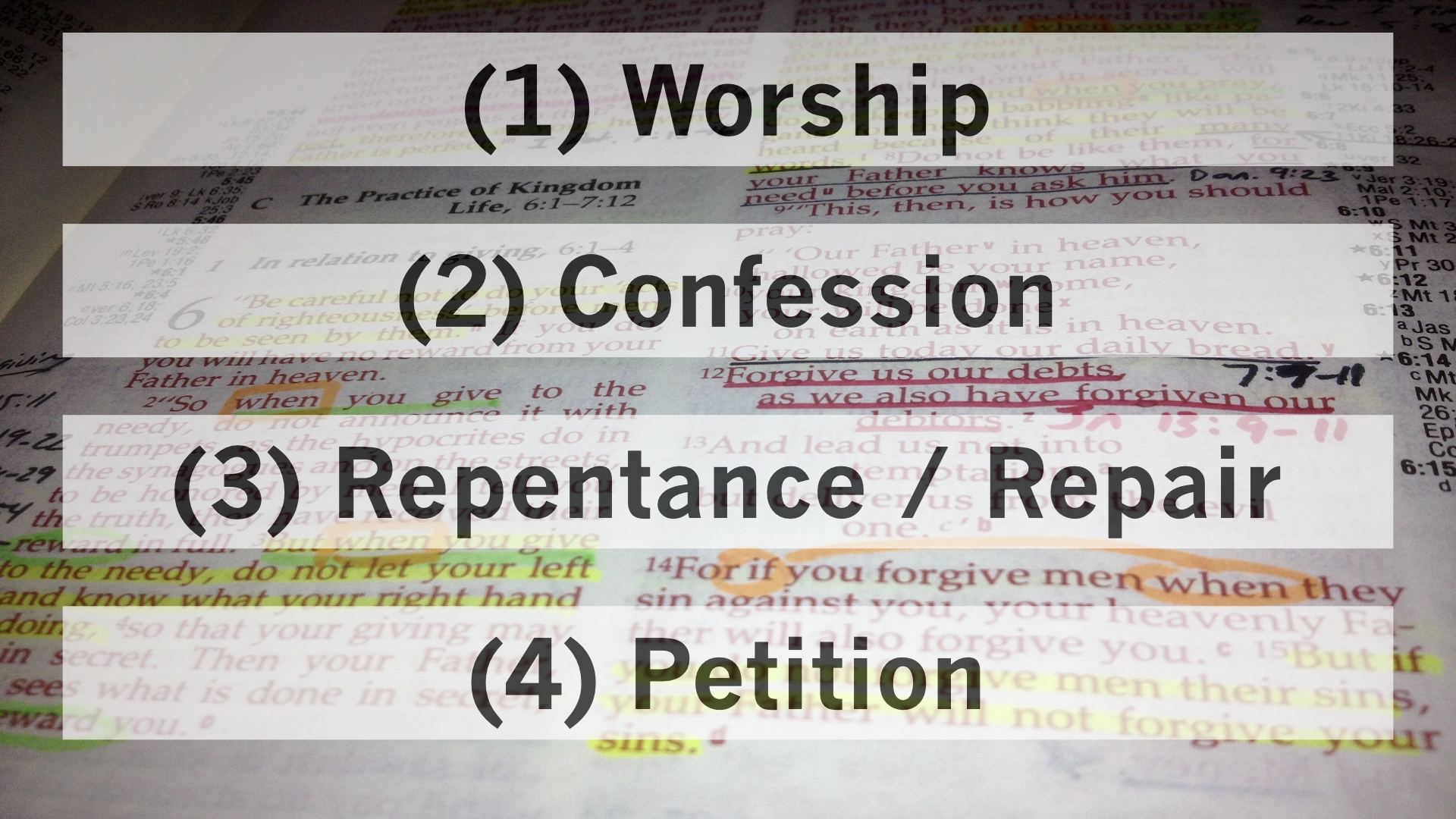
So I think we need to pray before we pray. Let’s try these actions which are tethered to the reality of our Prayer Book.
Worship. This is a deep pondering of who God is; it is humbly assigning Him the highest worth. In face, the Old English spelling of this word (“worthship”) gives us insight into what worship does. It is this kind of humility that God responds to (Isaiah 6:5-7; 57:15; Luke 18:9-14).
Confession. As we are worshiping, we will see our inadequacies (much like Isaiah did in Isaiah 6, or the tax collector did in Luke 18). We then need to confession these shortcomings. Dick Brogden wrote, “Confessed sin opens the portals of heaven into our darkness, and light and glory overwhelm shame. Confession is our glory for it lifts our heads and eradicates shame.” We see this so vividly lived out in the prayers of David (Psalm 139:23-24; 51:1-2; 19:12-14).
Repentance. I think we could also call this Repair. After confession where we have fallen short, we resolve now to both take a different path and repair what was damaged (Matthew 5:23-24; Mark 11:25-26; 1 Peter 3:7).
Petition. After worship, confession, and repentance / repair, our heart’s attitude is now in the place for God to heed our cries for His help (1 Peter 3:12).
Let’s learn to pray before we pray. Don’t just rush in and rush out of God’s presence. Take time to worship, confession any sins the Holy Spirit reveals, make things right, and then present your petitions.
Our hearts need to be prepared to present our petitions. This is how we know that God will hear our voice.
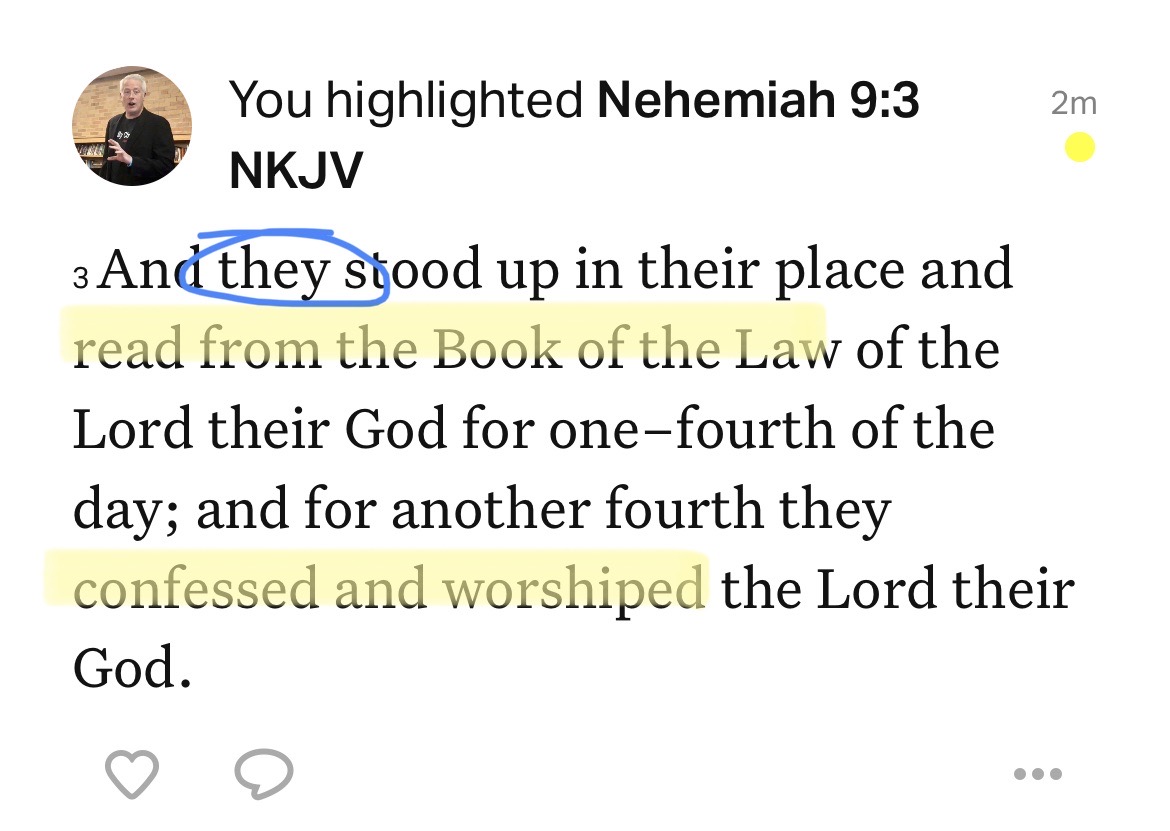
And they stood up in their place and read from the Book of the Law of the Lord their God for one-fourth of the day; and for another fourth they confessed and worshiped the Lord their God. (Nehemiah 9:3)
I have three takeaways from this verse—
(1) When we read God’s Word, the Holy Spirit illuminates it to us. Confession and worship should be normal responses to the Word and the Spirit.
Answer me when I call, God of my righteousness! You have relieved me in my distress; be gracious to me and hear my prayer. … But know that the Lord has set apart the godly person for Himself; the Lord hears when I call to Him. (Psalm 4:1, 3)
I can’t come into God’s presence in my own strength. But when I am clothed in the righteousness of Jesus, the distress of my sin is relieved and I am joyfully welcomed into the awesome presence of my Heavenly Father! He longs to hear my voice, and He loves to be gracious to me!
I cry out with my voice to the Lord; with my voice I implore the Lord for compassion. I pour out my complaint before Him; I declare my trouble before Him. (Psalm 142:2)
David knew the release and healing that would come after he poured out his complaint in God’s presence. The injuries others have done to us afflict our thoughts and emotions, and we need a safe place to get that poison out of our mind and heart.
God’s presence is that safe place, that healing place.
We are to love the sinner but hate the sin. This is hard to do, especially when the sin they are doing is directed at us and making us angry! Jesus gave us a great example in these times of high anger: withdraw. Check out my full message “A Christlike Response to Skeptics.” I have lots of new content every week, which you can check out on my YouTube channel.
“In many pagan religions the purpose of worship is to placate the gods—to keep them happy and to stay on their good side, lest they mess with, you know, the harvest or procreation or whatever. Worship is thus a work pagans do to earn or keep the favor of their deity. Christians don’t worship to placate God or earn His favor. We don’t worship to make God happy or bring Him pleasure. God is all-satisfied, all-happy, and all-pleased in Himself alone. We add nothing to Him when we come together to worship. At the same time, as we worship, God adds Himself to us. He deigns to commune with us, inhabits our praises, and brings us into His presence and joy in ways that transform all we are, think, feel, value, say, and do. … In worship, rightly conceived and conducted, our minds and imaginations expand beyond their everyday thoughts and dreams, stretched and molded to fill up with the glory of the heavenly throne room, to be conformed to the mind of Christ, and to see the world as He does (1 Corinthians 2:16).” —T.M. Moore
J. Warner Wallace shares two reasons why we can still consider the Bible relevant today.
My grandpa had honey bees on his farm, and I’ve been intrigued by them ever since that time. In fact, honey bees were subject of my semester-long research project in my ecology class. So I’m always fascinated to read more discoveries about these amazing insects!
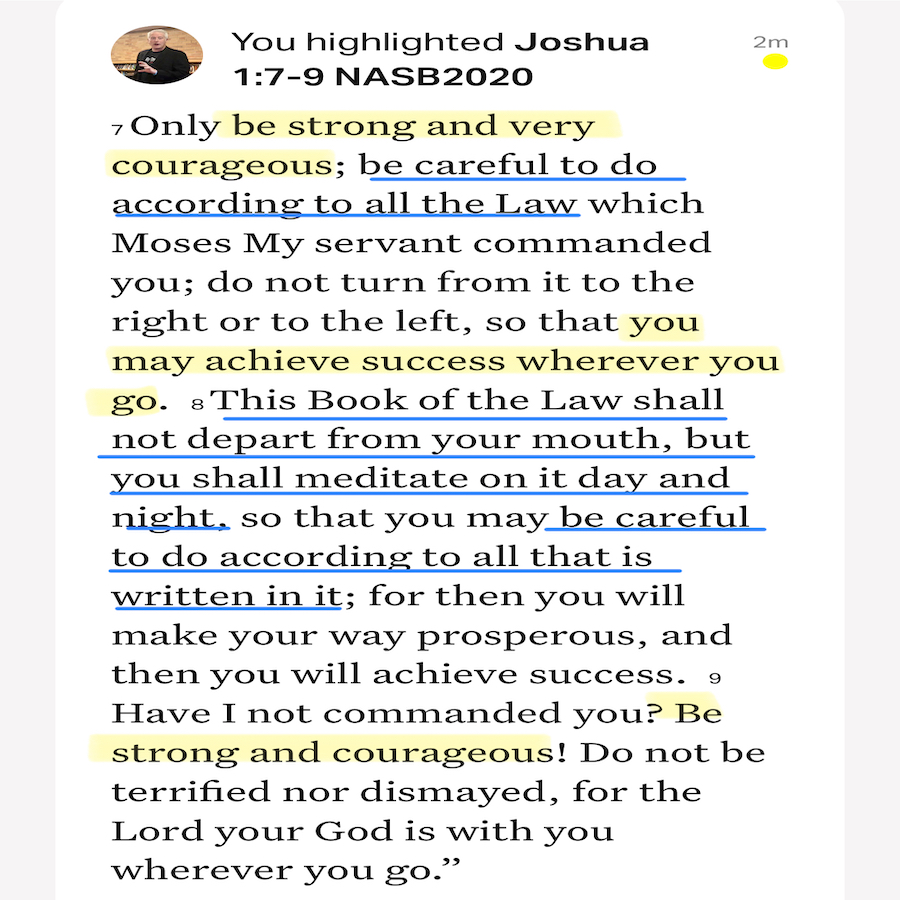
The level of a leader’s strength and courage is directly tied to the leader’s meditation upon God’s word. God’s wisdom transforms a leader’s heart and sharpens his thoughts. This is what gives the leader the necessary courage to lead people in a God-honoring way. I have a whole series of posts on godly leadership where I expand more on these thoughts.
Listen to the podcast of this post by clicking on the player below, and you can also subscribe on Apple, Spotify, or Audible.
I think it’s safe to say that most of us would feel much more secure if we knew exactly where life was taking us. That way, perhaps we could be ready for what lies ahead. It would certainly help to decrease our anxiety if we knew we were ready for what was coming next.
In Luke 19, Jesus is on the path toward Jerusalem and Calvary. And in just a 5-verse section, the word “ahead” is used three times.
First, we read that Jesus “went on ahead” toward Jerusalem (v. 28). He knew exactly what was awaiting Him there; in fact, He had told His disciples numerous times the precise details of what was ahead. Even though His experience was going to be excruciating, for the joy that was even further ahead (see Hebrews 12:2), Jesus persevered.
Next we read that Jesus sent two of His disciples “to the village ahead of you” to retrieve the donkey colt that was awaiting Him (v. 30). What is unspoken here is that Jesus had obviously spoken to the colt’s owners aheadof time about what He would require.
Finally, we read that those two disciples “who were sent ahead” found everything just as Jesus had said it would be (v. 32).
I find this to be so comforting! What all of this means is:
I never walk an unknown path!
Jesus has already walked this path, and is fully aware of all that is ahead of me.
Jesus has already spoken to others aheadof time to help resource me along this path.
Phillip Keller pointed out, “Sheep are notorious creatures of habit. If left to themselves, they will follow the same trails until they become ruts; graze the same hills until they turn to desert wastes; pollute their own ground until it is corrupt with disease and parasites. … No other class of livestock requires more careful handling, more detail direction, than do sheep.” So Keller explains how good shepherds visit paths and pasturing areas ahead of time to make sure they know how to lead their sheep.
David gives us these reassuring words about our Good Shepherd: “He guides me in paths of righteousness for His name’s sake” (Psalm 23:3).
Shepherds individualize their care. Good shepherd leaders don’t have a one-size-fits-all approach for everyone around them. Good shepherd leaders know how to individualize the care that each and every person needs.Check out my book Shepherd Leadership where I go into more detail about these kinds of leaders.
“The Bible really seems to clinch the matter when it puts the two things together into one amazing sentence. The first half is, ‘Work out your own salvation with fear and trembling’—which looks as if everything depended on us and our good actions: but the second half goes on, ‘For it is God who worketh in you’—which looks as if God did everything and we nothing. I am afraid that is the sort of thing we come up against in Christianity. I am puzzled, but I am not surprised. You see, we are now trying to understand, and to separate into water-tight compartments, what exactly God does and what man does when God and man are working together. And, of course, we begin by thinking it is like two men working together, so that you could say, ‘He did this bit and I did that.’ But this way of thinking breaks down. God is not like that. He is inside you as well as outside: even if we could understand who did what, I do not think human language could properly express it. In the attempt to express it different Churches say different things. But you will find that even those who insist most strongly on the importance of good actions tell you you need Faith; and even those who insist most strongly on Faith tell you to do good actions.” —C.S. Lewis, on Philippians 2:12-13
“My religion consists of a humble admiration of the illimitable superior spirit who reveals Himself in the slight details we are able to perceive with our frail and feeble mind.” —Albert Einstein
The safest place to vent our hurts and frustrations is in God’s presence. He is not going to fall off His throne when you tell Him what’s really in your heart (because He already knows!). But it can bring healing to your hurt when your ears hear what’s really going on in your heart.
Listen to the podcast of this post by clicking on the player below, and you can also subscribe on Apple, Spotify, or Audible.
Day by day and with each passing moment, Strength I find to meet my trials here; Trusting in my Father’s wise bestowment, I’ve no cause for worry or for fear. He whose heart is kind beyond all measure Gives unto each day what He deems best—
Lovingly, its part of pain and pleasure, Mingling toil with peace and rest.
Ev’ry day the Lord Himself is near me With a special mercy for each hour; All my cares He fain would bear, and cheer me, He whose name is Counselor and Pow’r. The protection of His child and treasure Is a charge that on Himself He laid; “As thy days, thy strength shall be in measure,” This the pledge to me He made.
Help me then in eve’ry tribulation So to trust Thy promises, O Lord, That I lose not faith’s sweet consolation Offered me within Thy holy Word. Help me, Lord, when toil and trouble meeting, E’er to take, as from a father’s hand, One by one, the days, the moments fleeting, Till I reach the promised land. —Lina Sandell
This is a weekly series with things I’m reading and pondering from Charles Spurgeon. You can read the original seed thought here, or type “Thursdays With Spurgeon” in the search box to read more entries.
Listen to the podcast of this post by clicking on the player below, and you can also subscribe on iTunes or Spotify.
Holy Familiarity
All these thirteen years, so far as Scripture informs us, Abram had not a single visit from his God. We do not find any record of his either doing anything memorable or having so much as a single audience with the Most High. Learn from this that if we once forsake the track of simple faith, once cease to walk according to the purity that faith approves, we strew our path with thorns, cause God to withhold the light of His countenance from us, and pierce ourselves through with many sorrows.
But mark, beloved, the exceeding grace of God: The way to recover Abram from his backsliding was that the Lord should appear to him…. This brings to my remembrance the words in the book of Revelation concerning the church in Laodicea: ‘You are neither cold nor hot. I could wish you were cold or hot. So then, because you are lukewarm, and neither cold nor hot, I will vomit you out of My mouth’ (Revelation 3:15-16)—a very solemn declaration. But what follows? ‘Behold, I stand at the door and knock. If anyone hears My voice and opens the door, I will come in to him and dine with him, and he with Me’ (Revelation 3:20). That means just this: For recovery out of a horrible state of languishing and lukewarmness there is no remedy but the coming of Jesus Christ to the soul in near and dear communion! …
Distance from God’s presence always means sin. Holy familiarity with God engenders holiness. The more you think of God, the more you meditate on His works, the more you praise Him, the more you pray to Him, the more constantly you talk with Him and He with you by the Holy Spirit, the more surely are you on the road to thorough consecration to His cause!
From Consecration To God
I’ve often said that one of the most powerful prayers we can pray is simply, “God, help!” In those two words we acknowledge our helplessness and His omnipotence, our sin and His forgiveness, our shortcomings and His desire to restore us.
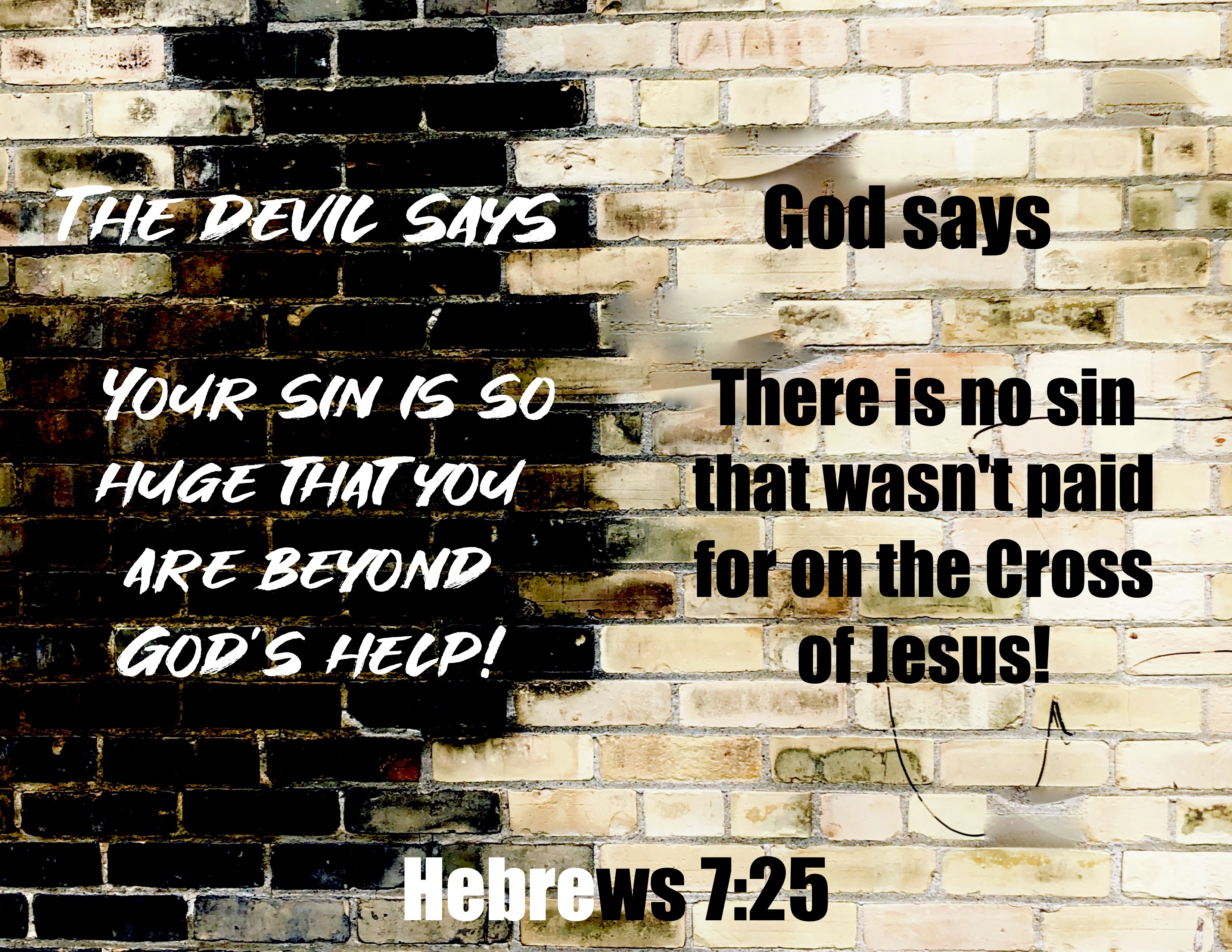
The devil lies! He loves to whisper the condemning words of, “You’ve messed up one too many times. You’re too far away for God to rescue you now. This time you exhausted God’s mercy.”
Once again, by simply crying out, “God, help!” you are calling out satan’s lies. Jesus paid too high of a price for Him to ever let you go. Near the end of this sermon, Charles Spurgeon spoke a powerful reminder: “The blessings of grace are not given today to be taken back tomorrow, but are eternal blessings [Genesis 17:7, 13, 19].” Amen!
My friend, cry out to God today—He loves you and He’s longing to restore you!



 When swelling and pride come, then emptiness and shame come also, but with the humble (those who are lowly, who have been pruned or chiseled by trial, and renounce self) are skillful and godly Wisdom and soundness. (Proverbs 11:2 AMPC)








 Craig T. Owens