Listen to the podcast of this post by clicking on the player below, and you can also subscribe on Apple, Spotify, or Audible.
Can we take just a couple of minutes to talk about fear? This isn’t on the list of anyone’s favorite topics, but it is something we all have to confront.
But when I am afraid, I will put my trust in You. I praise God for what He has promised. I trust in God, so why should I be afraid? What can mere mortals do to me? … I praise God for what He has promised; yes, I praise the Lord for what He has promised. I trust in God, so why should I be afraid? What can mere mortals do to me? (Psalm 56:3-4, 10-11 NLT)
Listen to the podcast of this post by clicking on the player below, and you can also subscribe on Apple, Spotify, or Audible.
Here’s an interesting interaction between King Saul and David—
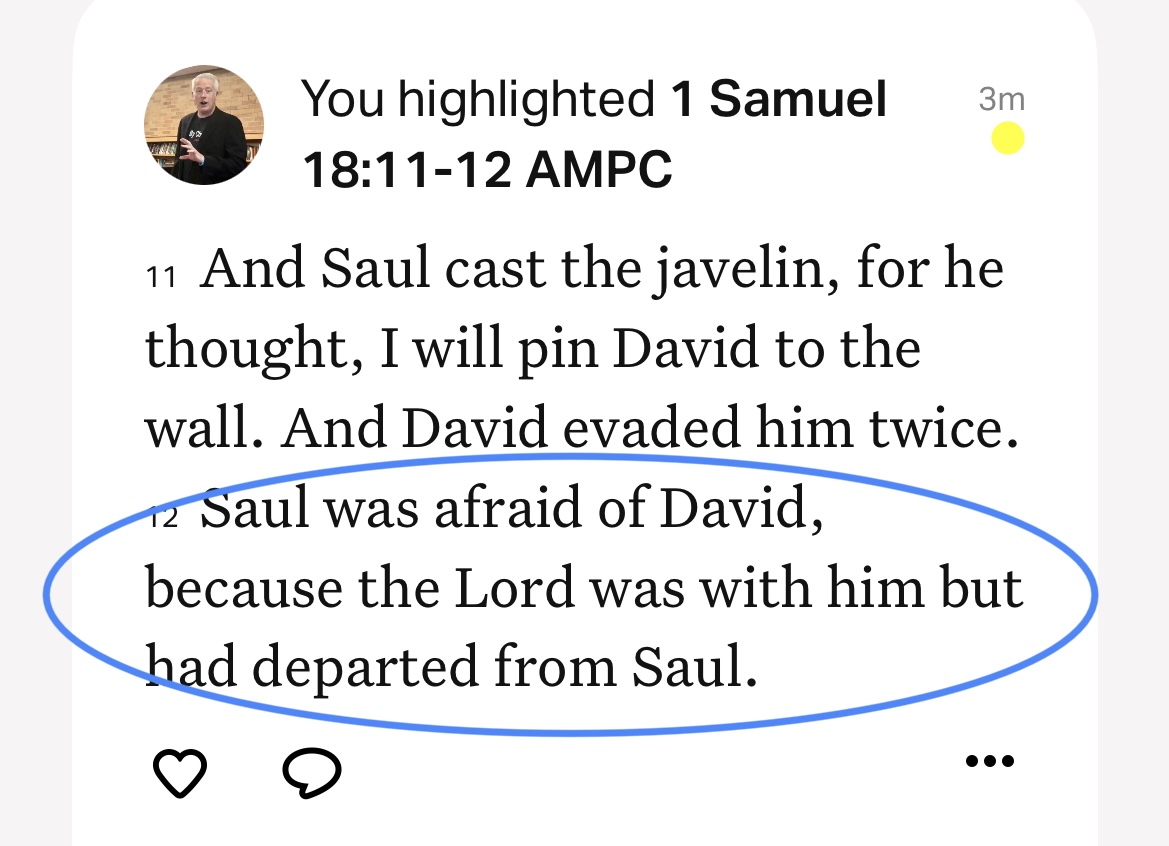
And Saul jealously eyed David from that day forward. … And Saul cast the javelin, for he thought, I will pin David to the wall. And David evaded him twice. Saul was afraid of David, because the Lord was with him but had departed from Saul. (1 Samuel 18:9, 11-12 AMPC)
This exchange in this well-known story got me wondering. I was thinking howSaul had the position of authority over David and he had a javelin in his hand, but the Bible still says that Saul “was afraid of David.” Why would that be? I think even the most atheistic of people intuitively know there is something other-worldly about those in whom the Spirit of God abides, which makes worldly people lash out at them in fear.
But those who fear God—as David did—don’t fear mortals. Jesus said, “Don’t be afraid of those who want to kill your body; they cannot touch your soul. Fear only God, Who can destroy both soul and body in hell” (Matthew 10:28 NLT). This reverent fearlessness is what galls those who fear the unknown, so they try to silence confident God-followers.
In these attacks, Jesus tells us not to respond naturally, but supernaturally. “But to you who are willing to listen, I say, love your enemies! Do good to those who hate you. Bless those who curse you. Pray for those who hurt you” (Luke 6:27-28 NLT).
Peter picked up those words from Jesus and instructed Christians: “Be careful to live properly among your unbelieving neighbors. Then even if they accuse you of doing wrong, they will see your honorable behavior, and they will give honor to God when He judges the world. … For God called you to do good, even if it means suffering, just as Christ suffered for you. He is your example, and you must follow in His steps.” (1 Peter 2:12, 21 NLT).
Although Saul feared the presence of God in David, he also had to acknowledge the success that came to David because of God’s abiding presence in him, and also, by extension, the success that came to Saul’s kingdom. On the one hand, Saul wanted David dead; on the other hand, he wanted David close by—
So Saul removed David from him and made him his commander over a thousand; and [David] went out and came in before the people. David acted wisely in all his ways and succeeded, and the Lord was with him. When Saul saw how capable and successful David was, he stood in awe of him. (1 Samuel 18:13-15 AMPC)
When Christians are supernaturally empowered by God, they never have to respond in natural fight-or-flight from those who lash out at them. Let your faithfulness to God be your testimony that points others to Him.
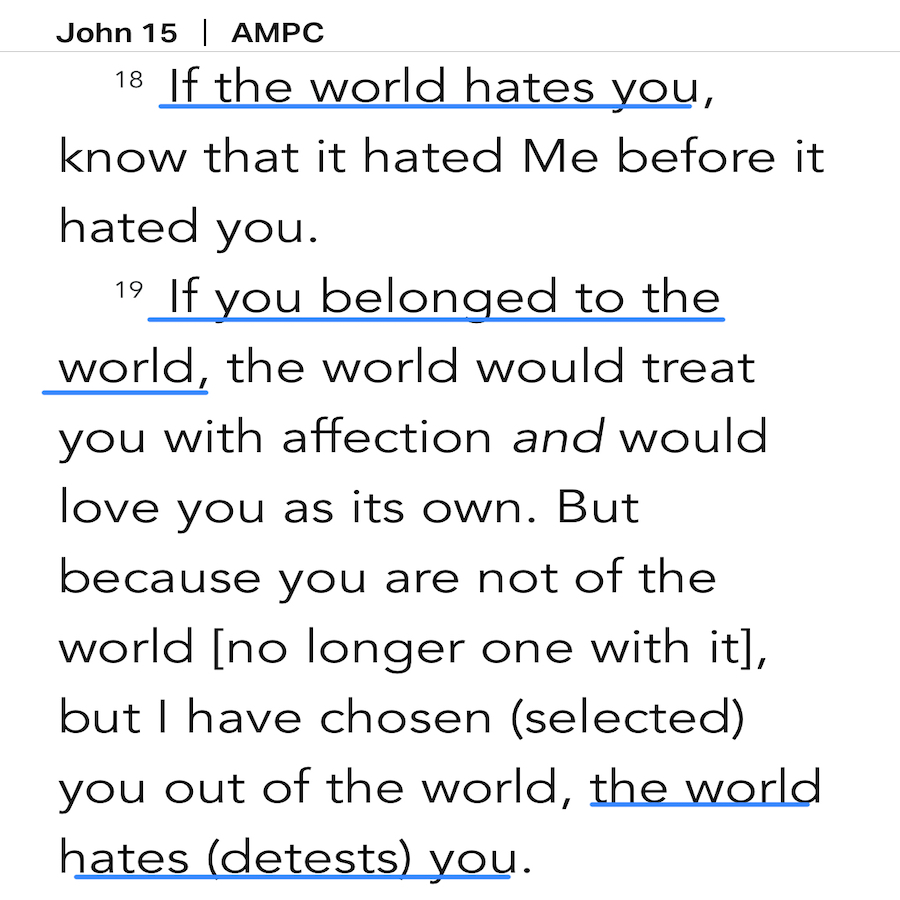
Jesus said, “If the world hates you, know that it hated Me before it hated you. If you belonged to the world, the world would treat you with affection and would love you as its own. But because you are not of the world [no longer one with it], but I have chosen (selected) you out of the world, the world hates (detests) you.” (John 15:18-19)
Listen to the podcast of this post by clicking on the player below, and you can also subscribe on Apple, Spotify, or Audible.
When fear seems to be griping a leader’s heart, how can that leader respond in a way that benefits both themself and their team? One important strategy is paying attention to how we talk to ourselves during our battles with fear.
On the Craig And Greg Show, Greg and I discussed this important leadership skill.
Check out the full Craig And Greg Show episode here.
Listen to the podcast of this post by clicking on the player below, and you can also subscribe on Apple, Spotify, or Audible.
On a recent episode of The Craig And Greg Show, Greg and I were sharing with leaders how to reframe their fears. In this clip, I discuss the importance of making sure we aren’t hampering a new situation with an old fear.
Sextortion is when someone demands money or other favors in exchange for not sharing an explicit photo or video of the targeted victim. The sextortion of minor children runs into the thousands every month. Axis reported, “Most targets of sextortion are teen boys, who seem to be more likely than girls to send an explicit selfie to someone they aren’t having a romantic relationship with. Anonymous scammers will reach out to their target over social media, engaging in a flirtation and eventually asking for nudes.” Axis also shared these helpful resources, “Families can prepare by telling their teens about resources like TakeItDown, a free service which will remove nudes from the internet within two days, and the 24/7 Crisis Text Line, which connects teens with professional counselors via text at any time.”
“First, government is not God; instead, government is God’s servant for the good of those served. And second, the people are not God, and therefore must not be allowed the last word on what defines the terms of ‘good’ public policy. Only God can define what is good for people, for He alone is good (Mark 10:18; Psalm 119:68).” —T.M. Moore
“Since the Roe v. Wade U.S. Supreme Court decision more than 50 years ago, almost 40% of all abortions in America have been in the Black community, resulting in erasing the lives and destinies of an estimated 23 million Black babies.” The National Black Fellowship is aggressively working to change this.
“You gain strength, courage and confidence by every experience in which you really stop to look fear in the face. You are able to say to yourself, ‘I have lived through this horror. I can take the next thing that comes along.’ You must do the thing you think you cannot do.” —Eleanor Roosevelt
J. Warner Wallace uses forensic evidence to demonstrate why we should believe the New Testament was written much closer to the time of the actual event than most skeptics believe. Check out this video.
Don’t give in to F.E.A.R. When the devil’s lies make us afraid, remember that F.E.A.R. stands for false evidence appearing real. The Holy Spirit can help you find the true evidence in God’s Word that will confront and dismantle the false evidence.Check out this full message here. I have lots of new content every week, which you can check out on my YouTube channel.
“Meanwhile it is also necessary for the ruler [pastor] to keep wary watch, lest the lust of pleasing men assail him; lest, when he studiously penetrates the things that are within, and providently supplies the things that are without, he seek to be beloved of those that are under him more than truth…” (Gregory the Great). Check out how T.M. Moore unpacks this quote.
The Culture Translator” newsletter from Axis has this sobering reminder of the dangers of pornography.
What it is: An eye-opening essay in The Free Press describes the impact of pornography on a teen’s developing brain.
What it tells us: The author of this piece, Isabel Hogben, is a homeschooled high schooler living in Redford City, California. In one of several devastating lines, Hogben details how she stumbled upon PornHub when she was only ten years old, even as her very present mother was “making sure I was eating nine differently colored fruits and vegetables on the daily.” Hogben goes on to explain that today’s pornography depicts a synthetically augmented and physically brutal type of sex that makes Playboy magazine look “like an American Girl Doll catalog.” She notes that teens who have never had a physical sexual encounter can’t know the difference between what fake sex and real sex is supposed to be like, skewing their expectations, and that her peers think selling nudes online is normal. As she examines the way porn causes scientifically-measurable changes in the brain, Hogden concludes that porn is not “content” as much as it is a dangerously addictive substance not unlike street drugs.
“Do nothing that you would not like God to see. Say nothing you would not like God to hear. Go no place where you would not like God to find you. Never spend your time in such a way that you would not like God to say, ‘What are you doing?’” —J.C. Ryle
“Learning to say no is not just about courage, but also learning how to prioritize your life and become more productive.” —John Maxwell
Listen to the podcast of this post by clicking on the player below, and you can also subscribe on Apple, Spotify, or Audible.
I’m not a fan of rollercoasters, but I know a lot of people who really like them. Some even travel all over the world to experience unique rollercoasters. The anticipation as the cars climb slowly up the big hill, knowing that there’s no stopping this thing now! Then the rush of emotions, a deep breath and a laugh at the end (usually laughing at our friends’ responses while on the ride), and then we just walk away. The moment of anticipation leading up to the big drop was usually longer and more intense than the ride itself.
Not only do people travel all over to find rollercoasters, some people seem to have their emotions perpetually on rollercoasters.
One of the telltale signs of someone with an immature mental health is the way every situation gets blown out of proportion before anything even happens. Then as an event unfolds, their exaggerations continue: the molehills are mountains, every valley is the valley of the shadow of death, the night is a nightmare, the “crisis” is lasting forever, no one has ever gone through what they’re going through, and the list goes on.
To break out of this habit requires us developing emotional capacity. John Maxwell describes it like this: “Emotional capacity is the ability to handle adversity, failure, criticism, change, and pressure in a positive way.” Just as athletes have to develop lung capacity or muscle capacity, developing emotional capacity takes time, patience, and diligence.
Increased emotional capacity is not escaping from our problems or even learning coping skill. Escapism never allows us to confront the things that are keeping our emotional capacity immature. On the other hand, maturing emotional capacity is learning to pause to get perspective so that we can avoid turning every mountain into a molehill, and every challenge into a do-or-die battle.
Let me illustrate this by looking at two emotions which seem to be the most rollercoaster-ish.
(1) The first rollercoaster emotion is anger
Out-of-proportion anger can either burn everyone around us when we explode, or it can eat away inside us if we hold it in. Neither of these are healthy emotional responses. Jesus got angry at the religious crowd that was keeping people away from God’s kingdom, but He didn’t ride the rollercoaster that led to a sinful expression of His anger.
God asked Jonah a very helpful question: Have you any right to be angry? (Jonah 4:4). When we feel the Holy Spirit asking us this question, our defiant first response is almost always, “Yes! I didn’t do anything wrong! It was all him!” Solomon would counsel us to cross-examine that thought (Proverbs 18:17).
Sometimes God will bring someone else across our path to help us pause to get perspective—to flatten the rollercoaster. For instance, God used Abigail to help David (see the story in 1 Samuel 25). However the Holy Spirit cross-examines us, we need to learn to truly listen. James told us:
My dear brothers and sisters, take note of this: Everyone should be quick to listen, slow to speak and slow to become angry, because human anger does not produce the righteousness that God desires. (James 1:19-20)
(2) The second rollercoaster emotion is fear
Fear usually causes us to fight or flight. Those are the natural responses, but the supernatural response is to pause to evaluate. I love the reminder that F.E.A.R. means false evidence appearing real.
As with anger, our first pause to get perspective on this potential rollercoaster that can plunge us into a deep, dark valley should be to cross-examine the false evidence of fear.
When the group of ladies came to the tomb of Jesus on the Sunday following His crucifixion, they were already battered and bruised in their emotions. Finding an empty tomb brought even more fear in their hearts. But there is a keyword in this account that will help us:
In their fright the women bowed down with their faces to the ground, but the men [angels] said to them, “Why do you look for the living among the dead? He is not here; He has risen! Remember how He told you, while He was still with you in Galilee: ‘The Son of Man must be delivered over to the hands of sinners, be crucified and on the third day be raised again.’” Then they remembered His words. (Luke 24:5-8)
The Holy Spirit can help us remember the truth in God’s Word to counteract the fear-inducing false evidence (2 Timothy 1:7; John 14:26), but we must pause to listen to this evidence before this rollercoaster emotion picks up speed.
The bottom line: Don’t try to escape your strong emotions. Pause. Cross-examine the evidence with the help of God’s Word, the Holy Spirit, and a friend to get a healthy perspective. This can help you flatten the rollercoaster before your emotions run away with you.
Listen to the podcast of this post by clicking on the player below, and you can also subscribe on Apple, Spotify, or Audible.
On a recent episode of The Craig and Greg Show, Greg and I discussed the fears that can paralyze leaders. In this short clip, I talk about an acronym I learned years ago that has helped me tremendously in evaluating my fears.
Check out the full Craig And Greg Show episode on fear by clicking here.
Listen to the audio-only version of this podcast by clicking on the player below, or scroll down to watch the video.
Fear is something every leader struggles with, but great leaders learn to reframe that fear into an opportunity to grow. Join Greg and me as we discuss overcoming fear, reframing fear, and helping your team to do the same.
[0:23] Good leaders learn how to frame their fear in a different way.
[1:09] Greg and I talk about our biggest fears.
[2:21] I share about having to overcome fears about making a decision.
[3:38] Most of fear is rooted in past experiences, but reframing as a learning experience can help you grow.
[6:17] Attempting to use fear as a motivation tool will backfire and restrict your team’s potential.
[7:23] Reducing the fears of your team begins with leading from a place of transparent humility.
[11:55] Pride is a big stumbling block for leaders, don’t be afraid to include others in the decision making process.
[13:50] The top fears that paralyze leaders.
[19:55] Good leaders game-plan for future conflict, so when it comes their team is ready.
[20:34] Give your team opportunities to battle their fears and grow from them.
[22:51] Greg shares a quote from Henry Ford.
[24:11] I share a Little League story.
[25:03] Greg and I would love to come alongside and help coach you!
Check out this episode and subscribe on YouTube so you can watch all of the upcoming episodes. You can also listen to our podcast on Spotify and Apple.
Listen to the podcast of this post by clicking on the player below, and you can also subscribe on Apple, Spotify, or Audible.
As Jesus headed towards Jerusalem, Mark records, “with Jesus leading the way” (Mark 10:32).
The Greek word for “lead” is proago. The prefix pro- means before or in front, and the root word -ago means to lead oneself, to lead by accompanying, or to lead by taking hold. This means that Jesus never sends us off by ourselves. He goes before us, with us, alongside us.
One would think that this would give the disciples great comfort. But Mark also records two unexpected responses from these men: “astonished” and “afraid.”
The words “astonished” or “amazed” are both the same word in Greek and are used both here and just a couple of verses earlier (verse 24), when Jesus said how hard it was for a rich person to enter into the kingdom of God. That statement amazed the disciples. Now they are astonished that Jesus is going to Jerusalem. “After all,” they might be thinking, “That’s where His main antagonists are headquartered! Why would He go there?”
It appears that the father they went on their journey, the more their astonishment morphed into fear. The Greek word here is the one for which we get the word “phobia”—the kind of fear that can paralyze us or tempt us to run away.
There are two things that Jesus does here to help His fearful friends:
(1) He gives them the unvarnished facts: “We are going up to Jerusalem…and the Son of Man will be delivered over to the chief priests and the teachers of the law. They will condemn Him to death and will hand Him over to the Gentiles, who will mock Him and spit on Him, flog Him and kill Him….”
Leaders who want to honor Jesus in their leadership would do well to follow this example—Give your fearful friends both the facts (no matter how painful they might seem) and the unshakable hope that God is sovereignly in control.
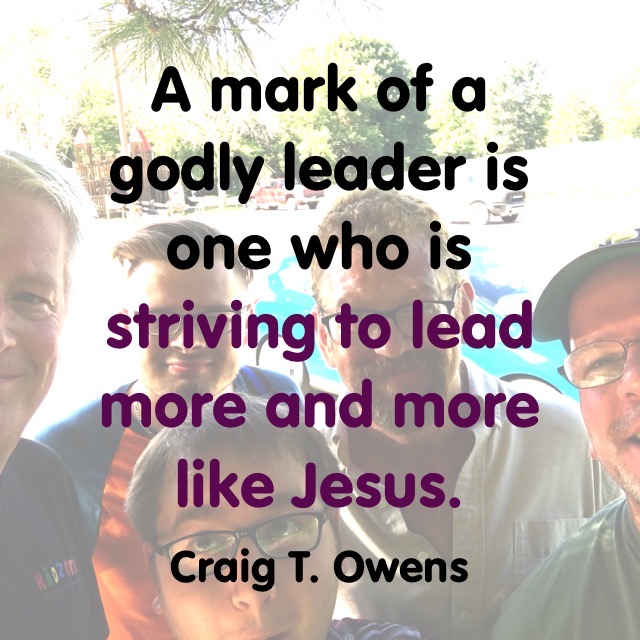
A mark of a godly leader is one who is striving to lead more and more like Jesus.
Let’s keep studying His life and allowing the Holy Spirit to teach us the lessons we can apply in our leadership roles.
This is part 70 in my series on godly leadership. You can check out all of my posts in this series by clicking here.








 Craig T. Owens