Listen to the audio-only version of this podcast by clicking on the player below, or scroll down to watch the video.
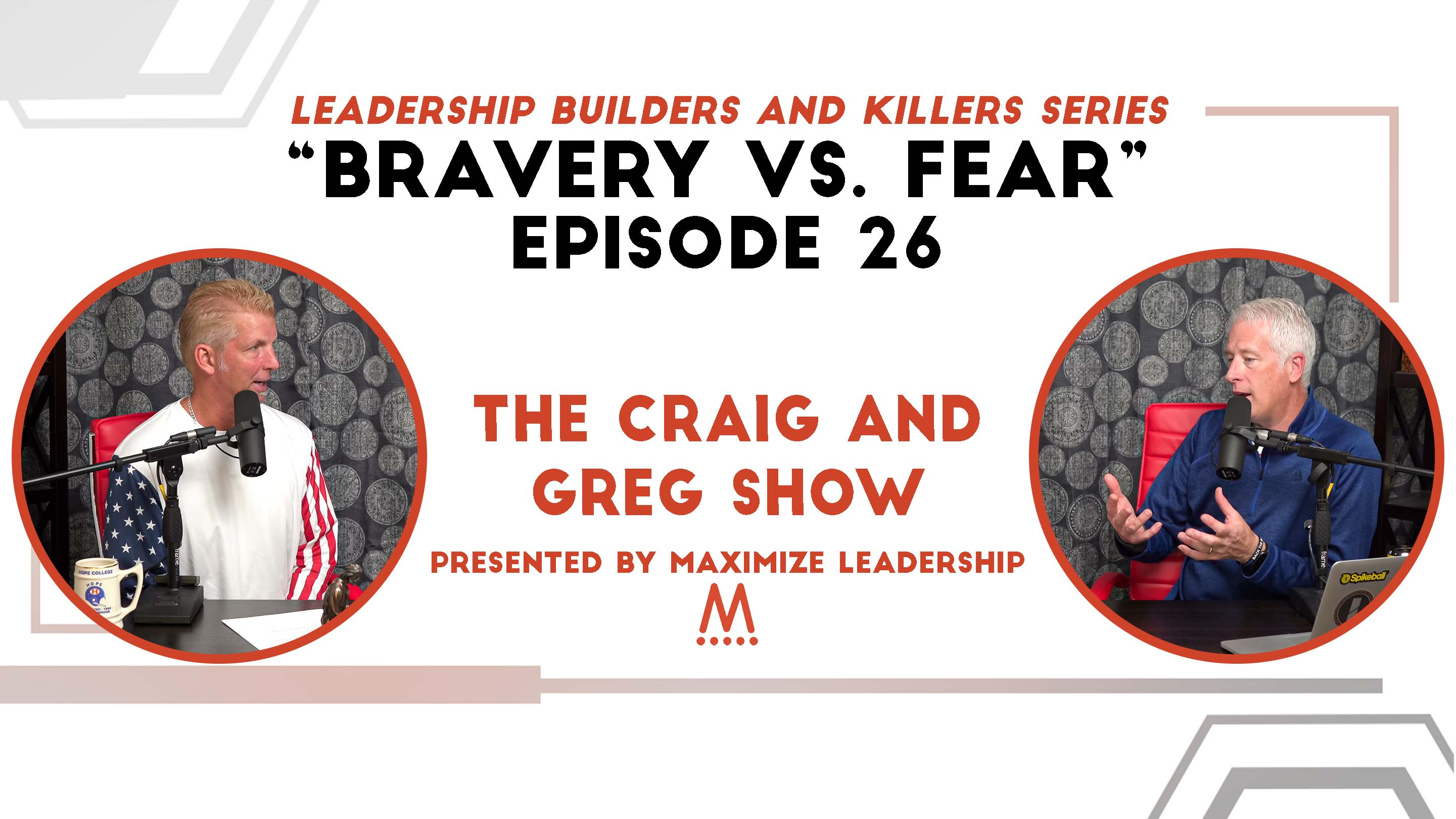
Fear is something every leader struggles with, but great leaders learn to reframe that fear into an opportunity to grow. Join Greg and me as we discuss overcoming fear, reframing fear, and helping your team to do the same.
[0:23] Good leaders learn how to frame their fear in a different way.
[1:09] Greg and I talk about our biggest fears.
[2:21] I share about having to overcome fears about making a decision.
[3:38] Most of fear is rooted in past experiences, but reframing as a learning experience can help you grow.
[6:17] Attempting to use fear as a motivation tool will backfire and restrict your team’s potential.
[7:23] Reducing the fears of your team begins with leading from a place of transparent humility.
[11:55] Pride is a big stumbling block for leaders, don’t be afraid to include others in the decision making process.
[13:50] The top fears that paralyze leaders.
[19:55] Good leaders game-plan for future conflict, so when it comes their team is ready.
[20:34] Give your team opportunities to battle their fears and grow from them.
[22:51] Greg shares a quote from Henry Ford.
[24:11] I share a Little League story.
[25:03] Greg and I would love to come alongside and help coach you!
Check out this episode and subscribe on YouTube so you can watch all of the upcoming episodes. You can also listen to our podcast on Spotify and Apple.
Listen to the podcast of this post by clicking on the player below, and you can also subscribe on Apple, Spotify, or Audible.
As Jesus headed towards Jerusalem, Mark records, “with Jesus leading the way” (Mark 10:32).
The Greek word for “lead” is proago. The prefix pro- means before or in front, and the root word -ago means to lead oneself, to lead by accompanying, or to lead by taking hold. This means that Jesus never sends us off by ourselves. He goes before us, with us, alongside us.
One would think that this would give the disciples great comfort. But Mark also records two unexpected responses from these men: “astonished” and “afraid.”
The words “astonished” or “amazed” are both the same word in Greek and are used both here and just a couple of verses earlier (verse 24), when Jesus said how hard it was for a rich person to enter into the kingdom of God. That statement amazed the disciples. Now they are astonished that Jesus is going to Jerusalem. “After all,” they might be thinking, “That’s where His main antagonists are headquartered! Why would He go there?”
It appears that the father they went on their journey, the more their astonishment morphed into fear. The Greek word here is the one for which we get the word “phobia”—the kind of fear that can paralyze us or tempt us to run away.
There are two things that Jesus does here to help His fearful friends:
(1) He gives them the unvarnished facts: “We are going up to Jerusalem…and the Son of Man will be delivered over to the chief priests and the teachers of the law. They will condemn Him to death and will hand Him over to the Gentiles, who will mock Him and spit on Him, flog Him and kill Him….”
Leaders who want to honor Jesus in their leadership would do well to follow this example—Give your fearful friends both the facts (no matter how painful they might seem) and the unshakable hope that God is sovereignly in control.
A mark of a godly leader is one who is striving to lead more and more like Jesus.
Let’s keep studying His life and allowing the Holy Spirit to teach us the lessons we can apply in our leadership roles.
This is part 70 in my series on godly leadership. You can check out all of my posts in this series by clicking here.
Listen to the podcast of this post by clicking on the player below, and you can also subscribe on Apple, Spotify, or Audible.
I am always interested when I see contrasts in the Bible. Things like:
Live this way, not that way
These people are blessed, these people have trouble
If you do this, you won’t have this
So an interesting contrast caught my eye in the story where Jesus calms the storm (Matthew 8:23–27). Jesus is sleeping peacefully in the middle of a storm that is described as “furious [where] the waves swept over the boat.” The disciples were anything but peaceful—they thought they were going to drown—so they yelled for Jesus to wake up.
Before Jesus calmed the storm, He says, “You of little faith, why are you so afraid?”
That’s the phrase that caught my attention. Notice the contrast between “little faith” and “so afraid.” In other words, small faith means big fear!
Strong’s Greek dictionary defines “little faith” as “dread (by implication) faithless.” So it appears there is an inverse proportion between faith and fear.
The word that Jesus used for “afraid” is only used here and in the same story in Mark 4:40, and in Revelation 21:8 which lists people who will be excluded from entrance into heaven.
The phrase “so afraid” (or “O ye of little faith” in the King James Version) is just one word in Greek: olgiopistos. The root word pistos is faith, but I find the prefix oligos very descriptive. It means:
small in quantity
short in time
slight in intensity
In other words, it is faith that is immature, or hasn’t been used much, or hasn’t been applied to a particular circumstance. This word olgiopistos is used five times in the New Testament, and only used by Jesus.
In addition to this story, it is used in Matthew 6:30 and Luke 12:28 when Jesus tells us not to worry about the things that God will provide for us—things like food, clothing, and shelter. Jesus uses this word for Peter when he began to sink in the water after walking a few steps toward Jesus. And Jesus uses it in Matthew 16:8 when He warns His disciples about the “yeast” of the Pharisees and Sadducees that can creep into their hearts and spoil their faith. (Check out all of these verses here.)
In mathematical circles, this relationship between faith and fear is one that would be called inversely proportional. When our faith is high, our fear is low; when our fear is high, our faith is low. I also think it is very eye-opening that the mathematical symbol for inverse proportionality (∝) is the same symbol called ichthus that the early church used to represent Jesus.
Faith and fear cannot coexist in the same heart. Sometimes our faith is small in quantity because we haven’t fed our faith with God’s promises. Sometimes our faith is short in time because we want things done on our time schedule. And sometimes our faith is slight in intensity because we are unsure if God can “come through” in this particular situation.
Whatever the case, when we feel any fear, we need to ask for faith. We need to return to God’s Word and be assured that His promises are applicable regardless of the situation we are in. As our faith grows, our fear has to diminish!
Listen to the podcast of this post by clicking on the player below, and you can also subscribe on Apple, Spotify, or Audible.
“Be kindly affectionate to one another with brotherly love, in honor giving preference to one another” (Romans 12:10).
What does it mean to give preference to a friend or loved one? Here are a few suggestions to get the ball rolling.
Giving preference means I am…
…speaking their “language.”I am a classic Doer, which means my style is, “Ready, Fire! aim.” I need to give grace to those who move a bit slower than me.
…moving at their “speed.” My temperament is highly choleric, so I get fired up quickly and attack situations head-on. I need to give grace to those temperaments that are less emotional and want to handle things more strategically.
…sensitive to their “fears.” It’s insensitive for me to say, “It’s no big deal” about something that troubles them. Empathy is important so I can see and feel things like they see and feel them.
…helping them battle their “demons.” Perhaps viewing pornography isn’t a temptation for me, but it may be for someone else. So I need to seek out resources and accountability to help them fight this battle like I was fighting my own battle.
…avoiding their “stumbling blocks.” Perhaps I can watch certain genres of movies without compromising my Christian testimony, but it may cause my brother or sister a lot of grief. If I am going to prefer them in love, I will avoid talking about those movies in their presence, and I certainly won’t try to get them to “lighten up” to see things my way.
Agape love is never selfish—it doesn’t want “my way” but it wants others to be edified. So, ultimately, what it means to give preference to another is to only promote those things that will build them up. Remember: saints is always plural in the New Testament, so we must build each other up to bring out the saintliness in all of us.
Check out this episode and subscribe on YouTube so you can watch all of the upcoming episodes. You can also listen to our podcast on Spotify and Apple.
Listen to the podcast of this post by clicking on the player below, and you can also subscribe on Apple, Spotify, or Audible.
How many times has fear constricted your world?
When I look back on some of my past decisions, I can see that often my procrastination in making that decision was from a fear-based, worst-case scenario. I held back because I was afraid of the outcome from my decision.
Also when I look back I see that even the things that didn’t go perfectly never turned out to be devastatingly bad, but something from which I could recover and learn valuable lessons.
Now, I’m not talking about shoot-from-the-hip, never-thought-it-through actions. Those things have frequently gotten me in hot water! What I’m talking about is thinking it through, getting good counsel, praying about it, and then still holding back from making a decision.
Fear would cause us to procrastinate, only see the negative possibilities, and maybe even become disobedient to God because we think we have to rely on our resources. On the other hand, hope wants us to see the possibilities, hear God’s voice, and then step out in confident faith.
My friend Greg and I discussed this fear versus hope topic on an episode of our leadership podcast called The Craig And Greg Show.
Listen to the podcast of this post by clicking on the player below, and you can also subscribe on Apple, Spotify, or Audible.
Then the king of Assyria sent his field commander with a large army… (Isaiah 36:2).
The enemies of God’s people always use the same tactics.
(1) Sending an intimidating force that seems overwhelming and invincible.
King Sennacherib didn’t send a small detachment of soldiers, but he sent “a large army” to try to intimidate the people of Judah.
(2) Asking doubt-inducing questions.
The field commander asked questions like…
On what are you basing this confidence of yours?
On whom are you depending?
Do you think Jehovah can save you from this?
(3) Fomenting distrust in God’s wisdom and ability.
Once the seeds of doubt had been sown, the field commander attempted to water those seeds by making accusations like…
Do not let Hezekiah deceive you: God can’t help you with this one!
The gods of other nations didn’t help them, so what makes you think your God will help you?
(4) Offering a compromise.
Then came the offer to give in…
Come now, make a bargain with my master and I’ll give you more riches than you can imagine!
Make peace with me while you have the chance, and I promise you will have a trouble-free life!
All of these tactics attempted to play on the fears of people who felt surrounded and overwhelmed.
But I love to remember that the acrostic of the word F.E.A.R. is False Evidence Appearing Real. The field commander in King Hezekiah’s time, and satan today, use the tactics of fear to try to get us to compromise.
King Hezekiah gave us a great example to follow. When he received the field commander’s letter with all of the threats listed, he “spread it out before the Lord” (Isaiah 37:14)! Isaiah reminded the people not to be afraid of the threats of the enemy, because those threats were actually blasphemy against God. And then God tells Hezekiah quite simply, “I will take care of this!”
And God did indeed take care of it.
Without the armies of Judah ever having to lift a sword or a spear or shield, God broke the power of the enemy and sent them away in shame!
When the enemy seems to be surrounding you today, he will use these same tactics. He will try to overwhelm you, get you to doubt what God has said, try to induce you to distrust God, and then offer you a compromise. All the devil has on his side is false evidence that he attempts to make look real.
So do what King Hezekiah did: Spread out those threats before God. Go to His Word and read again what He has already promised you. Then stand firm in faith. God will take care of your adversary!
Listen to the podcast of this post by clicking on the player below, and you can also subscribe on Apple, Spotify, or Audible.
Why is it that so many people have a worst-case mindset as their guiding factor?
As a leader responsible for programs, and large groups of people, and the financial well-being of organizations, I know that I frequently fell into this trap. When we began making plans for the future, I wanted to keep a “fallback plan” in place. I frequently found myself saying to our leadership team, “Even in the worst case scenario we can….”
But then I realized how much vitality this was sapping from our team.
If we as leaders want to infuse more energy and excitement in our teams it may take some paradigm shifts on our part. Here are three shifts that I have endeavored to implement in my life:
Shift scarcity to abundance.
Shift fear to hope.
Shift worst-case to best-case.
On a recent episode of our leadership podcast, my friend Greg Heeres and I discussed the limitations that come as a result of a leader’s limiting fears.
As a Christian, I believe the greatest Helper in these three paradigm shifts is the Holy Spirit. When I take time to pray about the big decisions for my personal life and for the organizations I lead, I find that His guidance helps me tap into God’s abundance, which gives me hope for the best-case scenarios to be realized. This hope in me quickly translates to hope and expectation in my team.
Leaders, start with prayer and then try these three paradigm shifts. As the Holy Spirit transforms your heart and mind, I believe you will begin to see a greater energy and excitement in the organizations that you lead.
Let’s stop asking, “What’s the worst thing that could happen?” and shift to asking, “What’s the best thing that could happen?”
Listen to the podcast of this post by clicking on the player below, and you can also subscribe on Apple, Spotify, or Audible.
“Anxiety disorders are the most common mental illness in the U.S., affecting 40 million adults in the United States age 18 and older, or 18.1% of the population every year.” —Anxiety & Depression Association of America
A multitude of factors go into someone’s anxiety: genetics, temperament, brain chemistry, life experiences. In addition to those factors, we have to keep in mind that humans are a three-part being—with a body, mind, and spirit—and a disease in one area does affect the other two areas.
All of this means that there is no one-size-fits-all solution for anxiety. But there is one Healer:
He may supernaturally heal your body, mind, or spirit
He may direct you to a medical doctor, a mental health professional, or a spiritual counselor
But always, He will walk through the challenges with you, strengthening you, and preparing you to minister to others going through a similar struggle (Psalm 23:1-6; 2 Corinthians 1:3-4)
David wrote, “When I am afraid, I put my trust in You” (Psalm 56:3). Notice that he said “when” not “if.” David knows what you probably know too: we can be easily consumed by our anxiety, doubts, and fears. But David also knows (and I hope you do too) that at those moments, we can go to God as our trustworthy First Source.
One of the dictionary definitions of anxiety is a feeling of disquiet. All of the conflicting thoughts make it hard to concentrate, the abundance of noise makes it difficult to talk to yourself, let alone talk to God.
I’d like you to consider another psalmist’s words. Look at the first half of Psalm 94:19—
When anxiety was great within me… (NIV)
In the multitude of my anxious thoughts… (AMP)
When doubts filled my mind… (NLT)
The setting of this psalm is one of lots of disquieting voices: a desire to see the wrongdoers punished, listening to arrogant words, getting fed up with boasting words, seeing good people being trampled, hearing foolish words uttered about God (vv. 1-8).
Experiencing anxiety is not sinful, but I do think that we grieve God’s heart when we immediately run to other sources for relief instead of going to our loving Heavenly Father first. After dealing with the disquiet in the opening verses of Psalm 94, the psalmist says, “My anxiety level was sky high!” But then notice how that verse concludes—
…Your consolation brought me joy (NIV)
…Your comforts cheer and and delight my soul (AMP)
…Your comfort gave me renewed hope and cheer (NLT)
Jesus told us about our Comforter who would always be with us (John 14:1, 16-17). A little further on in these same remarks Jesus also said, “These things I have spoken to you, that in Me you may have peace. In the world you will have tribulation; but be of good cheer, I have overcome the world” (John 16:33 NKJV).
I like that phrase, “Be of good cheer.” That phrase is just one word in Greek, and sometimes it’s translated “be of good courage.” In every single instance, it’s only used by Jesus and it’s only used when He comes close to anxious people (Matthew 9:2, 9:22, 14:27; Mark 6:50, 10:49; Luke 8:48; John 16:33; Acts 23:11).
A furious squall battered the boat, almost swamping it. The disciples were—to say the least—disquieted! In their anxious state they notice Jesus peacefully sleeping. They wake Him up with, “Don’t You care that we’re drowning?!” Jesus stands up and says to the storm, “Quiet. Be still.”
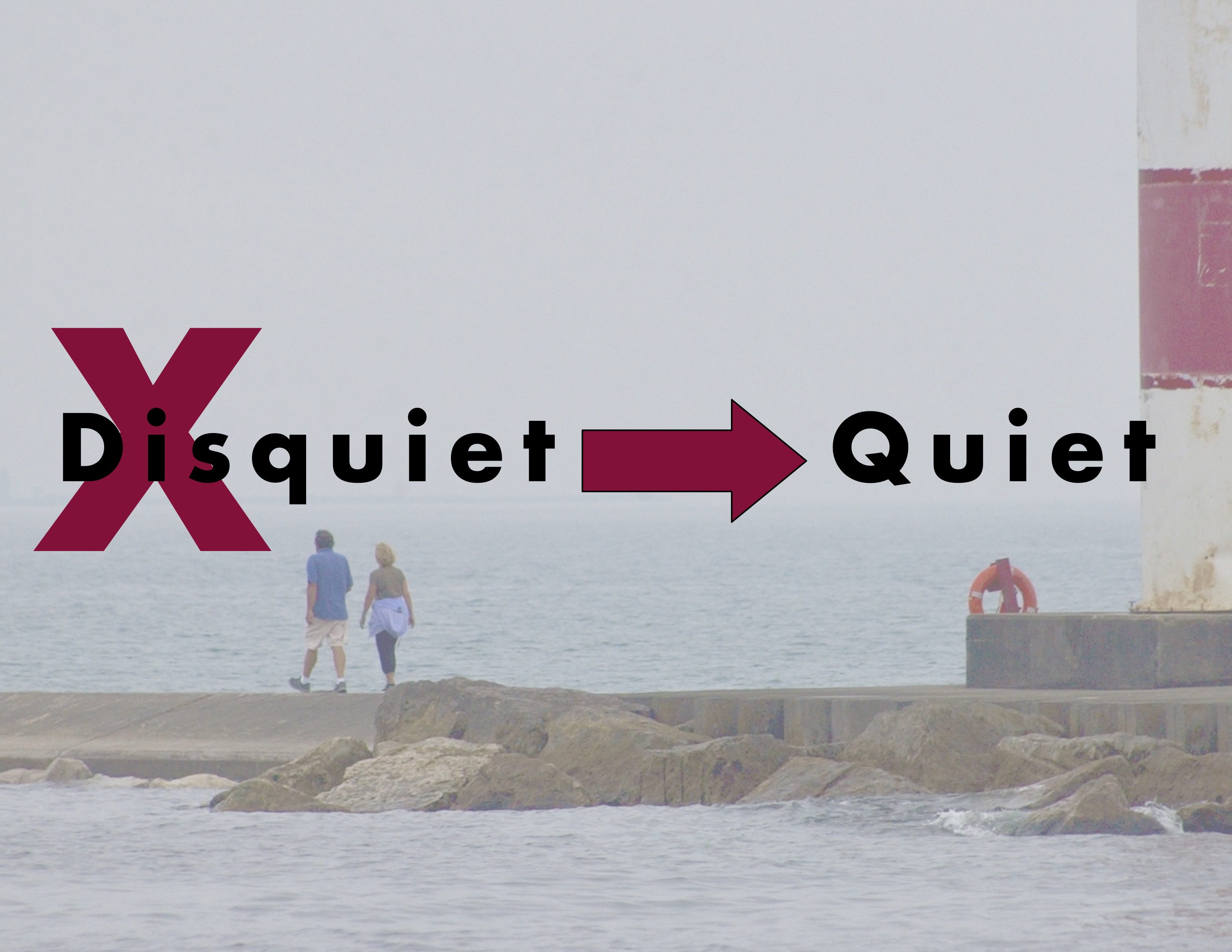
Recall that one of the descriptions of anxiety was being disquieted. That prefix dis- means to be separated: our anxiety would seek to distance us from God’s presence, to make us feel like His help is too far away. But when we go to Jesus, He alone can say, “Quiet” to our disquieting thoughts. He can remove the “dis-” and bring us close to Him. Only His peace can X-out the noise of the storm and bring you to a place of quiet rest.
After Jesus said, “Quiet. Be still,” notice this: “…THEN the wind died down and it was completely calm” (Mark 4:39). And the great thing is this: Even if another storm begins disquieting us just a few minutes after the calm, we can go to Him again. There is no limit: We can continually go to the Eternal Source of peace, to the only One who can speak, “Quiet” to our anxious thoughts.
[0:58] Our empowerment comes from facing our fears.
[1:35] How does fear paralyze a leader?
[2:14] One fear leaders need to address in themselves and others: The fear of dropping the ball.
[3:00] Leaders need to be aware that confidence can ebb and flow.
[3:50] How we lead through fear.
[4:27] Transparency in a leader empowers the team to greatness. On the other hand, blaming is a defense mechanism that disempowers the team.
[5:49] Greg shares how we lead by example and with transparency.
[7:25] I address the fear that blocks leaders from giving authority to others.
[8:15] Greg suggests we switch our mindset from fear to learning opportunities.
[9:21] I share a Little League lesson that served me well into adulthood.
[10:50] How Greg and I help coach people through their fears.
[11:34] What other fears to leaders face?
[12:50] Creating a culture of safety helps our teammates confront their fears.
[14:03] How can leaders encourage people who are trapped by their fears?
[15:41] Leaders have to go first. I said, “Sometimes bravery is just going one step farther than you went before.”
[16:50] Greg shares a brave moment in his adoption process.
[18:18] We need to assess the gifts that others on our team possess.
[19:20] Greg unpacks a great quote about bravery.
[20:03] I share about the moment when I think bravery begins.
Check out this episode and subscribe on YouTube so you can watch all of the upcoming episodes. You can also listen to our podcast on Spotify and Apple.



 Fear is something every leader struggles with, but great leaders learn to reframe that fear into an opportunity to grow. Join Greg and me as we discuss overcoming fear, reframing fear, and helping your team to do the same.