


Listen to the podcast of this post by clicking on the player below, and you can also subscribe on Apple, Spotify, or Audible.
 I find it interesting how many spiritual disciplines have both a physical and spiritual impact on our lives. Bible study, solitude, and giving all have benefits in both the physical and spiritual realms. This is even more apparent in spiritual discipline #4—fasting.
As we saw with giving last week, fasting is another one of the spiritual activities that Jesus has a cautionary word for us (Matthew 6:16-18). As with giving and praying, Jesus notes that there are only two categories: true fast-ers and hypocrites. Of course, hypocrite means someone simply playing a role—it’s not who they really are.
In Matthew 9:14-17, Jesus is asked about fasting and He uses some unusual analogies about fabrics and wineskins to teach us two don’ts about fasting:
- Don’t fast if you’re not ready for it. Jesus notes that “the unshrunken cloth” will do damage to both the new and old pieces of fabric. This goes back to the get-to vs. have-to attitude we should have about spiritual discipline.
- Don’t try to add a new religious practice to a religion-hardened heart. Jesus addresses this using the analogy of new wine ruining old wineskins.
These fasting thoughts aren’t a teaching that is exclusive to the New Testament, but through the prophet Isaiah, God addressed it in the exact same way (Isaiah 58:5-9). In this passage we can learn the dos about fasting:
- Do fast when my heart’s motivation is a hunger for more of God.
- Do fast as the Holy Spirit directs you, not in a formulaic, lifeless ritual.
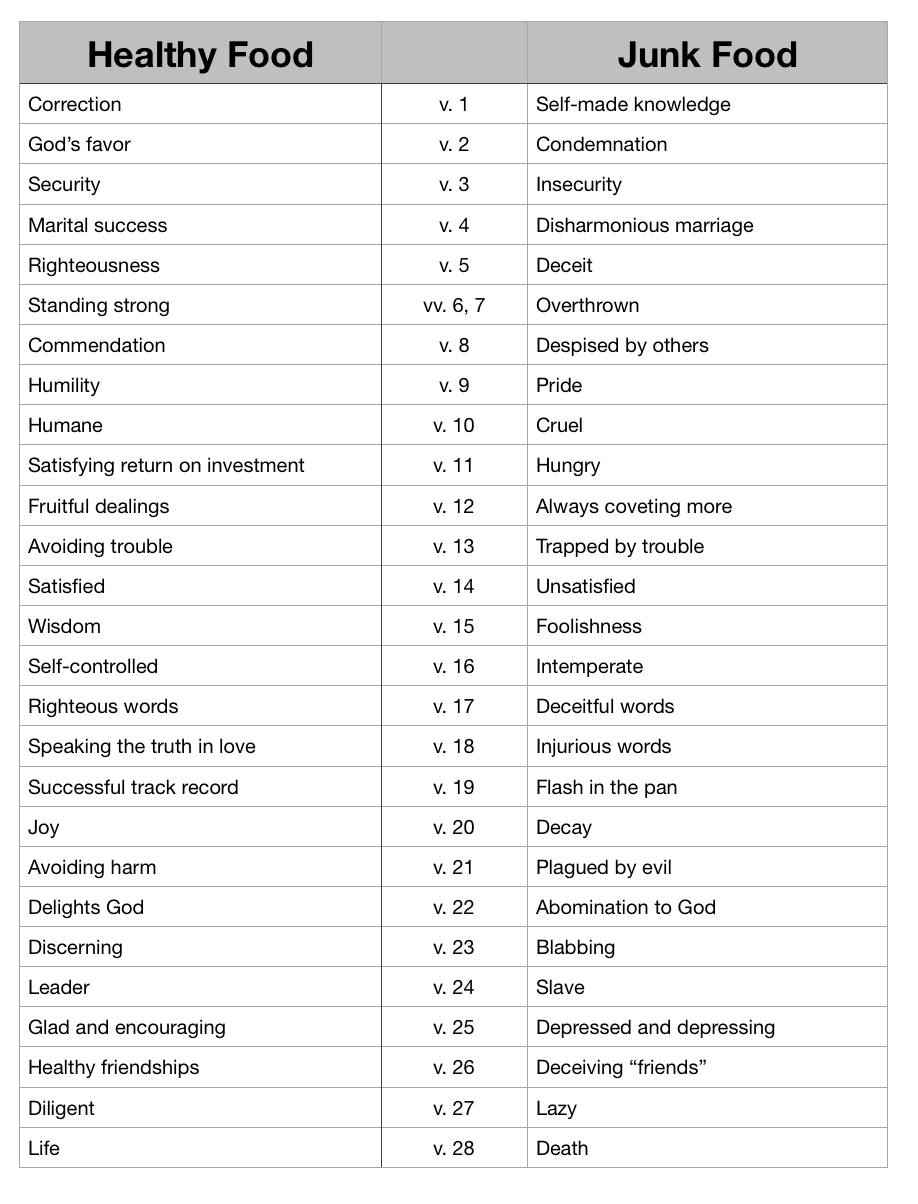
I’m not a big fan of diets that are no-no diets because telling people what they cannot eat isn’t a good motivator. But telling people what they can eat brings joy and freedom.
The insidious nature of junk food is not so much the fat, sugar, and other unhealthy ingredients, but the fact that junk food is really empty calories. Your body needs a certain amount of fuel to operate. Junk food contains calories but lacks nutrients. You eat junk food, your body sends a signal to your brain that you’re no longer hungry, and then you never eat the nutrient-rich food. This is why your Mom may have told you something like, “Broccoli first, then dessert.”
The Hebrew word for “fast” literally means to cover the mouth, but I think fasting is more than that. Just as we said money was one aspect of giving, so food is one aspect of fasting. The idea behind fasting is to be able to identify the “empty calories” of some of our lifestyle choices so that we can feast on the rich “nutrients” that God has for us.
Just as junk food with its empty calories keeps us from nutrient-rich food, hours of video games or TV binge watching keeps us from mind-enriching learning, endless social media scrolling keeps us from developing real relationships with real people, and obsessive news gathering keeps us from focusing on God’s promises.
Periodically fasting from these things will allow us to spot the junk food we’ve been consuming. Our so that statement for this spiritual discipline says: I fast so that I can identify the junk food that is keeping me from feasting on Jesus.
Can I give you a brief assignment for this spiritual discipline? After making sure your heart attitude about fasting is God-honoring, add regular fasting to your life so that you can use that time to feast on Jesus.
If you’ve missed any of the other messages in this series on six empowering spiritual disciplines, you can check them out by clicking here.
►► Would you please prayerfully consider supporting this ministry? My Patreon supporters get behind-the-scenes access to exclusive materials. ◀︎◀︎









 Craig T. Owens