No Contention, No Compromise

Listen to the podcast of this post by clicking on the player below, and you can also subscribe on AppleSpotify, or Audible. 

As we continue our look at the Book of Jude, let me remind you that Jude calls Christians to contend for the faith with a servant’s attitude and with an all-in attitude that will not give in even when the going gets tough. 

What exactly are we contending for? Jude calls it the faith once for all entrusted to the saints” (Jude 3). 

(Check out all of the Scriptures in this post by clicking here.) 

It might be helpful to look at this phrase in the AMPC: “…to contend for the faith which was once for all handed down to the saints—the faith which is that sum of Christian belief which was delivered verbally to the holy people of God.” 

During the Reformation there was a phrase that became prominent: “Sola Scriptura” which means the Bible is our authoritative guide for everything in our lives. Jesus addressed the religious leaders who added to the Scripture (Mark 7:8-9, 13), and here Jude is now addressing those who took away from Scripture (Jude 4).   

We have to be so careful here. Contending doesn’t meet fighting for our traditions, nor does it mean compromising with the whims of culture. Jesus told us to preach the Gospel, not to argue nor give in to avoid problems. Jude says this Gospel message have been entrusted to us. 

Ronald Reagan was talking about the freedoms in the United States of America, but his warning sounds like it originated with Jude: “Freedom is never more than one generation away from extinction. We didn’t pass it to our children in the bloodstream. It must be fought for, protected, and handed on for them to do the same, or one day we will spend our sunset years telling our children and our children’s children what it was once like in the United States where men were free.” 

We don’t want to spend our sunset years telling our children and grandchildren how it used to be when we contended for the faith that was entrusted to us, but we want to tell them how we are still winsomely and consistently contending for this faith still to this day! 

So how do we contend for this faith the right way?  

(1) Study God’s Word and then study it some more. I like what Charles Spurgeon said of John Bunyan,  “Why, this man is a living Bible! Prick him anywhere—his blood is Bibline, the very essence of the Bible flows from him. He cannot speak without quoting a text, for his very soul is full of the Word of God. I commend his example to you, beloved.” May that be said of us! 

James encourages Christians to receive God’s Word in their hearts. The Amplified Bible says it this way: “the Word which [is] implanted and rooted in your hearts.” But I really love the KJV rendering that calls it “the engrafted word.” We study God’s Word to us so that it can become a living, breathing part of who we are—the very fabric of our thoughts and attitudes. 

(2) Wrestle with the whole counsel of Scripture. This is hard work, but it is the most rewarding work of all! Don’t stick with only passages of the Bible that are enjoyable to read, but consider the whole counsel of God’s Word. Ask yourself things like: What did it mean then? What does it mean now? What does it mean for me? Where can I cross-reference this with another place in Scripture? 

(3) Make your “No” merciful, peaceful, and loving. This is how Jude calls us to live in v. 2, and the apostle Peter said something very similar in 1 Peter 4:1-5. 

(4) Make your “Yes” compelling and attractive. Remember that we want to be known more for what we’re for, not for what we’re against. Again, Peter sounds this same note in 1 Peter 3:13-16. 

As saints entrusted with the faith, we have to learn to contend for this faith without becoming contentious and without compromising the truth. 

If you’ve missed any of the other messages in this series Earnestly Contend, you can find them all here. 

►► Would you please prayerfully consider supporting this ministry? My Patreon supporters get behind-the-scenes access to exclusive materials. ◀︎◀︎

Don’t Undo The Good

Just one moment of indulgence…

Just one small compromise in values…

Just a little bit of childish folly…

…and you undo all that you had done so well. 

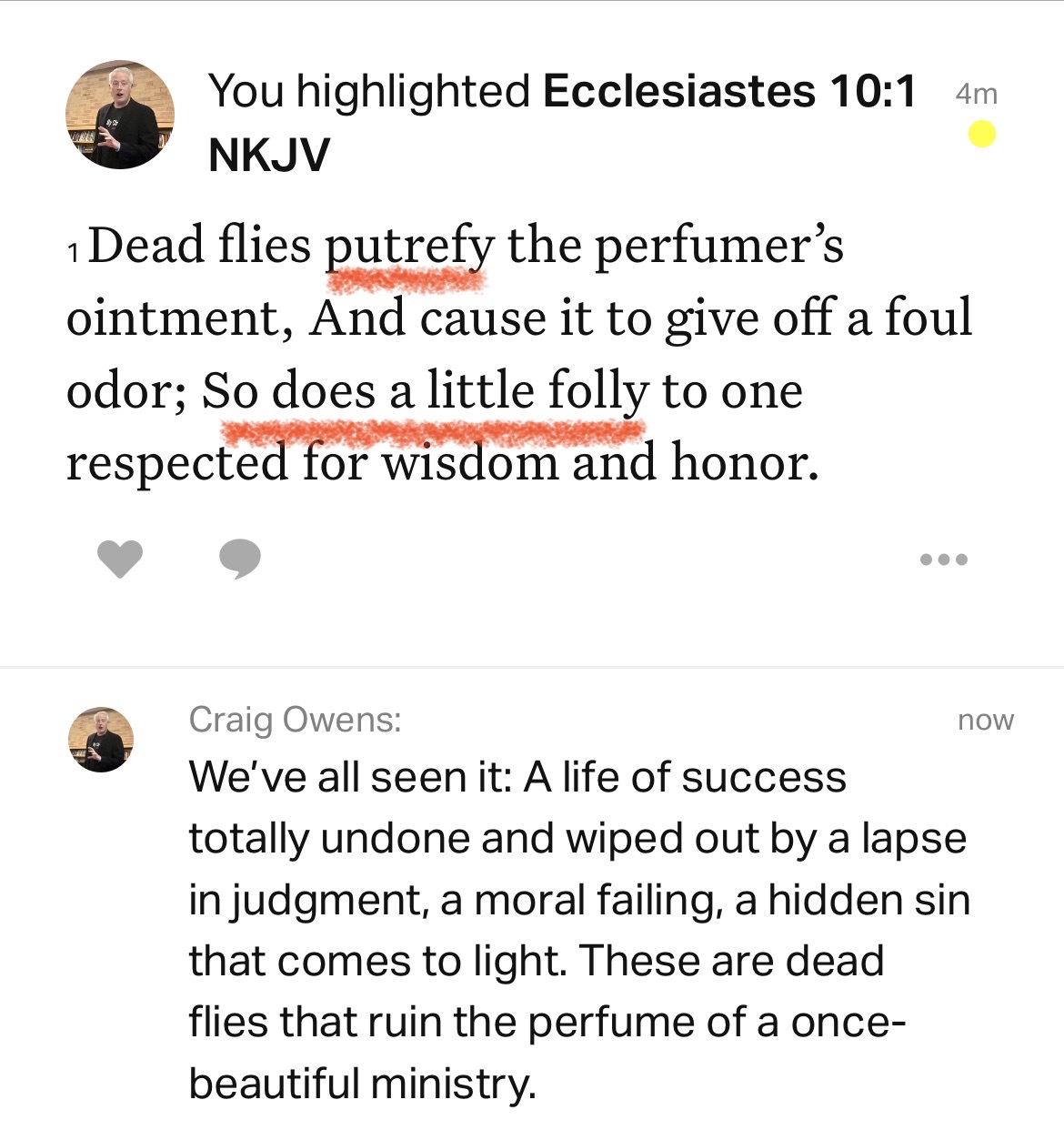
Dead flies cause the ointment of the perfumer to putrefy and send forth a vile odor; so does a little folly in him who is valued for wisdom outweigh wisdom and honor. (Ecclesiastes 10:1 AMPC) 

You can go a bit deeper on this in my posts Don’t Putrefy Your Leadership

Links & Quotes

Some human employers may ask us to do business for them without giving us a good example or enough resources. But when Jesus told us to be about the Father’s business, He gave us an example and the full empowerment of the Holy Spirit! Check out this full sermon.

I have a lot of new video content on my YouTube channel every week. Please check it out and subscribe so you don’t miss anything.

“Compromise is a costly word; non-compromise, even more so.” —Bono 

Shane Morris said, “But as much as AI’s potential can cause harm, blaming it alone misses the point and likely makes these problems worse. Humans are the fallen ones, and that fallenness manifests in all kinds of destructive ways. Machines, strictly speaking, don’t have morals or intentions. They can only reflect ours.” Check out his podcast AI is not the problem, we are.

“I do not believe that a nation dies save by suicide. To the very last every problem is a problem of will; and if we will we can be whole. But it involves facing our failures as well as counting our successes.” —G.K. Chesterton 

I love reading and I have a long list of what I would like to read next. Scott Hubbard addresses this question: “Perhaps the question ‘What should I read or listen to?’ would come into sharper focus if we had a better sense of why we read at all. ‘Why read?’ has more than one right answer. We read to learn, to rest, to deepen friendship with fellow readers, to enjoy the craft of skilled wordsmiths. But alongside these good reasons, consider three others that put our reading into the service of greater loves.” 

“I only hope that we never lose sight of one thing—that it was all started by a mouse.” —Walt Disney 

“The scientific man does not aim at an immediate result. … His duty is to lay the foundation for those who are to come, and point the way.” —Nikola Tesla 

This week marked the 100th anniversary of a court case that was known as “the trial of the century,” perhaps you have heard it called the Scopes Monkey Trial. It was, and has been, more sensation than substance. Check out this post that puts this trial in its proper perspective.

Compromised Leadership

Listen to the podcast of this post by clicking on the player below, and you can also subscribe on AppleSpotify, or Audible. 

If we are wise, we can learn invaluable leadership lessons even from those who fell short in their attempts. For example, consider Lot, the nephew of Abraham. 

Lot was found “sitting at the gate” in Sodom. This was a place of leadership, the place where legal and business matters were discussed. That means Lot appeared to be accepted by the townsfolk (see Genesis 19:1-14). 

But that also means Lot had compromised his values. 

Lot didn’t walk right into this leadership role. The Bible tells us how Lot first lived in the vicinity of Sodom and Gomorrah, but then steadily moved closer and closer to the city, until eventually he compromised his values enough to be accepted into a civic leadership position.

Lot obviously did not live or speak according to God’s righteous standards because when he attempted to appeal to a depraved mob of Sodomites, they ridiculed him, reminding him that he was not one of them. And then when Lot tried to warn his future sons-in-law (men who were also Sodomites) about God’s impending judgment on the city, they only laughed at him. 

Jesus warned us, “Woe to you when all men speak well of you, for so did their fathers to the false prophets” (Luke 6:26).

The Sodomites spoke well of Lot when he was in the city gate, going along with them, not standing up for righteousness. 

So too for us: People of the world will appear to be your friend as long as you don’t make them uncomfortable by standing up and speaking up for the truth. As soon as Lot tried to stand for God, the Sodomites showed him their true colors. 

On the other hand, look at the examples of Joseph, Mordecai, Esther, Daniel, and Nehemiah to see righteous people who didn’t compromise their commitment to God’s ways in order to achieve a leadership position in earthly governments. Instead, their righteousness was blessed by God, and He gave them favor. 

Ironically, Lot compromised God-honoring values to try to earn favor with men, and in the end, lost favor with them. Those other godly leaders resolutely stood for God regardless of what anyone may have said about them and God gave those leaders favor with men. 

A mark of an ungodly leader is one who compromises godly values to gain a leadership status in the world’s eyes. 

This is part 76 in my series on godly leadership. You can check out all of my posts in this series by clicking here.

►► Would you please prayerfully consider supporting this ministry? My Patreon supporters get behind-the-scenes access to exclusive materials. Like this exceptional Bible study tool to help with Creation apologetics. ◀︎◀︎

Don’t Putrefy Your Leadership

Listen to the podcast of this post by clicking on the player below, and you can also subscribe on AppleSpotify, or Audible. 

King Solomon nailed it pretty succinctly with this verse: Dead flies putrefy the perfumer’s ointment, and cause it to give off a foul odor; so does a little folly to one respected for wisdom and honor. (Ecclesiastes 10:1) 

As a Christian leader, I always have mixed emotions when I hear of another prominent Christian leader who has stumbled. Part of me is angry because I know that all Christian leaders will get painted with the same brush. Another part of me is incredibly sad to hear of a brother or sister who has squandered the trust that was placed in them. Finally, part of me becomes quite self-reflective, because I don’t want to repeat their mistakes. 

Tom Peters said, “There are no minor lapses of integrity.” King Solomon would agree. And so do I. 

Godly leadership can be such a beautiful thing, but just a couple of dead flies can putrefy the whole thing! 

Here are four things that I have seen in the lives of those leaders who haven’t finished well. These are the things all of us need to watch carefully in our own lives.

(1) They compromised in “the little things.” None of them started off by saying, “I’m going to completely ruin my reputation as a godly leader.” But they allowed themselves to indulge in things that were just “little things” in their minds. Perhaps they thought, “It won’t hurt if I indulge in this one little thing.” The apostle Paul warns us, “So, if you think you are standing firm, be careful that you don’t fall!” (1 Corinthians 10:12). 

(2) Pride crept in. They thought they were better than others. Peter said it this way: “All of you, clothe yourselves with humility toward one another, because, ‘God opposes the proud but shows favor to the humble’” (1 Peter 5:5). I addressed this topic in my book Shepherd Leadership: The Metrics That Really Matter like this—

     Did you catch that? God stands back from the proud person who will not admit his error nor ask for help, let alone ask for forgiveness. On the other hand, God lavishes His grace on the humble one who admits both his error and his need for help. Admission of an inappropriate action or reaction brings God’s help! 

     Friends, the mark of a maturing shepherd is not one who never misspeaks or never makes a mistake. No, the mark of a maturing shepherd is the one who is closing the gap between his mess up and his confession.

Pride will keep us from confessing the “little sins” and keep us from God’s help. But humility quickly admits the smallest of slip-ups and therefore receives God’s grace and help. 

(3) They lowered their standards. If anything, leaders should raise their standards as they become more successful. Think of it this way: when I was young and immature, I didn’t give much thought to my diet or my exercise routine. As I became older (and hopefully more mature), I became much more tuned-in to these things. Physically, the older I get, the more I need to pay attention to my health. The same thing is true in our leadership: maturity should lead to higher standards and higher levels of scrutiny. 

(4) They stopped listening to others. The combination of little compromises, pride, and lowered standards doesn’t easily invite accountability nor transparency. The track record is pretty consistent among those who have fallen short: they stopped listening to people who tried to correct them.

I want to finish well. I don’t want a leadership stumble in my life to rob God of glory, nor to cause others to stumble in their Christian walk. I am committed to living my life in a way that will allow Jesus to say to me at the end, “Well done, good and faithful servant.” 

I pray that all Christian leaders will join me in this.

►► Would you please prayerfully consider supporting this ministry? My Patreon supporters get behind-the-scenes access to exclusive materials. ◀︎◀︎

The Tactics Of Fear

Listen to the podcast of this post by clicking on the player below, and you can also subscribe on AppleSpotify, or Audible. 

Then the king of Assyria sent his field commander with a large army… (Isaiah 36:2).

The enemies of God’s people always use the same tactics.

(1) Sending an intimidating force that seems overwhelming and invincible. 

King Sennacherib didn’t send a small detachment of soldiers, but he sent “a large army” to try to intimidate the people of Judah. 

(2) Asking doubt-inducing questions. 

The field commander asked questions like…

  • On what are you basing this confidence of yours? 
  • On whom are you depending? 
  • Do you think Jehovah can save you from this? 

(3) Fomenting distrust in God’s wisdom and ability. 

Once the seeds of doubt had been sown, the field commander attempted to water those seeds by making accusations like…

  • Do not let Hezekiah deceive you: God can’t help you with this one! 
  • The gods of other nations didn’t help them, so what makes you think your God will help you? 

(4) Offering a compromise. 

Then came the offer to give in…

  • Come now, make a bargain with my master and I’ll give you more riches than you can imagine! 
  • Make peace with me while you have the chance, and I promise you will have a trouble-free life! 

All of these tactics attempted to play on the fears of people who felt surrounded and overwhelmed. 

But I love to remember that the acrostic of the word F.E.A.R. is False Evidence Appearing Real. The field commander in King Hezekiah’s time, and satan today, use the tactics of fear to try to get us to compromise. 

King Hezekiah gave us a great example to follow. When he received the field commander’s letter with all of the threats listed, he “spread it out before the Lord” (Isaiah 37:14)! Isaiah reminded the people not to be afraid of the threats of the enemy, because those threats were actually blasphemy against God. And then God tells Hezekiah quite simply, “I will take care of this!” 

And God did indeed take care of it. 

Without the armies of Judah ever having to lift a sword or a spear or shield, God broke the power of the enemy and sent them away in shame! 

When the enemy seems to be surrounding you today, he will use these same tactics. He will try to overwhelm you, get you to doubt what God has said, try to induce you to distrust God, and then offer you a compromise. All the devil has on his side is false evidence that he attempts to make look real.

So do what King Hezekiah did: Spread out those threats before God. Go to His Word and read again what He has already promised you. Then stand firm in faith. God will take care of your adversary! 

Our God always gets the final word, the decisive word, and the best word.

Let me repeat it one more time: Don’t give into fear, but stand firm in your faith in God! 

►► Would you please prayerfully consider supporting this ministry? My Patreon supporters get behind-the-scenes access to exclusive materials. ◀︎◀︎

Thursdays With Oswald—What Is Mammon?

Oswald ChambersThis is a weekly series with things I’m reading and pondering from Oswald Chambers. You can read the original seed thought here, or type “Thursdays With Oswald” in the search box to read more entries.

What Is Mammon?

     You cannot serve God and Mammon [Matthew 6:24]. A man of the world says we can; with a little subtlety and wisdom and compromise (it is called diplomacy or tact), we can serve both. The devil’s temptation to our Lord to fall down and worship him, i.e., to compromise, is repeated over and over again in Christian experience. We have to realize that there is a division as high as heaven and as deep as hell between the Christian and the world. ‘Whosoever therefore will be a friend of the world is the enemy of God’ [James 4:4]. … 

     Never compromise with the spirit of Mammon. When you are right with God, you become contemptible in the eyes of the world. Put into practice any of the teaching of the Sermon on the Mount and you will be treated with amusement at first; then if you persist, the world will get annoyed and will detest you. … What is Mammon? The system of civilized life which organizes itself without considering God. … 

     When we become mature in godliness God trusts His own honor to us by placing us where the world, the flesh, and the devil may try us, knowing that ‘greater is He that is in you than he that is in the world’ [1 John 4:4].

From Studies In The Sermon On The Mount

Mammon wants to get what it wants to get, without considering God and without regard to the long-term consequences. Mammon wants satisfaction right now! 

Mammon is the system of the world. People are constantly driven by what they can get for themselves right now, with little—if any—thought to what God thinks or to what the inevitable outcome is going to be. 

A Christian is different. 

A Christian is focused on something which cannot be seen right now. But just because the rewards cannot be seen doesn’t make them any less real. In fact, Jesus teaches that the rewards He gives are Reality itself. 

When a Christian insists on doing things God’s way, the devil will sneer and people will laugh. But God’s Spirit in you is greater than all of that, and He will help you to stand firm in Him, not compromising with the lure of Mammon. 

8 Quotes From “Workmen Of God”

Although written over 100 years ago, Workmen Of God is still a treasure-trove for anyone in pastoral ministry today. I have shared longer passages from this book in my weekly series called “Thursdays With Oswald,” but here are a few other gems from this book. You can read my full book review of Workmen Of God by clicking here.

“We must keep ourselves in touch, not with theories, but with people, and never get out of touch with human beings, if we are going to use the Word of God amongst them, and if the Holy Spirit is to apply the Word of God through us as workmen meeting not to be ashamed.”

“Men’s minds will always assent that Jesus Christ is right—why? Because Jesus Christ is Incarnate Reason. There is something in Jesus Christ that appeals to every man, no matter what condition he is in. If once Jesus Christ is brought into contact with the man, let that man seem to us dead and indifferent, destitute of anything like goodness—let him come in contact with Jesus Christ by the Holy Spirit, and you will instantly see that he can grasp something about Him in a way we cannot understand unless we know the Holy Spirit.”

“Unless your religion will go to the lowest and the worst and the most desperate case you know of, your religion is of no use.”

“Intercessory prayer for a backslider is a most instructive but most trying work for God, it will teach the worker that prayer is not only making petitions, but that prayer is breathing and atmosphere.”

“When the message you have to deliver, brother preacher, strikes straight home, don’t water it down just a little. Go straight for God if you come from Him. Neither for fear nor favor alter the message.”

“Love for men as men will never stand the strain. In order to catch men for the Lord Jesus Christ, you must love Jesus Christ absolutely, beyond all others. You must have a consuming passion of love, then He will flow through you in a passion of love and yearning and draw all men to Himself.”

“We need to live steadfastly in the presence of God so that when we are praised we don’t arouse the spirit of envy, the spirit that makes a man want to do something, not because he loves God, but because he wants to emulate us. … God grant we may see that the great need of every worker is a first-hand acquaintance with Jesus Christ which puts to death the spirit of ambition.”

“You cannot have holiness without a chaste physical life. Oh, the sapping power of God because of unchaste men and women who preached His Gospel.”

A Solution to the Porn Epidemic

This was originally posted by Murray Vassar. It is an outstanding post that I wanted to share with you…

computerFor ten years I have been studying at Christian universities and seminaries, and I have found that pornography is rampant among my peers. The problem is so bad that Christian leaders have begun advising young women not to break up with their boyfriends over porn addiction. The logic is tragically compelling: if Christian women insist on only dating porn-free men, the odds are they will never get married.  

We are repeatedly told that the solution to porn addiction is accountability groups. Accountability groups may be helpful for some, but they have clearly been unable to halt the epidemic. Often, such groups merely end up normalizing porn use. 

Before we can find a true solution, we must identify the reason for the epidemic. Availability is not the primary problem. The primary problem is that deep down inside, perhaps even subconsciously, we do not think porn is really that bad. (I know many will object, but hear me out.)

You can break your addiction to pornography in one day. It only takes two steps: (1) go to your cell phone company and trade in your smart-phone for a regular phone, and (2) call your internet provider and cancel your service (or have your wife set a password only she knows). We do not do this for the simple reason that we do not hate pornography enough. If we really thought that viewing pornography was like drinking poison, we would do whatever it took to cut off access. 

At this point someone may object that his work or studies require home internet. Perhaps this is true for a small segment of the population. The vast majority, however, have access to computer labs at public or university libraries. Living without home internet would be inconvenient, but not impossible. Furthermore, for those few who absolutely require home internet, my point remains. If you truly thought that viewing pornography was like drinking poison, you would take whatever steps necessary to cut off access – even if those steps involved moving or changing jobs. 

Jesus said, “If your eye causes you to sin, pluck it out and cast it from you.” We are so quick to identify this saying as hyperbole that we ignore the point of the hyperbole. Jesus does not want you to literally cut out your eye, but that doesn’t mean you get to keep your smart-phone. 

So the problem is that we don’t hate porn enough. But why don’t we hate porn? What has happened? I think the answer is clear. I know few Christian men who would be comfortable saying it’s not a sin to go to a strip club. However, I know few Christian men who would be comfortable saying it is a sin to watch Deadpool, even though the film features a scene in a strip club. Through a series of infinite compromises over a span of decades, we have convinced ourselves that there is a fundamental difference between viewing a naked woman in person and viewing a video recording of that same naked woman. On-screen depictions of nudity and sexuality have become so trivial that we simply cannot muster up genuine hatred when we take that infinitesimally small step from Game of Thrones to ‘real pornography.’  

So what is the solution? We need to ask God to fill us with his hatred for an industry which degrades and destroys the most vulnerable members of our society. Then, in the power of the Spirit, we need to pluck out our modem and cast it from us.

10 Quotes From “Our Portrait In Genesis”

The Complete Works Of Oswald ChambersOswald Chambers has given us another valuable resource in Our Portrait In Genesis, as he walks through the first book of the Bible with us. You can read my full book review here. As usual, there are just way too many good quotes to share all at once, so here is the first batch of quotes from this book.

“It is not my faith laying hold of the Word, but the life in the Word laying hold on me.”

“We transgress a law of God and expect an experience akin to death, but exactly the opposite happens, we feel enlarged, more broad-minded, more tolerant of evil, but we are more powerless; knowledge which comes from eating of the tree of the knowledge of good and evil, instead of instigating to action, paralyzes.”

“No man can murder his brother who has not first murdered God in himself.” 

“It is ingrained in our thinking that competition and rivalry are essential to the carrying on of civilized life; that is why Jesus Christ’s statements seem wild and ridiculous. They are the statements either of a man or of God Incarnate. To carry out the Sermon on the Mount is frankly impossible to anyone but a fool, and who is the fool? The man who has been born again and who dares to carry out in his individual life the teaching of Jesus. And what will happen? The inevitable result, not the success he would otherwise have. A hard saying, but true.”

“Grace is the overflowing immeasurable favor of God; God cannot withhold, the only thing that keeps back His grace and favor is our sin and perversity.” 

“Faith un-tried has no character value for the individual. … Spiritual character is only made by standing loyal to God’s character no matter what distress the trial of faith brings.”

“We must be careful never to compromise over any promise of God when by reason of human limitation there has been only a partial fulfillment. Such a compromise is easily detected whenever you feel, ‘Oh well, I suppose that is all God meant.’ Every word God has spoken will be absolutely fulfilled; to climb down from that confidence is to be disloyal to God.”

“There is always the danger of becoming a fanatical adherent to what God has said instead of adhering to God who said it.”

“The only way to wait for the Second Coming is to watch that you do what you should do so that when He comes is a matter of indifference.” 

“It is a question of faith in God, the rarest thing, we have faith only in our feelings. I don’t believe God unless He will give me something in my hand whereby I may know I have it, then I say, ‘Now I believe.’ There is no faith there.”