Pentecost Shows That God Is For Us

I have been trumpeting this truth: God is for you! He’s not looking for opportunities to blast you, but to bless you. 

Yesterday we remembered Pentecost. In Jewish history, Pentecost is simply a celebration that took place fifty (pente) days after the Passover. But the first Pentecost celebration after Christ’s resurrection became the launching point for the Church. On this Pentecost, the followers of Jesus were baptized in the Holy Spirit. This baptism is primarily for two things: 

  1. Christians are empowered to know more clearly that “God is for me.” 
  2. Christians are empowered to tell others more persuasively that “God is for you.” 

We only continue to grow in our understanding of God’s favor by believing what Jesus did for us on the Cross (2 Corinthians 5:21). The Holy Spirit helps us to know this—

Now we have not received the spirit that belongs to the world, but the Holy Spirit Who is from God, given to us that we might realize and comprehend and appreciate the gifts of divine favor and blessing so freely and lavishly bestowed on us by God. (1 Corinthians 2:12 AMP) 

Check this out…

(1) The baptism in the Holy Spirit empowers me to know more clearly that God is for meFor you are becoming progressively acquainted with and recognizing more strongly and clearly the grace of our Lord Jesus Christ—His kindness, His gracious generosity, His undeserved favor and spiritual blessing—in that though He was so very rich, yet for your sakes He became so very poor, in order that by His poverty you might become abundantly supplied (2 Corinthians 8:9 AMP). 

(2) The baptism in the Holy Spirit empowers me to tell others more persuasively that God is for them—You will receive power when the Holy Spirit comes on you; and you will be My witnesses (Acts 1:8). All this is from God, Who reconciled us to Himself through Christ and gave us the ministry of reconciliation: that God was reconciling the world to Himself in Christ, not counting people’s sins against them. And He has committed to us the message of reconciliation (2 Corinthians 5:18-19). 

Because God is for you, He wants to baptize you in His Holy Spirit!

If you haven’t been baptized in the Holy Spirit, ask for that gift that God wants to give you. The more of the Holy Spirit there is in your life, the more you will recognize God’s favor and be equipped to be His witness. 

We will be continuing to explore this topic of God’s favor on Sunday. I hope you can join me either in person or on Facebook Live.


5 Lessons From 2 Mothers

If you’ve been reading my series of posts on God’s favor, I hope you are becoming more aware of how strongly I want you to know this: God is for you! He’s not looking for opportunities to blast you, but to bless you. (If you want to read some of these previous posts, check out the link at the bottom of this post.) 

In writing his account of the birth of Jesus, Luke is captured with the idea of God’s favor. Luke uses the word favor more than any of the other gospel writers, and he uses the word quite frequently as he relates the events leading up to the birth of Jesus. During his narrative we meet two women—Elizabeth and Mary. Here are five lessons we can learn from these two mothers. 

(1) “Favor” is not the same thing as “favorite.” To say, “I am the one on whom God’s favor rests” is not the same as saying, “I am God’s favorite.” Elizabeth recognized God’s favor on both herself and on Mary (Luke 1:25 & 43), and Mary also recognized God’s favor on herself (Luke 1:28, 30, 48-49). But nowhere did these women think they were God’s favorites. God has no favorites, but instead He showers His abundant, never-ending favor on everyone! 

(2) “Favor” probably didn’t look like what they would have planned for themselves. Elizabeth didn’t get pregnant until the age when she should have been a grandmother, and Mary got pregnant before she was even married. I’m sure neither of them thought their lives would go this way! But God knew what He was doing all along (see Isaiah 45:7-9; Psalm 139:16). 

(3) They needed humility, obedience, and perseverance to remain in the place where they could recognize God’s favor. No one can stop God’s favor, but the devil would love to keep you from recognizing God’s favor. One way satan does this is by trying to get us to appeal to our pride (“I think I can do this better”) because then obedience to God and perseverance through the trying times is very difficult to maintain. 

(4) God’s favor is for God’s glory (not necessarily for our comfort). God is accomplishing HIS plan through us. His favor toward us places us where He needs us, when He needs us there, and with the talents we need to respond correctly when we get to that moment. Mary spoke the words that I’m sure were also in Elizabeth’s heart: “I am the Lord’s servant. May it be to me just as you have said.” 

(5) God’s favor doesn’t necessarily answer all our questions. Even though God’s favor places us in the right place, at the right time, with the right skills, we will still undoubtedly have questions about why God is doing what He’s doing. If you feel that way, you’re not alone—Hebrews 11 is full of people who felt the same way. But hang in there and keep trusting God: He knows what He’s doing! In the meantime remember this: God is able to make ALL grace abound toward you, that you, ALWAYS having ALL sufficiency in ALL things, may have an abundance for EVERY good work (2 Corinthians 9:8). 

Check out this video of the full message I shared on these lessons from the life of Elizabeth and Mary. 

Join me this Sunday as we continue looking at God’s favor. You can join me either in person or on Facebook Live. 

If you’ve missed any of my previous posts on God’s favor, check out: 

God Removes Disgrace

I’ve been thinking, writing, and speaking about God’s favor quite a bit lately. You can check out some thoughts here, here, and here. 

This topic isn’t complete without considering God’s grace. After all, grace literally means God’s unmerited favor. 

So what do you think disgrace means? 

The prefix dis- means separation. When something is disassembled, it’s not whole as it used to be. If someone is feeling discouraged, they are separated from what used to give them courage. So disgrace could mean that we are separated from God’s grace. 

But are we really? 

Listen carefully to this, and then take a look at this 4-minute video—satan cannot stop God’s grace, but he can stop you from recognizing God’s grace. In other words, disgrace doesn’t mean that God’s grace has been withdrawn from you, but rather disgrace is when you are having difficulty seeing, hearing, or feeling God’s grace. 

Elizabeth was feeling disgrace, but then check out what God did for her…

You can read the story for yourself in Luke 1:5-25. This video clip is a small snippet from a longer message. If you would like to listen to the whole message, please click here. 

What If I Sin?

I have been trumpeting this truth: God is for you! He’s not looking for opportunities to blast you, but to bless you. God wants you to know that you have found His favor. 

But what happens if we sin? Do we lose God’s favor? In a word—NO! 

Here’s what happens instead: God becomes our Prodigal Father. 

Let me show you from both the Old Testament and the New Testament what I mean, but first, let’s define prodigal: it means recklessly extravagant or lavishly abundant. This is always how God treats His children. 

In Isaiah 59, the prophet reminds us that nothing about God’s strength or ability to respond to our pleas has been diminished. Instead: your sins have separated you from your God—we can leave God, but He never leaves us! 

Isaiah catalogs all our sins that have become a quicksand trap for us. God looks to see who can help us, and finding no one, here’s what He does: so His own arm worked salvation for Him, and His own righteousness sustained Him. 

God did what was underserved. God did what no one else could do: HE HIMSELF BECAME OUR SALVATION! 

If ever there was a definition of recklessly extravagant, lavishly abundant love… this is it!! 

In Luke 15, Jesus tells a story that people often call the story of the prodigal son, but it’s really the father who is prodigal. The son squanders all his father’s blessings on wild living and finds himself bankrupt, starving, and completely disgraced. But the moment the son came to his senses and began to move toward his father by confessing his sin, his prodigal father ran to him! 

Jesus tells us this father was overflowing with compassion. There wasn’t anything his son could have done to diminish the father’s love, nor was there anything the son could have done to make his father love him more. The father was all-loving all the time. He was recklessly extravagant and lavishly abundant in his love. 

The father RAN to his son and covered his son’s disheveled, stinking rags with his royal robe. 

This is exactly what Isaiah said God would do for us…

  • instead of ashes, we get a crown 
  • instead of rags of mourning, we get an anointing of gladness
  • instead of a spirit of despair, we get a garment of praise
  • instead of shame, we get a double portion of God’s riches
  • instead of disgrace, we get God’s inheritance

How does all this happen? Our Prodigal Father abundantly, lavishly “clothes me with garments of salvation and arrays me in a robe of righteousness”!!

Don’t ever buy into satan’s lies that God loves you less, or that you’ve used up your changes, or that your sins are too many or too big. If we confess our sins, He is faithful and just and will forgive us our sins and purify us from ALL unrighteousness (1 John 1:9). 

Join me this coming Sunday either in person or on Facebook Live as we learn more about God’s favor toward us. 

Realizing God’s Favor

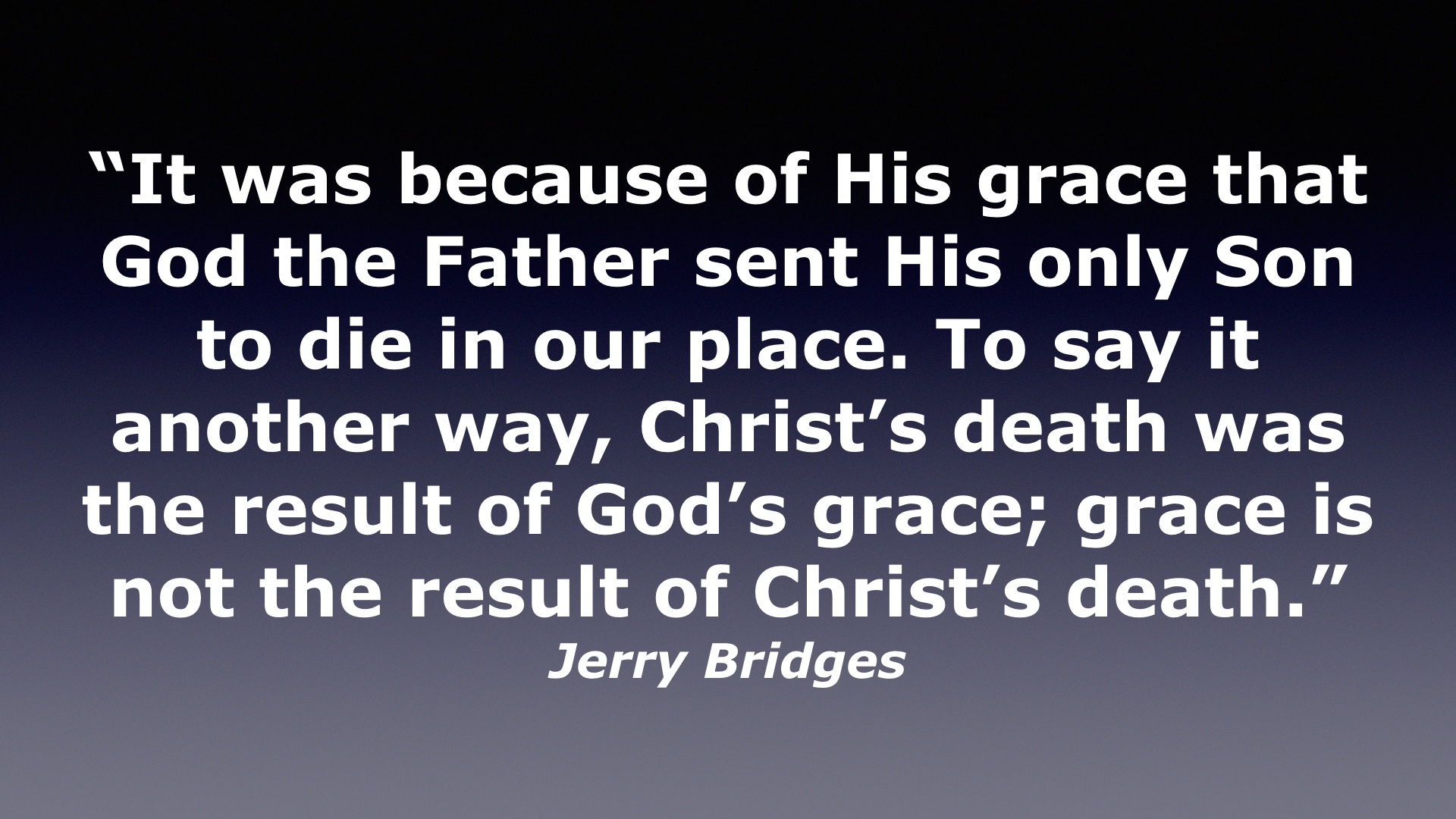
“It was because of His grace that God the Father sent His only Son to die in our place. To say it another way, Christ’s death was the result of God’s grace; grace is not the result of Christ’s death.” —Jerry Bridges

God had been showing us His love throughout the Old Testament period, but the Advent of Jesus made it abundantly and unmistakably clear that God is for us! 

Check out how Luke focuses on God’s favor in a way that no other Gospel writer does:

  • John (the one who would announce the arrival of Jesus) means Jehovah is a gracious Giver.
  • Elizabeth (John’s mother) said that God had not only shown His favor to her by making her pregnant, but she also said God had removed her disgrace. 
  • Mary (the mother of Jesus) was greeted by the angel with the phrases “You are highly favored” and “You have found favor with God.” 
  • On the night of Christ’s birth, the angels sang, “Glory to God in the highest heaven, and on earth peace to those on whom His favor rests.” 
  • Jesus, in His first public sermon, quoted Isaiah’s words, saying He had come to proclaim God’s favor. 

But please notice this truth—We don’t try to find or earn God’s favor. It’s already there; we just need to realize it’s there! 

You see, we don’t grow in God’s favor, nor do we get more favor, but we progressively become more deeply and intimately acquainted with God’s favor that is already there. Check out what Moses said:

If I have found favor in Your sight, show me now Your way, that I may know You progressively become more deeply and intimately acquainted with You, perceiving and recognizing and understanding more strongly and clearly and that I may find favor in Your sight (Exodus 33:13)

The angel said to Mary, “You are HIGHLY FAVORED” (Luke 1:28). God uses the same word when He says to us: God made us ACCEPTED in the Beloved (Ephesians 1:6). 

How can this be?? Because on the Cross, Jesus switched places with us. He took all our sin and DISgrace, and gave us all of His righteousness. Now when God the Father looks at us, all He sees is the righteousness of His Son. Now all praise to God for His wonderful kindness to us and His favor that He has poured out upon us because we belong to His dearly loved Son (TLB).

God’s grace is undiminished. It is as full today as it ever has been. God could never love you more than He already does. God could never love you less because of anything you do. Keep your eyes on Him and you will find just how much favor He has for you! 

Join me this Sunday either in person or on Facebook Live as we continue to learn more about God’s favor. 

God Is For You!

I’m going to make a statement that might shock some people. 

Some of you who have been around Christianity might have heard this before, and you may even mentally agree with it. But even people who mentally agree with it want to add a “Yeah, but…” to it. Or they mentally agree with it but don’t live like it’s true. 

Ready? Here it is … 

God is for you.

Far too many people mistakenly think God is looking for an opportunity to punish them; He’s trying to catch them doing something wrong; He’s perched on the edge of heaven with lightning bolts of judgment in His hand. God doesn’t want to blast you; He wants to bless you! 

Although the word favor appears quite frequently in Scripture, God’s favor is also implied in the word grace, which means God’s unmerited favor. 

It’s unmerited because none of us is worthy of God’s favor; it’s not something anyone can earn. We have all sinned, and therefore we’re all worthy of the death penalty. Every single one of us! 

I have worshipped idols, I have blasphemed God’s name, I have broken the Sabbath, I have dishonored my parents, I have coveted, I have lied, I have committed adultery, and I have murdered. And so have you (see James 2:10).

Do you understand what Jesus did for us on the Cross? HE SWITCHED PLACES WITH US!

Jesus became my sin, and He made it possible for me to become His righteousness (2 Corinthians 5:21). Check this out: 

For God took the sinless Christ and poured into Him our sins. Then, in exchange, He poured God’s goodness into us!

“It was because of His grace that God the Father sent His only Son to die in our place. To say it another way, Christ’s death was the result of God’s grace; grace is not the result of Christ’s death.” —Jerry Bridges

Don’t allow the devil’s lies of your unworthiness keep you from missing out on this truth. All of us are unworthy of God’s favor. But God demonstrated that He was for us when Jesus died on the Cross in our place. Now there is no more guilt, no more condemnation, absolutely nothing standing in the way of all of God’s unmerited favor because 

GOD IS FOR YOU! 

Join me next Sunday as we continue with our series called God’s Favor. You can either join me in person or on Facebook Live.

God’s Favor

What if I were to tell you that God is for you? 

What if I were to tell you that God wants to bless you? 

What if I were to tell you that God’s favor is constantly pursuing you? 

Well, here’s me telling you that it’s all true! 

“Since God did not spare even His own Son but gave Him up for us all, won’t He also give us everything else?” (Romans 8:32). 

Why would God do this? Because if you feel distant from Him, how can you glorify Him? If you feel disconnected from His love, how will you draw others to Him? If you feel like your relationship with Him is hanging by a thread, how can you happily abide in His presence? 

Knowing God’s favor is the key to living the abundant life Jesus purchased for you on the Cross! 

Join me this Sunday as we begin a new series exploring the wonderful depths of God’s favor. You can join me in person at Calvary Assembly of God, or tune in on Facebook Live at 10:30am Sunday morning.

If you missed any of the messages in this series, you can catch up here:

A.L.I.V.E.—The “E” Is For Engagement Of Christ’s Followers

Let’s get some insight into the Greco-Roman and Jewish mindsets of the first century AD. Specifically, the mindset of men. 

There is a well-known letter written June 17, 1 BC, from a man named Hilarion, who was gone off to Alexandria, to his wife Alis, whom he has left at home. He writes to her: “If—good luck to you—you bear a child, if it is a boy, let it live; if it is a girl, throw it out.” This letter captures the male-dominated mindset in the Roman world concerning women and children. In a word: inferior or even disposable. 

This mindset wasn’t limited to the world the Jews called “pagan,” but it was prevalent in Judaism too. Every day Jewish men began their morning prayer time with, “God, I thank You that You did not make me a Gentile, a slave, or a woman.” 

With this background, it makes it startling that a Jewish man (who prayed that prayer thousands of times) writing to people in Rome (who undoubtedly had the same mindset as Hilarion), begins his list of thank you notes with gratitude to two women! Paul goes on to list no less than 8 women, even giving preferential treatment to a wife (Priscilla) over her husband (Aquila) when he mentions her name first! (see Romans 16:1-4, 6, 12).

William Barclay wrote, “Anyone who asks the question: ‘What has Christianity done for the world?’ has delivered himself into a Christian debater’s hands. There is nothing in history so unanswerably demonstrable as the transforming power of Christianity and of Christ on the individual life and on the life of society.”

Indeed Christians changed the lives of at least four groups:

  1. Women (especially in the role of marriage)—divorce was so common that it was neither unusual nor particularly blameworthy for a woman to have a new husband every year. Yet Christians taught men to esteem their wives and for marriage to be honored by everyone (Ephesians 5:28; Hebrews 13:4). 
  2. Children—who weren’t even considered a part of the family until they had grown up and proven their worth to the father. Yet Christians taught fathers to nurture their children (Ephesians 6:4).
  3. Senior citizens—the pragmatic Romans had little to do with those they considered less valuable. But the first blind asylum was founded by Thalasius, a Christian monk; the first free medical dispensary was founded by Apollonius, a Christian merchant; the first hospital of which there is any record was founded by Fabiola, a Christian lady.
  4. The weak and sick—when a plague hit Rome, all the young, healthy people left the sick and elderly behind. They ran away, but the Christians stayed to help. The Christians taught that everyone (regardless of age, sex, or wealth) was valuable (1 Timothy 5:1-2). 

That was just the start of Christianity. Men like William Wilberforce and Abraham Lincoln were Christians who opposed slavery; Clara Barton was nicknamed “the angel of the battlefield” and founded the Red Cross; Paul Brand was a doctor who ran to leprosy patients when everyone else shunned them; Mother Teresa loved those poor, dying souls whom others ignored. 

So what’s your conclusion? Throughout history Christians have been martyred for their faith, but not only are they willing to die for their belief that Jesus is alive, but they continue to do good to those who persecute them. Would people do this to perpetuate a hoax? Or does this sound more like the real deal?

Please check out the other evidence I have presented for the resurrection of Jesus:

A.L.I.V.E.—The “V” Is For Verified Prophecy

This is part 4 in my 5-part series, “I can know Jesus is A.L.I.V.E. because of ….” I have already addressed A—Apologetics, L—Lives changed, and I—It is finished. Today I want to consider the prophecies that the life, death, and resurrection of Jesus supposedly fulfilled. 

We have all heard about “copycat” crimes. Could the life and death of Jesus fit that? Since Jesus was born from the family line of King David, and His family really wanted the promised Messiah to finally appear, perhaps He was pushed that way. Perhaps He lived in a certain way to make it look like He was fulfilling prophecy. 

Detective J. Warner Wallace wrote, “Homicide detectives are perhaps the least trusting people in the world. My own experience investigating murders has taught me to consider everyone a liar—until, at least, I have good reason to believe otherwise.” 

So was Jesus a liar? Was He following some copycat script to make it merely look like He was the Messiah? Or do we have good reasons to believe He was telling the truth? Consider three points—

  • How could David describe a crucifixion scene in 1000 BC, since the Persians didn’t invent it until around 400 BC (see Psalm 22:12-18)?
  • How could Jesus control others’ actions (i.e. Judas’ betrayal; being killed by crucifixion, not by stoning; soldiers gambling for His clothes)? 
  • Even His own followers—whom He would need to perpetrate the hoax—didn’t understand what He was doing (John 12:16). 

Prosecutors have to present enough evidence to convince a jury that they have arrested and brought to trial the right man. One of the key terms is beyond a reasonable doubt—“a part of jury instructions in all criminal trials, in which the jurors are told that they can only find the defendant guilty if they are convinced ‘beyond a reasonable doubt’ of his or her guilt.” 

Let’s consider a hypothetical case that a prosecutor might present: 

  • multiple eyewitnesses saw a man fleeing the scene, and all of them identified the suspect in a police line-up
  • the shoe prints at the crime scene were the same size and design that of the suspect was wearing when he was arrested
  • prosecutors presented text messages in which the suspect threatened to do to the victim exactly what was done to the victim
  • the wounds made by the weapon which was used on the victim correspond with the weapon the police found in the suspect’s car
  • the blood on that weapon matched the blood of the victim
  • the fingerprints on that weapon are the suspect’s fingerprints

That is the evidence. From that evidence, the jury is asked to draw inferences about the reasonableness of that suspect being the one who committed the crime. 

I have listed just six pieces of evidence. How strong do you think the prosecutor’s case is? What if the jurors were presented with 50 pieces of evidence? What about 100? 200? How about 300 pieces of evidence? 

Jesus fulfilled at least 300 prophecies—which were made before He was born!—in His life, death, and resurrection!

Math professor Peter Stoner calculated that the odds for just one man in history to fulfill only 8 prophecies is 1-in-1×10¹⁷. How amazing is that!? To give us a little perspective, Stoner says that 1×10¹⁷ silver dollars would cover the entire state of Texas in silver dollars two-feet thick. If just one of those silver dollars was marked, and a blindfolded man could select that one marked coin on his very first attempt, that would be about the same odds of Jesus fulfilling only 8 prophecies. 

As a juror, if you weighed this evidence, do you find enough proof to “convict” Jesus? 

But ultimately Jesus didn’t come just to fulfill prophecy; He came to rescue you and me from the penalty of our sin (Luke 4:16-21), and that is the best news of all! 

Join me either in person or on Facebook Live this Sunday for the final message in this 5-part series. 

A.L.I.V.E.—The “I” Is For It Is Finished

Throughout history, lots of martyrs have died for what they believe. But only One had been resurrected from the dead to prove that what He believed and taught was true.

Jesus, however, is not a martyr. His life and His work weren’t cut short. Calvary didn’t happen to Jesus, but He came specifically to die on a Cross. He knew what was going to happen to Him. Check this out…

So we can know Jesus is alive by His “It is finished” declaration from the Cross—

Later, knowing that everything had now been finished, and so that Scripture would be fulfilled, Jesus said, “I am thirsty.” … When He had received the drink, Jesus said, “It is finished.”

Actually His “It is finished” wasn’t just a statement, it was a yell that reverberated throughout the countryside. The Greek words Mark uses are megas phōnē, which sounds a lot like our word megaphone. Jesus wanted to make sure everyone heard Him, and then look at the result:

Then Jesus uttered another loud cry and breathed His last. And the curtain in the sanctuary of the Temple was torn in two, from top to bottom.

The curtain that separated God’s presence from mankind was torn in two. The writer of Hebrews notes, “Our High Priest offered Himself to God as a single sacrifice for sins, good for all time. Then He sat down in the place of honor at God’s right hand.”

What do you conclude from all this? C.S. Lewis offered this challenge:

“A man who was merely a man and said the sort of things Jesus said would not be a great man or a moral teacher. He would either be a lunatic—on the level with the man who says he is a poached egg—or else he would be the devil of hell. You must take your choice. Either this was, and is, the Son of God; or else a madman or something worse. You can shut Him up for a fool… or you can fall at His feet and call Him Lord and God. But let us not come with any patronizing nonsense about His being a great human teacher. He has not left that open to us.”

Jesus told us that He would die, how He would die, when He would die, why He would die, and that He would be resurrected. If you heard all of these claims before His crucifixion, you might think He was a lunatic or a braggart. But after His It Is Finished! declaration, we have only one logical conclusion: Jesus is exactly who He said He was. It was out of love for you that Jesus laid down His life and picked it up again. Will you put your faith in Him today?

We are working our way through 5-parts of this series: “I can know Jesus is A.L.I.V.E. because of….” We’ve already covered: