12 More Quotes From “Ordering Your Private World”

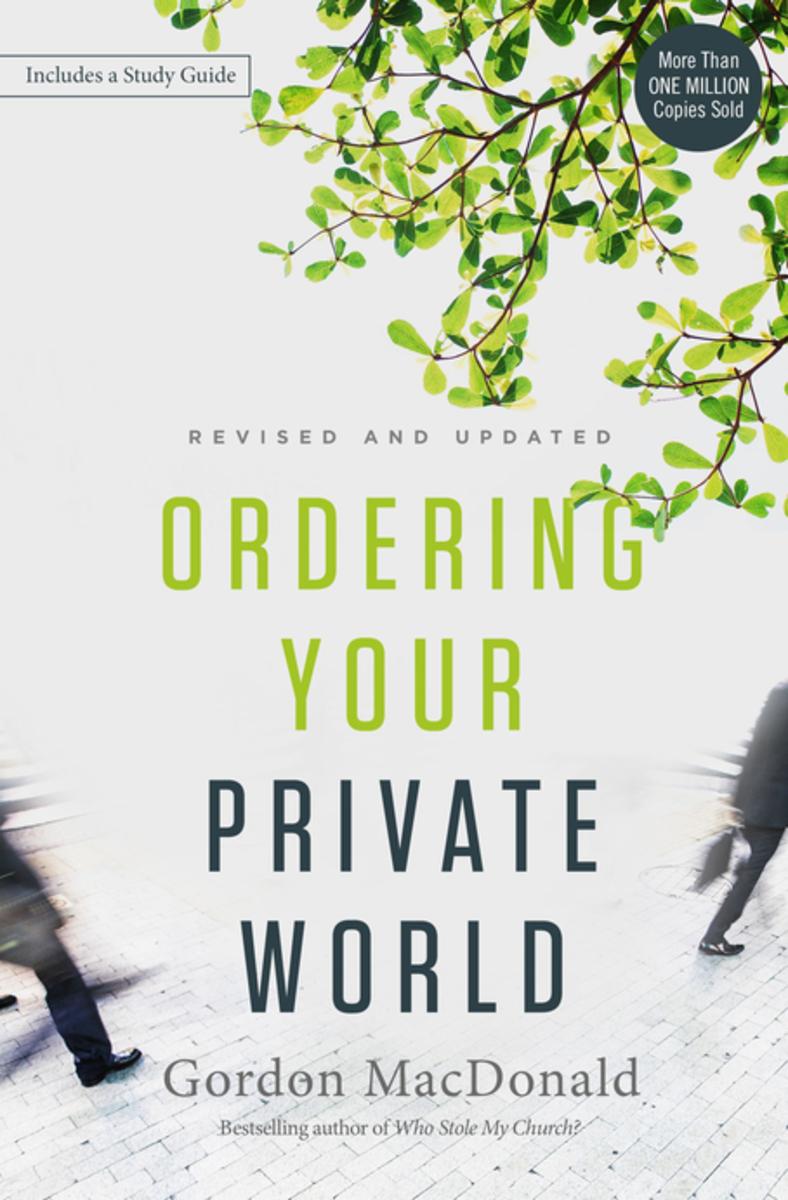
Gordon MacDonald did a phenomenal job synthesizing biblical principles as he teaches us how to pay attention to our private, inner world. One of the things I enjoyed was the number of other authors and teachers he quotes throughout Ordering Your Private World. Here are a few of those quotes he shared…

“The battle is lost or won in the secret places of the will before God, never first in the external world. … Nothing has any power over the man who has fought out the battle before God and won there. … I must get the things settled between myself and God in the secret places of my soul where no stranger intermeddles, and then I can go forth with the certainty that the battle is won.” —Oswald Chambers

“I took pleasure where it pleased me, and passed on. I forgot that every little action of the common day makes or unmakes character, and that therefore what one has done in the secret chamber, one has some day to cry aloud from the house-top. I ceased to be lord over myself. I was no longer the captain of my soul, and did not know it. I allowed pleasure to dominate me. I ended in horrible disgrace.” —Oscar Wilde 

“Think of no other greatness but that of the soul, no other riches but those of the heart.” —John Quincy Adams, in a letter to his daughter

“A public man, though he is necessarily available at many times, must learn to hide. If he is always available, he is not worth enough when he is available.” —Elton Trueblood

“Remember a long life of steady, consistent, holy labor will produce twice as much fruit as one shortened and destroyed by spasmodic and extravagant exertions; be careful and sparing of your strength when and where exertion is unnecessary.” —Catherine Booth, in a letter to her husband William Booth, founder of the Salvation Army

“There can be intemperance in work just as in drink. What feels like zeal may be only fidgets or even the flattering of one’s self-importance.” —C.S. Lewis

“The man of action has the present, but the thinker controls the future.” —Oliver Wendell Holmes

“No other pleasure suits every occasion, every age or every place. But the study of letters is the food of youth, the delight of old age, a delight at home and no burden abroad; it stays with us at night, and goes with us on our travels, near and far.” —Cicero

“We need to find God, and He cannot be found in noise and restlessness. God is the friend of silence. See how nature—trees, flowers, grass—grow in silence; see the stars, the moon and sun, how they move in silence…. The more we receive in silent prayer, the more we can give in our active life. We need silence to be able to touch souls. The essential thing is not what we say, but what God says to us and through us. All our words will be useless unless they come from within—words which do not give the light of Christ increase the darkness.” —Mother Teresa

“St. Augustine says, ‘God gives where He finds empty hands.’ A man whose hands are full of parcels can’t receive a gift. Perhaps these parcels are not always sins or earthly cares, but sometimes our own fussy attempts to worship Him in our way. Incidentally, what most often interrupts my own prayers is not great distractions but tiny ones—things one will have to do or avoid in the course of the next hour.” —C.S. Lewis

“Let inward prayer be your last act before you fall asleep and the first act when you awake.” —Thomas Kelly

“I know that there are certain mental and emotional and moral and spiritual attitudes that are anti-health: anger, resentments, fear, worry, desire to dominate, self-preoccupation, guilts, sexual impurity, jealousy, a lack of creative activity, inferiorities, a lack of love. These are the twelve apostles of ill health. So in prayer I’ve learned to surrender these things to Jesus Christ as they appear.” —E. Stanley Jones

You can check out my review of Gordon MacDonald’s Order Your Private World by clicking here. And you can read some quotes from Gordon by clicking here.

C.S. Lewis Asks, Is There Such A Thing As “Christian Obstinacy”?

“There are times when we can do all that a fellow creature needs if only he will trust us. In getting a dog out of a trap, in extracting a thorn from a child’s finger, in teaching a boy to swim or rescuing one who can’t, in getting a frightened beginner over a nasty place on a mountain, the one fatal obstacle may be their distrust. We are asking them to trust us in the teeth of their senses, their imagination, and their intelligence. We ask them to believe that what is painful will relieve their pain and that what looks dangerous is their only safety. We ask them to accept apparent impossibilities: that moving the paw farther back into the trap is the way to get it out—that hurting the finger very much more will stop the finger hurting—that water which is obviously permeable will resist and support the body—that holding onto the only support within reach is not the way to avoid sinking—that to go higher and onto a more exposed ledge is the way not to fall. …

“But if we succeed, we do so because they have maintained their faith in us against apparently contrary evidence. …

“Now to accept the Christian propositions is ipso facto to believe that we are to God, always, as that dog or child or bather or mountain climber was to us, only very much more so. …

“There is, you see, no real parallel between Christian obstinacy in faith and the obstinacy of a bad scientist trying to preserve a hypothesis although the evidence has turned against it. Unbelievers very pardonably get the impression that an adherence to our faith is like that, because they meet Christianity, if at all, mainly in apologetic works. And there, of course, the existence and beneficence of God must appear as a speculative question like any other. Indeed, it is a speculative question as long as it is a question at all. But once it has been answered in the affirmative, you get quite a new situation. To believe that God—at least this God—exists is to believe that you as a person now stand in the presence of God as a Person. What would, a moment before, have been variations in opinion, now become variations in your personal attitude to a Person. You are no longer faced with an argument which demands your assent, but with a Person who demands your confidence.” —C.S. Lewis, in The World’s Last Night

8 Quotes From “The World’s Last Night”

In seven essays expressly shared to get the reader to think in terms of eternity, C.S. Lewis masterfully practices his craft. Check out my full book review of The World’s Last Night by clicking here. Below is just a small sampling of a few of the outstanding quotes in this book.

“Simply to say prayers is not to pray; otherwise a team of properly trained parrots would serve as well as men.”

“Prayer is not a machine. It is not magic. It is not advice offered to God. Our act, when we pray, must not, any more than all our other acts, be separated from the continuous act of God Himself, in which alone all finite causes operate.”

“Scientists are mainly concerned not with believing things but with finding things out. And no one, to the best of my knowledge, uses the word believe about things he has found out. The doctor says he ‘believes’ a man was poisoned before he has examined the body; after the examination, he says the man was poisoned. No one says that he believes the multiplication table. No one who catches a thief red-handed says he believes that man was stealing. The scientist, when at work, that is, when he is a scientist, is labouring to escape from belief and unbelief into knowledge. Of course he uses hypotheses or supposals. I do not think these are beliefs.”

“Since most men, as Aristotle observed, do not like to be merely equal with all other men, we find all sorts of people building themselves into groups within which they can feel superior to the mass.”

“‘Good works’ in the plural is an expression much more familiar to modern Christendom than ‘good work.’ Good works are chiefly alms-giving or ‘helping’ in the parish. They are quite separate from one’s ‘work.’ And good works need not be good work, as anyone can see by inspecting some of the objects made to be sold at bazaars for charitable purposes. This is not according to our example. When our Lord provided a poor wedding party with an extra glass of wine all round, He was doing good works. But also good work; it was a wine really worth drinking.”

“Christ died for men precisely because men are not worth dying for; to make them worth it.”

“It would be difficult, and, to me, repellent, to suppose that Jesus never asked a genuine question, that is, a question to which He did not know the answer. That would make of His humanity something so unlike ours as scarcely to deserve the name. I find it easier to believe that when He said ‘Who touched Me?’ (Luke 7:45) He really wanted to know.”

“For what comes [after Christ’s Second Coming] is Judgment: happy are those whom it finds labouring in their vocations, whether they were merely going out to feed the pigs or laying good plans to deliver humanity a hundred years hence from some great evil. The curtain has indeed now fallen. Those pigs will never in fact be fed, the great campaign against White Slavery or Governmental Tyranny will never in fact proceed to victory. No matter; you were at your post when the Inspection came.”

The World’s Last Night (book review)

I am a huge C.S. Lewis fan! His perspective on the spiritual world is unequaled in any other author I have read. In The World’s Last Night, Lewis shares seven essays ranging from how our prayers really impact things, to life on other planets, to the end of our world as we know it.

The title of this book (and the title of the concluding chapter) are taken from a question by John Donne: “What if this present were the world’s last night?” So all of Lewis’ essays are written from that perspective. If this is the world’s last night, why should we keep praying? If demons knew this was the world’s last night, why would they keep on tempting? If atheists knew this was the world’s last night, would they keep arguing the same way?

As with all of his writings, C.S. Lewis has a unique knack of giving his readers a perspective that is totally original. His skills in philosophy, literature, and understanding the human heart are unparalleled! If you are ready to have your horizons expanded, these essays will not disappoint!

(And for any fans of The Screwtape Letters, Screwtape himself makes a special appearance as he gives a toast in hell that is sure to evoke both smiles and chagrins.)

No Room For God?

My friend Scott delivered a right-between-the-eyes message yesterday. Here are my takeaways.

Quite possibly the deadliest of the relationship killers is pride.

Think of all the ugly things surrounding Pride:

  • Always fault-finding
  • Always defensive
  • Constantly craving attention
  • Disregarding advice
  • Saying “I’m better than you!”
  • Saying “I don’t need your help!”
  • Quick to tell others “Here’s how you should do that”
  • Can’t handle any constructive criticism
  • But always critical of others

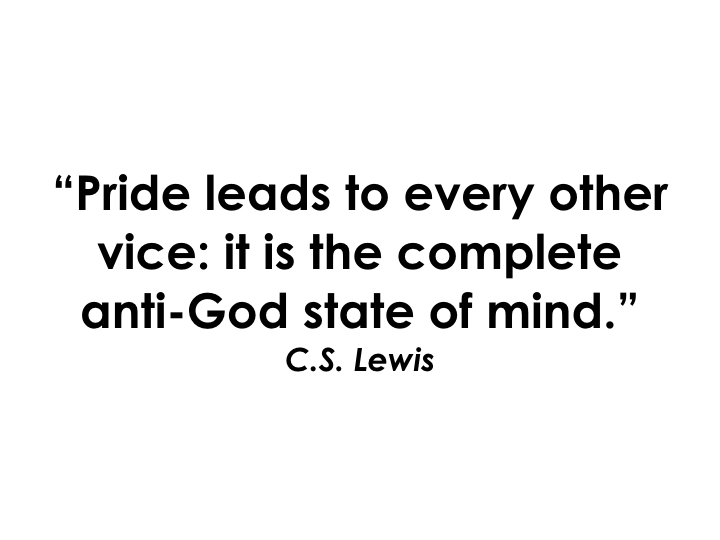
In fact, C.S. Lewis said, “Pride leads to every other vice: it is the complete anti-God state of mind.”

One psalmist got right to the root of the problem of pride when he wrote—

In his pride the wicked does not seek Him; in all his thoughts there is no room for God. (Psalm 10:4)

No room for God?!

The Bible is all about relationships. Adam was first created to be in a relationship with God, and then Eve was created so she and Adam could be in a relationship with each other. Jesus reiterated this when He was asked what the greatest commandment was, and He said, “Love God with all your heart, mind and soul.”

But if Pride rules in my heart, and there is no room for God, how can I love Him with all I’ve got? The simple answer is: I can’t.

Jesus quickly added that the next greatest commandment also revolved around relationships when He said, “And love your neighbor as yourself.”

If my proud heart is filled with prideful love, it cannot be filled with God’s love.

If my pride-filled heart has no room for God’s love, then it has no room to love anyone else.

Pride kills every relationship.

Jesus had absolutely no trace of pride when He set aside all His heavenly privileges and came to earth as a Human (Philippians 2:6-8). The Apostle Paul then tells us that our attitude should be the same as Christ’s attitude.

Humility kills pride!

Are you filled with pride? Ask yourself some of these questions:

  • Do I have a problem submitting to authority?
  • When I get into an argument, do I always have to have the last word?
  • Am I willing to accept blame?
  • Can I ask for forgiveness, or am I always right?
  • Do I sometimes cheat at a game just so I can win?
  • If I lose, is it someone else’s fault?
  • If I win, do I brag about how good I am?
  • Do I think I’m the only one who can solve all my own issues?
  • Do I think I can solve everyone else’s issues too?

If you found yourself saying “yes” to these questions it’s probably time to ask the Holy Spirit to do a heart-check on your level of pride. Make sure that in your heart there is increasingly more room for God.

Relationship Builders And Killers

C.S. Lewis reminds us that there is no such thing as a neutral encounter with other people…

“It is a serious thing to live in a society of possible gods and goddesses, to remember that the dullest and most uninteresting person you talk to may one day be a creature which, if you saw it now, you would be strongly tempted to worship, or else a horror and a corruption such as you now meet, if at all, only in a nightmare. All day long we are, in some degree, helping each other to one of these destinations.” —C.S. Lewis

Wow! Think about it: Relationships with other people are what helps us and others grow toward heaven or shrink toward hell.

Fortunately the Bible has a lot to say to us about relationship builders and relationship killers. The builders help us form and nurture relationships that honor God and move others forward, and the killers destroy potentially life-giving relationships while dishonoring God’s design for us.

I hope you will join me this Sunday at Calvary Assembly of God as we begin to identify both the relationship builders that can help us grow, and the relationship killers that are holding us back. It’s going to be an eye-opening journey!

If you missed any of the messages in this series, you can check them out here:

Thinking Christianly

“If you read history you will find that the Christians who did most for the present world were just those who thought most of the next. The Apostles themselves, who set on foot the conversion of the Roman Empire, the great men who built up the Middle Ages, the English Evangelicals who abolished the Slave Trade, all left their mark on Earth, precisely because their minds were occupied with heaven. It is since Christians have largely ceased to think of the other world that they have become so ineffective in this.” —C.S. Lewis

“To think secularly is to think within a frame of reference bounded by the limits of our life on earth: it is to keep one’s calculations within this-worldly criteria. To think christianly is to accept all things with the mind as related, directly or indirectly, to man’s eternal destiny as the redeemed and chosen child of God…. There is nothing in our experience, however trivial, worldly, or even evil, which cannot be thought about christianly.” —Harry Blamires

Most of us do not think; we live healthy ordinary lives and don’t bother about thinking at all; but when an upheaval comes from underneath proving that the basis of things is not rational, we find the value of the Bible attitude, which is that the basis of things is tragic and not rational…. We have to live based on our relationship to God in the actual condition of things as they are.” —Oswald Chambers

God wants a child’s heart, but a grownup’s head. He wants us to be simple, single-minded, affectionate, and teachable, as a good children are; but He also wants every bit of intelligence we have to be alert at its job, and in first-class fighting trim.” —C.S. Lewis

“Don’t let anyone capture you with empty philosophies and high-sounding nonsense that come from human thinking and from the spiritual powers of this world, rather than from Christ.” —Apostle Paul (Colossians 2:8)

“We do not think on the basis of Christianity at all. We are taught to think like pagans for six days a week and to reverse the order for one day, consequently in critical moments we think as pagans and our religion is left in the limbo of the inarticulate.” —Oswald Chambers

[Emphasis in these quotes added by me]

To read thought-provoking quotes like this every day, please follow me on Twitter and Tumblr.

Jesus—100% God And 100% Human

Listen to the podcast of this post by clicking on the player below, and you can also subscribe on AppleSpotify, or Audible.

On paper, it seems so simple: “We believe in the Deity of the Lord Jesus Christ. As God’s Son, Jesus was both human and divine.” But trying to wrap our finite human minds around the concept of the full humanity and the full deity of Jesus is challenging!

First off, Jesus was fully human. Both Matthew and Luke record details about Christ’s physical birth, and the writer of Hebrews says that Jesus was made every bit as human as us (Hebrews 2:17).

But Jesus was also fully God. John records how God became flesh in the Person of Jesus (John 1:1-2, 14), and Paul tells us how Jesus chose not to use His deity when He came to earth as a human (Philippians 2:6-8).

I know that anytime we say, “God is like…” we’ve already sold ourselves short, but I’d like to try one analogy that’s been helpful for me.

Imagine a coin that has two distinct sides. While we are looking at one side (heads), we cannot see the other side (tails) but that doesn’t mean the other side has ceased to exist. In fact, if we were able to split that coin in half, so that there was only a heads and a tails, we haven’t cut the value of the coin in half, but we’ve made the coin of no value at all! 

In the Greek language of the New Testament, there are a couple of words for “knowing”: one is gnosis and the other oido. Together these words combine head knowledge and heart knowledge, or knowledge by study and knowledge by experience.

C.S. Lewis captures the idea this way: “It is Christ Himself, not the Bible, who is the true Word of God. The Bible, read in the right spirit and with the guidance of good teachers, will bring us to Him.”

Just as Jesus was both God and Man, we are to use both our mind and our heart to know Him.

To focus on the “heads” side—the deity of Jesus—is to pervert gnosis into gnosticism, and deny the humanity of Jesus. To focus on the “tails” side—the humanity of Jesus—is to pervert gnosis into agnosticism, and deny the deity of Jesus. True gnosis keeps both sides in mind: Deity and humanity.

To truly know THE Word of God (Jesus) in all His humanity and in all His deity, we need to study the Word of God. We also need the help of the Holy Spirit. I like the Old English wording of this verse—Ye have an unction [charisma] from the Holy One, and ye know [gnosis] all things (1 John 2:20).

So read your Bible, but not just to read your Bible. Ask the Holy Spirit to make THE Word known to you. Live in the balance of gnosis as you get to know Jesus more deeply and personally.

(When Jesus proclaimed His “I Am” statements in the New Testament, He was tying Himself to all of the “Jehovah” titles of the Old Testament. Check out I Am Jehovah.)

This post is a part of our series studying our foundational beliefs. If you would like to read more about the first foundational beliefs we have discussed, check out this post on the inspiration of Scripture, and this post on the Trinity.

►► Would you please prayerfully consider supporting this ministry? My Patreon supporters get behind-the-scenes access to exclusive materials. ◀︎◀︎

The Delight Of Praise

C.S. Lewis at his desk“Just as men spontaneously praise whatever they value, so they spontaneously urge us to join them in praising it. ‘Isn’t she lovely? Wasn’t it glorious? Don’t you think that magnificent?’ The Psalmists in telling everyone to praise God are doing what all men do when they speak of what they care about.

“My whole, more general, difficulty about the praise of God depended on my absurdly denying to us, as regards the supremely Valuable, what we delight to do, what indeed we can’t help doing, about everything else we value. I think we delight to praise what we enjoy because the praise not merely expresses but completes the enjoyment; it is its appointed consummation. It is not out of compliment that lovers keep on telling one another how beautiful they are; the delight is incomplete till it is expressed. … This is so even when our expressions are inadequate, as of course they usually are. But how if one could really and fully praise even such things to perfection—utterly ‘get out’ in poetry or music or pain the upsurge of appreciation which almost bursts you? Then indeed the object would be fully appreciated and our delight would have attained perfect development. The worthier the object, the more intense this delight would be.” —C.S. Lewis, in Reflections On The Psalms

10 Quotes From C.S. Lewis

C.S. Lewis(When is it ever not a good day to share C.S. Lewis quotes?!)

“There is either a warning or an encouragement here for every one of us. If you are a nice person—if virtue comes easily to you—beware! Much is expected from those to whom much is given. If you mistake for your own merits what are really God’s gifts to you through nature, and if you are contented with simply being nice, you are still a rebel: and all those gifts will only make your fall more terrible, your corruption more complicated, your bad example more disastrous. The devil was an archangel once; his natural gifts were as far above yours as yours are above those of a chimpanzee.” —C.S. Lewis 

“The monstrosity of sexual intercourse outside marriage is that those who indulge in it are trying to isolate one kind of union (the sexual) from all the other kinds of union which were intended to go along with it and make up the total union. …You must not isolate that pleasure and try to get it by itself, any more than you ought to try to get the pleasures of taste without swallowing and digesting, by chewing things and spitting them out again.” —C.S. Lewis

“On the contrary, those who are seriously attempting chastity are more conscious, and soon know a great deal more about their own sexuality than anyone else. They come to know their desires as Wellington knew Napoleon, or as Sherlock Holmes knew Moriarty; as a rat-catcher knows rats or a plumber knows about leaky pipes. Virtue—even attempted virtue—brings light; indulgence brings fog.” —C.S. Lewis

“For there are two things inside me, competing with the human self which I must try to become. They are the Animal self, and the Diabolical self. The Diabolical self is the worse of the two. That is why a cold, self-righteous prig who goes regularly to church may be far nearer to hell than a prostitute. But, of  course, it is better to be neither.” —C.S. Lewis

 “A great deal of our anxiety to make excuses comes from not really believing in it, from thinking that God will not take us to Himself again unless he is satisfied that some sort of case can be made out in our favor. But that would not be forgiveness at all. Real forgiveness means looking steadily at the sin, the sin that is left over without any excuse, after all allowances have been made, and seeing it in all its horror, dirt, meanness, and malice, and nevertheless being wholly reconciled to the man who has done it. That, and only that, is forgiveness, and that we can always have from God if we ask for it.” —C.S. Lewis 

“To be a Christian means to forgive the inexcusable, because God has forgiven the inexcusable in you.” —C.S. Lewis

“The human lives in time but our enemy destines them to eternity. He therefore, I believe, wants them to attend chiefly to two things, to eternity itself, and to that point of time which they call the Present. For the Present is the point at which time touches eternity. Of the present moment, and of it only, humans have an experience analogous to the experience which our Enemy has of reality as a whole; in it alone freedom and actuality are offered them. He would therefore have them continually concerned either with eternity (which means being concerned with Him) or with the Present—either meditating on their eternal union with, or separation from, Himself, or else obeying the present voice of conscience, bearing the present cross, receiving the present grace, giving thanks for the present pleasure.” —C.S. Lewis

“War creates no absolutely new situation; it simply aggravates the permanent human situation so that we can no longer ignore it.” —C.S. Lewis

“The rescue of drowning men is, then, a duty worth dying for, but not worth living for.” —C.S. Lewis

“Christianity does not simply replace our natural life and substitute a new one; it is rather a new organization which exploits, to its own supernatural ends, these natural materials.” —C.S. Lewis