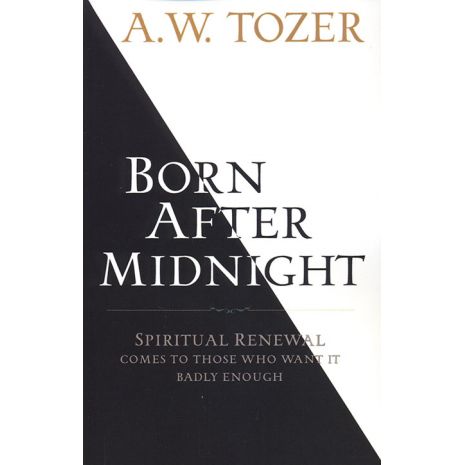
8 Quotes From “Born After Midnight”

A.W. Tozer’s writings are nearly five decades old, but they still ring with prophetic truth for this generation. Check out my book review of Born After Midnight by clicking here. Below are a few of the quotes from this book.

“It may be said without qualification that every man is as holy and as full of the Spirit as he wants to be. He may not be as full as he wishes he were, but he is most certainly as full as he wants to be. … The problem is not to persuade God to fill us, but to want God sufficiently to permit Him to do so.”

“In of book of Acts, faith was for each believer a beginning, not an end; it was a journey, not a bed in which to lie while waiting for the day of our Lord’s triumph. Believing was not a once-done act; it was more than an act, it was an attitude of heart and mind that inspired and enabled the believer to take up his cross and follow the Lamb whithersoever He went.”

“I am afraid we modern Christians are long on talk and short on conduct. … Our Lord and His apostles were long on deeds. The Gospels depict a Man walking in power, ‘who went about doing good, and healing all that were oppressed of the devil; for God was with Him’ (Acts 10:38). The moral relation between words and deeds appears quite plainly in the life and teachings of Christ; He did before He spoke, and all the doing gave validity to the speaking.”

“We settle for words in religion because deeds are too costly. It is easier to pray, ‘Lord, help me to carry my cross daily’ than to pick up the cross and carry it.”

“‘Whoever will be great among you, let him be your minister,’ said our Lord (Matthew 20:26), and from these words, we may properly conclude (and the context strongly supports the conclusion) that there is nothing wrong with the desire to be great provided (1) we seek the right kind of greatness; (2) we allow God to decide what is greatness; (3) we are willing to pay the full price that greatness demands; and (4) we are content to wait for the judgment of God to settle the whole matter of who is great at last.”

“God may allow his servant to succeed when He has disciplined him to a point where he does not need to succeed to be happy. The man who is elated by success and cast down by failure is still a carnal man. … God will allow His servant to succeed when he has learned that success does not make him dearer to God nor more valuable in the total scheme of things.”

“While we cannot determine circumstances, we can determine our reaction to them. And there is where the battle is to be fought and the victory won.”

“To ‘accept the universe’ does not mean that we are to accept evil conditions as inevitable and make no effort to improve them. So to teach would be to cancel the plain teaching of the Scriptures on that point. Where a situation is contrary to the will of God, and there are clear promises concerning it in the Scriptures, it is our privilege and obligation to pray and labor to bring about change.”

More quotes from this book are coming soon…
Pour It Out!

“We can simply pour from the fullness of our heart the burdens of our spirit and the sorrow that seems to crush us. We can know that God hears, loves, understands, receives, and separates from our prayer everything that is in error, imperfect, or wrong. And then He presents the remainder, along with the incense of the great High Priest, before His throne on high.

“We may be assured that our prayer is heard, accepted, and answered in Christ’s name. … Do we truly know the power of our supernatural weapon of prayer? Do we dare to use it with the authority of a faith that not only asks but also commands? God baptizes us with holy boldness and divine confidence, for He is looking not for great people but for people who will dare to prove the greatness of their God!” —A.B. Simpson

[see Romans 8:26-27; Psalm 141:2; Revelation 5:8, 8:3-4]

Praying With The Authority Of The Creator

pray-boldlyJesus had a way of praying that sounds unusual to our ears because He didn’t pray “normal” prayers. His prayers were bold statements! But Jesus also taught us to pray just like He did.

Most prayers that Christians pray sound like they come from the same formula. We may start with something like, “Heavenly Father” or “Dear God.” Then we probably spend some time praising God for His greatness before we make our requests of Him. Often our requests include something like “If this is Your will, I ask You to please heal/help/answer/etc.” And then almost always the prayer concludes, “In Jesus’ name, Amen!”

When Jesus prayed, His prayers sounded more like commands than requests. He would say things like, “Be clean” or “Rise up and walk” or “Blind eyes, be opened.” He usually didn’t ask His Father if it was His will to heal/help/answer/etc. And He never concluded a prayer by saying, “In My name, Amen!”

In Luke 6 there is a story about a man with a withered hand. Jesus healed him by speaking to the man, not to God. He said, “Stretch out your hand,” and when the man did so, his hand was completely restored. Jesus spoke with the authority of the Creator. 

I believe this was possible because Jesus had an unbroken conversation with His Father and the Holy Spirit. Certainly He had set times of prayer (see Mark 1:35, Mark 6:45-46, and Luke 6:12-13 as examples), but Jesus also told us that He only did what His Father told Him to do (John 5:19), and He only said what His Father told Him to say (John 12:49).

I know sometimes people want to say, “Yeah, but this is Jesus we’re talking about! C’mon, He’s the Son of God, so of course He could do these things.” But remember that the miracle of Christ’s Incarnation is that He chose NOT to do these things out of His Deity while He was on Earth, but restricted Himself only to His humanity. That’s why the Bible says that everything we face, Jesus also faced in the flesh (Hebrews 2:14-18).

But perhaps another example from someone who had no Deity in his nature might help. Consider Joshua—this man spent more time in God’s presence, listening to His voice, than even Moses (Exodus 33:11). So when the time came, Joshua could pray an incredibly bold prayer: He actually spoke to the sun and the moon and told them to stand still in the sky, AND THEY OBEYED HIM!

Just like Jesus spoke to the man with the withered hand in the authority of the Creator, Joshua spoke to the sun and the moon in the same authoritative voice. How could these men do that? Because they were familiar with God’s voice, and when He told them to speak out boldly, they simply obeyed.

Jesus said we could pray the same way—Very truly I tell you, whoever believes in Me will do the works I have been doing, and they will do even greater things than these, because I am going to the Father. And I will do whatever you ask in My name, so that the Father may be glorified in the Son. You may ask Me for anything in My name, and I will do it (John 14:12-14, emphasis added).

How can we learn to pray this boldly? We need to spend more and more time in dialogue with God. We need to become increasingly aware of the His abiding presence with us. Then we, too, can pray in the Creator’s authority.

Praying this way glorifies God!

Get together with a friend this week and work through these application questions:

  1. Am I spending time in planned prayer and Bible reading?
  2. How can I make myself more aware of God’s perpetual presence?
  3. What’s holding me back from praying more boldly?

F.B. Meyer On The Access God Gives Us

F.B. Meyer“Think how often Jesus, during His earthly ministry, put others in a position to command Him. ‘As Jesus and His disciples were leaving Jericho,’ Jesus stopped and responded to two blind men who had called out to Him. ‘What do you want Me to do for you?’ (Matthew 20:29, 32). It was as though He said, ‘I am yours to command.’ Could we ever forget how Jesus yielded the keys to His resources to the Greek woman from Syrian Phoenicia because of her reply to Him? In effect, He told her to help herself to all that she needed (see Mark 7:24-30). What human mind can fully realize the total significance of the lofty position to which God lovingly raises His little children? He seems to be saying, ‘All My resources are at your command.’ And I will do whatever you ask in My name (John 14:13).” —F.B. Meyer

Links & Quotes

link quote

“The Kingdom of God is Good News because it ushers all who receive it into God’s good plan for their lives, a plan which brings them, among other things, pleasures forevermore (Psalm 16:11).” —T.M. Moore

“Remember a little more the intimate connection between the body and the soul. Go to the poor man and tell him of the bread of heaven, but first give him the bread of earth, for how shall he hear you with a starving body?” —Charles Spurgeon

“We must open our Bibles every morning with this prayer—‘Give us this day our daily bread.’” —Charles Spurgeon

“The Lord rebukes his people for seeking ‘their own’ pleasure on His holy day [Isaiah 58:3-4]. But what does He mean? He means they are delighting in their business and not in the beauty of their God. He does not rebuke their hedonism. He rebukes the weakness of it. They have settled for secular interests and thus honor them above the Lord. Notice that calling the Sabbath ‘a delight’ is parallel to calling the holy day of the Lord ‘honorable.’ This simply means you honor what you delight in. Or you glorify what you enjoy. The enjoyment and the glorification of God are one. His eternal purpose and our eternal pleasure unite.” —John Piper

“We may conclude that the chief end of God is to glorify God and enjoy Himself forever. He stands supreme at the center of His own affections. For that very reason, He is a self-sufficient and inexhaustible fountain of grace.” —John Piper

David Wilkerson warns, “We think that when we fail to trust God in our daily situations, we only harm ourselves. We think we’re simply missing out on His blessings. But that isn’t the whole story. … Unbelief is the mother of all sins.”

Stan Guthrie writes about the strange spectacle of Christian surrender in cultural ideas. He states, “We need more cultural engagement, not less, particularly in the realm of ideas.”

Max Lucado recalls an amazing story from the life of John Wesley and then asks, “How bold are your prayers?”


Links & Quotes

link quote

“To do an evil action is base; to do a good action, without incurring danger, is common enough; but it is the part of a good man to do great and noble deeds, though he risks everything.” —Plutarch

“A slender acquaintance with the world must convince every man that actions, not words, are the true criterion of the attachment of friends.” —George Washington

Jon Bloom reminds us that your Bible is a gold mine! “The Bible contains over 31,000 verses—so much gold and so little time. We’ll never exhaust the gold it contains during our brief lives, but we must discover all we can.”

Dr. Steve Turley on the consequences from families that skip church for sports.

Another good reason to be involved in a local church. “We can’t really experience salvation by ourselves. By its very nature, it reaches out toward others in community,” say Ben Sternke. Read more from his post here.

I am shocked (I type this with great sarcasm!)—Planned Parenthood has donated to (bribed?) several Democrats who are on the committee to investigate Planned Parenthood’s murderous crimes.

Importunity

Importunity is not a word that pops up in everyday conversation, but the concept permeates Scripture. Check out these words from Jesus—

I tell you, though he will not get up and give him the bread because he is a friend, yet because of the man’s boldness he will get up and give him as much as he needs. (Luke 11:8 NIV)

Boldness here in the NIV is translated IMPORTUNITY in the King James Version. It’s the only time this Greek word is used in the New Testament, and it is used in context to prayer (see vv. 1-4). The English and Greek dictionaries both agree on the definition of importunity…

…urgent, shameless asking, sometimes to the point of being annoying!

This is how Jesus tells us to pray.

Notice Jesus said the friend responded not out of friendship, but because of the importunate attitude.

God responds to our importunity as well (vv. 9-10). He responds not as an annoyed friend and not even as a loving earthly father (vv. 11-12). Friends and fathers have moods and they have limits—Our God has no limit on His love nor on His supply!

He will give him as much as he needs … Ask and it will be given to you… How much more will your Father in heaven give the Holy Spirit to those who ask Him!” (vv. 8, 9, 13).

“Our giving depends much on the state of our minds at the moment. When depressed, we have no pleasure in giving; we either refuse, or we give merely to get quit of the applicant. Darkness of mind shrivels us up, makes us selfish, neglectful of others. When full of joy, giving seems our element—our joy overflows in this way; we cannot help giving; we delight in applications; we seek opportunities of giving. So with the blessed God. Being altogether happy, His delight is to give; His perfect blessedness flows out in giving. We can never come wrongly to such an infinitely happy Being.” —Horatius Bonar (emphasis added)

May the Holy Spirit help us to be importunate in our prayer today, for you can never come wrongly—nor too often—to such a happy, loving, generous Father!

The Counselor

The CounselorThere are several people in the Bible that are called “a counselor.” But there is only One Who is called “the Counselor.” This is the title Jesus gave to the Holy Spirit, when He said One was coming Who would be of invaluable help to us.

This Sunday is Pentecost Sunday. On that first Pentecost after Christ’s ascension, something amazing happened to the followers of Jesus—they were baptized in the Holy Spirit. The Counselor saturated their lives with His wisdom.

From this moment the Christians operated in extraordinary wisdom, power, discernment, boldness, and effectiveness.

Josh McDowell points out, “By AD 100, the apostles had died, but the Christian Church was still in its infancy, with fewer than twenty-five thousand proclaimed followers of Christ. But within the next two hundred years, the fledgling church experienced explosive multiplication of growth, to include as many as twenty million people. This means the church of Jesus Christ quadrupled every generation for five consecutive generations!” (emphasis added)

This type of growth was only possible because of the counsel The Counselor imparted every day to these new Christians. And this same counsel and help and empowerment is available to all Christians today!

This Sunday at Calvary Assembly of God we begin a new series called “The Counselor.” If you are in the Cedar Springs area and don’t have a home church, I invite you to come join us to learn more about this power that is for you.

9 Quotes From “Bible Reading”

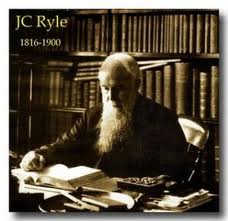
J.C. RyleJ.C. Ryle’s book Bible Reading has a question repeated all throughout the book: What are you doing with the Bible? do you read it? how do you read it? This is a book that will challenge and encourage both the Bible-reading novice, and the Bible-reading veteran. You can read my full book review by clicking here. Below are some quotes that I highlighted in this powerful little book.

“This is the Book to which the civilized world is indebted for many of its best and most praiseworthy institutions. Few probably are aware how many good things that men have adopted for the public benefit, of which the origin may be clearly traced to the Bible. It has left lasting marks wherever it has been received. From the Bible are drawn many of the best laws by which society is kept in order. From the Bible has been obtained the standard of morality about truth, honesty, and the relations of man and wife, which prevails among Christian nations, and which—however feebly respected in many case—makes so great a difference between Christians and heathen.” 

“The Bible applied to the heart by the Holy Spirit is the grand instrument by which souls are first converted to God. That mighty change is generally begun by some text or doctrine of the Word, brought home to a man’s conscience. In this way the Bible has worked moral miracles by the thousands. It has made drunkards become sober—immoral people become pure—thieves become honest and violent-tempered people become meek. It has wholly altered the course of men’s lives.”

“The Bible can show a believer how to walk in this world so as to please God. It can teach him how to glorify Christ in all the relationships of life, and can make him a good leader, employee, subordinate, husband, father, or son. It can enable him to bear misfortunes and loss without murmuring, and say, ‘It is well.’ It can enable him to look down into the grave, and say, ‘I will fear no evil’ (Psalm 23:4). It can enable him to think about judgment and eternity, and not feel afraid. It can enable him to bear persecution without flinching and to give up liberty and life rather than deny Christ’s truth.” 

“The Lord God knows the weakness and infirmities of our poor fallen understandings. He knows that, even after conversion, our perceptions of right and wrong are extremely vague. He knows how artfully satan can overlay error with an appearance of truth, and can dress up wrong with plausible arguments, till it looks like right. Knowing all this, He has mercifully provided us with an unerring standard of truth and error, right and wrong, and has taken care to make that standard a written Book—the Scripture.”

“A man must make the Bible alone his rule. He must receive nothing and believe nothing which is not according to the Word. He must try all religious teaching by one simple test—Does it square with the Bible? What does the Scripture say?” 

“A false minister may say, ‘You have no right to use your private judgment: leave the Bible to us who are ordained.’ A true minister will say, ‘Search the Scriptures, and if I do not teach you what is scriptural, do not believe me.’ A false minister may cry, ‘Listen to the Church,’ and ‘Listen to me.’ A true minister will say, ‘Listen to the Word of God.’”

“Love of the Word appears preeminently in our Lord and Savior Jesus Christ. He read it publicly. He quoted it continually. He expounded it frequently. He advised the Jews to search it. He used it as His weapon to resist the devil. He repeatedly said, ‘The Scripture must be fulfilled.’ Almost the last thing He did was to ‘open their minds so they could understand the Scriptures’ (Luke 24:45). I am afraid that man cannot be a true servant of Christ, who has not something of his Master’s mind and feeling towards the Bible.” 

“Read the Bible with Christ continually in view. The primary object of all Scripture is to testify about Jesus: Old Testament ceremonies are shadows of Christ; Old Testament judges and deliverers are types of Christ; Old Testament history shows the world’s need of Christ; Old Testament prophecies are full of Christ’s sufferings; Old Testament prophecies are full of Christ’s glory yet to come. … All these shine forth everywhere in the Bible. Remember this clue, if you would read the Bible right.”

“Let us resolve to read the Bible more and more every year we live. Let us try to get it rooted in our memories, and engraved into our hearts. … Let us resolve to be more watchful over our Bible reading every year that we live. Let us be jealously careful about the time we give to it, and the manner that time is spent. Let us be aware of omitting our daily reading without sufficient cause. Let us not be gaping, and yawning and dozing over our book, while we read. … Let us be very careful that we never exalt any minister, or sermon, or book, or tract, or friend above the Word. Cursed be that book, or tract, or human counsel, which creeps in between us and the Bible, and hides the Bible from our eyes! … Let us resolve to talk more to believers about the Bible when we meet them. Sorry to say, the conversation of Christians, when they do meet, is often sadly unprofitable! How many frivolous, and trifling, and uncharitable things are said! Let us bring out the Bible more, and it will help to drive the devil away, and keep our hearts in tune.”

Bold Pastors

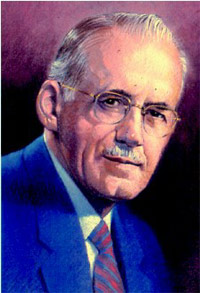
A.W. TozerI want to be this kind of pastor that A.W. Tozer describes! What about you, my dear pastor?

“The Church at this moment needs men, the right kind of men, bold men…. We languish for men who feel themselves expendable in the warfare of the soul, who cannot be frightened by threats of death because they have already died to the allurements of this world. Such men will be free from the compulsions that control weaker men. They will not be forced to do things by the squeeze of circumstances; their only compulsion will come from within—or from above. This kind of freedom is necessary if we are to have prophets in our pulpits again instead of mascots. These free men will serve God and mankind from motives too high to be understood by the rank and file of religious retainers who today shuttle in and out of the sanctuary. They will make no decisions out of fear, take no course out of a desire to please, accept no service for financial considerations, perform no religious act out of mere custom; nor will they allow themselves to be influenced by the love of publicity or the desire for reputation.” —A.W. Tozer

What stood out to you in this quote?