Thursdays With Oswald—Dealing With Persecution

Oswald ChambersThis is a weekly series with things I’m reading and pondering from Oswald Chambers. You can read the original seed thought here, or type “Thursdays With Oswald” in the search box to read more entries.

Dealing With Persecution

     If a disciple is going to follow Jesus Christ, he must lay his account not only with purity and with practice, but also with persecution [Matthew 5:38-42]. … 

     When we are on Jesus Christ’s errands, no time is to be taken in standing up for ourselves. Personal insult will be an occasion in the saint for revealing the incredible sweetness of the Lord Jesus. … Naturally, if a man does not hit back it is because he is a coward; supernaturally, it is the manifestation of the Son of God in him: both have the same appearance outwardly. … 

     Our strength has to be the strength of the Son of God, and “He was crucified through weakness.” Do the impossible, and immediately you do, you know that God alone has made it possible. … 

     The miracle of regeneration is necessary before we can live the Sermon on the Mount. The Son of God alone can live it, and if God can form in us the life of the Son of God as He introduced Him into human history, then we can see how we can live it too. …  

     The Sermon on the Mount is not, “Do your duty”; but, “Do what is not your duty.” … You will go the second mile, not for their sakes, but for Jesus Christ’s sake. … The first thing God requires of a man is to be born from above, then when he goes the second mile for men it is the Son of God in him Who does it. …  

     We always say we do not know what Jesus Christ means when we know perfectly well He means something which is a blunt impossibility unless He can remake us and make it possible. … We can always find a hundred and one reasons for not obeying our Lord’s commands, because we will trust our reasoning rather than His reason, and our reason does not take God into calculation. 

From Studies In The Sermon On The Mount 

If the teachings of Jesus in the Sermon on the Mount sound humanly impossible, that’s because they are! 

I cannot turn the other cheek, give to everyone who asks me, or go the second mile; but Jesus in me CAN. I have to allow the Holy Spirit to transform me, to mold the character of Jesus into me. When this happens, it is no longer I who are trying to do these things, but the Spirit of Christ in me that is actually doing these things.

Blessings And Woes

… blessed are you … woe to you … (Luke 6:20-27). 

Blessings and woes: the positives and negatives of the Christian life. Jesus listed these back-to-back to remind us that we need to keep both of them in mind, sort of like two rails that keep us on track. 

It’s interesting to note how many of these blessings and woes are opposites of each other. It comes down to this—

there are blessings for seeking the Kingdom of God, AND there are woes for seeking our own immediate pleasure.

Notice the contrasts Jesus lists:

  • You are blessed when you seek heavenly rewards; you experience woe when your focus is earthly treasure (vv. 20, 24). 
  • You are blessed when you are driven by a hunger for God; you experience woe when your god becomes your selfish appetites (vv. 21, 25). 
  • You are blessed when you acknowledge your sin, weep over it, and repent from it; you experience woe when sin is laughed at (vv. 21, 25). 
  • You are blessed when you are hated by the world for loving God; you experience woe when you are loved by the world for loving sinful pleasures (vv. 22, 26). 

I think C.S. Lewis captured these thoughts well when he wrote in Mere Christianity, “Give yourself up and you will find your real self. Lose your life and you will save it. … Look for Christ and you will find Him, and with Him everything else thrown in.” 

Blessings for seeking Jesus and His kingdom; woes for seeking only your own kingdom. 

So how do we live blessed? Here’s what Jesus taught us (vv. 27-49)—

Love your enemies
Always do good, even (especially!) to your haters
Bless those who curse you 
Don’t fight for your rights
Be an impartial, liberal giver
Treat others the way you want to be treated 
Love and give to others without expecting a return
Be merciful
Don’t be judgmental
Give, give, and give some more
Look in the mirror at yourself first before looking out the window at others
Serve others
Check what sort of fruit your life is bearing
Build everything in your life on God’s Word

Avoid the woes AND enjoy the blessings of God! 

The Everlasting Hope In Our Everlasting Lord

It was for our benefit that God came to Earth in His First Advent, not in thunder, and lightning, and all the brilliance of His heavenly glory, but as a Baby. Otherwise, He would have been unapproachable by sinful man. 

But make no mistake about it—although born as a human baby, Jesus was still “Christ by highest heaven adored; Christ the everlasting Lord”! 

The thought of God being everlasting permeates the Scriptures:

  • He is everlasting Lord
  • He fulfills an everlasting covenant
  • so He is worthy of everlasting praise
  • His everlasting arms support us
  • and give us His everlasting love and everlasting kindness
  • His everlasting salvation gives us everlasting life, or rejecting it leads to our everlasting punishment
  • and in His presence is everlasting joy  

Charles Wesley captures this fully-God-fully-Man essence in his song Hark! The Herald Angels Sing by calling Jesus the everlasting Lord and then listing His humanness at His First Advent with phrases like offspring of a virgin’s womb, veiled in flesh, incarnate Deity, pleased as Man with men to appear, and Immanuel. 

Jesus came to earth as Man not because He was forced to, but because it fulfilled the everlasting covenant that God had planned. The writer of Hebrews explains beautifully how He became like us in all of our humanness so that He could be a merciful help to us (see Hebrews 2:10-18). 

When Matthew tells the birth story of Jesus, he includes a line pregnant with meaning: “All this took place to fulfill…” (Matthew 1:22). 

What “all this”? Just take a look at Christ’s genealogy in the opening verses of Matthew 1. You see Abraham who tried to “help” God fulfill the covenant by fathering a child with another woman; Jacob who swindled his birthright from Esau; Judah who fathered Perez through his widowed daughter-in-law, whom he thought was a prostitute; Rahab was a prostitute; Ruth was a non-Jewish foreigner; David committed adultery with Bathsheba and then had her husband killed, and from their relationship came Solomon; Solomon’s son split the kingdom in two; from Abijah to Jeconiah the kings became progressively more and more evil; from Jeconiah forward the kings were without a kingdom; and then Joseph was a prince without a throne or even the glimmer of a hope of a throne. 

Yet ALL THIS took place to fulfill God’s plan. All of history is His story! Every deed and misdeed was used by God to fulfill His everlasting plan of redemption. Jesus had a very human family tree so that none of us could be outside His merciful reach.

What’s your genealogy like? More good than bad? What about your own history? More mess ups than positives? Nothing in your genealogy—past or present—can ever stop our everlasting Lord from fulfilling His everlasting covenant with YOU (Romans 8:28)! 

Christ’s genealogy is proof that your genealogy is no hindrance to His everlasting plan! 

It may appear He is late in time, but behold Him come at just the right time. Accept Him as your everlasting Lord, lean on His everlasting arms, and bask in His everlasting joy. 

Jesus—our Immanuel here—came so you could have all of God’s everlastingness! 

To take a look at the other stanzas of this Christmas carol, please click here.

Thursdays With Oswald—Difficult Times Reveal Our Habits

Oswald ChambersThis is a weekly series with things I’m reading and pondering from Oswald Chambers. You can read the original seed thought here, or type “Thursdays With Oswald” in the search box to read more entries.

Difficult Times Reveal Our Habits 

     Practice means continually doing that which no one sees or knows but ourselves. Habit is the result of practice, by continually doing a thing it becomes second nature. The difference between men is not a difference of personal power, but that some men are disciplined and others are not. The difference is not the degree of mental power but the degree of mental discipline. If we have taught ourselves how to think, we will have mental power plus the discipline of having it under control. Beware of impulse. Impulsiveness is the characteristic of a child, but it ought not to be the characteristic of a man, it means he has not disciplined himself. Undeterred impulse is undisciplined power.

     Every habit is purely mechanical, and whenever we form a habit it makes a material difference in the brain. The material of the brain alters very slowly, but it does alter, and by repeatedly doing a thing a groove is formed in the material of the brain so that it becomes easier to do it again, until at last we become unconscious of doing it. When we are regenerated we can reform by the power and presence of God every habit that is not in accordance with His life. … We have to learn to form habits according to the dictates of the Spirit of God. The power and the practice must go together. … If we keep practicing, what we practice becomes our second nature, and in a crisis we will find that not only does God’s grace stand by us, but our own nature also. The practicing is ours not God’s and the crisis reveals whether or not we have been practicing. [See Matthew 5:31-37.]

From Studies In The Sermon On The Mount

All of us have blind spots. These are typically habits that we have left in place, unchallenged and unchanged. That “groove” in our brain is operating on auto-pilot, but those blind-spot habits aren’t serving us well. 

The role of the Holy Spirit in the life of a Christian is to help us notice these habits in which we are unconsciously incompetent. But once the Spirit of God points these out, then we must practice, and practice, and practice until the new healthy habit has overwritten the old groove of the unhealthy habit. 

Then we will find, as Chambers points out, that in a time of crisis “not only does God’s grace stand by us, but our own nature also.” 

Times of difficulty will reveal habits—both the unhealthy and the healthy. The question then becomes: what are you going to do about the unhealthy habits? 

Joining The Angel Choir

The angels are highly visible around the birth of Jesus Christ in Bethlehem, but here’s the amazing thing—we are invited to join the angelic choir singing praise to Jesus! 

Nowhere else do we see such a concentration of angels as during Christ’s time on earth, and especially at His birth. In the Old Testament prior to Christ’s birth, and in the New Testament following Christ’s ascension, we don’t see as many angels clustered together on Earth— 

  • Gabriel brings a birth announcement to Zechariah 
  • Gabriel brings a birth announcement to Mary
  • an angel talks to Joseph in a dream (three times!) 
  • an angel gives instructions to the wise men in a dream
  • angels minister to Jesus in the wilderness after His battle with the devil 
  • angels are poised for action in case Jesus calls on them prior to His crucifixion
  • angels are present at Christ’s tomb after His resurrection
  • and a massive angel choir sings at Christ’s birth (Luke 2:8-14) 

Charles Wesley wrote a Christmas carol called Hark! The Herald Angels Sing. In the first stanza, we’re invited to “join the triumph in the skies.” But how can someone sing a song grand enough, majestic enough, or worthy enough to honor Almighty God?! That would be like me being asked to compose a song or play something on the piano to honor Mozart—how could I play anything worthy of his musical talent? 

In a similar way, when the Israelites thought about coming into God’s presence, they were gripped with knee-knocking, gut-churning fear (Exodus 19:16-19; 20:18-19)! 

But notice that the angels didn’t sing, “God is born in Bethlehem.” They sang, “Christ is born in Bethlehem.” Christ: the Messiah; the One who sets things right. No wonder this is such good news of great joy that brings peace and God’s favor (Luke 2:10, 14). 

The simple fact is that we couldn’t approach God and join in their angelic song. Instead, Jesus approached us as our Messiah, our Deliverer. How could this happen? Wesley’s carol reminds us that Jesus came so that God and sinners are reconciled! 

The First Advent is God approaching us. If we allow Jesus to reconcile us to our Holy Heavenly Father, then we have no fear of Christ’s Second Advent. His Second Advent will be attended to by angels just like His First Advent (Matthew 25:31-32; Mark 8:38; Jude 1:14-15). Those who haven’t had their sins forgiven will hear a song that is soul-crushing to them, while those who have accepted the reconciling work of Jesus will join with the angelic host in a victorious song bringing glory to God forever and ever (Revelation 14:9-11; 15:1-4). 

We don’t have to wait until we get to Heaven to join the triumph of the skies. We can join the angelic choir right now in singing our praise to God today. And every day! 

To take a look at the other stanzas of this Christmas carol, please click here.

Thursdays With Oswald—Standing Pure Against The Onslaught Of Lust

Oswald ChambersThis is a weekly series with things I’m reading and pondering from Oswald Chambers. You can read the original seed thought here, or type “Thursdays With Oswald” in the search box to read more entries.

Standing Pure Against The Onslaught Of Lust

     God does not give a man a new body when he is saved: his body is the same, but he is given a new disposition. God alters the mainspring; He puts love in the place of lust. What is lust? The impatience of desire—I must have it at once. Love can wait seven years; lust cannot wait two seconds. …  

     A disciple has to be free from the degradation of lust, and the marvel of the Redemption is that Jesus Christ can free him from it. … 

     You have heard that it was said, “Do not commit adultery.” But I tell you that anyone who looks at a woman lustfully has already committed adultery with her in his heart. If your right eye causes you to sin, gouge it out and throw it away. It is better for you to lose one part of your body than for your whole body to be thrown into hell. And if your right hand causes you to sin, cut it off and throw it away. It is better for you to lose one part of your body than for your whole body to go into hell [Matthew 5:27-30].

     What does that mean? It means absolute unflinching sternness in dealing with the right things in yourself that are not the best. “The good is the enemy of the best” in every man, not the bad, but the good that is not good enough. Your right hand is not a bad thing, it is one of the best things you have, but Jesus says if it offends you in developing your spiritual life, and it hinders you in following His precepts, cut it off and cast it from you. Jesus Christ spoke rugged truth, He was never ambiguous, and He says it is better to be maimed and damned, better to enter into life lame in man’s sight and lovely in God’s than to be lovely in man’s sight and lame in God’s. …  

     In the beginning of the Holy Spirit will check us in doing a great many things that may be perfectly right for everyone else but not right for us. No one can decide for another what is to be cut off, and we have no right to use our present limitations to criticize others. Jesus says we must be prepared to be limited fools in the sight of others, in order to further our spiritual character. If we are unwilling to give up the wrong things only for Jesus, never let us talk about being in love with Him.

From Studies In The Sermon On The Mount

God’s love is stronger than flesh’s lust. The real question is—Are you willing to obey the Holy Spirit Who tells you what things need to be gouged out or cut out of your life in order to defeat lust? 

Don’t make excuses. Don’t compare yourself to others. Don’t delay in obeying. Lust can—and must!—be defeated in the life of a Christian. How true that it is “better to enter into life lame in man’s sight and lovely in God’s than to be lovely in man’s sight and lame in God’s”! 

11 Quotes On The Gospel Of Mark

Alongside my daily Bible study time in the Gospels of the New Testament, I have been reading J.C. Ryle’s Expository Thoughts On The Gospels. You can check out my review of this book by clicking here. 

These are a few of the quotes I especially appreciated from Ryle’s comments on the Gospel of Mark. 

“We should always read the Old Testament with the desire to find something in it about Jesus Christ.” [cf John 5:39] 

“It will always be found that when prayers are few, grace, strength, peace, and hope are small. We shall do well to watch our habits of prayer with a holy watchfulness. Here is the pulse of our Christianity. Here is the true test of our state before God. Here true religion begins in the soul, when it does begin. Here it decays and goes backward, when a man backslides from God. Let us walk in the steps of our blessed Master in this respect as well as in every other. Like Him, let us be diligent in our private devotion. Let us know what it is to ‘depart into solitary places and pray.’” 

“What extravagant importance is attached to trifles by those who are mere formalists in religion!” 

“Christ’s service does not exempt His servants from storms.” 

“The assaults of persecution from without have never done half so much harm to the church as the rise of false doctrines within. False prophets and false teachers within the camp have done far more mischief in Christendom than all the bloody persecutions of the emperors of Rome. The sword of the foe has never done such damage to the cause of truth as the tongue and the pen.” 

“Incredible is the bondage in which men live to the opinion of the world! Let us all pray daily for faith and courage to confess Christ before men. … In spite of laughter, mockery, and hard words, let us boldly avow that we serve Christ.” 

“It is a dreadful fact, whether we like to allow it or not, that pride is one of the commonest sins which beset human nature. We are all born Pharisees. We all naturally think far better of ourselves than we ought. We all naturally imagine that we deserve something better than we have. It is an old sin. It began in the garden of Eden, when Adam and Eve thought they had not got everything that their merits deserved. It is a subtle sin. It rules and rains in many a heart without being detected, and can even wear the garb of humility. It is a most soul-ruining sin. It prevents repentance, keeps men back from Christ, checks brotherly love, and nips in the bud spiritual desires. Let us watch against it, and be on our guard. Of all garments, none is so graceful, none wears so well, and none is so rare as true humility.” 

“It is not so much the having money, as the trusting in it, which ruins the soul. Let us pray for contentment with such things as we have.” 

“Above all, let all who desire to walk in Christ’s steps labor to be useful to others. … Let them never forget that true greatness does not consist in being an admiral, or a general, a statesman, or an artist. It consists in devoting ourselves, body, and soul, and spirit to the blessed work of making our fellow man more holy and more happy. … Let us strive to leave the world better, holier, happier than it was when we were born.” 

“The dark ages of Christendom were times when the Bible was kept back from the people. The Protestant Reformation was mainly effected by translating and circulating the Bible. The churches which are most flourishing at this day are churches which honor the Bible. The nations which enjoy the most moral light are nations in which the Bible is most known. … The godliest families are Bible-reading families. The holiest men and women are Bible-reading people.” 

“Let us remember that for our sakes Jesus voluntarily endured the most painful, horrible, and disgraceful death. Surely the thought of this love should constrain us daily to live not unto ourselves but unto Christ.” 

You can read the quotes I shared from Ryle’s thoughts on the Gospel of Matthew by clicking here. 

Returning Home

And Abram went on his journey from the south as far as Bethel, to the place where his tent had been at the beginning … to the place of the altar which he had made there at first. And there Abram called on the name of the Lord (Genesis 13:3, 4).

While he was in Egypt, Abram pitched no tents nor did he set up any altar of worship. In fact, it was probably unwise of him to go to Egypt in the first place, as there is no record of God telling him to do so. While he was sojourning there, Abram also perpetrated a lie as an attempt to protect himself.

Whenever we take an unwise detour—and then realize it—part of repentance is to return to where we know we previously had met with God. Abram returned it to the place where he had first set up his tents, and worshipped God once again at the altar he had built at first. There he once again “called on the name of the Lord.”

It was from this place (not from Egypt) that God could say to Abram, “Arise, and walk in the land through its length and width, for I give it to you” (v. 17). “THEN” (v. 18)—and only then—was it safe for Abram to move his tents and set up a new altar of worship. 

Prayer—Father, I am sure I have strayed into an Egypt before, sojourning where my wits—and not Your voice—have led me. Thank You, Lord, for protecting me there, and for allowing me to “return home” to the place You intended for me, to the place where Your blessings flow. May I not move forward again unless You direct me. In Jesus name, Amen.

12 Huge Mistakes Parents Can Avoid (YouVersion reading plan review)

Tim Elmore has fantastic insights for those who work with today’s youth. Whether you are a parent, a teacher, a youth pastor, or a coach, you are always guaranteed some great content when you study what Dr. Elmore presents. 

YouVersion has a reading plan based on Tim Elmore’s book 12 Huge Mistakes Parents Can Avoid. The reading plan has three advantages over the book—(1) Daily Scripture readings which augment the material covered each day; (2) A video message from Dr. Elmore explaining how we can avoid these mistakes; and (3) A place to have an honest dialogue with another parent/coach/teacher, if you are doing this reading plan as a shared plan. 

There is also one huge advantage the book has over the reading plan—lots more content, including warning signs, and ideas for recovering from past mistakes. 

So the real winning combination is not either-or, but both-and. You should both read the book (you can check out my review by clicking here) and do the YouVersion reading plan along with another adult or two (or three or four…). 

Don’t get blindsided by these 12 mistakes. After all, they are all avoidable and correctable! 

(You can also check out some quotes I shared from the book by clicking here.)

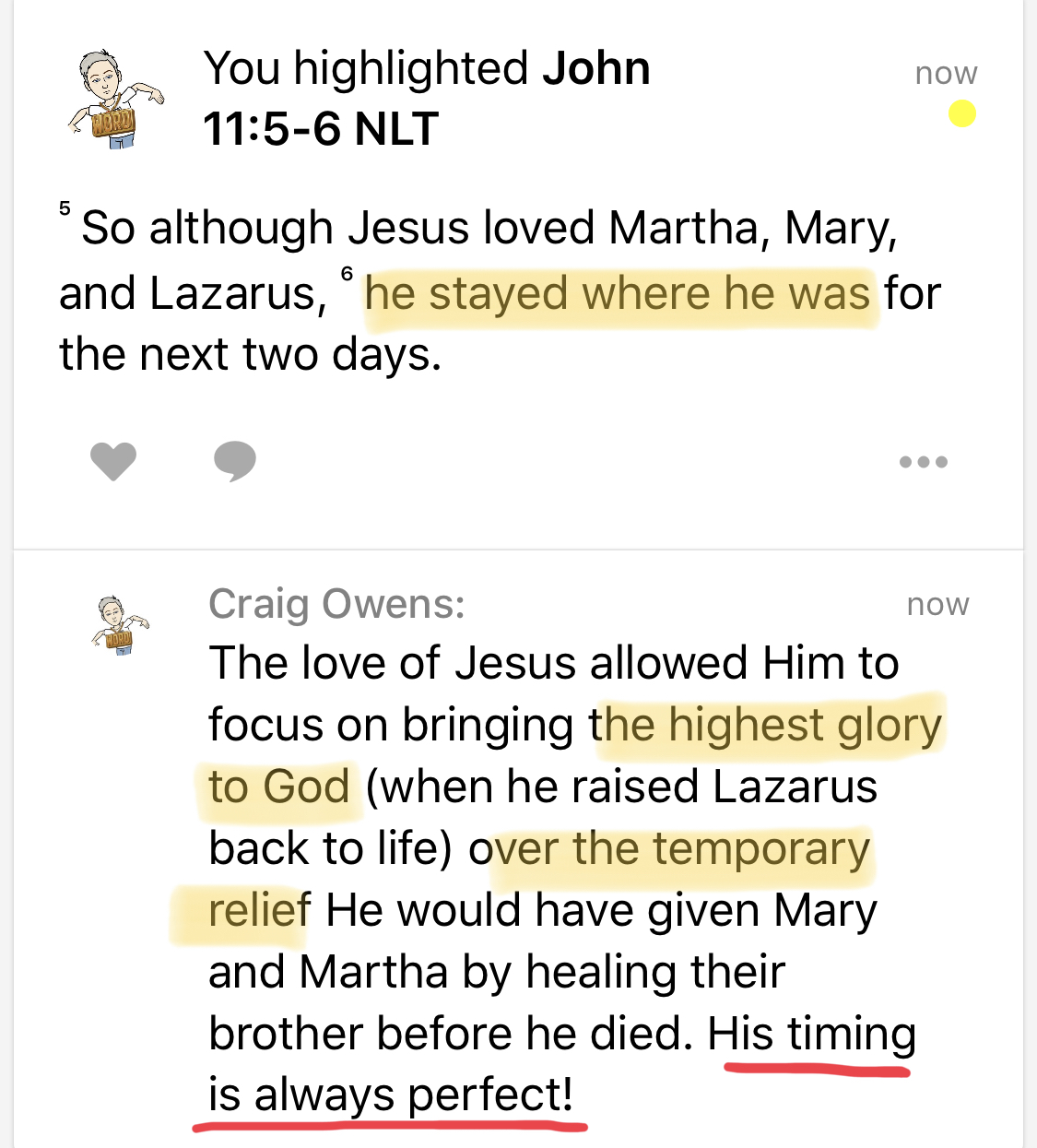
Christ’s Love Has Perfect Timing!