6 Quotes From “Joy To Your World”

In Joy To Your World, T.M. Moore encourages Christians to view joy as the fuel for their testimony to others about their vibrant relationship with Jesus. Check out my book review by clicking here.

“The Christian life is joy, the joy Jesus glimpsed as He went to the Cross, that sustained Him through all His betrayal and suffering, and in which He now dwells, at the right hand of God.”

“The joy which infects those who receive the gift of eternal life in Jesus Christ causes them to see creation and all culture in an entirely new light. Whereas formally such things were merely taken for granted and used as we saw fit, now they are received as gifts and servants of the joy-giving God, to be redeemed, renewed, and redeployed with joy to the praise of His glorious grace.”

“First, we need to make sure our own lives makes sense, that the way we live supports the reasons we might give for why we live this way. … Second, we must make sure that we know the Gospel. … Finally, we need to make sure we can explain the Gospel’s impact on our own lives. How has the Gospel brought new hope, new purpose, new direction, and new life to us?”

“It is not our task to convert those who ask a reason for the hope that is within us. It is our task to make sure, to the best of our ability, that we have explained the Good News of Jesus as clearly as we can.”

“Joy is not determined by what we can see in our immediate environment. Instead, joy is a condition that attaches to knowing the Lord and being able to see past or through what is seen to engage what is not seen (Hebrews 12:1).”

“When, because of our knowledge of God, the joy that fills our souls comes to expression as joy lived, then our lives will make sense, our salvation will be visible to the watching world, and we can offer any who may ask, sound reasons for how that joy can be theirs as well.”

10 More Quotes From “Shade Of His Hand”

In Shade Of His Hand, Oswald Chambers is giving us his insight on the biblical book of Ecclesiastes. I typically share longer passages from Oswald Chambers’ works in my weekly “Thursdays With Oswald” posts. Here are a few shorter quotes from this book.

“In personal life, in church life and in national life, we try Jesus Christ’s teaching, but as soon as it becomes difficult we abandon it, or else we compromise.”

“Jesus Christ says, ‘Come unto Me… and I will give you rest,’ i.e., I will put you in the place where your eyes are open. And notice what Jesus Christ says we will look at—lilies and sparrows and grass. … The salvation of Jesus Christ enables a man to see for the first time in his life, and it is a wonderful thing.”

“The essential element in moral life is obedience and submission. If you want spiritual truth, obey the highest standard you know. ‘If any man will do His will, he shall know of the teaching, whether it be of God or whether I speak from Myself’ (John 7:17). Intellectually, curiosity is the thing; morally, obedience is what is needed.”

“Whenever our spiritual life is unsatisfactory it is because we have said to God—‘I won’t.’ … If Jesus Christ has done no mighty works for me it is either because I don’t believe He can, or I don’t want Him to. … Get to the place where you make the thing inevitable, burn your bridges behind you, make retreat impossible, then go ahead. Solomon’s counsel is wise—‘Trust in the Lord with all thine heart; and lean not unto thine own understanding.’ It is leaning to our own understanding that keeps the bridges behind.”

“When you are joyful, be joyful; when you are sad, be sad. If God has given you a sweet cup, don’t make it bitter; and if He has given you a bitter cup, don’t try and make it sweet; take things as they come. … Suffering, and the inevitable result of suffering, is the only way some of us can learn, and if we are shielded God will ultimately take the one who interferes by the scruff of the neck and remove him.”

“For a man to have doubts is not a sign that he is a bad man.”

“If your religion does not make you a better man, it is a rotten religion. The test of true religion is when it touches these four things—food, money, sex and mother earth. These things are the test of a right sane life with God, and the religion that ignores them or abuses them is not right. … A man needs to hold a right attitude to all these things by means of his personal relationship to God.” 

“We do not think on the basis of Christianity at all. We are taught to think like pagans for six days a week and to reverse the order for one day, consequently in critical moments we think as pagans and our religion is left in the limbo of the inarticulate.”

“It is only when a man is born from above of the Spirit of God that he finds the ‘want to’ is altered.”

“If you are the servant of men for their sake you will soon be heartbroken; but if you serve men for the sake of Jesus Christ, nothing can ever discourage you (cf. 2 Corinthians 4:5).”

To read more quotes from this book, click here. To check out my review of Shade Of His Hand, click here.

11 Quotes From “Shade Of His Hand”

The book of Ecclesiastes in the Bible can be a challenging read for many people. In Shade Of His Hand, Oswald Chambers walks us through this biblical book of wisdom chapter-by-chapter. Shade is a great companion for your personal Bible study time in Ecclesiastes. Check out my full book review by clicking here.

Below are just a few of the many (many!) passages I highlighted in Shade. Some of the longer passages I have already shared in my weekly “Thursdays With Oswald” posts. You can read those by clicking here.

“We always get out of touch with the Bible attitude to things when we come to it with our own conclusions.”

“The intellectual order of life does not take things as it finds them, it makes us shut our eyes to actual facts and try to live only in the ideal world. … Solomon is fearless in facing facts as they are. … It is not a question of living a blind life in the brain away from actuality, not of living in dawns or on mountain tops; but of bringing what you see there straight down to the valley where things are sordid, and living out the vision there.”

“Unless you bank your faith in God, you will not only be wrongly related in practical life and have your heart broken, but you will break other things you touch.”

“Almighty God does not matter to me, He is in the clouds. To be of any use to me, He must come down to the domain in which I live; and I do not live in the clouds but on the earth. The doctrine of the Incarnation is that God did come down into our domain. The Wisdom of God, the Word of God, the exact expression of God, was manifest in the flesh.”

“To serve God in order to gain heaven, is not the teaching of Christianity. Satisfaction cannot be found in gain, but only in a personal relationship to God. … A man is not to serve God for the sake of gain, but to get to the place where the whole of his life is seen as a personal relationship to God.”

“Whenever we put theology or a plan of salvation or any line of explanation before a man’s personal relationship to God, we depart from the Bible line, because religion in the Bible is not faith in the rule of God, but faith in the God Who rules.”

“Sometimes it is cowardly to speak, and sometimes it is cowardly to keep silence. In the Bible the great test of a man’s character is his tongue (see James 1:26). The tongue only came to its right place with in the lips of the Lord Jesus Christ, because He never spoke from His right to Himself. He Who was the Wisdom of God Incarnate, said ‘the words that I speak unto you, I speak not of Myself.’ … We are either too hasty or too slow; either we won’t speak at all, or we speak too much, or we speak in the wrong mood. The thing that makes us speak is the lust to vindicate ourselves.”

“The general history of Christianity is that it has been tried and abandoned because it is found to be difficult; but wherever it has been tried and honorably gone on with, it has never failed.”

“The Christian faith is exhibited by the man who has the spiritual courage to say that that is the God he trusts in, and it takes some moral backbone to do it.” 

“We reap terrific damage to our own characters when we vow and do not perform. … Promises are a way of shirking responsibility.”

“It is appalling to find spiritual people when they come into a crisis taking an ordinary common-sense standpoint as if Jesus Christ had never lived or died.”

More quotes from Shade Of His Hand are coming soon…

7 More Quotes From “Jesus Always”

jesus-alwaysIn Jesus Always by Sarah Young, we hear Jesus speak the words of Scripture to us in His first-Person voice.

“I am training you to view your life from a heavenly perspective—through eyes of faith. When things don’t go as you had hoped to, talk with Me. Seek My face and My guidance. I will help you discern whether you need to work to change the situation or simply accept it.”

“The more you keep your gaze on Me—in quiet times and busy times—the better you can reflect My glory to other people. … When you are aware that I am present with you, you’re less likely to do or say something that’s displeasing to Me. When you’re struggling with difficult circumstances or painful feelings, awareness of My presence offers courage and comfort.”

“If you aspire to reach the heights—especially the high places of achievement and recognition—be prepared to shoulder the responsibilities that accompany success. But don’t forget to enjoy the satisfaction of accomplishing good things with Me, through Me, and for Me.”

“Pursuing a close walk with Me is the best way to live in the present. Keep bringing your thoughts back to Me whenever they wander. Return to Me joyfully, beloved. I will take great delight in you and rejoice over you with singing.”

“You tend to waste energy trying to determine whether your resources are adequate for the day. You keep checking your ‘power gauge’ instead of looking to Me for My provision. How much better to simply acknowledge your insufficiency when you awaken! This frees you to rely on My boundless sufficiency.”

“Your becoming a Christian was only the beginning of the work I’m doing in you. You need to be made new in the attitude of your mind and to put on the new self—becoming increasingly godly, righteous, and holy. This is a lifelong endeavor, and it is preparing you for heaven’s glory.”

“See Me smiling on you in radiant approval. My limitless love falls continually upon you, like heavenly snowflakes that melt into your upturned face. No matter how distressing your circumstances, this love is sufficient to sustain you. Someday you will even ascend to Heaven on it. I eagerly anticipate the time when I will take you into glory—to be with Me forever!”

Be sure to check out my review of Jesus Always by clicking here, and you can read the first set of quotes I shared from this book here.

If you’d like to be notified immediately when I post more quotes, please subscribe to my blog, and be sure to follow me on Twitter and Tumblr, where I share inspiring quotes every day.

6 Quotes On Helping Others

think-on-these-thingsJohn Maxwell, in his book Think On These Things, challenges us to think differently about the world around us. Here are six quotes on how we should think differently about those who are in need.

“The beauty of genuine concern is its willingness to become involved without being influenced by the ‘price tag.’”

“How many lives are wasted and destroyed because the world’s attitudes and actions toward needy people say ‘I couldn’t care less’? How beautiful this world would be if this unchristian philosophy was replaced with Christian attitudes until people would begin saying, ‘I couldn’t care more.’ If I am to say to my world, ‘I couldn’t care more,’ I must open my eyes and look for hurting people.”

“Jesus was concerned that others would see the hurts of humanity and respond with care. Too many times we, like the disciples, see only the problems of people. We feel the frustration of their failures and the weight of their weaknesses. We remember only the reliance upon our strength and forget our obligation to freely give what we have received.”

“My helping hand to a needy world is empty unless love is the motive. Material handouts are a poor substitute for love and understanding. People do not need more trinkets, they need more tenderness.”

“It is sad to realize that many people have needs that very few can meet. The reason? Most people concentrate their efforts on picking fruit instead of producing it.”

“The next time you want to help someone who is in difficulty, stop and think. Why not change your approach? Instead of ‘telling it like it is’ why not ‘tell it like it could be.’ Before you begin to question my motives, let me state that I am not asking you to be dishonest. I did not say, ‘Tell it like it could never be.’ I said, ‘Tell it like it could be!’ … When you ‘tell it like it could be’ you help others to see things more clearly. There is no better way to change a problem than to help someone see a solution. Many times people with problems become slaves to their situation because they can see nothing but problems.”

To read more quotes from Think On These Things, click here. To read a review of this book, click here. And to see quotes from John Maxwell and other notable thinkers that I post daily, please follow me on Twitter and Tumblr.

9 Quotes From “Leadership Promises For Every Day”

leadership-promisesLeadership Promises For Every Day is a devotional book for leaders and aspiring leaders. A passage from the Bible is combined with a passage from one of John Maxwell’s outstanding books. It’s an excellent way to start your day! If you haven’t already, check out my review of this book here, and then enjoy a few quotes—

“How many leaders have ruined their lives and damaged the lives of others through immorality? Character has become a crucial issue today precisely because of the myriad of leaders in the political, business, and religious worlds who have fallen morally. No doubt they fall partly because the enemy has targeted leaders for attack. Leaders need to remember that they influence many others beyond themselves; they never fall in a vacuum. They also need to realize that replacing fallen leaders is a slow and difficult process.”

“Our goal among brothers should not be to punish or excommunicate, but to restore. Confrontation is a redemptive act of leadership.”

“Leaders need to respond to individuals based on their needs rather than their faults. … Good leaders do this well. They don’t lead out of a predetermined package of behaviors, but size up every situation and discern what must happen to reach the desired goal.”

“People rise or fall to meet our level of expectations for them. If you express skepticism and doubt in others, they’ll return your lack of confidence with mediocrity. But if you believe in them and expect them to do well, they’ll wear themselves out trying to do their best.”

“Leaders must constantly ask if their plans fit God’s revealed will for them and their organization. Then they must ask if their plans remain relevant to the needs of their mission, their values, their vision, and their long-range objectives. Finally, they need to ask if their plans fit the needs of their culture and time.”

“We need to remember that when people follow behind us, they can only go as far as we go. If our growth stops today, our ability to lead will stop along with it. Neither personality nor methodology can substitute for personal growth. We cannot model what we do not possess. Begin learning and growing today, and watch those around you begin to grow.”

“Servanthood is not about position or skill. It’s about attitude.” 

“People who blame others for their failures never overcome them. They simply move from problem to problem. To reach your potential, you must continually improve yourself, and you can’t do that if you don’t take responsibility for your actions and learn from your mistakes.”

“Laughter breeds resilience. Laughing is the quickest way to get up and get going again when you’ve been knocked down.”

I am always sharing great quotes from John Maxwell and others on Twitter and Tumblr. If you’re not following me there, please do so!

John Maxwell On Helping Others

In John Maxwell’s book Think On These Things, he encourages us to think about our world the way Jesus thinks about the world. This must lead to us loving and serving others!

maxwell-stooping“The way to the top is not ‘stepping on others,’ but ‘stooping to help others.’”

“How many lives are wasted and destroyed because the world’s attitudes and actions toward needy people say ‘I couldn’t care less’? How beautiful this world would be if this unchristian philosophy was replaced with Christian attitudes until people would begin saying, ‘I couldn’t care more.’ If I am to say to my world, ‘I couldn’t care more,’ I must open my eyes and look for hurting people.”

“Jesus was concerned that others would see the hurts of humanity and respond with care. Too many times we, like the disciples, see only the problems of people. We feel the frustration of their failures and the weight of their weaknesses. We remember only the reliance upon our strength and forget our obligation to freely give what we have received.” 

“My helping hand to a needy world is empty unless love is the motive. Material handouts are a poor substitute for love and understanding. People do not need more trinkets, they need more tenderness.”

“The next time you want to help someone who is in difficulty, stop and think. Why not change your approach? Instead of ‘telling it like it is’ why not ‘tell it like it could be.’ Before you begin to question my motives, let me state that I am not asking you to be dishonest. I did not say, ‘Tell it like it could never be.’ I said, ‘Tell it like it could be!’ … When you ‘tell it like it could be’ you help others to see things more clearly. There is no better way to change a problem than to help someone see a solution. Many times people with problems become slaves to their situation because they can see nothing but problems.” 

If you would like to read my review of Think On These Things, please click here. And you can read some other quotes I shared from this book by clicking here.

Notes From The Global Leadership Summit

I had an amazing time last week at the Willow Creek Global Leadership Summit. Every year I came away with some many thoughts, and a brand new passion for the various leadership roles in which I get to serve.

Below are just a few of my notes that I jotted down during an intense two days.
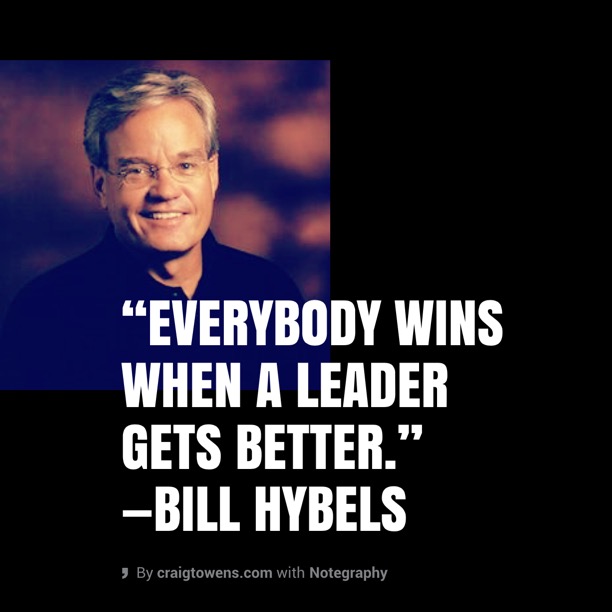
Hybels - everybody winsBill Hybels—The Lens Of Leadership

“Everybody wins when a leader gets better.”

“Armed with enough humility, leaders can learn from anyone.”

Hybels discussed four leadership lenses:

1.   Passionate leader (depicted by vibrant bright red frames)

  • They understand unbridled passion in leadership.
  • “Passion is like protein for the team.”
  • A motivated worked will outperform an unmotivated worker by 40%.
  • People are more motivated by working for a passion-filled leader than they are by compensation or perks.
  • Passion comes from a mountain-top dream, or a valley-deep frustration of current settings.

2.   People leader (cool frames, but cracked lenses)

  • An organization will only be as healthy as the top leader wants it to be.
  • This world needs more pastors of businesses, factories, medical offices, military units, etc.

3.   Performance leader (self-adjusting glasses)

  • Leaders ask: what progress should be made? how do we measure this? what doesn’t need to be measured?
  • Every worker wants to know how they are doing. For the leader, it’s cruel to hire someone and never let them know how they’re doing. Every staff member should get an update at least every six months.

4.   Legacy leader (sunglasses with a rearview mirror [cyclist])

  • Every once in awhile we need to look behind to see what legacy we’re leaving behind.
  • Leaders should reflect on this annually.
  • If my leadership assignment were to end today, what legacy would I leave?

Mulally - overcommunicateAlan Mulally—CEO Boeing and Ford Motor Company

An average commercial airline has 4 million parts!

  • People first
  • Include everyone
  • Create a compelling vision
  • Present a workable strategy
  • Set clear performance goals
  • Relentless implementation
  • Share lots of data
  • “Over-communicate the plan and the current status against the plan.”
  • Instill a positive can-do attitude
  • Keep your emotional resilience
  • Have fun


Melinda Gates - hear the criesMelinda Gates—Gates Foundation

Melinda says of herself, “I am an impatient optimist. We are changing the world, but we need to change it faster.”


“At the end of the day, you have to hear the cries of those in need, let your heart break and act in courage.”

Jossy Chacko—Empart

“All of us have been entrusted with something. What are we doing to leverage it?”

In thinking about the parable of the talents … “To Jesus, faithfulness is not just sitting with what you have been given, but multiplying what you have been given. God’s mission is not maintaining.”

“Playing it safe is not enough for a follower of Jesus Christ.”

Three principles for expanding our leadership reach:

Jossy Chacko - faithfulness1. Enlarge your vision

  • “When people hear my vision, they should know the size of my God.”
  • “An enlarged vision should keep us driven.”
  • “Do not be confused about what people say about your vision; trust what God has said to you.”

2. Empower your people

  • “Leadership is about taking wise chances and giving people opportunities.”
  • “Your leadership reach will be determined by your empowerment choices.”
  • Three things to keep in mind: (1) Focus on building their character before empowering them; (2) Empowerment has to be through relationship; and (3) Make sure we have agreed on the right outcomes, and have the right way to measure them.

3. Embrace risk

  • Faith = risk. Without faith it is impossible to please God = without taking risks it is impossible to please God.
  • Paradigms to be changed: (1) See risk as your friend to love, not as your enemy to be feared; (2) See comfort and safety as your enemies; and (3) Increase your pain threshold.
  • “Your leadership capacity is in direct relationship to your pain threshold.”
  • “Don’t allow the fear of losing what we have to lose what God has in store for you.”
  • “By me not taking risks, who is missing out?”

Bradberry - EQDr. Travis Bradberry—TalentSmart

All inputs into the brain travel through the limbic system first (emotional center) before the inputs travel to the frontal cortex. The EI (emotional intelligence) center is in the front of the brain, just above the left eye.

Only 36% of people are able to accurately identify their emotions as they happen.

EQ (the Emotional Quotient that measures emotional intelligence) is not IQ.

EQ can be improved all throughout life.

Four components of emotional intelligence:

 1. Self-awareness: knowing my emotions, and knowing my tendencies. I need to lean into my discomfort if I want to improve.

   2. Self-management: what I do with this increased self-awareness. This is not “stuffing” my feelings. The biggest mistake is only trying to manage negative emotions; positive emotions need to be managed too.

   3. Social awareness: focusing more on others than on myself.

   4. Relationship management: using the first three skills in concert. Seeing how my behavior is affecting the other person, and then adjusting accordingly.


How to increase my EQ:

  1. Control stress—stress under control is healthy; chronic stress is unhealthy. Gratitude reduces the stress hormone cortisol.
  2. Clean up my sleep hygiene—sleep cleans up toxic hormones in the brain. To get better sleep: (1) Don’t take any kind of sleeping pill; and (2) Reduce “blue lights” in the evening.
  3. Reduce my caffeine input—especially after noon.
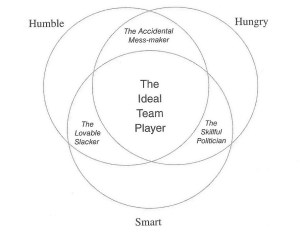
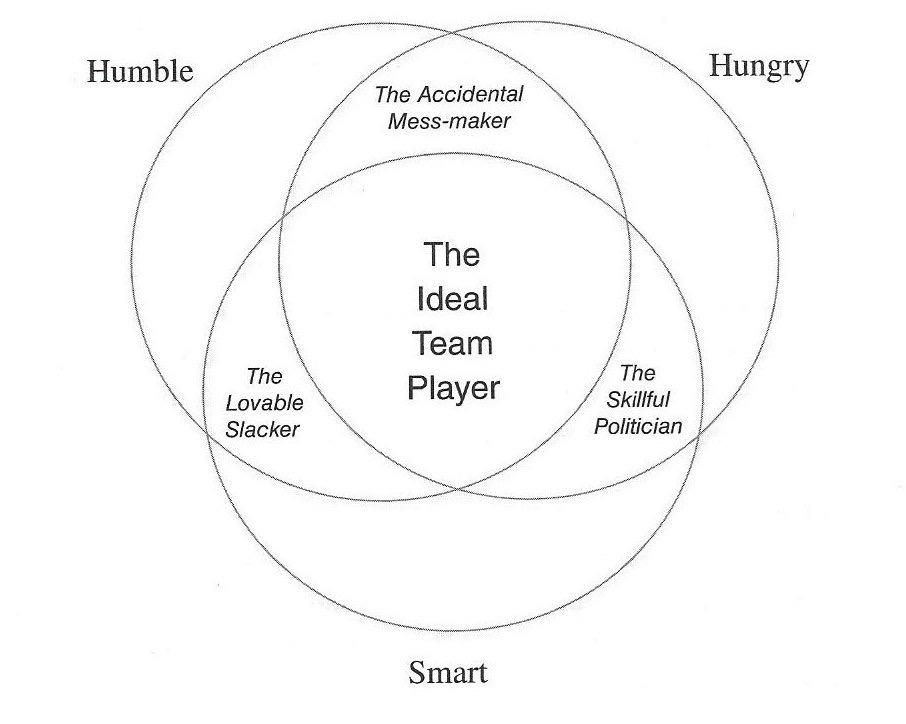
Ideal team playerPatrick Lencioni—Author

Three qualities of an ideal team player:

1.   Humble

  • Lacking self-confidence is not humility.
  • “Denying skills and downplaying abilities is not humility.”

2.   Hungry

  • Strong work ethic
  • Driving hard

3.   Smart

  • Not intellectual smarts, but people smarts = EQ

“To develop people, we have to have the courage to humbly and constantly talk to people about their ‘stuff.’”
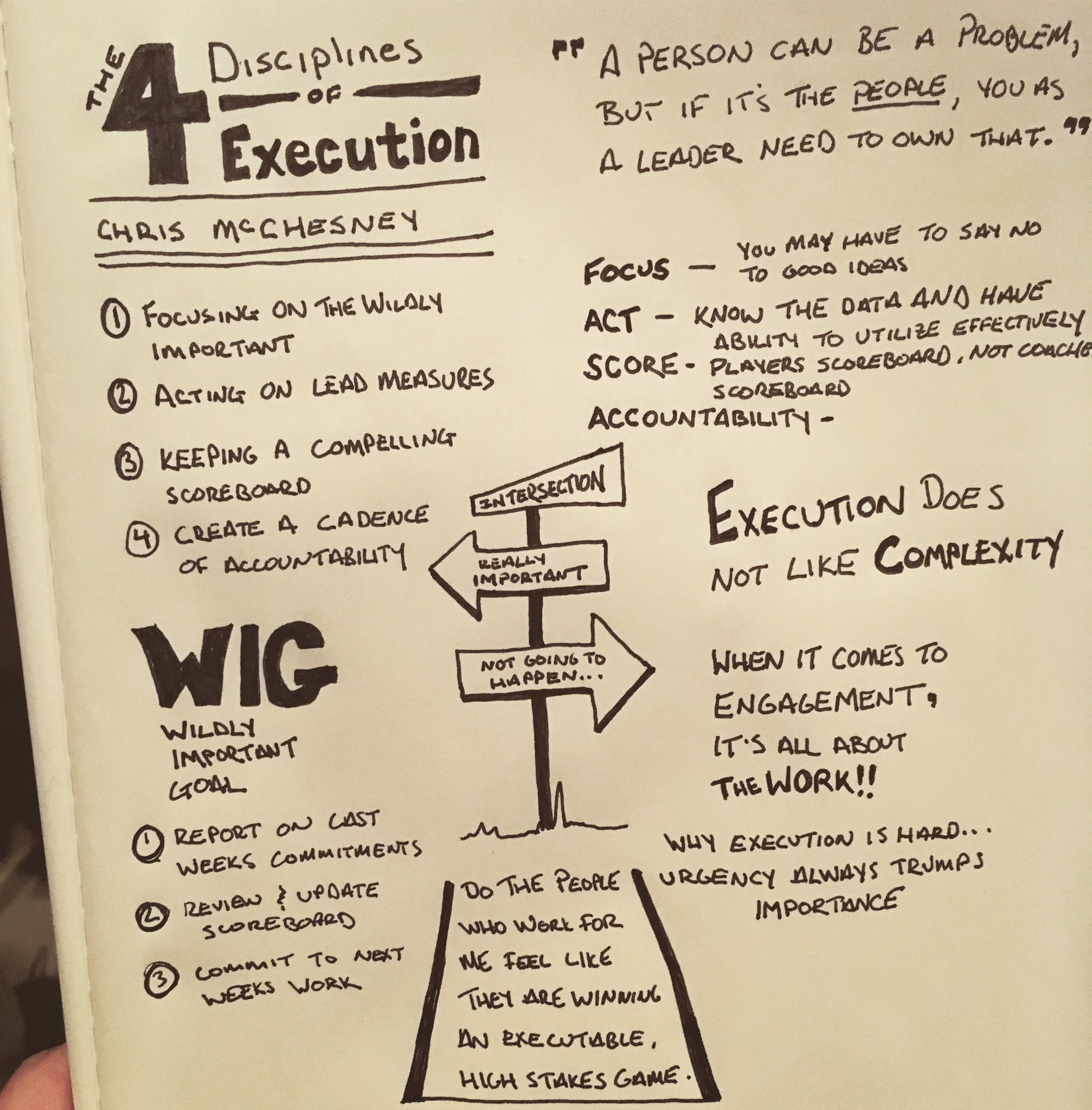
McChesney - execution disciplinesChris McChesney—Franklin Covey

Rahm Charan asked:

  • Q: Do leaders struggle more with strategy or execution? A: Execution.
  • Q: Are leaders more educated in strategy or execution? A. Strategy.

“The hardest thing a leader will ever do is drive a strategy that changes someone’s behavior.”

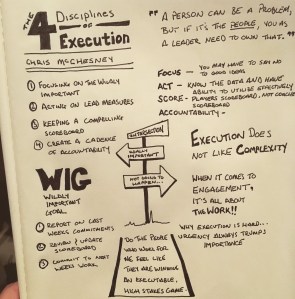
There are four disciplines for making changes in human behavior:

1.  Focus

  • “Focus on the wildly important.”
  • If a team focuses on 2-3 goals, they are likely to get them done. But if there are 4-10 goals, momentum is killed. At 11+ goals, the team is going backward.
  • We narrow the focus by coming up with a WIG: wildly important goal (this lives at the intersection of ‘really important’ and ‘not going to happen’).

2.  Leverage

  • “What are the fewest number of battles necessary to win the war?”
  • “When you want to go big, don’t think big, think narrow.”
  • One WIG per team at the same time. Everything else is in sustainment mode.
  • Make goals like this—“From x to y by when.”

3.  Engagement

  • “The biggest driver of engagement is when people feel like they’re winning.”
  • “Do the people who work for me feel like they’re playing a winnable game?”

4.  Accountability

  • Everyone needs to answer: “What are the things I do that have the biggest impact on the WIG?”
  • After sharing the scoreboard, allow people to determine what they need to do next. The people need to determine their own next moves, not the leader. The leader pulls this out of people.

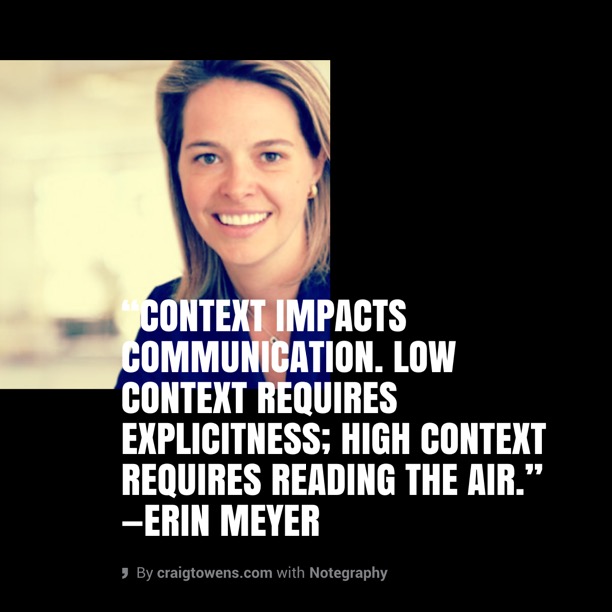
Erin Meyer - contextErin Meyer—INSEAD

On The Culture Map communication is divided into Low vs. High Context:

  • Low = feel we don’t have the same context or relationship. We feel we need to explain things very simply and explicitly.
  • High = we assume we have a larger body of shared reference points. We feel communication is more implicit or nuanced.

Anglo-Saxon countries are typically low context.

Latin American are mid-low.

Asian countries are usually high context.

In low context we tend to nail things down in writing, where in high context we leave things more open to later interpretation.

“Context impacts communication. … We need to read both the messages ‘in the air’ as well as the explicitly stately messages.”

“In a high context culture, repeat things less, ask more questions, learn to ‘read the air.’”
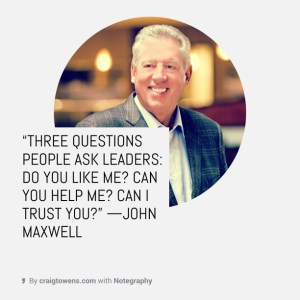
 

Maxwell - 3 questionsJohn Maxwell—Author 

“Good leaders lift.”

“You have to find the people before you lead the people.”

“The one thing leaders have to get right—they must intentionally add value to people every day.”


Five things that intentionally adds value to people:

  1. Value people—“God values people I don’t know; He even value people I don’t like.” “Are we going to spend our lives connecting with people, or correcting them?”
  2. Think of ways to add value to people—“Intentional living is thinking upfront on how to help people.”
  3. Look for ways to add value to people.
  4. Do things that add value to people.
  5. Encourage others to add value to people.

If you attended the GLS, please share in the comments below something amazing / challenging / paradigm-busting that you learned. Let’s all keep on learning!

Thursdays With Oswald—Working Out God’s Will

Oswald ChambersThis is a weekly series with things I’m reading and pondering from Oswald Chambers. You can read the original seed thought here, or type “Thursdays With Oswald” in the search box to read more entries.

Working Out God’s Will

     We do not enter into the life of God by imitation, or by vows, or by ceremonies, or by Church membership; we enter into it by its entering into us at Regeneration. The Cross of Jesus Christ is the gateway into His life. … 

     The world is that system of things which organizes its life without any thought of Jesus Christ. … 

     Nothing blinds in the mind to the claims of Jesus Christ more effectually than a good, clean-living, upright life based on self-realization. For a thing to be satanic does not mean that it is abominable and immoral. The satanically managed man is moral, upright, proud, and individual; he is absolutely self-governed and has no need of God. … 

     When by the Cross of Christ we have entered into the experience of identification with our Lord, then there comes the practical working out of Matthew 11:29, “Take My yoke upon you, and learn of Me; for I am meek and lowly in heart.” … 

     God will bring across our path people who embody the characteristics that we have shown to Him—stubbornness, pride, conceit, opinionatedness, sensuality, a hundred little meannesses. “Now,” He says, “love them as I have loved you.” 

From The Psychology Of Redemption

So God’s will is not something we learn by going to church, or imitating someone we think to be a godly person. God’s will is living like Jesus:

  • Totally abandoned to God’s will
  • Staying linked to Jesus
  • Loving the people that God brings across our path like God loves us

How are you doing?

The Rewards For Getting Along With Difficult People

How To Get Along With OthersHere’s a shocking statement—Difficult people are difficult to get along with. I know, I probably just blew your mind with that one, but sometimes it’s important to state the obvious.

Christians should be the best at getting along with others. First of all, because they have the Holy Spirit to help them, and, second, because the world is watching to see if having a relationship with Jesus really does make a difference.

We’ve already learned that in order to change our behavior toward difficult people, we can’t change our behavior (check out my post on that topic here). Instead, we need to change our thoughts first. One thought to change is about ourselves, and another thought to change is the fact that Jesus promised rewards for those who loved difficult people—

If you love those who love you, what credit is that to you? Even sinners love those who love them. And if you do good to those who are good to you, what credit is that to you? Even sinners do that. And if you lend to those from whom you expect repayment, what credit is that to you? Even sinners lend to sinners, expecting to be repaid in full. But love your enemies, do good to them, and lend to them without expecting to get anything back. Then your reward will be great, and you will be children of the Most High, because he is kind to the ungrateful and wicked. (Luke 6:32-35)

One way to love others is by learning to “speak their language.” Most of us communicate with four different accents: Doer, People, Planner, Vision.

You can watch the video where I explain these styles in more detail, but you can learn their accent by listening for…

(1) How they handle stressful situations:

  • Doer—get hyper-focused
  • Planner—withdraw to plan
  • People—call a meeting
  • Vision—take time to daydream

(2) How they listen to others:

  • Doer—take short bullet points and then quick action
  • Planner—take detailed notes, and ask lots of detailed questions
  • People—make good eye contact, take very little notes, and then reiterate what was said
  • Vision—doodle, and express “ping pong ball” thoughts

(3) How they speak about folks with other “accents”:

  • Doer—this is taking too long; nothing ever gets done; they’re daydreamers
  • Planner—they jump the gun; they’re swayed by emotions; they’re unpredictable
  • People—why don’t they want to meet; they’re too aggressive; they’re too robotic
  • Vision—they don’t see the big picture; they’re too rigid; they’re too emotional

You CAN get along better with everyone. Romans 12:18 tells us that peaceful living with others depends on you and me. Let’s do this well so that Jesus is glorified!