Hammers are very similar to money. Don’t believe me? Just take a look at some of the things they have in common. They both…
…are tools.
…can be used to build up or destroy.
…are amoral.
…don’t have any power until they’re in a person’s hand.
I realize in church circles it can make people uncomfortable to talk about money, but it shouldn’t be that way. The Bible is very clear in saying wealth comes from God, as well as how to use that wealth, so why should that be uncomfortable? Here are some of the things the Bible says about wealth:
If we take the glory for our success, God calls us “foolish” (Luke 12:16-21).
Money can be used to build God’s kingdom (Acts 4:34-37) or to build our own reputations (Acts 5:1-11).
Making the pursuit of money our priority becomes an idol (Luke 16:10-13).
The anxiety over money can choke our spiritual life (Matthew 13:22).
God gives us the ability to work, to make money, and to enjoy both the work and the rewards of work (Ecclesiastes 5:19).
God alone judges our attitude toward money (Luke 16:15).
It’s not money that is immoral, but our pursuit of Money (with a capital “M” or what the Bible calls Mammon) that is immoral.
It’s not money that will ruin us, but our trust in money that will ruin us.
It’s not money that gives us a secure future, but GodWho richly provides us with everything for our enjoyment (1 Timothy 6:17).
Don’t envy people with more money than you. Don’t look down on people with less money than you. Don’t—as Jesus said to the Pharisees—justify your opinions and attitudes about money.
Only an honest listening to the Holy Spirit about your attitude and lifestyle concerning money is what can keep us from letting money rob us of God’s blessing.
The wise King Solomon said, “Anxiety in a man’s heart weighs him down…” (Proverbs 12:25). And now medical science proves it.
There’s the physical weight of anxiety:
Digestion of food is hindered
Sleep is disrupted
Short-term memory is hampered
Immune system is depressed
Heart disease risks are elevated
Not to mention the emotional and relational weights of anxiety
But do you know what brings an almost immediate bounce-back from these conditions? Feeling and expressing gratitude.
The feelings of gratitude…
Release endorphins (the feel-good hormone)
Make good memories easier to recall
Strengthen relationships
Improve overall physical health
The verse I quoted earlier from Proverbs was only the first half of the verse. The full verse says, “Anxiety in a man’s heart weighs him down, but a good word makes him glad.” Science tells us that it doesn’t matter if those good words are words others say to us, or words we say to ourselves, or words we say to others. Our bodies cannot tell the difference, so any grateful/thankful/positive words cancel out the heaviness of anxiety!
Try it! Keep a gratitude journal … write a letter to someone you haven’t properly thanked for their investment in your life … make it a point to compliment others … speak more positively to yourself. Those grateful words are not only the antidote to the anxiety weighing you down now but also the inoculation against future anxiety.
This is a weekly series with things I’m reading and pondering from Oswald Chambers. You can read the original seed thought here, or type “Thursdays With Oswald” in the search box to read more entries.
Strength For Others
The real reason for prayer is intimacy of relationship with our Father.
We kneel, how weak, we rise full of power.
Why therefore should we do ourselves this wrong
For others that we are not always strong,
That we are ever overcome with care
That we should ever weak or heartless be
Anxious or troubled, when with us is Prayer
And joy and strength and courage are with Thee?
From Christian Disciplines
It’s a pretty simple principle: I cannot give to others what I do not possess.
Jesus rose early in the morning to find a place of private prayer (see Mark 1:35) so that He would be filled with His Father’s presence and able to meet the pressing needs of people that day. Why, oh why, don’t I follow my Lord’s example more?
People all around me need encouragement, light, hope, love. I cannot give what I do not possess. But I can possess these things in abundance if I will make use of prayer to tap into that intimate relationship with my Heavenly Father.
Prayer provides the strength I need for the day, so that I can provide the strength that others need for the day. Without prayer, I not only rob myself of God’s help, I rob others as well.
This is a weekly series with things I’m reading and pondering from Oswald Chambers. You can read the original seed thought here, or type “Thursdays With Oswald” in the search box to read more entries.
Why Wait For A Tragedy To Get Your Attention?
God is not a supernatural interferer; God is the everlasting portion of His people. When a man “born from above” begins his new life he meets God at every turn, hears Him in every sound, sleeps at His feet, and wakes to find Him there. He is a new creature in a new creation, and tribulation but develops his power of knowing God….
From Christian Disciplines
Tribulation has an amazing power to get people’s attention. After every calamity (whether it’s the attack on Pearl Harbor or the World Trade Centers, a shooting in a school, or a young family killed by a drunk driver) our churches are filled. People are searching for something to help them make sense of that tragedy. Yet after a couple of weeks, life returns to “normal” and the churches empty out.
What we discovered in that moment of tragedy is what we should be discovering every day: God is there.
Do you hear God in all the sounds? Do you see Him at every turn? Do you sleep peacefully in Him each night? Do you go through your day without anxiety because You know He is by your side?
You can because He is there. Don’t wait for a tribulation to remind you of that fact. Open your eyes and ears and heart to His presence surrounding you even now.
This is a weekly series with things I’m reading and pondering from Oswald Chambers. You can read the original seed thought here, or type “Thursdays With Oswald” in the search box to read more entries.
Contemptible Unbelief
“All power is given unto Me in heaven and in earth” (Matthew 28:18). All power is given—unto whom? To the Being who lived a humble, obscure life in Nazareth; the One who says, “Come unto Me, all ye that labor and are heavy laden, and I will give you rest.” If all power is given to Jesus Christ, what right have I to insult Him by worrying? If we will let these words of Jesus come into our heart, we shall soon see how contemptible our unbelief is.
… Will I say skeptically, “What does Jesus Christ know about my circumstances? Is His power and understanding sufficient to manage things for me?” To talk like that is the way to realize the size of our unbelief, and to see why Jesus Christ was so stern in condemning it.
From Bringing Sons Unto Glory
I love the phrase from the old hymn—
Oh, what peace we often forfeit
Oh, what needless pain we bear
All because we do not carry
Everything to God in prayer!
When I think how All-powerful and All-loving He is, I begin to see how utterly contemptible is my unbelief and my unwillingness to take everything to Him. If all power is given to Jesus Christ, what right have I to insult Him by worrying?
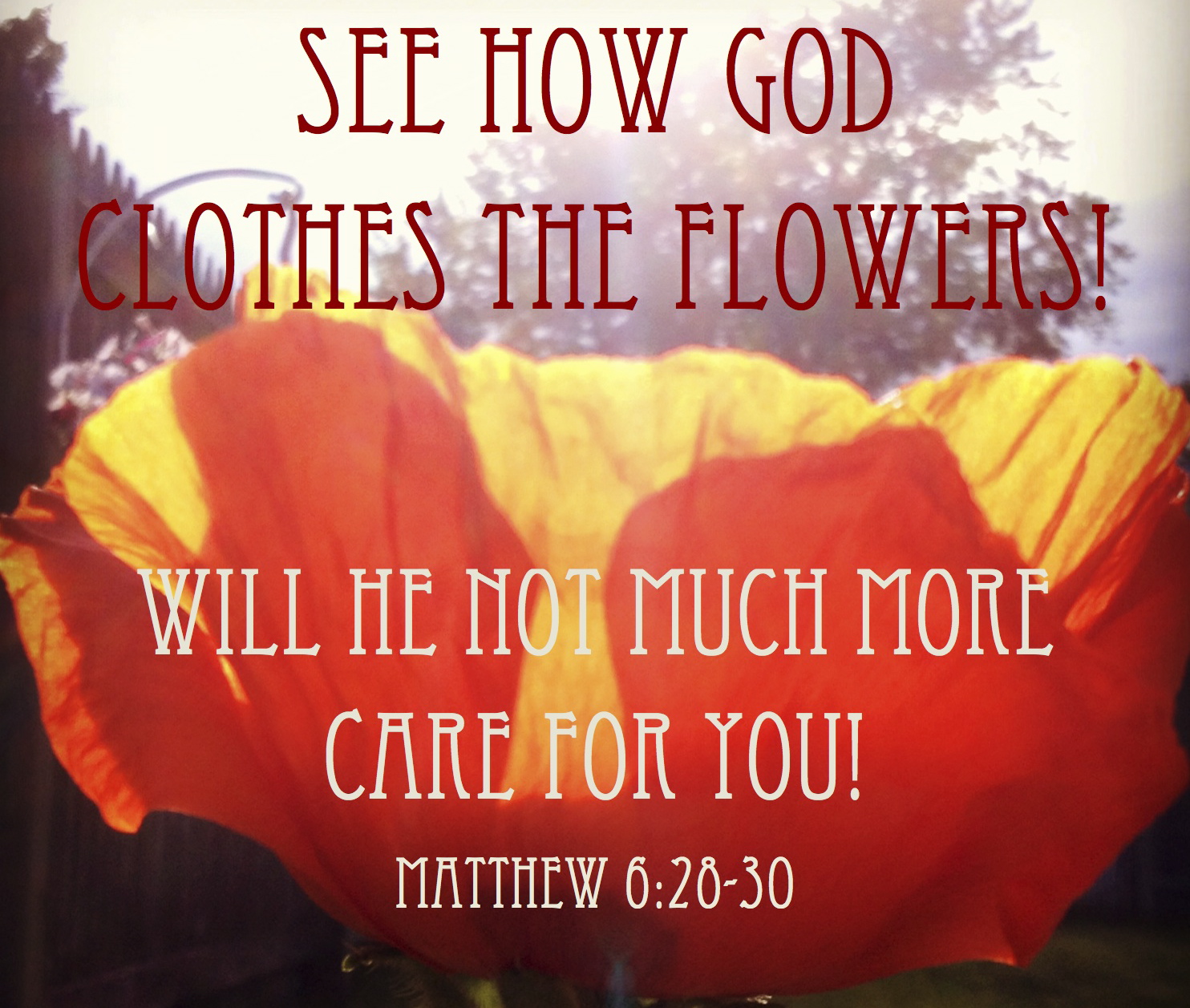
And why worry about your clothing? Look at the lilies of the field and how they grow. They don’t work or make their clothing, yet Solomon in all his glory was not dressed as beautifully as they are. And if God cares so wonderfully for wildflowers that are here today and thrown into the fire tomorrow, He will certainly care for you.
I am reminded again that my stressful feelings come because things are not going according to my plans. This can only mean one thing: Somehow I have let myself believe that I am in control of all my circumstances!
Enough!It’s time to once and for all give my concerns to the only One who can handle them.
“‘Come unto Me,’ says Jesus, ‘and I will give you rest.’ Do Jesus Christ’s words apply to me? Does He really know my circumstances? Fretting is sinful if you are a child of God. Get back to God and tell Him with shame that you have been bolstering up that stupid soul of yours with the idea that your circumstances are too much for Him. Ask Him to forgive you and say, ‘Lord, I take Thee into my calculation as the biggest factor now!’” —Oswald Chambers
Listen to the podcast of this post by clicking on the player below, and you can also subscribe on Apple, Spotify, or Audible.
If you’ve ever been to a doctor’s office, you have probably experienced the patellar reflex test. It might be better known as the “knee-jerk reaction.” This is when the doctor taps your knee just below the kneecap to test your body’s involuntary response. How you respond (or don’t respond) tells the doctor a lot about your nervous system’s health.
Did you know that we have a spiritual patellar reflex too?
Consider this verse—
Do not be anxious about anything, but in everything, by prayer and petition, with thanksgiving, present your requests to God. (Philippians 4:6)
How you respond spiritually to stressful things says a lot about your spiritual knee-jerk reflex.
We see this spiritual knee-jerk reflex in the well-known story of Daniel in the lion’s den. Some of the guys who were jealous of Daniel trick the king into passing a law that forbids everyone from praying to anyone other than the king. Look at Daniel’s spiritual knee-jerk reflex:
Now when Daniel learned that the decree had been published, he went home to his upstairs room where the windows opened toward Jerusalem. Three times a day he got down on his knees and prayed, giving thanks to his God, just as he had done before. (Daniel 6:10)
Daniel’s knee-jerk reaction was to hit his knees in prayer!
This is because hitting his knees in prayer was a spiritual habit for Daniel. Check out this key phrase: he got down on his knees and prayed, giving thanks to his God, just as he had done before. The verb tense here is one that means unbroken continuity. In other words, Daniel always prayed, so when anxious times came his spiritual knee-jerk reflex was to do what he always did: Pray, giving thanks to God.
Cast your cares on the Lord and He will sustain you; He will never let the righteous fall. (Psalm 55:22)
“Care, even though exercised upon legitimate objects, if carried to excess, has in it the nature of sin. The precept to avoid anxious care is earnestly inculcated by our Savior, again and again; it is reiterated by the apostles; and it is one which cannot be neglected without involving transgression: for the very essence of anxious care is the imagining that we are wiser than God, and the thrusting ourselves into His place to do for Him that which He has undertaken to do for us. We attempt to think of that which we fancy He will forget; we labor to take upon ourselves our weary burden, as if He were unable or unwilling to take it for us. Now this disobedience to His plain precept, this unbelief in His Word, this presumption in intruding upon His province, is all sinful. Yet more than this, anxious care often leads to acts of sin. He who cannot calmly leave his affairs in God’s hand, but will carry his own burden, is very likely to be tempted to use wrong means to help himself. This sin leads to a forsaking of God as our Counselor, and resorting instead to human wisdom. This is going to the broken cistern instead of to the fountain; a sin which was laid against Israel of old. Anxiety makes us doubt God’s lovingkindness, and thus our love to Him grows cold; we feel mistrust, and thus grieve the Spirit of God, so that our prayers become hindered, our consistent example marred, and our life one of self-seeking. Thus want of confidence in God leads us to wander far from Him; but if through simple faith in His promise, we cast each burden as it comes upon Him, and are careful for nothing because He undertakes to care for us, it will keep us close to Him, and strengthen us against much temptation.” —Charles Spurgeon