Who Can Claim God’s Promises?

Listen to the podcast of this post by clicking on the player below, and you can also subscribe on AppleSpotify, or Audible. 

It’s a bit scary to me to realize how many people have a scarcity mindset. As a result, far too many people are trying to figure out how to get their piece of the pie, but they don’t really want others to have their piece too. This should never be the mindset of a Christian! Our God has an unlimited supply, so we should be the most generous and abundance-minded people. 

Sadly, sometimes I still encounter Christians who think that only some people can claim some of God’s promises. 

This is part 5 in our series “Is that in the Bible?” 

Statement #5—Old Testament promises are for the Jews, New Testament promises are for the Christians. Is that in the Bible? No! 

First of all, this assumes a dichotomy between the Old Testament and the New Testament. Second, it reveals a lack of understanding of what Jesus has done for everyone who places their faith in Him. 

Jesus Himself said, “Do not think that I have come to do away with or undo the Law or the Prophets; I have come not to do away with or undo but to complete and fulfill them” (Matthew 5:17 AMP). 

Plato told a story about people chained in a cave in such a way that they could only see the shadows on the wall. He said that if the chains were unlocked, some would turn toward the opening of the cave, see the solid figures that had been creating the shadows, and move out of the cave. Plato also said that some would see the reality and choose to stay trapped in the cave—they would prefer shadows over reality. 

Both John and the writer of Hebrews describe how Jesus came as the incarnate Reality of God. Jesus reveals that He is the Substance behind all of the shadows of worship in the First Testament (Hebrews 1:1-2; John 1:1-14). 

Look at the worship practices of the tabernacle, specifically the practices on the Day of Atonement. Two goats or lambs were brought into the outer court on that day—one had all of the sins of the people transferred to it and was sent into the wilderness as the scapegoat, and the other was sacrificed so its blood could make atonement for the sins of the people. The high priest would take this blood past the curtain separating the Holy Place from the Holy of Holies, and would sprinkle it on the atonement cover (also called the mercyseat) of the ark of the covenant of the Lord. 

John said that Jesus came to make His dwelling among humans. The word John uses for “dwelling” is the same word for “tabernacle.” Jesus Himself became not only our High Priest, but every single item the earthly high priest used on the Day of Atonement. Jesus is the…

  • scapegoat—Leviticus 16:20-22; John 1:29 
  • sacrificial lamb—Leviticus 16:15; 1 Peter 1:18-19
  • curtain in front of the Holy of Holies—Hebrews 10:22 
  • mercyseat—Exodus 24:8; Leviticus 4:6, 5:9; Hebrews 4:16

(Check out all of the above references by clicking here.)

By His life, death, and resurrection the shadows became Substance through Jesus. Hebrews 10:1-14 describes this, but especially note verse 12: “But when this High Priest [Jesus] offered for all time one sacrifice for sins, He sat down at the right hand of God.” 

Look again at the picture of the tabernacle and note that there are no chairs. That was because the earthly priest’s work was never done. But our fully human, fully divine High Priest completed everything that needed to be done, so He could sit down. 

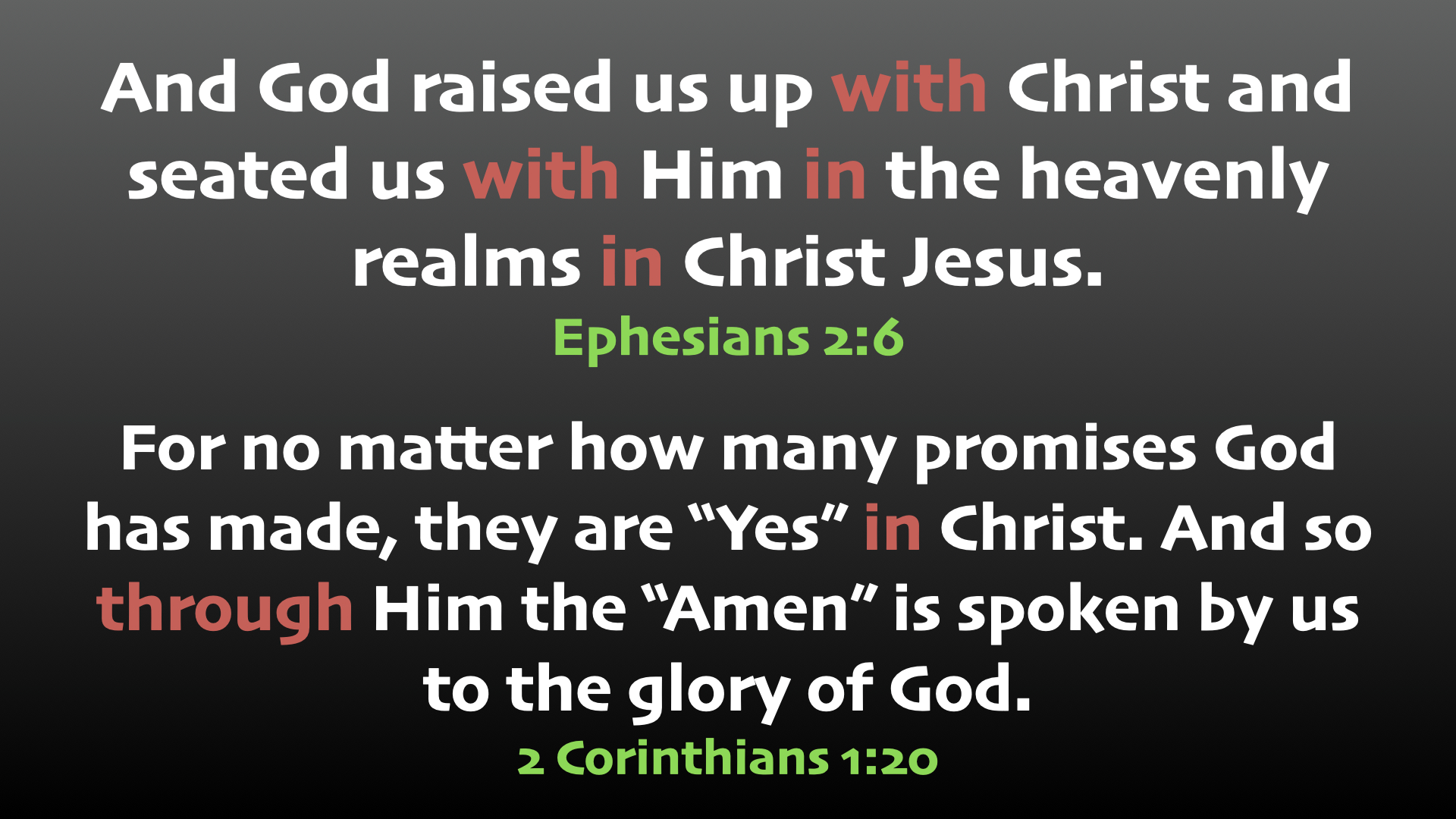
This High Priest not only sits down in God’s presence, but He takes us with Him into the Holy of Holies: “God raised us up with Christ and seated us with Him in the heavenly realms in Christ Jesus” (Ephesians 2:6)! 

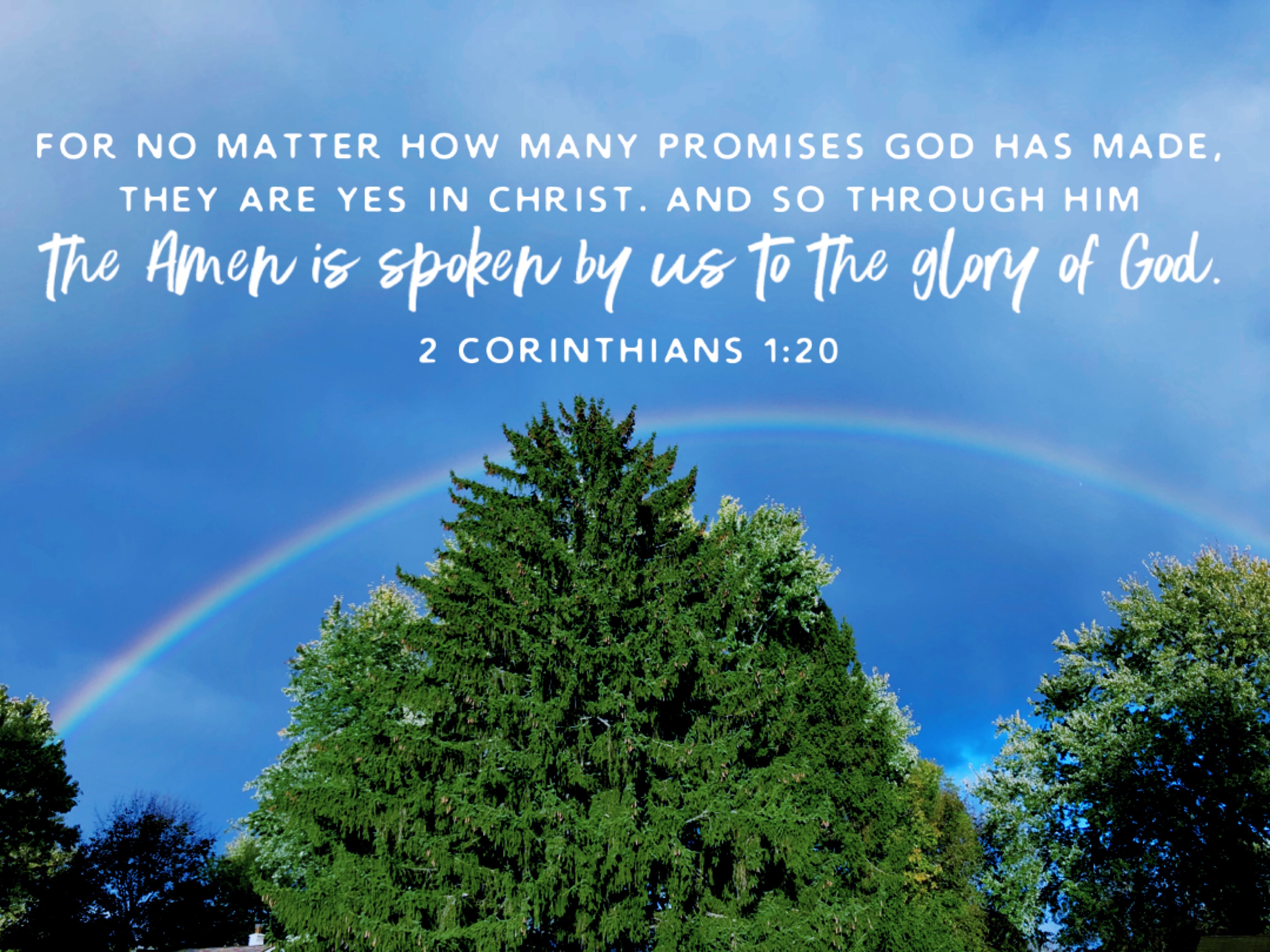
So now ALL God’s promises are for ALL who are in Jesus! “For no matter how many promises God has made, they are ‘Yes’ in Christ. And so through Him the ‘Amen’ is spoken by us to the glory of God” (2 Corinthians 1:20). 

I like how the Personalize Promise Bible turns that verse into this prayer: “My heavenly Father is faithful to His every Word. No matter how many promises He has made, in Jesus, He makes good on every one. I have God’s Word; therefore, I have God’s will. Every time that I pray in line with His Word, the answer is guaranteed.” 

My friend, if you have placed your faith in the completed work of Jesus, then EVERY promise in the Bible is a promise you can claim for your life. Hallelujah! What an amazing thing God has done for us through His Son Jesus Christ! 

If you’ve missed any of the topics we have covered in this series, you can find the full list by clicking here. 

►► Would you please prayerfully consider supporting this ministry? My Patreon supporters get behind-the-scenes access to exclusive materials. ◀︎◀︎
The Approachable Jesus

Listen to the podcast of this post by clicking on the player below, and you can also subscribe on AppleSpotify, or Audible. 

A friend of mine who was in a position of leadership in the Assemblies of God used to joke with people, “Since you’re bowing and walking backwards out of my office, would you like to kiss my ring too?” There are some people that we feel are in a special class so that we have to approach them differently. 

If we feel that way about certain people, what might we be thinking when we consider approaching the supreme, awesome, preeminent, incomparable Jesus?! It’s very likely that we could feel Him to be unapproachable, as though we aren’t worthy of His attention. 

But when Jesus Himself told us, “When [not ‘if’] you pray,” He is assuming that we will pray. And then He adds this amazing thought: “And I will do whatever you ask in My name, so that the Father may be glorified in the Son” (John 14:13)! 

Jesus loves to help us. He died a cruel death on the Cross so that He could help us! Jesus ties our trusting prayer with His willingness to serve us (Luke 12:22-37). Note this last line from our approachable Savior: 

It will be good for those servants whose Master finds them watching when He comes. Truly I tell you, He will dress Himself to serve, will have them recline at the table and will come and wait on them. (v. 37) 

Jesus serves us?! What an amazing thought! But does this make Jesus somehow less majestic? I like what John Piper has to say about this: “Does this belittle the risen Christ—to say that He was and is and will ever be the servant of His people? It would, if ‘servant’ meant ‘one who takes orders,’ or if we thought we were His masters. Yes, that would dishonor Him. But it does not dishonor Him to say that we are weak and need His help.” 

How do we not treat Jesus as an order-taking servant? First, we have to remember that approachable doesn’t mean something we do casually. I think this is discovered in our attitude—it’s the difference between being childlike and being childish. 

The childlike attitude is one of wonder and trust. One that calls God, “Daddy.” One that is lovingly dependent on Him. One that says, “I don’t understand what I’m going through right now, but I trust Your wisdom.” 

The childish attitude is one who treats majestic things flippantly. Perhaps the childish one talks about God as “the Big Guy upstairs.” Or one who remains selfishly independent, or who says, “Do it my way—now!”

The childlike attitude glorifies Jesus as our approachable Servant Savior. 

The childlike attitude also recognizes that there are more dimensions of the majesty of God to be discovered in an abiding relationship with Jesus. Our approachable Savior wants us to come to Him, to call to Him for help, and to know Him more intimately (Jeremiah 29:13-14; Matthew 11:28-30; Hebrews 4:16; 10:19, 22). 

Prayer not only unlocks deeper, proper intimacy with Jesus, but it conforms our heart more and more to His heart. As we are conformed to Him, we reflect His approachable glory to others (2 Corinthians 4:6, 3:18). 

We approach the awesome Jesus reverently in childlike faith. It’s in God’s presence that the Holy Spirit matures our faith so that we become glory-reflectors that point others to Jesus. 

If you’ve missed any of the eight messages in our series Awesome: Learning to pray in the awesome name of Jesus, you can find the list of all of the messages by clicking here. 

►► Would you please prayerfully consider supporting this ministry? My Patreon supporters get behind-the-scenes access to exclusive materials. ◀︎◀︎

The Preeminent Jesus

Listen to the podcast of this post by clicking on the player below, and you can also subscribe on AppleSpotify, or Audible. 

There is only one Jesus, but He is presented to us in the Bible with many facets, and we get to pray in all of those facets of His name! 

One of the facets of Jesus is His preeminence. The dictionary defines preeminent as “above and before others; superior; surpassing.” 

The Bible uses the word preeminence to mean “holding the first place.” The apostle Paul uses this idea of Christ’s supremacy when He describes Him this way—

The Son is the image of the invisible God, the FIRSTBORN over all creation. For in Him ALL things were created: things in heaven and on earth, visible and invisible, whether thrones or powers or rulers or authorities; ALL things have been created through Him and for Him. He is BEFORE ALL things, and in Him ALL things hold together. And He is the HEAD of the body, the church; He is the BEGINNING and the FIRSTBORN from among the dead, so that in EVERYTHING He might have the SUPREMACY. For God was pleased to have ALL His fullness dwell in Him. (Colossians 1:15-19, emphasis mine) 

Therefore God exalted Him to THE HIGHEST PLACE and gave Him the name that is above EVERY name, that at the name of Jesus EVERY knee should bow, in heaven and on earth and under the earth, and EVERY tongue acknowledge that Jesus Christ is Lord, to the glory of God the Father. (Philippians 2:9-11, emphasis mine) 

Praying in Christ’s preeminence means that we never have to settle for less than God’s best! 

When we began this series, I mentioned that there were some people who misuse the words of Jesus. Specifically the phrase where Jesus says, “I will do whatever you ask in My name” (John 14:13, 15:16, 16:23). They have taken this as license to ask for things for their own comfort, or claiming that praying “in the name of Jesus” means that we never have to experience pain, poverty, or any setbacks. 

But preeminence ≠ prosperity! 

Prosperity wrongly says Christians will never have trouble, never experience poverty or lack, and can claim and obtain lavish things just by invoking “in the name of Jesus.” 

Preeminence correctly says that Christians may have trouble, or poverty, or even martyrdom, but that Christ’s preeminence gets the final word, the decisive word, and the best word! 

Jesus didn’t pray to be removed from trials. The godly apostle Paul experienced ample trouble, and so did the heroes of faith (John 12:27-28; 2 Corinthians 11:23-27; Hebrews 11:35-38). Yet even in all of these troubles and pain and hardship, Christ’s preeminence prevails! 

As Paul said in Colossians 1, Jesus was the “firstborn from among the dead,” meaning that He is now preeminent even over death! Jesus said that His followers will—not “may”—experience persecution here, just as those heroes of the faith listed in Hebrews 11 did, but that the rewards in eternity are beyond compare (see 1 Corinthians 15:55, 57-58; Matthew 5:11-12; Hebrews 11:39-40). 

Horatio Spafford wrote the hymn It Is Well With My Soul. One of the stanzas reminds us:

Though satan should buffet though trials should come
Let this blest assurance control
That Christ has regarded my helpless estate
And has shed His own blood for my soul

Praying in the name of the preeminent Jesus does at least four things for us: 

  1. Gives us a surpassing victory—Romans 8:31-32, 37 
  2. Keeps us humble and God glorified—2 Corinthians 4:7
  3. Detaches us from earthly things that would take our eyes off of Jesus—Philippians 3:8
  4. Keeps us focused on Heaven—2 Corinthians 4:17

(check out all of the verses listed above by clicking here)

Let me say it again: Praying in Christ’s preeminence means that we never have to settle for less than God’s best! 

God’s best is not awaiting us here on earth, but it is our promised eternal reward for persevering to the end. It may seem tough at times, but our preeminent Savior walks with us every step of the way! 

If you’ve missed any of the other messages in this series on prayer, you can find links to all of those messages by clicking here. 

►► Would you please prayerfully consider supporting this ministry? My Patreon supporters get behind-the-scenes access to exclusive materials. ◀︎◀︎

The Divine Jesus

Listen to the podcast of this post by clicking on the player below, and you can also subscribe on AppleSpotify, or Audible. 

I was teaching a class for my team members, and at one of the breaks a new employee came up to me to say how much he was enjoying the day, and to tell me that he would like to do what I was doing. I asked him, “But do you want to do what I did in order to do what I’m doing?” When I explained that I read about 10-12 books for this training time, and that it took me about 40 hours to prepare for our 4-hour class, he didn’t seem as interested. 

Most people don’t want to put in the work, but they just want the results. As Christians we need to remember these words from William Penn: “No pain, no palm; no thorns, no throne; no gall, no glory; no cross, no crown.” 

The human Jesus understands and empathizes with our painful struggles, and the divine Jesus helps us endure through these painful struggles to get the rewards on the other side. 

What do we mean by divine? The dictionary simply defines it as things relating to God or gods, so we need to use some context to help us understand who this divine Jesus is. After all, the New Testament refers to both Jesus and Artemis as divine (Romans 1:20; Hebrews 1:1-3; Acts 19:27). 

One way we can distinguish is by doing what the writer of Hebrews advised: “Remember your leaders, who spoke the word of God to you. Consider the outcome of their way of life and imitate their faith” (Hebrews 13:7). We see that the so-called worshippers of Artemis were more interested in their own financial gain than they were her divinity (Acts 19:23-27). In contrast, the apostle Paul demonstrated a totally Jesus-focused lifestyle: “However, I consider my life worth nothing to me; my only aim is to finish the race and complete the task the Lord Jesus has given me—the task of testifying to the good news of God’s grace” (Acts 20:24). 

Paul was following Jesus, and called all Christians to do the same. He noted that Jesus gave up all of His divine privileges to become our human Jesus, but because of this obedience, God made the divinity of Jesus shine more gloriously than anything else in creation! Then Paul transitioned to a word specifically for Christians: 

Therefore, my dear friends, as you have always obeyed—not only in my presence, but now much more in my absence—continue to work out your salvation with fear and trembling, for it is God who works in you to will and to act in order to fulfill His good purpose. (Philippians 2:12-13) 

In essence this is like Jesus saying, “I want you to have what I have, but you will have to do what I did to get it: That is, go through the painful struggles of life. But I will be right here with you every single step of the way!” 

The writer of Hebrews echoes this idea by reminding us that Jesus was made perfect through suffering, and so are we. So he calls us to “not throw away your confidence; it will be richly rewarded.” He also reminds us that although the times of suffering are not pleasant, there is an unimaginable reward on the other side (Hebrews 2:9-11; 10:35-39; 12:1-11).

I especially like this conclusion: “No discipline seems pleasant at the time, but painful. Later on, however, it produces a harvest of righteousness and peace for those who have been trained by it” (Hebrews 12:11).

The divine Jesus has made it possible for us to be rewarded as He was rewarded! His divine power leads to our divine nature. And His divine power helps us defeat the world’s weapons (2 Peter 1:3-4; 2 Corinthians 10:4) 

Jesus asks, “Do you want to do what I did in order to do what I’m doing?” The power of the divine Jesus can help us be perfected, but we only get to this perfected place by suffering as He suffered. That’s why we need to know our human Jesus understands, empathizes, and helps. 

Most people don’t want to put in the work, but they just want the rewards. Our divine Savior helps us work out what God has worked in us. He helps us get the rewards! 

If you’ve missed any of the messages in our series on prayer called Awesome: Learning to pray in the awesome name of Jesus, you can find all of the messages by clicking here. 

►► Would you please prayerfully consider supporting this ministry? My Patreon supporters get behind-the-scenes access to exclusive materials. ◀︎◀︎

Poetry Saturday—Sorrowful, Yet Rejoicing

Listen to the podcast of this post by clicking on the player below, and you can also subscribe on AppleSpotify, or Audible. 

“…sorrowful, yet always rejoicing…” (2 Corinthians 6:10)

Sorrow was beautiful, but her beauty was the beauty of the moonlight shining through the leafy branches of the trees in the wood, and making little pools of silver here and there on the soft green moss below. When Sorrow sang, her notes were like the low sweet call of the nightingale, and in her eyes was the unexpectant gaze of one who has ceased to look for coming gladness. She could weep in tender sympathy with those who weep, but to rejoice with those who rejoice was unknown to her.

Joy was beautiful, too, but his was the radiant beauty of the summer morning. His eyes still held the glad laughter of childhood, and his hair had the glint of the sunshine’s kiss. When Joy sang his voice soared upward as the lark’s, and his step was the step of a conqueror who has never known defeat. He could rejoice with all who rejoice, but to weep with those who weep was unknown to him.

“But we can never be united,” said Sorrow wistfully.

“No, never.” And Joy’s eyes shadowed as he spoke. “My path lies through the sunlit meadows, the sweetest roses bloom for my gathering, and the blackbirds and thrushes await my coming to pour forth their most joyous lays.” 

“My path,” said Sorrow, turning slowly away, “leads through the darkening woods, with moon-flowers only shall my hands be filled. Yet the sweetest of all earth-songs—the love song of the night—shall be mine; farewell, Joy, farewell.” 

Even as she spoke they became conscious of a form standing beside them; dimly seen, but of a Kingly Presence, and a great and holy awe stole over them as they sank on their knees before Him.

“I see Him as the King of Joy,” whispered Sorrow, “for on His Head are many crowns, and the nail prints in His hands and feet are the scars of a great victory. Before Him all my sorrow is melting away into deathless love and gladness, and I give myself to Him forever.” 

“Nay, Sorrow,” said Joy softly, “but I see Him as the King of Sorrow, and the crown on His head is a crown of thorns, and the nail prints in His hands and feet are the scars of a great agony. I, too, give myself to Him forever, for sorrow with Him must be sweeter than any joy that I have known.” 

“Then we are one in Him,” they cried in gladness, “for none but He could unite Joy and Sorrow.”

Hand in hand they passed out into the world to follow Him through storm and sunshine, in the bleakness of winter cold and the warmth of summer gladness, “as sorrowful yet always rejoicing.”Lettie Cowman

►► Would you please prayerfully consider supporting this ministry? My Patreon supporters get behind-the-scenes access to exclusive materials. ◀︎◀︎

Recovering Mentally

Listen to the podcast of this post by clicking on the player below, and you can also subscribe on AppleSpotify, or Audible. 

I had a great time on the Thriving In Ministry podcast with Kyle Willis and Dace Clifton. 

Kyle asked me a question about how I recharge myself mentally. A key verse in the Bible for me is 2 Corinthians 10:5 where the the apostle Paul counsels us to capture our thoughts. This is extremely hard to do when we are physically or mentally drained. 

In my younger years, I used to try to “do nothing” as my recovery time. As I matured, I realized that top athletes had a different way to help their body recover, and I began to adapt those practices to my time of mental recovery. Dace also shares a very helpful tip for his mental recovery time. 

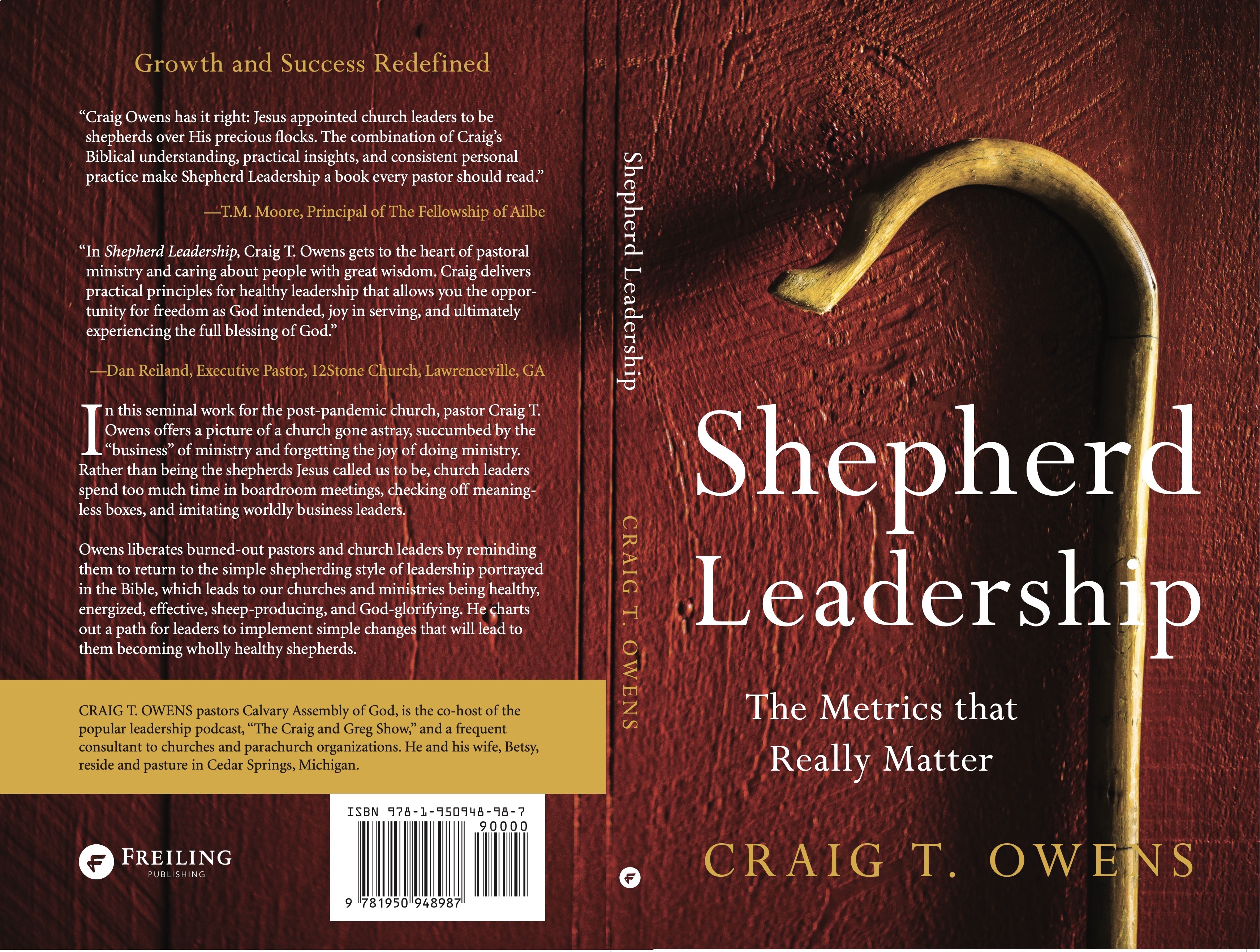
In my book Shepherd Leadership: The Metrics That Really Matter I make the case that in order for the sheep to be healthy, the shepherd has to get healthy first. The principle is simple: You cannot give to others what you do not possess yourself. I hope you will pick up a copy of my book to learn how Jesus taught us to be wholly healthy leaders.

I’ll be sharing more clips from this Thriving In Ministry interview soon, so please stay tuned. Shepherd Leadership: The Metrics That Really Matter is available in print or ebook, and in audiobook through either Audible or Apple.

►► Would you please prayerfully consider supporting this ministry? ◀︎◀︎


Unburdened

Listen to the podcast of this post by clicking on the player below, and you can also subscribe on AppleSpotify, or Audible.

Let’s get on the same page with a few facts: 

  • Nearly 1-of-5 adults in the United States age 18 and older battle some form of anxiety disorder. 
  • Being anxious is not a sin but we can grieve God’s heart if we don’t train ourselves to turn to Him as our First Source. Notice that David said, “When [not “if”] I am afraid, I put my trust in You” (Psalm 56:3). 

We’ve been looking at both the dictionary definitions and biblical definitions of anxiety. One definition is being disquieted, but we saw that coming close to Jesus Xs out the “dis-” and takes us to a place of quiet. A second definition is being insecure because we are so full of cares. Clinging to Jesus Xs out the “in-” and makes us secure when His strong arms are around us. 

A third definition of anxiety is found here: “Cast your cares on the Lord and He will sustain you; He will never let the righteous be shaken” (Psalm 55:22). This word for cares or anxieties is the only time this Hebrew word is used in the Bible. The idea is a heavy burden, which the Amplified Bible captures like this: “Cast your burden on the Lord—releasing the weight of it—and He will sustain you….”

We can be burdened because we pick up and carry things on our own. But the word for cares or burdens in Psalm 55:22 can mean not only things we pick up, but things given to us by God or allowed by God. You might ask, “Why would God give me a burden?” 

  • Sometimes it’s allowed—God allowed satan to afflict Job within limits, and He allowed Joseph’s brothers to ambush him (Job 1:8-12; 2:3-7; Genesis 50:20).  
  • Sometimes it’s given—God gave Jesus a bitter cup to drink, and He gave Paul a “thorn in the flesh” (Matthew 26:39-42; 2 Corinthians 12:7). 
  • In every instance, the limits are perfectly measured to accomplish what God wants to do. The way we respond glorifies Him and keeps us dependent on Him (Job 1:20; 2:10; Genesis 50:20; 2 Corinthians 12:8-10; Hebrews 10:10). 

(Check out all of the above biblical passages by clicking here.)

Still in the middle of this, the burdens can seem overwhelming and anxiety-inducing. That’s why God tells us what to do with these burdens: Cast them off! 

In Psalm 55:22, David gives us the word “cast” in the imperative mood, which means it’s a command. Literally, the word means to throw away or shed the burden. 

How often do we do this? David said he prayed “evening, morning, and noon” for God’s help (Psalm 55:16-17). 

What does God do when we cast off these burdens? He sustains and supports us—“He will sustain you; He will never let the righteous be shaken.” 

The apostle Peter quotes the opening words of this verse when he writes, “Cast all your anxiety on Him,” and then he tells us why we can do this: “Because He cares for you” (1 Peter 5:7). Just like David said he prayed for his burdens to be released “evening, morning, and noon,” the verb tense Peter uses implies the same thing. We don’t just release our burdens once, but we continue to do it again and again and again! 

The word Peter uses for “cast” is only used twice in all the New Testament. The word means not just to drop our burdens at our feet—where we may trip over them or be tempted to pick them up again—but to throw our burdens on someone else. The only other place this word is used is when on the day Jesus rode into Jerusalem the disciples “threw their cloaks on the colt and put Jesus on it” (Luke 19:35). 

Peter tells us that this casting off of our burdens requires us to humble ourselves before God. Pride makes us think we can handle it on our own, and that same pride robs God of the glory He would receive when He provides relief from our heavy load. We cast these burdens onto Jesus so that we can be alert to the enemy’s sneaky tactics, and help others who are also being attacked. And just as David said God supported and sustained him, Peter said the same thing (1 Peter 5:6-10). I especially like the wording from the King James Version—

But the God of all grace, Who hath called us unto His eternal glory by Christ Jesus, after that ye have suffered a while, make you perfect, stablish, strengthen, settle you. (1 Peter 5:10 KJV) 

Jesus can X-out the instability that comes with carrying heavy burdens and make us stablished, strengthened, and settled in Him. 

Don’t try to carry these anxiety-inducing burdens on your own, but cast them on Jesus every evening, morning, and noon. Let Him carry those burdens so you can live in a way that glorifies Him every single day. 

If you’ve missed any of the messages in our series X-ing Out Anxiety, you can find all of the messages by clicking here. 

►► Would you please prayerfully consider supporting this ministry? ◀︎◀︎

Quieting The Storms

Listen to the podcast of this post by clicking on the player below, and you can also subscribe on AppleSpotify, or Audible. 

“Anxiety disorders are the most common mental illness in the U.S., affecting 40 million adults in the United States age 18 and older, or 18.1% of the population every year.” —Anxiety & Depression Association of America 

A multitude of factors go into someone’s anxiety: genetics, temperament, brain chemistry, life experiences. In addition to those factors, we have to keep in mind that humans are a three-part being—with a body, mind, and spirit—and a disease in one area does affect the other two areas. 

All of this means that there is no one-size-fits-all solution for anxiety. But there is one Healer: 

  • He may supernaturally heal your body, mind, or spirit 
  • He may direct you to a medical doctor, a mental health professional, or a spiritual counselor 
  • But always, He will walk through the challenges with you, strengthening you, and preparing you to minister to others going through a similar struggle (Psalm 23:1-6; 2 Corinthians 1:3-4) 

David wrote, “When I am afraid, I put my trust in You” (Psalm 56:3). Notice that he said “when” not “if.” David knows what you probably know too: we can be easily consumed by our anxiety, doubts, and fears. But David also knows (and I hope you do too) that at those moments, we can go to God as our trustworthy First Source. 

One of the dictionary definitions of anxiety is a feeling of disquiet. All of the conflicting thoughts make it hard to concentrate, the abundance of noise makes it difficult to talk to yourself, let alone talk to God. 

I’d like you to consider another psalmist’s words. Look at the first half of Psalm 94:19—

  • When anxiety was great within me… (NIV) 
  • In the multitude of my anxious thoughts… (AMP)
  • When doubts filled my mind… (NLT) 

The setting of this psalm is one of lots of disquieting voices: a desire to see the wrongdoers punished, listening to arrogant words, getting fed up with boasting words, seeing good people being trampled, hearing foolish words uttered about God (vv. 1-8). 

Experiencing anxiety is not sinful, but I do think that we grieve God’s heart when we immediately run to other sources for relief instead of going to our loving Heavenly Father first. After dealing with the disquiet in the opening verses of Psalm 94, the psalmist says, “My anxiety level was sky high!” But then notice how that verse concludes—

  • Your consolation brought me joy (NIV) 
  • Your comforts cheer and and delight my soul (AMP)
  • Your comfort gave me renewed hope and cheer (NLT)

Jesus told us about our Comforter who would always be with us (John 14:1, 16-17). A little further on in these same remarks Jesus also said, “These things I have spoken to you, that in Me you may have peace. In the world you will have tribulation; but be of good cheer, I have overcome the world” (John 16:33 NKJV). 

I like that phrase, “Be of good cheer.” That phrase is just one word in Greek, and sometimes it’s translated “be of good courage.” In every single instance, it’s only used by Jesus and it’s only used when He comes close to anxious people (Matthew 9:2, 9:22, 14:27; Mark 6:50, 10:49; Luke 8:48; John 16:33; Acts 23:11). 

A furious squall battered the boat, almost swamping it. The disciples were—to say the least—disquieted! In their anxious state they notice Jesus peacefully sleeping. They wake Him up with, “Don’t You care that we’re drowning?!” Jesus stands up and says to the storm, “Quiet. Be still.” 

Recall that one of the descriptions of anxiety was being disquieted. That prefix dis- means to be separated: our anxiety would seek to distance us from God’s presence, to make us feel like His help is too far away. But when we go to Jesus, He alone can say, “Quiet” to our disquieting thoughts. He can remove the “dis-” and bring us close to Him. Only His peace can X-out the noise of the storm and bring you to a place of quiet rest. 

After Jesus said, “Quiet. Be still,” notice this: “THEN the wind died down and it was completely calm” (Mark 4:39). And the great thing is this: Even if another storm begins disquieting us just a few minutes after the calm, we can go to Him again. There is no limit: We can continually go to the Eternal Source of peace, to the only One who can speak, “Quiet” to our anxious thoughts. 

Please follow along with us as we learn more about X-ing out our anxieties. 

►► Would you please prayerfully consider supporting this ministry? ◀︎◀︎

It’s A Big Deal

Listen to the podcast of this post by clicking on the player below, and you can also subscribe on AppleSpotify, or Audible. 

I get a little leery when people are advocating for a government that is friendly to Christianity. In biblical history and world history, Christians tend to backslide when things are going smoothly for them. 

Difficulties and even persecution cause us to evaluate if what we’re standing on is really a sure foundation (2 Corinthians 1:9; Philippians 4:10-13). 

As the Jews returned from their exile in Babylon, things were going fairly easily for them. And as they had done so many times before, they began to backslide. The Archeological Study Bible noted, “This generation was not guilty of the gross idolatry of its forefathers. Rather, these Israelites embraced a kind of dead orthodoxy, in which they tried to get by with the minimum that their faith required.”  

Onto this scene comes a prophet named Malachi. Malachi means “My messenger,” and we don’t know if this was actually the prophet’s name or not, but he took it on as his nature, delivering the heavy words of God. In fact, he held the words of God with such respect that when he says this is “an oracle,” he literally is saying, “This is a heavy burden to bear!” 

Malachi uses the phrase “LORD Almighty” (or LORD of Hosts in the KJV, and Lord of Heaven’s Armies in the NLT) twenty-four times. By contrast with the other minor prophets…

  • Hosea, Joel, Amos, Obadiah, and Jonah use this phrase zero times 
  • Micah and Habakkuk each use it once
  • Nahum and Zephaniah each use it twice
  • Haggai uses it 12 times (or 32 percent of the total verses in his book) 
  • Zechariah uses the phrase 46 times (which 22 percent of his total verses) 

But Malachi’s 24 times is 44 percent of his total verses! In other words, he wanted his audience to be crystal clear that it wasn’t him who was speaking, but the King of kings was speaking to us through Malachi! 

God is still speaking through Malachi to us today! Just like Israel in Malachi’s day, I think Christians today run the very real risk of backsliding. Just like Israel, when we forget the weightiness of the glory of the LORD ALMIGHTY we can begin to slip into an it’s-no-big-deal attitude. 

By contrast, when we’re honoring the LORD of Hosts, and reverencing Him, and desirous of His glory being seen, it’s a very big deal that we listen to His voice and closely follow His commands.  

So Malachi’s six warnings to the Israelites of his day should still be heeded by Christians today. We should examine ourselves very closely to see if we have the same it’s-no-big-deal attitude. We should ask ourselves, “Are we…

(1) …offering less-than-our-best sacrifices? Are we just giving God the leftovers?”  

(2) …listening to church leaders that don’t reverence God’s name?” 

(3) …honoring the sanctity of marriage?” 

(4) …self-seeking instead of neighbor-loving?” 

(5) …withholding the full tithe from our local church?” 

(6) …following God only for personal gain?” 

(Check out all of the verses for these questions by clicking here.) 

If this study of the minor prophets—especially these last three—has told us anything, it’s that God keeps His word. When He says He is coming back as the righteous Judge, that will happen. In fact, it could happen at any moment! 

We must be ready! We must guard our hearts against the it’s-no-big-deal attitude. We must reverence our awesome God. The things of God are a very big deal indeed (see Hebrews 10:37-39; Revelation 22:12-16). 

To guard ourselves against this backsliding attitude, we must live every day reverencing the awesome, weighty, majestic name of Jesus! 

If you’ve missed any of the messages in our series exploring the powerful lessons in the the twelve minor prophets, please click here to get the list of all of those messages. 

►► Would you please prayerfully consider supporting this ministry? ◀︎◀︎

Thursdays With Spurgeon—Faith Sees Better Than Sight Does

This is a weekly series with things I’m reading and pondering from Charles Spurgeon. You can read the original seed thought here, or type “Thursdays With Spurgeon” in the search box to read more entries.

Listen to the podcast of this post by clicking on the player below, and you can also subscribe on iTunes or Spotify.

Faith Sees Better Than Sight Does  

For we walk by faith, not by sight. (2 Corinthians 5:7) 

     There is walking by faith, and there is walking by sight. The most of men, all men indeed, naturally walk by sight. They have a proverb that says, ‘Seeing is believing,’ and they are wise men, for they trust people as far as they can see them, and no further. … Self-reliance is the name of the principle, and according to the world, the best and grandest thing that a man can do is have faith in himself. … 

     I think the world must be pretty well ashamed of itself if it still considers this poor earth to be all that a soul has to live for. I feel as if I could not talk upon the matter. Solomon tried everything there was in this world—riches, power, pleasure—every sort of delicacy and delight he had, beyond the point of satisfaction. And what was his verdict upon at all? ‘Vanity of vanities, all is vanity’ (Ecclesiastes 1:2). … 

     If there is not another world to live for, I must say that this life is a most unutterably empty kind of thing! It is not worthy of a man! But oh, to believe what God tells me: that there is a God; that God became flesh to bear me up to Himself! To believe that I am God’s son, that I have an immortality within myself that will outlast the stars, that I will one day see His face and sing His praise forever with cherubim and seraphim! Why, there is something here! …

     If you walk only by sight and believe only what you see, what do you believe? You believe that while you are living here, it is a good thing to make the best you can of it. And then you will die and be buried, and that will be the end of you! What a poor, miserable, ignorant belief this is! … But when you believe in what God reveals and come to walk by faith, how your information expands! Now riddles are all solved, and the inexplicable is understood! … 

     The principle of faith does best in the dark. He who walks by faith can walk in the sunlight as well as you can, for he walks with God. He has enlightened eyes, but he can walk in the dark as you cannot, for his light is still shining upon him. He trusts in the unseen and in the invisible, and his soul rejoices when present things are passing away.

From Faith Versus Sight

One of the temptations of the devil has been to try to get us focused on the seen—the temporal. He did this successfully with Adam and Eve in the Garden of Eden. He tried to get Jesus to focus on the temporal in his wilderness temptations, but Jesus steadfastly kept His eyes on the unseen. 

The devil’s strategy hasn’t changed. He will try to get you to say, “Woe is me! Look at all of the bad things happening around me!” 

But we walk by faith, not by sight. “Faith is the assurance—the confirmation, the title deed—of the things we hope for, being the proof of things we do not see and the conviction of their reality—faith perceiving as real fact what is not revealed to the senses” (Hebrews 11:1 AMP).   

Don’t give in to the temptation to believe only what you see. There is so much more waiting for you. It’s all yours by faith in Jesus Christ!

►► Would you please prayerfully consider supporting this ministry? ◀︎◀︎