Respecting Elected Officials

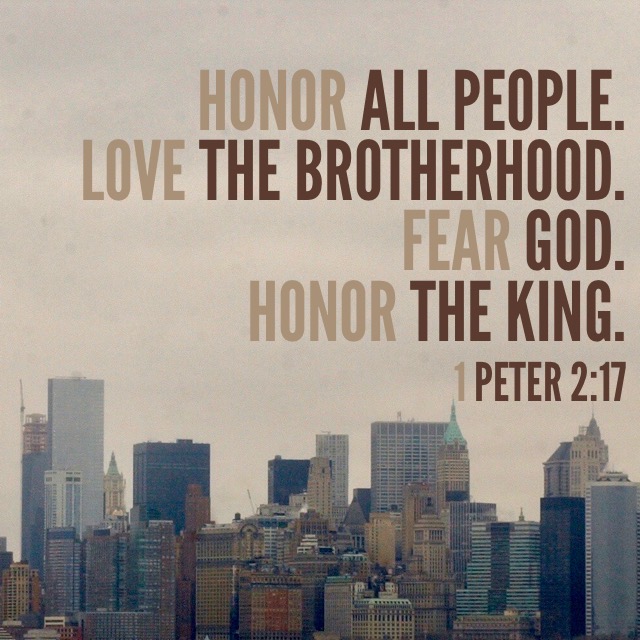
During our prayer time yesterday, I was contemplating the Apostle Peter’s instruction to, “Fear God, and respect the king” (1 Peter 2:17).

  • How do I respect the king (or the other elected officials in my city, state, and country)?
  • Does respect mean saying “yes” to every law that’s passed?
  • Can I be respectful and still disagree with those in elected office? How?

During our hour of prayer at the church last night, I was really wrestling with how I as a Christian should show respect to those in authority in our governments. Here are the nine things the Holy Spirit showed me.

I can show respect to those in authority by:

  1. Not forgetting that God placed them in their office (Daniel 4:25).
  2. Praying for them regularly (1 Timothy 2:1-2).
  3. Obeying all laws that aren’t immoral (Luke 20:25; Acts 5:29).
  4. Disobeying laws that are immoral (Esther 4:16; Acts 4:19).
  5. Holding them to biblical standards (Proverbs 8:15).
  6. Insisting they uphold the United States Constitution (Ecclesiastes 8:2).
  7. Reminding them that God’s wisdom is the ultimate standard (Proverbs 8:22-23).
  8. Requiring them to honor their promises, unless those promises conflict with God’s Word or the Constitution (Esther 1:13; 8:8).
  9. Speak to and about them without complaining or arguing (Philippians 2:14-15).

(Check out all of the above passages by clicking here.)

I’m working on living these out. What do you think?

6 Quotes from “Porn-Again Christian”

Earlier today I posted a review of Porn-Again Christian: A Frank Discussion on Pornography and Masturbation. Here are some of the quotes from this book that really caught my eye

“Simply, according to God, marriage and sex are related, connected, and exclusive.”

“The cold hard truth is that most guys’ struggles are only known by their fellow Christian buddies and unless Christian dudes man up and stop arguing about stupid secondary theological issues and spend their energies holding one another accountable to get dominion over their underwear, then Christian friendship is nothing more than Christian fakery.”

“The act of lusting after the unclothed body of a woman is not a sin. The issue is which woman’s unclothed body you are lusting after. If she is your bride, then you are simply making the Song of Songs sing again to God’s glory and your joy. If she is not your bride, then you are simply sinning. It was God who clothed our mother Eve after her sin, and it is Eve’s daughters who undress themselves for themselves for the camera in violation of God’s desire that the female bodies he formed be seen only in their full glory by their husbands.”

“Pornography has the sad effect of objectifying people into objects with parts, thereby divorcing a person from their body and consequently diminishing their dignity.”

“The Bible is emphatically clear that God’s men should abstain from certain sins that war against their souls. First, God’s men should not commit adultery (Exodus 20:14). Second, God’s men should not covet their neighbor’s wife, even if her clothes leave little to the imagination (Exodus 20:17). Third, God’s men should not participate with prostitutes who use their bodies as a commodity to be rented for a good time or a good photo (Proverbs 23:26-27; 1 Corinthians 6:15-16). Fourth, God’s men should not be polygamous, because their father Adam and Head Jesus each had one bride (Eve and the Church). Fifth, God’s men should not be fornicators who slide their hands, which God made to lift up in prayer (1 Timothy 2:8), up the shirt of their girlfriend, even if she asks (1 Corinthians 6:9-13).”

“Eve may or may not have been beautiful, but to Adam she was glorious because she was all he had ever known. Practically, he had no standard of beauty to compare his bride to—she was his only standard of beauty. In creation, we see the wise pattern that for every man his standard of beauty is not to be objectified, but rather it should simply be his wife. This means that if a man has a tall, skinny red-headed wife then that is sexy for him, and if his neighbor has a short, curvy brunette wife than that is sexy for him. Pornographic lust exists to elicit coveting and dissatisfaction that no woman can satisfy because she cannot be tall and short, endowed and waifish, black and white, young and old, like the harem laid out in pornography.”

Christian men, you MUST read this book!

Do You Know Your Community?

Jesus called His followers to be salt and light. It’s pretty easy to figure out that the salt cannot season the food if it stays in the saltshaker, and the light cannot illuminate the darkness if it stays covered up. In order to season and shine in your community, you have to know your community.

And, pastor, that starts with you.

What you do is a much more effective sermon that what you say. Pastor, you need to know your community, so that you can be involved in your community, so that you and your church can season and shine in your community together.

So let me ask a couple of questions:

  • Do you know your Mayor / City Manager / Township Supervisor? If you don’t know them, how can you affirm their leadership (Romans 13:1-7)?
  • Do you attend City / Township Council meetings? If you don’t, how will you know what issues they’re wrestling with? If you don’t know those issues, how can you pray effectively for them (1 Timothy 2:1-2)?
  • Are you involved in your community? Don’t just assume people in your community will come to your church to sit among stranger to hear a stranger speak; instead, be so involved in your community that they will come to church to fellowship with friends and hear a friend speak (John 2:1-2).

I opened with the question, “Do you know your community?” But maybe a better way to ask this is, “Does your community know you?”

Does the community come to you to ask for help? This may be the best barometer of your involvement in your community: how often they seek your help or assistance in addressing issues within your community.

If you’re not as involved as you should be, the good news is that it’s never too late to start! Go get involved—go season and shine!

Thursdays With Oswald—No Substitution

This is a weekly series with things I’m reading and pondering from Oswald Chambers. You can read the original seed thought here, or type “Thursdays With Oswald” in the search box to read more entries.

No Substitution

     If in preaching the gospel you substitute your knowledge of the way of salvation for confidence in the power of the gospel, you hinder people from getting to reality. Take care to see while you proclaim your knowledge of the way of salvation, that you yourself are rooted and grounded by faith in God. Never rely on the clearness of your presentation, but as you give your explanation make sure that you are relying on the Holy Spirit. Rely on the certainty of God’s redemptive power, and He will create His own life in people.

From My Utmost For His Highest

The apostle Paul said,

When I came to you, brothers, I did not come with eloquence or superior wisdom as I proclaimed to you the testimony about God. …My message and my preaching were not with wise and persuasive words, but with a demonstration of the Spirit’s power, so that your faith might not rest on men’s wisdom, but on God’s power. (1 Corinthians 2:1, 4, 5)

As a pastor I have be so careful that I am steeped in the Word of God. It’s not my persuasive words that will win people to Christ, or draw them into a deeper relationship with God. My words will only be effective to the extent that they are God’s words. Yes, I still must study to be a workman who has no cause to be ashamed, correctly analyzing and accurately dividing [rightly handling and skillfully teaching] the Word of Truth (1 Timothy 2:15), but I must not allow my “knowledge” to ever be a substitute for the purity of the Word of God.

Leadership Tension

Along time ago I was studying the virtues that the Greek philosophers taught. To the Greeks, the virtue was considered the “golden mean” between two opposite extremes. It was the ability to balance the tensions that produced the virtue.

In areas where I have leadership responsibilities, I try to find the virtue of leadership as the balance between these two tensions:

  • Here is a trustworthy saying: Whoever aspires to be an overseer desires a noble task. (1 Timothy 3:1)
  • Should you then seek great things for yourself? Do not seek them. (Jeremiah 45:5)

On the one side: desire leadership. On the other side: don’t desire leadership. Do your best at it, but be ready to give it up.

I love this statement on leadership from John Maxwell—

Leadership is the willingness to put oneself at risk.
Leadership is the passion to make a difference with others.
Leadership is being dissatisfied with the current reality.
Leadership is taking responsibility while others are making excuses.
Leadership is seeing the possibilities while others are seeing the limitations.
Leadership is the readiness to stand out in a crowd.
Leadership is an open mind and an open heart.
Leadership is the ability to submerge your ego for the sake of what is best.
Leadership is evoking in other the capacity to dream.
Leadership is inspiring others with a vision of what they can contribute.
Leadership is the power of one harnessing the power of many.
Leadership is your heart speaking to the hearts of others.
Leadership is the integration of heart, head, and soul.
Leadership is the capacity to care, and in caring, to liberate the ideas, energy and capacity of others.
Leadership is the dream made reality.
Leadership is, above all, courageous.

I am trying to balance the pulls of leadership, but while I do I’m loving the leadership tension!

UPDATE: This idea of leadership tension became one of the key seed thoughts for my book Shepherd Leadership: The Metrics That Really Matter

A Mighty Fortress

“I know that the Lord is always on the side of the right. But it is my constant anxiety and prayer that I and this nation should be on the Lord’s side.” —Abraham Lincoln

I agree with President Lincoln. Prayer changes things. Prayer changes me. Prayer changes my outlook. Prayer keeps me aligned with God’s principles.

Now more than ever, our nation needs Christians to pray. The Apostle Paul said it loud and clear:

I urge, then, first of all, that requests, prayers, intercession and thanksgiving be made for everyone—for kings and all those in authority, that we may live peaceful and quiet lives in all godliness and holiness. (1 Timothy 3:1-2)

If our nation is to remain on the Lord’s side we need to be praying for our elected officials. We need to pray that they will have godly wisdom in carrying out their responsibilities. We need to pray that God will keep them safe.

Please join me on the National Day Of Prayer (NDP) this Thursday, May 5. Calvary Assembly of God will be open for prayer from 9am-7pm, and there will be special prayer times at noon and at 6pm.

If you cannot join me at the church, please pray on your own. You can get more information from the NDP Task Force by clicking here.

Don’t Fight It

A couple of weeks ago I wrote about some unique insights I gathered from taking a trip with my wife’s TomTom GPS unit. Well, I was taking another trip with TomTom the other day, and I got really annoyed!

I was running late. I grabbed my laptop and my cell phone, fired up the TomTom and hit the road. I got about a mile down the road and realized I forgot something for my meeting. So I turned my car around and quickly headed back home. All of a sudden a voice was reminding me…

  • “At the first possible place, make a legal u-turn.”
  • “Turn right at the next road and turnaround.”
  • “To return to your entered route, make a legal u-turn.”

This voice was still just as sweet and even-keeled as before, but it was really getting on my nerves. I knew I was heading in the wrong direction, but I wanted to get this taken care of quickly, but the voice kept reminding me. I tried to tune the voice out—tried to ignore it—but it didn’t work.

I turned the voice off.

When I wrote about TomTom earlier, I equated it to the moral GPS of the Holy Spirit. And that analogy still stands:

The Holy Spirit does convict us. He warns if we’re on the wrong path, and He lovingly and persistently keeps reminding us to do a u-turn. Those who listen and respond are fully restored. Those who don’t listen—those who switch off their moral GPS—can have their conscience permanently seared.

Are you listening to the Holy Spirit? Do you hear Him encouraging you? Do you hear Him challenging you? Do you hear Him reminding you to turn around? Stay tuned in—He only has the best in mind for you.

Priceless Freedom

Turn it up!

I had a blast last night with a bunch of students at Calvary Assembly of God who are excited about Jesus. They are free, and they are hungry for more of God in their lives. It was awesome!

Jesus said, “My purpose is to give them a rich and satisfying life” (John 10:10 NLT). And He said, “If the Son gives you freedom, you are free!” (John 8:35 CEV).

Last night we looked at Paul’s instruction to Timothy where he reminded Timothy not to let anyone look down on him. If you dig a little deeper into the meaning of these words, it’s clear that you and I teach others how to treat us. In other words, Timothy was already devaluing himself, so others assumed that’s how they should treat him too.

Paul said, “Timothy, you are valuable. So hold your head up high and set an example worth imitating for everyone around you.”

God loves you so much that He created a cosmos to display His majesty, He gave you a conscience to prod you to look for Him, and He sent His one and only Son to earth to pay the price for so you could be in a personal relationship with Him.

You are of immense value to God. God bought you with a high price. And if you accept that incredible gift of Jesus, you are free to live… to REALLY LIVE!

When we closed the service last night, the students began to worship God, and they didn’t want to leave! They lifted their hands in freedom, they sang in freedom, they loved God in total freedom because they recognized their value in Him. And today I believe they are going to be living in that priceless freedom.

What about you? Are you living free today? Accept the gift Jesus already paid for your life and you can live free!

Still Learning

I live by the axiom, “If you’re through learning, you’re through.” So I try to learn something new every day.

I just finished a class called New Testament Survey: a quick overview of the 27 books that compromise the New Testament of the Bible. Here’s a couple of interesting factoids I picked up from my studies:

  • The earliest-written book was James. Interesting, because at one point James thought Jesus (his half-brother) was nuts.
  • Only Matthew uses the term kingdom of heaven; all of the other writers use kingdom of God.
  • Mark uses the word immediately more times than anyone else. Perhaps because his source (Peter) was always doing things so quickly… sort of a ready, FIRE!, aim kinda guy.
  • Luke wrote what is called “the global gospel” for everyone, so he included 45 teachings/events that no one else records.
  • John doesn’t record any of Jesus’ parables.
  • John uses the word believe nearly 100 times— way more than any other writer.
  • Luke talks about the Holy Spirit nearly 60 times in the 28 chapters of Acts.
  • Romans is the longest of Paul’s epistles with 7101 words; Philemon is the shortest with just 355 words.
  • With the exception of the pastoral epistles (1 Timothy, 2 Timothy, Titus) Paul’s letters are arranged in the Bible from longest to shortest.
  • In 1 & 2 Thessalonians (only 136 verses) Paul refers to God, Christ, the Holy Spirit, or a combination thereof more than 150 times.
  • Paul gives Timothy seven word pictures to describe the kind of pastor he should be: son, soldier, athlete, farmer, workman, instrument, and servant.
  • Hebrews is called “the book of better things” so better is used 13 times. This word is used only six times in the remaining 26 books of the New Testament.
  • James wrote 108 verses but issues 50+ direct commands.
  • In John’s three short epistles he uses the word know 33 times, and the word dear ten times.

Keep on learning! There’s a lot of good stuff out there. What have you learned lately?

The Not-So-Little Stuff

Listen to the podcast of this post by clicking on the player below, and you can also subscribe on AppleSpotify, or Audible.

My youngest son showed up at the dinner table one evening with a swollen left eyelid. I looked at it a little more closely and could see what looked to be a bug bite in the corner of his eye.

“No big deal,” I thought. “It’s just a mosquito bite. Happens all the time in Michigan.” (After all the mosquito is slated to become our new state bird!)

But when he woke up the next morning, his left eye was only open a slit. By the time I got him to the urgent care, his eyelid was a deep pink color and he was feeling very lethargic.

Guess what? It’s not such a little thing anymore!

Frequently I hear people saying, “Don’t sweat the small stuff.” And I suppose to a certain extent that’s true. But typically the big stuff started off as the little stuff. Usually big problems are simply little problems that weren’t dealt with earlier.

  • Someone says, “My marriage failed last night” (big stuff). But the small warning signs had been there for months, but they weren’t taken care of.
  • Someone says, “My finances just hit rock bottom” (big stuff). But the small unnecessary purchases over time led to this moment.
  • Someone says, “I gave in to temptation” (big stuff). But the little flirting with the temptation created just the right environment for the big tumble.

Charles Simmons wrote —

“Life is made up of little things. It is very rarely that an occasion is offered for doing a great deal at once. True greatness consists in being great in the little things.”

On the flip side, rarely is a big problem presented all at one; it’s usually just the little things compounded over time.

The apostle Paul warned the church at Corinth about the little things that can blow up into the big things:

Your flip and callous arrogance in these things bothers me. You pass it off as a small thing, but it’s anything but that. Yeast, too, is a “small thing,” but it works its way through a whole batch of bread dough pretty fast. So get rid of this “yeast.” (1 Corinthians 5:6-7, The Message paraphrase)

A final thought from Paul to his protégé Timothy: “Keep a close watch on how you live” (1 Timothy 4:16 NLT). Great advice!

By the way, my son was fine after a little steroid treatment and some Benadryl, but some people never recover from their lack of attention to the little things.

Don’t let this happen to you! Watch out for the little things because you may find that they’re not so little after all!

►► Would you please prayerfully consider supporting this ministry?  My Patreon supporters get behind-the-scenes access to exclusive materials, like a 10-minute video I just shared on study tips for the poetic books of the Bible. ◀︎◀︎