Thursdays With Oswald—No Substitution

This is a weekly series with things I’m reading and pondering from Oswald Chambers. You can read the original seed thought here, or type “Thursdays With Oswald” in the search box to read more entries.

No Substitution

     If in preaching the gospel you substitute your knowledge of the way of salvation for confidence in the power of the gospel, you hinder people from getting to reality. Take care to see while you proclaim your knowledge of the way of salvation, that you yourself are rooted and grounded by faith in God. Never rely on the clearness of your presentation, but as you give your explanation make sure that you are relying on the Holy Spirit. Rely on the certainty of God’s redemptive power, and He will create His own life in people.

From My Utmost For His Highest

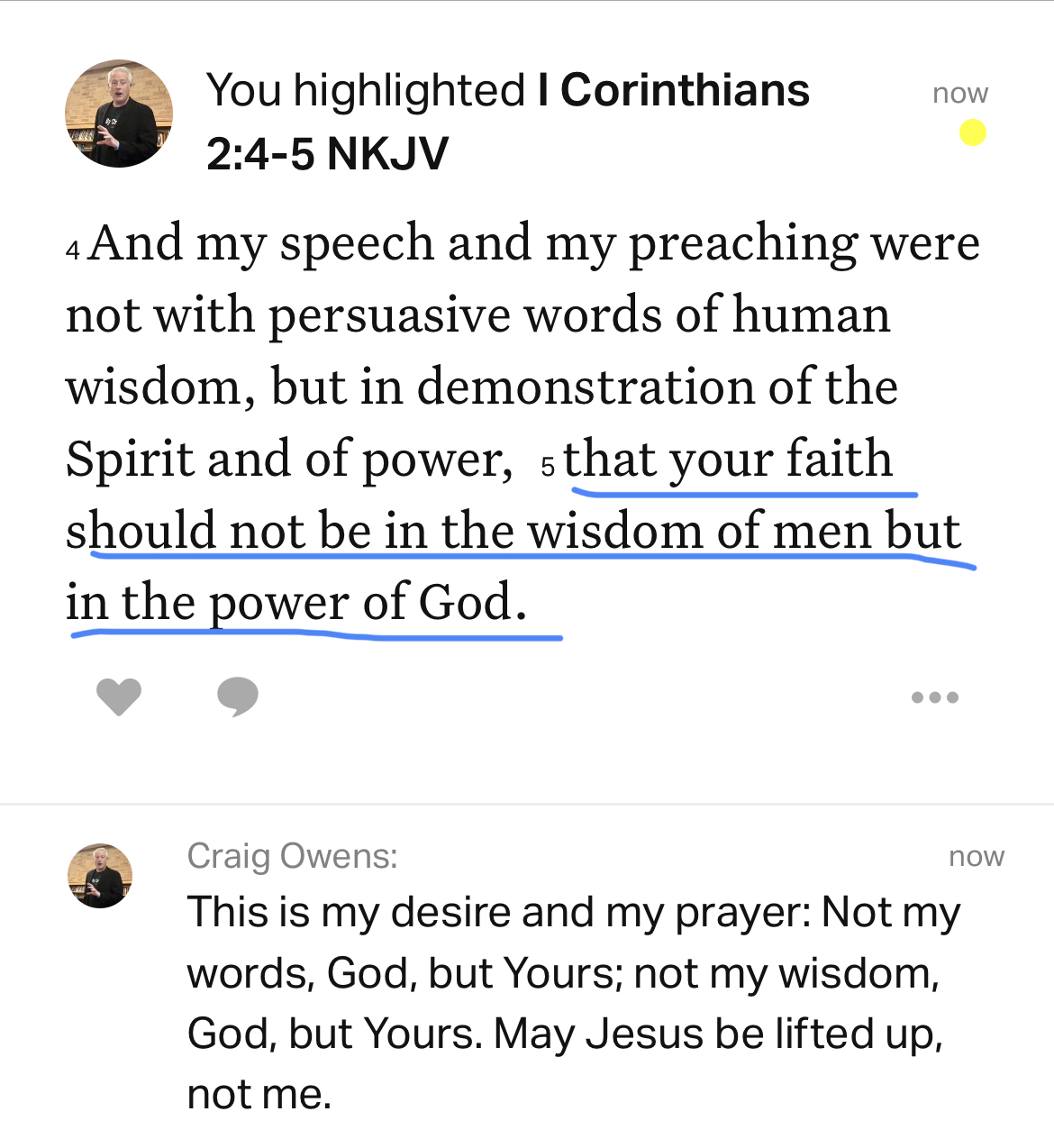
The apostle Paul said,

When I came to you, brothers, I did not come with eloquence or superior wisdom as I proclaimed to you the testimony about God. …My message and my preaching were not with wise and persuasive words, but with a demonstration of the Spirit’s power, so that your faith might not rest on men’s wisdom, but on God’s power. (1 Corinthians 2:1, 4, 5)

As a pastor I have be so careful that I am steeped in the Word of God. It’s not my persuasive words that will win people to Christ, or draw them into a deeper relationship with God. My words will only be effective to the extent that they are God’s words. Yes, I still must study to be a workman who has no cause to be ashamed, correctly analyzing and accurately dividing [rightly handling and skillfully teaching] the Word of Truth (1 Timothy 2:15), but I must not allow my “knowledge” to ever be a substitute for the purity of the Word of God.

Thursdays With Oswald—Instantly Detecting Compromise

This is a weekly series with things I’m reading and pondering from Oswald Chambers. You can read the original seed thought here, or type “Thursdays With Oswald” in the search box to read more entries.

Instantly Detecting Compromise

     We must be continually renewed in the spirit of our mind so that the slightest beginning of compromise with the spirit of the world is detected. “Well, what’s the harm; there’s nothing wrong in it,” when you hear that you know you have the spirit of the world, because the Spirit that comes from Jesus says, “Does this glorify God?”

From Biblical Ethics

There’s a HUGE difference between a Christian being in the world and of the world. A Christian who is compromising, is slowly becoming of the world. They say, “This isn’t wrong.”

A Christian who is uncompromising, is slowly becoming in the world but of Heaven. They judge everything by whether or not it brings glory to God.

Compromise is the slow erosion. Seldom does one go from a passionate follower of God to a worldly person suddenly. It is the small compromises day after day that are the most dangerous.

So one of my frequent prayers must be—

Search me, O God, and know my heart; test me and know my anxious thoughts. Point out ANYTHING in me that offends You. (Psalm 139:23-24, NLT)

Thursdays With Oswald—Judging A Life

This is a weekly series with things I’m reading and pondering from Oswald Chambers. You can read the original seed thought here, or type “Thursdays With Oswald” in the search box to read more entries.

Judging A Life

     God holds us responsible for the way we judge a young [Christian] life; if we judge it by the standards by which we would judge a mature life, we will be grossly unjust. … Be as merciless as God can make you towards the vices of a mature life, but be very gentle and patient with the defects of a growing life.

From Biblical Ethics

It’s a delicate balance that requires true discernment from the Holy Spirit. The ‘defects’ that we see in those who are new in the Christian walk need gentle correction, but the ‘vices’ of those who should know better by now need to be dealt with forcefully.

I see both the gentle and forceful in Paul’s words to the Corinthian church:

Dear brothers and sisters, when I was with you I couldn’t talk to you as I would to spiritual people. I had to talk as though you belonged to this world or as though you were infants in the Christian life. I had to feed you with milk, not with solid food, because you weren’t ready for anything stronger. And you still aren’t ready, for you are still controlled by your sinful nature. You are jealous of one another and quarrel with each other. Doesn’t that prove you are controlled by your sinful nature? Aren’t you living like people of the world? (1 Corinthians 3:1-3)

My prayer: God, help me to be perfectly balanced and directed by You. I don’t want to be too forceful with the young, nor too gentle with the mature. I want to see everyone growing in their relationship with You.

More Amateurs Needed

Did you know that the origin of the word clergy comes from the Latin meaning “learned men”? These are the men and women who are supposed to lead our churches, because they have the education that others don’t. They are professionals.

Now compare that with the definition of laity: “the people outside of a particular profession, as distinguished from those belonging to it.”

Did you catch that? The laity are outside and uneducated. They are amateurs.

The origins of clergy is traced back to the 12th century, and laity first appears in the 16th century. But long before this, the Apostle Paul had a different idea —

Take a good look, friends, at who you were when you got called into this life. I don’t see many of “the brightest and the best” among you, not many influential, not many from high-society families. Isn’t it obvious that God deliberately chose men and women that the culture overlooks and exploits and abuses, chose these “nobodies” to expose the hollow pretensions of the “somebodies”? (1 Corinthians 1:26-28 from The Message, emphasis added)

There is a HUGE PROBLEM when we think that only the professional clergy is equipped to do the ministry of the church! What makes a healthy church (like the first century church we read about in the book of Acts) is when EVERYONE is actively involved in ministry.

These words from Howard Hendricks are tough to hear, but right on target:

“I believe a great problem in evangelicalism today—whether in the local church, missions, seminary education, or what have you—is we have too many big-time operators! And too few servants. … 

“The typical church hires a clergyman to rob them of the privilege of exercising Christ’s gifts. … The greatest curse on the Church today is that we are expecting a small group of professionals to get God’s work done.”

I hope I haven’t stepped on too many toes with this one. My intent is not to offend, but to get the church thinking. I want to see EVERYONE that calls themselves a Christian actively involved in ministry.

Thursdays With Oswald—Why Did God Choose Me?

This is a weekly series with things I’m reading and pondering from Oswald Chambers. You can read the original seed thought here, or type “Thursdays With Oswald” in the search box to read more entries.

Why Did God Choose Me?

Oh, the bravery of God in trusting us! Do you say, “But He has been unwise to choose me, because there is nothing good in me and I have no value”? That is exactly why He chose you. As long as you think that you are of value to Him He cannot choose you, because you have purposes of your own to serve. But if you will allow Him to take you to the end of your own self-sufficiency, then He can choose you to go with Him.

From My Utmost For His Highest

If God chose me because I was so special, and if I did something valuable for Him, who would get the glory for that? I would.

But I want to exalt God only

But we have this treasure in earthen vessels, that the excellency of the power may be of God, and not of us. (2 Corinthians 4:7)

Brothers, think of what you were when you were called. Not many of you were wise by human standards; not many were influential; not many were of noble birth. But God chose the foolish things of the world to shame the wise; God chose the weak things of the world to shame the strong. He chose the lowly things of this world and the despised things—and the things that are not—to nullify the things that are, so that no one may boast before Him. It is because of Him that you are in Christ Jesus, who has become for us wisdom from God—that is, our righteousness, holiness and redemption. Therefore, as it is written: “Let him who boasts boast in the Lord.” (1 Corinthians 1:26-31)

I want to go with You, Lord. Please keep me humble!

Do You Speak “Teen-ese”?

I highly respect the work that Dr. Tim Elmore does with teenagers. Since I have two teenagers in my home, one of his latest blog posts about communicating with teens caught my attention. He asked 16- to 24-year-olds their preferred method of communication. Their response:

1. Text messaging

2. Internet (i.e. Facebook.com)

3. iPods and Podcasts

4. Instant messaging

5. Cell phone

6. DVD / CD

7. Books

8. Email

Email is last? Yep! Not only last, but described by one teen as the method for communicating with “old people.”

Ouch!

But as a parent, if I truly want to communicate with my teenagers, I have to learn to speak Teen-ese. It’s selfish of me to try to ask my teenager to communicate the way I’m most comfortable (that would be email, if you hadn’t guessed). If I’m going to get their attention, I need to speak the way they speak.

Paul wrote to the church in Corinth that he did the same thing. He said, “I try to find common ground with everyone.” Paul’s native language—his most comfortable language—would have been speaking to Jews in the synagogue about Christ fulfilling Old Testament law.

But he stretched himself. He learned to speak to non-Jews … to those who knew nothing about the Hebrew Old Testament … to those who worshipped idols … to those who were humanistic philosophers … to soldiers … to slaves … to government officials … to everyone.

Parents, don’t try to make your teenagers talk to you in your comfortable language.

Learn Teen-ese. Make it a goal to understand them, instead of trying to make them understand you. By this, you will show your love and earn their ear.

(Watch for a review on Dr. Elmore’s latest book—Generation iY—coming later this week.)

For Men Only (book review)

After nearly 21 years of marriage, I thought I had my wife pretty well figured out, but Shaunti & Jeff Feldhahn made me second-guess that belief in For Men Only.

This book is the compilation of surveys, focus group discussions, and lots of highly revealing emails and letters from women all over the country. Then Jeff & Shaunti dig through all of the data to help us guys figure out what’s really going on inside the hearts and minds of the special women in our lives.

Although there were a lot of statistics and bar charts throughout the book, For Men Only is not a dry academic book. On the contrary, the Feldhahns make these results so “livable” for all of us clueless men. The bottom line: when we guys try to understand and communication with the women in our lives the same way we understand and communicate with other guys, we’re setting ourselves up for a lot of frustration.

In the famous “love chapter” in the Bible (1 Corinthians 13), the Apostle Paul implies that love should always be maturing. And when the Apostle Peter says that men should live considerately with our wives, he is really saying that we should live with ever increasing knowledge of them. For Men Only is really helping me do this, and I believe it will help any other men who are serious about continuing to understand their wives better so they can love them more deeply.

A great read for every guy!

I am a Multnomah book reviewer.

Maturing Love

Psst… I’m mostly speaking to the guys with this one (but you ladies can listen in too).

So I’m hoping you figured out before now that today is Valentine’s Day, right? Allow me to let you in on a little secret: this day may be a no-big-deal day for you, but it is a HUGE deal for the ladies in your life! So the most loving thing you can do is make today a big deal to you too!

Maybe you’ve already figured that part out, and you are trying to make today a special day. But let me ask you a question: Does this Valentine’s Day look just like last year’s? I sure hope not, because our love should be growing up.

Smack-dab in the middle of his great treatise on love, the apostle Paul says this about grown-up love:

When I was a child, I talked like a child, I thought like a child, I reasoned like a child. When I became a man, I put childish ways behind me.

Quite simply this means: your love is supposed to be maturing. You’re supposed to be getting better at expressing your love … more creative in your date night planning … more intuitive in your gift giving

So how are you doing? Is your love growing up?

Thursdays With Oswald—The Word Of God

This is a weekly series with things I’m reading and pondering from Oswald Chambers. You can read the original seed thought here, or type “Thursdays With Oswald” in the search box to read more entries.

The Word Of God

       The Bible nowhere says we have to believe it is the Word of God before we can be Christians. The Bible is not the Word of God to me unless I come at it through what Jesus Christ says, it is of no use to me unless I know Him. The key to my understanding of the Bible is not my intelligence, but my personal relationship to Jesus Christ. … You may believe the Bible is the Word of God from Genesis to Revelation and not be a Christian at all.

From Facing Reality

Do I just know the Word of God, or do I know the God of the Word? If I read and study the Bible just to gain knowledge, I will become a very religious person. But if I read the Bible to know Christ more, I will enter into a deeper relationship with Him.

…knowledge puffs up while love builds up… (1 Corinthians 8:1)

I want to read my Bible as a love letter, and fall more and more in love with the God who wrote it to me.

Am I Learning?

Listen to the podcast of this post by clicking on the player below, and you can also subscribe on AppleSpotify, or Audible. 

In the Old Testament, there’s a phrase that repeats at the end of the historical record of almost every king of Israel and Judah:

As for all the other events of his reign, and all he did, are they not written down in the annals of the kings of Israel [or] Judah?

This phrase is repeated again and again (almost 40 times!). To me, the question mark at the end of this key phrase is really more like this: These stories are all here for your benefit—are you reading them? are you learning from them?

“Those who do not learn from history are doomed to repeat it.” —George Santayana

But maybe we think, “Those things don’t pertain to me.” Or even, “C’mon, that’s as plain as the nose on your face! I don’t need to study that because everyone knows you shouldn’t act that way!” How about this…

These things happened to them as examples and were written down as warnings for us, on whom the fulfillment of the ages has come. So, if you think you are standing firm [if you think you know it all], be careful that you don’t fall! (1 Corinthians 10:11-12, my paraphrase)

In light of that, here are some questions that would serve us well:

  • Am I reading these examples?
  • Am I learning from them?
  • Am I reviewing my own personal history?
  • Am I learning from that?
  • Am I writing down my experiences (both failures and successes) so that others can learn from me?

And maybe the most important introspective question of all: When was the last time I learned something new from something old?

►► Would you please prayerfully consider supporting this ministry? My Patreon supporters get behind-the-scenes access to exclusive materials. ◀︎◀︎