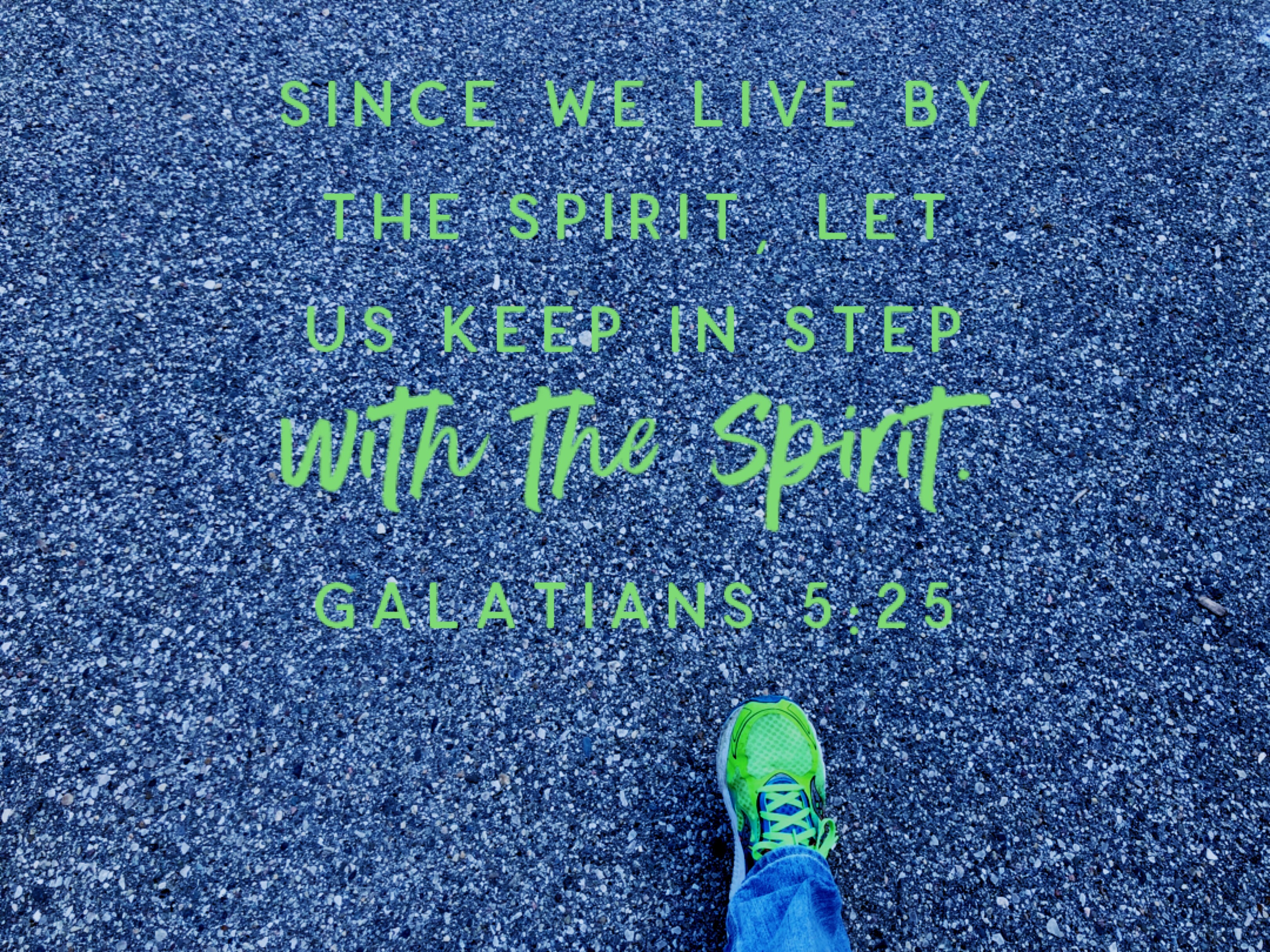
When The Holy Spirit Redirects Us

Listen to the podcast of this post by clicking on the player below, and you can also subscribe on AppleSpotify, or Audible. 

A well-known passage in Proverbs tells us, “Trust in the Lord with all your heart and lean not on your own understanding; in all your ways submit to Him, and He will make your paths straight” (Proverbs 3:5-6).

Here’s what this looks like in a New Testament setting

Paul reminds us, “Since we live by the Spirit, let us keep in step with the Spirit” (Galatians 5:25). I cannot think of a better way to live. 

If you would like to watch the full video from which the above clip was taken, you can find it here.

►► Would you please prayerfully consider supporting this ministry? My Patreon supporters get behind-the-scenes access to exclusive materials. ◀︎◀︎

My Rebel Mind

Listen to the podcast of this post by clicking on the player below, and you can also subscribe on AppleSpotify, or Audible. 

…Peter took [Jesus] aside and began to rebuke Him (Mark 8:32). 

Can you imagine someone rebuking Jesus?! 

It’s even harder to comprehend when we realize that just three verses earlier Peter made such a bold declaration about Jesus more explicitly than anyone else ever had: “You are the Messiah!” 

This is similar to what happened when Jesus preached His first public sermon in Luke 4:16-30. Luke tells us that the people went from speaking well of Jesus to wanting to kill Him in just a matter of a couple of minutes.

Why? How could this happen so quickly?

In his Gospel, Matthew records Peter’s rebuke this way: “Never, Lord! This shall never happen to You!” (Matthew 16:22). This was Peter’s response to Jesus predicting His cruel mistreatment at the hands of the religious leaders, and His impending crucifixion. 

In the sermon in Luke 4, the people wanted their Messiah to only focus on the Jews and let the rest of the world burn. When Jesus said He was on-mission to save all people everywhere, they were furious with Him. They were angry because He wasn’t going to do things their way. “After all,” they probably thought, “our way is the most logical way.” 

You and I are also in danger of going from praising to rebuking in just a matter of minutes. It can happen so naturally. By naturally I mean that our sinful nature must not be allowed to get its own way.

After Peter rebuked Jesus, He told him, “You do not have in mind the concerns of God, but merely human concerns” (Mark 8:33). Our mind of flesh is hostile to the mind controlled by the Holy Spirit.

There are things that may seem unpleasant or illogical to my natural mind, but I must not be controlled by that mind. I must listen to, and obey, what the Holy Spirit reveals to me. That means I must allow my mind to be transformed to “the concerns of God.” 

Our daily prayer must be like the prayer Jesus prayed just moments before His arrest: Father, not My will, but Your will be done. If I continue to do things my way, my natural mind will naturally rebuke Jesus, and I can go from praise to rebuke in a matter of moments. I don’t ever want to be guilty of rebuking Jesus, so I desire to “have the same mindset as Christ Jesus” (Philippians 2:5). I hope you will join me in this prayer.

►► Would you please prayerfully consider supporting this ministry? My Patreon supporters get behind-the-scenes access to exclusive materials. ◀︎◀︎

Respectful Boldness

Listen to the podcast of this post by clicking on the player below, and you can also subscribe on AppleSpotify, or Audible. 

As we near the crucifixion of Jesus, we begin to see how politics plays a role in so many decisions. The Sanhedrin is trying to balance their popularity with the Jewish people and their standing with powerful leaders in the Roman government. Pontius Pilate is trying to balance how the Sanhedrin portrays him to the Jewish people and what those in Rome are telling Caesar Tiberius about him. King Herod Antipas also has issues with balancing the pressure from the Sanhedrin with the popularity of Jesus. 

Luke gives us a very telling statement about the politics of the day when he writes, “That day Herod and Pilate became friends—before this they had been enemies” (Luke 23:12). How did they become friends over this issue of what to do with Jesus? Remember that the Sanhedrin is a common thorn-in-the-side for both of them, and the political axiom that still holds to this day says, “The enemy of my enemy is my friend.” 

I point out all of the political maneuverings during this pivotal time because these political balancing acts are still being played out today and Christians will end up in the crosshairs. 

Pilate was trying to appease the Sanhedrin but there was no Roman law that Jesus had broken that was deserving of the death penalty they were demanding. So twice Pilate tells these religious leaders, “I will punish Him and then release Him.” In fact, without waiting for their approval, Pilate subjects Jesus to the tortuous punishment known as flagellation (Luke 23:13-22; John 19:1-11). 

I think Pilate believed that if they saw Jesus so humiliated and beaten down they would back off from their desire for His death. But Pilate miscalculated their commitment to seeing Jesus eliminated from the scene. 

Pilate finally gives in and says, “You take Him and crucify Him. As for me, I find no basis for a charge against Him.” But the Jewish religious leaders insisted, “We have a law, and according to that law He must die, because He claimed to be the Son of God.” 

If you have ever watched a movie about the gladiatorial games in the Roman Colosseum, you’ve probably viewed the scene where one combatant is disarmed and helpless. Before the victor strikes his deathblow he will look to Caesar in the stands. The Roman Caesar will either give a thumbs-up signal to pardon the victim or he will give a thumbs-down signal to send the defeated one to their death. 

Pilate has this same authority here in the region of Judea. The Sanhedrin knew Pilate had the power of life and death, so did the convicted prisoner Barabbas, and so did Jesus. 

Pilate asks Jesus, “Don’t You realize I have power either to free You or to crucify You?” 

There was another king who called himself “king of kings” but God called him “My servant.” He was King Nebuchadnezzar of Babylon. Daniel, an exile from Israel who was Nebuchadnezzar’s prime minister, reminded him where his authority originated, “The Most High is sovereign over all kingdoms on earth and gives them to anyone He wishes” (Daniel 4:17). 

In the same way, Jesus addressed Pilate, “You would have no power over Me if it were not given to you from above.” 

John Piper wrote: “This does not intimidate Jesus because Pilate’s authority over Jesus is subordinate to God’s authority over Pilate. Jesus gets His comfort at this moment not because Pilate’s will is powerless, but because Pilate’s will is guided. Not because Jesus isn’t in the hands of Pilate’s fear, but because Pilate is in the hands of Jesus’s Father.” 

Jesus shows us an important principle: Should we respect our leaders (even the ungodly ones)? Yes! Should we fear them? No! 

We don’t fear them because their power is limited to just this life and is under the control of the Most High God (Luke 12:4). Peter and John learned this lesson well, as we see in their interaction with the same Sanhedrin that turned Jesus over to Pilate (see Acts 4:1-10). What Jesus and these apostles demonstrate for us is respectful boldness.

In light of this, here are five things Christians should keep in mind. When persecution comes against us, we should respond like this: 

  1. Be prepared—Matthew 5:11-12; John 15:20
  2. Be respectful—1 Peter 2:17 
  3. Be loving—Matthew 5:44
  4. Be prayerful—Acts 4:27-30
  5. Be bold—Acts 4:18-20

(Check out all of the above Scriptures by clicking here.)

Jesus taught us there is a time for eloquent silence, but when the Holy Spirit needs us to speak, He will give us the respectfully bold words to share. Jesus said, 

On My account you will be brought before governors and kings as witnesses to them and to the Gentiles. But when they arrest you, do not worry about what to say or how to say it. At that time you will be given what to say, for it will not be you speaking, but the Spirit of your Father speaking through you. (Matthew 10:18-20)

Respectful? Yes. Fearful? No. Respectful, loving, prayerful boldness is how we will glorify the Most High God in the face of persecution. 

If you’ve missed any of the other messages in our series of Bold Claims, you can find them all here. 

►► Would you please prayerfully consider supporting this ministry? My Patreon supporters get behind-the-scenes access to exclusive materials. ◀︎◀︎

Links & Quotes

One of the best pieces of advice if you’re looking to regulate your emotions is very simple: SLOW DOWN! Constantly having your game face on or being “on a mission” can cause your emotional regulation to suffer, and seriously hurt your leadership. Be sure to check out all of my videos on my YouTube channel.

You may have heard the oft-repeated line that human beings and chimpanzees share 98-99% of our DNA with each other. This simply isn’t true, and yet it will not die. John Stonestreet has an idea of what is behind this claim in his post Of Primates and Percentages.

“The unprepared mind cannot see the outstretched hand of opportunity.” —Alexander Fleming

John Piper asks, “Why is anxiety about the future a form of pride?” Check out this faith-building post that concludes with these words, “The way to battle the unbelief of pride is to admit freely that you have anxieties, and to cherish the promise of future grace in the words, ‘He cares for you.’ And then unload your fears onto His strong shoulders.”

“Hold fast to eternal salvation through the eternal covenant carried out by eternal love to eternal life.” —Charles Spurgeon

“Celebrate what you’ve accomplished, but raise the bar a little higher each time you succeed.” —Mia Hamm

The Craig And Greg Show: Mulligan! Embrace Do-Overs

Listen to the audio-only version of this podcast by clicking on the player below, or scroll down to watch the video.

I am not a very good golfer, so when Greg and I hit the course together Greg is generous enough to give me a mulligan—sometimes a lot of them! In the same way, we as leaders need to be willing to give our team members chances to learn from and improve upon their mistakes. In this episode, we discuss how embracing a “mulligan culture” in your organization helps everyone grow and thrive.

  • [0:22] I explain what Greg gives me that is a huge blessing
  • [1:25] Leaders need to be gracious.
  • [2:56] What is the goal of mulligans?
  • [4:10] Mulligans can cost our business something. How do we calculate that?
  • [7:18] Success usually goes up with the mulligan attempt.
  • [9:54] Expect greater success in the second chances.
  • [11:04] Mulligans need to be given in a safe environment.
  • [13:06] Second chances and comeback stories are inspiring!
  • [14:31] Remember that people are the focal point of our mulligans.
  • [14:55] Greg shares about an unusual phobia with which many people struggle.
  • [16:50] An important reminder seasoned leaders need to share with emerging leaders.
  • [18:22] High-performing leaders make it look easy because of the mulligans other people gave them along the way.

Check out this episode and subscribe on YouTube so you can watch all of the upcoming episodes. You can also listen to our podcast on Spotify and Apple.

Faithfulness And Excellence

Listen to the podcast of this post by clicking on the player below, and you can also subscribe on AppleSpotify, or Audible. 

I had such a great time with Karl Vaters on his podcast called The Church Lobby. Right at the beginning of the conversation, Karl wanted to talk about the subtitle of my book: The metrics that really matter. 

Check this out…

Some resources for you to check out:

►► Would you please prayerfully consider supporting this ministry? My Patreon supporters get behind-the-scenes access to exclusive materials. ◀︎◀︎

Gut-Level Compassion

Listen to the podcast of this post by clicking on the player below, and you can also subscribe on AppleSpotify, or Audible. 

I think the best-known verse in the Bible may be, “For God so loved the world that He gave His one and only Son, that whoever believes in Him shall not perish but have eternal life” (John 3:16). This truly is amazing love! 

But on several occasions, the Gospel writers talk about the compassion of Jesus. This is a different word altogether. The root Greek word is “bowels.” To feel this kind of compassion means to feel it in your gut—to ache with the same pain that is afflicting someone else. 

But compassion means more than feeling the pain, it also means going into action to alleviate the pain. True compassion aches and then acts. 

Look at the compassion of Jesus—

  • He sees crowds of people “harassed and helpless, like sheep without a shepherd.” His compassionate response is to pray for His Father to send more shepherds to these sheep (Matthew 9:36-38). 
  • He sees people plagued by diseases—paralysis, deafness, blindness, even death—and He places His hands on them and brings complete healing (Matthew 14:14, 20:34; Mark 1:41, 9:22; Luke 7:11-15). 
  • He notices hungry people and He feeds them (Matthew 15:32; Mark 8:2). 
  • He encounters confused people and He teaches them the illuminating truth (Mark 6:34). 

(Check out the above Bible verses by clicking here.) 

This word isn’t just used for Jesus, but we see His compassionate heart behind the gut-level response of others. See the Christ-like compassion in…

  • …a crushing, insurmountable debt completely forgiven (Matthew 18:21-27). 
  • …a Samaritan caring for an injured Jew (Luke 10:30-35).
  • …a prodigal father fully forgiving and restoring his wayward son to himself (Luke 15:11-24). 

(Check out the above Bible verses by clicking here.)

This kind of compassion is costly. It cost Jesus time to be alone, it cost the king, the prodigal father, and the Samaritan money to forgive a debt, lose an inheritance, and pay medical bills. But Christ-like compassion knows there is no greater reward than aching and acting like Jesus. 

Christ-like compassion must be extended in faith. Like touching someone with unclean disease, or fasting to receive power to release a loved one shackled to a heavy burden, or embracing someone who hurt me, or canceling a debt owed to me, or helping someone who despises me. When we ache and act like this, we show the love of God in irrefutable ways. Our selfless, Christ-like compassion paints a vivid picture for a skeptical world to see and embrace the love of God that sent His Son to ransom us.

Let’s make it our prayer that we would ache with the needs of the people around us, and then to move in faith-filled, Christ-honoring, selfless action to alleviate that need. Then let us believe that our compassion will show others the love of a Savior. 

►► Would you please prayerfully consider supporting this ministry? My Patreon supporters get behind-the-scenes access to exclusive materials. ◀︎◀︎

Eloquent Silence

Listen to the podcast of this post by clicking on the player below, and you can also subscribe on AppleSpotify, or Audible. 

We’ve just looked at two back-to-back bold statements of Jesus. To the Sanhedrin, He said, “I am the I AM,”  and to Pontius Pilate, He said, “I am a king.” Christ’s third bold claim essentially amounts to, “And I don’t have to prove either of these to you; I don’t have to argue with you about it.” 

After He was arrested, there was a back-and-forth shuttling of Jesus from the Sanhedrin to Pilate, then from Pilate to King Herod, and then back to Pilate again. Pilate told the Sanhedrin, “I find no basis for a charge against Him.” But the Sanhedrin countered, “But He is stirring up trouble all the way from Galilee to here in Jerusalem!” (see Luke 22:67-23:11).

Pilate was looking for “an out”—a way he could safely discharge or punish Jesus that would keep both the Sanhedrin and his Roman superiors happy. So when Pilate heard that Jesus was from Galilee, he was more than happy to pass this “hot potato” to King Herod. When Jesus was hauled before Herod, we read that he was greatly pleased to see Jesus. 

Why was that? To answer that question, we need to understand who Herod was. His name is Herod Antipas, and he was the son of Herod the Great. Herod the Great was king when Jesus was born, and he was the one who attempted to kill Jesus. 

Herod Antipas was infamous for having seduced his sister-in-law Herodias, whom he married after divorcing his wife. Shortly after this, Herod arrested John the Baptist for calling out this marriage as sinful. Herodias especially was embarrassed by this and wanted John killed, but Herod feared the backlash from the people if he did this. Eventually Herodias got her way and Herod was forced to have John beheaded (Matthew 14:5; Mark 6:17-28).

When news about Jesus began to reach his ears, Herod thought that Jesus was John reincarnated and he wanted to see him (Luke 9:9). So now when Jesus is brought before him, Herod is looking for a magic trick—Jesus remains silent. Then the religious leaders resume their accusations against Jesus, and still He remains silent. Then Herod and his soldiers began mocking and ridiculing Jesus, and amazingly, He still doesn’t say a word. 

Jesus knew the Scriptures that make it clear that there is nothing to be gained by bantering with fools. For instance, Solomon wrote, 

Do not answer a fool according to his folly, or you yourself will be just like him. … Don’t waste your breath on fools, for they will despise the wisest advice. (Proverbs 26:4, 23:9). 

So here is the next bold claim from Jesus: {Eloquent silence.}

Even in the face of accusation, ridicule, and mocking, Jesus refused to engage in meaningless arguing with Herod or the Sanhedrin’s false witnesses. His silence was so eloquent that it got the attention of Governor Pilate:  

“Then Pilate asked [Jesus], ‘Don’t You hear the testimony they are bringing against You?’ But Jesus made no reply, not even to a single charge—to the great amazement of the governor.” (Matthew 27:13-14) 

Let’s learn from Jesus: Sometimes the best thing to say is NO thing! 

Peter pointed Christians to this example of Jesus when he wrote—

To this you were called, because Christ suffered for you, leaving you an example, that you should follow in His steps. “He committed no sin, and no deceit was found in His mouth.” When they hurled their insults at Him, He did not retaliate; when He suffered, He made no threats. Instead, He entrusted Himself to Him who judges justly. (1 Peter 2:21-23)

Jesus called us to let our good deeds shine brightly to bring glory to God. Fools will ridicule and mock and accuse us, just as the religious crowd did to Jesus. Let’s not let our bantering with fools put out the light of our testimony. 

When I was a little kid in Sunday School, we used to sing a song called This Little Light Of Mine. We would hold up our pointer finger like a candle as we sang. But holding up our pointer finger across our lips is also a way to let our light shine too. Your silence in the face of foolish ridicule will speak so eloquently!

Let’s learn this lesson from Jesus. Instead of bantering with fools, entrust yourself to the perfect Judge who is perfectly keeping track of every word. He is the One who can add eloquence to your silence as you shine brightly for Him. 

If you’ve missed any of the other messages in our series of Bold Claims, you can find them all by clicking here. 

►► Would you please prayerfully consider supporting this ministry? My Patreon supporters get behind-the-scenes access to exclusive materials. ◀︎◀︎

Links & Quotes

When you say, “I don’t know how to do this,” your mind stops looking for answers. But if we simply add one word—“I don’t know how to do this yet”—your mind will stay active. Adding this one word will unleash the creative, solution-finding part of your mind.

“Our preaching ought to have a voice for all classes, and all should have an ear for it. To suit our word to the rich alone is wicked sycophancy, and to aim only at pleasing the poor is to act the part of a demagogue. Truth may be so spoken as to commend the ear of all, and wise teachers seek to learn that acceptable style.” —Charles Spurgeon, Spurgeon And The Psalms

“How did Jesus live among us? He was different things to different people. See if you find yourself on this list.
To the victim, Jesus defended.
To the rebel, He held out mercy.
To the brutalized, Jesus comforted with kindness.
To the questioning, He spoke truth.
To the fearful, Jesus stood beside.
To the lonely, He nodded, ‘I’ve been there.’
To the sick, Jesus revitalized.
To the outlier, He welcomed in.
To the forgotten, Jesus remembered in detail.
To the filthy, He washed clean.
To the broken, Jesus empathized.
To the doubting, He listened.
To the isolated, Jesus joined company.
To the discouraged, He drew near.
To the cynic, Jesus answered.
To the rejected, He restored.
To the anxious, Jesus calmed.
To the betrayed, He identified.
To the betrayer, Jesus forgave.
To the wounded, He sympathized.
To the wanderer, Jesus pointed the way.
To the shattered, He rebuilt dreams.
To the lost, Jesus led home.
To the abandoned, He was home.
To the destitute, Jesus deepened.
To the single again, He completed.
To the tempted, Jesus was available.
To the courageous, He gave purpose.
To the one in trouble, Jesus led out.
To the exhausted, He was wholeness.
To the hurried, Jesus patiently waited.
To the over-committed, He built margin.
To the weak, Jesus fortified.
To the one in debt, He released.
To the searching, Jesus satisfied.
To the foolish, He said, ‘Turn around.’
To the pure in heart, Jesus blessed.
To the one who keeps on going, He rewarded.” —He Gets Us (part 2) reading plan on YouVersion

This is a pretty long article, but it’s quite fascinating to see the engineering behind the artificial intelligence (AI) of ChatGPT.

“God is not afraid of my questions. Am I afraid of His answers?” —Betsy Owens

C.M. Ward was the speaker for the Revivaltime radio broadcast for a quarter of a century. Dan Betzer, who was also involved in these broadcasts, once said that he heard Rev. Ward preach on the story of the prodigal son in Luke 15 more than a dozen times without ever repeating himself. Here is a quick biographical sketch of this influential man’s ministry. I have also shared before my brief encounter with Rev. Ward when I was a young man.

A bonus quote from Charles Spurgeon: “‘No God’ means no law, no order, no restraint to lust, no limit to passion. Who but a fool would be of this mind? What a bedlam, or rather what a battleground, would the world become, if such lawless principles came to be universal!” —Charles Spurgeon, commenting on Psalm 53:1

A reminder of just how amazing our Sun is! Our Creator perfectly fashioned our Sun and Earth and solar system to sustain the life we enjoy. Check out this amazing article from The Institute for Creation Research.

Messy And Meaningful Ministry