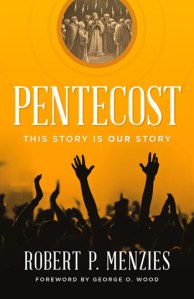
14 Quotes From “Pentecost”

Pentecost

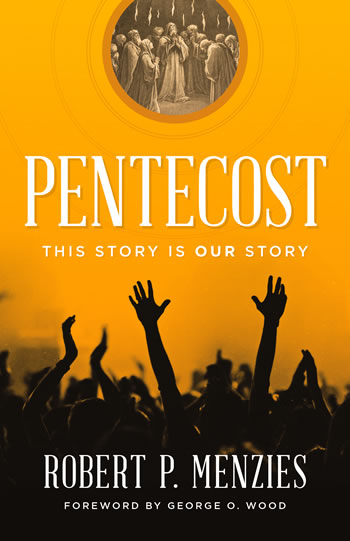
I thoroughly enjoyed reading Pentecost by Robert P. Menzies, and learned quite a bit. You can read my full book review by clicking here. Here are a few quotes that stood out to me.

“It’s because Pentecostals fuse the biblical and contemporary horizons that we link baptism in the Holy Spirit with speaking in tongues, since that’s what Acts 2 does. It’s why we associate Spirit-baptism with empowerment for mission rather than with spiritual regeneration. And it’s why we expect God to perform ‘signs and wonders’ and to manifest spiritual gifts in worship services. All these things happened in the first Pentecostal community, and their story is our story.” 

“At its heart, the Pentecostal movement is not Spirit-centered but Christ-centered. The work of the Spirit, as Pentecostals understand it, centers on exalting and bearing witness to the Lordship of Christ.”

“Pentecostals are ‘people of the Book.’ Although Pentecostals certainly encourage spiritual experience, they do so with a constant eye to Scripture.”

“So, the stories of Acts are our stories, and we read them with expectation and eagerness: stories of the Holy Spirit’s power, enabling ordinary disciples to do extraordinary things for God. … The hermeneutic of the typical Pentecostal believer is straightforward and simple: the stories in Acts are my stories—stories that were written to serve as models for shaping my life and experience.”

“In Luke’s view, every member of the church is called (Luke 24:45–49; Acts 1:4–8/Isaiah 49:6) and empowered (Acts 2:17–21; cf. 4:31) to be a prophet. Far from being unique and unrepeatable, Luke emphasizes that the prophetic enabling experienced by the disciples at Pentecost is available to all of God’s people. … Through his two-volume work, Luke declares that the church, by virtue of its reception of the Pentecostal gift, is nothing less than a community of prophets. It matters not whether we are young or old, male or female, rich or poor, black or white; the Spirit of Pentecost comes to enable every member of the church, each one of us, to fulfill our prophetic call to be a light to the nations.” 

“Not long ago a Chinese house church leader commented, ‘When Western Christians read the book of Acts, they see in it inspiring stories; when Chinese believers read the book of Acts, we see in it our lives.’”

“Luke’s theology of the Spirit is different from that of Paul. Unlike Paul, who frequently speaks of the soteriological dimension of the Spirit’s work, Luke consistently portrays the Spirit as a charismatic or, more precisely, a prophetic gift, the source of power for service.” 

“Luke crafts his narrative so that the parallels between Jesus’ experience of the Spirit (Luke 3–4) and that of the disciples on the day of Pentecost (Acts 1–2) cannot be missed. Both accounts: 1. Are placed at the outset of Luke’s Gospel on the one hand, and the book of Acts on the other; 2. Associate the reception of the Spirit with prayer; 3. Record visible and audible manifestations; 4. Offer explanations of the event in the form of a sermon that alludes to the fulfillment of Old Testament prophecy.”

“Luke’s understanding of baptism in the Holy Spirit, I have argued, is different from that of Paul. It is missiological rather than soteriological in nature. … The tendency in Protestant churches has been to read Luke in the light of Paul. Paul addresses pastoral concerns in the church; Luke writes a missionary manifesto.” 

“Bold witness for Jesus is recognized as our primary calling and the central purpose of our experience of the Spirit’s power. Missions is woven into the fabric of our DNA.”

“I do not wish to minimize in any way the significance of the great doctrinal truths of Paul’s writings. I merely point out that since Paul was, for the most part, addressing specific needs in various churches, his writings tend to feature the inner life of the Christian community. His writings, with some significant exceptions, do not focus on the mission of the church to the world. … It is probably fair to say that while Paul features the ‘interior’ work of the Spirit (e.g., the fruit of the Spirit, Gal. 5:22–23); Luke features His ‘expressive’ work (Acts 1:8). Thus, by appropriating in a unique way the significant contributions of Luke-Acts, Pentecostals have developed a piety with a uniquely outward or missiological thrust.”

“The clarity of the Pentecostal message flows from the simple, straightforward manner in which we read the Bible. As I have noted, Pentecostals love the stories of the Bible. We identify with the stories that fill the pages of the Gospels and Acts, and the lessons gleaned from these stories are easily grasped and applied in our lives. For Pentecostals, the New Testament presents models that are to be emulated and guidelines that are to be followed. It should be noted that our approach to doing theology is not dependent on mastering a particular set of writings, say, the works of Luther; or coming to terms with a highly complex theological system. Pentecostals also do not worry much about cultural distance or theological diversity within the canon. We do not lose sleep over how we should understand the miracle stories of the Bible or how we might resolve apparent contradictions in the Bible. Our commitment to the Bible as the Word of God enables us to face these questions with a sense of confidence.”

“We must remember that whatever we do, God is measuring the work we do for Him in a qualitative, not quantitative way. … Only the work which is done by the power of the Holy Spirit can be acceptable in the Kingdom of God.” —David Yonggi Cho

“Some will still remain skeptical. They will ask: Is not this approach to church life, with its emphasis on ecstatic experience, emotional response, and spiritual power, filled with inherent dangers? Might it not encourage us to feature emotionally manipulative methods and to focus on superficial matters? Yes, undoubtedly, there are dangers. However, there is more danger in an approach that fails to make room for the full range of human experience, including the emotions, in our encounter with God.”

Forethought Or After-Thought?

What is man that You are mindful of him, the son of man that You care for him? You made him ruler over the works of Your hands; You put everything under his feet. (Psalm 8:4-5)

forethoughtafterIn mythology, humans are an after-thought, a nuisance, slaves and servants of the gods, and usually pawns in the gods’ scheming against each other.

But Jehovah God created man as a part of His creation. He created mankind in His own image and breathed His own life into him. After the first five days of creation, God said, “It is good.” But on the sixth day, after creating man, He said, “It is very good!”

Jehovah God has man at the forefront of His mind. He not only calls us into a relationship with Him, but the Trinity works in divine cooperation to make it possible for us to come to Him.

He doesn’t see a mass of humanity, but He sees each one of us individually and uniquely. And He is attentive to us—“For the Lord has heard my cry for mercy; the Lord accepts my prayer” (Psalm 6:9).

As David burst into praise with this realization of God’s forethought of us, let us echo this praise (Psalm 8:9)—

O Lord, our Lord, how majestic is Your name in all the earth!

Links & Quotes

link quote

These are links to articles and quotes I found interesting today.

[VIDEO] A short video from John Maxwell: Pride

“Holiness is inwrought by the Holy Spirit, not because we have suffered, but because we have surrendered.” —Richard Shelley Taylor

[PICTURE] A cool father-son moment after the Broncos Super Bowl loss: Broncos’ Shaun Phillips Receives Touching Text From Son

[VIDEO] A powerful pro-life statement: Science Is Clear On When Life Begins

“We need to learn that truth consists not in correct doctrine, but in correct doctrine plus the inward enlightenment of the Holy Spirit.” —A.W. Tozer

“For it is not so much of our time and so much of our attention that God demands; it is not even all our time and all our attention; it is our-selves. … He cannot bless us unless He has us. When we try to keep within us an area that is our own, we try to keep an area of death. Therefore, in love, He claims all. There’s no bargaining with Him.” —C.S. Lewis

“We need an outside word of love, kindness, support, faith and confidence. We long for people we admire to put their arms around us and speak life into our being. We hunger for relationship. We crave intimacy.” —Bill Leach

Pentecost (book review)

PentecostI grew up with this stuff: I’m a fourth-generation Pentecostal, so I cut my teeth on this distinctive doctrine. But I was still amazed at the depth of insight into this dynamic theology that Dr. Robert Menzies shares in Pentecost: This Story Is Our Story.

Although Dr. Menzies shares a number of anecdotal stories to help illustrate certain points, this book is really a serious doctrinal work. Many people have written-off the operational gifts of the Holy Spirit seen in the book of Acts as something that ceased at the death of the apostles, or at the closing of the cannon of Scripture. But Dr. Menzies points out from the outset that Luke’s writings in the Gospel that bears his name and in the book of Acts are not just historical, but doctrinal too.

Many times people look at Paul’s writings as doctrinal, and the four Gospels and Acts as simply historical; thus giving more “weight” to the Pauline epistles. Dr. Menzies persuasively shows that Luke’s writing in Luke-Acts is just as doctrinal, and just as Holy Spirit-inspired, as every other book of the New Testament. In fact, he really goes beyond that to show how Luke’s writing is heavily influenced by Old Testament prophesies about the coming of the Messiah and the subsequent outpouring of the Holy Spirit.

This is not a sensational book, but a scholarly work. It is extensively referenced, as evidenced by the ample endnotes. But don’t let this scare you off as a book just for pastors and theologians, as Dr. Menzies’ writing style is very readable by all.

Anyone who is interested in this distinctive doctrine of the Holy Spirit should read Pentecost.

Links & Quotes

link quote

These are links to articles and quotes I found interesting today.

Some thoughts on creativity: 8 Creativity Lessons From A Pixar Animator

Tim Elmore on how to connect with others: Who Do You Connect With When You Teach?

“Thy poor prayer would have no force with Omnipotence if force were needed; but His love, like a spring, rises of itself and overflows for the supply of all thy needs.” —Charles Spurgeon

[VIDEO] Comedy from Ken Davis: Why I Don’t Have A Cat

Insight from Mark Driscoll: 5 Things To Look For In A Good Bible Teacher

“Don’t pray for sermons, let sermons come from your prayers. So, as long as I’m meeting with God, I will always have something to say.” —Chilly Chilton

Michael Hyatt’s excellent advice to leaders: 5 Reasons You Should Smile More As A Leader

Encouragement from Max Lucado: A Passion For The Forgotten

John Stonestreet on the dangers of pornography: The Root Of Sexual Exploitation

Only a little time left to download a free song from U2 and help end AIDS: Fight AIDS With (Red)

“The fundamental issue for any of us is to feel loved. If we feel loved by the significant people in our lives, we are more likely to reach out potential for God and good in the world.” —Dr. Gary Chapman

An interesting study on missionaries and societal success: The Truth About Missionaries

Praying ‘Round & ‘Round

There are lot of different ways to look at the function of prayer, but please allow me to share one more with you. Perhaps this prayer cycle will help you see the value of each aspect of prayer.

Prayer cycle

(To download a PDF of this file, click here → Prayer cycle)

Each step in this cycle helps facilitate the next step. If any step breaks down, the whole cycle of prayer can grind to a halt. But as any part of the cycle is strengthened, the whole cycle expands and grows in potency!

  • We need to be be assured that God’s Word is true when it says to come to Him in prayer.
  • Once we are assured that God’s Word is true, then the Holy Spirit will illuminate His Word to our present circumstance, giving us the mind of Our Lord. This is called discernment.
  • Having discernment will bring us the peace that knows God hears us, and that God is working on our behalf and for His glory.
  • All of these steps flowing together allow us to pray and live in greater boldness, which fuels the whole cycle again.
  • At the heart of this cycle is the empowerment of the Holy Spirit, who helps us at each step along the cycle of prayer.

Here are some Scriptures that correspond with the various steps in the cycle:

AssuranceIf you remain in Me and My words remain in you, ask whatever you wish, and it will be given you. (John 15:7)

DiscernmentBut the Counselor, the Holy Spirit, Whom the Father will send in My name, will teach you all things and remind you of everything I have said to you. (John 14:26)

PeacePeace I leave with you; My peace I give you. I do not give to you as the world gives. Do not let your hearts be troubled and do not be afraid. (John 14:27)

BoldnessAfter they prayed, the place where they were meeting was shaken. And they were all filled with the Holy Spirit and spoke the word of God boldly. (Acts 4:31)

Holy Spirit EmpowermentIn the same way, the Spirit helps us in our weakness. We do not know what we ought to pray for, but the Spirit Himself intercedes for us through wordless groans. And He who searches our hearts knows the mind of the Spirit, because the Spirit intercedes for God’s people in accordance with the will of God. And we know that in all things God works for the good of those who love Him, who have been called according to His purpose. (Romans 8:26-28)

The only way I know of to learn how to pray better is to pray more! Don’t wait for a better opportunity to begin to pray … Start right now!

Next Sunday I am continuing our series on prayer. If you are near Cedar Springs, please join us!

Sunday Recap

Another great Sunday worshiping with my church family and learning more about prayer! Here are a few take-aways that I hope encouraged you today.

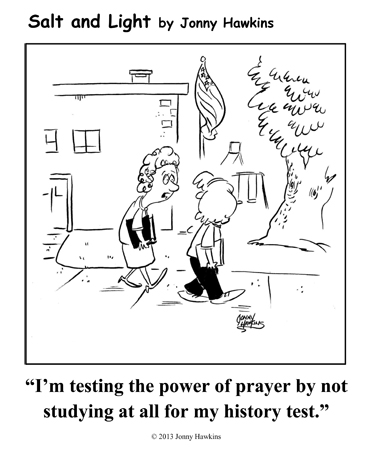
Salt & Light - prayerPrayer isn’t supposed to look like this Jonny Hawkins cartoon!

In the cycle of prayer, your level of peace will determine your level of perseverance. This is why it’s so important to be immersed in God’s Word and allowing the Holy Spirit to give you His discernment. Keep on praying!

“The worst of it is that we can believe God about everything except the present pressing trial. This is folly. Come, my soul, shake off such sinfulness, and trust your God with the load, the labor, the longing of this present.” —Charles Spurgeon

“God’s silences are His answers. … Some prayers are followed by silence because they are wrong [this is where we need God’s discernment], others because they are bigger than we can understand [this is where we need His peace].” —Oswald Chambers

God was going to give Hannah a son, but the time was not yet right. God needed a strong man in a dark time, and it wasn’t dark enough yet! (see 1 Samuel 1:1-17)

God feels & sees

In the meantime, remember this: God feels all of your infirmities, and He sees all of your tears.

Poetry Saturday—“I Stand” by C.B. Bubier

Oh this is lifeI stand upon the mount of God,
With sunlight in my soul;
I hear the storms in vales beneath,
I hear the thunder’s roll.

But I am calm with Thee, my God,
Beneath these glorious skies;
And to the height on which I stand
No storms nor cloud can rise.

Oh! this is life! oh, this is joy!
My God to find Thee so;
Thy face to see, Thy voice to hear,
And all Thy love to know! —C.B. Bubier

Boomerang

BoomerangI was very hesitant to enter the pastorate. As I look back now, I see God had been preparing me for this all my life, but I was reluctant to take on such a heavy spiritual responsibility.

When I finally submitted, I made a covenant with God: “I never want to preach a sermon where my finger is pointed at the congregation, where I am saying, ‘You people better listen to this!’ But I only want to share what You have been challenging me to do and become. I want the congregation to hear an overflow of the work being done in me.”

I recently read a paragraph from Oswald Chambers that validates that covenant I made—

“It is an easy business to preach, an appallingly easy thing to tell other people what to do; it is another thing to have God’s message turned into a boomerang—‘You have been teaching these people that they should be full of peace and of joy, but what about yourself? Are you full of peace and joy?’ The truthful witness is the one who lets his light shine in works which exhibit the disposition of Jesus; one who lives the truth as well as preaches it.

My pastor friend, don’t preach it if you’re not living it! Or another way: live it first, then preach it.

6 Quotes From “The Global War On Christians”

The Global War On ChristiansYesterday I shared some eye-opening statistics from The Global War On Christians by Jeff L. Allen, Jr. Below are some of the quotes which especially stood out to me. If you want to read my full review of this book, please click here.

“Spectacular outbreaks of violence are often produced by less intense incidents, such as believers being harassed on the streets, slurred in the media, shunned in the workplace, and hassled as they gather to worship. The usual cycle is for complaints to be made about these incidents, which are then ignored or dismissed. That failure to act usually serves to emboldened the perpetrators, who then may become more likely to move on to even more lethal assaults, in effect testing the limits of official tolerance.”

“The bottom line is that the global war on Christians will never be won as long as the myth persists that nobody’s really responsible for it.”

“Perpetuating the idea that Islam is by far the primary threat facing Christians in the early twenty-first century also stokes the idea of a ‘clash of civilizations’ between the two faiths, adding fuel to the fire of those who long for a new holy war. That doesn’t do justice to the complex reality of the situation, as there are examples of both conflict and coexistence, and for every virulent and dangerous current in the Islamic world there are also movements and individuals devoted to peace.” 

“Politically correct silence does no one any good, and arguably insults the dignity of those who run risks to life and limb on a daily basis to keep the faith alive.”

“Politics distorts perceptions of the global war on Christians in another sense. Ideological bias tempts observers in the West to see only part of the picture. Those on the political left may celebrate martyrs to corporate greed or to right-wing the police states, but fear to speak out about the suffering of Christians behind the lines of the Islamic world. Conservatives may be reluctant to condemn the situation facing Christians in the state of Israel or in regimes that are presently in fashion on the right has allies in the ‘war on terror.’ Either way, the result is a reductive reasoning of the true score of anti-Christian persecution, and a double standard when it comes to engaging its protagonists. If we want to see the global war on Christians clearly, we have to stop looking at it through the funhouse mirror of secular politics.”

“Historically, waves of persecution have fueled major advances for Christianity. … Today, it’s no accident that zones where persecution of Christians is the most intense… are also the places where Christianity is growing the most dramatically.”