Listen to the podcast of this post by clicking on the player below, and you can also subscribe on Apple, Spotify, or Audible.
I want to give you some thoughts to take your Bible studies even deeper. Here are three strategies to make your Bible study time stickier—sticking in your heart and your mind.
Listen to the podcast of this post by clicking on the player below, and you can also subscribe on Apple, Spotify, or Audible.
After examining Jesus himself and then getting a report back from King Herod, Pontius Pilate announces to the crowd of religious leader, “I find no basis for a charge against Him. But…” (John 18:38-39).
The “But” signals the language of an unsure leader.
Pilate knew the truth. He knew the Roman law. He had soldiers around him to protect him from physical harm. No recrimination or rebuke would have come from Rome for letting Jesus go free. Yet Pilate wavered.
He was unsure of his leadership position. “Did I earn this position or did I manipulate my way into it? What will others think of me if I make this decision? Is there a way that I can keep everybody happy?”
Pilate gave himself an out: “…but it is your custom for me to release to you one prisoner at the time of the Passover. Would you like me to release Jesus?”
Pilate was hoping to satisfy the fickle mob that was pressing in on him and pestering him to give in to their demands, even if it meant he would be perverting justice. Unsure leaders are always trying to find a way to navigate the current situation, just to get on to the next chapter of their leadership.
A godly leader who is sure of his calling can make tough calls while still preserving justice and maintaining truth.
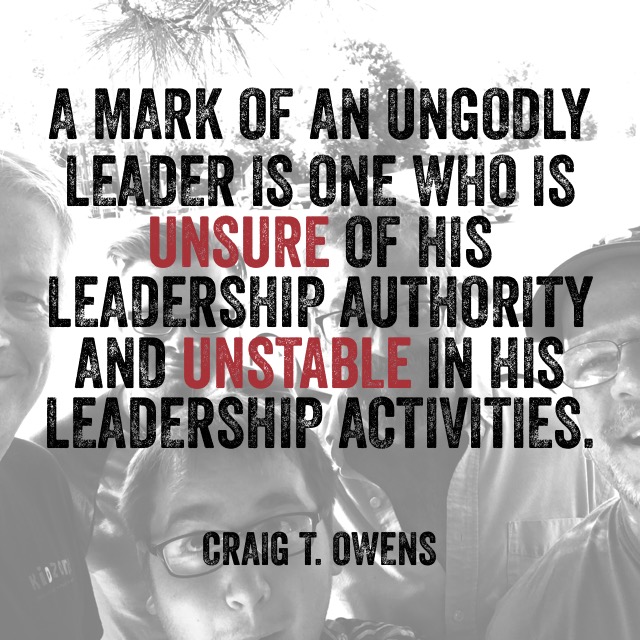
A mark of anungodly leader is one who is bothunsure of his leadership authority andunstable in his leadership activities.
I talk more about a godly leader’s sure calling in my book Shepherd Leadership. And in this blog post, I give a three-word statement that can help godly leaders navigate through the toughest of decisions.
This is part 79 in my series on godly leadership. You can check out all of my posts in this series by clicking here.
Listen to the podcast of this post by clicking on the player below, and you can also subscribe on Apple, Spotify, or Audible.
Much like Jude who had a message he wanted to deliver to the saints, but was compelled by the Holy Spirit to address something concerning him (Jude 3-4), I, too, was excited to deliver the next message in our series on discovering your gifts and then living in your gift zone. But I am deeply concerned about the words and actions of Christian saints during these past election cycles.
I recently heard John Stonestreet say, “Currently, politics is carrying far more cultural weight than it is able to bear.” I agree: Christians are putting far too much emphasis on political candidates than the Bible would suggest.
I frequently quote something from Charles Colson that always makes people smile. He said, “Salvation will never arrive in Air Force One.” The flip side is true as well: Neither will the Apocalypse arrive on Air Force One.
We have to remember that the Most High is sovereign over all the nations of the earth, and He gives them to whom He choose (Daniel 4:25, 32). When we think that our candidate or our party is the only way our nation can be saved, aren’t we elevating the political process above God’s plan?
I hope this doesn’t come as a shock to anyone, but there are no perfect candidates, perfect political parties, nor perfect party platforms. We can study our Bibles, pray, study the candidates’ lifestyle and policies, but ultimately we will have to cast a ballot for an imperfect candidate.
God doesn’t have an “R” or “D” next to His name. He has not endorsed a political candidate. You may be sitting next to someone right now that is going to vote for the opposite political party that you will be voting for. And the way we interact with those people—whether they are fellow Christians or not—is deeply concerning to me.
Moses saw a couple of fellow Israelites fighting each other, and he asked them, “Why are you hitting your fellow Hebrew” (Exodus 2:13). The Hebrew word rea means a friend who is also a fellow citizen. These Hebrews were citizens of Zion, but they were living in Egypt, and they definitely weren’t treating each other in a way that would be a testimony to the Egyptians.
When Stephen retold this portion of the story in his sermon, he phrased it this way, “Men, you are brothers” (Acts 7:25-26). Stephen used the Greek word adelphos which literally means “from the same womb.” But the Christians used this word to mean brothers and sister in Christ—people with whom we will spend eternity.
Let us always remember that others who are participating in the American political process are BOTH fellow US citizens AND brothers and sisters in Christ.
In J.R.R. Tolkien’s Return of the King, when Gandalf sees fellow citizens and friends at each other’s throats, he exclaims, “Work of the enemy! Such deeds he loves: friend at war with friend, loyalty divided, and confusion of hearts.” Indeed, the enemy of our souls would love to see the chaos of a nation at war with itself; especially to see Christians at odds with each other.
Paul said, “Therefore, as we have opportunity, let us do good to all people,especially to those who belong to the family of believers” (Galatians 6:10). On the flip side, Jesus said that when we think or speak poorly of a fellow human, we are in danger of judgment (Matthew 5:22).
Listen to Paul’s appeal to his friends at Philippi—
Therefore if you have any encouragement from being united with Christ, if any comfort from His love, if any common sharing in the Spirit, if any tenderness and compassion, then make my joy complete by being like-minded, having the same love, being one in spirit and of one mind.
I plead with Euodia and I plead with Syntyche to be of the same mind in the Lord. Yes, and I ask you, my true companion, help these women since they have contended at my side in the cause of the gospel, along with Clement and the rest of my co-workers, whose names are in the book of life. (Philippians 2:1-2, 4:2-3)
The politicians we have are always downstream from culture, which means we have allowed those sorts of politicians to be in place.
John Stonestreet used a phrase I hadn’t heard before, but I think it’s appropriate: “Christian political engagement should hit its fever pitch notduring elections. The only way to relieve the political pressures of our day is to build up the pre-political aspects of our life together, especially the family and the Church. When we care well for our children, our neighbors, and our communities, the state doesn’t have to.”How true this is!
I wrote something this summer based on Isaiah 3:4-5. In essence, I wrote that God gives nations the “leaders” they deserve. They are leaders in that they occupy an office, but they don’t lead people nor care for the citizens—they don’t have wisdom to lead nor do they care about anyone but themselves. This is the inevitable result for a nation that turns its back on God! So if we think our political and civic leaders are self-focused, unskilled, and childish, we should look in the mirror. It’s not “them,” it’s us. We have to change—turning wholeheartedly to God—and only then God can change our leadership.
We need to be praying for our governmental leaders, not vilifying them. We need to be speaking well of our fellow US citizens. We need to be especially treating our fellow brothers and sisters in Christ well.
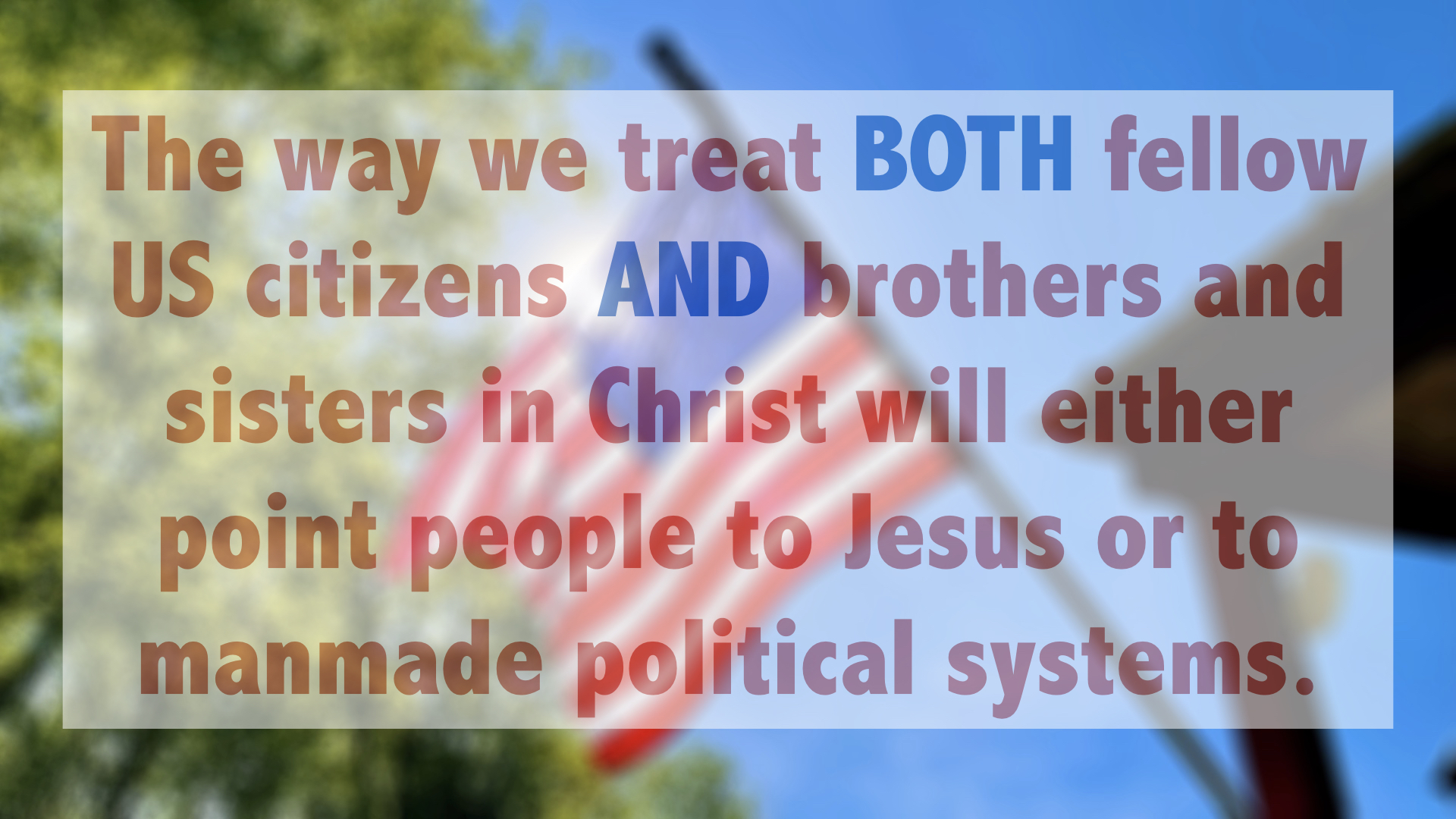
Our hope is not in the results of an election. Our hope is in Jesus. The way we treat BOTH fellow US citizens AND brothers and sisters in Christ will either point people to Jesus or to manmade political systems.
I pray we can do better at pointing people to Jesus! I pray I can do better!
When a teammate seems to choke in a pressure-packed situation, good coaches help them learn from their mistake and get right back into the game. This is how leaders help their teammates go from choke to clutch. Check out the full conversation Greg and I had about this.
I have lots of new content every week, which you can check out on my YouTube channel.
“Most of us who aspire to be tops in our fields don’t really consider the amount of work required to stay tops.” —Althea Gibson, tennis great
“There is only one way forward when vindication is delayed: total forgiveness. And I can give you a motivation to forgive totally greater than any other that could be conceived: you do it for an audience of One. Yes. That’s it. That is how you do it! Total forgiveness comes easily when you realize you are doing it for God and the glory of Jesus Christ!” —R.T. Kendall
ICR reports: “Millions of years of erosion should have toppled all the beautiful sandstone arches out West, yet many hundreds remain.” But following the biblical timeline of Creation and the Flood makes it unsurprising that the arches are still standing.
“A coach is someone who can give correction without causing resentment.” —John Wooden
October is the month Protestants remember the start of the Reformation. The folks at Desiring God have a wonderful resource available by email every day during October called Here We Stand. Each day you will receive an email with a mini-biography of a key character in the Reformation. I am thoroughly enjoying these each day. Sign up here.
None of us are self-made. God created us on purpose and for a purpose. He gave us the gifts we need to accomplish that purpose. We will only find our fulfillment in life in stewarding those God-given gifts and opportunities in ways that glorify God. Not only fulfillment here, but then eternal satisfaction when we hear our Savior say, “Well done, good and faithful servant! Enter into your Master’s happiness!”
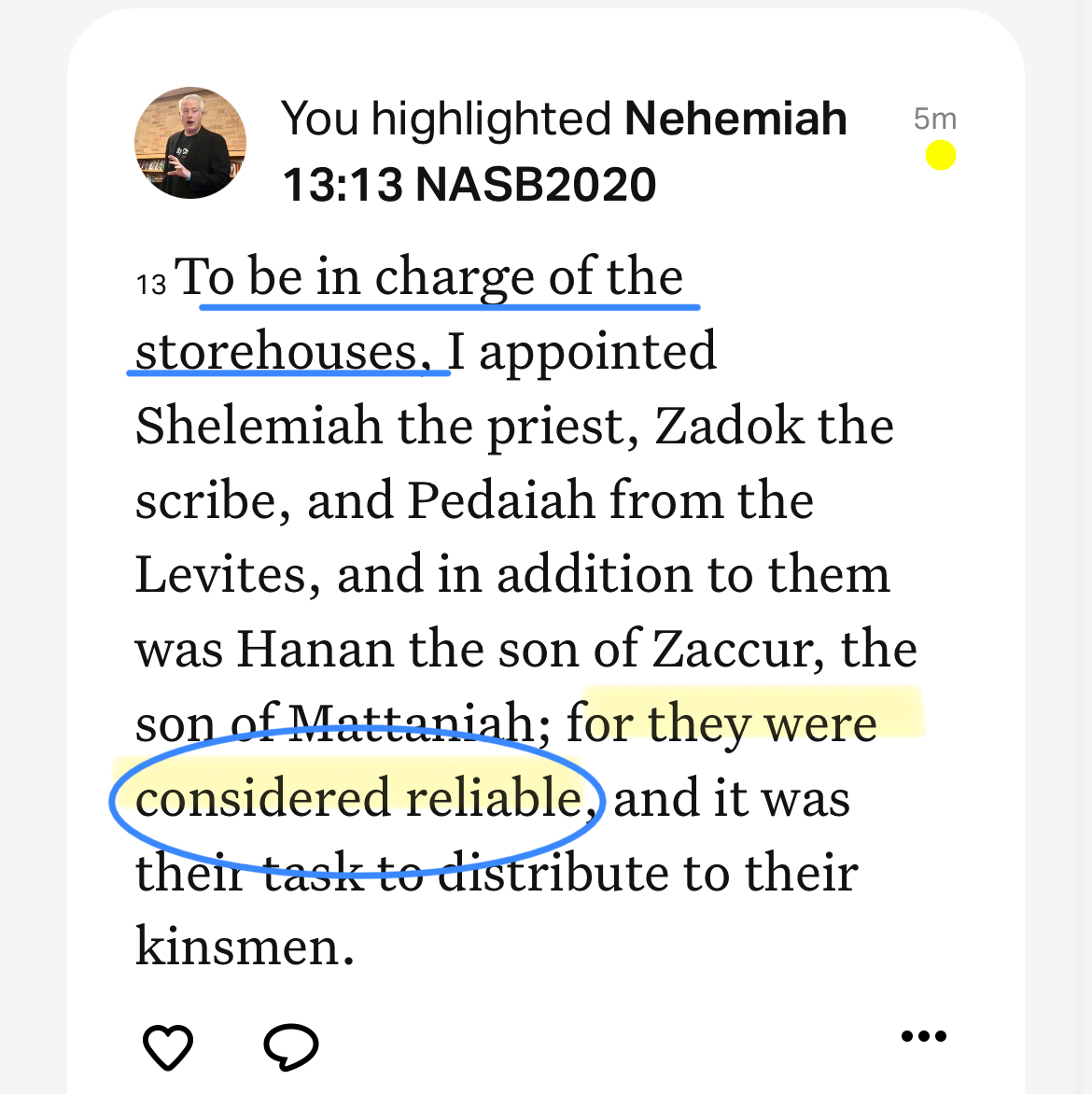
I also discovered that the portions of the Levites had not been given to them, so the Levites and the singers who performed the service had gone away, each to his own field. So I reprimanded the officials and said, “Why has the house of God been neglected?” Then I gathered them together and stationed them at their posts. All Judah then brought the tithe of the grain, wine, and oil into the storehouses. To be in charge of the storehouses, I appointed Shelemiah the priest, Zadok the scribe, and Pedaiah from the Levites, and in addition to them was Hanan the son of Zaccur, the son of Mattaniah; for they were considered reliable, and it was their task to distribute to their kinsmen. (Nehemiah 13:10-13)
According to the Hebrew definitions:
“considered” = accountable
“reliable” = trustworthy
Both words mean someone who has passed the test and someone who is still passing the test. These men were faithful leaders before they were given this important job, and then they continued to prove themselves faithful even as their work was carefully scrutinized.
A title doesn’t make you a leader, and a title doesn’t sustain you as a leader. Your faithful, God-honoring, trustworthy accountability makes you a leader—even if you never get the title, God sees you and He will reward you.
Listen to the podcast of this post by clicking on the player below, and you can also subscribe on Apple, Spotify, or Audible.
In my book When Sheep Bite, I not only wrote about biting sheep, but I also wrote about wolves dressed in sheep’s clothing, and wolves who aren’t trying to hide themselves at all! How are shepherd leaders to deal with these folks?
That was one of the topics I addressed on the Leading From Alignment podcast with John Opalewski and Jim Wiegand.
In the chapter of my book called ‘Driving Away the Wolves,’ I wrote:
Loving shepherds are constantly among their sheep so that the sheep can know their voice and so the shepherd can know the voice of each individual sheep. This has the two-fold benefit of the sheep knowing which voice is trustworthy, and for you as the shepherd to spot the off-key voice of the “meaningless talk and deception” of those wolves who are hiding out among the sheep.
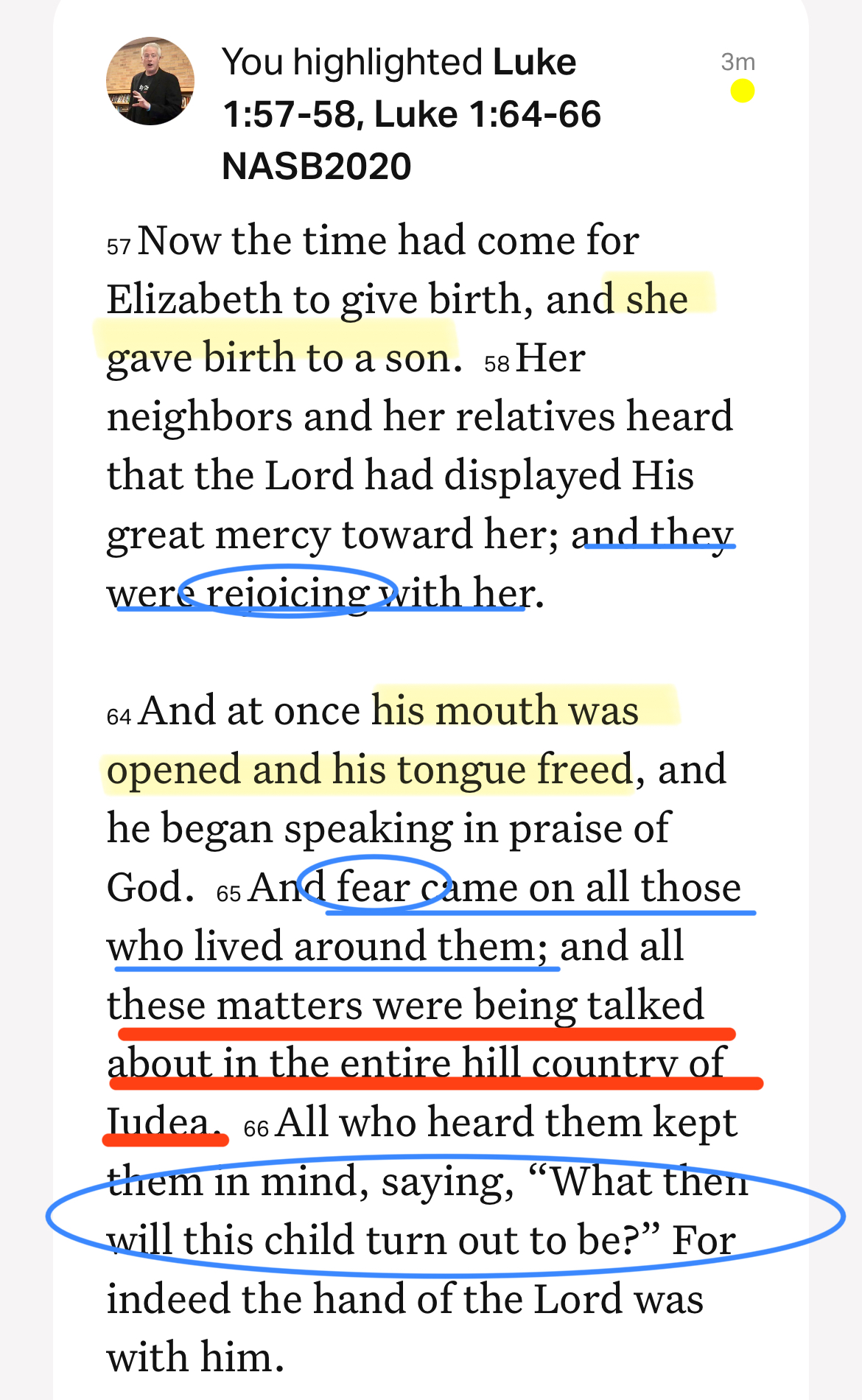
Now the time had come for Elizabeth to give birth, and she gave birth to a son. Her neighbors and her relatives heard that the Lord had displayed His great mercy toward her; and they were rejoicing with her. … And at once his mouth was opened and his tongue freed, and he began speaking in praise of God. And fear came on all those who lived around them; and all these matters were being talked about in the entire hill country of Judea. All who heard them kept them in mind, saying, “What then will this child turn out to be?” For indeed the hand of the Lord was with him. (Luke 1:57-58, 64-66)
When God does what only He can do, our testimony is irrefutable! People will rejoice, reverence God, and ask questions, but they will never be the same after witnessing a miracle.
Let’s pray for God to do the miraculous in our own lives even now so that we can be living testimonies that draw others to our Savior and Lord!
Listen to the podcast of this post by clicking on the player below, and you can also subscribe on Apple, Spotify, or Audible.
In the 40 days between His resurrection and His ascension, we read that Jesus was with His disciples “giving instructions through the Holy Spirit” (Acts 1:2).
I think this word “instructions” in the NIV is too soft. The other translations say things like:
commandments (NKJV)
orders (NASB & NET)
instructed and commanded (AMPC)
The Greek word Luke uses in Acts 1:2 is entellomai and it is a word that carries weight. Throughout the New Testament this word is used to identify…
…the words of God (Matthew 4:6, 15:4; Luke 4:10; Acts 13:47; Hebrews 9:20)
…the words of Moses (Matthew 19:7; Mark 10:3; John 8:5)
…the words of Jesus (Matthew 17:9, 28:20; Mark 11:6; John 14:31; 15:14, 17; Acts 1:2, 13:47)
…the words of recognized leaders (Mark 13:34; Hebrews 11:22)
In other words, these aren’t just any words, but they carry an awesome authority with them. These are binding commands. They are not merely wise counsel or suggestions for godly living. They are indispensable to the Christian life.
Luke points out that Jesus gave these commands “through the Holy Spirit” because it is only through the Holy Spirit that you and I can understand them, apply them, and be empowered to obey them.
Jesus uses the same word entellomai in the Great Commission (Matthew 28:20) as well as in Acts 1:2. Clearly, the Scripture is telling us that we are powerless to understand and powerless to obey without the Holy Spirit’s daily empowerment. Jesus would never give us commands that we were unable to carry out, which is why He gives us instructions through the Spirit, and then the Spirit gives us the power to joyfully obey those commands.
Don’t ever think that you are on your own in trying to figure out what Jesus said, and how you are going to live it out.
I discuss the role of the Holy Spirit in a Christian’s life in much greater detail in my series called We Are: Pentecostal.
Listen to the podcast of this post by clicking on the player below, and you can also subscribe on Apple, Spotify, or Audible.
Would you like to be known as somebody who’s “full of it”? I know that phrase usually has a negative connotation, but I would like to make the case that this is actually a really good thing.
I have blogged and talked and written quite a bit about a godly leader’s reactions being a strong indication of what a leader is truly full of. Three notable leadership posts are:
Listen to the podcast of this post by clicking on the player below, and you can also subscribe on Apple, Spotify, or Audible.
A quick recap: We are all gifted by God, but we typically restrict ourselves to a comfort zone which is much smaller than our God-given gift zone. In order to maximize our impact for the Kingdom of God, we are going to have to get uncomfortable with staying comfortable—we are going to have to trust God as we push out further into our gifts.
Last week I gave you a homework assignment to think about the things you love to do. Why do we need to know this? Because it is one of the indicators of our areas of giftedness.
In the whole carrot-versus-stick discussion, you will find that most people are motivated by reward way more than they are by the fear of punishment. Look at how these God-fearing men were motivated by the God’s rewards:
Who’s more likely to get the reward: the one who loves what they are doing or the one who hates what they are doing? We are more likely to stick with what we love doing, and you are going to love doing what you are gifted by God to do.
Why we do what we do is much more important that what we do (Isaiah 1:11, 13, 15; Matthew 7:22-23).
We have been gifted by God to do great things. When we do those great things, we are rewarded and it brings God glory. That realization should answer the question of why we do what we do (Ephesians 2:10).
The way we see the world, what motivates us, and how we act are all determined by our gifts. We are working on the same Great Commission, but how we live that out will be different because of our different gifts.
In the Old Testament, the saints wanted Zion to be strong and God-glorifying:
David fought battles and wrote worship songs
Solomon gave wise proverbs
Josiah brought about reforms
Ezra encouraged the Israelite governor and high priest
Daniel encouraged the Babylonian rulers
Nehemiah built the wall
In the New Testament era, the saints should all want the Body of Christ to be strong and God-glorifying. Toward that goal, we still need warriors, worshipers, wisemen, reformers, teachers, counselors, workers.
Toward that goal, we all have a part to play (Ephesians 4:12). Check out the example of Paul in…
…Thessalonica: Paul was in the synagogue on three Sabbaths (Acts 17:1-2; 2 Thessalonians 3:8)
…Corinth: Paul was synagogue on the Sabbath days, but after Silas and Timothy arrived, Paul was able to be preaching every day for 18 months (Acts 18:1-5, 11)
What’s the difference? Silas and Timothy used their gifts so that Paul could use his. Without the “enzyme” of Silas and Timothy’s gifting, the whole Body of Christ would have been impoverished.
One of the things that will help your spot your areas of giftedness is noticing what you are passionate about—What do you love to do?
Let me give you three things to consider:
When can I do this again? vs. When will this be over?
When I do this, I’m tired but fulfilled vs. When I do this, I’m tired.
I would do this without pay vs. I would rather find something else to do.
Our prayer should echo what Paul prayed:
For this reason, since the day we heard about you, we have not stopped praying for you. We continually ask God to fill you with the knowledge of His will through all the wisdom and understanding that the Spirit gives, so that you may live a life worthy of the Lord and please Him in every way: bearing fruit in every good work, growing in the knowledge of God. (Colossians 1:9-12)
If you’ve missed any of the messages in our series Living in Your Gift Zone, you can find them all here.







 Craig T. Owens