I am so proud of a group from our Sunday School class who went out into the cold, snowy streets to share the love of Jesus! Not content with merely talking about being disciples of Jesus, this group wanted to be disciples of Christ.
On New Year’s Day, they walked the streets of downtown Grand Rapids to find those who needed to keep warm. They handed out gloves, hats, blankets, candy, Bibles, hugs and prayer to those in need. After they returned home, my favorite comment from the group was this: “When can we do this again?” I love it!
This slideshow requires JavaScript.
This group meets for their Sunday School class every Sunday morning at 9:30am. If you’d like to spend some time with a really great bunch of folks, this is the group for you!
Perhaps a New Year’s resolution you made was to stop viewing pornography. That’s a great first step! I like these tips from CovenantEyes for helping you stick with your no-porn goal.
Develop a game plan. Instead of retreating to porn, have a book to read or another activity planned.
Get outside of yourself. When you focus on your circumstances, the temptation to escape comes calling. Serving others is the best antidote to a self-induced pity party. Ring a bell for the Salvation Army, visit a nursing home or work in a soup kitchen.
Burn off steam and calories. Go for walks. Get some exercise in. Hit the gym with a friend.
Reach out. Call a friend. Be open and honest about your feelings and temptations. (Keeping secrets breeds failure.)
Avoid Facebook and social media. Comparing your life to the façade on Facebook only leads to more stress and loneliness.
Don’t throw in the towel. If you have a setback, get back up and start over!
And I’ll add one more of my own:
7. Learn your triggers. Do you usually feel the urge to look at porn at night? when you’re tired? when you’re lonely? Know when your temptation is at its strongest, and be ready with one of the above strategies before the temptation flares up.
CovenantEyes has some great ebooks and other resources you can check out here. You also might want to add their accountability software to your devices.
Our week of prayer continues today with this prayer focus for Tuesday—
Seek God for strength to keep moving forward even in the midst of discouragement or suffering, knowing that faith to persevere strengthens character and kindles hope.
I love to pray God’s Word. Perhaps today you could pray something like this:
Heavenly Father, this time of life I’m in right now is tough. But I trust You. In fact, I also glory in my suffering, because I know that suffering produces perseverance; perseverance produces character; and character produces hope. And hope does not put me to shame, because Your love has been poured out into my heart through Your Holy Spirit [Romans 5:3-5].
So I trust in You entirely, the everlasting God, the Creator of the ends of the earth. You will never grow tired or weary, and Your understanding is higher than mine. You give strength to me when I’m weary and You increase my power when I’m weak. Even youths grow tired and weary, and young people stumble and fall; but when my hope is in You, You will renew my strength. In You, I will soar on wings like eagles; I will run and not grow weary, I will walk and not be faint [Isaiah 40:28-31].
While I’m in this difficult time, Father, I place my trust and my hope in You. In Jesus’ name, Amen.
Our week of prayer continues today with this prayer focus—
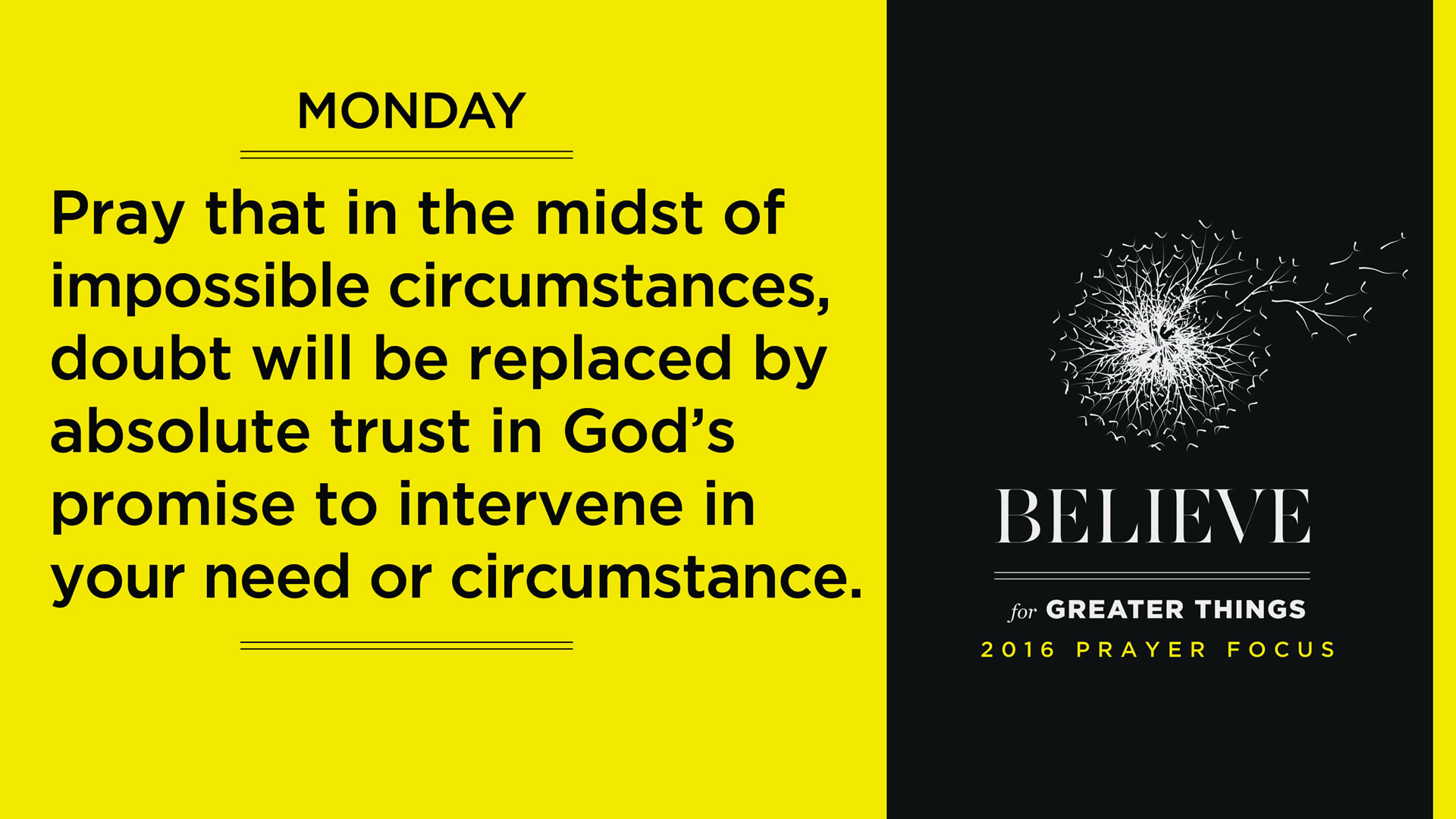
Pray that in the midst of impossible circumstances, doubt will be replaced by absolute trust in God’s promise to intervene in your need or circumstance.
When I pray, I love to pray God’s Word. Perhaps on Monday you could pray something like this:
Jesus, You said if I have faith as small as a mustard seed, I can say to this mountain—this “impossible thing” in my life—“Move from here to there,” and it will move. Nothing will be impossible [Matthew 17:20]. It was impossible for death to hold You, Jesus, so I know that no word from You will ever fail [Acts 2:24; Luke 1:37].
I have some seemingly “impossible” situations in my life. There is a relationship that seems beyond repair … there is a doctor’s diagnosis that seems terminal … there is a financial debt that seems like a bottomless pit … there is a situation that seems hopeless. But things that seem like they’re terminal, impossible and hopeless to man are perfect opportunities for You to do what only You can do. I put my absolute trust in You. I believe that You are going to do what others say is impossible, so that all will see Your unequaled greatness. In Jesus’ mighty name I pray, Amen.
Listen to the podcast of this post by clicking on the player below, and you can also subscribe on Apple, Spotify, or Audible.
One of the best ways to learn how to pray is not to read about prayer. It’s not even to listen to other people pray. The best way to learn how to pray is … to pray!
Can you imagine a baby thinking to herself, “I’m not going to start talking until I’ve got the English language nearly mastered. I need to brush up on my vocabulary and have a few tongue-twisters handy, and then I’ll start talking”? Of course not!
Babies learn to talk by talking!Well, perhaps they learn by babbling first. But ask any parent, and they will tell you that those first da-da, ma-ma, ba-ba sounds are like music in their ears!
It’s the same way with our Heavenly Father. He’s not waiting for you to be a prayer expert (whatever that is!) before you start talking with Him. Even if your attempt at praying sounds like a baby’s babbling to you, those attempts are sweet sounds to our loving Heavenly Father.
One verse about Jesus gives us four practical prayer tips to help us practice praying—
Very early in the morning, while it was still dark, Jesus got up, left the house and went off to a solitary place, where He prayed. (Mark 1:35)
Check out these four prayer tips:
1. early in the morning. This speaks to me of priority. I want to talk with God before I talk with anyone else—before I make my plans for the day, or even before I have any major decisions to make.
Practical application: I need to go to bed on time.
2. Jesus got up. This was a physical change of position to make sure He was alert.
Practical application: Don’t try to pray laying in bed, but find a posture where I am most alert; maybe even go for a walk while I pray.
3. left the house [and] went to a solitary place. He left the familiar and left any distractions behind. Some translations of Matthew 6:6 say we should go into our prayer closet.
Practical application: Find a place that’s just for prayer, then eliminate the distractions (like turning off my phone).
4. He prayed. This Greek word is used 87 times in the New Testament and it means … PRAY. There’s nothing wrong with reading the Bible, or listening to worship music, but I shouldn’t allow these activities to substitute for prayer.
Practical application: My mind can wander when I’m praying unless I’m intentional about staying focused. So I keep a list of things I want to pray about, and I keep a blank piece of paper ready for things that come to my mind. Both of these things keep my mind from wandering away from prayer.
How about you: Can you make prayer a priority? Can you find a place and posture that will help you pray? What can you do to stay focused while you’re praying?
Remember: the best way to learn how to pray is to pray. Get started today! Your Father is waiting to hear your sweet voice!
I’ll be continuing our series on Practical Prayer this Sunday. If you don’t have a home church in Cedar Springs, I’d love to have you join us. Otherwise, you can tune in to our live broadcast via Periscope.
We are starting the New Year with a time of prayer. Each day of this week has a special prayer focus, as we believe God for greater things in 2016.
Sunday’s focus—
Pray that God will stir faith in your heart to accomplish greater things than you could imagine in and through your life this year.
When I pray, I love to pray God’s Word. Perhaps on Sunday you could pray something like this:
Jesus, You told me that whoever believes in You will do the works You have been doing. Not only that, but also I will be able to do even greater things than those, all because You are going to the Father to intercede for me. You also said that You will do whatever I ask in Your name, so that my Heavenly Father may be glorified in You. You promised me that I may ask You for anything in Your name, and You will do it. [John 14:12-14]
I don’t want 2016 to be just “another” year. I don’t believe You desire for 2016 to be a year of status quo in my life. You are able to do immeasurably more than all I can ask or imagine, according to Your power that is at work within me, so that You will receive all the glory! [Ephesians 3:20-21]. So I am believing You to do things in my life I never even imagined before. I am ready! In Jesus’ name I pray. Amen.
I remember when I was searching for my first job, and I kept getting turned down because I didn’t have any “experience.” And I kept thinking, “How am I supposed to get any experience if you won’t hire me?!” It’s frustrating being in a place where the only way you can get the job is to have experience, which you can’t get because you don’t have the job!
Sadly, I think this is how many people—even many Christians—feel about prayer.
Mature Christians say, “You need to pray.” But newer Christians keep thinking, “I don’t have the experience to allow me to come into God’s presence, because I haven’t been praying before. Does God even want to hear from me now?” It can be frustrating being in a place where you feel the only way you can get to God is to have advanced prayer experience, which you can’t get because you don’t know how to pray that way!
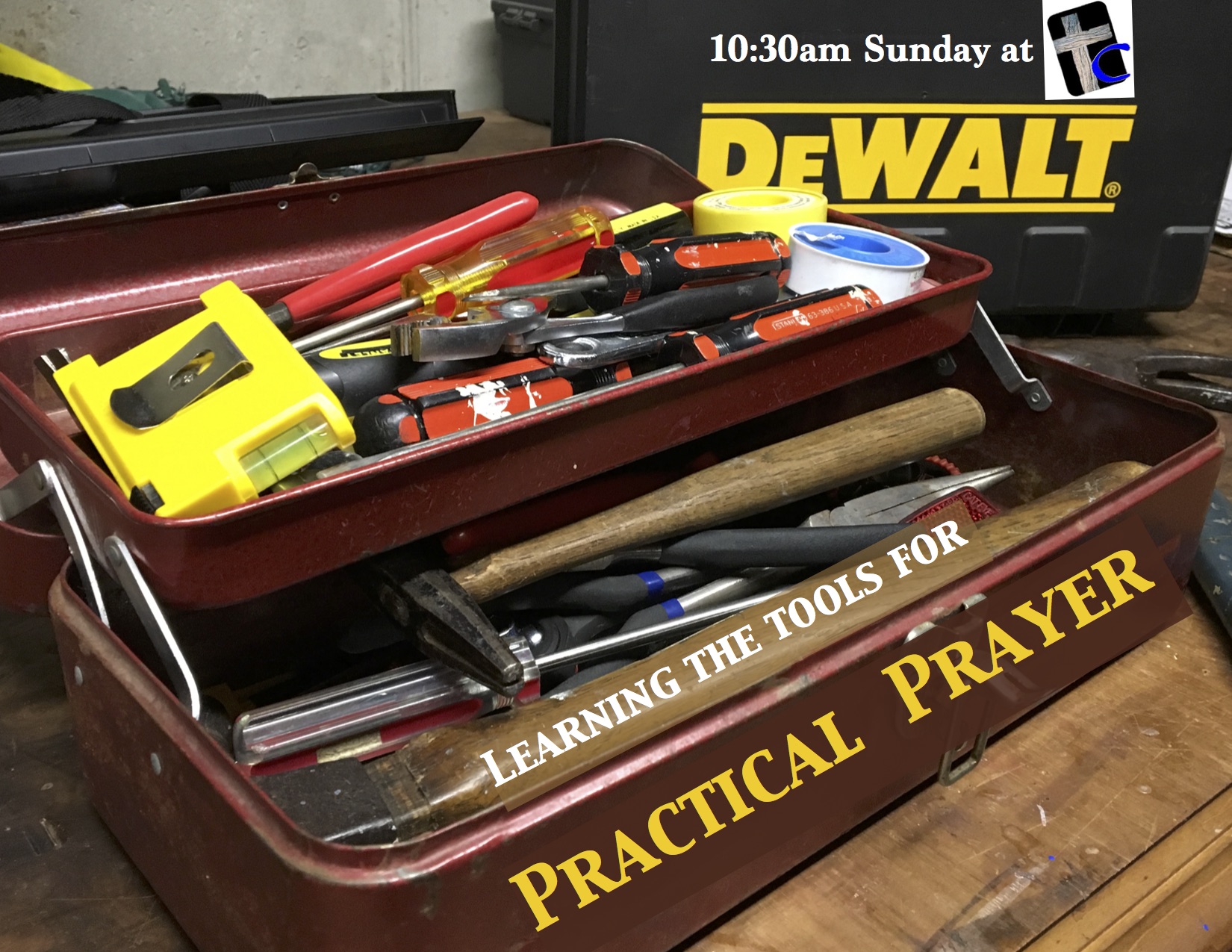
This Sunday I am beginning a new nuts-and-bolts series on how anyone can learn what prayer really is. We will be looking at some of the most basic things that anyone can do to get the prayer experience they need. The series will be called Practical Prayer, and I believe everyone is going to find it highly practical.
I hope you can join me at 10:30am this Sunday. If you cannot join us in person, be sure to check out our live broadcast on Periscope every week (search for @craigtowens).



 Perhaps a New Year’s resolution you made was to stop viewing pornography. That’s a great first step! I like these tips from






 Craig T. Owens