Poetry Saturday—One God

One God! one Majesty! 
There is no God but Thee! 
Unbounded, unextended Unity! 

Awful in unity,
O God! we worship Thee,
More simply one, because supremely Three!

Dread, unbeginning One! 
Single, yet not alone, 
Creation hath not set Thee on a higher throne. 

Unfathomable Sea!
All life is out of Thee,
And Thy life is Thy blissful Unity.

All things that from Thee run, 
All works that Thou hast done, 
Thou didst in honor of Thy being One. 

And by Thy being One, 
Ever by that alone, 
Couldst Thou do, and doest, what Thou hast done. 

We from Thy oneness come, 
Beyond it cannot roam, 
And in Thy oneness find our one eternal home. 

Blest be Thy Unity! 
All joys are one to me— 
The joy that there can be no other God than Thee! —Frederick Faber

Thursdays With Spurgeon—The Humility Of Christ’s Birth

This is a weekly series with things I’m reading and pondering from Charles Spurgeon. You can read the original seed thought here, or type “Thursdays With Spurgeon” in the search box to read more entries.

The Humility Of Christ’s Birth

     Moreover, there was a peculiar wisdom ordaining that Jesus Christ should be the Son of the woman, and not of the man, because ‘that which is born of the flesh is flesh’ (John 3:6). Had He been born of the flesh, and merely flesh, He would, naturally, by carnal generation, have inherited all the frailties and the sins and the infirmities that man has from his birth. He would have been conceived in sin and shaped in iniquity, even as the rest of us. Therefore He was not born of man, but the Holy Spirit overshadowed the virgin Mary and Christ stands as the one man, save one other, who came forth pure from His Maker’s hands, who could ever say, ‘I am pure.’ Yes, and He could say far more than that other Adam could say concerning his purity, for He maintained His integrity and never let it go! And from His birth down to His death He knew no sin, neither was guile found in His mouth….

     Let us take courage here. If Jesus Christ was born in a manger in a rock, why should He not come and live in our rocky hearts? If He was born in a stable, why should not the stable of our souls be made into a house for Him? If He was born in poverty, may not the poor in spirit expect that He will be their friend? If He thus endured degradation at the first, will He count it any dishonor to come to the very poorest and humblest of His creatures and tabernacle in the souls of His children? Oh no!

From The Birth Of Christ

If Jesus was only God, He would never have been able to stoop to love us. 

If Jesus was only Man, He would never have been able to help us. 

Only the God-Man has both the power and the love to save use. Truly there is no one like Jesus! 

No one like Jesus our troubles can see
No one can feel them so keenly as He
No one like Jesus our burdens will bear
He and He only can answer our prayer

No one like Jesus could die for our sins
No one but Jesus can make the heart clean
No one but Jesus such mercy can show
He and He only such love can bestow

Jesus, Jesus
Precious Savior
Oh, how I love You
Love and adore You
Thank You, thank You
Precious Jesus
Oh, how You love me
Oh, what a Savior to me —Fanny J. Crosby, No One Like Jesus

Where’s God?

We’ve all asked that question. Something happens that rocks our world, and we wonder where in the world God is. 

We call out to God and He seems silent. We search our hearts to see if we can discern something we’ve done wrong, and seeing nothing amiss we cry out again, “God, where are You?” 

So where is God in our heartache? In our abandonment? In our sorrows? In our distress? In death? Believe it or not, God may be closer in His silence than you’ve ever perceived before. 

Join me this Sunday as we begin a new series called Where’s God? I hope you can join me in person, but if you can’t, please join me on Facebook Live.

In case you missed any of the posts in this series, you can find them all here:

Sleep Stats

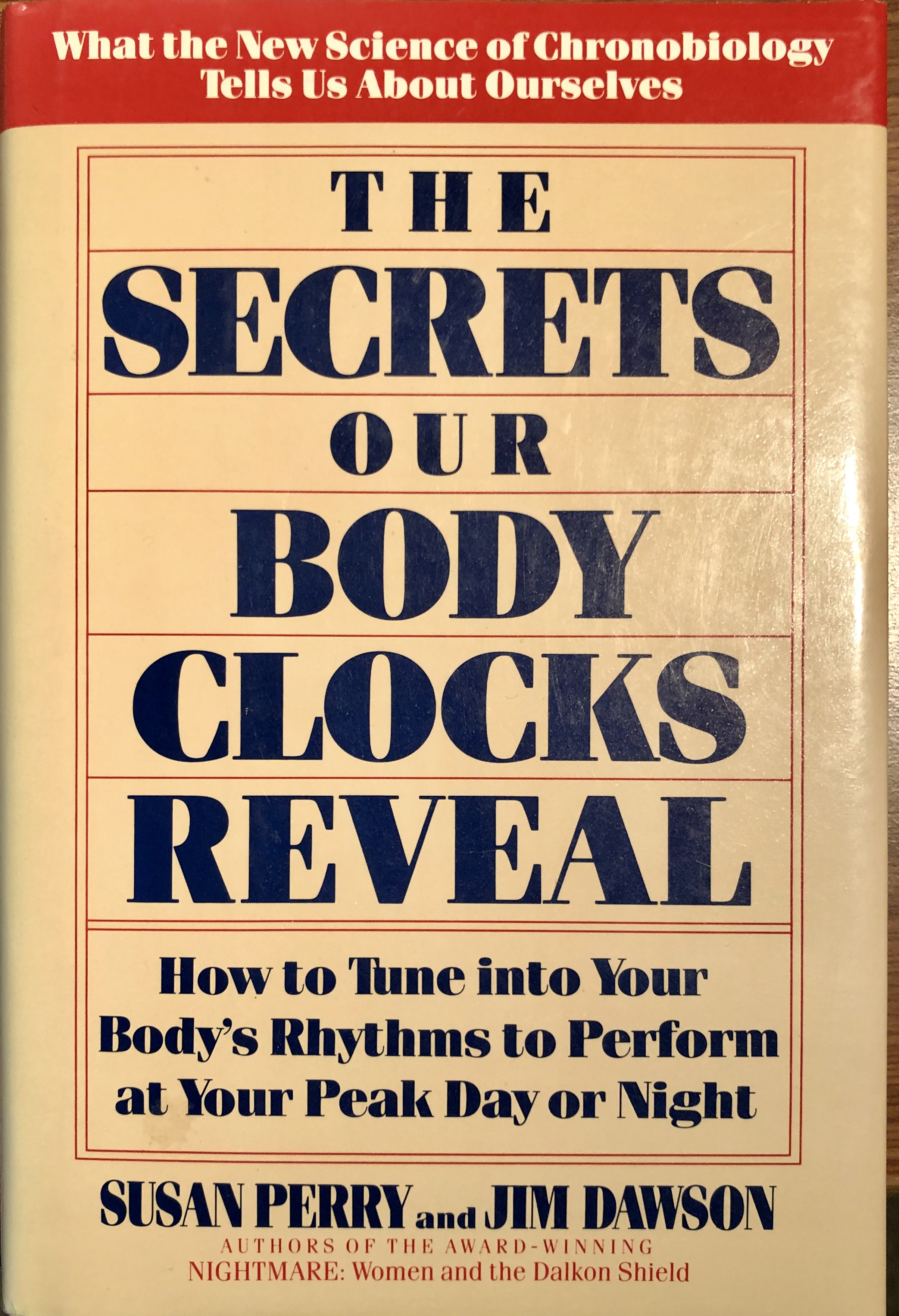
Sleep is so important for maintaining good physical and emotional health. In the book The Secrets Our Body Clocks Reveal, the authors share some interesting information on sleep. 

“The clearest ninety-minute rhythm is the ‘sleepability’ cycle. About every ninety minutes, you enter a short period during which you are vulnerable to fatigue and sleepiness. …

“These rhythmic periods of sleepability are shorter during the morning hours than in the afternoon. That’s why it’s usually more difficult to take a nap in the morning than later in the day. Some of the time, you can fight off this fatigue—particularly if what you are doing is interesting or different. However, most of the time you would do best to give in to the rhythm and take a short break from your work—especially around the lunch hour, when you are already battling the early afternoon let down.” 

“Scientists have found that when we are bored, under stress, or short of sleep, our ninety-minute cycles tend to shorten to roughly sixty minutes. That may explain why we eat and smoke more under stressful or boring circumstances.” 

What deep sleep does for you:

  • Restores body and brain
  • Stimulates growth
  • Maintains mental health

What dream sleep does for you:

  • Consolidates and sorts memory
  • Enables learning
  • Ensures our physical safety

Things that can disrupt your sleep rhythms:

  • Dieting (loss of weight can cause more frequent awakenings during the night)
  • Caffeine
  • Alcohol
  • Low-sodium diet (elderly people only)
  • Cigarettes
  • Sleeping pills
  • Exercising vigorously if you’re not accustomed to it
  • A sleeping partner who snores or thrashers about in the night
  • Pets moving about in your bedroom
  • Sporadic, unpredictable noises
  • A room that is too warm (more than 75° F) or too cool (less than 60° F)
  • Hunger
  • Stress

Things that can enhance your sleep rhythms:

  • Regular aerobic exercising (at least twenty continuous minutes) particularly in the late afternoon
  • Sex right before bedtime
  • Following a bedtime ritual
  • Relaxation exercises right before bed
  • A bedtime snack high in carbohydrates
  • A dark and quiet bedroom
  • A “white noise” 

“Many scientists now believe that we were meant to sleep twice a day, once during the afternoon and again at night. … In one study, college students who regularly napped showed improved scores on skill and memory tests taken just after a nap.” 

“Scientists have also discovered that short naps (twenty minutes or less) are just as revitalizing as long ones—and less disruptive to regular sleep rhythms. In addition, regular nappers wake up more refreshed than those who take only an occasional nap. When naps are part of the regular daily rhythm, they are less disruptive.” 

You can check out my full book review of The Secrets Our Body Clocks Reveal by clicking here. Some other quotes and statistics I shared from this book can be found here. 

Another great book is Sleep: It Does A Family Good. That book review is here. 

Proper Correction

Listen to the podcast of this post by clicking on the player below, and you can also subscribe on AppleSpotify, or Audible.

…to the church of the Thessalonians (2 Thessalonians 1:1). 

This short letter from the apostle Paul to the church in Thessalonica is a masterpiece on how to correctly correct fellow Christian brothers and sisters. 

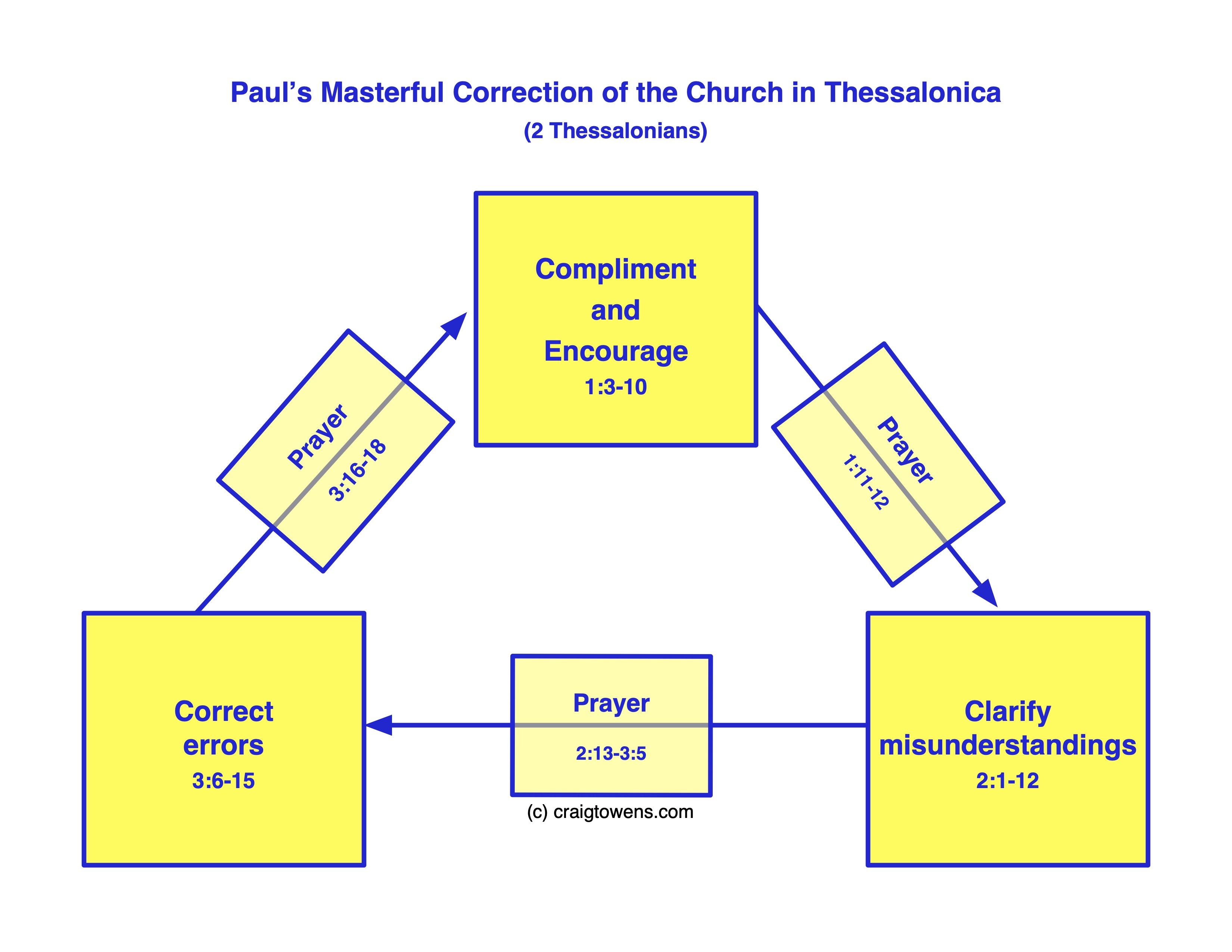
The entire letter follows this pattern: 3 Cs surrounded by prayer—

  1. Compliment
  2. Prayer
  3. Clarify
  4. Prayer
  5. Correct
  6. Prayer

(And then repeat, if necessary.) 

You can download the PDF of this flow chart → Paul’s correction of the Thessalonicans

(1) Compliment and encouragement—“We are bound to thank God always for you…because your faith grows exceedingly” (1:3). Paul complimented their love for each other, their patience and endurance in persecution, and their future glorification. He encouraged them that Jesus IS coming, and He will deal with their persecutors and take the righteous into glory with Him (1:3-10). 

(2) Prayer—And then he prays for them to be equipped to endure to the end and finish well (1:11-12). 

(3) Clarify misunderstandings—“Let no one deceive you by any means” (2:3). Paul reminds them of what he taught them about the end times and the Second Coming of Christ, clarifying that watchful Christians will by no means miss out on the signs (2:1-12). 

(4) Prayer—Paul again praises their acceptance of the gospel and launches into another prayer for them to finish well (2:13-3:5). 

(5) Correct errors of understanding—“But we command you” (3:6). There were those who were departing from the faith, growing slack in their work ethic, being disorderly, and meddling as busybodies. Paul said, “We command and exhort through our Lord Jesus Christ” that you knock it off! He even told the church to “not keep company” with such people (3:6-15). 

(6) Prayer—Finally, Paul closes with a prayer for God’s peace to be with his brothers and sisters (3:16-18). 

This is such a masterful pattern for all of us in church ministry to follow! 

If you are in a leadership role, I hope your ongoing prayer would be the same as mine: “Holy Spirit, in all my interactions with my fellow saints, remind me of this godly, practical plan for confrontation, and help me to live it out for God’s glory. In Jesus’ name, amen.” 

P.S. You can also learn a lesson from the way the prophet Samuel handled correction in this post.

►► Would you please prayerfully consider supporting this ministry? My Patreon supporters get behind-the-scenes access to exclusive materials. ◀︎◀︎

Fasting Power

We are always engaged in an intense spiritual battle. Sometimes we feel the intensity of the battle, sometimes we don’t. But it’s always happening. 

This is why we need to make prayer an ongoing discipline. If we do, we will be much more likely to turn to prayer when we feel the intense moments, and our faith in those intense moments will be strengthened and ready to respond. 

Every day we are either preparing or repairing. Prayer is either helping us prepare for the challenges we will be facing, or it’s helping us recover from the battle we just fought. Believe me: it’s much better to be preparing than it is to be repairing!

One time the disciples of Jesus got stymied in a spiritual battle. A father brought his demon-possessed son to them, asking that they cast out the demon. But this distraught father then had to report to Jesus, “They couldn’t do it” (see Matthew 17:14-21). 

Why couldn’t they? These men had been taught how to pray by Jesus Himself, and they already had experienced ministry success (Matthew 6:9-13; Mark 6:13). So were they stumped now? 

Jesus told them, “It’s because you have so little faith.” He went on to tell them that these intense spiritual battles require an ongoing lifestyle of prayer. Jesus wasn’t suggesting that they should have said to that father, “Come back in a few days after we have prayed and fasted.” 

But what Jesus was really saying was that all of us need to stay connected to the Source of our spiritual power at every single moment (John 15:5, 7). Sometimes this requires taking our eyes off ourselves and our own appetites. 

In a word: we need to fast. 

The word fasting means “to cover the mouth” or “to close the mouth.” 

  • often fasting is in response to calamity or as a sign of mourning 
  • sometimes it’s alongside an intense prayer 
  • ideally it should be a regular discipline in our lives. In Matthew 6:16-18, notice the phrase “when you fast.” Not “if you fast,” but when. Jesus assumed that we would do this, and since this teaching appears right after Jesus teaches us how to pray, it makes sense that prayer and fasting go well together.  

Fasting is not…

Fasting intensifies our focus on God in the quiet times so that we can keep our eyes on Him in the crashing storms. 

Fasting helps us tune in to the unmistakable Voice of the Holy Spirit in the peaceful moments so that we can still recognize His Voice in the tumult of battle. 

Is there a comfort food you tend to run to? Is there a coping activity that you typically use to de-stress? Is there someone or something other than God that is your go-to in times of trouble? Perhaps we should start there and fast from those things for a short period of time. 

Fasting in the quiet times will strengthen us for the intense battle times. 

Let’s prepare daily for victory, instead of having to repair after a failure.

Poetry Saturday—Lord Of All Being

Lord of all being, throned afar,
Thy glory flames from sun and star;
Center and soul of every sphere,
Yet to each loving heart how near!

Sun of our life, Thy quickening ray,
Sheds on our path the glow of day;
Star of our hope, Thy softened light
Cheers the long watches of the night.

Our midnight is Thy smile withdrawn;
Our noontide is Thy gracious dawn;
Our rainbow arch, Thy mercy’s sign;
All, save the clouds of sin, are Thine.

Lord of all life, below, above,
Whose light is truth, whose warmth is love,
Before Thy ever blazing throne
We ask no luster of our own.

Grant us Thy truth to make us free,
And kindling hearts that burn for Thee,
Till all Thy living altars claim
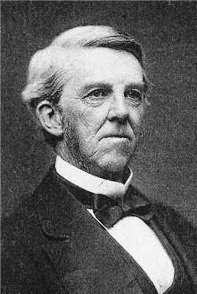
One holy light, one heavenly flame. —Oliver Wendell Holmes

Thursdays With Spurgeon—Comments On Commentaries

This is a weekly series with things I’m reading and pondering from Charles Spurgeon. You can read the original seed thought here, or type “Thursdays With Spurgeon” in the search box to read more entries.

Comments On Commentaries

     It has been said that the passage I have taken for my text [Isaiah 7:1-17] is one of the most difficult in all the Word of God. It may be so. I certainly did not think it was until I saw what the commentators had to say about it, and I rose up from reading them perfectly confused! One said one thing, and another denied what the other had said. And if there was anything that I liked, it was self-evident that it had been copied from one to the other and handed through the whole of them! 

     One set of commentators tells us that this passage refers entirely to some person who was to be born within a few months after this prophecy….

     Well, that seems a strange frittering away of a wonderful passage, full of meaning, and I cannot see how they can substantiate their view when we find the evangelist Matthew quoting this very passage in reference to the birth of Christ [Matthew 1:22-23]….

     I find, moreover, that many of the commentators divide the sixteenth verse from the fourteenth and fifteenth verses, and they read the fourteenth and fifteenth verses exclusively of Christ, and the sixteenth verse of Shear-Jashub….

     Then another view, which is the most popular of all, is to refer the passage, first of all, to some child who was then to be born, and afterward, in the highest sense, to our blessed Lord Jesus Christ. … 

     But I think that if I had never read those books at all, but had simply come to the Bible without knowing what any man had written upon it, I would have said, ‘There is Christ here as plainly as possible! Never could His name had been written more legibly than I see it here.’ 

From The Birth Of Christ

Spurgeon was not advocating that we never consult commentaries because elsewhere he said about the use of commentaries: “I find it odd that he who thinks so highly of what the Holy Spirit teaches him speaks so little of what the Holy Spirit teaches others also.” 

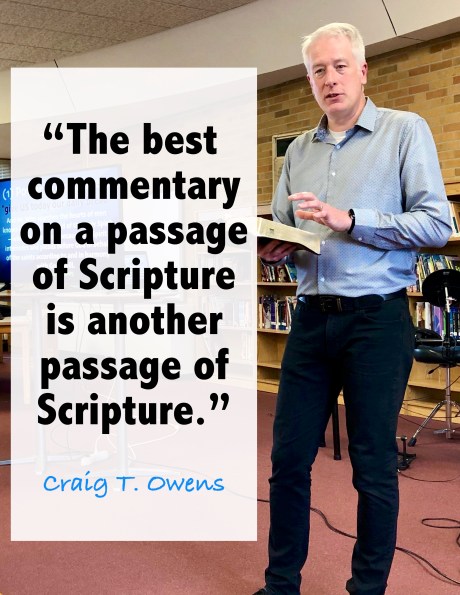
But what I believe Spurgeon is advocating here is this important principle—The best commentary on a passage of Scripture is another passage of Scripture. Which is why he used the passage in Matthew to help him understand the passage in Isaiah.

God makes Himself clear in His Word. The same Holy Spirit that inspired the pen of those who wrote the words in the Bible is the same Holy Spirit in you that can illuminate those words to your heart and mind. 

Commentators have their place. I believe that place is after you have prayed through and wrestled with a passage of Scripture for yourself. Think of commentators as the answers in the back of your math book. After you have worked through the equations for yourself, go to the answer key to verify your answers. If you simply look up the answer before you wrestle with the problem, how have you benefitted yourself? 

And always remember that God’s Word is infallible, but men are fallible. Commentators may provide an insight that helps you see something more clearly, but they are never a substitute for God’s very own word on a matter. 

Should you use commentaries? Sure! Find a good one, but consult it only after you have asked the Holy Spirit to help illuminate the passage, and after you have allowed the commentary of Scripture itself to shine its light on the difficult verse or passage.

“Let Me Show You The Way”

“When you are preparing to do something challenging, you usually take time to enlist My help. But when you’re facing everyday tasks, you tend to dive in unassisted—as if you can handle these matters alone. How much better it is to approach everything in humble dependence on Me! Whenever you find yourself in ‘diving’ mode, ask Me to help you stop and seek Me—letting Me show you the way to go forward. I will guide you along the best pathway for your life.” —Jesus (in Sarah Young’s Jesus Always)

10 Quotes From “The Knowledge Of The Holy”

A.W. Tozer helps us think long and deep about the greatness of God, opening windows of insight that many have not contemplated previously. Check out my full book review of The Knowledge Of The Holy by clicking here. 

“With our loss of the sense of Majesty has come the further loss of religious awe and consciousness of the divine presence. … The decline of the knowledge of the holy has brought on our troubles. A rediscovery of the majesty of God will go along way toward curing them.” 

“What comes into our minds when we think about God is the most important thing about us.” 

“The man who comes to a right belief about God is relieved of ten thousand temporal problems, for he sees at once that these have to do with matters which at the most cannot concern him for very long; but even if the multiple burdens of time may be lifted from him, the one mighty single burden of eternity begins to press down upon him with a weight more crushing then all the woes of the world piled one upon another. …

“But unless the weight of the burden is felt, the gospel can mean nothing to the man; and until he sees a vision of God high and lifted up, there will be no woe and no burden. Low views of God destroyed the gospel for all who hold them.” 

“Among the sins to which the human heart is prone, hardly any other is more hateful to God than idolatry, for idolatry is at bottom a libel on His character. … The essence of idolatry is the entertainment of thoughts about God that are unworthy of Him.” 

“The heaviest obligation lying upon the Christian Church today is to purify and elevate her concept of God until it is once more worthy of Him—and of her.” 

“When the Spirit would acquaint us with something that lies beyond the field of our knowledge, He tells us that this thing is like something we already know, but He is always careful to phrase His description so as to save us from slavish literalism.” 

“An attribute of God is whatever God has in anyway revealed as being true of Himself.” 

“We might be wise to follow the insight of the enraptured heart rather than the more cautious reasonings of the theological mind.” 

“If we ever think well it should be when we think of God.” 

“The harmony of His being is the result not of a perfect balance of parts but of the absence of parts.… An attribute, then, is not a part of God, it is how God is…. The divine attributes are what we know to be true of God. He does not possess them as qualities; they are how God is as He reveals Himself to His creatures.”