Have you ever been afraid? Even scared half to death? Once there was the biggest, lumpiest, scariest monster hunched in my room just waiting to pounce on me! My mouth was so dry that I couldn’t even call out for help. Finally, I got enough moisture in my mouth to be able to yell out, “DAD!!” When my Dad came into my room and turned on the light, the monster disappeared. But right where he had been waiting to pounce on me was my desk chair with a hoodie hanging on the back.
Sometimes we’re scared because of what we don’t see clearly or can’t fully understand because there’s not enough light for us to make out the details.
On the night Jesus was born, an angel announced the news of His birth to some nearby shepherds. The angel was coming with good news, but Luke writes that the shepherds were terrified! I like the picturesque language of the King James Version that says they were “sore afraid,” as if they shook so much it made them sore!
Why were they so terrified? I think it’s because they knew that when angels show up that means God Himself is close by! In fact, Luke emphasized that it was an angel of the Lord who shone with the glory of the Lord.
For their entire lives, these shepherds had been trying to live by the law. They had been told that this is what would make them acceptable to God. The law told them how to live, and how to make things right with God if they broke a law. If they didn’t make things right, God would punish them. So perhaps they were sore afraid because they weren’t ready to meet God.
But the angel told them something unexpected: Today your Savior has been born! A Savior, not a Judge!
This is what God promised through one of His prophets: “The days are coming,” declares the Lord, “when I will make a new covenant with the people of Israel. I will put My law in their minds and write it on their hearts. I will forgive their wickedness and will remember their sins no more.”
The writer of Hebrews said all of the laws were just a “shadow of what is in heaven” (Hebrews 8:5). This shadow was the source of fear, but now Jesus had come as the Light of the world and as our Savior. Jesus came to take away the penalty of sin: Christ died to set them free from the penalty of the sins they had committed under that first covenant (Hebrews 9:15).
In The Pilgrim’s Progress, Faithful told how a man came and beat him because he had broken the law. Even when Faithful begged for mercy the man said, “I don’t know how to show mercy to anyone.” This man was Moses the Lawgiver.
Faithful explained what finally gave him relief: “He would have finished me off, but then one came by, and told him to stop. I did not know Him at first, but as He went by, I saw the holes in His hands and in His side and I concluded that He was Jesus.”
The Law says, “Clean yourself up first and then you can come to God. But if you miss anything, God will bring down the hammer of His judgment!” Jesus says, “Come to Me just as you are. If you ask Me, I will forgive your sins. I’ll clothe you in My robe of righteousness so you can stand faultless and unafraid before God” (see Romans 8:1; Galatians 3:26-27).
This is very Good News indeed! It means we can join in the song of the angels: Glory to God in the highest heaven, and on earth peace to those on whom His favor rests.
…the Lord filled them with joy by changing the attitude of the king of Assyria so that he assisted them in the work on the house of God, the God of Israel (Ezra 6:22).
King Darius didn’t just allow the Israelites to worship God at the temple, he assisted them in reestablishing worship at the temple! He did this because God changed his attitude.
Nearly 60 years later, King Artaxerxes did the same thing for Ezra: “the king had granted him everything he asked for, for the hand of the Lord his God was on him” (7:6). Artaxerxes gave Ezra and the returning Israelite exiles…
Ezra says again that this was all due to God putting this in Artaxerxes’ heart: Praise be to the Lord, the God of our fathers, who has put it into the king’s heart to bring honor to the house of the Lord in Jerusalem this way (vv. 27-28).
Daniel declares that all of the world leaders are in that position of leadership because God placed them there. The apostle Paul teaches us that government officials are God’s servants and that we are to pray for them (Romans 13:1-7; 1 Timothy 2:1-2).
God can change the attitude of even the most hard-hearted, godless leader. Not just change their attitude, but give God’s people favor with that leader.
Don’t become frustrated—pray.
Don’t get discouraged—pray.
Pray, pray, pray for all of God’s servants who are in leadership over us. God has a plan. All of history is His story, and He will change attitudes so that His servants fulfill His plan.
I don’t often add fictional books into my reading rotation, but when I do I want something excellent. I’ve always been fond of Sir Arthur Conan Doyle’s Sherlock Holmes stories, but The Valley of Fear is a cut above!
Doyle was a medical doctor. Probably because of my medical/science background, I’ve always found Dr. Doyle’s scientific observations through the eyes and brain of his first-rate detective to be quite intriguing. I also appreciate how Doyle gives his readers all of the same evidence that Sherlock Holmes observes so that the solution becomes an enlightening “Aha!” moment.
The Valley Of Fear had an added dimension to it. The main part of the crime is solved fairly early in the story, but then one of the characters hands Dr. Watson a written narrative that turns out to be the backdrop to the commission of the crime. Dr. Watson then spends almost all of the remainder of the book telling the story that was given to him. So the crime is committed, the crime is solved, and then we read an in-depth account of what led to the crime. Just as with all of Doyle’s stories, all of the clues are readily available in this narrative, which makes the “Aha!” culmination of this behind-the-scenes narrative all the more satisfying.
This book is a wonderful way to either start your Sherlock Holmes reading adventure or continue your enjoyment of these wonderfully-rich stories.
When Gabriel told Mary that she would be the mother of Jesus, he said that “the Lord God will give Him the throne of His father David.” Just before the angel showed up Luke noted that Mary was “pledged to be married to a man named Joseph, a descendant of David” (Luke 1:27, 32).
At this time in history marriages were often arranged to preserve and strengthen family lines. Both Joseph and Mary could trace their family lineage through the royal line of Israel’s King David.
Mary is betrothed to Joseph. Betrothal was considered as strong as a marriage with the only exception being that the couple didn’t yet live together nor sleep together. Betrothal usually lasted a year and would require a divorce to cancel it.
Mary tells Joseph what Gabriel said to her and then she leaves to visit Elizabeth for the next three months! Joseph is left alone to consider his options.
The word Luke uses for “consider” is not even close to what’s happening in Joseph’s mind. The word means to revolve around and around in your mind, like trying to solve a Rubik’s Cube.
Consider Joseph’s options. If he divorces Mary—which was apparently his first reaction—Mary would be publicly embarrassed. Not to mention that Joseph knew that God hated divorce.
If Joseph decided to proceed with the marriage, he would either have to confess he was the father of her child—which could result in both of them being stoned—or admit that she was pregnant by another man—which would be a permanent disgrace for Mary’s family.
In either case, both families would be shamed!
While Joseph was still considering all these unsavory options an angel says to him, “Joseph, son of David, do not be afraid.” By calling him by that title he is really saying, “I know how important your family heritage is to you. I know how important Mary’s family heritage is to her. But do not be afraid to take Mary home as your wife because this all fits into God’s plan.
Would it have been easier on Joseph and Mary and their families if God could have waited until after they were married? Of course! But then it wouldn’t fit into God’s miraculous plan, because 700 years earlier God promised that Jesus would be born of an unmarried virgin.
God knows YOUR future too! It’s a future He already saw as good and fruitful, if you will put your trust in Him (Psalm 139:16; Jeremiah 29:11; John 15:16).
If you seem paralyzed by a no-win dilemma like Joseph was, first DON’T do what Joseph did: pray! Then DO what Joseph did after hearing the angel: obey.
Remember Who knows you and Who knows your future, and then take each step on your journey as God directs you.
If you’ve missed any of the other messages in our series called Do Not Be Afraid, you can access the full list by clicking here.
This is a weekly series with things I’m reading and pondering from Charles Spurgeon. You can read the original seed thought here, or type “Thursdays With Spurgeon” in the search box to read more entries.
The Purpose Of The Baptism In The Holy Spirit
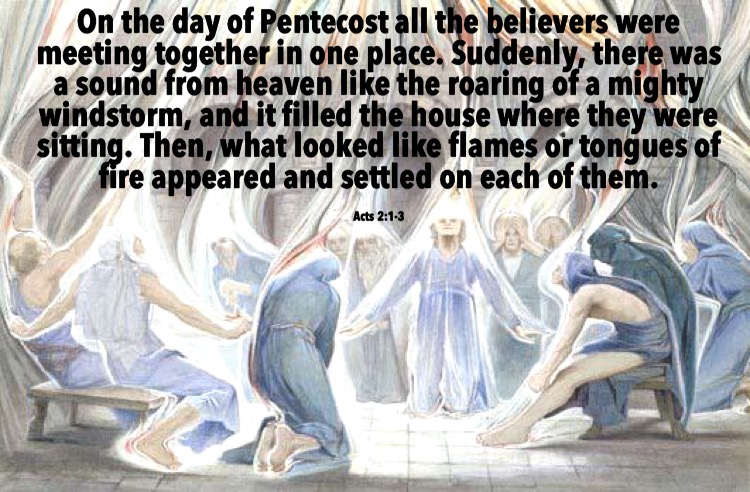
On the day of Pentecost all the believers were meeting together in one place. Suddenly, there was a sound from heaven like the roaring of a mighty windstorm, and it filled the house where they were sitting. Then, what looked like flames or tongues of fire appeared and settled on each of them. (Acts 2:1-3)
Ordinary winds blow from this or that quarter of the skies, but this descended from heaven itself. It was distinctly like a downdraft from above. This sets forth the fact that the true Spirit, the Spirit of God, comes from neither this place nor that, neither can His power be controlled or directed by human authority. His working is always from above, from God Himself! The work of the Holy Spirit is, so to speak, the breath of God, and His power is always, in a special sense, the immediate power of God. …
Tongues of flame sitting on each man’s head symbolized a personal visitation to the mind and heart of each one of the chosen company. The fires came not to consume them, for the flaming tongue injured no one. To men whom the Lord has prepared for His approach, there is no danger in His visitations. They see God and their lives are preserved. They feel His fires and are not consumed. This is the privilege of only those who have been prepared and purified for such fellowship with God. The intention of the symbol was to show them that the Holy Spirit would illuminate them as fire gives light. ‘He will guide you into all truth’ (John 16:13). …
But the fire does more than give light; it inflames, and the flames that sat upon each show them that they were to be ablaze with love, intense with zeal, burning with self-sacrifice, and that they were to go forth among men to speak not with the chill tone of deliberate logic, but with burning tongues of passionate pleading, persuading, and entreating men to come to Christ that they might live! The fire signified inspiration. God was about to make them speak under a divine influence, to speak as the Spirit of God should give them utterance. …
O You who are our God, answer us by fire, we pray! Answer us both by wind and fire and then we will see You to be God indeed. The kingdom comes not and the work is flagging. Oh, that You would send the wind and fire! You will do this when we are all of one accord: all believing, are expecting, and all prepared by prayer. Lord, bring us to this waiting state!
From Pentecostal Wind And Fire
As I said earlier, Pentecost is not the culmination of God’s power, it is the initiation of His power that is necessary to empower us to be witnesses for Jesus.
If Jesus said that we needed this power to live and testify for Him, why would we ever want anything but the full outpouring of this Holy Spirit power?! Jesus Himself relied on the power of the Holy Spirit during His earthly ministry, so how much more so do we need this baptism into the fire and wind of the Spirit!
C.S. Lewis gives us fantastic insight into the temptations the devil tries to use against Christians. You can read my full book review here. Just as a reminder: When Screwtape talks about “the Enemy” he is referring to God and when he says “our Father” he is talking about satan.
“Prosperity knits a man to the World. He feels that he is ‘finding his place in it,’ while really it is finding its place in him.”
“Music and silence—how I detest them both! How thankful we should be that ever since our Father entered Hell—though longer ago than humans, reckoning in light years, could express—no square inch of infernal space and no moment of infernal time has been surrendered to either of those abominable forces, but all has been occupied by Noise—Noise, the grand dynamism, the audible expression of all that is exultant, ruthless, and virile—Noise which alone defends us from silly qualms, despairing scruples, and impossible desires. We will make the whole universe a noise in the end.”
“Let his inner resolve be to bear whatever comes to him, but to bear it ‘for a reasonable period’—and let the reasonable period be shorter than the trial is likely to last. It need not be much shorter…. The fun is to make the man yield just when (had he but known it) relief was almost in sight.”
“Surely you know that if a man can’t be cured of churchgoing, the next best thing is to send him all over the neighborhood looking for the church that ‘suits’ him until he becomes a taster or connoisseur of churches.”
“Our Enemy is a hedonist at heart. All those fasts and vigils and stakes and crosses are only a facade. Or only like foam on the seashore. Out at sea, out in His sea, there is pleasure, and more pleasure. He makes no secret of it; at His right hand are ‘pleasures forevermore.’ Ugh! … He has filled His world full of pleasures. There are things for humans to do all day long without His minding in the least—sleeping, washing, eating, drinking, making love, playing, praying, working. Everything has to be twisted before it’s any use to us.”
“You will say that these are very small sins; and doubtless, like all young tempters, you are anxious to be able to report spectacular wickedness. But do remember, the only thing that matters is the extent to which you separate the man from the Enemy. It does not matter how small the sins are provided that their cumulative effect is to edge the man away from the Light and out into the Nothing. Murder is no better than cards if cards can do the trick. Indeed the safest road to Hell is the gradual one—the gentle slope, soft underfoot, without sudden turnings, without milestones, without signposts.”
“Your patient has become humble; have you drawn his attention to the fact? All virtues are less formidable to us once the man is aware that he has them, but this is specially true of humility. Catch him at the moment when he is really poor in spirit and smuggle into his mind the gratifying reflection, ‘By Jove! I’m being humble,’ and almost immediately pride—pride at his own humility—will appear. If he awakes to the danger and tries to smother this new form of pride, make him proud of his attempt. … You must therefore conceal from the patient the true end of Humility. Let him think of it not as self-forgetfulness but as a certain kind of opinion (namely, a low opinion) of his own talents and character.”
“There are two equal and opposite errors into which our race can fall about the devils. One it to disbelieve in their existence. The other is to believe, and to feel an excessive and unhealthy interest in them.”
“Even of his sins the Enemy does not want him to think too much: once they are repented, the sooner the man turns his attention outward, the better the Enemy is pleased.”
“Whenever they are attending to the Enemy Himself we are defeated, but there are ways of preventing them from doing so. The simplest is to turn their gaze away from Him towards themselves. Keep them watching their own minds and trying to produce feelings there by the action of their own wills. When they meant to ask Him for charity, let them, instead, start trying to manufacture charitable feelings for themselves and not notice that this is what they are doing. When they meant to pray for courage, let them really be trying to feel brave. When they say they are praying for forgiveness, let them be trying to feel forgiven. Teach them to estimate the value of each prayer by their success in producing the desired feeling; and never let them suspect how much success or failure of that kind depends on whether they are well or ill, fresh or tired, at the moment.”
It’s one of my favorite services of the year: Our annual Candlelight Christmas Eve service.
Please join me at 6pm on Thursday, December 24, for some hot chocolate and Christmas cookies, Christmas carols and special music, a special story just for the kids, and an encouraging thought from the Scripture about the wonderful gift of the birth of Jesus Christ.
Our service lasts less than an hour so it will fit into your family’s Christmas plans.
Get a map to City Impact by clicking here.
Sun Tzu taught, “If you know the enemy and know yourself, you need not fear the result of a hundred battles.” With that maxim in mind, if you read The Screwtape Letters by C.S. Lewis, you will gain insight into the enemy’s tactics, unlike perhaps any other source.
Lewis said this book was an easy book for him to write, but it gave him no joy to write it. Exposing the dark strategies of satan and his ugly cohort is indeed a joyless business. But even the apostle Paul tells us that we shouldn’t be unaware of the devil’s schemes.
If you are a Christian and you read this book, you need to reverse your thinking. This book is a series of letters from Screwtape, a more experienced demon, to his nephew Wormwood who has just been given his first “patient” to seduce into hell. Whereas Christians call God their Father, in this book Screwtape refers to satan as “our Father” and God as “the Enemy.”
Perhaps the most insightful part to me of this amazing book is the subtlety of the temptations which are employed to trip up Christians and keep seekers away from the truth. In fact, at several points Screwtape warns Wormwood that he is trying too hard to use something huge to bring down his patient when only the smallest of things will do the trick.
I would encourage newer Christians to wait a while to read this book. In the meantime, read the Bible as much as you can—get to know the Real before you read about the counterfeit. For more mature Christians, however, this is an important book to read.
(As a brief aside, in reading The Screwtape Letters this time through, I listened to the audiobook narrated by Joss Ackland and he delivered a phenomenal performance!)