David was uncomfortable with the spiritual status quo that had seemed to descend on him and the people around him. He desperately wanted to stoke the passion of his heart to burn hot for God again. So he prayed, he fasted, he abased himself, he cried out to God. Zeal for God consumed David!
In both of them we see a passion for God that moved them to action, but action that also aroused the anger of those who preferred the passivity of “religious activity” to the realness of God’s presence. Both David and Jesus became the targets of insults, scorn, and mockery.
Just as Jesus would announce 1000 years later, David expressed the same motivation that prompted his zealous action: God’s glory—
may those who hope in You not be disgraced because of me
may those who seek You not be put to shame because of me
may Your salvation protect me
Zeal for a real closeness to God’s presence is rare.
Zeal for that intimacy upsets hypocrites.
Zeal for God empowers others who aren’t satisfied with merely playing at religion.
Zeal for God glorifies God.
And most importantly: Zeal for God pleases God!
When you see play actors and religionists blocking hungry seekers from coming closer to God, I pray that your zeal, too, burns white hot. Be prepared to be the target of scorn, but know that God’s smile on your zeal for Him far outweighs their insults.
Pentecost for over 1500 years was a celebration in Jerusalem that brought in Jews from all over the world. But on the Day of Pentecost that came just ten days after Jesus ascended back into heaven, the meaning of Pentecost was forever changed!
Followers of Jesus—now empowered by an infilling of the Holy Spirit—began to take the good news of Jesus all over the world. These Spirit-filled Christians preached the Gospel and won converts to Christ even among hostile crowds, performed miracles and wonders, stood up to pagan priests and persecuting governmental leaders, and established a whole new way of living as Christ-followers.
We, too, can be Pentecostal followers of Jesus Christ today. We can experience an anointing and an empowering in our lives that turns ordinary Christianity into extraordinary Christianity!
Listen to the podcast of this post by clicking on the player below, and you can also subscribe on Apple or Spotify.
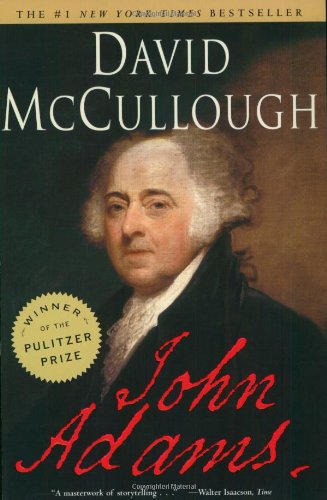
I find David McCullough to be one of the most thorough, impartial, comprehensive, and engaging historians that I have read. These attributes—and many others—are on full display in his biography of our second president John Adams.
Many have rightly called Thomas Jefferson the pen of the Declaration of Independence and John Adams the voice of the Declaration. But it’s not just this historic document for which Adams should be remembered, but the very form of government which we enjoy right now is a living tribute to his forceful and persuasive genius.
This biography is brilliantly told by McCullough through the first-person accounts of Adams’ vast quantity of letters, as well as the letters written to and about him, and the contemporary newspapers of the day. McCullough takes us back to Adams’ boyhood home to give us a good understanding of the upbringing and family heritage that fueled his quest for learning and leading. From his first elected office, through his time in Europe advocating for the newly created United States of America, into his presidency, and then through his long retirement, Adams was tireless in his efforts to make this country the best it could be.
For students of history or leadership, this is a remarkably insightful look into a man that was at the heart of so much of what characterizes our great nation today. I have other books about John Adams in my library, but David McCullough’s lengthy work is, in my opinion, the definitive source.
Listen to the podcast of this post by clicking on the player below, and you can also subscribe on Apple or Spotify.
John Maxwell said, “We overestimate what we can do in a day; we underestimate what we can do in a year.” In the case of parents, I think we do the same thing: we lose sight of the big picture when we get bogged down in the details and the pressures of each day. As a result, many times we are unaware of the long-lasting rewards that come from our daily obedience and God’s eternal faithfulness. This was never more true than in the fantastic love story of Ruth + Boaz.
Last week we looked at the history of Pentecost and what took place 50 days after the Passover, we saw a picture in the Old Testament that was fulfilled in the New Testament. The Jews saw this too. In the Hagiographa (Holy Writings), they picked one of the books of the Old Testament to read at each of the annual Jewish feasts, and the Book of Ruth was selected for Pentecost. I think this was because Ruth herself is in essence a “harvest” of God’s blessing. She is the firstfruits of the non-Jewish people whom God has engrafted into His holy family.
The story of Ruth’s coming into God’s family is birthed out of heartache. Elimelech and Naomi live in Bethlehem, which means “house of bread,” but it was a time of famine; Elimelech’s name means “God is King,” but Israel had no king and everyone lived for themselves; Naomi’s name means “pleasant,” but her days were bitter (see Judges 21:25; Ruth 1:1-5).
After Elimelech and his two sons die, Naomi changes her name to Mara (which means bitterness), and yet she hears “that the LORD had come to the aid of His people by providing food for them” (1:6) and she decides to return to Bethlehem. She counsels her daughters-in-law to remain with their families in Moab, but Ruth decides to cling to Naomi.
In the face of utter hopelessness, Ruth could have chosen what was familiar—her family, her homeland, her gods—but instead she chose to cling to Jehovah.
Perhaps when she heard that Jehovah had come to the aid of His people she realized, “I’ve never heard of Chemosh coming to the aid of his people. We sacrifice to him but he doesn’t do anything for us. This Jehovah cares for His people. I will put my faith in Him.”
Ruth’s first step of obedience triggers a whole series of events, starting with one that the writer of this story introduces by saying, “As it turned out, Ruth found herself working in a field belonging to Boaz.”
But this is no accident—God oversees and directs all of the details. All of history is His story. God is in charge of the tiniest of details: even down to directing Ruth to the right barley field. Ruth’s trust in Jehovah, her obedience in following Him, set things in motion that God had planned, just as Paul explained in Romans 8:28.
Moms, at the end of the story of your life, you will look back and see so many as-it-turned-out moments. But that means you are living in an as-it-turned-out moment right now.If you believe God is overseeing the details of your life, then every momentis divinely orchestrated by Jehovah, every moment is strategic, every moment is God-directed. You must remain daily obedient to God.
Don’t underestimate the legacy of God’s provision that is being established every single day that you remain obedient in following Him. Look at the amazing way God used Ruth and Boaz in the family tree of Jesus Christ (Ruth 4:16-22; Matthew 1:1-6).
Moms, your obedience today is preparing your children—and their future generations—for them to experience God’s provision in a coming famine (see Amos 8:11; Psalm 91).
Of course, Ruth can’t give birth to Obed without there being a father, which is why the story is called Ruth + Boaz. On Father’s Day we’ll look at the integrity of Boaz that made this possible too, so please make plans to join me then.
This is a weekly series with things I’m reading and pondering from Charles Spurgeon. You can read the original seed thought here, or type “Thursdays With Spurgeon” in the search box to read more entries.
Listen to the podcast of this post by clicking on the player below, and you can also subscribe on iTunes or Spotify.
It’s Not About Me
Look to Me, and be saved, all you ends of the earth! For I am God, and there is no other. (Isaiah 45:22 NKJV)
To whom does God tell us to look for salvation? Oh, does it not lower the pride of man when we hear the Lord say, ‘Look to Me, and be saved, all you ends of the earth’? … How frequently you who are coming to Christ look to yourselves. ‘Oh!’ you say, ‘I do not repent enough.’ That is looking to yourself. ‘I do not believe enough.’ That is looking to yourself. ‘I am not worthy.’ That is looking to yourself.
‘I cannot discover,’ says another, ‘that I have any righteousness.’ It is quite right to say that you have not any righteousness. But it is quite wrong to look for any. It is ‘Look to Me.’ God will have you turn your eye off yourself and look to Him. The hardest thing in the world is to turn a man’s eye off himself. As long as he lives, he always has a predilection to turn his eye inside and look at himself, whereas God says, ‘Look to Me.’ …
It is not a consideration of what you are but a consideration of what God is and what Christ is that can save you.
For God has committed them all to disobedience, that He might have mercy on all (Romans 11:32). He has passed a sentence of condemnation on all so that the free grace of God might come upon many to salvation. ‘Look! Look! Look!’ This is the simple method of salvation. ‘Look to Me, and be saved, all you ends of the earth!’
From Sovereignty And Salvation
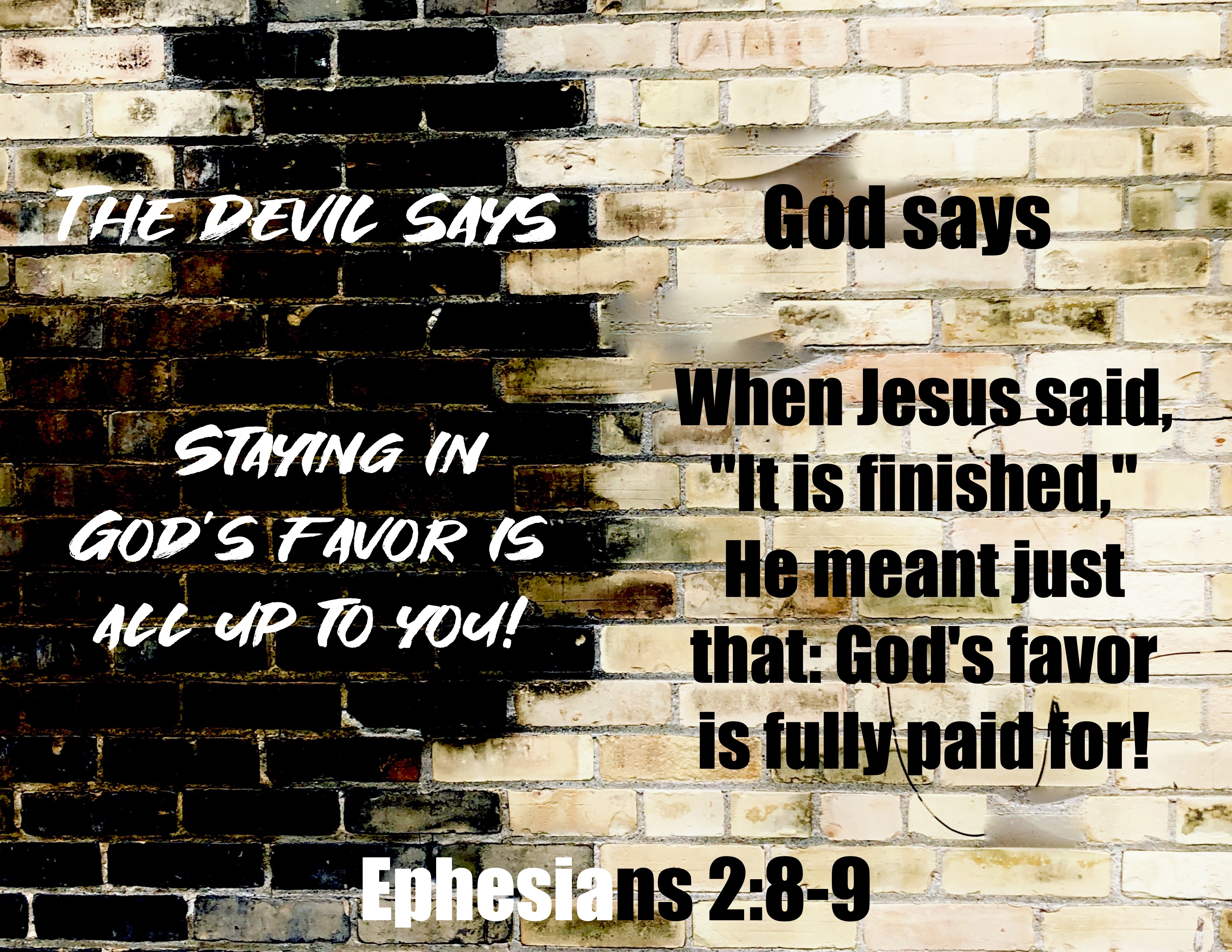
One of the greatest—and most effective—lies that satan keeps whispering is that you have to do something to be saved. Or you have to do something to stay in God’s favor. Or your salvation is hanging by a flimsy thread.
No, no, no! A thousand times no!
When Jesus said, “It is finished,” He meant just that: everything is done. Salvation is a free gift of God’s grace extended to you through faith in Jesus alone. Jesus paid it all, so there is absolutely nothing you or I can add to it. For it is by grace you have been saved, through faith—and this is not from yourselves, it is the gift of God—not by works, so that no one can boast (Ephesians 2:8-9).
Tell the devil he is a liar. Then, as Spurgeon said, look away from yourself and what you think you have to do and look only to the completed work of Calvary. True freedom and eternal joy come to the heart that looks away from itself and keeps its gaze on its Savior! When Jesus said, “It is finished,” He meant it! It is no longer what I must do, but what Jesus already did!
Listen to the podcast of this post by clicking on the player below, and you can also subscribe on Apple or Spotify.
…May the Lord grant all of your requests (Psalm 20:5).
To me, the blessing of this psalm feels like the blessing God gave to the high priest to pronounce over the people of Israel (Numbers 6:23-27). But in this blessing of Numbers 6, the people are simply passive recipients of the priestly blessing.
Here in Psalm 20, David is asking God to give the people the blessing of His answer to their prayers. The people aren’t just passive but are actively involved in seeking God’s blessing. David teaches his people that they can pray for:
relief from distress
protection
help
support
acceptance of their sacrifices
fulfillment of their desires
successful plans
victory
And in case someone might think that one or two of those items aren’t worthy of God’s attention, David adds this closing line, “May the Lord grant ALL your requests.”
David also shows us the assurance with which his people can pray these prayers. He says, “Now I know…”
God is the Source
God answers out of His limitless power
God is completely trustworthy
God does “answer us when we call”
This is a blessing a leader prays over his people as an encouragement to them to pray about anything and everything that is of concern to them.
A mark of a godly leader is his prayer of blessing on the people under his care.
This is part 56 in my series on godly leadership. You can check out all of my posts in this series by clicking here.
Listen to the podcast of this post by clicking on the player below, and you can also subscribe on Apple or Spotify.
You who answer prayer … You answer us with awesome and righteous deeds, God our Savior…. Shout for joy to God, all the earth! (Psalm 65:2, 5; 66:1).
Psalms 65 and 66 tell of God’s awesome involvement in our lives. He is both globally involved and personally involved. He’s not too big to care for my needs, and He’s not so preoccupied with me that He is unaware of global events.
Look at the grandeur of our Creator—
You answer us with awesome deeds of righteousness
You are the hope of all the ends of the earth
You formed the mountains by Your power
You stilled the roaring of the seas
You care for the land and water it; You enrich it abundantly
Your carts overflow with abundance
all of creation shouts for joy and sings praise to You
all the earth says, “How awesome are Your deeds!” and bows down to You in praise
You rule forever by Your power, Your eyes watch the nations
how awesome are Your works on man’s behalf!
And yet He is not just God of global events, but He is intimately involved with each and every person. He notices me!
The psalmist says, “Come and listen, all you who fear God; let me tell you what He has done for me.” Then he tells how God…
forgave my sin
listened to my prayer
honored my prayer
has not withheld His love from me
Oh, come and see! See how awesome God is that the earth trembles before Him. See how awesomely loving He is that He stoops to listen to me. He is indeed a global God but He is also an intimately personal God.
The more we know our God in both His majesty and His intimacy, the more we will praise Him.
Listen to the podcast of this post by clicking on the player below, and you can also subscribe on Apple or Spotify.
The baptism in the Holy Spirit is what Pentecostal Christians frequently refer to as our distinctive doctrine. Notice I said distinctive, not better. Can someone go to heaven without being baptized in the Spirit? Yes! But I’ve found that living in this distinctive empowerment makes the journey to heaven so much more productive and joyful.
After the resurrection of Jesus, everything took on a whole new meaning, because the “light” had been turned on in the Old Testament palace. All of the practices that Jews had been observing for thousands of years suddenly had a new illumination in the New Testament.
Pentecost had always been a celebration 50 days following the Passover. In the Old Testament, the law was given from Sinai on the fiftieth day after the deliverance from Egypt, so in a sense, the appearance of God on Sinai was the birthday of the Jewish nation. In the New Testament, the first outpouring of the Holy Spirit on the first Pentecost after Jesus ascended to heaven was the birthday of the Christian nation for all people.
One of our foundational truths says: “All believers are entitled to and should ardently expect and earnestly seek the promise of the Father, the baptism in the Holy Spirit and fire, according to the command of our Lord Jesus Christ. This was the normal experience of all in the early Christian Church.”
And another foundational truth is a corollary: “The baptism of believers in the Holy Spirit is witnessed by the initial physical sign of speaking with other tongues as the Spirit of God gives them utterance.”
God has always confirmed His presence with signs and wonders. From the signs in Egypt to convince Pharaoh that Jehovah was greater than the Egyptian gods to the ministry of Jesus. In fact, Peter said that the signs and wonders done by Jesus were God’s authentication of His ministry (see Luke 5:17-26; Acts 2:22; Acts 10:38).
R.A. Torrey noted, “The baptism of the Holy Spirit always imparts power for service…. The baptism of the Holy Spirit is the Spirit of God falling upon the believer, taking possession of his faculties, imparting to him gifts not naturally his own, but which qualify him for the service to which God has called him.”
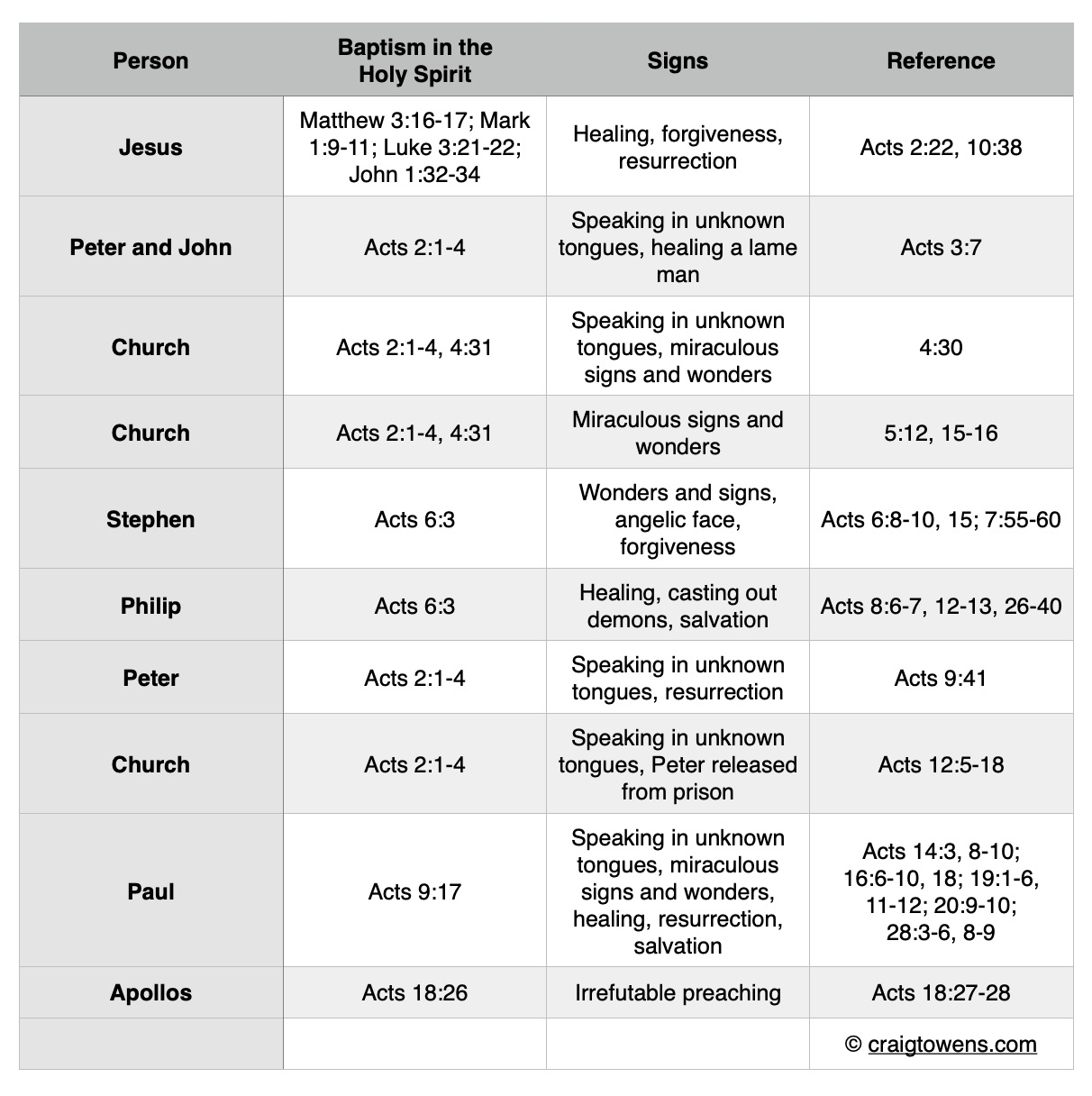
Check out this chart that walks us through the book of Acts to see how God authenticated the ministry of those who were baptized in the Holy Spirit by performing signs and wonders through them:
When a Christian is baptized in the Holy Spirit there are two types of evidence:
Initial evidence—typically speaking in a language that hasn’t been studied but has been supernaturally given by God.
Ongoing evidence—I would sum this up in the word sanctification (or as I like to remember it by saying “saint-ification”). This is the lifestyle change, the empowered living, and even the miraculous that cannot be counterfeited by man’s efforts alone.
Let’s not try to put God in a box—telling Him when, where, how, and through whom He can work. Instead, let’s yield ourselves entirely to Him by letting the Holy Spirit empower us to be effective, unmistakable witnesses for Jesus Christ.
I will be relaunching our series called We Are: Pentecostal in two weeks. Please follow along with all of the messages in this series by clicking here for the details.



 For zeal for Your house consumes me, and the insults of those who insult You fall on me (Psalm 69:9).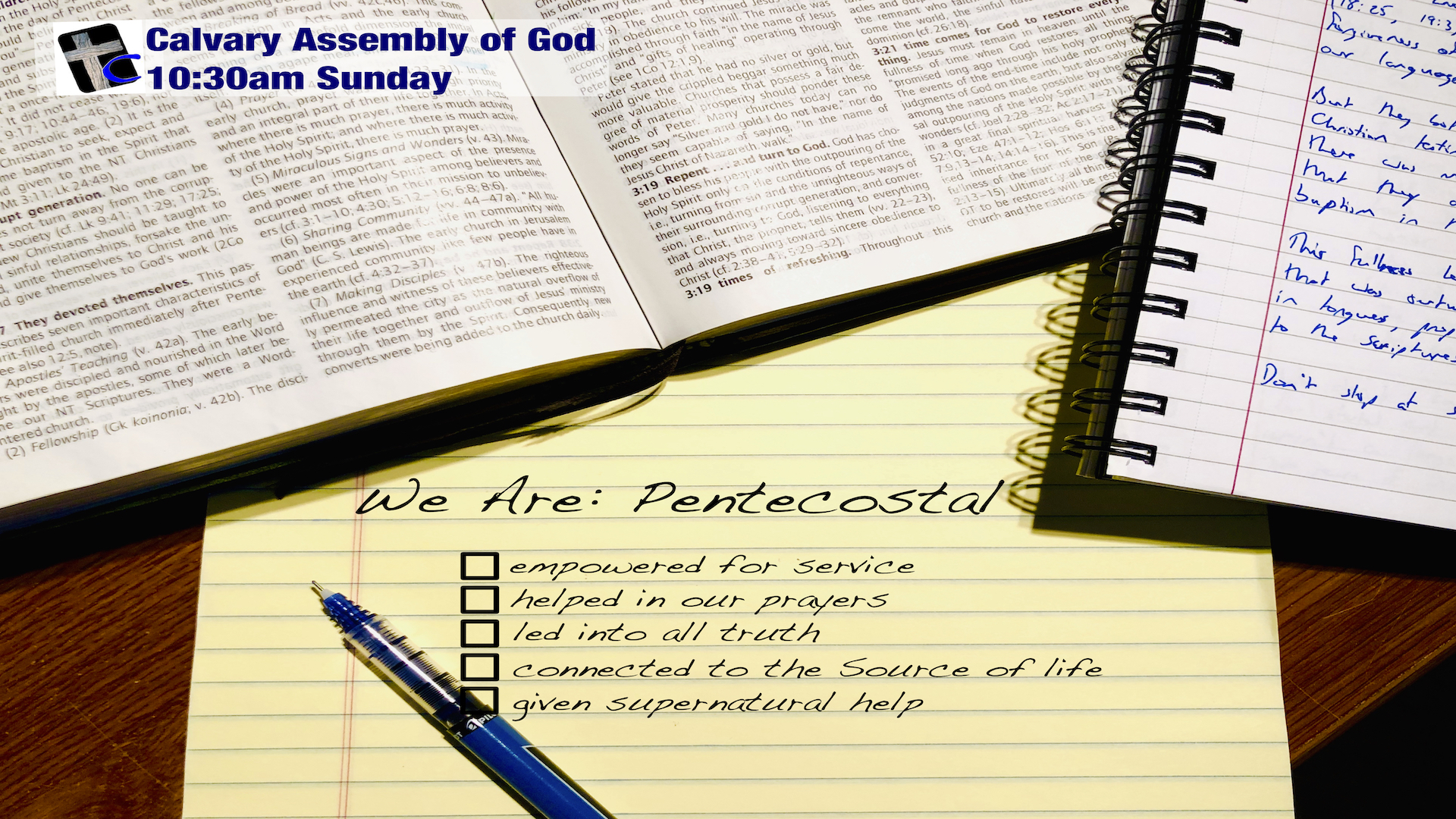





 Craig T. Owens