Listen to the audio-only version of this podcast by clicking on the player below, or scroll down to watch the video.
On this episode of “The Craig And Greg Show” we talk about how the first episode of The Craig and Greg Show debuted over two years ago on September 15th, 2020, and was appropriately titled “Leaders are Learners.” However, the discussions that became this show go back years before then.
On our 50th episode, Greg and I take you into the bagel shop where many long conversations about leadership became the show you see today.
Thank you for your support over the last fifty episodes. The entire Craig and Greg Show team wishes you a very merry Christmas, and we’re so excited to share more leadership insight with you in 2023 and beyond!
Check out this episode and subscribe on YouTube so you can watch all of the upcoming episodes. You can also listen to our podcast on Spotify and Apple.
Listen to the podcast of this post by clicking on the player below, and you can also subscribe on Apple, Spotify, or Audible.
I can’t remember how old I was the first time I saw a Cary Grant film, but I do remember always wanting to be like Cary Grant. Graham McCann captures this sentiment that I apparently shared with many, many others in his book Cary Grant: A Class Apart.
Cary Grant was born Archie Leach, but he became Cary Grant. Although this was an attempt to expand beyond his lower class upbringing in Bristol, England, Cary never left Archie nor Bristol behind. Instead, he used these humble beginnings to keep himself grounded as he became more successful and more popular.
Mr. McCann does an excellent job taking us through the growth of Cary Grant, and showing us how his maturing was seen in both the movie roles he accepted, and how he acted in those movies. After reading this book, I am seeing things differently in his movies than I saw them originally.
Cary remained very guarded about his personal life, not often giving interviews. And even when he did grant interviews, they seldom delved into his personal affairs. Mr. McCann is very studious about quoting others who were close to Cary, and deflating those “urban legend” reports that were based on mere hearsay.
Throughout this very well-researched biography, you will appreciate Cary’s development as an actor, the precision he brought to all of his movie roles, and the behind-the-scenes work he did that rarely got noticed outside of Hollywood. Inside Hollywood, however, someone once quipped, “Cary has earned so many Oscars for all those who have worked with him.”
Those who appreciate quality films, and especially those who have followed Cary Grant’s filmography, will learn so much more from this exceptional biography.
Don’t despair in the middle of the Story! All of History is His Story. No matter how dark it seems, we are assured of God’s victorious outcome!
Bethlehem is our proof:
700 years before it happened, Bethlehem is named as the birthplace of Jesus (Micah 5:2; Luke 2:1-7)
700 years before Jesus was born in Bethlehem, His titles were given and then fulfilled in the way that Jesus lived (see for example Isaiah 9:6 and Hebrews 13:20)
Sometimes God has to let the darkness fall so heavy so that it seems hopeless. In fact, in human power alone it is hopeless and impossible. So God foretells His victory—
“Listen to this, you descendants of Jacob, you who are called by the name of Israel and come from the line of Judah, you who take oaths in the name of the Lord and invoke the God of Israel—but not in truth or righteousness—you who call yourselves citizens of the holy city and claim to rely on the God of Israel—the Lord Almighty is His name: I foretold the former things long ago, My mouth announced them and I made them known; then suddenly I acted, and they came to pass. … Therefore I told you these things long ago; before they happened I announced them to you so that you could not say, ‘My images brought them about; my wooden image and metal god ordained them.’” (Isaiah 48:1-5)
We have seen how Micah prophesied our Messiah coming as the Great Shepherd and as the Prince of Peace, but He also comes as our Mighty Deliverer (Micah 5:1-6). He comes at an incredibly dark time that is described like this: “He will rescue us from the Assyrians when they pour over the borders to invade our land” (Micah 5:6 NLT).
Darkness may appear to have a stranglehold even now in our time. One of the verses in the New Testament that pretty accurately sums up a Christ-less culture says, “The god of this world has blinded the unbelievers’ minds that they should not discern the truth, preventing them from seeing the illuminating light of the Gospel of the glory of Christ” (2 Corinthians 4:4 AMP) .
But this is only temporary darkness. When the mob came to arrest Jesus, He said, “This is your hour—when darkness reigns” (Luke 22:53). Darkness only gets an hour, but the Light of God shines for all of eternity!
One of my favorite Advent texts is found in Hebrews 2:14-15:
Since the children have flesh and blood, [Jesus] too shared in their humanity so that by His death He might destroy him who holds the power of death—that is, the devil—and free those who all their lives were held in slavery by their fear of death.
Our Mighty Deliverer came to destroy satan’s power and free those held hopelessly in darkness. The word “destroy” is a powerful, all-encompassing word. Imagine a tyrannical ruler who sent one of his strongest police officers with an arrest warrant, who then grabbed onto you and subdued you with his vice-like grip.
Only someone stronger than that officer can release you from that grip. That’s what Jesus did when He destroyed satan’s ironclad grip on your soul. Paul asks mockingly, “Where, O death, is your victory? Where, O death, is your sting? The sting of death is sin, and the power of sin is the law. But thanks be to God! He gives us the victory through our Lord Jesus Christ!” (1 Corinthians 15:55-57)
Now you may be free of the grip of that officer, but the arrest warrant still remains—you are still subject to the penalty. But that word “destroy” also means that the charges against you have been set aside so that there is no penalty outstanding against you. The apostle Paul again addressed this when he wrote, “For we know that our old self was crucified with [Jesus] so that the body ruled by sin might be done away with, that we should no longer be slaves to sin. … Who will bring any charge against those whom God has chosen? It is God who justifies” (Romans 6:6, 8:33).
You are now set completely and irrevocably free! “But it has now been revealed through the appearing of our Savior, Christ Jesus, who has destroyed death and has brought life and immortality to light through the gospel” (2 Timothy 1:10).
The Messiah—our Mighty Deliverer—destroys darkness and delivers those who believe in Him!
No matter how hopeless it may seem, the Mighty Deliverer always prevails! Jesus has destroyed every enemy that has opposed God’s people! Jesus our Champion shines a light so brightly that nothing in satan’s arsenal can ever diminish it.
The Light shines in the darkness, and the darkness can never extinguish it (John 1:5 NLT).
So allow me to repeat: Don’t despair in the middle of the Story! All of History is His Story. No matter how dark it seems, Bethlehem is our proof that Jesus has destroyed our enemy and removed from him all grounds for charging us with sin. Bethlehem is our proof that we can live assured of God’s victorious outcome!
Every Monday I share a 1-minute thought to get your week started. It’s my weekly Monday Motivation series of videos. Check out this week’s video and subscribe on YouTube.
“The Lord Jesus Christ is always ready to take the most imperfect prayer and perfect it for us. If our prayers had to go up to heaven as they are, they would never succeed; but they find a Friend on the way, and therefore they prosper.” —Charles Spurgeon
I love this thought from T.M. Moore: “We sometimes use the word reflect to express what we want to see happen in our lives as Christians. We say we want to reflect Jesus to the world, like a mirror reflects an image. As agents of Jesus Christ and His Kingdom, believers are not so much like mirrors as they are like prisms. Mirrors reflect light. The light strikes them and bounces off, without bringing anything of the mirror with it. Prisms refract light.” Please take a couple of minutes to read Moore’s post Prisms of the Light.
This is a weekly series with things I’m reading and pondering from Charles Spurgeon. You can read the original seed thought here, or type “Thursdays With Spurgeon” in the search box to read more entries.
Listen to the podcast of this post by clicking on the player below, and you can also subscribe on Apple, Spotify, or Audible.
Judging By First Appearances
A good horse cannot be a bad color, and a really good preacher can wear what he likes, and none will care much about it; but though you cannot know wine by the barrel, a good appearance is a letter of recommendation even to a plowman. Wise men neither fall in love or take a dislike at first sight, but still the first impression is always a great thing even with them; and as to those weaker brethren who are not wise, a good appearance is half the battle.
What is a good appearance? Well, it’s not being pompous and starchy and making oneself high and mighty among the people, for proud looks lose hearts, and gentle words win them. … When a man is as proud as a peacock, all strut and show, he needs converting himself before he sets up to preach to others. The preacher who measures himself by his mirror may please a few silly girls, but neither God nor man will long put up with him. The man who owes his greatness to his tailor will find that needle and thread cannot long hold a fool in a pulpit. …
At the same time, the preacher should endeavor, according to his means, to dress himself respectably; and, as to neatness, he should be without spot, for kings should not have dirty footmen to wait at their table, and they who teach godliness should practice cleanliness. … A worn coat is no discredit, but the poorest may be neat, and the men should be scholars rather than teachers till they are so.
From John Ploughman’s Talks of Plain Advice For Plain People
Like it or not, people do form first impressions on external appearances, and all leaders (and especially pastors) would do well to measure these words from Charles Spurgeon.
I think Spurgeon is talking about honesty here. I need to be honest with who I am, while at the same time being honest about the office that I hold. I’m not playing dress-up, but I also need to be aware that I am representing the King of kings so an appropriate dress and lifestyle are required.
I also need to be honest that people are forming first impressions the moment they see me, but also that I cannot try to dress or act in a way to please or attract people.
I remember meeting a group of “seasoned saints” who all showed up at our church one morning. When I engaged them in conversation, they told me that their new pastor appeared to be too young for their style. They formed an opinion about him before ever giving him a chance. I told them that I knew their pastor and that I liked him a lot. I directed them to return to their home church and give their best support to their pastor for at least six months before they made any decisions. Thankfully, during that time they got to know this pastor and remained in that church with him.
I am in the position I am in because God placed me there. I am working to hear Him say, “Well done, good and faithful servant.” I don’t want my appearance to get in the way of people hearing the message. I don’t want to try to be someone I’m not. I need to remain sensitive to the Holy Spirit’s direction in how I should dress, talk, and live. If my conscience is clear before God, then I won’t have to pay attention to the opinions of others.
Listen to the podcast of this post by clicking on the player below, and you can also subscribe on Apple, Spotify, or Audible.
The word amazement shows up numerous times throughout the Gospels. As you might expect, it’s almost always associated with something Jesus said or did. He would heal someone, calm a storm, silence His detractors, or teach persuasively, and the people stood amazed!
But there are two instances where Jesus Himself is amazed.
The first time is when a Roman centurion sends a message to Jesus by way of a servant. This centurion asks Jesus to speak a word of healing over another one of his servants. He says that just a word from Jesus will be sufficient, and he doesn’t need Jesus to personally come to his house.
When Jesus heard this, He was amazed. “Turning to those who were following Him, He said, ‘I tell you the truth, I haven’t seen faith like this in all Israel!’” (Matthew 8:10; Luke 7:9).
Because of this centurion’s faith, his servant was immediately healed!
The second time Jesus was amazed was when He was visiting His hometown. There He discovered people with whom He had grown up that refused to believe that He was who He claimed to be. As a result, Jesus “was amazed at their unbelief” (Mark 6:6).
So either Jesus is amazed at our faith in Him, or He is amazed at our unbelief in Him. When I have faith in Jesus—when I believe He is who He says He is, and that He is willing to do what He says He will do—He is amazed at my faith and can do miracles on my behalf. But when I doubt, when I allow my unbelief to seize my heart, I exclude myself from the miracles He wants to do.
Jesus will be amazed at you. Will He be amazed at your faith in Him? Or will He be amazed at your unbelief in His power that is waiting to be released on your behalf? I pray that Jesus will always be amazed at our faith in Him.
Listen to the podcast of this post by clicking on the player below, and you can also subscribe on Apple, Spotify, or Audible.
Last week we saw the dark times in which Micah lived as he prophesied the advent of the Messiah. Israel was both surrounded by enemies as well as lots of practices within their borders that were heartbreaking to God. Many times, our lives can feel the same way: enemies of God all around us and our own turmoil and doubts inside our hearts and minds.
In this dark, hopeless time, the Messiah came as our Great Shepherd. Take a look at what this Shepherd brings us:
He will stand and shepherd His flock in the strength of the Lord, in the majesty of the name of the Lord His God. And they will live securely, for then His greatness will reach to the ends of the Earth. And He will be their peace. (Micah 5:4-5)
We see this idea of Jesus our Great Shepherd bringing peace to our hearts in the New Testament as well:
May the God of peace, who through the blood of the eternal covenant brought back from the dead our Lord Jesus, that Great Shepherd of the sheep, equip you with everything good for doing His will, and may He work in us what is pleasing to Him, through Jesus Christ, to Whom be glory for ever and ever. Amen. (Hebrews 13:20-21)
This peace is also implied in Psalm 23:1 when David wrote, “The Lord is my Shepherd, I shall not be in want.” That phrase “I shall not be in want” really captures the definition of peace.
The Hebrew word for peace is shalom. An easy-to-remember definition of shalom is “nothing lost, nothing missing.” Our Great Shepherd makes sure nothing is lost or missing that would cause us anxiety or doubt, so we can have total peace—we can have shalom!
Jesus said the devil’s agenda was for everything to be lost or missing—“the thief comes only to steal and kill and destroy”—but our Great Shepherd’s agenda is for there to be nothing lost or missing—“I have come that they may have life, and have it to the full” (John 10:10).
Isaiah, who was prophesying at the same time as Micah, sounded a similar note:
Therefore the Lord Himself will give you a sign: The virgin will conceive and give birth to a Son, and will call Him Immanuel. … And He will be called Wonderful Counselor, Mighty God, Everlasting Father, Prince of Peace. (Isaiah 7:14, 9:6)
When this Great Shepherd was born in Bethlehem, the shepherds in the field were the first to hear the good news. Notice what the angels announced: “Glory to God in the highest heaven, and on earth peace to those on whom His favor rests” (Luke 2:14).
Who has God’s favor? Those with faith in Him: “Without faith it is impossible to please God” (Hebrews 11:6). So those with faith in God have God’s favor.
Faith in what? In all that Jesus purchased for us by His blood shed on the Cross: “Therefore, since we have been justified through faith, we have peace with God through our Lord Jesus Christ” (Romans 5:1).
Faith comes from believing that God has made the promise of peace, that God has fulfilled the promise of peace through Jesus, and that God is bringing us to His eternal peace. So now our lives of peace in a world of turmoil can serve as a testimony to others.
Jesus called His followers to be peacemakers (Matthew 5:9) but we cannot do this while we are experiencing anxiety or doubts. To be peacemakers we must be full of peace because of our relationship with the Prince of Peace, who has ensured that nothing is lost and nothing is missing!
If you feel anxious, remember that Bethlehem is your proof that the Prince of Peace has come to remove doubts, anxiety, fear, and inner turmoil. Let every pang of anxiety be immediately a call to run to the Prince of Peace. He has paid an incalculable price to purchase your peace, so don’t leave this gift unopened and unused. A dark, anxious world is looking for peace. Know the author of shalom so that you can introduce others to this Prince of Peace.
God will give you everything you need to minister to others. But there’s one thing you have to do first…
“He who thinks half-heartedly will not believe in God; but he who really thinks has to believe in God.” —Isaac Newton
Back in 1929, Donald Gee shared three temptations that Pentecostals needed to be cautious of avoiding: (1) selfish satisfaction, (2) fanaticism, and (3) the temptation to forsake the pure worship of God in exchange for popularity. Check out the full article here.
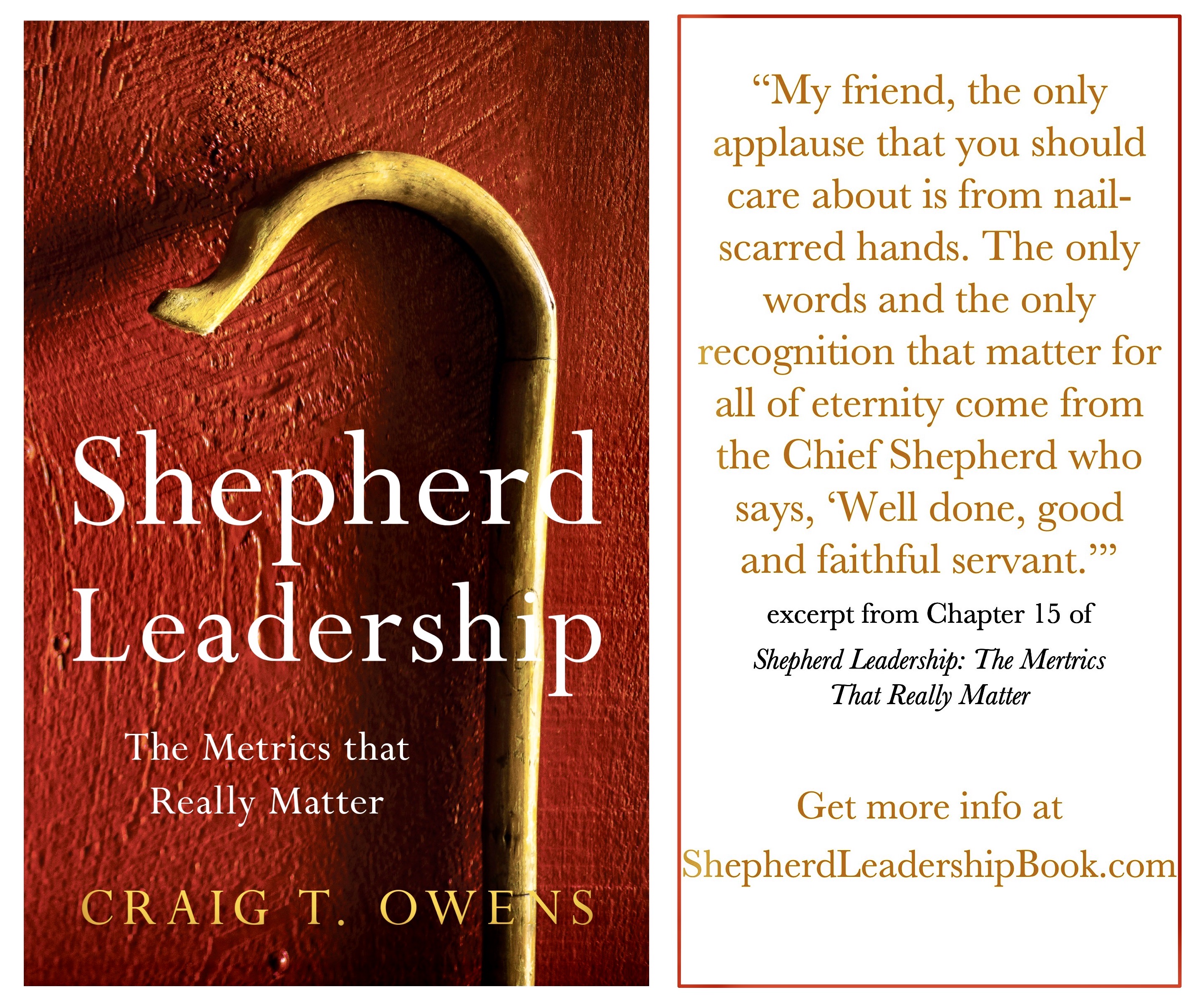
I really appreciate the leadership insights from Dan Reiland. That’s why I was so honored to have him write such a nice endorsement of my book Shepherd Leadership! Here is an important post Dan wrote for leaders, warning us of 5 ways we can misuse our spiritual authority.



 Check out the resources I mention in this video:









 Craig T. Owens